Performance Management When AI Does the Work: What to Evaluate Instead of Output
Turn this article into takeaways for your work.


Each assistant summarizes the article only for you and suggests best practices for your work.
Performance management when AI does the work means shifting what gets scored, from how much a person produced to the judgment behind what they produced: the problem they chose to solve, what they verified before shipping it, what they deliberately left out, and whether they made the people around them better. Output volume stops being a reliable signal once an agent can generate most of it in seconds, and a review process still anchored to volume ends up rewarding whoever prompts the loudest, not whoever thinks the clearest.
Key Facts
- Only 13% of frequent AI users say their organization rewards reinvention of work with AI even when the outcome falls short, and that figure roughly doubles for "Frontier Professionals" (26% vs. 11%). Source: Microsoft, 2026 Work Trend Index, "Agents, Human Agency, and the Opportunity for Every Organization"
- Microsoft's own 2026 data splits AI users into an uneven capability map: 16% are "Frontier Professionals" with both skill and organizational support, 10% are "blocked agency" (skilled, unsupported), 16% are "stalled" (low skill, low support), and 50% sit in an underdeveloped "emergent zone." Source: Microsoft, 2026 Work Trend Index
- Employees whose managers actively support AI adoption report 48% engagement, versus 30% for those without that support, and the highest productivity ratings triple when manager support is present (33% vs. 9%). Source: Gallup, "Employee Engagement Remains Flat as AI Adoption Accelerates," July 2026
- Analysis of 623 million code changes from 2023 to 2026 found code duplication up 81% and refactoring of legacy code down 74% since AI-assisted commits became common, evidence that rising output volume can mask falling quality rather than prove rising skill. Source: GitClear/GitKraken research, reported by LeadDev, July 2026
Why Output Volume Stopped Working as a Signal
For most of the history of knowledge work, how much a person produced was a workable stand-in for how good they were. More closed tickets, more lines shipped, more decks turned around: these correlated loosely with skill and effort, so managers leaned on them because counting is easy and judging is hard.
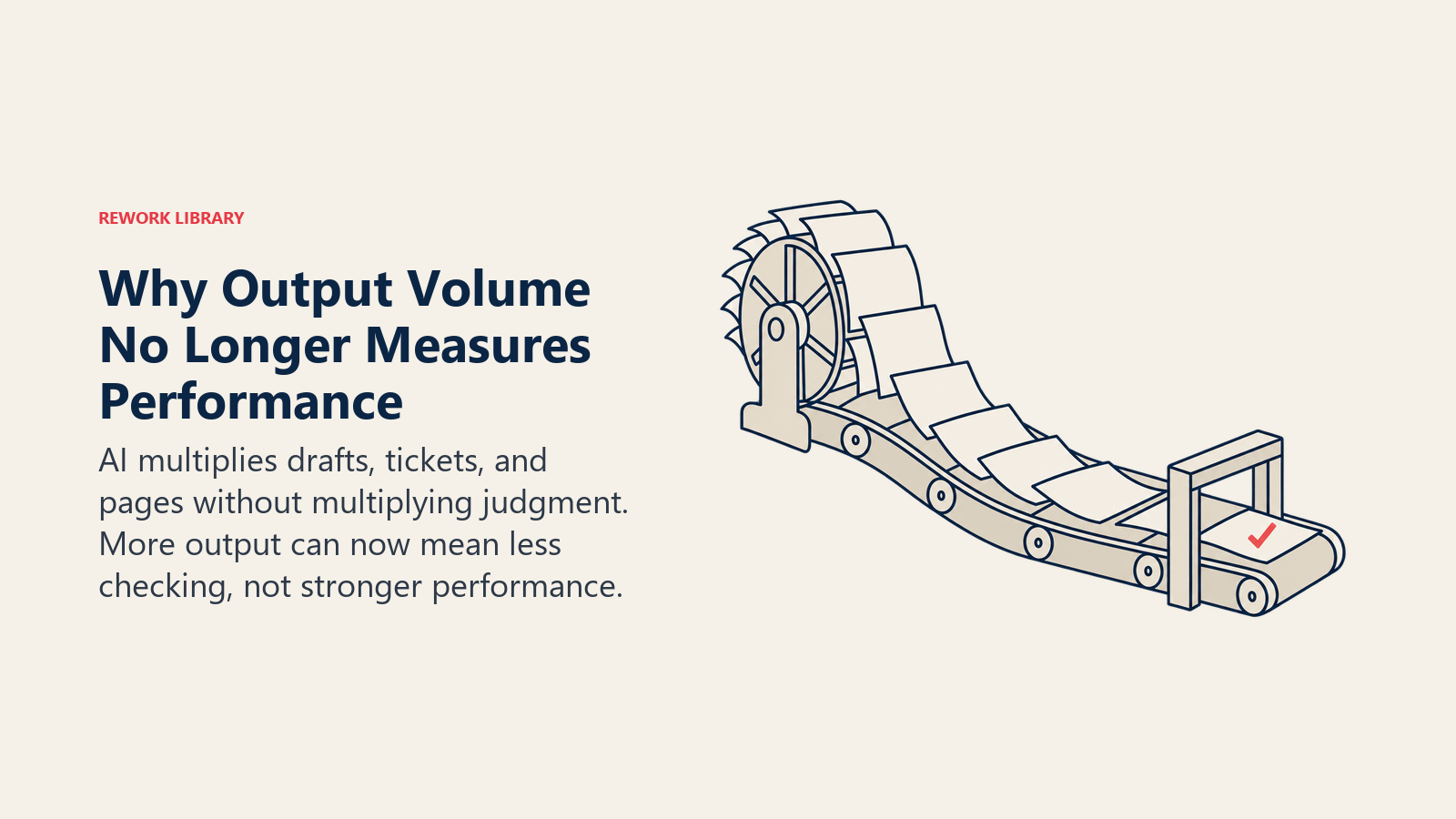
AI breaks that correlation, not by making people worse, but by making the proxy meaningless. When a junior analyst and a principal analyst can both generate a 12-page market analysis in the same afternoon using the same tool, the page count stops distinguishing them. This is the same erosion The Broken Bottom Rung traces at the hiring stage, except here it shows up mid-career, in the review: the skill gap between the two analysts has not closed, it just moved to a place a word count cannot see, whether the analysis asked the right question and whether someone would bet a decision on it.
This is Goodhart's Law showing up inside performance systems: when a measure becomes the target, it stops being a good measure. Output metrics were tolerable proxies for skill because they were hard to inflate without also doing better work. AI makes them trivially inflatable with no corresponding gain in judgment, which is exactly the condition under which a metric quietly turns from useful to misleading. A team that keeps scoring people on volume after that shift is measuring who has the most generous AI subscription and the least hesitation about shipping unreviewed output, related to what Workslop: How AI-Generated Busywork Erodes Effort and Ownership documents from the receiving end: work that looks finished and isn't.
Volume also stops being comparable across people even in good faith. Two employees with identical AI access can produce very different volumes depending on how much verification each does before shipping. The person who checks an agent's work twice as carefully will, correctly, produce less raw volume than the person who ships the first draft. A system that still rewards volume is quietly penalizing the more careful worker, close to the opposite of what performance management should do. That extra checking time is not free, either. It is the same load pace and burnout in the AI era describes as the verification tax, hours a review process assumes AI freed up when it actually just moved them.
What to Assess Instead
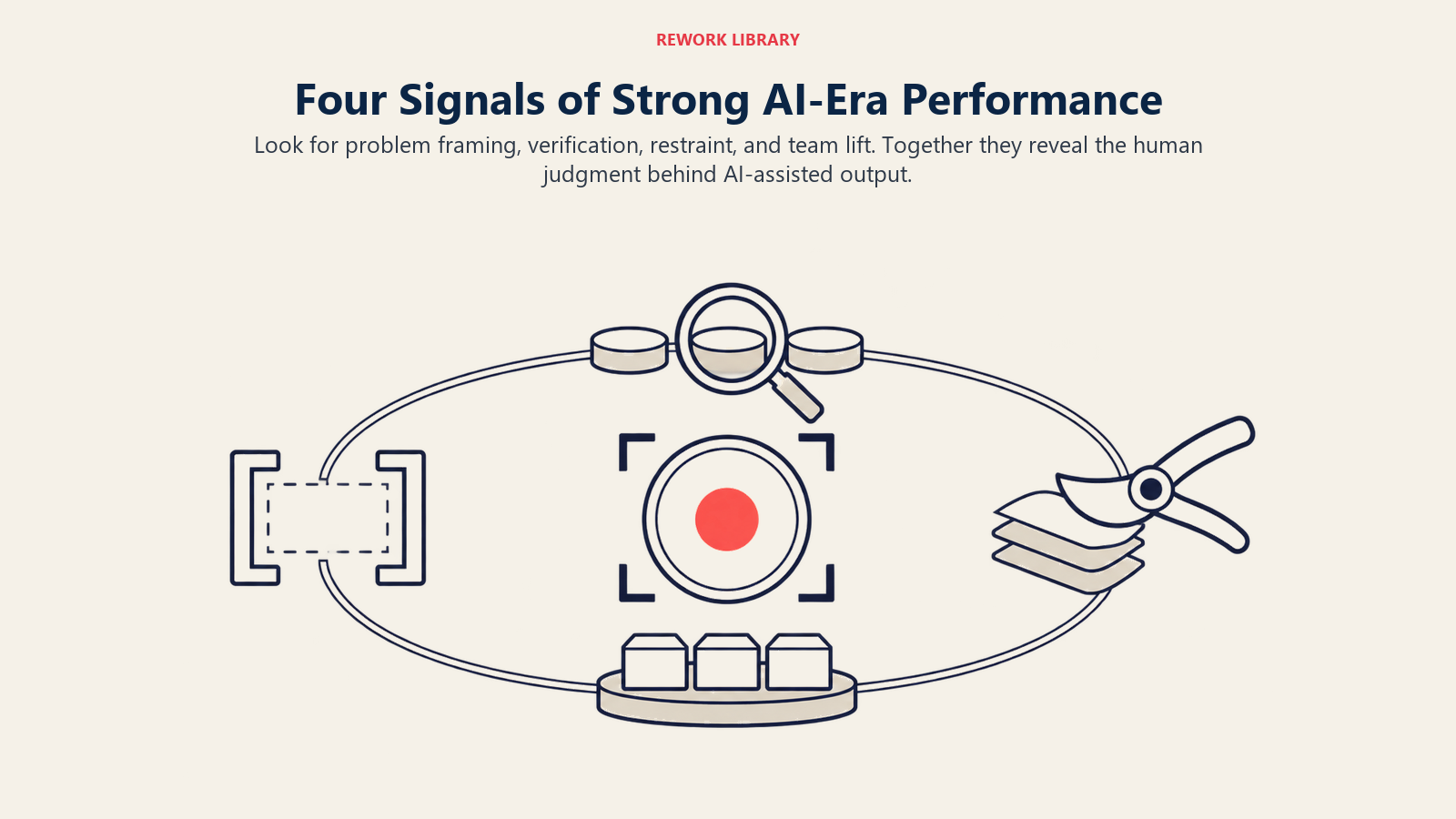
If volume is out, the review has to move to things that are harder to fake and harder to inflate with a better prompt. Four hold up reasonably well.
Judgment and problem framing
Before anyone generates anything, someone decided what problem was worth solving and how to frame it. That decision is invisible in the final output and entirely human. Ask what the person chose to work on and what alternative framing they rejected, and why. A strong answer here beats a polished deliverable, because a polished deliverable answering the wrong question is worse than useless: it's expensive and convincing.
Quality of verification
The gap between "AI produced this" and "this is correct" is where most of the real work now happens, and it is exactly the gap that Keeping Human Judgment Sharp: The De-Skilling Paradox of AI at Work covers from the skills side. Evaluate how someone verified a claim, a number, or a recommendation before it went out the door, not whether they used AI to draft it. Did they check the source behind a cited statistic? Did they run the numbers a second way? Did they stress-test the recommendation against an obvious counterargument? A person who catches their own agent's mistake before a client sees it is doing the job. A person who forwards the mistake is not, no matter how fast either one worked.
What they chose not to ship
An underrated signal: restraint. AI makes it cheap to generate five versions of anything, so shipping the mediocre fourth draft instead of doing one more pass is now a choice, not a time constraint. Ask what a person cut, simplified, or declined to send because it wasn't good enough yet. It's a workable proxy for standards in a world where "I ran out of time" is a much weaker excuse than it used to be.
How they raised the team's capability
Some of the highest-leverage work in an AI-saturated team is invisible in any individual's output: the prompt template someone built and shared, the verification checklist they wrote after catching a bad agent output, the junior colleague they walked through why a recommendation was wrong. Culture Metrics That Matter (And the Vanity Ones to Drop) makes the broader case for tracking behaviors like this instead of vanity counts; performance reviews should do the same at the individual level. A team member whose personal output looks average but who made three colleagues measurably better is often the person you least want to lose.
Old Signal vs. New Signal
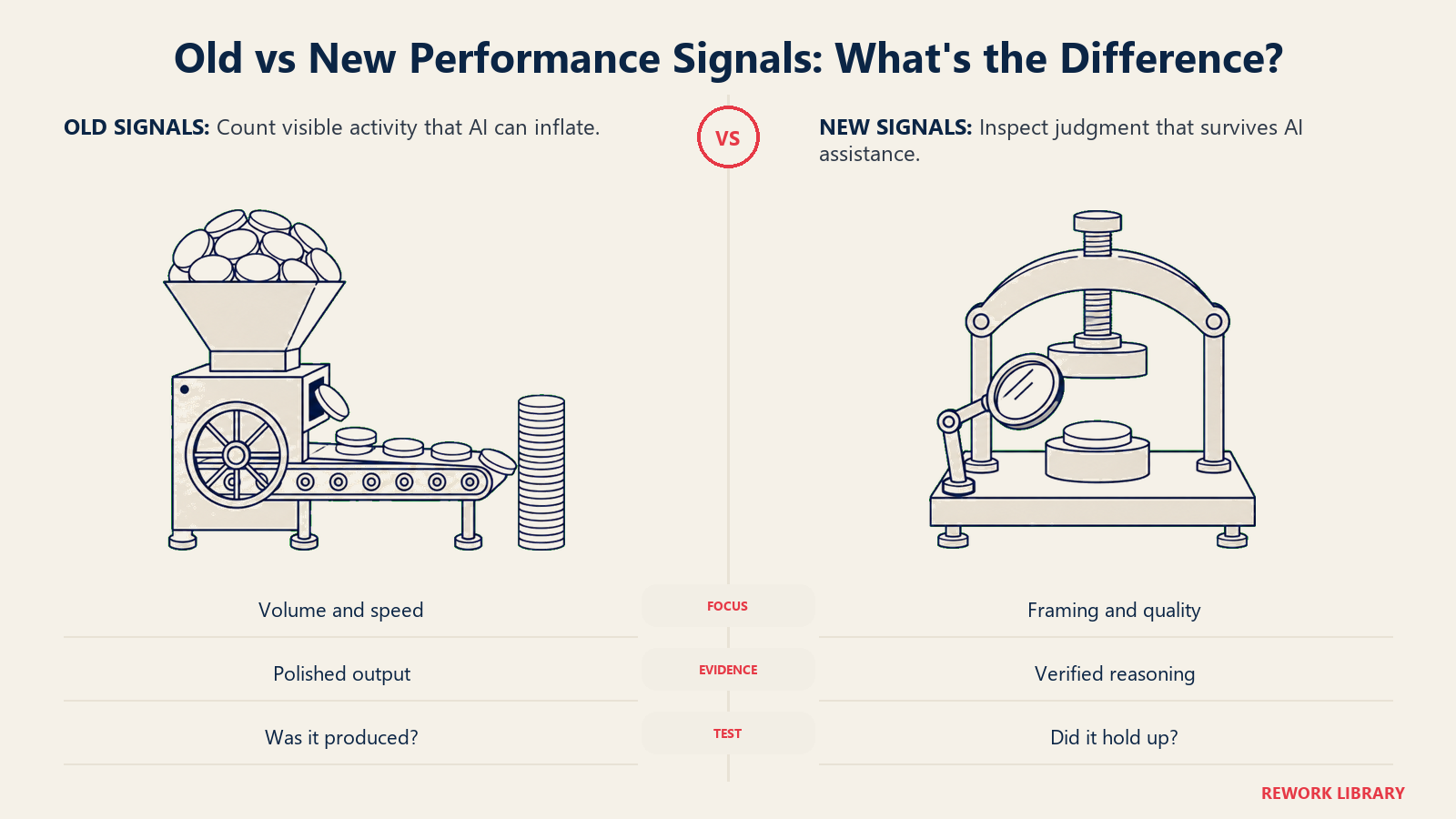
Old signals count speed, volume, and polish. New signals examine framing, verification, defensibility, and whether the result holds up.
| Old performance signal | Why AI breaks it | What to use instead |
|---|---|---|
| Volume of output (tickets closed, words written, decks produced) | AI multiplies volume for anyone with access, regardless of skill, so it no longer separates strong performers from weak ones | Judgment behind the work: what problem was chosen, and why |
| Speed to completion | AI collapses the time cost of a first draft, so speed now reflects tool access more than ability | Time-to-correct-answer, including the verification pass, not just time-to-first-draft |
| Polish or fluency of the final deliverable | AI-assisted drafts are polished by default, so fluency stops indicating the author understood the content | Whether the person can defend the content under questioning, unaided |
| Number of tools or features used | Usage counts inflate on their own and can be manipulated by habit, not skill | Evidence of catching an AI error before it shipped |
| Individual task count | Ignores work that has no task ticket, like teaching a teammate or building a shared checklist | Contribution to the team's capability, not just the person's own queue |
| Meeting or ticket "closed" status | An agent can close a ticket without the underlying problem being solved | Whether the same issue reopens later, and how often |
The Fairness Problem: AI Access and Skill Are Not Evenly Distributed
A performance system that quietly assumes everyone has the same AI capability is comparing people on an uneven field and calling it fair. Microsoft's own 2026 Work Trend Index splits surveyed AI users into a rough four-way map: 16% are "Frontier Professionals" with both the skill and the organizational backing to use agents on complex work; 10% are "blocked agency," skilled but without the license or support to use it; 16% are "stalled," with neither; and roughly half sit in an underdeveloped middle zone. Two employees with identical talent can land in very different buckets depending on which team they're on or which tools their manager approved.
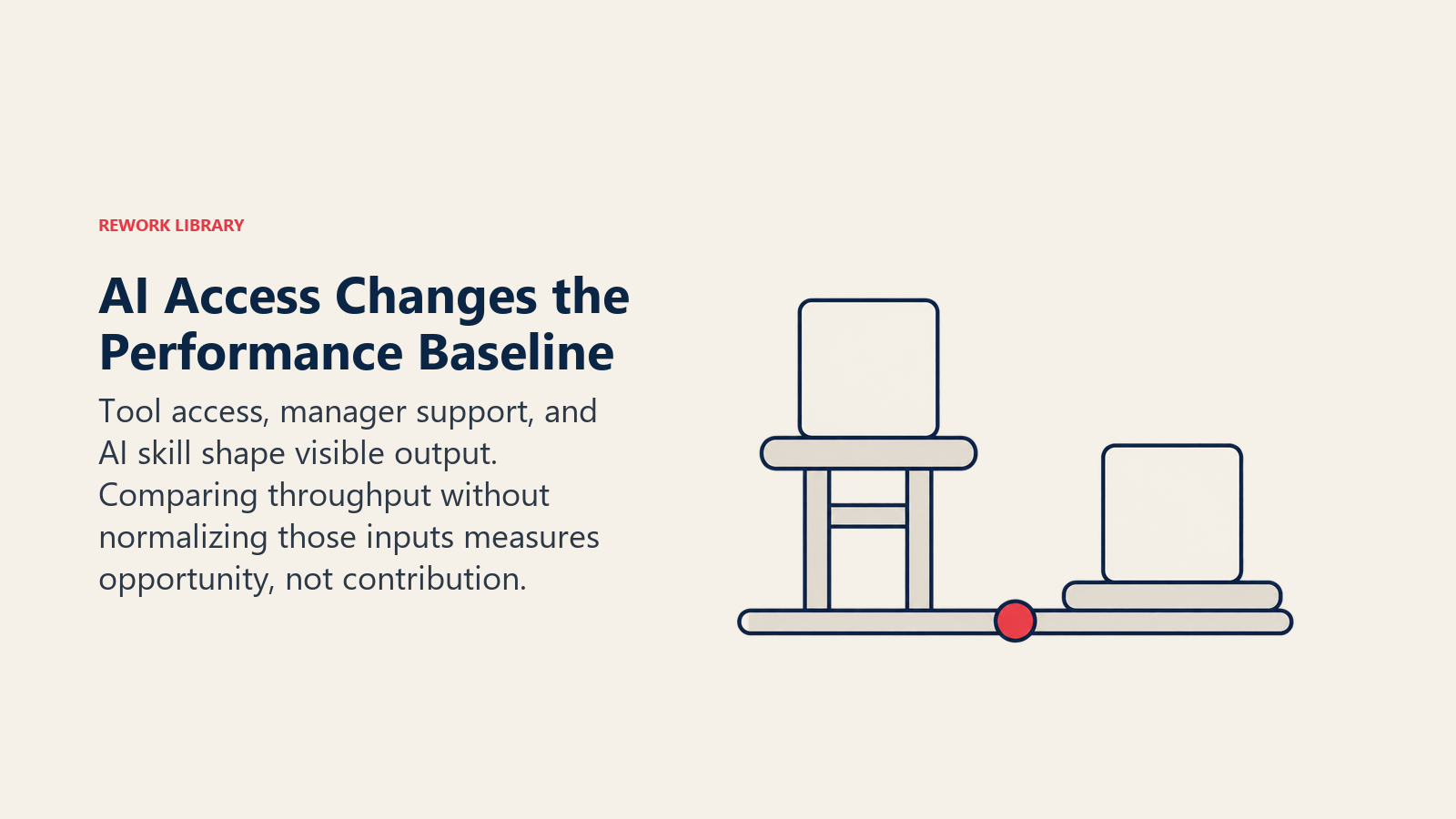
That has direct consequences for reviews. If one person's manager provisioned a frontier-grade AI seat and actively coaches its use, and another's didn't, comparing their output head to head measures the manager's provisioning decisions, not the person. Gallup's July 2026 data backs this from a different angle: employees whose managers actively support AI use report 48% engagement against 30% for those without it, and the highest self-reported productivity gains nearly quadruple with manager backing (33% vs. 9%). The manager, not just the employee, is a major input into how much AI-assisted output someone can plausibly generate.
There is also a skill-gap version of the same problem, separate from access. Some people learned to write a specific, verifiable prompt and check the result; others accept whatever comes back first. Neither shows up as a difference in effort. It shows up as a difference in judgment, which conveniently routes around the access problem: score the thinking, not the throughput, and uneven access matters much less. The same fairness math carries straight through to pay: see compensation and fairness in the AI era for what breaks when one AI-leveraged person's output looks, on paper, like five people's.
Goal-Setting That Survives AI-Inflated Throughput
Most goal frameworks were built assuming a rough ceiling on how fast a person could produce. AI removes that ceiling for some tasks and leaves it untouched for others, so a goal written before that shift often becomes trivially easy or accidentally meaningless within a quarter. The AI Productivity Paradox is the org-level version of this problem: adoption is high and measured business impact is not following at the same rate, which is a reason to distrust any goal that treats "used more AI" as inherently equal to "delivered more value."
A few adjustments hold up:
- Tie goals to outcomes the business can verify, not activity the employee can inflate. "Publish 20 articles" is now a bad goal because it can be hit with unreviewed output. "Improve the qualified-lead rate from organic content by X%" survives, because AI cannot fake a conversion.
- Set a verification standard alongside a throughput target, explicitly. If the goal involves AI-assisted output, name what "reviewed" means for that specific type of work, not as a vague aspiration but as a checklist someone can be held to.
- Revisit goals more often than the old annual or semi-annual cycle. A target set assuming last quarter's tool capability can be stale within months given how fast agent capability is moving; a goal that made sense in January can be undemanding by June for reasons that have nothing to do with the person's growth.
- Separate "did more get shipped" from "did the person get better." A manager can track both, but they measure different things, and only the second belongs in a competency or promotion conversation.
- Write goals a person could not hit by prompting harder. If a target can be satisfied entirely by generating more AI output with no additional judgment, it is not measuring the thing performance management exists to measure.
Running the Review Conversation in This World
The mechanics of the conversation change less than the substance, but a few habits matter more now than they did five years ago.
Ask "show me," not "tell me"
Instead of asking someone to summarize what they accomplished, have them walk through one piece of work end to end: what they asked the AI for, what came back, what they changed, and why. This surfaces judgment in a way a results summary cannot, and it's a natural moment to also ask how AI changed their approach to the work itself, not just its output.
Separate the review of the work from the review of the person
A deliverable can be excellent because a tool is excellent. Ask directly: what part of this would have been different if a less-skilled person had used the same tool? If the honest answer is "not much," that deliverable is weak evidence for the review, regardless of how good it looks on the page. This is also where accountability gets decided in practice: How to Build a Culture of Accountability argues ownership has to attach to a person, not a tool, and the review is where that principle either holds or quietly slips.
Name the AI-fluency expectation instead of leaving it implicit
Microsoft's 2026 data found that only 13% of AI users feel rewarded for reinventing their workflow with AI, even when results fall short, a gap it calls a "Transformation Paradox": people are ready to change how they work, but incentives haven't caught up. Closing that gap starts with saying plainly, in the review, what good AI use looks like for that role, rather than assuming everyone already knows.
Make space for "I chose not to use it here"
Sometimes the right call is not using AI at all: a client-sensitive draft, a judgment-heavy negotiation, writing that needs a specific voice. A review that implicitly rewards AI use everywhere trains people to reach for it even when it's the wrong tool.
The Honest Risk: Companies Just Raise the Quota
None of this works if leadership responds to AI-inflated output by simply raising the bar and calling the new baseline "performance." It requires no thought: if a team was shipping 20 reports a month and AI makes 35 achievable, set the new target at 35 and declare the job unchanged. That isn't performance management adapting to AI. It's extracting more output at the same headcount while quietly redefining "meets expectations" upward, without asking whether the extra 15 reports are any good or whether anyone had time to verify them.
This is where the fairness problem and the measurement problem meet. A quota raised to match AI-assisted throughput assumes even access and skill across the team, which this article has already shown breaks down in practice. It also assumes the added output is worth the same as the original, which the GitClear research suggests is not safe: AI-assisted commits there rose alongside an 81% jump in duplicated code and a 74% drop in refactoring old code, more output and worse quality at once. A sales, support, or content team should ask the same question of its own numbers before treating them as a new floor.
The honest version of this transition is slower and less flattering to a leadership team's slide deck: some of the time AI buys back should go to verification, some to raising the team's collective capability, and only some to raw additional throughput. A company that takes all of it as throughput and calls the result "performance" is running its people harder and outsourcing the accounting to a chatbot. The organizations that get this right will be the ones whose leaders can say, specifically, what they're asking employees to do differently now that a machine can produce a first draft, including that part of the answer is "produce less raw output, but stand fully behind more of it." Being explicit about that tradeoff, out loud, is exactly what the social contract of AI at work argues employers now owe employees, instead of quietly redefining "meets expectations" upward and hoping nobody asks why.
For the org-design side of this shift, including how span of control changes when a manager oversees fewer people doing more verification-heavy work, see From Doer to Orchestrator: How AI Is Rewriting the Individual Contributor's Job and AI-Complementary Skills: What to Actually Hire and Develop for Now.

Co-Founder, Rework.com
On this page
- Key Facts
- Why Output Volume Stopped Working as a Signal
- What to Assess Instead
- Judgment and problem framing
- Quality of verification
- What they chose not to ship
- How they raised the team's capability
- Old Signal vs. New Signal
- The Fairness Problem: AI Access and Skill Are Not Evenly Distributed
- Goal-Setting That Survives AI-Inflated Throughput
- Running the Review Conversation in This World
- Ask "show me," not "tell me"
- Separate the review of the work from the review of the person
- Name the AI-fluency expectation instead of leaving it implicit
- Make space for "I chose not to use it here"
- The Honest Risk: Companies Just Raise the Quota