The Broken Bottom Rung: How AI Is Eroding the Way Junior Employees Learn to Become Experts
Turn this article into takeaways for your work.


Each assistant summarizes the article only for you and suggests best practices for your work.
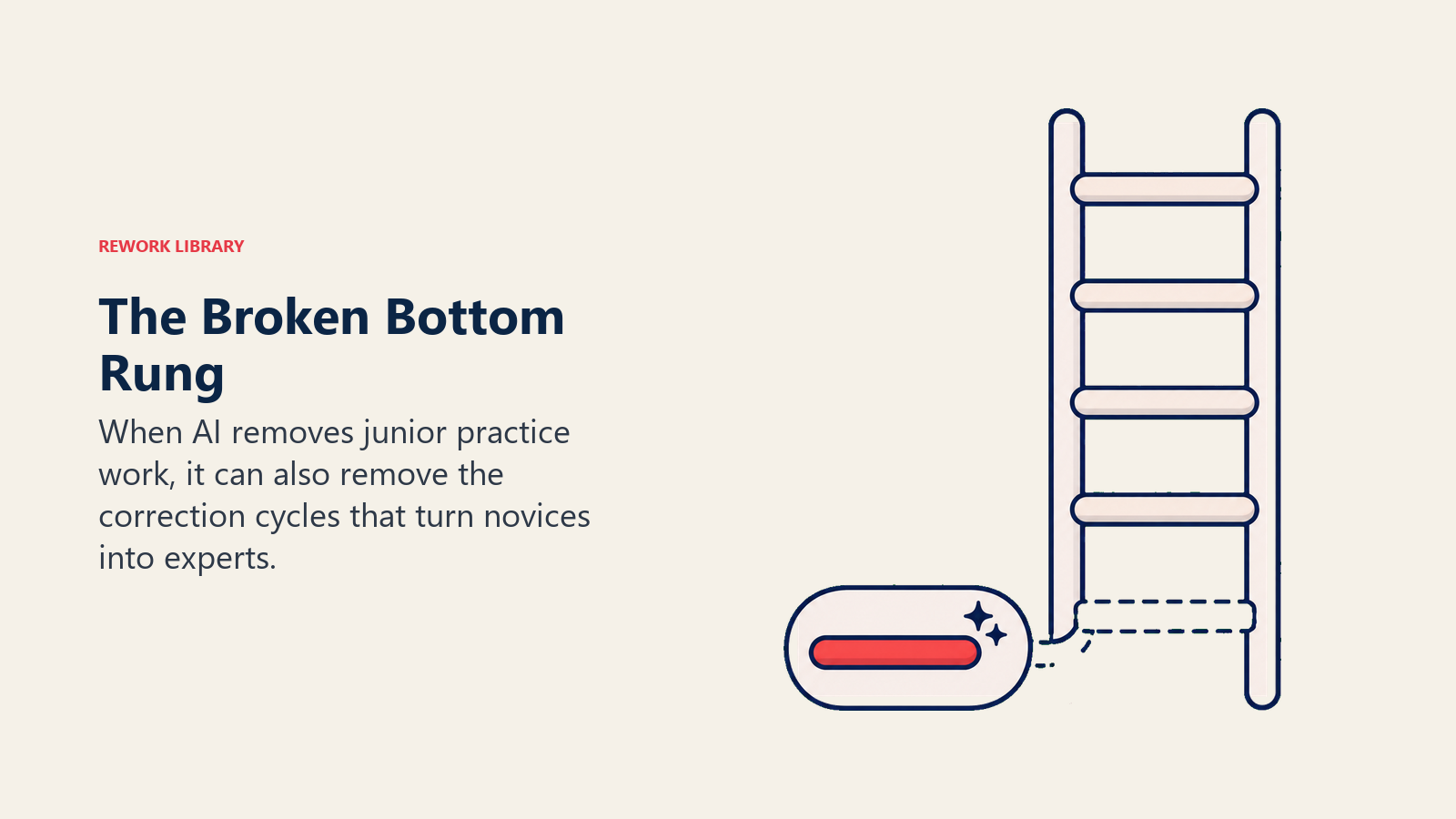
The "broken bottom rung" describes what happens when AI absorbs the first-draft research, routine code, basic analysis, and summarizing work that entry-level employees used to do. That work was never just cheap output to hand off. It was how juniors built judgment, through repetition, correction, and exposure to how experienced people think. When AI removes the reps, it doesn't just shrink a hiring line, it removes a training mechanism nobody replaced yet.
This is not a settled story. The entry-level hiring data is genuinely contested, and a fair reading of it has to hold two things at once: something real is happening to young workers in AI-exposed roles, and the picture is messier and more concentrated than "entry-level jobs are disappearing" headlines suggest.
What the Grunt Work Actually Taught
For decades, the first two years of a knowledge job worked like an unglamorous apprenticeship. A junior analyst built the first draft of a model so a senior analyst could correct it, and the correction was the lesson. A first-year associate summarized case law so a partner could tell them what they'd missed, and the gap between the summary and the partner's read was the education. A junior engineer wrote boilerplate and ran unit tests, not because the codebase needed it, but because writing bad code and having it reviewed is how engineers learn to write good code.
None of this looked like training on an org chart. It looked like cost center work: cheap labor doing tasks nobody senior wanted to do. But the output was a side effect. The real product was a junior who, eighteen months later, had internalized thousands of small corrections into something closer to instinct. Economists call this tacit knowledge: know-how you can't fully write down, only acquire by doing the task badly enough times to notice the pattern. MIT economist David Autor and Neil Thompson, in their 2025 paper on expertise, build a framework around exactly this: automation's effect depends on whether it strips out the routine tasks that build expertise or the specialized tasks that use it, and the two have opposite effects on wages and headcount.
AI agents and AI copilots now do a large share of that routine, correction-generating work directly, drafting the memo, writing the boilerplate, summarizing the transcript, flagging the obvious errors, before a human sees a rough draft. That's a genuine capability gain. It is also, unintentionally, the removal of the exact mechanism that used to turn a 22-year-old into a 30-year-old who can be trusted with judgment calls.
Is Entry-Level Hiring Actually Collapsing? What the Evidence Shows
Three independent data sources point the same direction, though not all at the same magnitude, and it matters to be precise about what each one measures.
SignalFire's 2026 State of Talent report, built from hiring data across thousands of venture-backed and large technology companies, found entry-level and new-grad hiring at large technology employers down roughly 65% compared to 2019, and around 76% at early-stage startups. The report names the mechanism directly: the twelve to eighteen months a junior engineer used to spend "writing boilerplate code, running unit tests, and performing routine debugging" is now handled by coding assistants, so companies stopped hiring for the task rather than the person.
The more rigorous academic evidence comes from Stanford's Digital Economy Lab. In an August 2026 analysis using ADP payroll data covering millions of workers, economists Erik Brynjolfsson, Bharat Chandar, and Ruyu Chen found that employment among workers aged 22 to 25 in highly AI-exposed occupations sits about 19% below where it would be had it tracked employment among similarly aged workers in less-exposed occupations. That gap has widened, from 15% in July 2025 to 19% a year later, a sign this looks like an accelerating trend rather than a one-time correction.
What the Data Does Not Show
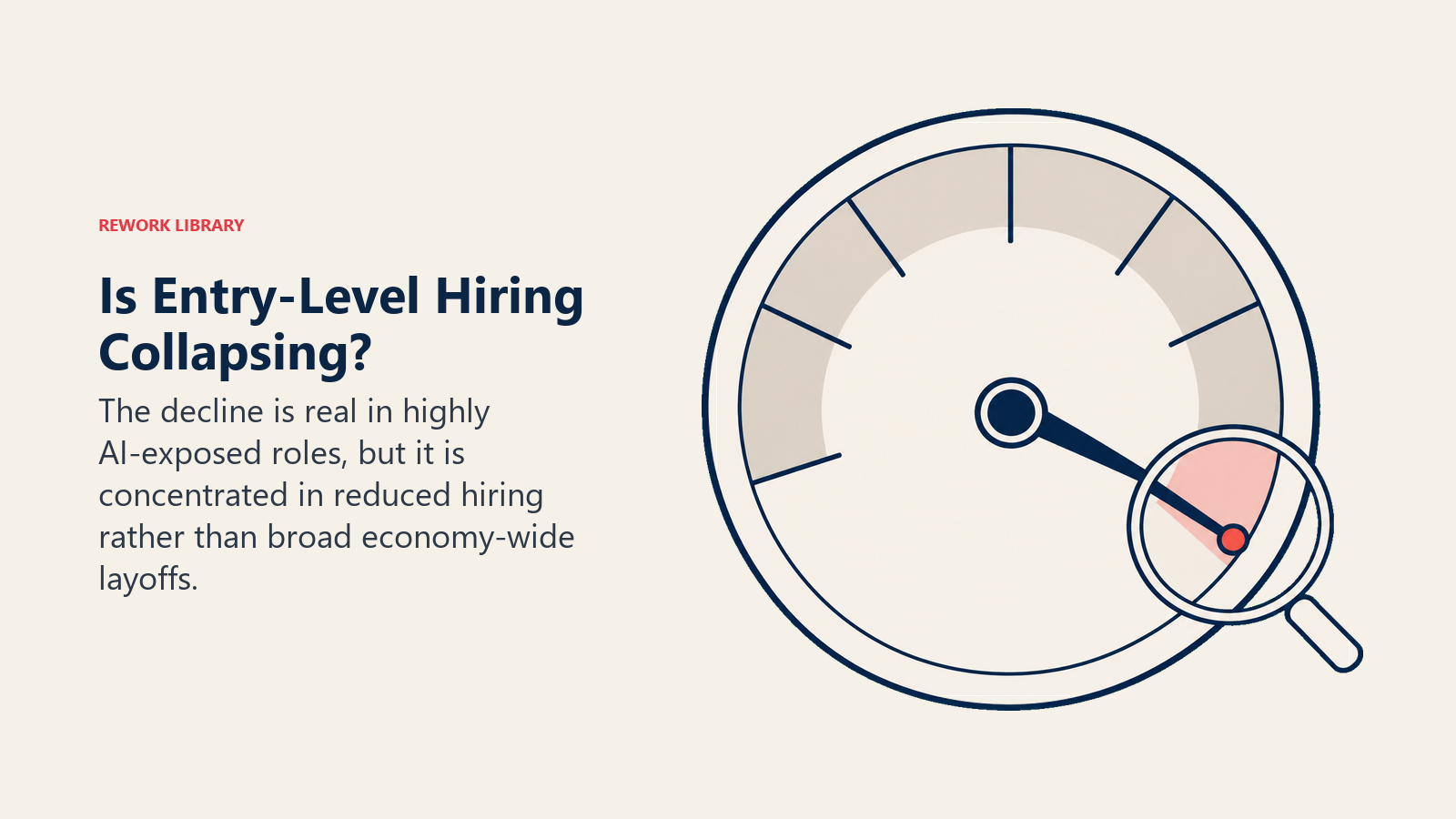
Read carefully, the Stanford paper is more precise, and more limited, than the headlines about it. The researchers are explicit that they find no evidence of "widespread, economy-wide job displacement associated with AI." The effect concentrates in specific, highly AI-exposed occupations, software development and customer support among them, not across the labor market broadly. The mechanism is reduced hiring of young workers, not a wave of layoffs. Older, more experienced workers in the same occupations aren't seeing the same decline, and where AI complements rather than substitutes for human tasks, employment among younger workers is flat or even rising.
LinkedIn's leadership has flagged the same pattern from a different angle. In a widely discussed May 2025 New York Times op-ed, LinkedIn's chief economic opportunity officer Aneesh Raman wrote that he sees "the bottom rung of the career ladder breaking," pointing to junior coders whose debugging work has moved into AI tools and first-year paralegals watching document review shift into AI-assisted workflows. LinkedIn's own workforce data shows overall hiring still running more than 20% below December 2019 levels, a slower labor market generally that makes it harder to isolate the AI-specific effect from ordinary macroeconomic softness. Some of what looks like an AI story is also a hiring-freeze story, and untangling the two cleanly is still an open question.
The honest summary: something specific and real is happening to hiring for young workers in a defined set of AI-exposed roles, the trend looks like it's widening rather than stabilizing, and it has not become a broad-based collapse across the labor market. Plan for the first claim. Stay skeptical of the second.
The Tacit-Knowledge Transfer Problem
Even if the hiring numbers stabilize, a second and quieter problem remains: what happens to the quality of the entry-level jobs that still exist, once the tasks inside them are hollowed out.
Philosopher Michael Polanyi described this as "we can know more than we can tell." Skilled judgment is often impossible to fully articulate as a rule. A senior underwriter can look at a loan file and sense something's off before they can explain why. A partner can read a junior's memo and know it's thin before pinpointing the missing argument. That instinct is the compressed residue of thousands of earlier corrections, most forgotten as explicit memories and retained only as pattern recognition. You cannot download that residue. You accumulate it, through the specific, tedious tasks AI now does faster and better.
That creates a real design problem, not just a hiring problem. A junior who still gets hired but whose entire job is reviewing and approving AI-generated drafts, without ever producing a bad first draft themselves, misses the step where correction becomes internalized. Reviewing someone else's work teaches you to spot errors. It teaches you far less about the reasoning that avoids the error in the first place, the kind you only build by struggling through the task yourself. This is one reason onboarding design has to be rebuilt on purpose now: the old default, hand them the grunt work and they'll figure it out, doesn't survive once there's no grunt work left to assign.
What Juniors Used to Learn, What AI Now Does, and How to Replace It
| What juniors used to learn by doing | What AI now does | How to replace the learning |
|---|---|---|
| First-draft research and synthesis | Summarizes sources, drafts briefs in seconds | Have juniors draft first, then compare against the AI draft and explain every difference |
| Basic financial or data analysis | Builds models, runs the numbers, flags anomalies | Require a written "what would I have missed" note before juniors see the AI's flagged errors |
| Routine code, unit tests, debugging | Writes boilerplate, generates and passes tests | Assign juniors to debug intentionally broken AI-generated code before shipping real fixes |
| Meeting notes and call summaries | Transcribes and summarizes automatically | Have juniors take their own notes first, then diff against the AI transcript for what they missed |
| Proofreading and QA passes | Flags errors, inconsistencies, and style issues | Rotate juniors through reviewing AI output for a named senior, with the senior explaining every override |
| Competitive or market research | Aggregates and synthesizes public information | Pair AI research with a structured interview: junior has to defend one recommendation live |
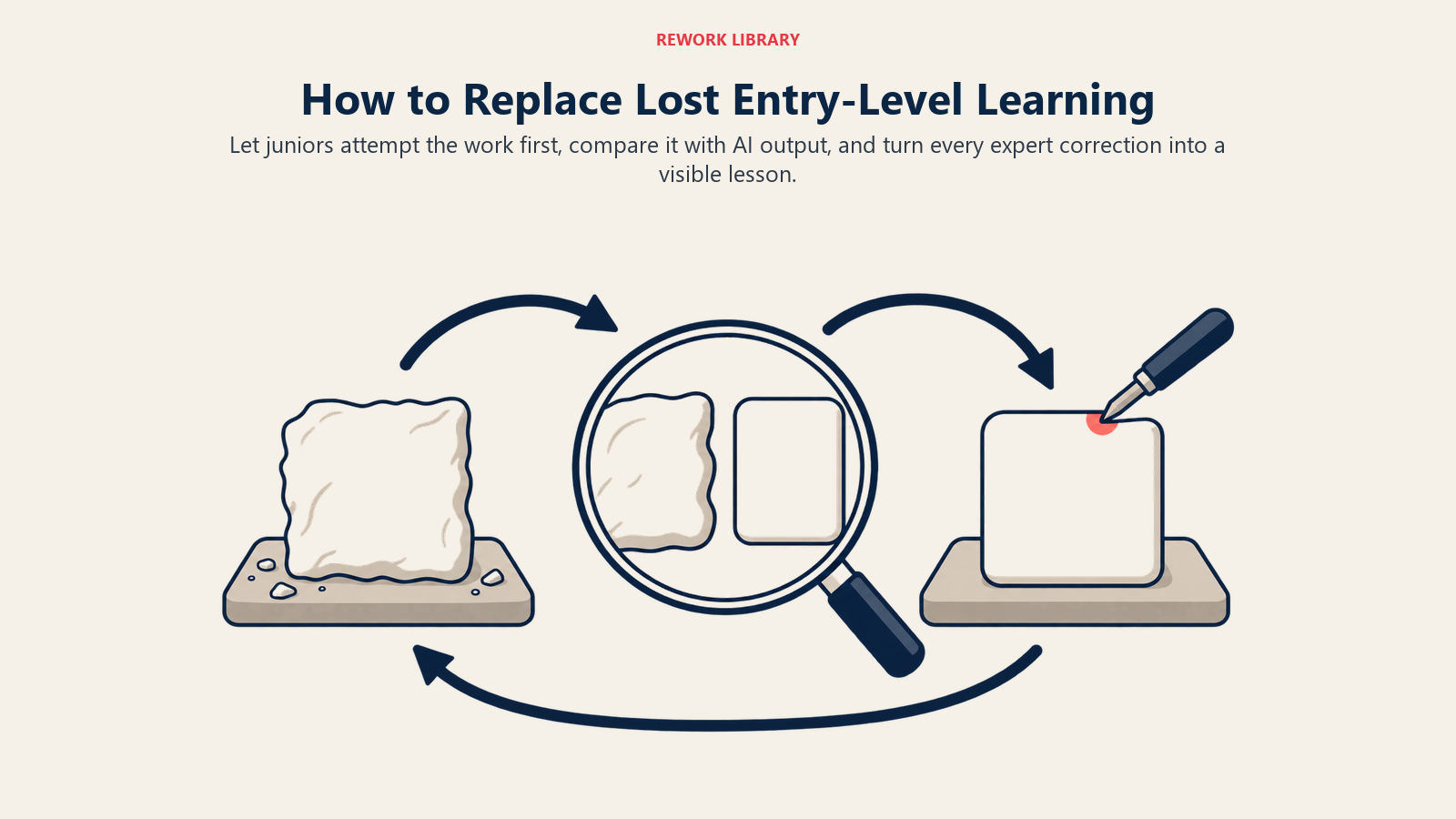
The pattern across every row is the same: the learning was never in producing the artifact. It was in the gap between a junior's first attempt and an expert's correction. If AI closes that gap by doing the first attempt itself, the fix is to reopen it deliberately, on purpose, as a designed exercise rather than an accidental byproduct of assigning cheap work.
The Senior Pipeline Problem: What Happens in Five to Ten Years
This is the part most AI-and-jobs coverage skips, because it's a forecast rather than a measurement, and forecasts deserve more hedging than headlines give them. But the mechanism is plain enough: today's senior engineers, analysts, and associates were mostly trained by yesterday's entry-level grunt work. If that grunt work has genuinely thinned out for the cohort hired in 2024 through 2026, the people who would have become the judgment-holders of the early 2030s aren't accumulating the reps that used to produce them.
SignalFire's report names this directly, calling it a "systemic risk" that arises "when an entire industry stops investing in early-career talent," and warning of a possible leadership gap five to ten years out. That's a claim from a venture firm with its own incentive to keep portfolio companies hiring junior talent, so treat it as a hypothesis, not a fact. But the underlying logic doesn't depend on who's saying it: expertise takes years to build, that time is currently unaccounted for once the tasks that built it are automated, and no proven substitute mechanism is operating at scale yet. An organization that guts its junior pipeline for three straight years without deliberately replacing the learning loop is making a bet on its 2032 bench it probably hasn't priced in. The same logic is why AI talent strategy now has to include a genuine build-versus-buy call on expertise itself, not just headcount math: buy senior talent from a shrinking pool, or build it internally with a redesigned apprenticeship. What a company owes the juniors it does hire, given that the old training-by-accident deal no longer holds, is exactly the kind of question the social contract of AI at work asks employers to answer honestly instead of by default.
Can AI Also Transfer Tacit Knowledge? The Counter-Evidence
The picture isn't purely subtractive, and a fair article has to say so. There's real evidence that, deployed a specific way, AI can compress the distance between a novice and an expert rather than just removing the novice's practice reps.
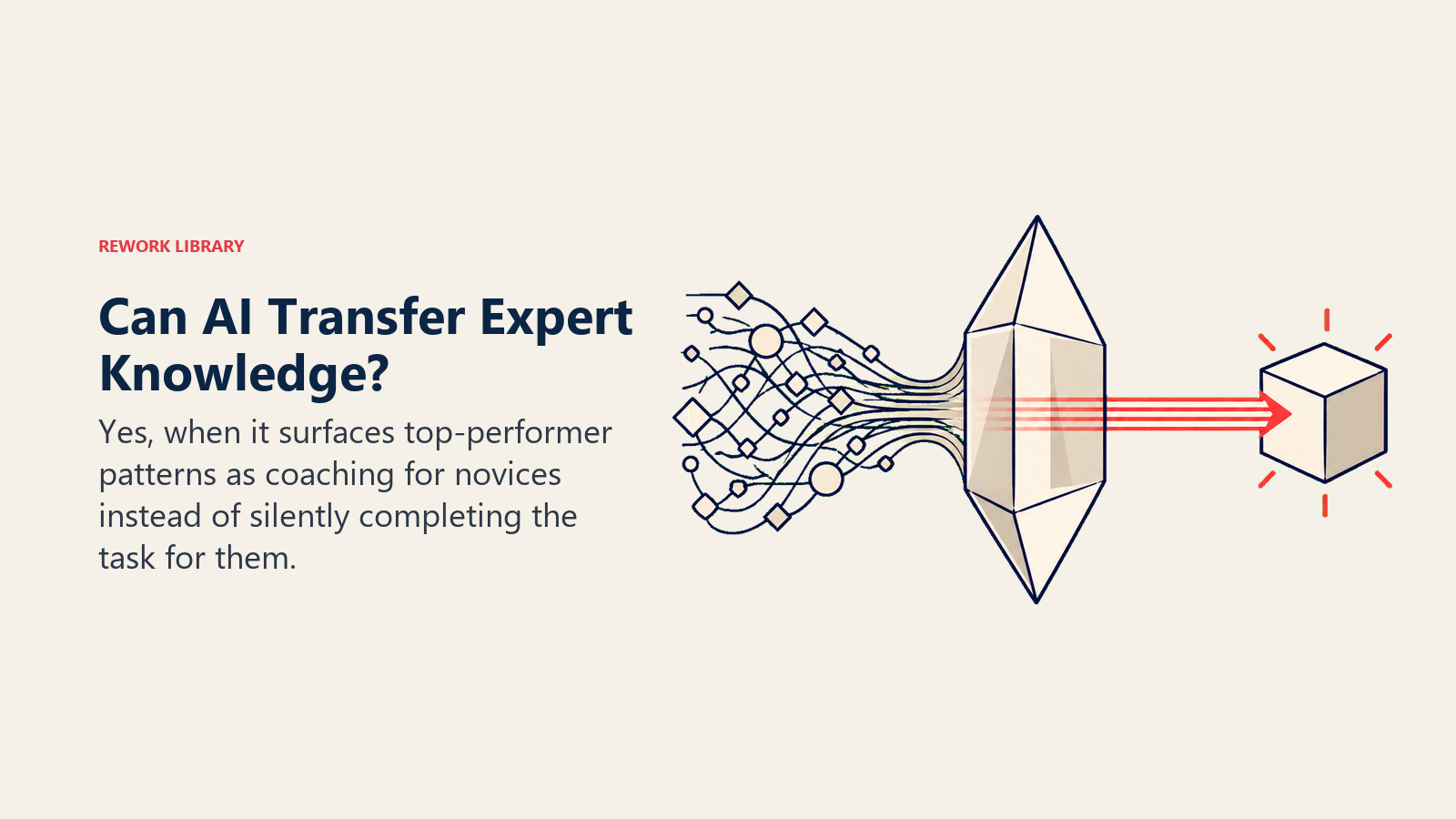
The clearest example is a large-scale study by economists Erik Brynjolfsson, Danielle Li, and Lindsey Raymond, published in the Quarterly Journal of Economics, of over 5,000 customer support agents given a generative AI assistant. Average productivity rose 14%, but the gain was uneven: novice and lower-skilled agents improved by 34%, while the most experienced barely moved. The explanation matters: the tool had learned the patterns of the company's best agents and was surfacing that distilled expertise to everyone else in real time, functioning less like a shortcut around the learning curve and more like a coach standing over a novice's shoulder.
That distinction, AI as a knowledge-transfer mechanism versus AI as a task-removal mechanism, is mostly a design choice, not a fact about the technology. A tool that surfaces "here's how a top performer would phrase this" teaches. A tool that just answers the customer directly does not. Most companies default to the second, faster option because it's what shows up in a productivity metric next quarter. David Autor makes a related, more optimistic case in his 2024 NBER paper, arguing AI's real opportunity is extending expert-level decision support to workers without formal credentials, in medicine, law, and skilled trades, effectively democratizing a version of expertise that used to require years of apprenticeship to earn. He frames this as what's possible, not a prediction of what companies will choose to build.
What Leaders Can Actually Do
None of the fixes below are exotic. They're deliberate substitutes for a learning mechanism that used to happen automatically as a side effect of expensive human labor, and now has to be designed on purpose.
Treat Deliberate Practice as a Line Item, Not a Luxury
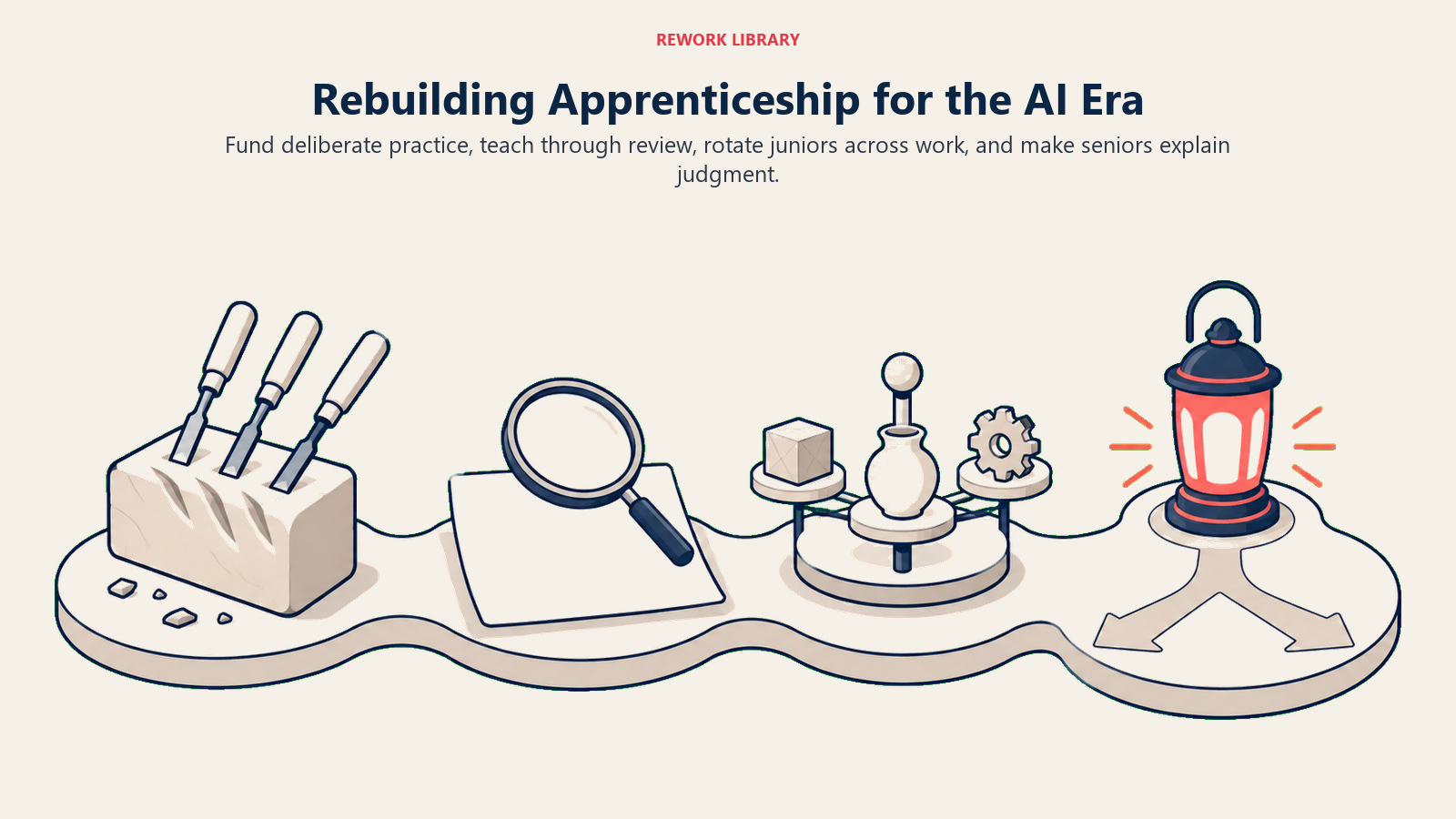
Psychologist Anders Ericsson's research on expertise found that raw hours on the job don't build skill; structured practice with fast, specific feedback does. Before AI, junior grunt work accidentally delivered both. Now leaders have to build the reps back in on purpose: give juniors a task the AI could do, let them attempt it unassisted first, then compare. It costs time that used to be free. Budget for it like any other capability investment, because it is one.
Make Reviewing AI Output a Training Exercise, Not Just a QA Gate
Most companies already have juniors reviewing AI-generated drafts before they ship. Few treat that review as instructional. The fix is procedural: have the junior write down, in their own words, what they'd change and why, before an experienced reviewer weighs in, then compare the two. The delta is the lesson, the same one a red-pen edit used to teach, just relocated. Workflow tools that log who reviewed what and why turn this into a searchable training record instead of a lost Slack thread, and they double as a defense against the kind of unreviewed, ungrounded output that shows up later as workslop.
Rotate Juniors Through Tasks Instead of One Queue
When a junior's whole job becomes supervising one AI workflow, they get depth in a narrow loop and no exposure to the adjacent judgment calls a messier, less-automated job used to provide for free. Deliberate rotation, three months on research support, three on analysis review, three shadowing client calls, rebuilds that breadth on purpose.
Redesign Mentorship Around Explanation, Not Assignment
The old mentorship model often ran on proximity: a junior sat near a senior, watched them work, and absorbed norms passively. Remote and increasingly AI-mediated work has thinned that channel out, especially as more teams operate as human-agent teams inside what some call the frontier firm. The fix is to make mentorship an explicit act of narrating judgment: seniors walking juniors through why they overrode an AI recommendation, not just that they did. This only works where junior employees feel safe admitting confusion in front of a senior, a psychological safety question as much as a training one, and where mistakes get treated as information, the difference between a blame culture and a learning culture.
None of this requires slowing AI adoption. It requires accepting that the old apprenticeship ran on a byproduct of inefficiency, and once the inefficiency is gone, the apprenticeship has to be rebuilt as its own deliberate system, inside whatever AI change management plan is already rolling agentic workflows and a more AI-native culture across the rest of the org. Skip that step and the gap doesn't announce itself. It just quietly compounds into AI cultural debt that shows up years later, in a leadership bench that isn't there.
Key Facts
- Entry-level and new-grad hiring at large tech companies is down roughly 65% versus 2019, and about 76% at early-stage startups. Source: SignalFire State of Talent Report, 2026
- Employment for workers aged 22-25 in highly AI-exposed occupations sits about 19% below where it would otherwise be, up from a 15% gap a year earlier, driven by reduced hiring rather than increased firing. Source: Stanford Digital Economy Lab, "Canaries in the Coal Mine," August 2026
- Overall U.S. hiring remains more than 20% below December 2019 levels, a broader labor-market backdrop that complicates isolating an AI-specific effect. Source: LinkedIn Economic Graph Workforce Report, January 2026
- Access to a generative AI assistant raised customer support agent productivity by 14% on average, and by 34% for novice agents, by surfacing the patterns of top performers. Source: Brynjolfsson, Li, and Raymond, "Generative AI at Work," NBER / Quarterly Journal of Economics
- AI's effect on expertise depends on whether it automates the routine tasks that build judgment or the specialized tasks that use it, with opposite effects on wages and employment. Source: Autor and Thompson, "Expertise," NBER, 2025

Co-Founder, Rework.com
On this page
- What the Grunt Work Actually Taught
- Is Entry-Level Hiring Actually Collapsing? What the Evidence Shows
- What the Data Does Not Show
- The Tacit-Knowledge Transfer Problem
- What Juniors Used to Learn, What AI Now Does, and How to Replace It
- The Senior Pipeline Problem: What Happens in Five to Ten Years
- Can AI Also Transfer Tacit Knowledge? The Counter-Evidence
- What Leaders Can Actually Do
- Treat Deliberate Practice as a Line Item, Not a Luxury
- Make Reviewing AI Output a Training Exercise, Not Just a QA Gate
- Rotate Juniors Through Tasks Instead of One Queue
- Redesign Mentorship Around Explanation, Not Assignment
- Key Facts