The Social Contract of AI at Work: What Employers Owe Employees Now
Turn this article into takeaways for your work.


Each assistant summarizes the article only for you and suggests best practices for your work.
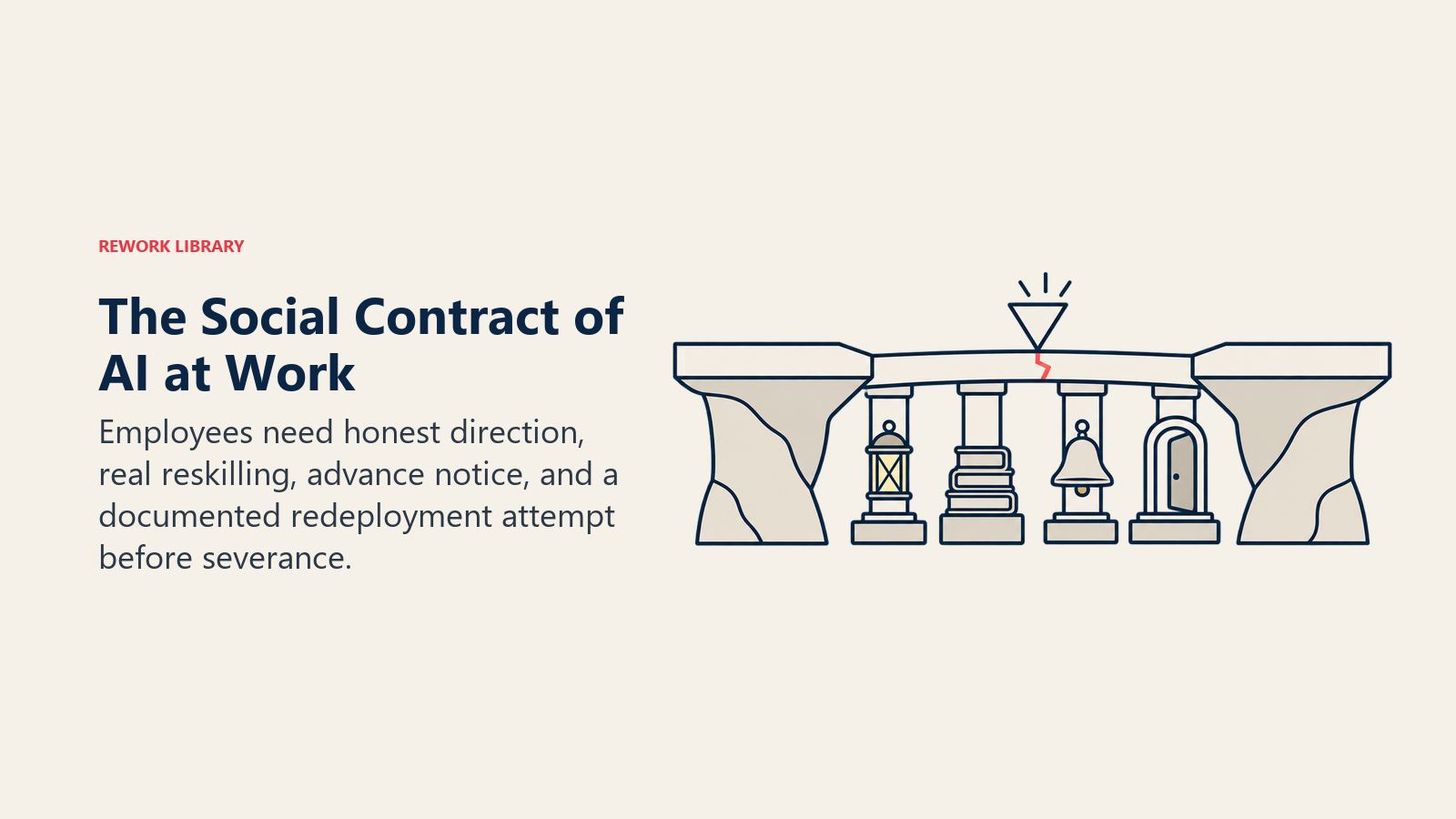
The social contract of work has always been an unwritten trade: reasonable effort and loyalty from an employee, in exchange for a reasonably predictable path from an employer, fair treatment, and honest information about where things stand. AI is rewriting that trade right now, inside nearly every company that uses it, and most are doing the rewrite without telling anyone. That silence, not the technology itself, is what breaks trust fastest.
What the Old Deal Actually Was
Nobody signed the old social contract. It accumulated over decades of postwar employment norms and the long boom that followed, and by the time it hardened into "common sense," most people could not have stated its terms outright. The terms were still there, and they were mutual.
An employee owed competence, effort, and a degree of loyalty measured in tenure. An employer owed something rarely written into any contract: predictable career progression tied to performance, investment in skill-building, a warning before anything drastic changed, and treatment as a person whose circumstances mattered, not a line item.
That deal was already fraying before generative AI arrived, worn down by offshoring, the end of defined-benefit pensions, and shareholder-primacy management. What AI adds is speed. A reorganization that used to take a fiscal year to plan can now be modeled and executed inside a single quarter, using the same tools whose adoption employees were told would "augment," not replace, them.
The Trust Cost of "Augment, Not Replace"
Most executives who said some version of "AI will augment your work" believed it at the time. The problem is what happened next at a large share of companies that said it, and how visible the gap has become.
What Broke the Promise
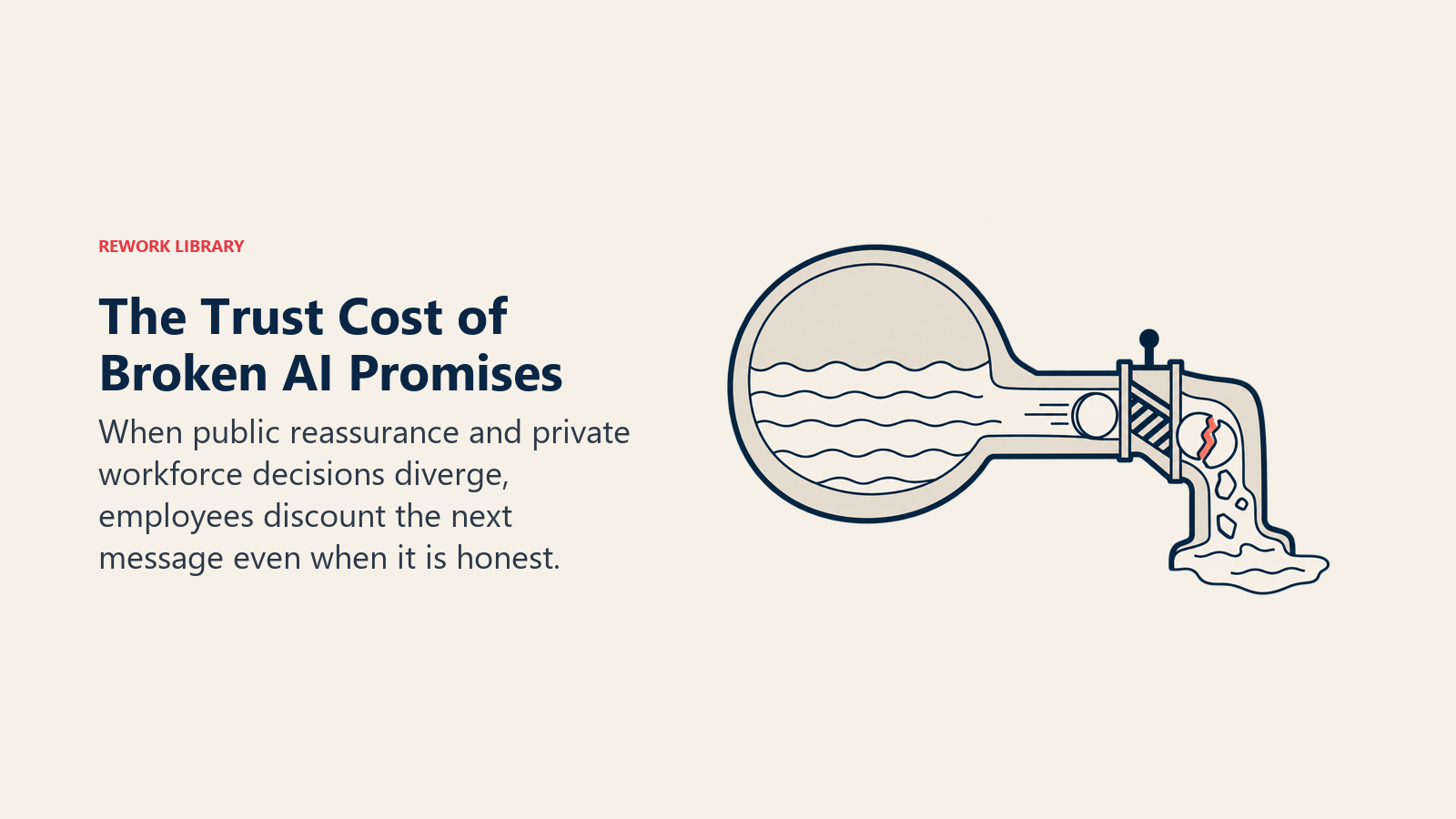
AI has now led all cited reasons for layoffs for four straight months through mid-2026, with cuts attributed to it running close to double the 2025 total, even as the same companies are collectively planning to spend hundreds of billions on AI infrastructure the same year. Read alone, that could describe a disciplined transition. Read against a second data point, it looks more like cover: a Resume.org survey of 1,000 hiring managers found 59% admit they emphasize AI as the reason for a layoff because it "plays better with stakeholders" than citing financial constraints, even though only 9% of the same respondents say AI actually replaced roles outright and 45% say it had little to no effect on staffing at all.
Employees feel that gap and remember it. A separate survey of 1,000 laid-off U.S. workers found 22% were told explicitly that automation replaced their role, another 31% suspected AI involvement even though their employer cited something else, and 86% said the layoff changed how they view job security and employer loyalty regardless of the real cause. Half said their employer had acted unfairly. Most employees already sense some disruption is coming; which jobs AI actually changes rather than replaces is usually more nuanced than either the promise or the panic. What breaks trust is a promise stated in public and quietly abandoned in private, which teaches every remaining employee to discount whatever leadership says next, including the honest parts.
What the Trust Data Shows
None of this is a hunch about vibes. The 2026 Edelman Trust Barometer found 78% of respondents trust their employer to do the right thing, the highest score of any institution measured, ahead of government, media, and business generally. That is real: "my employer" remains one of the last trusted relationships most people have. The harder finding sits next to it: 75% said business leaders are obligated to help bridge the divides opening around them, but only 44% said leaders actually do that well, a 29-point gap between what people expect and what they say they get.
Pew Research Center's survey of U.S. workers found 52% feel worried about how AI may be used in their workplace, against 36% who feel hopeful, and 32% think AI will mean fewer job opportunities for them personally over the long run. Put both findings together and the picture is coherent: people still extend real trust to "my employer" as an institution, but the trust is conditional, and it decays exactly where communication has been vaguest. Building trust in the workplace covers the mechanics of that trust more broadly; AI-era change is simply the sharpest current test of it.
Transparency About Where AI Is Actually Heading
The cheapest, least-used lever for closing that gap is telling people the truth about direction, even unfinished.
Most companies avoid this for reasons that are understandable and mostly wrong. Legal counsel worries that naming roles under review invites a talent exodus before a plan is final; executives worry that admitting uncertainty looks weak. Both instincts protect against a smaller, visible risk while exposing the company to a larger one: employees fill an information vacuum with the worst available rumor, exactly what the last unexplained reorganization taught them to assume.
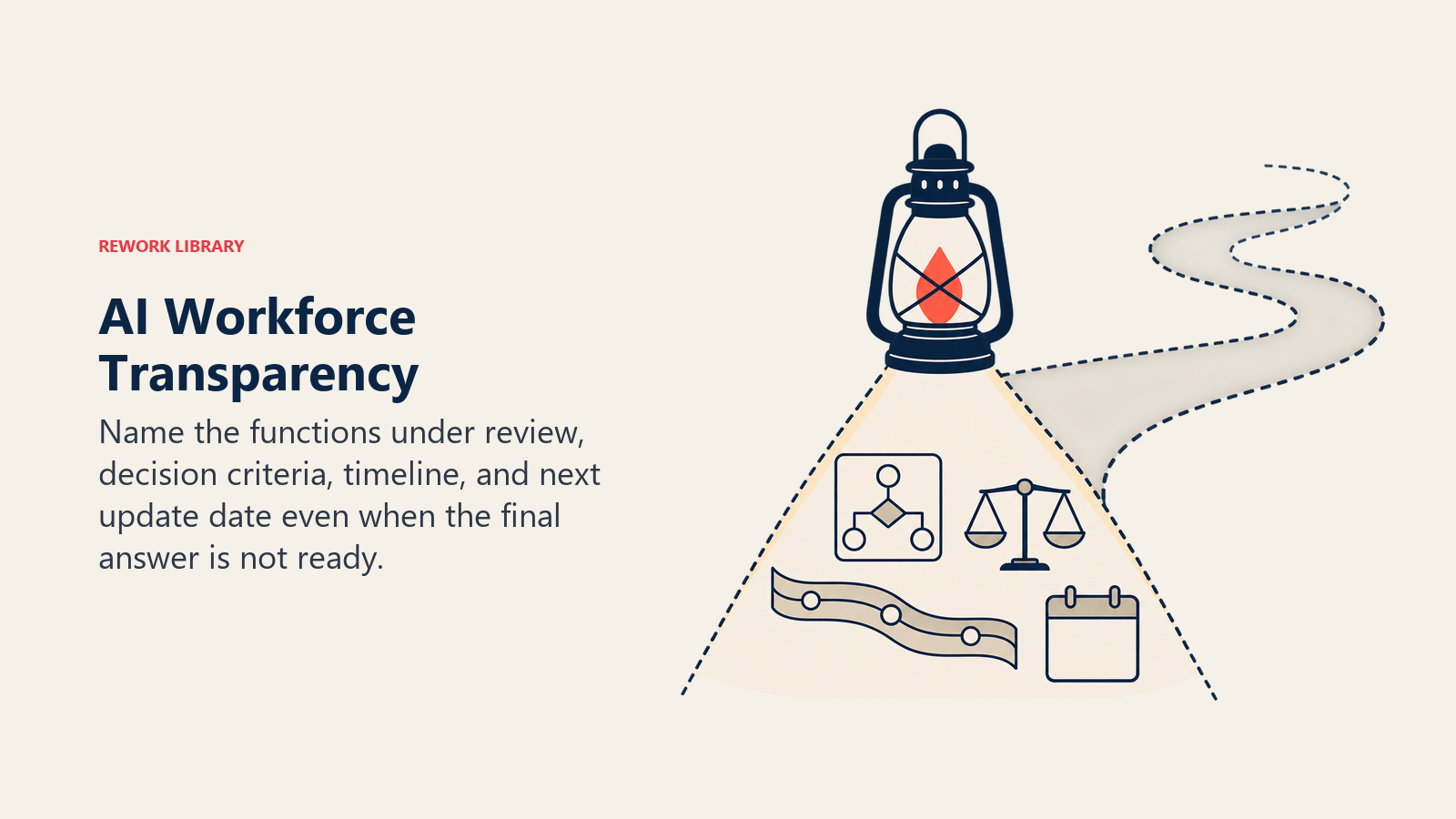
Transparency does not mean naming individual roles before a decision is made; that would float anxiety over jobs that might survive. It means naming the functions under review, the timeline for a decision, the criteria driving it, and a fixed date by which people hear something concrete, even if that something is "we don't know yet, here is when we will." Org design and delayering shows how slowly structural change actually moves in most organizations, which counters the assumption that every AI headline means sweeping restructuring is one announcement away.
Redeployment as Obligation, Not Nicety
The clearest test of whether a company's new deal is honest is what happens to the person whose role is eliminated. Severance and a generic outplacement referral is the default. A named, resourced redeployment path is the exception, and the data on how rarely companies even attempt it is more damning than any anecdote.
The Redeployment Gap
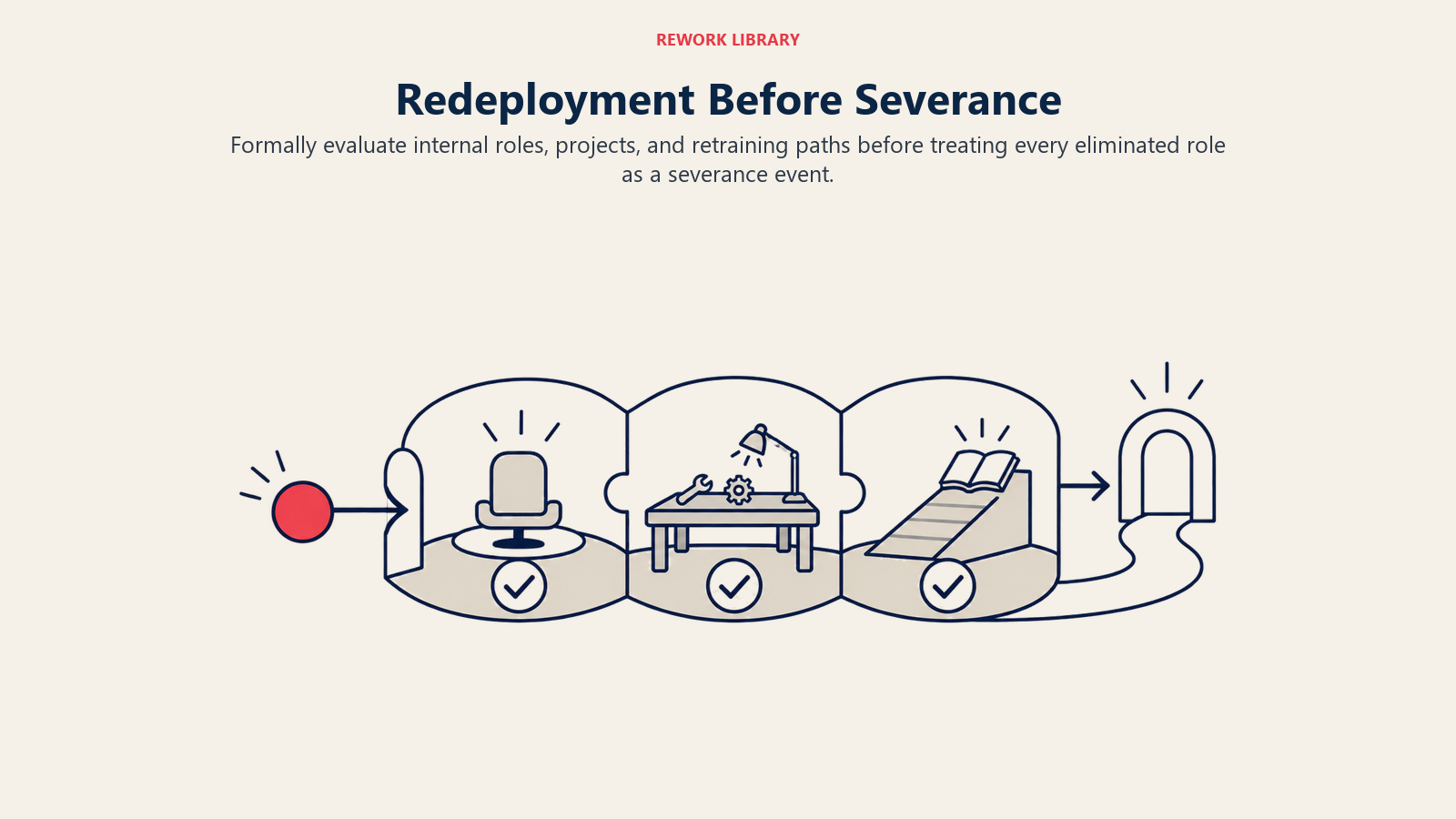
A study of 600 HR professionals on the true cost of AI-driven layoffs found 32.9% of organizations lost critical skills and institutional knowledge as a direct result of cutting roles during AI-driven restructuring. More than half of the same HR leaders estimated up to a quarter of the eliminated roles could have transitioned into a different position with the right support, and another 28.3% put that figure between a quarter and half. The reason so few transitions happened is not mysterious: 55.1% of the organizations admitted retraining or redeployment was never formally evaluated in the first place. It was not tried and found too hard. It was not considered.
That gap between what was possible and what was attempted is the difference between redeployment as a genuine obligation and redeployment as a talking point. Schneider Electric's internal Open Talent Market matches employees to open roles, projects, and mentorships across the company, built on the finding that nearly half of departing employees cited a lack of visible internal opportunity, not a lack of ability, as their reason for leaving. Unilever redeployed thousands of employees across slowed and growing parts of the business during a prior disruption using a similar internal marketplace. Neither example erases the fact that layoffs still happen at both companies. What they show is that redeployment infrastructure is buildable before it is needed, which is precisely the option most of that 55.1% never got to test. Skills half-life and continuous reskilling covers the mechanics of building that kind of pathway, and reskilling programs that actually work covers what separates a program people finish from one that only looks good in a board deck; a company that never builds it has already chosen, quietly and months in advance, to treat every future role elimination as a severance event rather than a transition.
What Employees Are Owed When a Role Changes
Strip away the messaging and the obligation is specific enough to write down, which is exactly why so few companies write it down. Advance notice, even partial, beats none, because it gives a person time to plan rather than react. An honest account of what changed and why, delivered by someone with real authority rather than routed entirely through a memo, respects the basic fact that a livelihood is not a line item. The middle manager in the age of AI is usually the person actually asked to deliver that account, often without the authority or information to make it credible, which is its own failure of the new deal. A genuine, documented attempt at redeployment before severance is the difference between an obligation taken seriously and one performed for the town hall. And for the people who stay, some accounting of how their own role's expectations are shifting matters too: a role that survives a reorganization with quietly doubled output and no adjustment in support is its own broken promise, just a slower one. What used to count as a predictable career path now needs to be restated honestly rather than assumed.
None of this is a generous reading of labor law. It is a well-documented finding in organizational psychology: research on procedural justice in layoffs, running back through Columbia Business School's Joel Brockner and continuing through more recent studies, finds that how a decision is explained and implemented shapes people's reactions to it nearly as much as the decision's substance does. Employees who received a clear, honest account of why a layoff happened showed measurably better outcomes than those who experienced the same layoff delivered abruptly and without explanation. Culture and change management covers the broader mechanics of carrying a workforce through disruption; procedural justice is the specific, measurable reason it works.
Honesty About Genuine Uncertainty
The hardest thing this new deal asks of leaders is not a communications skill. It is admitting, in public, that they do not fully know where this goes.
That admission is uncomfortable because leadership is conventionally supposed to project confidence, and because most executives genuinely believed a year or two ago that they had a clearer read on AI's trajectory than events have since supported. Anthropic's own CEO publicly walked back an earlier claim that AI could eliminate half of entry-level white-collar jobs. Ford deployed AI-driven quality inspection at scale, then rehired 350 experienced engineers after the automated systems missed defects that trained specialists caught, a reversal Ford's leadership attributed directly to underestimating how much judgment had left with those engineers. Klarna's CEO told reporters plainly that cost had dominated a decision that should have weighed quality more heavily, and said the fix was investing further in human support, not less. None of these are stories about AI failing. They are stories about named leaders admitting a specific plan did not survive contact with reality, without pretending otherwise.
That is the standard the new deal actually requires. An employee can tell the difference between "we don't know exactly how this changes your role over the next year, and here is what we are watching" and confident silence that turns out, eighteen months later, to have been confident guessing. Only one of those builds a durable working relationship.
The Old Deal, What AI Changed, and What an Honest New Deal Says
The shift is not from stability to chaos. It is from implicit promises to explicit commitments about skills, notice, and redeployment when work changes.
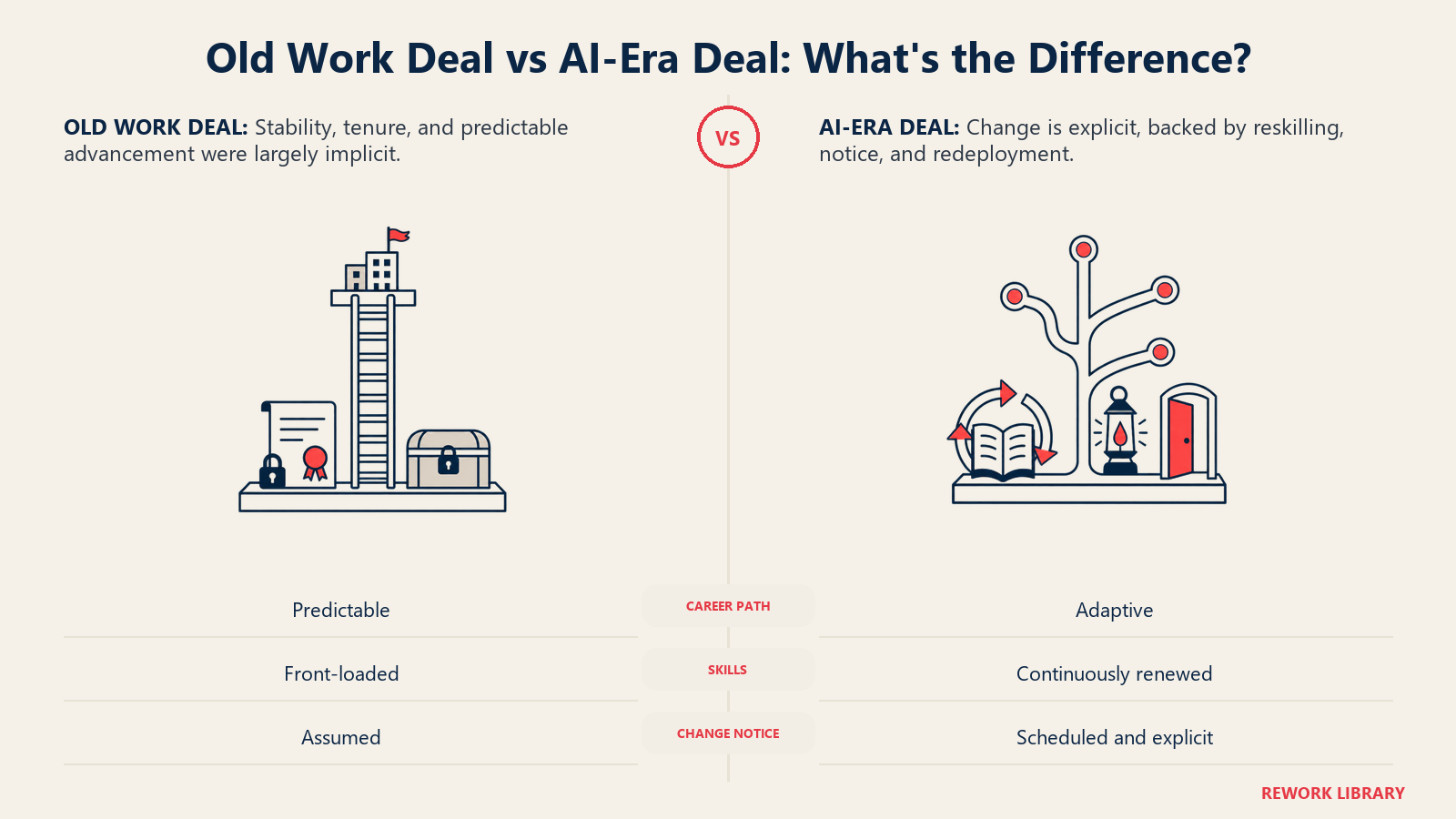
| The old implicit deal | What AI changed | What an honest new deal actually says |
|---|---|---|
| Loyalty and tenure earn predictable advancement | Advancement paths shift faster than tenure can track them | "Your path may change more than once. We will tell you when it does and why." |
| Skills learned early carry a career for decades | Skills half-life is shrinking, especially at entry level | "We will invest in reskilling you, with a real budget and timeline behind that promise." |
| A role, once assigned, is stable barring poor performance | A role can be redesigned or eliminated for reasons unrelated to performance | "If your role changes, we owe you a real redeployment attempt before severance." |
| Bad news arrives with advance warning through official channels | Reorganizations can be modeled and executed faster than communication cycles used to require | "We will tell you what we know, what we don't know yet, and when we expect to know more." |
| Leadership projects certainty about where the company is headed | Leaders often have less genuine certainty about AI's trajectory than at any recent point | "We haven't fully figured this out either, and pretending otherwise would cost more trust than admitting it." |
What a Few Companies Have Actually Done
The honest news is that credible handling exists, in specific, named, checkable examples, not just training decks.
IBM cut jobs while pushing into AI, then reversed the broader industry narrative by tripling its entry-level hiring, its chief human resources officer stating plainly that the roles were being restructured around AI fluency rather than eliminated, and warning that cutting the leadership pipeline would cost more than it saved. Ford's leadership named its own mistake directly: automated inspection missed defects departed engineers used to catch, and the fix was rehiring that expertise, not more tooling. Klarna's CEO did the same in public, saying the company had over-weighted cost against quality and was correcting toward a hybrid model that keeps a human reachable by design. Leadership's role in shaping culture covers why this kind of visible correction matters beyond the decision itself: it signals what the organization actually rewards when something goes wrong.
None of these three is a story where nothing went wrong. Each is a story where the response was to say so plainly and correct course in public rather than bury it in a quarterly filing, a lower bar than perfect foresight, and exactly the bar most companies are currently failing to clear.
Closing the Collection
Twenty-eight articles back, this collection opened by insisting on evidence over prophecy: what is measurably happening to tasks, skills, structure, and output, not what a keynote predicts. That discipline holds through to this last question, maybe more than anywhere else, because the social contract is where prophecy does the most damage. A leader who tells a workforce "you will be fine" without evidence is not reassuring anyone. They are making a promise they cannot back, in the one domain where broken promises compound fastest.
What the evidence actually supports is narrower and more workable than either the doom or the reassurance being sold elsewhere. Trust in "my employer" remains real and largely intact, which means it has not already been spent, only strained. Redeployment is buildable in advance rather than improvised under pressure, and the companies that build it are the ones later citing it as a genuine strength. Uncertainty admitted early costs less credibility than confidence proven wrong later. None of that requires solving AI. It requires an employer treating its own workforce the way it would want to be treated by whatever comes for its industry next, which is the actual, durable definition of a social contract: not a document either side signed, but a pattern of behavior each side can predict from the other, under exactly the kind of pressure this collection has spent its length describing.
Key Facts
- Edelman Trust Barometer 2026: 78% of respondents trust their employer to do the right thing, the highest score of any institution measured, yet only 44% say business leaders are effectively bridging the divides that 75% say leaders are obligated to bridge, a 29-point gap. Source: Ragan Communications, "By the Numbers: Edelman Trust Barometer 2026"
- Pew Research Center: 52% of U.S. workers feel worried about future AI use in their workplace versus 36% who feel hopeful, and 32% think AI will mean fewer job opportunities for them personally in the long run. Source: Pew Research Center, "Workers' views of AI use in the workplace"
- MIT Project NANDA, "State of AI in Business 2025": roughly 95% of generative AI pilots show no measurable profit-and-loss impact. Source: Fortune
- ResumeGenius survey of 1,000 laid-off U.S. workers (July 2026): 22% were told automation replaced their role directly, 31% suspected AI involvement despite another stated reason, and 86% said the layoff changed how they view job security and employer loyalty; half felt their employer acted unfairly. Source: ResumeGenius, "AI Layoffs Report"
- Resume.org survey of 1,000 hiring managers (January 2026): 59% admit they emphasize AI as the reason for layoffs because it "plays better with stakeholders" than financial constraints, even though only 9% say AI has fully replaced any role. Source: NJBIA, "Survey Finds 6 in 10 Companies Make AI the Scapegoat for Layoffs"
- Careerminds "Cost of AI Layoffs" study, 600 HR professionals (February 2026): 32.9% of organizations lost critical skills after AI-driven layoffs, and 55.1% never formally evaluated redeployment as an alternative before cutting the role. Source: People Matters
- Joel Brockner (Columbia Business School), "Managing the Effects of Layoffs on Survivors": procedural justice, how clearly and honestly a decision is explained, shapes employee reactions to organizational change as much as the decision's substance does. Source: Sage Journals

Co-Founder, Rework.com
On this page
- What the Old Deal Actually Was
- The Trust Cost of "Augment, Not Replace"
- What Broke the Promise
- What the Trust Data Shows
- Transparency About Where AI Is Actually Heading
- Redeployment as Obligation, Not Nicety
- The Redeployment Gap
- What Employees Are Owed When a Role Changes
- Honesty About Genuine Uncertainty
- The Old Deal, What AI Changed, and What an Honest New Deal Says
- What a Few Companies Have Actually Done
- Closing the Collection
- Key Facts