Which Jobs AI Changes Rather Than Replaces
Turn this article into takeaways for your work.


Each assistant summarizes the article only for you and suggests best practices for your work.
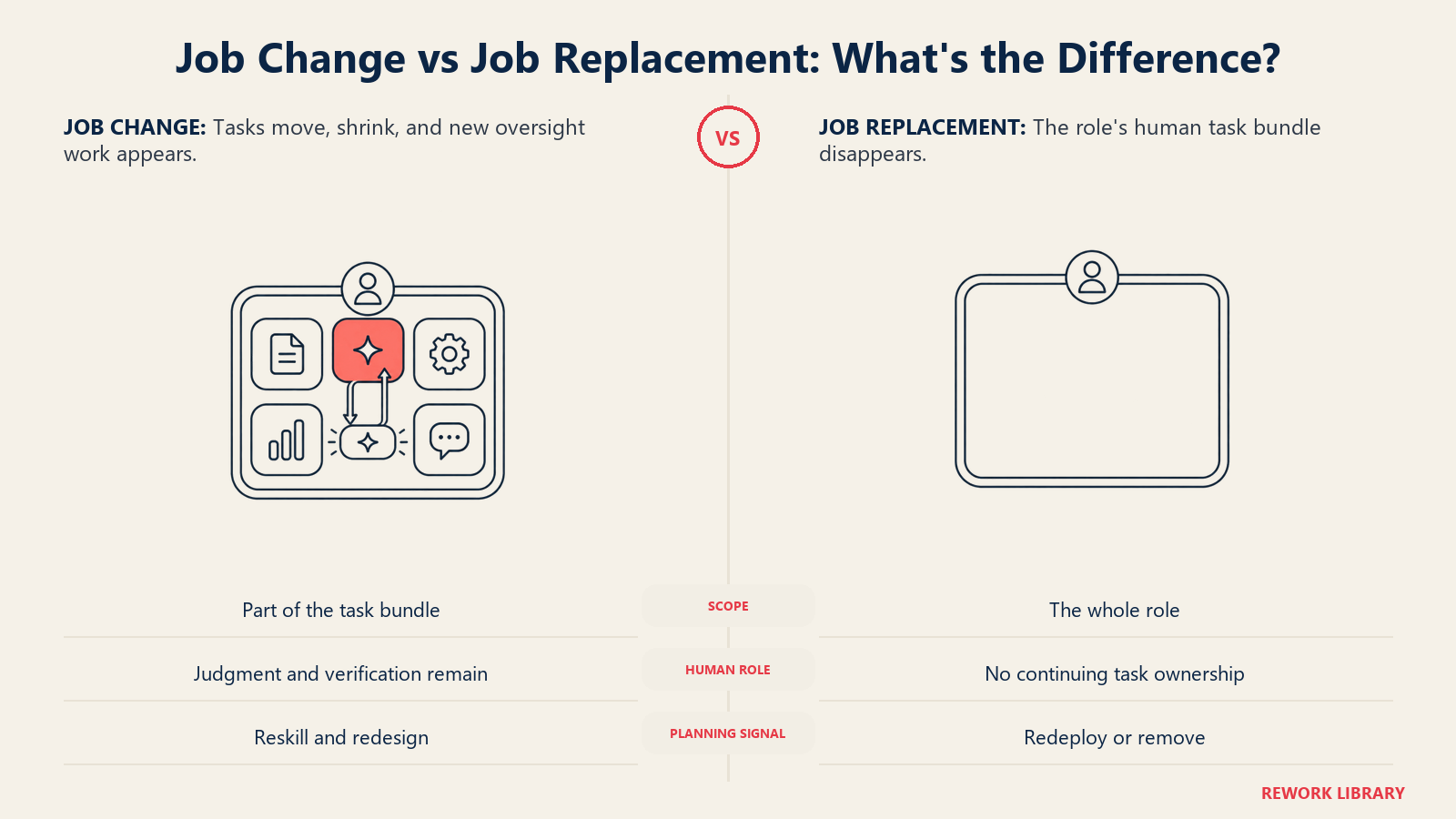
AI does not replace jobs. It replaces tasks inside jobs, leaves others alone, and adds a few new ones, like checking its own work, that didn't exist before. A role changes shape once enough tasks move, but the job itself rarely vanishes in one piece. That distinction, task versus job, is the difference between planning well and reading a scary headline.
Every "X% of jobs will be automated" number you've seen since 2013 measures something different from what most people assume. Some count occupations, some count tasks, some count theoretical exposure, and some count what workers actually do with AI today. None answers what a leader needs: what happens to this org chart in eighteen months. This article names the forecasts and their authors so you can judge them yourself, and lays out what actually happens when a third of a role's tasks shift. For the broader controlled-study evidence behind AI and work generally, not just the jobs forecasts, see how AI is changing work and what the evidence shows.
Why "Will AI Take My Job" Is the Wrong Question
A job title is a bundle. "Financial analyst" bundles data pulls, model building, and presenting a number to a nervous VP. "Customer service rep" bundles reading an angry email, looking up an order, deciding whether to bend a policy, and writing a reply that doesn't sound like a form letter. No two tasks have the same relationship to AI. Some are pattern-matching a model handles well today. Some require weighing a customer's history against a policy nobody wrote down, a judgment call, not a lookup.
Treating "financial analyst" as one indivisible unit and asking whether AI will "take" it produces a yes-or-no answer to a question that was never yes-or-no. The honest question is which tasks move, which stay, and what gets added once the moved ones are gone. That's the frame labor economists have used for two decades, and it's the one this article uses throughout, because it predicts what happens next.
The Task, Not the Job, Is the Unit That Matters
MIT economist David Autor built the modeling framework most labor economists still use for this, in a 2013 paper called "The Task Approach to Labor Markets". His core claim: technology doesn't compete with occupations, it competes with tasks inside them. A computer or a model substitutes for tasks that follow explicit, codifiable rules (what Autor calls routine tasks) and complements workers on tasks that require flexible judgment or communication that depends on context a rule can't capture.
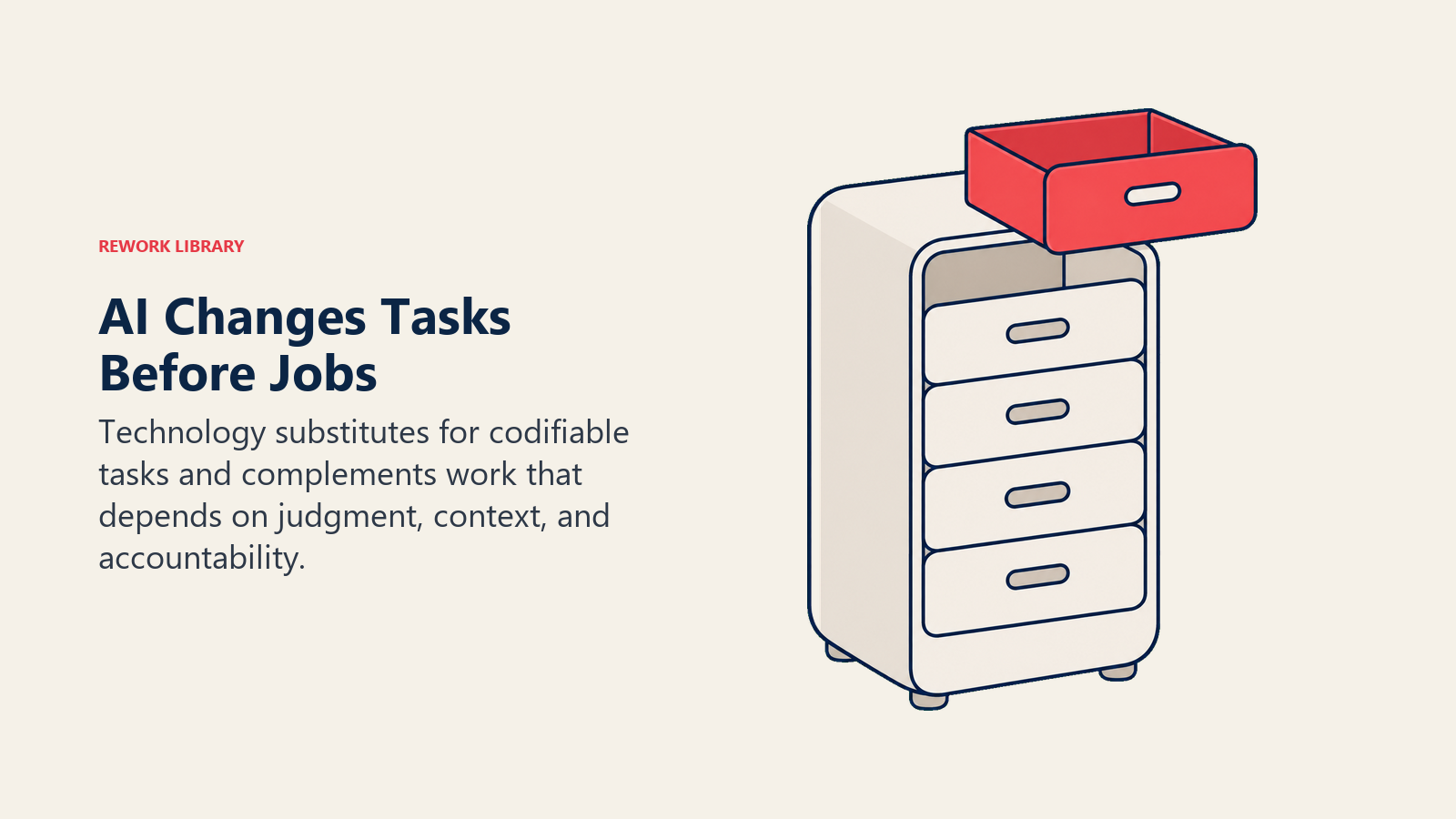
That framework explains something the "47% of jobs at risk" headlines never could: why bank tellers didn't disappear when ATMs arrived, and why paralegals didn't disappear when document-review software got good. The technology absorbed a routine slice of the job and left the tasks that required judgment, relationship, or accountability for a human to still do. The job's task mix changed. The job title mostly didn't.
Autor's more recent 2024 paper, "Applying AI to Rebuild Middle Class Jobs", adds a second piece: automation has a displacement effect, where technology takes over tasks a human used to do, and a reinstatement effect, where it creates new tasks only a human, or a human overseeing a machine, can do. Past automation waves reinstated about as many tasks as they displaced, though rarely for the same workers or timeline, which is why the transition feels disruptive even when the long-run employment count holds up. Autor's argument for AI is more optimistic still: because it can encode a slice of expert judgment and hand it to less credentialed workers, it could expand who gets to do higher-stakes decision-making, not just automate it away. That's a stated potential, not a settled outcome.
Which Task Types Are Actually Exposed
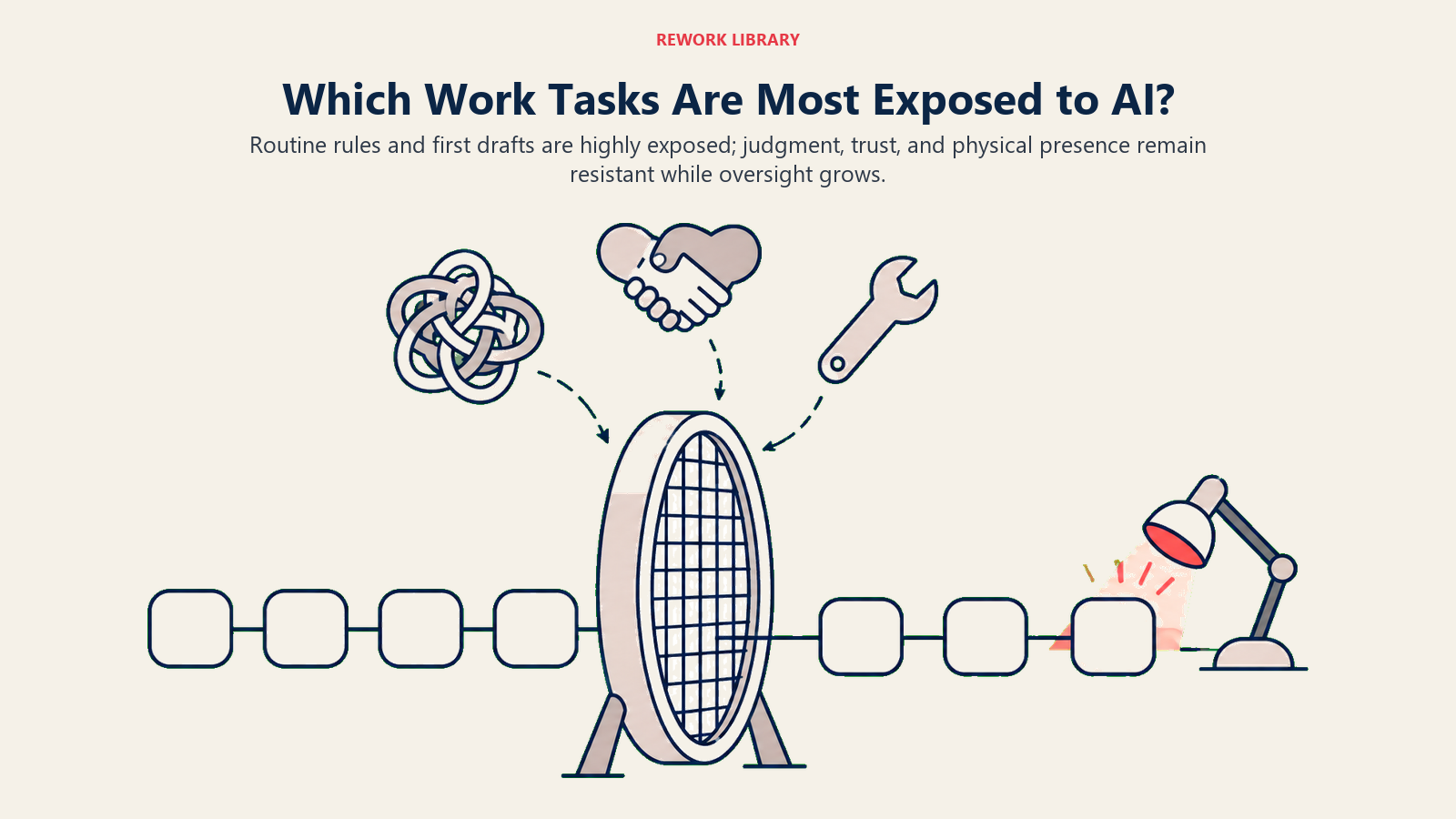
Not every task in a role has the same relationship to AI capability. Grouping tasks by type, rather than by job title, is what makes a forecast useful instead of vague.
Routine, rule-based tasks: highly exposed
Tasks with a clear input, a clear output, and a rule connecting them are the most exposed category, and have been since long before generative AI. Data entry, standard-format document review, scheduling, and templated report generation fall here. AI (and RPA before it) doesn't need to understand the work, it just needs the rule to be explicit and the exceptions to be rare.
Information synthesis and first drafts: highly exposed, but augmented more than eliminated
Summarizing a document, drafting an email, or pulling together research from multiple sources is squarely what current generative AI does well. The task doesn't disappear from the job. It shrinks from "spend two hours writing" to "spend fifteen minutes editing," which changes the skill the role requires, from producing to judging, without removing the role.
Judgment calls under ambiguity: resistant
Deciding whether to make a policy exception, weighing conflicting priorities with incomplete information, or making a call that carries accountability if it goes wrong stays resistant, not because a model can't produce an answer, but because someone has to own the consequences of a wrong one. This is where human-in-the-loop design earns its name: the model proposes, a person decides and owns it.
Physical presence, relationships, and high-stakes trust: resistant
Tasks that require being physically present, building a relationship over time, or being the person a client trusts with something they wouldn't tell a chatbot stay resistant for a different reason: the value comes partly from who is doing it, not just what gets produced. A negotiation, a hard performance conversation, or in-person care work sits here. The human premium covers why some companies staff these specific touchpoints with a person on purpose, as a strategy rather than a cost decision.
New tasks AI creates: verification, orchestration, exception handling
This is the category most job-loss forecasts miss, because it didn't exist when they were written. As AI takes on more routine and drafting work, someone has to verify its output, decide which tool or agent should handle a given request, and catch the cases where the model confidently produces something wrong. These are new tasks, not shrunken old ones, and they tend to land on the same people whose routine tasks just got automated, part of why "the job disappeared" rarely matches what actually happened.
| Task type | Exposure to AI | What replaces or augments it |
|---|---|---|
| Routine, rule-based (data entry, scheduling, templated reports) | High | Full automation; task usually disappears from the human's day |
| Information synthesis, first drafts, summarization | High | AI drafts, human edits and approves; task shrinks, doesn't vanish |
| Judgment calls under ambiguity, policy exceptions | Low | AI proposes options; a person still decides and is accountable |
| Physical presence, relationship-building, high-trust conversations | Low | Largely untouched; value is partly who is doing it |
| Verification, orchestration, exception handling | New category | Did not exist as a distinct task before AI; grows as automation grows |
What Happens to a Job When 30% of Its Tasks Shift
Picture a support team where a third of ticket volume used to be simple, repeatable questions: password resets, order status, standard refunds. AI now handles that slice end to end, either fully automated or with a human approving a suggested reply in seconds. Nobody on the team lost their job that day. What changed is the composition of what's left.
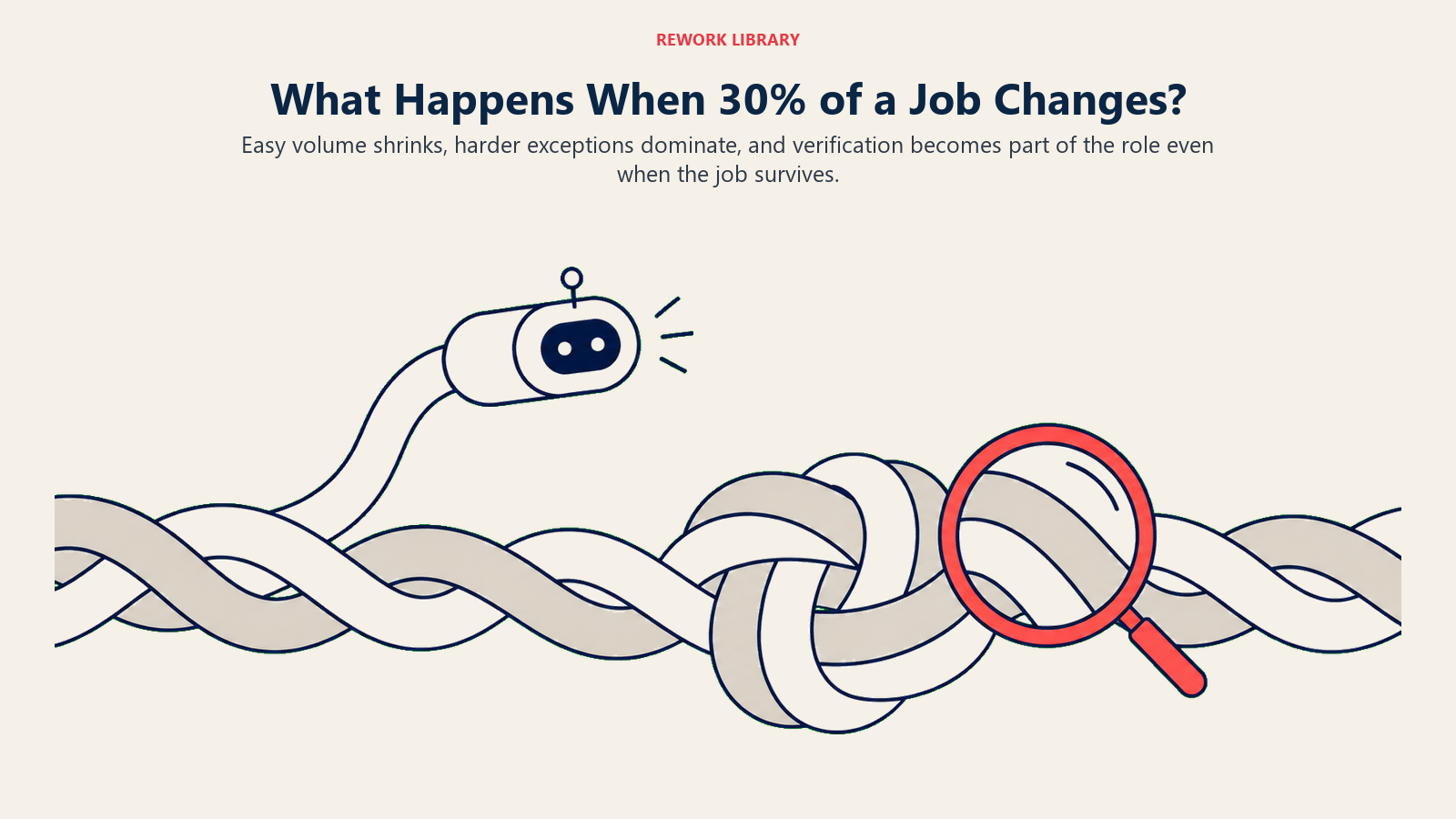
The remaining two-thirds skews harder: ambiguous cases, angry customers, exceptions that don't fit the script. A rep who used to spend most of a shift on easy tickets now spends most of it on hard ones, plus a new task that didn't exist a year ago: spot-checking AI auto-replies for tone or fact errors. The role still exists. The skill it rewards shifted from "handle volume quickly" to "handle ambiguity and catch the AI's mistakes," a different hiring profile and often a smaller headcount, even though no single person's job was eliminated outright.
That's the pattern worth planning around, not the binary "will this job exist in five years." A role can survive the transition and still need fewer people and different skills than the job description on file. Asking "which tasks are shifting, and what does the remaining bundle require" gets the right answer months before "which jobs get automated" would.
Key Facts
- Technology substitutes for routine, codifiable tasks and complements workers on tasks requiring judgment or unstructured problem-solving; automation historically both displaces and reinstates tasks over time. Source: Autor, "The Task Approach to Labor Markets" (NBER, 2013)
- AI's distinct opportunity, per Autor, is extending expert-level decision-making to more workers, not just automating tasks away, though this is a stated potential, not yet a measured outcome at scale. Source: Autor, "Applying AI to Rebuild Middle Class Jobs" (NBER, 2024)
- Frey and Osborne's widely cited 2013 estimate that 47% of US employment was at high risk of computerization was an occupation-level judgment call, not a task-level measurement, and couldn't represent an occupation changing rather than disappearing whole. Source: Frey and Osborne, "The Future of Employment" (Oxford Martin School, 2013)
- Using a task-based method instead, the OECD found only about 9% of jobs across 21 countries at high automation risk, roughly a fifth of the Frey and Osborne figure. Source: Arntz, Gregory, and Zierahn, "The Risk of Automation for Jobs in OECD Countries" (OECD, 2016)
- Nearly a decade after the 47% figure was published, US employment in the occupations it flagged as highest-risk had not collapsed the way the forecast implied. Source: ITIF, "Oops: The Predicted 47 Percent of Job Loss From AI Didn't Happen" (2022)
- In 2025, 47% of work tasks are performed mainly by humans, 22% mainly by technology, and 30% by a combination, a split WEF expects to move closer to even by 2030. Source: World Economic Forum, Future of Jobs Report 2025
- The same WEF report projects 170 million new jobs created and 92 million displaced globally by 2030, a net gain of 78 million, alongside nearly 40% of core job skills changing. Source: World Economic Forum press release, January 2025
- BLS now assigns every detailed occupation a low, moderate, high, or "very high" AI exposure rating, but explicitly does not distinguish whether that exposure means a task gets automated or augmented. Source: BLS, "Artificial Intelligence (AI) Exposure Categories"
The Forecasts, Named and Checked
Every big automation number in a boardroom deck has an author, a method, and a stated limitation, and none of the three usually make the slide. Naming them tells a useful forecast from a scary one.
Frey and Osborne's 47% (2013): what it actually measured
Frey and Osborne, both at Oxford, hand-labeled 70 occupations as automatable or not by expert judgment, then trained a machine-learning model to extend those labels across the full O*NET database. The output was one risk score per occupation, not per task, so it couldn't represent an occupation where some tasks were automatable and others weren't, which describes most occupations. Critics also noted it classified occupations like fashion models and school bus drivers as high-risk in ways that don't match how those jobs are structured. The 47% figure is a genuine, peer-reviewed estimate of computerization potential under specific modeling choices. It was never a prediction that 47% of workers would be unemployed within twenty years, and task-based methods, not this one, are current best practice now.
The OECD's task-based correction
When Arntz, Gregory, and Zierahn re-ran a similar question using task composition instead of whole-occupation labels, the OECD-wide estimate dropped to about 9%, ranging from 6% in Korea to 12% in Austria. Same broad question, radically different answer, because the unit of analysis changed from "job" to "job's actual task mix." That tenfold gap is the best argument for reading past the headline number to the method underneath it.
What the intervening decade actually showed
By 2022, the Information Technology and Innovation Foundation looked at what had happened to the occupations Frey and Osborne flagged as highest-risk. Mass job loss on that scale hadn't materialized. That doesn't mean automation had no effect, it means the effect showed up as task and skill shifts inside surviving occupations, exactly what the task-based framework predicts and the occupation-based one can't see.
WEF's Future of Jobs 2025: the current best-documented split
WEF surveyed over 1,000 employers representing 14 million workers across 55 economies for its 2025 report, the most current data on how work actually splits between human and machine execution. Its 2025 baseline, 47% human-only, 22% technology-only, 30% combined, is itself evidence for the task-level view: most work isn't cleanly "automated" or "not," it's split within roles.
BLS AI exposure categories: useful, but read the fine print
BLS's newest exposure ratings are the most granular US government data available, but BLS is explicit that "exposure" measures whether AI can touch a large share of an occupation's tasks, not whether it will replace the job or just make people faster at the same work. A "very high exposure" rating for personal financial advisors fits the augmentation pattern here: the advisor still exists, the task mix changes.
How to Read the Next Forecast You Put in Front of Your Leadership Team
Before a job-loss or job-creation number goes into a board deck, ask three questions. What's the unit of analysis, an occupation or a task? Occupation-level numbers overstate both risk and safety, because they can't see partial change inside a role. What's the method: expert judgment, a model extrapolating expert judgment, or observed usage data? Observed usage, increasingly available from AI vendors and BLS's newer exposure work, is closest to ground truth. And does the forecast state its own limitations, the way Autor, WEF, and BLS all do? One with none is one you haven't found the limitations of yet.
What This Means for the Roles You're Actually Deciding About
None of this argues AI's labor effects are small or distant. WEF's own numbers project nearly 40% of core skills changing by 2030, real disruption by any measure. The argument is narrower: plan against the task mix inside your roles, not the job title on the org chart. Audit which tasks are routine and codifiable, which require judgment or trust that can't yet be delegated, and which new verification or orchestration tasks are quietly appearing. That audit tells you where to hire, reskill, and shrink headcount, even when no single role technically "disappeared," months before a job-title forecast would tell you anything useful.
The task-level view also explains why the human side needs deliberate attention, not just a spreadsheet. When a role's task mix shifts, so does what "doing a good job" looks like and how much a person trusts a model they're now checking, questions covered in what AI-native culture actually looks like and how human-agent teams reset trust.
A few risks worth naming. Verification and orchestration don't show up automatically just because a company deployed AI agents or copilots; someone has to own catching a model's mistake, or the company finds the gap through a wrong output that went out under someone's name, the failure this library calls workslop. It's also worth telling a genuine capability shift apart from marketing dressed up as one, a pattern covered in what agent washing is. And because task-mix shifts accumulate like technical debt, invisible until the bill comes due, treating this as a one-time review instead of an ongoing audit is its own risk, one a basic AI governance process is built to catch.
The job title on the org chart is the least useful place to look for what AI is doing to your workforce. The task list underneath it is where the real change happens, one task at a time, in both directions.
The next time someone tells you a job is safe or doomed, ask them which tasks they mean.

Co-Founder, Rework.com
On this page
- Why "Will AI Take My Job" Is the Wrong Question
- The Task, Not the Job, Is the Unit That Matters
- Which Task Types Are Actually Exposed
- Routine, rule-based tasks: highly exposed
- Information synthesis and first drafts: highly exposed, but augmented more than eliminated
- Judgment calls under ambiguity: resistant
- Physical presence, relationships, and high-stakes trust: resistant
- New tasks AI creates: verification, orchestration, exception handling
- What Happens to a Job When 30% of Its Tasks Shift
- Key Facts
- The Forecasts, Named and Checked
- Frey and Osborne's 47% (2013): what it actually measured
- The OECD's task-based correction
- What the intervening decade actually showed
- WEF's Future of Jobs 2025: the current best-documented split
- BLS AI exposure categories: useful, but read the fine print
- How to Read the Next Forecast You Put in Front of Your Leadership Team
- What This Means for the Roles You're Actually Deciding About