AI Workforce Strategy for Executives: A Task-First Planning Method for Headcount, Hiring, and Redeployment
Turn this article into takeaways for your work.


Each assistant summarizes the article only for you and suggests best practices for your work.
An AI workforce strategy is a plan for how tasks, not job titles, get reallocated between people and AI over time, and what that means for hiring, redeployment, and headcount. Done well, it starts by mapping which tasks AI can absorb, which still need human judgment, and which capabilities the company will need in 18 months that it doesn't have today. Done poorly, it starts with a headcount number a CFO wants and works backward, which is a budget exercise wearing a strategy costume.
Most executives already sense the difference. The pressure is real: boards ask what the AI plan is for the workforce, and "we are experimenting" is no longer an acceptable answer. But the honest starting point is that a large share of what gets called AI workforce strategy in 2026 is a smaller number on a spreadsheet, justified after the fact with AI language. This is a method for building the version that isn't that, one piece of the broader question of what the future of work actually looks like for the people running it.
Key Facts
- Replacing an employee typically costs 50 to 200 percent of annual salary, depending on seniority, once recruiting, ramp time, and lost productivity are counted (SHRM, "The Myth of Replaceability").
- The US hires rate sat at 3.2 percent and the quits rate at 1.9 percent in the July 2026 JOLTS release, both near multi-year lows: employees are staying put while employers hire cautiously (BLS, Job Openings and Labor Turnover Survey).
- AI was the stated reason behind 54,836 announced layoffs in 2025, about 4.5 percent of the roughly 1.2 million total job cuts tracked that year, far behind market conditions and store or unit closings (Challenger, Gray & Christmas, 2025 Year-End Report).
- 88 percent of organizations report using AI somewhere in the business, but only 39 percent attribute any EBIT impact to it, and high performers are roughly three times more likely to have redesigned the workflow rather than bolting a tool onto an unchanged one (McKinsey, The State of AI: Global Survey 2025).
- Employment among workers aged 22 to 25 in highly AI-exposed occupations sits about 19 percent below where it would be had it tracked less-exposed peers, a gap widened from 15 percent a year earlier (Stanford Digital Economy Lab, "Canaries in the Coal Mine").
Start From Tasks, Not Headcount Targets
The single most common planning error is skipping straight to a number. "Cut 10 percent," "flatten this layer," and "freeze this function" are headcount conclusions, and treating them as the starting point gets the sequence backward. A headcount number does not tell you which work still needs a person, which work needs a different kind of person, or which work AI can already do well enough to stop assigning to anyone.
Economist David Autor's task-based framework, developed well before generative AI existed, is the right lens here. Autor decomposes a job into the individual tasks that make it up rather than treating it as one indivisible unit, which makes it possible to ask a sharper question than "will this role survive AI." His more recent work on AI and expertise argues that AI's real opportunity is extending judgment and decision-making to more people, not just automating the tasks around the edges of a job. A role can lose 40 percent of its task volume to AI and still be worth the headcount, if the remaining 60 percent is the part that actually needed a trained person. See which jobs AI changes rather than replaces for the fuller version.
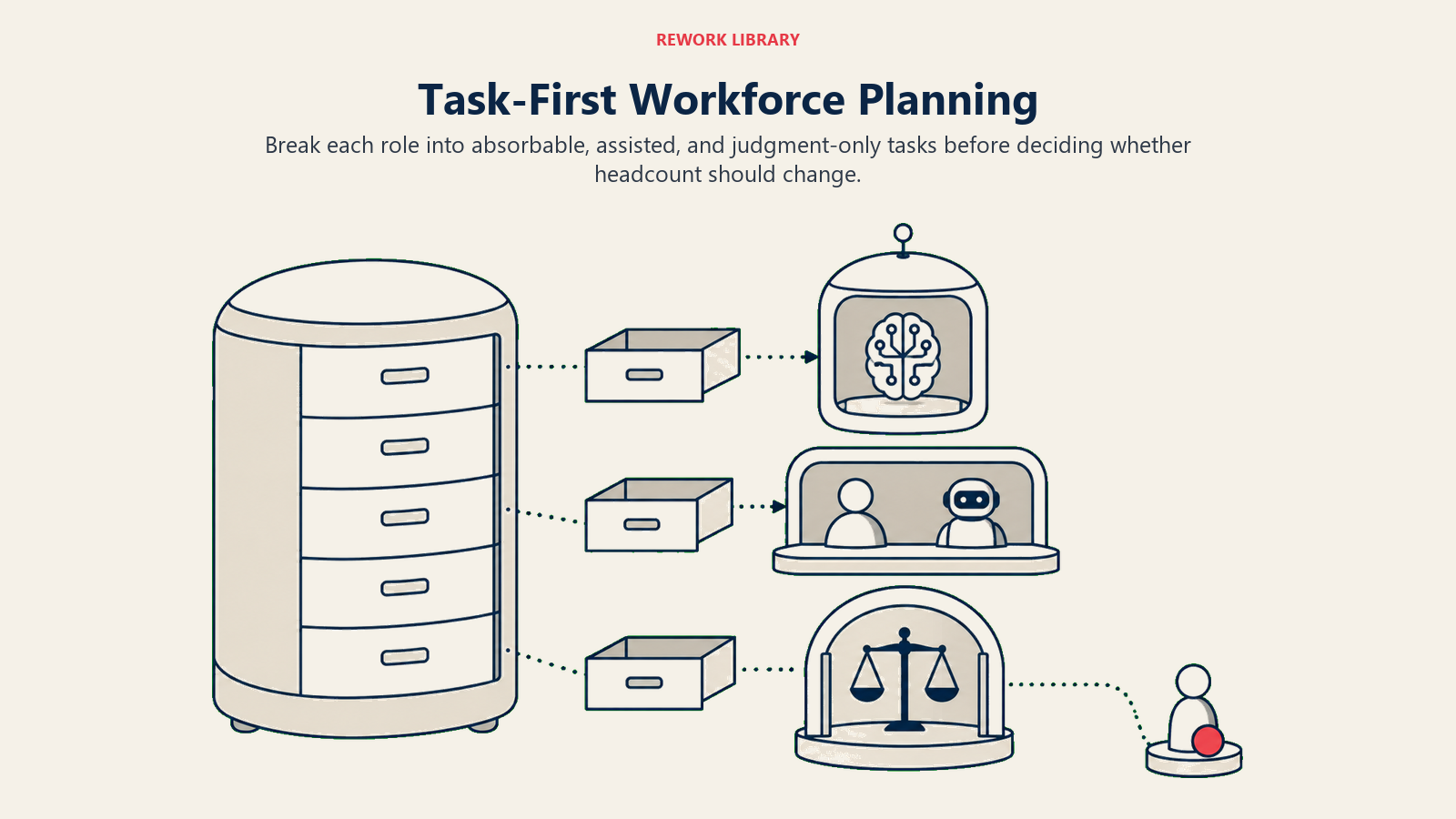
In practice, the first planning artifact should never be an org chart with names crossed off. It should be a task inventory: for every function under review, list the tasks people actually spend time on, tag each as AI-absorbable now, AI-assisted, or judgment-only, and only then look at what that leaves for humans to do. Skip this step and companies end up cutting a team by a fixed percentage, then discovering months later that the wrong tasks are now unowned.
Build the Capability Map Before the Cut List
A task inventory tells you what work looks like today. A capability map tells you what the organization needs to do 12 to 24 months out, the more useful question while AI capability itself keeps moving.
What a Capability Map Actually Contains
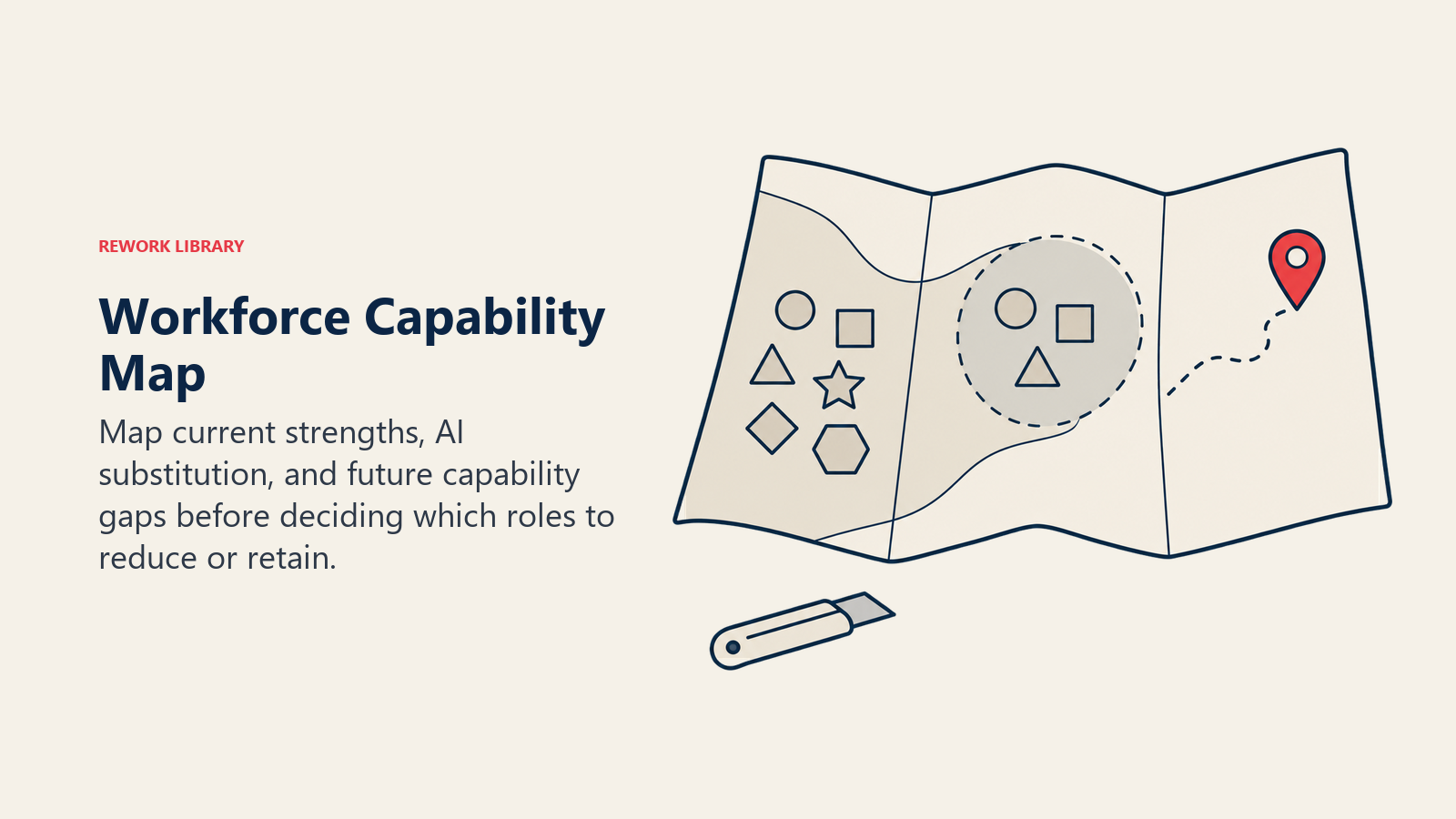
A useful capability map has three columns. First, the capabilities the business has today, mapped to the people who hold them, not the roles that nominally own them. Second, the capabilities AI can substitute for at an acceptable quality level now, a moving target needing a quarterly refresh. Third, the capabilities the business will need that neither current staff nor current AI tools cover, usually the most neglected column because it requires admitting a gap rather than defending a headcount line. This third column is where AI-complementary skills and continuous reskilling actually earn their place in a workforce plan.
The Sequencing Mistake: Cutting Before Mapping
The order matters more than most executives assume. A company that cuts headcount first and maps capability second is betting that whoever remains holds the skills the business needs, which is rarely true, because layoffs remove people by cost, tenure, or rating, not capability coverage. A gap discovered after the reduction is expensive twice: once in severance, again in the rehiring needed to close the gap the cut created. Mapping first costs a few weeks of analysis. Cutting first costs a second, pricier round of hiring for the capability that just walked out the door.
The Hiring Freeze Trap: How Attrition Quietly Removes the Wrong People
A hiring freeze looks like a conservative, low-risk move: no layoffs, no headlines, just a pause while the organization figures out its AI plan. In practice, a freeze combined with normal attrition is not neutral. It is a selection mechanism, and by default it selects for the wrong outcome.
Voluntary attrition is not random. Employees with the most external options, typically your strongest performers and most in-demand technical talent, are also the most likely to leave when internal mobility stalls under a freeze. Employees with fewer options tend to stay, regardless of performance. A freeze that runs for two or three quarters without anyone actively managing who leaves quietly reshapes the org chart around whoever chose to remain, not around who the business would have chosen to keep.
The current labor market makes this easy to miss. The US hires rate was 3.2 percent and the quits rate 1.9 percent in the July 2026 JOLTS release, both near multi-year lows in what economists have started calling a "job hugging" market, where employees who might otherwise leave are staying put out of caution (BLS JOLTS). Low overall quits can create false comfort: a leader watching aggregate attrition stay flat can miss that the attrition happening is concentrated among the people the company can least afford to lose.
The fix is not to abandon the freeze. It is to stop treating it as a passive default and start treating retention of specific capability holders as an active, named priority, with stay-plans for people in the capability-gap column of the map above, not just for people with a high title. This is also where transparency does real work: employees tolerate a freeze far better when they understand the reasoning behind it, which is a culture question as much as a workforce-planning one.
Redeployment Economics vs. Rehiring Cost
Once the capability map exists, the decision at every gap is a build-versus-buy question: redeploy someone internally, or let them go and hire externally later. The math almost always favors redeployment more than instinct suggests.
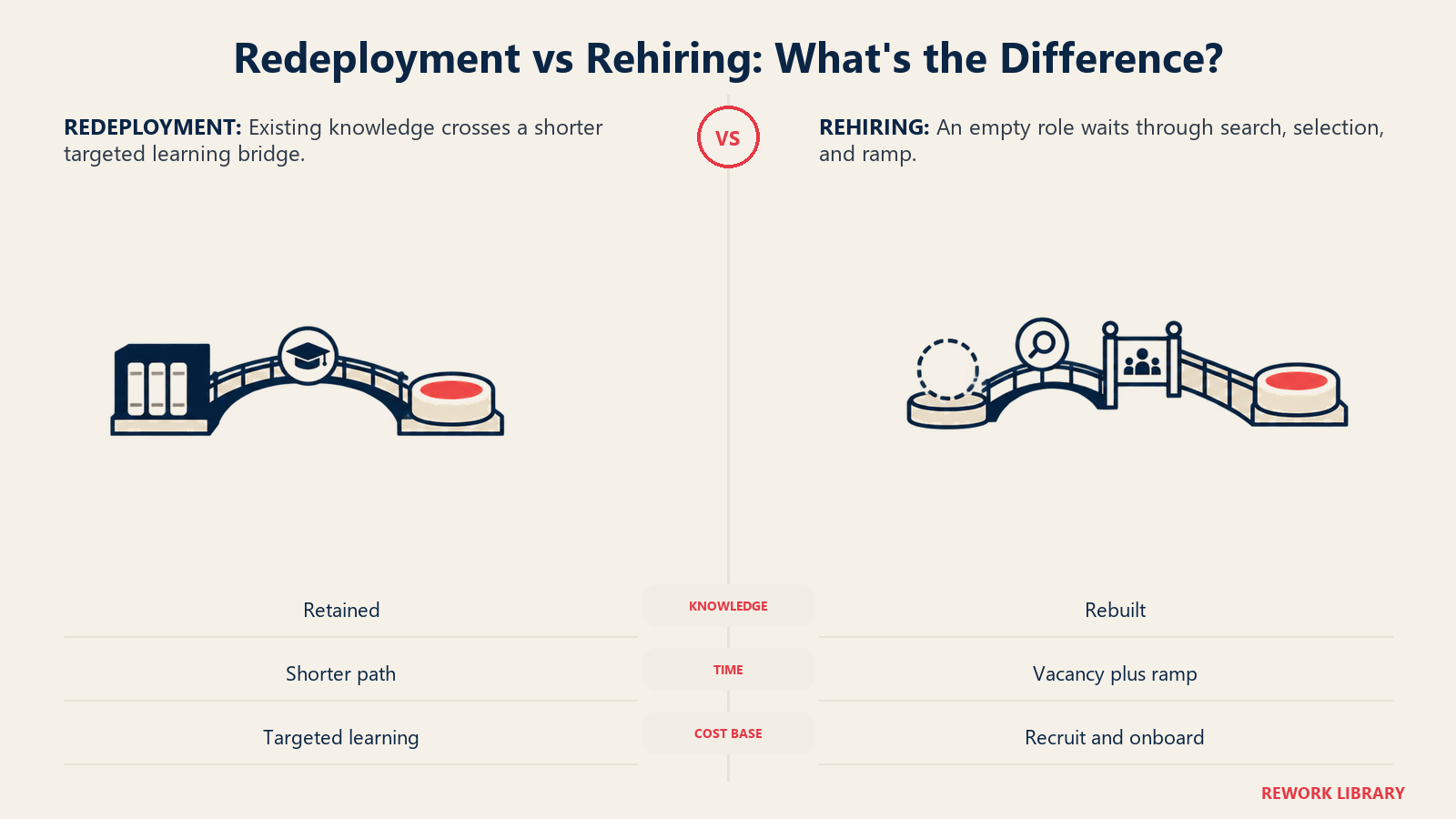
SHRM's guidance puts the fully loaded cost of replacing an employee at 50 to 200 percent of annual salary once recruiting, interviewing, onboarding, and ramp time are counted, with the higher end concentrated in specialized and leadership roles (SHRM, "The Myth of Replaceability"). Redeploying an existing employee into an adjacent capability rarely costs anywhere near that, because the person already carries institutional knowledge and a track record the hiring process cannot see on a resume. The retraining cost is real, but it is weeks of targeted learning against months of vacancy plus a six-figure replacement bill.
The table below lays out the sequence a workforce plan should follow, and the mistake most plans make at each step.
| Planning step | The question it answers | The common mistake |
|---|---|---|
| Task inventory | Which tasks in this function can AI absorb, assist, or not touch at all? | Assessing the job title instead of the actual task mix, so a role is judged obsolete when only part of it is |
| Capability map | What will the business need in 12 to 24 months that it does not have today? | Treating the map as a one-time exercise instead of a quarterly-refreshed view as AI capability shifts |
| Freeze management | Who is actually leaving during a hiring pause, and are they the people we can afford to lose? | Treating a freeze as passive and discovering the wrong people left only after the fact |
| Redeploy-or-rehire decision | Is it cheaper to retrain an existing employee or to let them go and hire the capability later? | Defaulting to rehire because redeployment feels slower, without pricing the 50 to 200 percent replacement cost |
| Scenario planning | What does headcount look like under a slow, moderate, and fast AI-capability curve? | Planning for one AI adoption speed and having no contingency when it moves faster or slower than modeled |
| Sequencing | In what order, over what horizon, do these changes actually roll out? | Front-loading every change into a single reorg instead of pacing it against real capability delivery |
| Metrics | Is the plan working, and how would we know before the annual review? | Tracking only headcount and cost, with no measure of whether the redeployed or hired capability is actually landing |
Scenario Planning Under Genuine Uncertainty
AI capability is not advancing at a single, predictable rate, and a workforce plan built on one adoption-speed assumption will be wrong in one direction or the other within a year. The more defensible approach is to build three scenarios rather than one forecast.
A slow-adoption scenario assumes the productivity paradox persists: tools get deployed, but the workflow redesign that actually delivers value lags, similar to the gap McKinsey describes between the 88 percent of companies using AI somewhere and the 39 percent who can point to any EBIT impact from it (McKinsey, State of AI 2025). Here, headcount plans should stay conservative about cuts and aggressive about pilots. A moderate scenario assumes steady, task-by-task absorption in line with what most functions experience now, where redeployment and targeted hiring keep pace if planning stays a quarter ahead. A fast scenario assumes a step change, a new model or agent capability that suddenly makes a task category fully AI-handled, requiring a redeployment plan that executes in weeks, not quarters. See the AI productivity paradox for why slow is more common in practice than fast, despite getting far less attention.
The point is not to predict which happens. It is to have already thought through the decisions each scenario implies, so the actual call, once the picture clarifies, is fast instead of improvised.
Sequencing the Transition Over 12 to 24 Months
A workforce transition rolled out as a single reorg event concentrates risk into one quarter and gives the organization no chance to learn and adjust. Sequencing it over a longer horizon spreads both the risk and the learning.
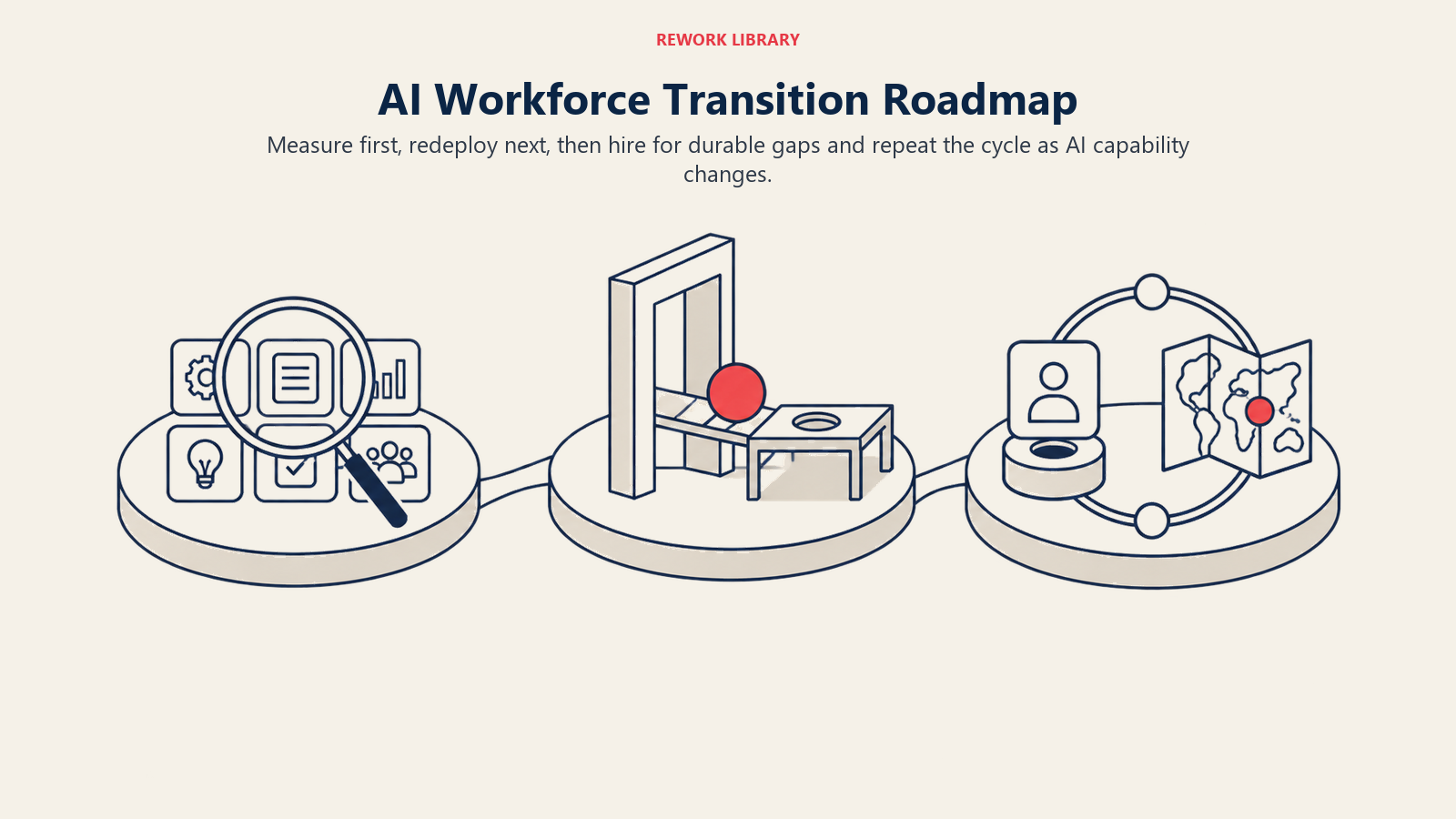
In the first six months, the priority is measurement, not action: build the task inventory and capability map, instrument which tasks AI agents and copilots are genuinely absorbing versus which still route back to a human, and identify the two or three functions with the largest gap. Resist headcount decisions in this window; the data collected here is what makes every later decision defensible instead of reactive.
In months six through twelve, redeployment moves from concept to execution in the highest-priority functions, paired with a hiring freeze on backfills for roles where task absorption is measurably real, not projected. This is also when org design and delayering decisions should be made, because flattening a layer before the capability map exists tends to remove coordination capacity the business still needs, and the middle manager's role is usually the first thing that breaks when that sequence gets skipped.
In months twelve through twenty-four, the plan shifts to steady-state: hiring resumes for capabilities the map flagged as durable gaps, redeployment becomes a standing process rather than a project, and the cycle repeats on a rolling basis instead of getting shelved once the pressure passes.
The Metrics That Actually Matter
Headcount and cost per employee are the metrics every finance function already tracks, and they are necessary but not sufficient. A plan can hit its headcount target and still fail if the wrong capabilities left with the people who were cut.
Watch time-to-productivity for redeployed employees against a genuine baseline, since redeployment only beats rehiring if retraining is actually shorter than a new hire's ramp. Watch voluntary attrition among people flagged as holding scarce capabilities, separated from overall attrition, since the aggregate can look healthy while the specific number quietly deteriorates, exactly the freeze trap described above. Watch capability coverage ratio: of the capabilities the map flagged as needed next, what share does the organization actually have covered by a person, not a plan to hire one. And watch task-absorption rate against the scenario that drove the plan, because moderate tracking toward fast needs to be caught within a quarter, not at the next annual review.
Is This Strategy or a Cost Decision Wearing a Strategy Label?
Here is the uncomfortable part. A large share of what companies call AI workforce strategy is a cost decision that was going to happen anyway, described afterward in AI terms because that framing is easier to put in front of a board than "we need to cut costs." The Challenger, Gray & Christmas 2025 year-end report found AI cited as a factor in 54,836 layoffs that year, real and rising, but still only about 4.5 percent of the roughly 1.2 million total job cuts tracked, well behind market conditions and store closures (Challenger, Gray & Christmas, 2025 Year-End Report). That gap is itself worth sitting with.
There is a genuine test for telling the two apart, and it does not require reading anyone's intent. A real AI workforce strategy has a task inventory and a capability map that predate the headcount decision. A cost decision wearing a strategy label has the headcount number first, produced by finance under budget pressure, with the AI narrative built afterward to make it palatable. A real strategy can name specific tasks roles no longer need to do, and specific capabilities the freed-up budget goes toward. A cost decision can only point to a percentage and a deadline.
The practical check: if you cannot name, for the roles being cut or the freeze being extended, which tasks AI is actually now doing that a person used to do, you do not yet have a workforce strategy. You have a budget target, and calling it AI does not make it one. Getting the sequence right, tasks first, capability map second, headcount decision last, closes that gap, and it is also what makes the decision survivable for the culture that keeps working after it lands, which matters more than the framing ever will.
Frequently Asked Questions about AI Workforce Strategy
What is the difference between an AI workforce strategy and a hiring freeze?
A hiring freeze is a single tactic, pausing external hiring. An AI workforce strategy decides which tasks AI can absorb and how headcount, hiring, and redeployment should change as a result. A freeze can be one piece of that plan, but alone it is not a strategy.
How do we start building a task inventory for AI workforce planning?
List the tasks people in a function actually spend time on, not the job title, then tag each as AI-absorbable now, AI-assisted, or judgment-only. Do this function by function, starting with the two or three under the most cost or capacity pressure.
Is redeployment always cheaper than rehiring?
Not always, but more often than leaders assume. SHRM puts the fully loaded cost of replacing an employee at 50 to 200 percent of annual salary, so redeployment tends to win unless the retraining gap is unusually large or there's no reasonable adjacency to the new capability.
Why is a hiring freeze risky if it avoids layoffs?
Voluntary attrition during a freeze is not random. Employees with the most external options, often the strongest performers, are most likely to leave when internal mobility stalls, while employees with fewer options tend to stay. An unmanaged freeze can quietly remove the wrong people.
How often should a capability map be updated?
Quarterly at minimum. AI capability changes fast enough that a task judged judgment-only six months ago may now be AI-assisted, and a map treated as a one-time exercise goes stale within two or three quarters.
What metrics show whether an AI workforce plan is actually working?
Time-to-productivity for redeployed employees against a real baseline, voluntary attrition among scarce-capability holders specifically, the capability coverage ratio against identified needs, and the task-absorption rate against the scenario the plan assumed. Headcount and cost alone don't show whether the right capabilities were kept or lost.
How do we know if our AI workforce strategy is actually a cost-cutting decision in disguise?
If the headcount number came first and the AI narrative was built to explain it afterward, it is a cost decision. If a task inventory and capability map existed before the headcount decision, it is closer to a genuine strategy. The order those two things happened in is the tell.
What is the risk of sequencing headcount cuts before building a capability map?
Layoffs remove people by cost, tenure, or performance rating, not capability coverage, so cutting first bets that whoever remains holds the skills the business needs next. When that bet is wrong, the company pays twice: once in severance, again to rehire for the capability the cut removed.

Co-Founder, Rework.com
On this page
- Key Facts
- Start From Tasks, Not Headcount Targets
- Build the Capability Map Before the Cut List
- What a Capability Map Actually Contains
- The Sequencing Mistake: Cutting Before Mapping
- The Hiring Freeze Trap: How Attrition Quietly Removes the Wrong People
- Redeployment Economics vs. Rehiring Cost
- Scenario Planning Under Genuine Uncertainty
- Sequencing the Transition Over 12 to 24 Months
- The Metrics That Actually Matter
- Is This Strategy or a Cost Decision Wearing a Strategy Label?