The Middle Manager in the Age of AI: Squeezed, Cut, and More Necessary Than Ever
Turn this article into takeaways for your work.


Each assistant summarizes the article only for you and suggests best practices for your work.
The middle manager in the age of AI sits between two forces pulling in opposite directions. AI is absorbing the status reporting, scheduling, and summarizing that filled a large share of a manager's week, exactly the work companies have used to justify cutting management layers since 2023. At the same time, teams that now include AI agents alongside people need more judgment, coaching, and exception handling from whoever runs them, not less. Companies that flatten based only on the first force and ignore the second are trading a short-term cost line for a leadership pipeline they will need in two years and will not have. AI workforce strategy for executives makes the broader planning case for starting from what the remaining tasks actually require instead of a headcount target set first and rationalized second.
Key Facts
- Middle managers made up roughly one-third of all layoffs in 2023, up from about 20% in 2019, a 60% jump in management's share of workforce reductions. Source: Bloomberg / Live Data Technologies analysis, reported by Fortune
- Global manager engagement fell to 22% in 2025, down from 31% in 2022, a nine-point drop in three years. Source: Gallup, State of the Global Workplace
- The average number of people reporting to one manager rose from 10.9 in 2024 to 12.1 in 2025, a nearly 50% increase since Gallup started tracking it in 2013. Source: Gallup, "Span of Control: What's the Optimal Team Size for Managers?"
- Bain's baseline across large organizations is 6-7 direct reports and 8-9 management layers; companies that deliberately redesign spans and layers post average gains of 24% wider spans and 14% fewer layers. Source: Bain & Company, "Streamlining Spans and Layers"
- Gartner has projected that one in five companies will eliminate more than half their middle management positions this decade as AI takes over coordination work. Source: Gartner projection, reported by Fortune
What "Middle Manager" Means Here
A middle manager is anyone who manages people who themselves manage or produce work, sitting between an individual contributor layer and senior leadership. The job has always had two halves bundled together on an org chart that behave completely differently under pressure: an administrative half (status tracking, resource allocation, reporting up, scheduling) and a judgment half (coaching, prioritizing under ambiguity, handling the exception that does not fit a playbook, making the call when two good people disagree).
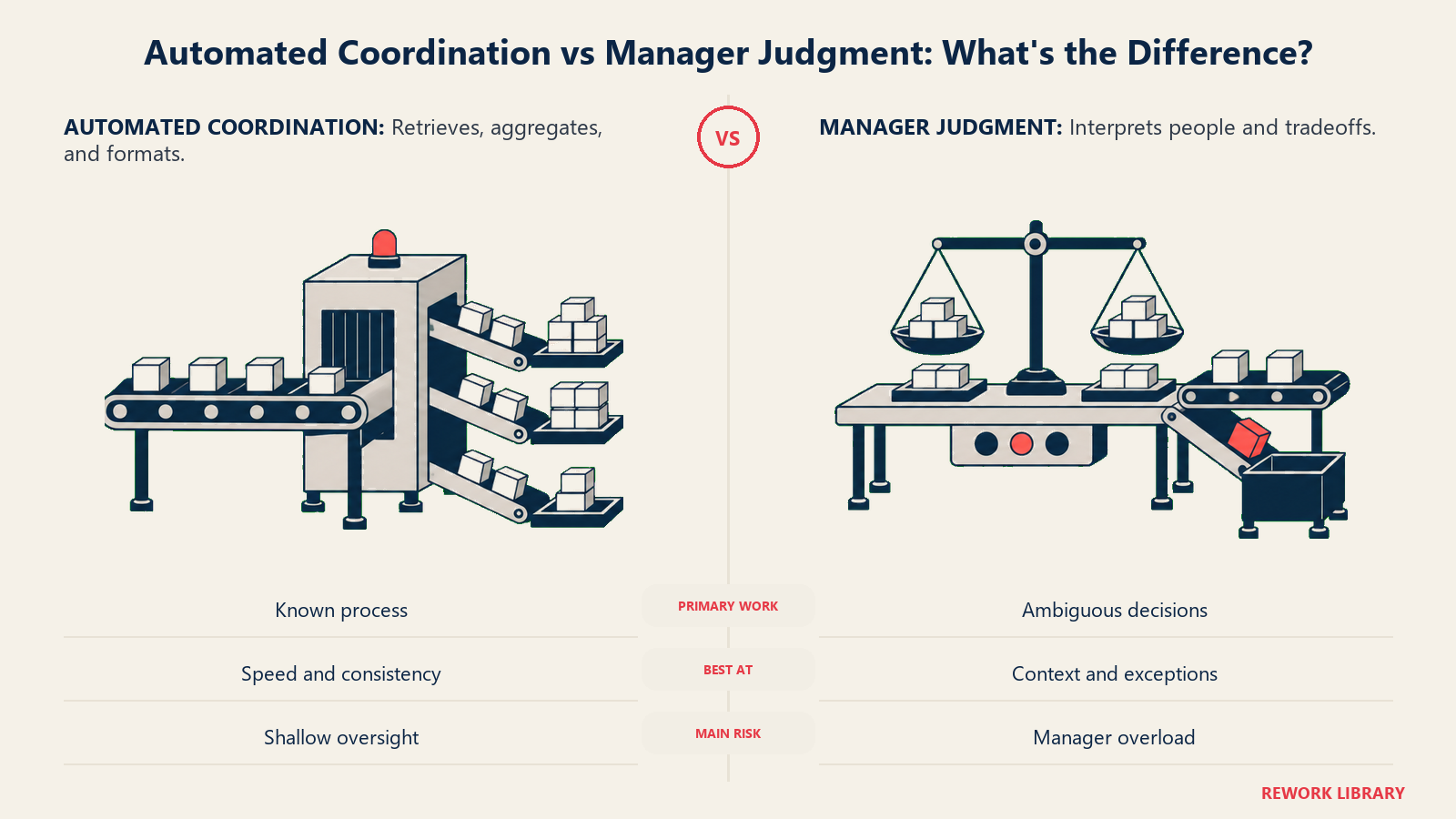
That distinction matters more in 2026, because AI is not neutral between the two halves. It is good at the first and still weak at the second, and most of the public argument about whether middle management is dying conflates them.
The Two Forces Pulling on the Role
Force One: AI Is Absorbing the Coordination Work
The clearest, most measurable thing happening to management right now is that software is doing a growing share of the paperwork that used to require a person's attention. Microsoft's 2026 Work Trend Index describes this directly: AI can streamline "low-value tasks, status meetings, routine reports, admin churn" so people running teams get time back for decisions and execution instead of updates. Its earlier research on the "infinite workday" found the average knowledge worker splits time roughly 57% communicating and 43% creating, with heavy email users burning close to 9 hours a week on it alone. A meaningful chunk of a manager's calendar is status theater, not decision-making, and that is precisely the layer an AI agent can compress: drafting the update, summarizing project health from ticket data, flagging the one metric that actually moved.
This is also the layer executives point to when justifying cuts. If an agent can generate the status rollup, the argument goes, you need fewer people whose main output was the rollup. What is the future of work? covers the broader pattern: task composition inside a role changes before the job title does, and management is not exempt.
Force Two: Agent-Augmented Teams Need More Judgment, Not Less
The second force gets less airtime because it is harder to put in a slide. When a team's output comes from a mix of people and AI agents, the manager's job shifts toward work that resists automation: deciding which tasks are safe to hand to an agent, catching the agent's confident wrong answer before it ships, coaching a junior employee who now gets fewer of the small reps an agent handles instead, and handling the exception a well-run process was never designed for. The broken bottom rung covers why that lost repetition matters: apprenticeship-style learning depends on doing the easy version of a task before the hard one, and a manager is often the only person positioned to notice when that path disappears.
Microsoft's 2026 data quantifies part of this. Employees whose managers openly modeled AI use reported a 17-point lift in the value they got from AI, a 22-point lift in critical thinking about when to trust it, and a 30-point lift in trust toward agentic AI specifically. Where managers built psychological safety around experimentation, teams showed up to 20 points higher AI readiness. None of that lift comes from a better status report. It comes from a manager actively coaching how a team works with AI, judgment-layer work, the exact thing flattening tends to cut first.
Keeping human judgment sharp covers the individual-level version of this: what atrophies when people stop exercising judgment because a tool does it for them. Managers are supposed to be the check against that atrophy happening across an entire team. Remove the manager and there is no one left whose job is to notice.
What AI Absorbs vs. What It Makes More Important
| Manager task | What AI absorbs | What it makes more important |
|---|---|---|
| Status reporting and rollups | Drafting, aggregating, and formatting updates from tickets, docs, and calendars | Deciding which one data point actually matters before it reaches a decision-maker |
| Scheduling and resource tracking | Calendar coordination, workload balancing across a known task list | Reallocating people when the plan breaks, which a rules-based tool cannot anticipate |
| First-pass reviews of routine work | Catching format errors, missing fields, obvious inconsistencies | Judging quality and fit for work that does not have a clear right answer |
| Onboarding and skill transfer | Delivering reference material, answering repeatable how-to questions | Coaching tacit judgment: when to escalate, when to push back, when a shortcut is unsafe |
| Performance tracking | Compiling metrics, flagging outliers against a baseline | Interpreting whether a metric miss is a skill gap, a bad process, or a bad quarter |
| Cross-team coordination | Summarizing what happened in a meeting the manager missed | Resolving the conflict two teams have when their AI-assisted plans do not actually mesh |
The pattern in every row is the same. AI compresses the part of the job that is retrieval, aggregation, and format. It leaves the part that is judgment about people and tradeoffs almost entirely alone, and that part gets harder in agent-augmented teams, because someone now has to supervise a non-human teammate too. The Frontier Firm and the rise of the agent boss names this addition directly: the manager who used to run a team of people now also runs a team that includes agents, and nobody removed anything from their plate to make room for it.
The 2023-2026 Flattening Wave: What the Evidence Actually Shows
The push to cut management layers did not start with AI. It began as a cost-cutting response to slower growth after 2022, and AI gave it a second, more durable justification once agent tools matured enough to touch coordination work directly.
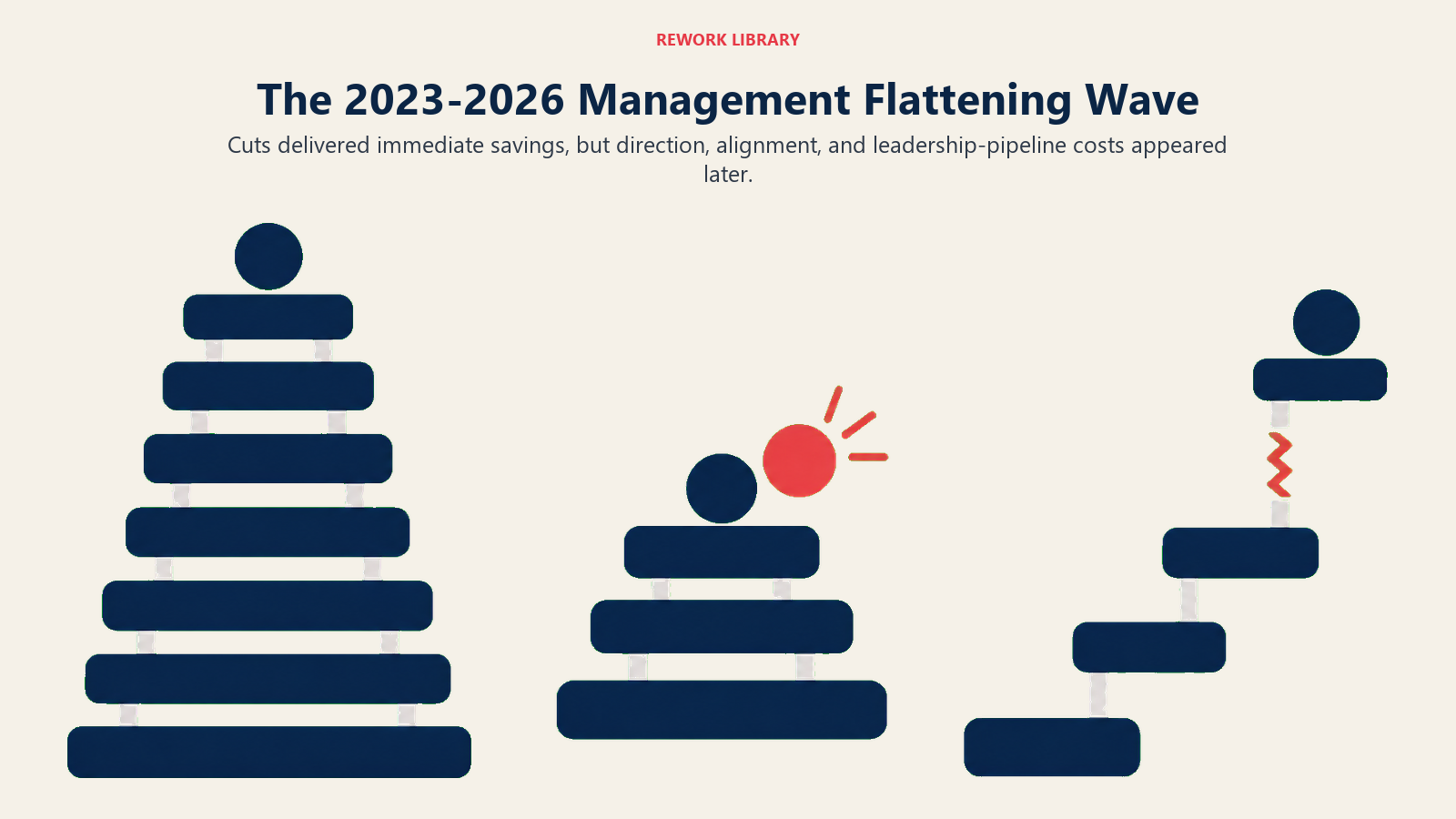
The scale is real and documented. A Bloomberg analysis built on Live Data Technologies workforce data found middle managers accounted for roughly one-third of all layoffs in 2023, up from about 20% in 2019, a 60% jump in management's share of cuts even though managers are a much smaller share of headcount overall. Specific companies confirm the pattern: Citi cut its management layers from 13 down to 8, UPS eliminated roughly 12,000 of its 85,000 manager and supervisor roles, and Amazon set an explicit target of increasing its ratio of individual contributors to managers. More recently, AI-linked restructurings at Coinbase, Block, and Snap pushed the same idea under a new label, the "player-coach" manager who keeps contributing individually rather than managing full time, a framing all three CEOs have used publicly to justify cutting pure management roles.
Bain's spans-and-layers research gives the structural baseline underneath all of this. The typical large organization runs 6-7 direct reports per manager across 8-9 layers between the front line and the CEO. Organizations that deliberately redesign, rather than simply cut, average a 24% improvement in span and a 14% reduction in layers, with efficiency gains Bain has measured in the tens to low hundreds of millions of dollars. That clause matters: Bain's numbers describe planned redesign, not the blunter layoffs most companies actually ran in 2023 and 2024.
Here is where the evidence gets uncomfortable for anyone selling flattening as a clean win. Gartner has projected that one in five companies will eliminate more than half their middle management positions as AI absorbs coordination work, a forecast worth naming as a forecast and not a measured outcome. The early data on what happens after the cut is mixed at best. A Korn Ferry 2025 survey found 41% of professionals said their company had cut manager roles, but 37% of respondents at those companies said the change left them feeling directionless and 43% said leadership was no longer aligned. Fortune's reporting on the aftermath describes one technology company that cut 70% of its engineering managers in 2024, saved $3.2 million, then watched its VP of Engineering inherit 47 direct reports and lose a senior engineer within six months. The savings showed up in the first quarter's numbers. The cost showed up two years later, once the people who would have filled those senior roles were never developed at all.
That is the honest read of the wave: the layoffs are real, the savings are immediate, and the leadership-pipeline damage is real but delayed, which is why it keeps getting underweighted.
Manager Burnout and the Widening Span
The people who survive the flattening wave are not thriving under it. Gallup's State of the Global Workplace found manager engagement fell to 22% globally in 2025, down nine points from 31% in 2022, the steepest decline of any worker category it tracks. Managers used to run several points above individual contributors on engagement, an "engagement premium" that has now largely disappeared. Leaders also report worse emotional experience than the people they manage: higher stress, anger, sadness, and loneliness, with young managers and female managers hit hardest.
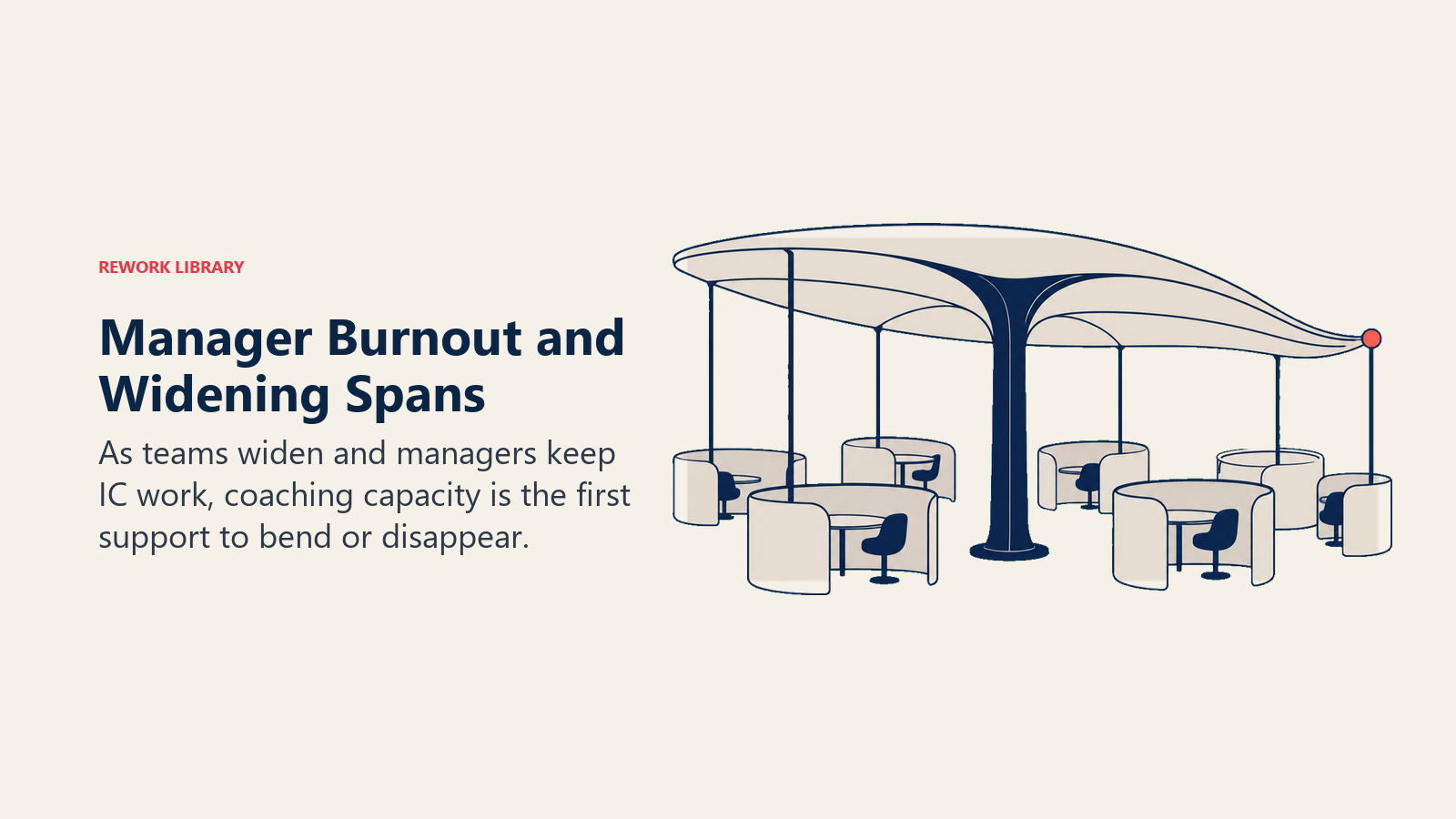
Span of control is the clearest mechanical driver. Gallup's manager-specific research found the average number of direct reports climbed from 10.9 in 2024 to 12.1 in 2025, a nearly 50% increase since it started tracking the figure in 2013. The distribution is uneven, most managers still run small teams, but a fast-growing slice run what Gallup now calls "megateams" of 25 or more, usually the direct result of a flattening decision made somewhere above them. And 97% of managers still carry individual contributor work of their own, a median of 40% of their time. Push span past what that mixed workload can absorb and something breaks, usually coaching first, because coaching is the task that is easiest to skip when a calendar is full and hardest to notice missing until a year later. Span of control when agents do the work breaks that ceiling down by what a manager is actually supervising, people, agent output, or both, rather than treating span as one fixed ratio.
None of this is an argument that spans cannot grow. Bain's own benchmark shows best-in-class organizations running 10-15 direct reports with no more than 7 layers, wider than the current average and workable. The difference is that those organizations built the support underneath a wider span deliberately, clearer decision rights, better tooling, real training, rather than removing a layer and asking whoever remains to absorb the difference unchanged.
From Work-Checker to Coach and Orchestrator
The job that survives this transition looks different from the 2022 version, and the difference is not cosmetic.
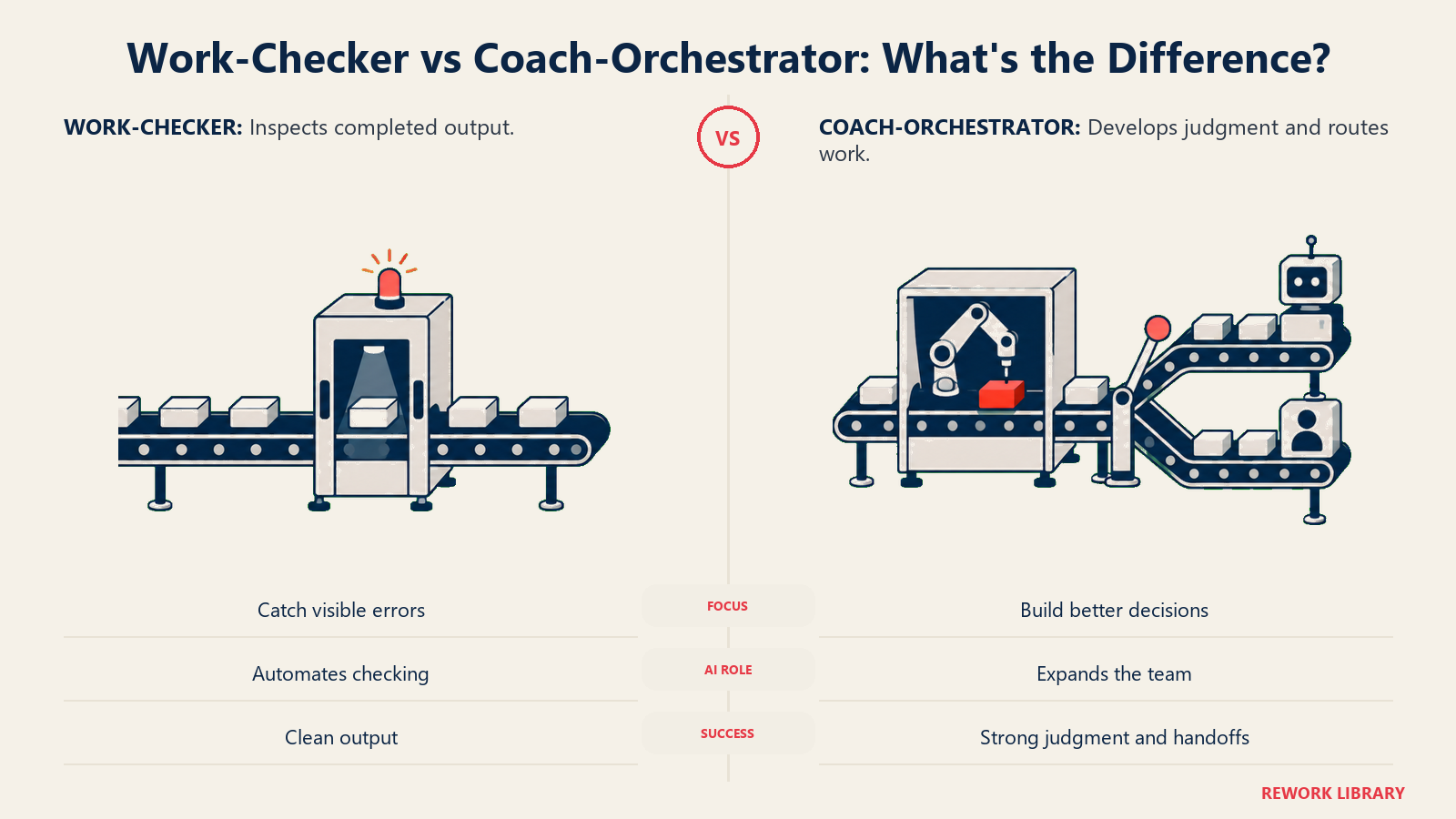
The old default middle-management job was substantially a work-checker role: review what a team produced, catch errors, roll status up the chain, allocate headcount against a plan. AI now does a meaningful share of the checking and nearly all of the rolling-up. What is left, and what is growing, splits into two distinct jobs layered on top of each other. The first is coach: developing people's judgment, including judgment about when to trust an AI agent's output and when to override it, which keeping human judgment sharp treats as a skill that atrophies without deliberate practice. The second is orchestrator at the team level: deciding which work goes to a person, which to an agent, and who is accountable when the two hand off badly, the same shift from doer to orchestrator describes happening to individual contributors, one level up the org chart.
Augmentation vs. automation is the useful frame for telling these two futures apart at the team level, not just the task level. A manager whose team uses AI to augment judgment needs to get better at coaching that judgment. A manager whose team uses AI to automate output needs to get better at verifying it and handling what it cannot. Most real teams do both at once, on different tasks, which is why the manager's job got more cognitively demanding even as parts of it visibly shrank. The AI productivity paradox explains why this shift is easy to miss from the outside: adoption looks high, measured output often does not move much, and the honest explanation is often that the manager is absorbing the redesign work personally, without credit, because nobody redesigned the workflow for them.
What Companies Get Wrong When They Delayer
Three mistakes show up repeatedly in companies whose flattening did not go as promised, and all three are avoidable with the data already cited above.
They cut the administrative half and expect the judgment half for free. Removing a manager removes both halves of the job at once. The savings show up immediately; the loss, coaching that stopped, exceptions that go unhandled, shows up in retention and quality months later, the exact lag Fortune's case studies describe.
They widen span without rebuilding the support underneath it. Bain's data shows wider spans can work, but only alongside the redesign: clearer decision rights, better tooling, real manager training. Skip the redesign and remove headcount anyway, and the result is Gallup's numbers instead: falling engagement, rising burnout, a vanished engagement premium.
They treat the leadership pipeline as a sunk cost instead of a supply chain. Deloitte's research on Gen Z career intent found only 6% currently want a senior leadership role, and DDI found roughly 40% of current leaders already considering leaving. Cutting the layer where people learn to lead removes the training ground for whoever was supposed to run the company in five years, at the exact moment fewer people are volunteering for the job anyway.
None of this means every flattening decision is wrong. Some companies genuinely had too many layers with too little decision-making at any of them, and Bain's redesign data proves fixing that can work. The failure mode is specific: cutting the role because the administrative half looks automatable, without asking where the judgment half goes. Leadership's role in shaping company culture covers how leaders signal what gets rewarded once a layer is gone; this article has stayed on the structural question of whether to remove that layer at all.
The honest forecast is not that middle management disappears. It is that the job keeps splitting in two, a shrinking administrative core AI keeps absorbing, and a growing coaching-and-orchestration core that gets harder every time a company cuts the wrong half by mistake.

Co-Founder, Rework.com
On this page
- Key Facts
- What "Middle Manager" Means Here
- The Two Forces Pulling on the Role
- Force One: AI Is Absorbing the Coordination Work
- Force Two: Agent-Augmented Teams Need More Judgment, Not Less
- What AI Absorbs vs. What It Makes More Important
- The 2023-2026 Flattening Wave: What the Evidence Actually Shows
- Manager Burnout and the Widening Span
- From Work-Checker to Coach and Orchestrator
- What Companies Get Wrong When They Delayer