Augmentation vs. Automation: The Real Distinction Leaders Keep Getting Wrong
Turn this article into takeaways for your work.


Each assistant summarizes the article only for you and suggests best practices for your work.
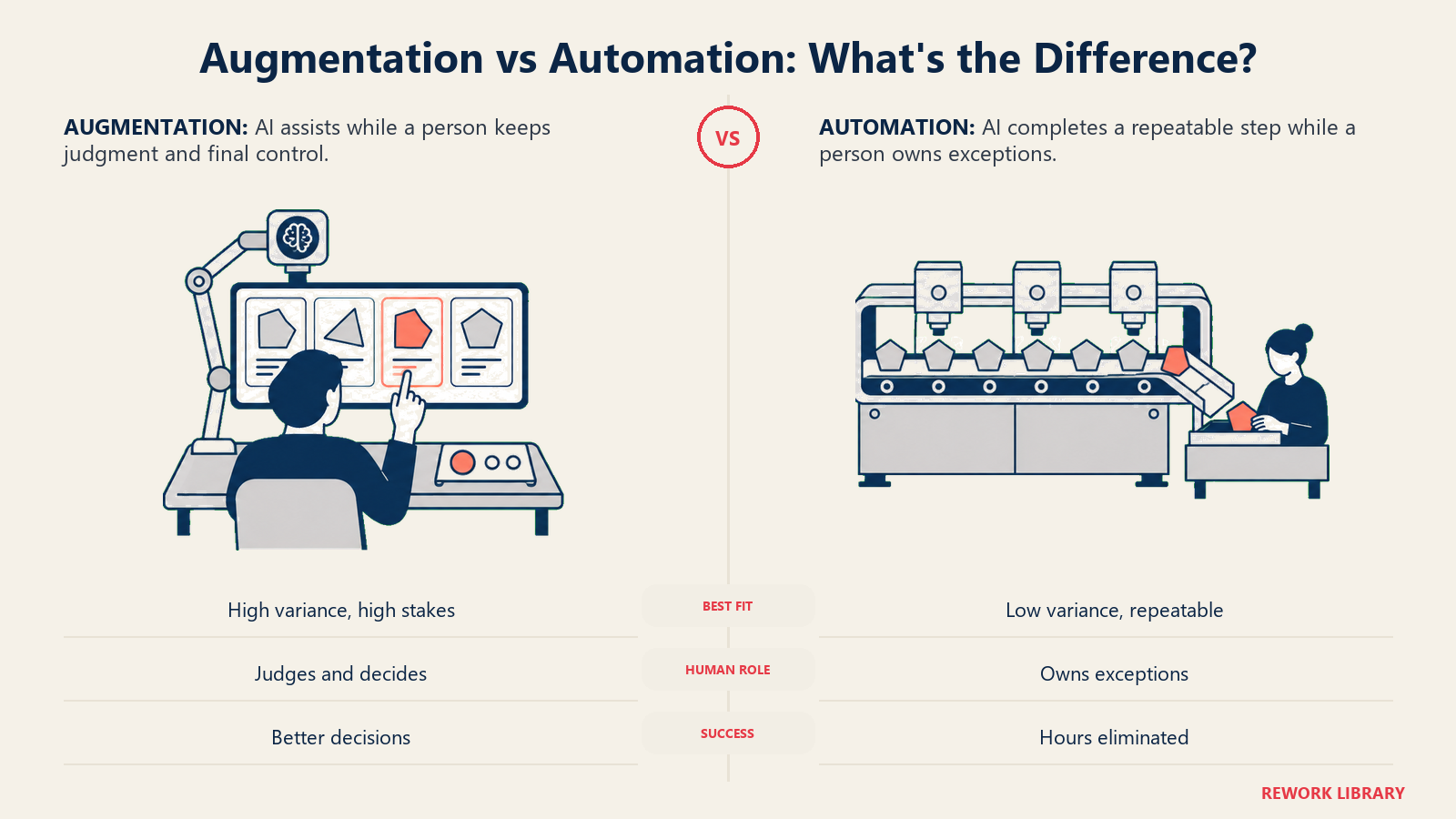
Augmentation and automation are opposite bets on the same task: automation removes the human from a step entirely and measures success by hours eliminated, while augmentation keeps a human in the loop with AI doing part of the work and measures success by better decisions. Confusing the two is why so many AI rollouts either backfire on quality or quietly cut headcount nobody budgeted for admitting.
Most executive conversations about AI still happen at the wrong altitude. Someone asks "should we automate this or augment it?" as if it were a single company-wide philosophy, like choosing a cloud vendor. It isn't, and the rise of AI agents that can chain several steps together on their own has made the confusion worse, not better, because a single agent can automate one part of a workflow while augmenting the human overseeing another part of the same process. The honest unit of analysis is the task, not the job, the department, or the company. A single role can contain a dozen tasks, some ripe for full automation, some that get worse the moment you remove a human, and most somewhere in between. Leaders who skip that granularity end up either over-automating (and inheriting a pile of unverified output) or over-augmenting (and calling a slow-motion layoff a productivity initiative).
The Task-Level Lens: Why "Job" Is the Wrong Unit
The economist David Autor built the task-based framework that most serious labor research still uses, and it starts from a simple observation: jobs are bundles of tasks, and technology acts on tasks, not job titles. In his 2015 Journal of Economic Perspectives paper, Autor argued that automation both substitutes for labor on some tasks and complements it on others, and that the net effect on a job depends on the mix. Computers are very good at routine, codifiable tasks; they're worse, even now, at problem-solving, judgment calls made with incomplete information, and work that requires adapting to a situation nobody wrote a rule for.
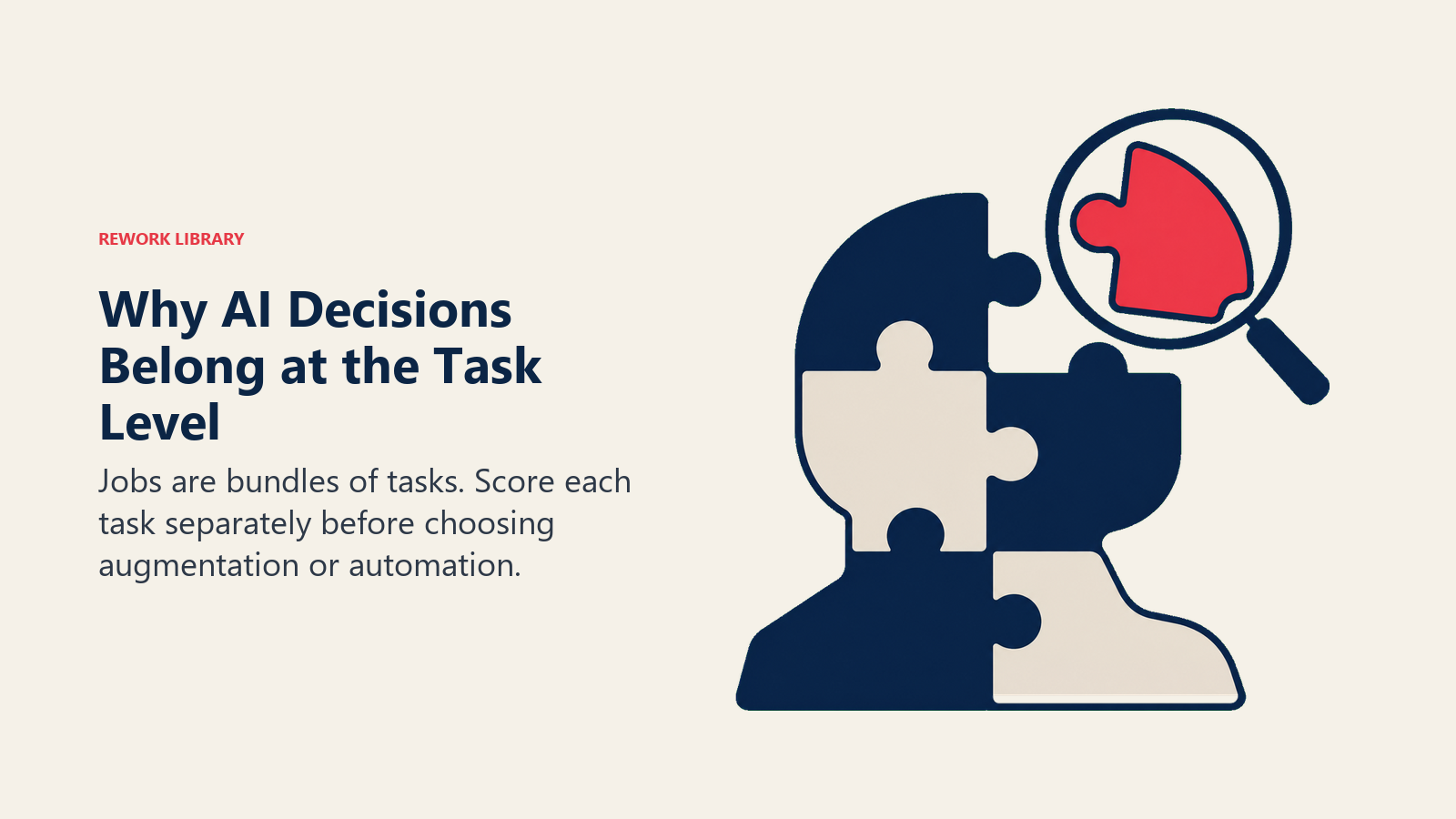
That framing matters because "augmentation vs. automation" is not a debate you can resolve for "customer support" or "finance" as a whole. Customer support contains password resets (automate them) and de-escalating an angry enterprise client who is threatening to churn (augment a rep, don't replace one). Finance contains three-way invoice matching (automate it) and deciding whether a vendor contract's unusual terms are worth the risk (augment the analyst who has seen enough bad contracts to have real judgment). The task, not the department, is where the automation-or-augmentation decision actually lives.
This is also where a lot of AI vendor pitches quietly mislead. "We automate customer support" sounds like a category. What it usually means is "we automate the 60% of tickets that were already scriptable," which is a very different, much narrower claim, and one worth pressure-testing before you buy.
What Each Strategy Is Actually Optimizing For
Automation and augmentation aren't two points on the same dial. They optimize for different things, and pretending otherwise is where most of the confusion starts.
Automation optimizes for throughput at fixed quality. The goal is to do the same task, correctly, more times, with fewer people watching it happen. It works when the task has low variance: the inputs look similar every time, the correct output is checkable by a rule, and an error is cheap to catch or reverse. Payroll runs, scheduling, data entry, and document routing are classic candidates.
Augmentation optimizes for decision quality at the same or higher headcount. The goal is not fewer people doing the task; it's the same people doing it better, faster, or with more options considered. It works when the task has high variance: inputs differ every time, the right answer requires context a model doesn't have, and getting it wrong is expensive or hard to walk back.
Erik Brynjolfsson's 2022 essay "The Turing Trap" names the deeper stakes of getting this backwards at scale. He argues that when AI imitates a human closely enough to fully substitute for them (automation), workers lose the bargaining power that comes from being needed, and the value created concentrates with whoever owns the technology. When AI augments instead, workers keep a claim on the value because their judgment is still the thing making the output good. Brynjolfsson's point isn't that automation is wrong; it's that the incentives in AI development and corporate strategy quietly favor automation over augmentation, even in cases where augmentation would create more total value. That bias shows up in board decks as often as it shows up in model design: automation has a cleaner ROI story ("we cut 12 FTEs"), even when the augmented version of the same project would have grown revenue by more.
Augmentation vs. Automation by Workflow Trait
Use this as a first-pass filter before you scope any AI project. If a workflow lands mostly in the left column, it's a reasonable automation candidate. If it lands mostly in the right column, treat it as an augmentation project and budget for a human decision-maker to stay in the loop.
| Workflow trait | Favors automation | Favors augmentation |
|---|---|---|
| Task variance | Low: same inputs and steps every run | High: edge cases and context change run to run |
| Cost of an error | Low, or easily caught downstream | High: expensive, reputational, or hard to reverse |
| How you verify the output | A rule or checksum (did the total match) | Domain judgment only an experienced person has |
| Volume | High repetition, thousands of instances a month | Lower volume, higher stakes per instance |
| Skill involved | Mechanical, already routinized before AI arrived | Tacit, built over years of pattern-matching |
| What "success" means here | Fewer people needed per unit of output | Same people, better calls, faster iteration |
| Typical example | Invoice matching, scheduling, data entry | Contract risk judgment, hiring decisions, prioritization |
The table is a starting filter, not a verdict. A task can score "favors automation" on volume and still fail on error cost, in which case the safer design is automation with a human checkpoint before anything ships, which is really a hybrid, not pure automation. Human-in-the-loop design exists specifically for that middle case.
The Hidden Cost of Automating a Task Someone Still Has to Verify
Here's the trap leaders fall into most often: they automate a task, celebrate the speed gain, and don't account for the fact that a human still has to check the output before it goes anywhere near a customer, a regulator, or a financial statement. If verification is manual and thorough, you haven't removed the labor; you've moved it downstream and often made it worse, because reviewing someone else's (or something else's) work for hidden errors is cognitively harder than doing the work yourself.
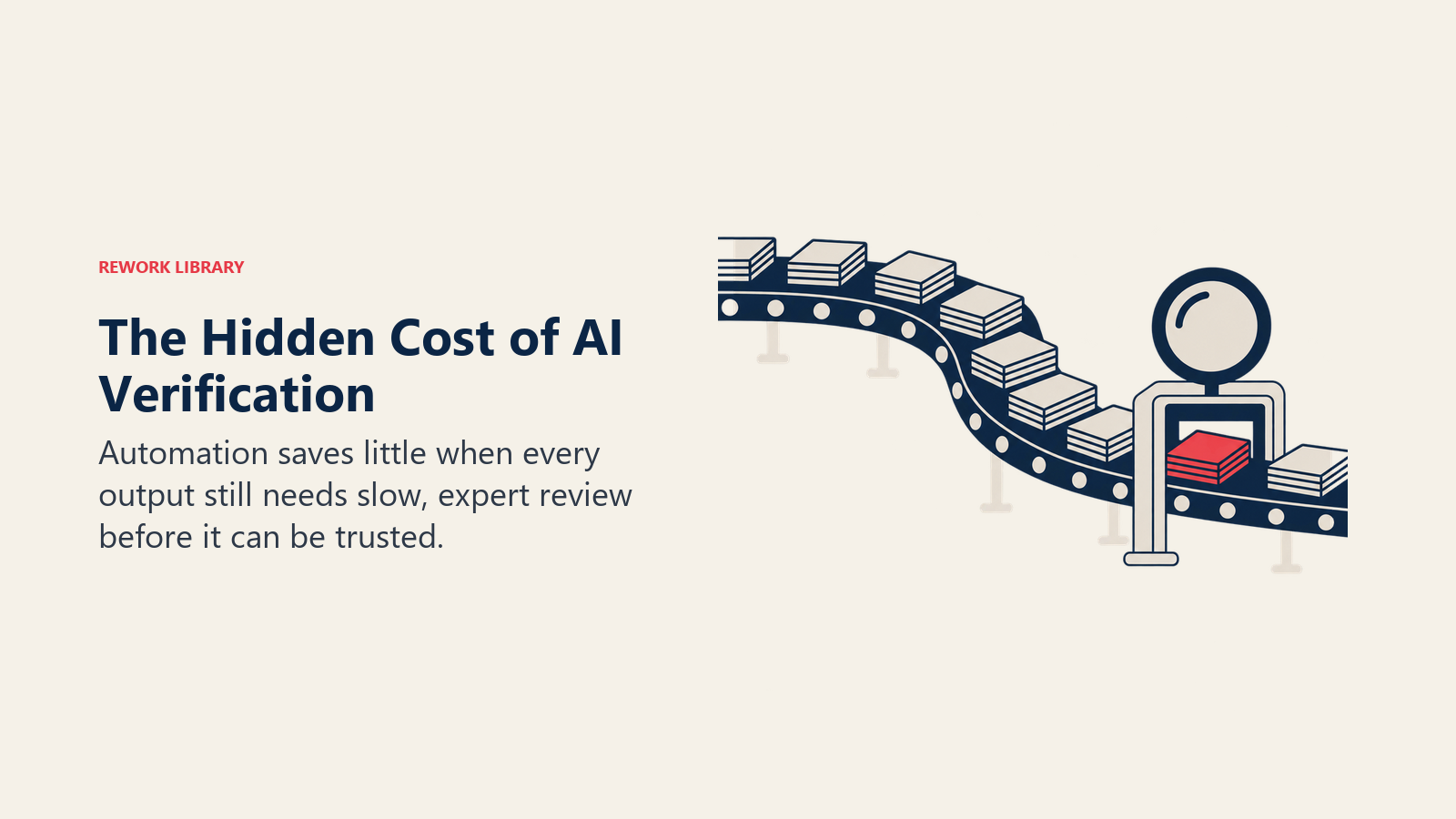
This is the mechanism behind "workslop," the term researchers at BetterUp Labs and Stanford's Social Media Lab gave to AI output that looks finished but doesn't actually advance the task. We've written about the culture side of that problem in what workslop does to effort and ownership; the task-design side is the point here. If an AI automation pipeline produces plausible-looking output faster than a human can sanity-check it, you have built a bottleneck at the review stage, not eliminated one at the production stage. The bill for that shows up as rework hours, as slower approvals because reviewers no longer trust polish as a signal of quality, and eventually as a real error that gets through because everyone got tired of checking.
MIT's Project NANDA put a number on where this plays out worst. Its 2025 "State of AI in Business" research, based on more than 300 deployment reviews and 150-plus leader interviews, found that 95% of generative AI pilots delivered no measurable profit-and-loss impact, and that more than half of AI budgets went to visible, customer-facing tools even though back-office automation (the kind with rule-checkable outputs and low error cost) delivered the stronger returns. That's the workflow-trait table above showing up in real spending data: money went toward the flashy, high-variance, hard-to-verify tasks, and the return went to the boring, low-variance, easy-to-verify ones.
The fix isn't "verify less." It's designing the automation so the verification step is cheap by construction: narrow the task until the output is checkable by a rule, add a confidence threshold that routes only the uncertain cases to a person, or accept that the task belongs in the augmentation column after all. RPA projects learned this the hard way a decade before generative AI arrived: a bot that's 95% accurate on an unbounded task creates more manual review work than it saves, while the same bot on a tightly scoped, rule-bound task barely needs a human at all.
Key Facts
- David Autor's task-based framework: automation both substitutes for and complements labor, with the net effect depending on the specific tasks a job contains, not the job title. Source: Autor, "Why Are There Still So Many Jobs?", Journal of Economic Perspectives, 2015
- Erik Brynjolfsson's "Turing Trap": current incentives favor building AI that substitutes for humans (automation) over AI that extends human capability (augmentation), even when augmentation would create more total value. Source: Brynjolfsson, "The Turing Trap," 2022
- 88% of organizations report regular AI use in at least one business function, but only about 6% qualify as "AI high performers" attributing more than 5% of EBIT to it. Source: McKinsey, "The State of AI in 2025," November 2025
- About one in four executives say their company has created significant, scaled value from AI; leading companies put over 80% of AI investment into reshaping functions rather than isolated task automation. Source: BCG, "From Potential to Profit: Closing the AI Impact Gap," 2025
- Gartner projected that at least 30% of generative AI projects would be abandoned after proof-of-concept by the end of 2025. Source: Gartner prediction, cited in CIO.com
- 95% of generative AI pilots delivered no measurable P&L impact, and back-office automation outperformed front-office augmentation on realized ROI despite receiving less than half the investment. Source: MIT NANDA, "The GenAI Divide: State of AI in Business 2025", via Fortune
Why "Augmentation" Is Sometimes a Euphemism for Headcount Reduction Deferred
Not every leader who says "we're augmenting, not automating" is being straight with their team, or with themselves. There's a specific pattern worth naming: a company rolls out AI tools under the banner of augmentation ("this will make everyone more productive, nobody's job is at risk"), then a year or two later quietly stops backfilling roles as people leave. Headcount falls by attrition, output per remaining person rises because the survivors are now doing augmented work, and leadership can honestly say "we never laid anyone off" while the team is a third smaller than it was. That's automation with a longer runway and better PR, not augmentation. The task-level test still applies; it's just being applied slowly, one departure at a time, instead of all at once.
The confusion is easy to weaponize because the two strategies often look identical in month one, and it gets murkier still when the augmentation is informal: employees quietly leaning on their own shadow AI tools to keep pace with a workload leadership never officially reduced. An augmented workflow and a task on the on-ramp to full automation both start with "give the team an AI copilot and see what happens." The difference only becomes visible in month twelve, in whether the team grew, held steady, or shrank, and in whether the plan was ever to backfill at all. Microsoft's own "agent boss" framing, covered in our piece on the Frontier Firm and the rise of the agent boss, captures the version companies are comfortable saying out loud: everyone manages agents now, which is true, and also compatible with a much smaller org chart than the one you started with.
None of this means augmentation claims are always dishonest. Plenty of leaders genuinely mean it: the AI copilots rolled out to their sales or engineering teams really are meant to help existing people do more, not to justify not replacing the next departure. The tell is specific and checkable: does the plan include a headcount number and a timeline, or does it stay vague on purpose? A leader who can say "we expect this team to hold at 40 people and produce 25% more output" is describing augmentation. A leader who says "we'll see how it goes" while quietly freezing requisitions is describing automation they haven't named yet, and the team usually figures that out faster than leadership expects, at real cost to trust once they do.
A Decision Framework for Every Workflow
Run each workflow through these four questions before deciding which strategy fits. The order matters: skipping straight to "what tool should we buy" is how teams end up automating the wrong tasks.
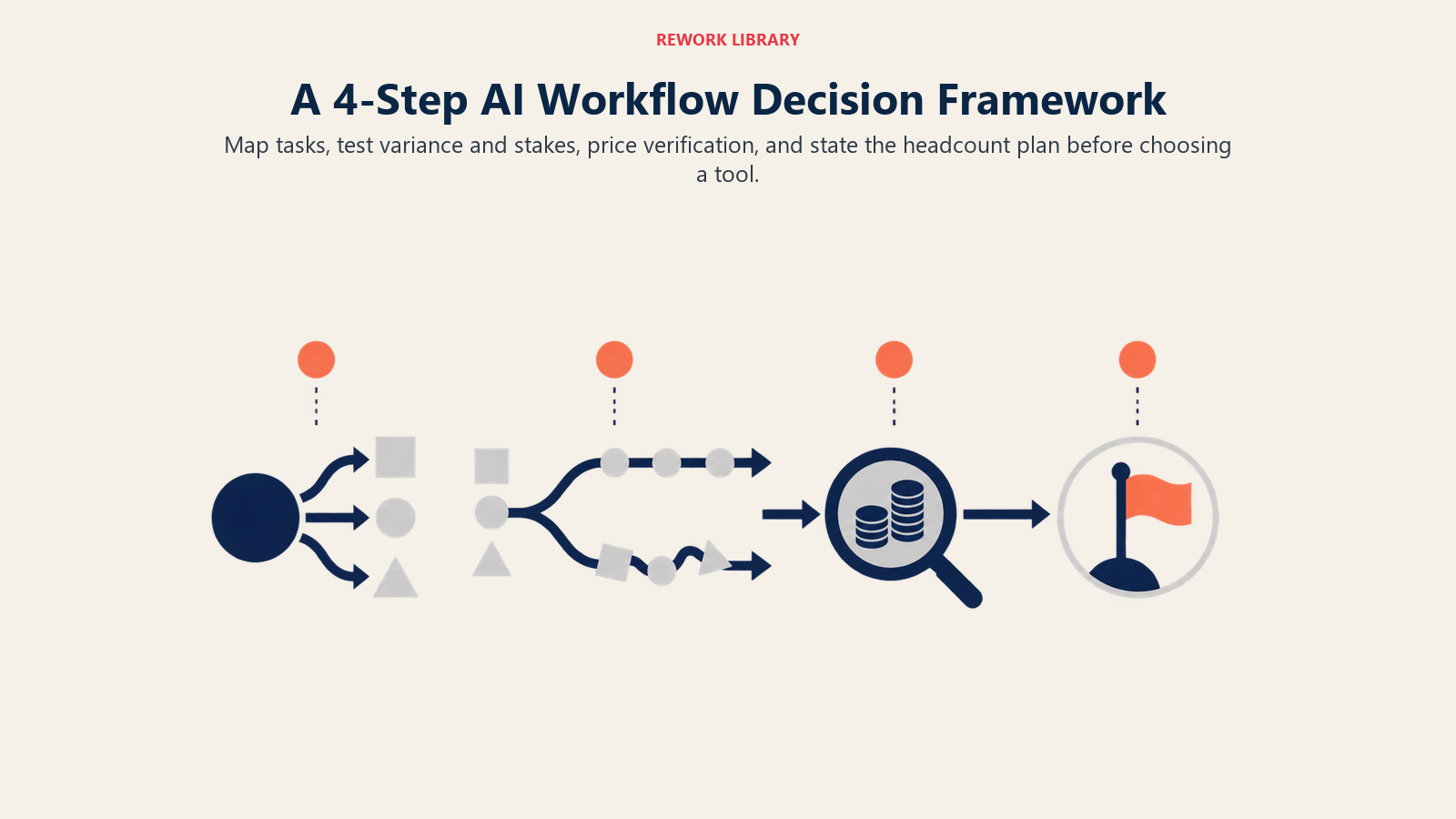
Step 1: Map the task, not the job
List the discrete tasks inside the role or process you're considering, the way Autor's framework suggests. A "customer success manager" role might contain fifteen distinct tasks. Score each one separately. Resist the urge to make one decision for the whole role.
Step 2: Test variance and stakes
For each task, ask two questions: how much does the input vary from instance to instance, and how expensive is a wrong output? Low variance plus low stakes points to automation. High variance plus high stakes points to augmentation. The workflow-trait table above is a faster version of this same test.
Step 3: Price the verification cost honestly
Before automating anything, estimate who checks the output, how long that takes, and what happens if a bad output slips through unchecked. If verification is expensive or the task doesn't have a clean way to verify at all, you're not choosing between automation and augmentation; you're choosing between augmentation and a quality problem you haven't measured yet. This is also where calibrated trust in an AI teammate matters: a reviewer who trusts the model too much rubber-stamps errors, and one who trusts it too little re-does the whole task anyway, erasing the time saved.
Step 4: Say the headcount plan out loud
Decide, in writing, whether the goal is fewer people, the same people doing more, or growth that AI makes affordable. Share that answer with the team doing the work. This step costs nothing and prevents the exact trust erosion described in AI cultural debt: teams tolerate a lot of change when the plan is honest, and very little when they suspect it isn't.
What This Looks Like Once You Run It
A workflow-by-workflow audit like this usually produces an uneven map: a third of tasks clearly automate, a third clearly need a human kept sharp and in the loop, and a third sit in a gray zone that needs a pilot to score honestly. That unevenness is the point. Companies treating "AI strategy" as one decision for the whole organization are the ones stuck at pilot stage in McKinsey's and BCG's surveys, because a single strategy applied to a hundred different tasks is wrong for most of them.
The practical next move is small: pick one workflow, run it through the four steps above, and write down the answer before you touch a tool. Do that ten times across a quarter and you'll have a real map of where automation earns its keep and where augmentation protects judgment worth protecting. None of it works without the groundwork covered in building an AI-ready culture: a team that doesn't trust the process behind the decision will resist even the calls that are objectively right.

Co-Founder, Rework.com
On this page
- The Task-Level Lens: Why "Job" Is the Wrong Unit
- What Each Strategy Is Actually Optimizing For
- Augmentation vs. Automation by Workflow Trait
- The Hidden Cost of Automating a Task Someone Still Has to Verify
- Key Facts
- Why "Augmentation" Is Sometimes a Euphemism for Headcount Reduction Deferred
- A Decision Framework for Every Workflow
- Step 1: Map the task, not the job
- Step 2: Test variance and stakes
- Step 3: Price the verification cost honestly
- Step 4: Say the headcount plan out loud
- What This Looks Like Once You Run It