More in
Sales Process Guide
Pipeline Stage Definitions That Actually Match the Buying Journey
Sep 24, 2026
The SDR-to-AE Handoff: How to Write It Down So It Actually Works
Apr 18, 2026
Deal Desk Basics: How Smaller Sales Teams Can Approve and Close Faster
Apr 18, 2026
Commit, Best Case, Pipeline: Defining Forecast Terms Your Whole Team Uses the Same Way
Apr 18, 2026
Win/Loss Analysis Without the Bias: A Repeatable Process for Sales Teams
Apr 18, 2026
Building a Sales Process One Deal Type at a Time
Apr 18, 2026
Multi-Threading Deals Without Annoying Your Champion
Apr 18, 2026
The Mid-Pipeline Slump: How to Diagnose and Fix Stalled Deals
Apr 18, 2026
Mutual Action Plans: When They Help and When They Hurt
Apr 18, 2026
Sales Operating Cadence: From Daily Stand-Up to Quarterly QBR
Apr 18, 2026
Qualification Frameworks: BANT, MEDDIC, GPCT. Which One Fits Your Sales Motion
Turn this article into takeaways for your work.


Each assistant summarizes the article only for you and suggests best practices for your work.
A SaaS sales team running a 60-day enterprise cycle was using BANT. Their close rate from first demo to contract was 12%. After nine months of lost deals, their VP of Sales ran a simple analysis: of every deal they lost in the back half of the pipeline, 74% had passed BANT qualification in the first call. These were exactly the kind of late-stage losses that structured lost deal reviews are designed to surface and diagnose. Budget existed. Authority was claimed. Need was stated. Timeline was given. None of it predicted whether they'd win.
They switched to MEDDIC. Twelve months later, late-stage conversion had improved by 23%. Not because MEDDIC is magic. It forces reps to verify the things that actually determine whether a complex deal closes: a real economic buyer, an identified champion with organizational influence, and a decision process the team can actually work through. According to Forrester, the average B2B purchase now involves 6 to 10 decision-makers, each armed with their own research. That's exactly why champion identification and economic buyer access matter so much in complex deals.
BANT made sense in 1960 when IBM invented it. The BANT framework originated as an IBM sales qualification tool and was designed for a single-buyer, single-product context that rarely exists in modern B2B sales. Your reps are not selling mainframes to procurement managers with clear budgets and single-person authority. If your deal requires a champion, multiple stakeholders, and a technical win, BANT will let bad deals through and occasionally disqualify good ones. This guide tells you which framework to use and how to implement it so reps apply it in calls, not after the fact.
Step 1: Understand What Each Framework Actually Tests
Qualification frameworks are useful only when you know which risk each one is designed to expose.
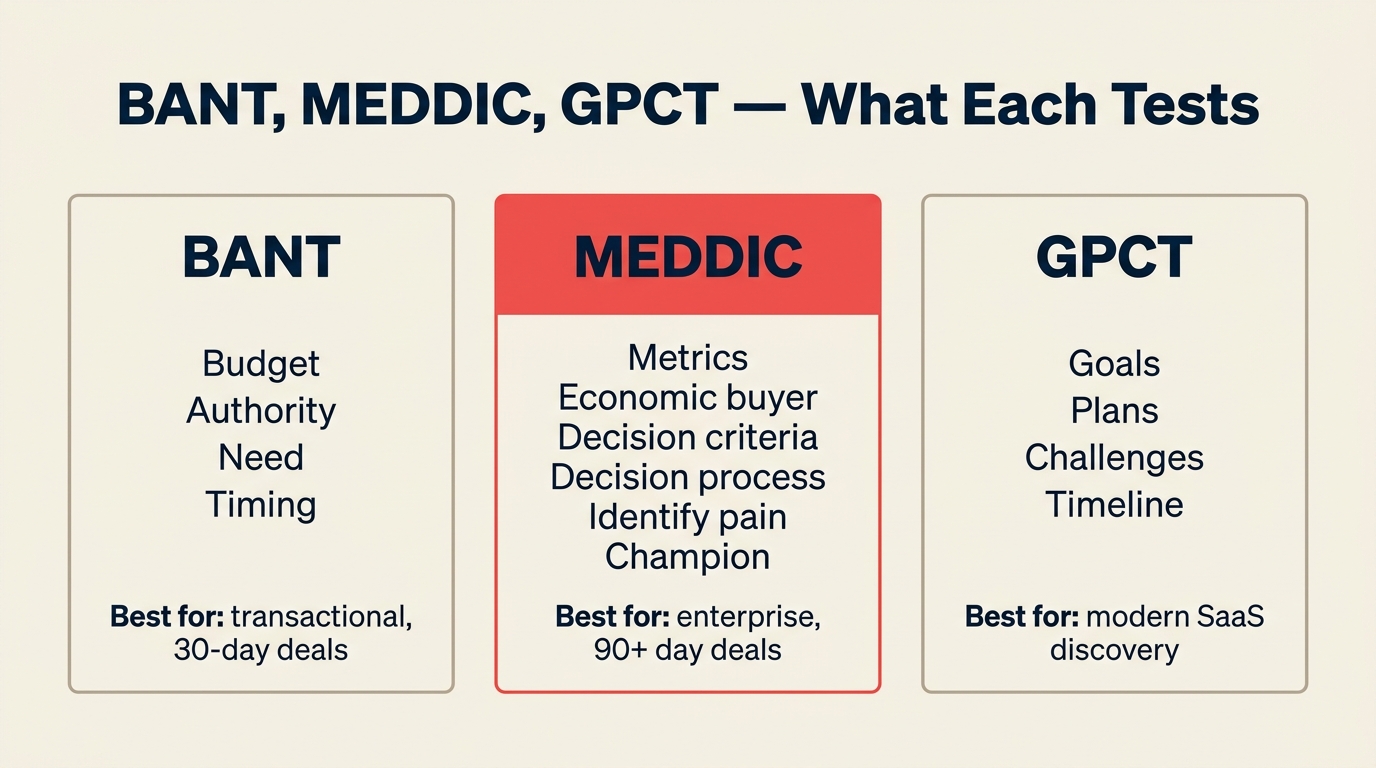
Before picking a framework, know what question each one is actually answering.
BANT: Budget, Authority, Need, Timeline
BANT asks: does this prospect have money, decision power, a problem to solve, and a deadline? It's designed for transactional sales where the buyer already knows they want something and your job is to confirm they're a real buyer. Works well for inside sales, SMB deals under 30 days, and situations where one person controls the decision.
Where it fails: complex deals where budget doesn't exist yet (it gets created as part of the justification process), authority is distributed across a buying committee, and timeline is "when we get approval" rather than a fixed date.
MEDDIC: Metrics, Economic Buyer, Decision Criteria, Decision Process, Identify Pain, Champion
MEDDIC asks: can you quantify the problem, have you met the person who signs, do you know how they decide, have you mapped the process, is the pain real enough to drive action, and do you have someone inside who wants you to win? It's designed for complex enterprise sales with long cycles and multiple stakeholders.
Where it excels: deals with 3+ stakeholders, cycles over 60 days, large contract values where losing is expensive, and organizations with formal procurement processes.
GPCT: Goals, Plans, Challenges, Timeline
GPCT asks: what is the buyer trying to achieve, what have they already tried, what's in the way, and when do they need results? It's designed for inbound, consultative selling where the rep is helping the buyer articulate a problem and build a business case, not just responding to an existing RFP.
Where it excels: inbound deals where the buyer hasn't fully defined their problem, consultative sales motions, deals where your value is helping them think through the solution, not just the product.
SPICED: Situation, Pain, Impact, Critical Event, Decision
SPICED is a newer framework built around customer success outcomes. It adds "Impact" (quantifiable business outcome) and "Critical Event" (the external deadline that makes the deal urgent) to a more traditional qualification model. Designed for SaaS companies where retention and expansion matter as much as the initial close.
Where it excels: expansion and upsell motions, deals where your champion needs to justify ROI internally, product-led growth companies moving upmarket.
Step 2: Match Framework to Deal Type
Use this decision matrix. Find your average deal size on the left and your average stakeholder count across the top, then read across.
| Deal Size / Cycle | 1 Stakeholder | 2-3 Stakeholders | 4+ Stakeholders |
|---|---|---|---|
| Under $10K / Under 30 days | BANT | BANT or GPCT | GPCT |
| $10K-$50K / 30-90 days | GPCT | GPCT or SPICED | MEDDIC (lite) |
| $50K-$150K / 60-120 days | SPICED | MEDDIC or SPICED | MEDDIC |
| $150K+ / 90+ days | MEDDIC | MEDDIC | MEDDIC |
A few overrides to this matrix:
- If you sell to a technical buyer who isn't the economic buyer, use MEDDIC regardless of deal size. Separating "the person who wants it" from "the person who signs" is MEDDIC's core value.
- If your buyer is still in problem definition mode, use GPCT even if the deal is large. Trying to apply MEDDIC before the buyer has articulated their goals is like trying to negotiate a contract during discovery.
- If you're selling to a company that recently adopted your category (first-time buyer), SPICED helps you anchor the conversation around outcomes they care about proving.
Step 3: Embed the Framework in Discovery Calls
The biggest failure mode for every qualification framework is this: reps learn the acronym in a training session, then ask five rapid-fire questions at the end of a call to "complete MEDDIC." Buyers hate it. It sounds like a checklist being read aloud. McKinsey research on B2B sales performance consistently shows that top-performing reps spend significantly more time in discovery than average reps. Not because they have more questions, but because they listen better and let qualification information emerge naturally from the conversation.
The goal is to surface qualification information through conversation, not interrogation.
Here are 5 questions that surface MEDDIC naturally:
- "What's driving the priority around this right now?" (surfaces Identified Pain and timeline)
- "Walk me through how a decision like this typically gets made at your company." (surfaces Decision Process and Economic Buyer)
- "Who else is involved in solving this problem, and what do they care most about?" (surfaces Champion and Decision Criteria)
- "If you fix this, what does success look like in 6 months? What number moves?" (surfaces Metrics)
- "Is there someone internally who's the biggest advocate for solving this problem? What are they saying to leadership about it?" (surfaces Champion quality)
None of these sound like a qualification checklist. All of them give you MEDDIC data. Write these into your discovery call guide, practice them in role play, and coach reps to listen for the answers rather than move to the next question.
Step 4: Build Qualification Fields Into Your CRM
Qualification only helps you if the data lives somewhere managers can see it. If your team is mid-migration between platforms, the Rework vs. Salesforce and Rework vs. HubSpot CRM breakdowns cover how each tool handles custom qualification fields and deal-level scoring natively. The challenge is deciding what becomes a CRM field versus what stays in call notes.
Make CRM fields for the things you'll filter and report on:
In HubSpot: create custom deal properties for Economic Buyer (name + title), Decision Process (dropdown: informal, committee, formal procurement), Identified Pain (text), and Qualification Score (number 0-10).
In Salesforce: use the standard MEDDIC fields or install a MEDDIC plugin. At minimum, create custom fields for Economic Buyer Confirmed (checkbox), Champion Name, Decision Criteria (text), and Decision Timeline (date).
In Pipedrive: use custom fields on the deal record. Create a "Qualification Completeness" field (percentage) that sales managers can filter on in pipeline view.
Keep in notes (not fields):
Specific objections. Exact language the buyer used to describe their pain. The story behind why this is urgent now. These are valuable for deal coaching but don't need to live in a structured field.
The rule: if you want to sort your pipeline by it or include it in a report, make it a field. If it's context that helps you coach a specific deal, it can live in notes.
Step 5: Use Qualification as a Disqualification Tool
This is where most sales teams leave money on the table. The discipline of disqualifying early is closely tied to how cleanly your pipeline stages are defined. When entry criteria are observable facts rather than gut calls, it's much easier to say "this deal doesn't belong here yet." Qualification frameworks are taught as ways to find deals worth working. But their highest-leverage use is identifying deals you should stop working.
Every hour your rep spends on an unwinnable deal is an hour not spent on a winnable one. The cost of a mis-qualified deal isn't just the lost revenue. It's the opportunity cost of the good deals that got less attention.
Clear disqualification signals by framework:
BANT disqualifiers: No budget exists and no path to creating one in this fiscal year. The person you're talking to explicitly says they're not involved in the decision.
MEDDIC disqualifiers: You cannot identify a champion (someone with organizational influence who actively wants you to win and will coach you through the process). The economic buyer has never been made available to you after multiple requests. You've been in the deal for 6+ weeks and still don't know the decision criteria.
GPCT/SPICED disqualifiers: The buyer has no defined goals tied to the problem you solve. There's no critical event driving urgency. They say they want to solve this "at some point."
When you spot these, have a direct conversation with the buyer: "Based on what we've discussed, I want to be honest. I'm not sure this is the right time for us to be talking. Here's what I'm not seeing..." A deal that surfaces honest feedback early is more valuable than one that drags through your pipeline for three months before dying.
Step 6: Score Qualification Completeness on Each Deal
Beyond choosing a framework, you need a way to quantify how well-qualified each deal is. This is what managers use in pipeline reviews to prioritize conversations.
A simple 0-10 qualification score works like this. Each MEDDIC element gets 0, 1, or 2 points:
| Element | 0 = Not Known | 1 = Partially Confirmed | 2 = Fully Confirmed |
|---|---|---|---|
| Metrics | Unknown | Directional goal stated | Specific number and timeline |
| Economic Buyer | Not identified | Name known, not engaged | Met and confirmed authority |
| Decision Criteria | Not known | General criteria stated | Specific written criteria |
| Decision Process | Not known | General process described | Steps, timeline, committee mapped |
| Identified Pain | None surfaced | Problem acknowledged | Quantified impact stated |
| Champion | Not identified | Someone friendly identified | Active coach inside account |
A deal scoring 10-12 is well-qualified. 7-9 is advancing but has gaps. Below 7, a manager should ask whether the deal belongs in the pipeline at all.
This score goes into your CRM as a custom field. Managers filter the pipeline view by qualification score before weekly reviews, so the conversation focuses on gaps rather than status updates. If you're setting up these custom fields for the first time, the CRM data model design guide walks through how to structure deal-level fields so qualification scores are reportable without cluttering the deal view.
Step 7: Train Reps Through Deal Reviews, Not Classroom Sessions
Frameworks don't stick from training. They stick from repeated application to real deals with a manager coaching in real time. The weekly pipeline review is where this coaching actually happens. The MEDDIC challenge format works best when it's embedded directly into that recurring cadence rather than treated as a separate event.
The best qualification training happens in weekly pipeline reviews. When a rep presents a deal, the manager asks: "Walk me through the MEDDIC on this." The rep answers. The manager pushes back on gaps: "You said the CFO is the economic buyer. Have you actually been in a meeting with her, or is that an assumption?" That exchange, repeated weekly, teaches qualification better than any onboarding module.
In Salesforce and HubSpot, you can build deal coaching templates that surface the MEDDIC fields directly in the deal record view. Reps see the gaps every time they open the deal. Managers see the same gaps during review.
Some teams use a "MEDDIC challenge" format: once a month, a rep presents a complex deal to the whole team and the team asks MEDDIC questions as a group. The rep who answers all of them completely usually wins the deal. The ones who can't usually don't.
Common Pitfalls
Over-qualifying small deals. Running full MEDDIC on a $3,000 SMB deal with a 14-day cycle creates overhead that slows the sale. Teams considering a switch to a lighter CRM often find that the tooling mismatch (not the framework itself) is what made qualification feel heavy. Match framework intensity to deal complexity.
Using MEDDIC as a checkbox, not a conversation. If reps are filling in MEDDIC fields after the call from memory, they're guessing. The information needs to come out in a discovery conversation, not be entered retrospectively to satisfy a manager.
Skipping Economic Buyer identification in SMB deals. It "feels too formal" to ask who has final sign-off at a 15-person company. But SMB deals die at the end because someone who wasn't in any of the conversations needs to approve. Identify the economic buyer in every deal, regardless of size.
Switching frameworks mid-quarter. Changing from BANT to MEDDIC mid-quarter means your pipeline data is inconsistent and your reps are re-qualifying everything. Pick one, implement it, and measure for a full quarter before changing.
What to Do Next
Pick one framework based on your deal matrix above. Don't run a pilot with MEDDIC on some deals and GPCT on others. You won't learn anything useful.
Run it for a full quarter. Track one metric: late-stage conversion rate (from your second-to-last stage to close). If it improves, you've got signal. If it doesn't, look at whether reps are actually applying the framework in discovery calls or just updating CRM fields after the fact.
The most common reason frameworks fail is implementation, not selection. A well-run BANT process beats a poorly-run MEDDIC process every time. Wikipedia's overview of the MEDDIC framework provides useful background on the origin and evolution of each element for teams rolling this out for the first time and needing shared vocabulary across the sales team.
Learn More

On this page
- Step 1: Understand What Each Framework Actually Tests
- Step 2: Match Framework to Deal Type
- Step 3: Embed the Framework in Discovery Calls
- Step 4: Build Qualification Fields Into Your CRM
- Step 5: Use Qualification as a Disqualification Tool
- Step 6: Score Qualification Completeness on Each Deal
- Step 7: Train Reps Through Deal Reviews, Not Classroom Sessions
- Common Pitfalls
- What to Do Next
- Learn More