More in
Sales Process Guide
Pipeline Stage Definitions That Actually Match the Buying Journey
Sep 24, 2026
The SDR-to-AE Handoff: How to Write It Down So It Actually Works
Apr 18, 2026
Deal Desk Basics: How Smaller Sales Teams Can Approve and Close Faster
Apr 18, 2026
Commit, Best Case, Pipeline: Defining Forecast Terms Your Whole Team Uses the Same Way
Apr 18, 2026
Win/Loss Analysis Without the Bias: A Repeatable Process for Sales Teams
Apr 18, 2026
Building a Sales Process One Deal Type at a Time
Apr 18, 2026
Multi-Threading Deals Without Annoying Your Champion
Apr 18, 2026
The Mid-Pipeline Slump: How to Diagnose and Fix Stalled Deals
Apr 18, 2026
Mutual Action Plans: When They Help and When They Hurt
Apr 18, 2026
Sales Operating Cadence: From Daily Stand-Up to Quarterly QBR
Apr 18, 2026
Lost Deal Reviews That Lead to Improvement
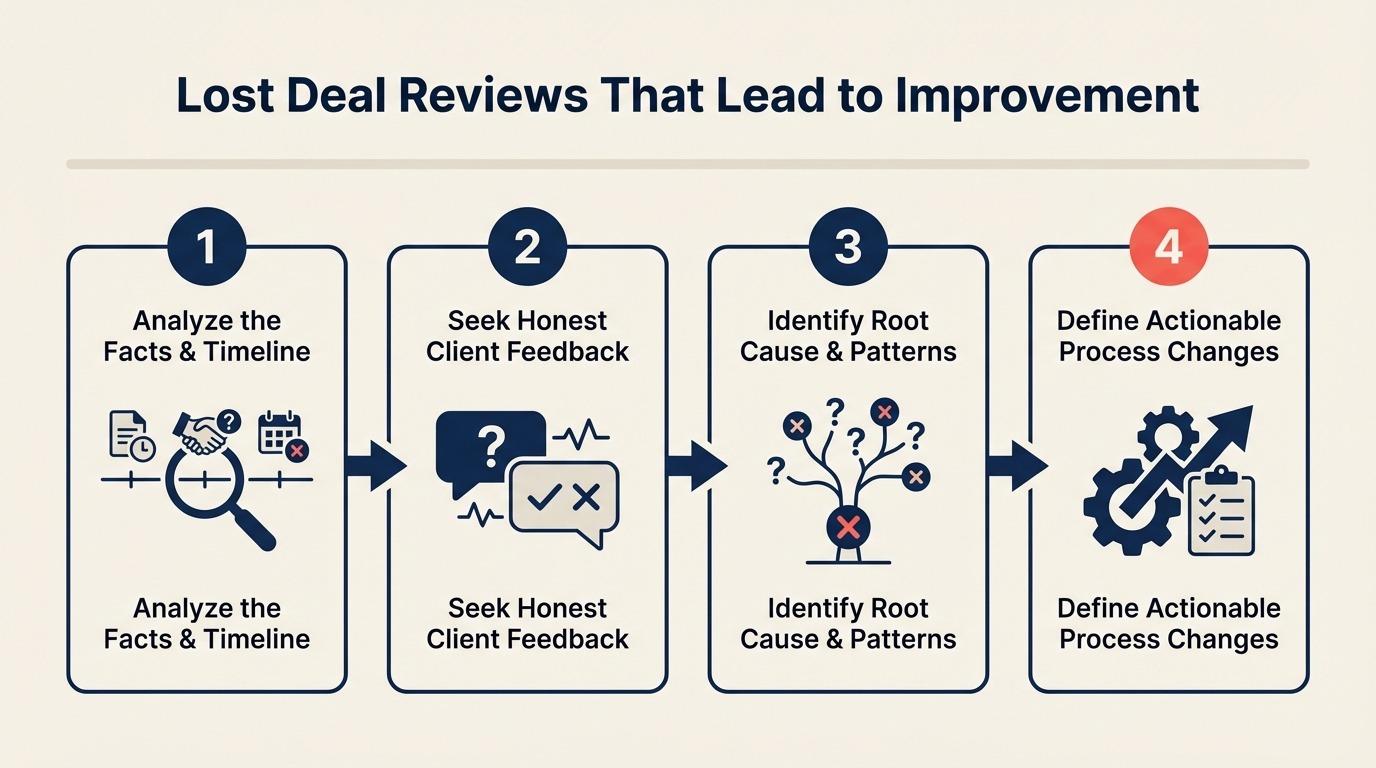
Turn this article into takeaways for your work.


Each assistant summarizes the article only for you and suggests best practices for your work.
A mid-market software company had been losing a specific type of deal for eight months. The pattern was clear in hindsight: enterprise procurement teams were stalling deals in the contract phase by invoking a security review requirement that hadn't come up earlier. Reps kept logging these losses as "procurement delays" or "no budget" and moving on. This pattern is exactly what a well-run sales playbook is supposed to capture and prevent. But only if the playbook gets updated when deals are lost.
One day a sales manager ran an actual lost deal review on one of these losses. Not a 10-minute CRM cleanup, but a structured 30-minute session asking the right questions. They found the answer in 20 minutes: nobody was introducing IT security into the deal before the contract phase. The buyer's security team had blockers that were entirely solvable, but only if surfaced before the 11th hour. The next three deals with similar profiles included an IT security call in week 3. All three closed.
That's what a real lost deal review is for.
Most lost deal reviews don't work because they're designed to explain why you lost, not to understand what you should do differently next time. "They went with a cheaper option." "The champion left." "Timing wasn't right." These aren't insights. They're rationalizations with CRM fields. A real review asks what the rep did, where the process failed, and what changes before the next similar deal. Harvard Business Review research on win/loss analysis found that most organizations never formally debrief lost deals, and those that do tend to collect rationalization from reps rather than buyer-side perspective, which produces systematically wrong conclusions. Gartner estimates that less than 30% of B2B organizations conduct formal win/loss analysis, leaving the majority without a systematic feedback loop on why competitive deals are lost.
Step 1: Select the Right Lost Deals to Review
Not every lost deal deserves a formal review. Running reviews on every loss creates overhead without proportional learning. Here's the criteria for which deals to prioritize:
Deal size above threshold. Set a minimum deal size for formal review (typically your average ACV or above). Losing a $1,200 SMB deal to a competitor doesn't warrant 30 minutes of structured analysis. Losing a $45,000 enterprise deal does.
Pattern matches. If you've lost 3 or more deals with similar characteristics (same industry, same objection, same competitor, same stage where things fell apart), those deals warrant review even if individual deal size is modest. Patterns are where process improvements live.
Deals the team expected to win. When a deal that was in "Commit" or "Best Case" doesn't close, that's a signal that something in your qualification or forecasting process failed. These losses are best understood alongside your forecast cadence data. If commits are missing consistently, the problem is usually in how deals enter the commit category, not just in how they're worked. These are high-learning deals regardless of size.
Recent losses. Details fade fast. A deal closed last week has 10x more learnable information than a deal closed three months ago. Review within 5 business days of the loss being logged.
Skip deals where the loss reason is genuinely external and non-recurring: a company-wide budget freeze, an unexpected acquisition, a key buyer leaving with no pattern. These teach you less than process-related losses.
Step 2: Require a 5-Field Post-Mortem in CRM Before the Meeting
A lost deal review where the rep hasn't prepared is 30 minutes of reconstructed memory and rationalization. Before the meeting happens, require the rep to fill in five fields in the CRM deal record:
Post-mortem field template:
Lost reason (specific): Not a dropdown. Write a full sentence. Not "pricing" but "Buyer cited our price was 28% above their other finalist; they had explicit budget cap we didn't uncover until week 6."
Decision timeline (actual): When did the buyer actually make their decision? Not when they told you they'd decide, but when the deal was actually over. This often surfaces a gap between when you thought you were winning and when the buyer had already moved on.
Competitors involved: Who else was in the deal? If unknown, write "unknown." That's also a signal that you weren't inside enough to know.
Last meaningful buyer action: The last thing the buyer did that showed genuine engagement. This usually tells you exactly when momentum stopped.
Rep's honest assessment: What's the one thing you would do differently in week 1 of a similar deal? This isn't about blame. It's about the rep's own post-sale clarity. The best reps know exactly where they'd do something different.
These five fields take 10-15 minutes for the rep to fill in honestly. Send the request the same day the loss is logged. If reps get in the habit of filling these in immediately, you'll build a dataset of losses that's actually useful for trend analysis.
Step 3: The 6-Question Review Framework
The review framework keeps the conversation focused on evidence, so the team learns from the loss instead of debating impressions.
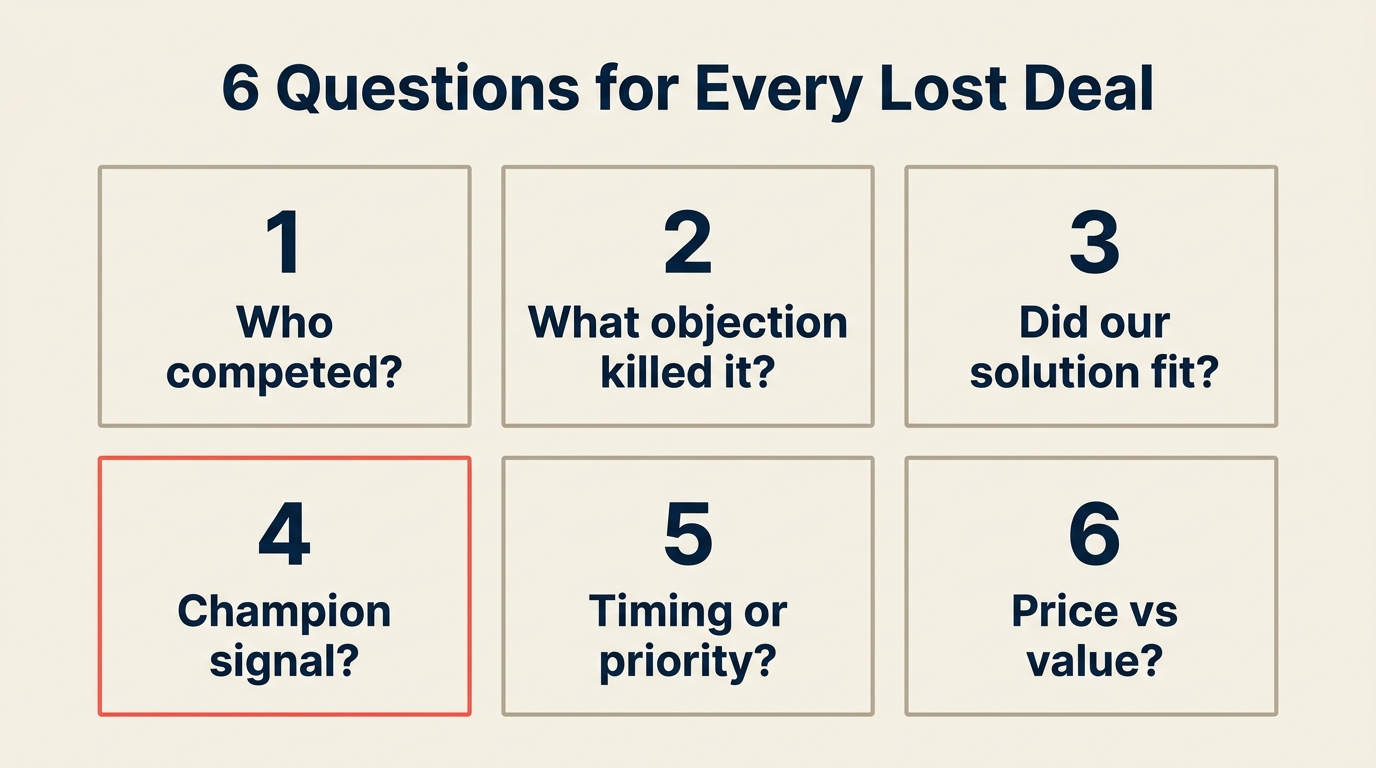
The review itself runs 25-30 minutes maximum. Use these six questions in order. Don't skip to the end.
Question 1: When did we actually lose this deal?
Not when the buyer told you they went with someone else. When did you actually lose? This is usually 2-4 weeks earlier than the formal notification. Look at the timeline: when did response times slow down? When did meeting requests start getting declined? When was the last time the buyer initiated contact?
Understanding the real loss point tells you where in your process the problem lives. If you lost at week 3 but didn't know until week 8, you have a deal visibility problem. If you lost at week 7 during technical evaluation, you have a technical win problem.
Question 2: What did the buyer's champion tell you vs. what actually happened?
Every deal has someone who was supposed to be pulling for you internally. What did they tell you? And what does the outcome suggest was actually happening? This question surfaces two things: how good your champion actually was, and whether you have a reliable way to test champion quality during an active deal.
Question 3: Where in the pipeline did you lose control of the process?
"Lose control" means a specific moment: a point after which the buyer's timeline and actions stopped being predictable or influenced by your process. This question is much easier to answer if your pipeline stages use observable entry and exit criteria. Vague stages make it impossible to pinpoint a loss moment with any precision. In enterprise deals, this often happens when procurement takes over from the business buyer. In mid-market deals, it often happens when a new stakeholder enters late.
Identifying this moment tells you what stage in your pipeline needs better exit criteria.
Question 4: What did the competitor do that you didn't?
This isn't about product features. It's about the sales motion: Did they run a business case workshop you didn't run? Did they meet with the CFO when you didn't? Did they provide a security review package proactively? Did they offer a paid pilot when you insisted on a full commitment? McKinsey's analysis of B2B sales winners and losers found that how you sell is often as decisive as what you sell. Buyers consistently cited process and responsiveness as key differentiators even when product capabilities were similar.
These are process and positioning questions, not product questions. They're the ones that generate actionable changes.
Question 5: What would you do differently in week 1 of a similar deal?
Force specificity here. Not "I'd qualify harder" but "I'd ask for the economic buyer to be on the first call, and I'd send a mutual action plan before the second meeting." The answer to this question is the output you're looking for.
Question 6: What process or enablement change would prevent this pattern?
This is the question that separates a deal review from a coaching session. It's not about what the rep would do differently. It's about what the team or the system should do differently. New discovery question. New security questionnaire introduced in stage 3. New rule requiring economic buyer engagement before "Proposal" stage entry.
If the answer to this question is "nothing, it was a one-off," and you've seen the pattern three times, you're not being honest about patterns.
Step 4: Separate Pattern Losses from One-Offs
After you've run the 6-question review, make a judgment: is this a pattern loss or a one-off?
Pattern losses have at least two of these characteristics: you've seen the same root cause in 2+ other deals, the loss point is in the same pipeline stage, the same objection or competitor appears, or the same gap in your process contributed.
One-off losses have a unique combination of circumstances that's unlikely to repeat: specific buyer situation, unique competitor offer, timing coincidence, or stakeholder departure.
Only patterns deserve process changes. Changing your qualification process because one deal had an unusual procurement situation creates overhead without reducing future losses. But if procurement surprises have killed 4 deals this year, that's a process problem.
Keep a running log of pattern losses. The pattern becomes visible only when you're looking across multiple reviews, not within a single one.
Step 5: Document the Change Commitment
A lost deal review that doesn't end in a specific change commitment is just group therapy. Before anyone leaves the room, write down one thing that changes before next month.
Action log template:
| Change | Owner | Deadline | What "Done" Looks Like |
|---|---|---|---|
| Add IT security intro to deal checklist at Stage 3 | Sales Ops | April 15 | Field in CRM, added to pipeline entry criteria doc |
| New discovery question: "Walk me through your security review process" | Manager | April 8 | Added to discovery call guide, practiced in next role play |
| CFO engagement required before Proposal stage advance | VP Sales | April 10 | Updated stage exit criteria doc, communicated to team |
The change doesn't have to be big. Small, concrete changes implemented quickly are worth more than comprehensive process overhauls that take three months to build and never ship.
One change per review. If you have five good ideas, pick the one that would have changed the outcome of this specific deal. Do that one first.
Step 6: Win/Loss Analysis Across a Quarter
Individual reviews give you deal-level insight. Quarterly aggregation gives you system-level insight.
At the end of each quarter, pull together all the loss records and look for patterns across:
- Which pipeline stages had the highest loss rates?
- Which competitors appeared most frequently and what did you lose to them on?
- Which objections recurred?
- Which industry segments or company sizes had the highest loss rates?
- Did reps who used qualification frameworks have lower late-stage loss rates?
This 60-minute quarterly exercise can produce the most actionable insights your sales leadership team will see all year. According to Forrester, organizations that conduct structured win/loss reviews at least quarterly show measurably higher quota attainment than those that review losses informally or not at all. Build a simple spreadsheet that aggregates lost reason, loss stage, competitor, deal size, and rep across all reviewed deals. Combine it with your weekly pipeline review data to see whether the deals you reviewed in-flight match the ones you later lost in post-mortem. That gap reveals your forecast blind spots.
If you're using HubSpot, build a saved report on closed-lost deals with those fields visible. In Salesforce, the Opportunity Reports section has standard win/loss views you can customize. In Pipedrive, export your lost deals to a spreadsheet and run basic pivot tables. Teams that find their CRM reporting too limiting for this kind of quarterly analysis sometimes compare options before their next renewal, since the flexibility of custom loss-reason fields varies significantly across platforms.
The patterns you'll find are usually predictable once you see them: one competitor owns a specific objection, one stage is leakier than it looks, one industry segment is being sold to wrong.
Common Pitfalls
Reviewing too many deals. If you run formal reviews on every loss, the quality degrades. Focus on the deals above threshold and the pattern matches.
Not involving the losing rep. Some managers run lost deal reviews without the rep who worked the deal. This is a mistake. The rep has context the CRM doesn't capture. And a rep who isn't part of the review won't internalize the findings.
Letting it turn into a pipeline review. It's tempting to start asking about other deals the rep is working. Keep the focus on the lost deal you're reviewing. The pipeline review has its own meeting.
Making no changes and repeating the review. If you run a lost deal review, identify a pattern, write it up, and then do nothing different before the next similar deal, you've trained your team that reviews are performative. The change commitment is not optional.
What to Do Next
Schedule 30-minute lost deal reviews for every deal above your threshold, same day they're marked lost in the CRM. Set a recurring calendar invitation that triggers the moment a deal closes lost above size. If you're also thinking about how to structure your CRM to capture loss reasons in a way that supports quarterly analysis, the CRM data model design guide covers how to build deal record fields that make win/loss reporting reliable rather than an export-and-pivot exercise.
For the first month, don't try to generate systemic changes. Just run the reviews and fill in the post-mortem fields. Build the habit and the data. In month two, start looking for the first pattern. In month three, make the first process change.
The compound effect of consistent loss reviews is slow at first. After six months, teams that do this consistently start seeing fewer late-stage surprises. The findings from loss reviews also directly inform what goes into your qualification frameworks. The MEDDIC disqualifiers that matter most for your specific market usually come from patterns you'll only see after six months of structured loss data. After a year, they can name the three or four specific patterns that drive most of their losses, and they have processes for each one.
Learn More

On this page
- Step 1: Select the Right Lost Deals to Review
- Step 2: Require a 5-Field Post-Mortem in CRM Before the Meeting
- Step 3: The 6-Question Review Framework
- Step 4: Separate Pattern Losses from One-Offs
- Step 5: Document the Change Commitment
- Step 6: Win/Loss Analysis Across a Quarter
- Common Pitfalls
- What to Do Next
- Learn More