More in
Sales Process Guide
Pipeline Stage Definitions That Actually Match the Buying Journey
Sep 24, 2026
The SDR-to-AE Handoff: How to Write It Down So It Actually Works
Apr 18, 2026
Deal Desk Basics: How Smaller Sales Teams Can Approve and Close Faster
Apr 18, 2026
Commit, Best Case, Pipeline: Defining Forecast Terms Your Whole Team Uses the Same Way
Apr 18, 2026
Win/Loss Analysis Without the Bias: A Repeatable Process for Sales Teams
Apr 18, 2026
Building a Sales Process One Deal Type at a Time
Apr 18, 2026
Multi-Threading Deals Without Annoying Your Champion
Apr 18, 2026
The Mid-Pipeline Slump: How to Diagnose and Fix Stalled Deals
Apr 18, 2026
Mutual Action Plans: When They Help and When They Hurt
Apr 18, 2026
Sales Operating Cadence: From Daily Stand-Up to Quarterly QBR
Apr 18, 2026
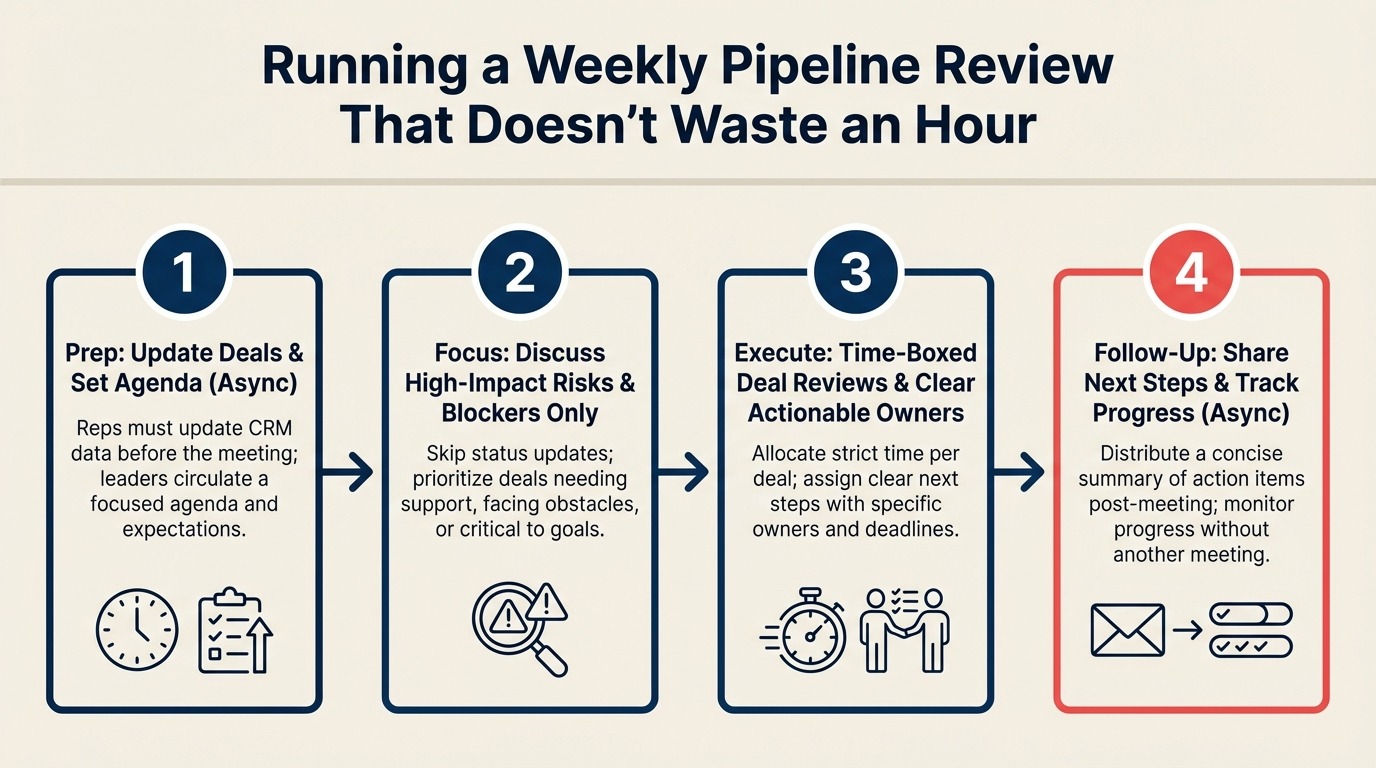
Running a Weekly Pipeline Review That Doesn't Waste an Hour
Turn this article into takeaways for your work.


Each assistant summarizes the article only for you and suggests best practices for your work.
Ask a rep what they're thinking during a pipeline review and you'll hear some version of this: "I'm hoping he doesn't ask about the Johnson deal. I'm going to say the same thing I said last week and hope it sounds different." That rep is not disengaged. They're responding rationally to a meeting format that doesn't actually help them close deals. Research from the Sales Management Association found that companies with effective pipeline management practices grew revenue 15% faster than those without. McKinsey's analysis of high-performing B2B sales teams similarly found that structured review cadences (where managers coach deal-by-deal rather than reviewing aggregate pipeline numbers) were a consistent differentiator between top- and bottom-quartile sales organizations. But the key word is "effective," which rules out the status-update format most teams still run.
The standard pipeline review has a structural problem. It's designed like a status update: rep talks about where each deal is, manager nods or asks a follow-up, meeting ends with no clear commitments. The rep leaves with the same list of deals and no new information. The manager leaves with a slightly better mental model of the pipeline but nothing actionable.
This format replaces that. It runs in 30 minutes, focuses on deal movement rather than deal status, and ends with documented next actions. Reps don't dread it because it's actually useful to them, not just to you.
Step 1: Pre-Work That Makes the Meeting Possible
The review can't work if the CRM data is wrong. Before anyone shows up, require reps to update five fields for every deal they'll bring to the meeting:
5-field CRM pre-work checklist:
- Stage: Is the deal in the right stage based on actual buyer behavior this week?
- Close date: Based on the buyer's stated timeline, not wishful thinking. If it slipped, update it.
- Next buyer action: Not what the rep is doing next, but what the buyer has committed to doing. "Buyer to send back legal redlines by Friday" is a next buyer action. "I'm going to follow up" is not.
- Last meaningful buyer action: The most recent thing the buyer did that demonstrated active engagement. A read receipt on an email doesn't count.
- Forecast category: Commit, Best Case, or Pipeline. This is the rep's honest call, not the manager's wish.
Send a reminder the evening before with those five fields. Make it clear: if a deal isn't updated before the meeting starts, it doesn't get discussed. That's not a punishment. It's a signal that the deal isn't real enough to deserve group attention. If you want the qualification score to surface in this pre-work view, the MEDDIC scoring approach gives you a simple 0-10 field that managers can filter on before the meeting starts.
In HubSpot, build a saved filter view with these five fields visible in list mode so reps can prep directly in the CRM. In Salesforce, use a custom report that surfaces these fields sorted by close date. In Pipedrive, the activity view plus deal fields works fine for small teams. If your team is evaluating whether your current CRM supports this kind of review well, the Rework vs. HubSpot CRM comparison covers pipeline view and deal field customization directly.
Step 2: The 3-Deal-Type Agenda Structure
The agenda works because it limits the meeting to deals that need a management decision, not every opportunity in the pipeline.
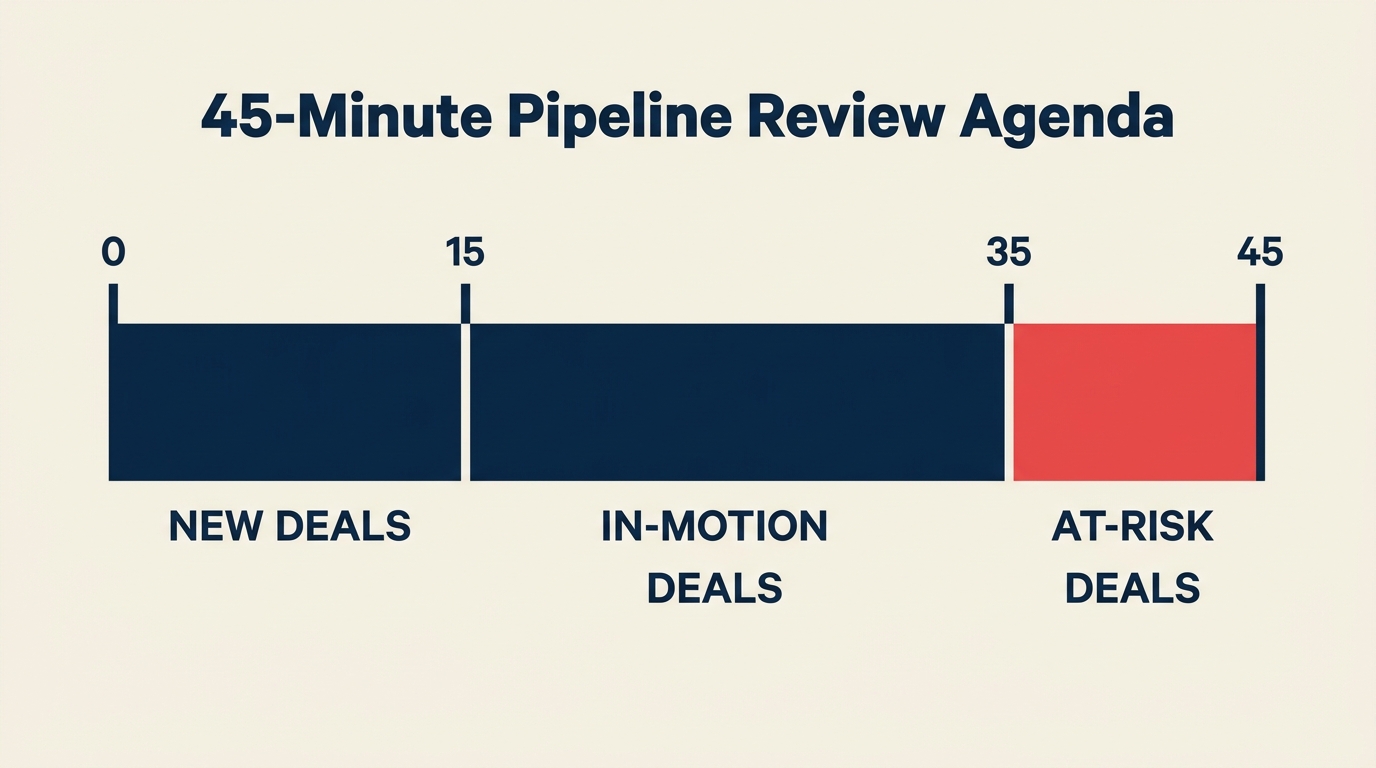
The meeting is 30 minutes, not 60. The way to hit that target is by only discussing three types of deals and capping each category:
Commits (10 minutes): Deals the rep has said will close this period. Any commit that's at risk gets 3-5 minutes of focused problem-solving. Any commit that's on track gets 60 seconds of confirmation.
Best Cases (10 minutes): Deals that could close this period if something goes right. For each one: what would need to happen this week to advance this to commit? That's the only question worth asking.
Stuck Deals (10 minutes): Deals that haven't had meaningful buyer engagement in 14+ days. These either need a specific recovery action or a stage downgrade. You're not reviewing every deal in the pipeline, just the ones with a decision to make.
Everything else (early-stage deals, nurture-track deals, anything without a close date this quarter) doesn't get time in the meeting. Managers who try to review the full pipeline in one meeting train their reps to give shallow answers on everything rather than deep thinking on the things that matter.
Step 3: The 4 Questions That Replace Status Updates
Replace "what's the status on the Acme deal?" with these four questions. They force forward-looking answers instead of backward-looking recaps.
Question 1: What happened since last week? This sounds similar to a status update but isn't. You're asking specifically about buyer-side actions, not rep-side actions. If the rep says "I sent a follow-up email," that's not an answer. If they say "the buyer's legal team sent back redlines on the MSA," that's an answer.
Question 2: What's the buyer's next committed action? Not what the rep plans to do. What has the buyer agreed to do, and by when? If there's no buyer-committed next step, the deal has no momentum. That's the problem to solve in this meeting.
Question 3: What's at risk? This is the most important question and the one most managers skip because the answer is uncomfortable. Ask it directly and don't let the rep off the hook with "I think we're in good shape." Push for a specific risk: Is the budget confirmed? Is the economic buyer still engaged? Has a competitor entered?
Question 4: What do you need from me? End every deal review with this. Sometimes reps need a manager to join a call. Sometimes they need an introduction to a connection in the account. Sometimes they just need permission to offer a discount to close before quarter end. If you don't ask, you don't find out.
These four questions fit in 3-5 minutes per deal. That's why the math works: 2-3 commits, 2-3 best cases, 2-3 stuck deals at 3-5 minutes each gets you to 25-30 minutes.
Step 4: The 14-Day Deal Progression Rule
Any deal with no buyer-committed action completed in the last 14 days gets a stage downgrade, not a pass. This rule only holds if your pipeline stages have observable entry criteria. If stages are ambiguous, reps can argue a deal "technically qualifies" to avoid the downgrade conversation. Forrester research on B2B sales velocity shows that deals where the buyer goes silent for more than 14 days close at a dramatically lower rate than deals where next steps are mutually agreed and followed through on schedule.
This is the rule most managers resist because it feels harsh. But a deal that hasn't moved in two weeks isn't in the stage you put it in. It's in an earlier stage. Keeping it in a later stage makes your pipeline look healthier than it is and destroys forecast accuracy.
The downgrade isn't a punishment. It's a recalibration. When you move a deal from "Proposal" back to "Evaluating," you're saying the buyer stopped acting like they're comparing proposals. They're back to evaluating whether to solve this problem at all.
That's useful information. It changes what the rep does next. Instead of following up on a proposal, they go back to discovery and find out what changed.
Apply the rule consistently. If you make exceptions for specific reps or specific deals, the rule collapses. Every rep will have a reason their deal is the exception.
Step 5: Manager vs. Rep Roles in the Room
The most common failure mode in pipeline reviews is the manager narrating the CRM while the rep sits silently. The manager pulls up a deal, reads off the stage and close date, asks a clarifying question, gets an answer, moves to the next deal. This takes an hour and teaches the rep nothing.
The correct role split:
The rep's job: Come prepared with updated CRM data. Describe the deal status using buyer actions, not internal activities. Have a clear point of view on what's at risk and what's needed.
The manager's job: Ask questions. Do not narrate or summarize. Hold the framework (the 4 questions). Make a decision on stuck deals: recovery plan or stage downgrade. Assign yourself action items when the rep needs your help.
Managers who do the talking make reps passive. Reps who do the talking develop deal instincts. After six months of good reviews, reps start self-coaching before they walk into the room because they know what questions are coming.
If your review format has the manager doing most of the talking, it's not a pipeline review. It's a forecast update with an audience.
Step 6: Document Outcomes in 5 Minutes
The last five minutes of every review are for documentation. Don't skip this. What doesn't get written down doesn't get followed up on.
Post-review update template (takes 3-4 minutes):
For each deal discussed, update the CRM immediately after the meeting (not at end of day):
- Next buyer action: Updated with what the buyer committed to this week
- Manager action: Any introduction, call, approval, or resource the manager committed to providing
- Forecast category: Updated if it changed during the meeting
- Red flag tag: Apply a red flag marker in the CRM to any deal that surfaced a real risk
- Deal note: One sentence summarizing what was decided in the meeting (example: "Agreed to move to Best Case pending CFO intro by Thursday")
In HubSpot, use deal notes and activity logging. In Salesforce, use the Chatter feed on the deal record and update the forecast category field. In Close, the built-in activity view makes this fast. In Pipedrive, use the deal detail notes field.
The documentation should take under 5 minutes because the meeting was focused. If you're writing paragraphs in notes after every review, something went wrong in the meeting itself.
Step 7: What Happens to Missed Commits
The hardest conversation in any pipeline review is the one about last week's missed commit. A rep said they'd close a deal. It didn't close. How you handle this determines whether your forecast means anything.
The accountability conversation is not a blame session. It's a diagnostic: "You called this as a commit last week. It didn't close. What happened?" Then you listen. The answer falls into one of three categories:
Buyer-side delay: Something changed with the buyer: budget freeze, stakeholder departure, competing priority. This is common and usually outside the rep's control. The right response is to figure out what the path forward looks like.
Rep-side over-optimism: The rep committed to something they didn't have clear evidence for. The right response is to understand what signals they were reading wrong and coach on what evidence actually supports a commit call.
Process failure: Something in your system failed: a legal review took too long, an approval got stuck, a technical evaluation wasn't completed. The right response is to fix the process, not coach the rep.
Getting to the right diagnosis means asking what actually happened, not assuming. Reps who get blamed for buyer-side delays start sandbagging. Reps who get coached on over-optimism get better at qualification. Know which conversation you're having. And when a missed commit follows the same pattern twice, escalate it to a formal lost deal review rather than handling it only in the weekly meeting. The structured format surfaces root causes that a 5-minute pipeline conversation won't.
Common Pitfalls
Reviewing every deal instead of the right deals. If you have 30 deals in the pipeline and 45 minutes, you'll spend 1.5 minutes per deal and learn nothing. Pick the 8-10 deals that need a decision or have a risk this week.
Letting reps present without CRM prep. If reps can walk in without updating their data, the review is based on memory rather than facts. Enforce the pre-work requirement.
No follow-through on action items. If the manager commits to an introduction or a call and then doesn't do it, the rep stops trusting the review as useful. Manager accountability matters as much as rep accountability.
Making the review a performance assessment. Pipeline reviews are about deals, not about the rep's overall performance. If you find that most of your review time is going toward rationalizing misses rather than fixing them, building a proper lost deal review process alongside the weekly review is what converts those conversations into systemic changes. Reps who fear that a missed commit will become a performance conversation start hiding bad news. And bad news that surfaces late is much more expensive than bad news that surfaces early.
What to Do Next
Run this format for four consecutive weeks before judging it. Track two metrics:
- Average meeting length: Are you hitting 30-35 minutes? If not, you're probably reviewing too many deals or the manager is doing too much of the talking.
- Forecast accuracy: Compare what you called at the start of each week to what actually closed. Track the delta. If it's improving over four weeks, the format is working. If it's not, look at whether the buyer-committed next action field is being filled in honestly. The forecast cadence guide covers the mechanics of moving from a weekly to a bi-weekly or monthly cadence once your review format is stable.
After four weeks, share the results with your team. Reps who see that the format is improving accuracy and deal quality will adopt it. Those who see no change will tell you what's still broken.
Learn More

Co-Founder, Rework.com
On this page
- Step 1: Pre-Work That Makes the Meeting Possible
- Step 2: The 3-Deal-Type Agenda Structure
- Step 3: The 4 Questions That Replace Status Updates
- Step 4: The 14-Day Deal Progression Rule
- Step 5: Manager vs. Rep Roles in the Room
- Step 6: Document Outcomes in 5 Minutes
- Step 7: What Happens to Missed Commits
- Common Pitfalls
- What to Do Next
- Learn More