More in
Sales Process Guide
Pipeline Stage Definitions That Actually Match the Buying Journey
Sep 24, 2026
The SDR-to-AE Handoff: How to Write It Down So It Actually Works
Apr 18, 2026
Deal Desk Basics: How Smaller Sales Teams Can Approve and Close Faster
Apr 18, 2026
Commit, Best Case, Pipeline: Defining Forecast Terms Your Whole Team Uses the Same Way
Apr 18, 2026
Win/Loss Analysis Without the Bias: A Repeatable Process for Sales Teams
Apr 18, 2026
Building a Sales Process One Deal Type at a Time
Apr 18, 2026
Multi-Threading Deals Without Annoying Your Champion
Apr 18, 2026
The Mid-Pipeline Slump: How to Diagnose and Fix Stalled Deals
Apr 18, 2026
Mutual Action Plans: When They Help and When They Hurt
Apr 18, 2026
Sales Operating Cadence: From Daily Stand-Up to Quarterly QBR
Apr 18, 2026 · Currently reading
Sales Operating Cadence: From Daily Stand-Up to Quarterly QBR
Turn this article into takeaways for your work.


Each assistant summarizes the article only for you and suggests best practices for your work.
Most sales teams have meetings. Fewer have a cadence. The difference is whether each meeting exists to surface information that improves a specific decision, or whether it exists because it always has.
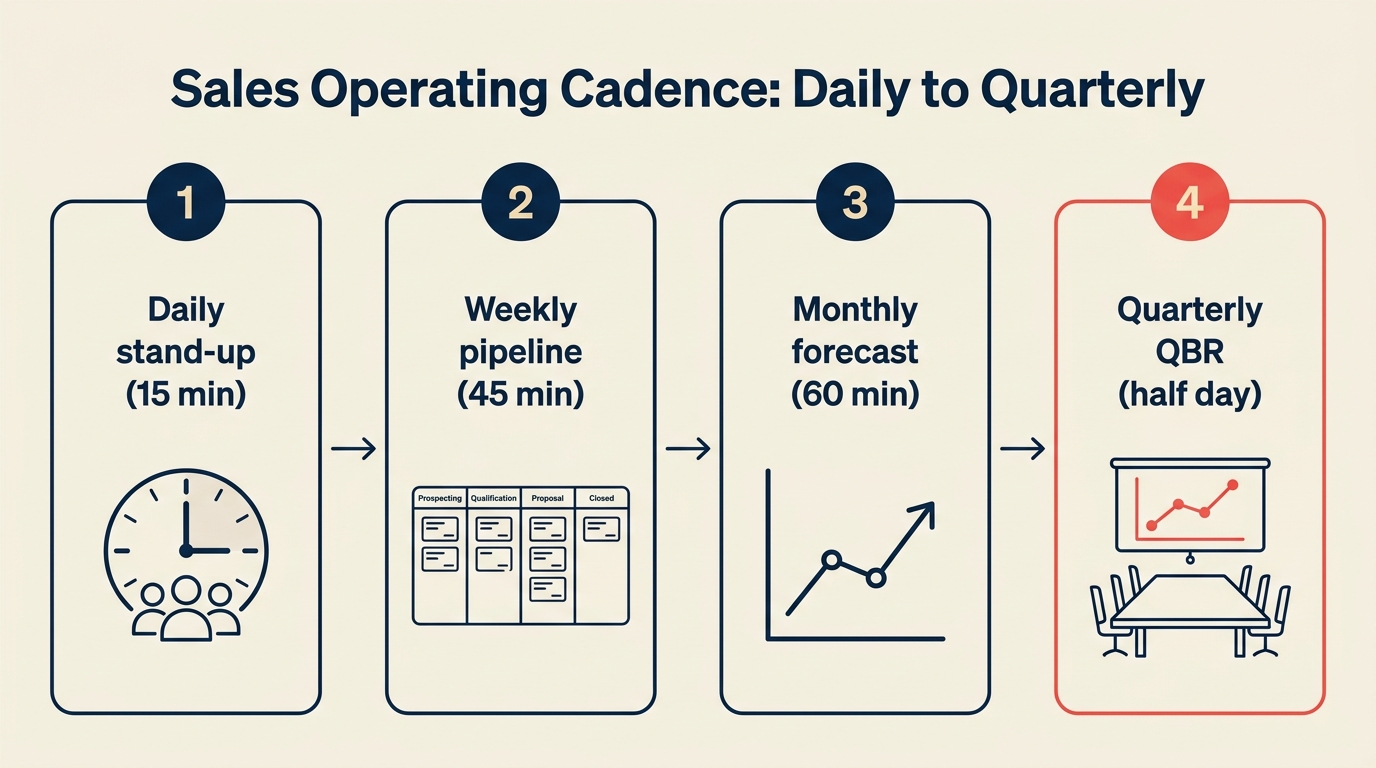
A well-designed operating cadence takes about 6-8 hours of structured time per week for a sales manager and eliminates most of the ad hoc "quick calls" that fragment everyone's selling time. McKinsey research on sales force productivity found that structured management cadences are among the top predictors of quota attainment, with teams operating a consistent review rhythm outperforming peers by 20–25%. It also creates a feedback loop: what happens in the daily stand-up feeds the weekly pipeline review. The weekly review feeds the monthly business review. The monthly review feeds the quarterly QBR. Information flows up. Decisions and coaching flow down.
An undesigned cadence looks different: a weekly pipeline call nobody prepares for, a monthly review that covers the same topics as the pipeline call, and a QBR that's 90% PowerPoint slides and 10% actual decisions. Then everyone fills the gaps with Slack messages and impromptu Zoom calls that interrupt actual selling.
Here's how to design a cadence that works.
The Four Cadence Levels (and What Each One Is For)
Each cadence level should own a different management decision, otherwise meetings blur together and the team repeats the same update four times.
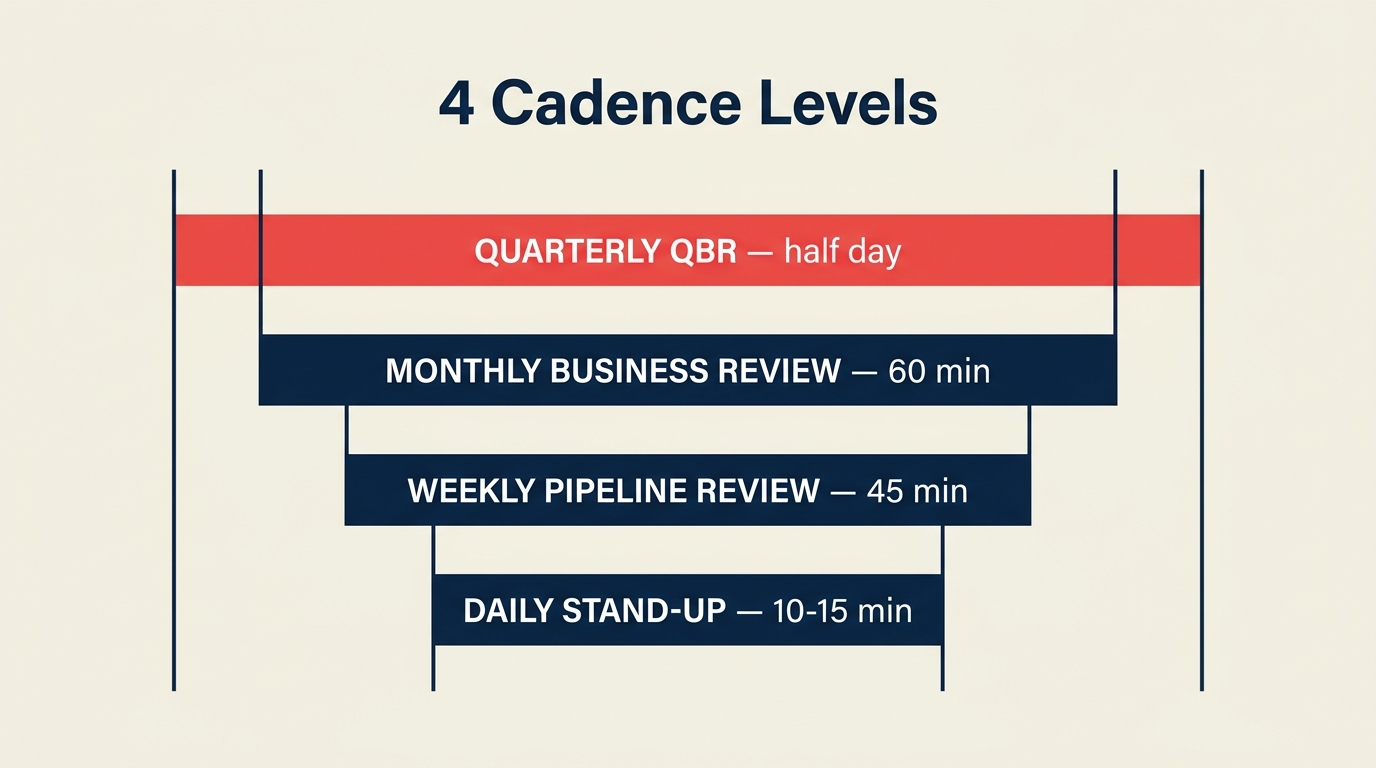
Before designing any individual meeting, define what decision each level of the cadence is responsible for.
Daily: Keeps individuals accountable to their daily commitments. Surfaces same-day blockers that the manager can remove before they cost a full day.
Weekly: Improves individual deals and updates the forecast. Identifies deals that need coaching or escalation before they stall.
Monthly: Reviews business-level performance trends. Identifies systemic patterns across the team that don't show up in individual deal reviews.
Quarterly: Evaluates strategy, calibrates goals, and makes structural decisions (territory, staffing, process changes) that are too significant for a weekly meeting but too important to defer.
If you can't articulate which decision a meeting is responsible for, that meeting probably shouldn't exist. Every slot in the cadence should be defensible.
Level 1: Daily Stand-Up (10-15 Minutes)
The daily stand-up is the most commonly implemented and most commonly abused meeting in sales. When it works, it creates daily accountability and surfaces blockers early. When it fails, it's a 40-minute status update that annoys everyone.
The three questions a daily stand-up answers:
- What did you commit to yesterday, and did you do it?
- What are your top 2-3 priorities today?
- Is there anything blocking you that the manager needs to address?
That's it. Not "how does your pipeline look?" Not "where are you on your quota?" Those belong in weekly reviews.
Format:
- Stand-up (literally or figuratively). Sitting down makes it drift longer
- Each rep answers the three questions: 60-90 seconds
- Manager notes blockers and addresses them after the stand-up, not during
- 10 minutes is the target; 15 is the ceiling
Who runs it: The manager or a designated team lead. Not a rotating responsibility. Consistency matters for the format.
When to skip it: If the team is remote and asynchronous, a daily Slack update format can replace the call. If it's consistently running over 20 minutes, something is wrong. Either the questions are too broad or reps are solving problems in the meeting instead of flagging them.
When it's non-negotiable: First day of a new month. Last day before a major close deadline. Any day when the team is behind on a key number.
Level 2: Weekly 1:1 (30 Minutes Per Rep)
The weekly 1:1 is where individual development happens. It's the manager's best tool for catching problems early, both deal problems and rep development problems, before they compound.
The most common mistake: turning 1:1s into status updates. If the rep is just telling you what's in the CRM, you're wasting half an hour on both sides. Gartner's research on frontline sales management found that managers who dedicate at least 50% of 1:1 time to skill coaching rather than deal updates produce reps with 23% higher quota attainment over a 12-month period. The pipeline review handles deal status; the 1:1 is for coaching. If you're struggling to separate the two, the productive one-on-ones guide has a framework that works across sales and non-sales contexts.
1:1 structure (30 minutes):
10 min: Deal coaching Pick one deal that's stuck or risky. Run the diagnostic: what's the actual problem, what's the plan, what does the rep need from you? Don't review all deals. That's the pipeline meeting. Pick the one that most needs attention.
10 min: Skill development One specific skill to work on this week. Connect it to something concrete from the rep's recent calls or pipeline movement. "You mentioned the CFO pushed back on ROI. Let's practice that specific objection for five minutes."
10 min: Career/energy check How is the rep doing? Are they energized or grinding? What's working? What's frustrating them? This is the part most managers skip and most reps value most.
What managers get wrong about 1:1s:
- Letting reps cancel them when pipeline is light (that's when they need them most)
- Using them only for pipeline updates (that's what the pipeline review is for)
- Making them prescriptive: "here's what you should do" instead of asking questions
Level 3: Weekly Pipeline Review (30-45 Minutes)
The weekly pipeline review is where forecast accuracy is built and deals get coaching at scale. It's designed for the manager to see the team's pipeline holistically, identify deals that need intervention, and update the week's forecast.
This meeting deserves its own detailed treatment. For the format and prep requirements, see Running a weekly pipeline review that doesn't waste an hour.
How it feeds into the cadence:
- Forecast categories updated in this meeting feed the VP's roll-up
- Deals flagged here become coaching topics in the weekly 1:1s
- Patterns observed here (multiple deals stalling at the same stage) feed the monthly review
Prep requirement: Reps update their CRM before the meeting. Not during. Not after. Before.
Level 4: Monthly Business Review (60-90 Minutes)
The monthly business review (MBR) is where the team steps back from individual deals and looks at business-level trends. It's distinct from the pipeline review: the pipeline review is about what's happening this week; the MBR is about what's happening this month and what it means for next quarter.
Who attends: Sales manager plus any direct reports who are managers themselves. Optionally, sales ops or the VP if the team is small.
MBR structure:
15 min: Month performance review Actual vs. target for the month. Win rate by deal type. Pipeline coverage entering next month. Not a narrative, just the numbers with brief commentary.
20 min: Trend identification What's changed from last month? Win rate up or down? Cycle length trending longer? Stage conversion dropping at a specific stage? The goal is to find patterns, not defend results. If you see stage conversion drop consistently, the mid-pipeline slump diagnostic provides a root cause framework that's worth running at the team level, not just on individual deals.
20 min: Pipeline quality review How healthy is next month's and next quarter's pipeline? Is there enough coverage? Where are the gaps? What needs to happen in the next 30 days to hit next month's number?
20 min: Process or coaching priorities Based on the trends, what's the focus for next month? A specific stage conversion problem, a qualification issue, a competitive response? One or two priorities, not a list of seven.
10 min: Decisions and owners What decisions were made in this meeting? Who owns what? What gets communicated to the team?
The four outputs the MBR should produce:
- A clear picture of next month's forecast
- One or two systemic issues identified (not just rep-level issues)
- Agreed coaching priorities for the next 30 days
- One process change or experiment to run
Level 5: Quarterly QBR (Half Day)
The quarterly business review is where strategy is evaluated and structural decisions are made. Done right, it's the most valuable meeting of the quarter. Done wrong, it's four hours of PowerPoint that everyone endures and nothing changes.
The structure that makes QBRs valuable:
Before the QBR: Each rep (or team lead) prepares a 10-15 minute presentation covering:
- Their quarter's results vs. target
- Their analysis of what drove the outcomes (wins and losses), ideally informed by win/loss analysis data, not just self-reported CRM loss reasons
- Their pipeline entering next quarter
- One thing they want to change in how they work
This is rep-led, not manager-summarized. Reps presenting their own results is more accurate, more accountable, and more developmental than managers presenting summaries.
In the QBR room:
Morning (3 hours):
- Team results reviewed collectively: overall attainment, deal type breakdown, win rate trends
- Individual presentations: 10-15 min per rep (if team is large, focus on top performers and bottom performers)
- Competitive landscape update: what's changed, what are buyers saying
Afternoon (1-2 hours):
- Next quarter planning: target discussion, pipeline coverage review, key accounts and deals to watch
- Process changes: what's being adjusted based on the MBR findings from the past quarter
- Individual goals: each rep states their Q2 focus (one word or phrase, not a list)
- Decision log: what was decided in this room and who owns what
What gets decided in the room:
- Territory or account assignments for next quarter
- Process changes or experiment rollouts
- Quota adjustments (if applicable)
- Headcount planning inputs for the VP
- Coaching priorities for the next quarter
A QBR without decisions is a presentation. Make sure the last 30 minutes produce a written decision log.
Connecting the Cadence: How Information Flows
The value of the cadence is in how the levels connect, not just in running each meeting well individually.
Daily → Weekly pipeline review: The daily stand-up surfaces same-day blockers. Deals that had blockers this week show up in the pipeline review as deals needing attention. The manager already knows the context from the stand-ups.
Weekly 1:1 → Pipeline review: Deal coaching in the 1:1 prepares the rep for the pipeline review conversation. The rep arrives having already thought through their stuck deals with the manager.
Weekly pipeline review → MBR: Month-over-month trends in win rate, stage conversion, and pipeline coverage are visible because four weeks of pipeline data have been reviewed and recorded.
MBR → QBR: Three months of MBR findings roll up into the QBR. Pattern analysis is already done. The QBR focuses on strategy and decisions, not on discovering what happened.
Sample Weekly Calendar (Sales Manager)
| Time | Activity |
|---|---|
| Monday 9:00-9:15am | Daily stand-up |
| Monday 2:00-3:30pm | Weekly pipeline review |
| Tuesday-Thursday | 1:1s (30 min each rep, scheduled) |
| Tuesday 9:00-9:15am | Daily stand-up |
| Wednesday 9:00-9:15am | Daily stand-up |
| Thursday 9:00-9:15am | Daily stand-up |
| Friday 9:00-9:15am | Daily stand-up |
This schedule totals approximately 6.5 hours of cadence meetings per week for a manager with 5 direct reports. Selling time for the manager remains intact.
For reps, cadence participation is approximately 2.5-3 hours per week (stand-ups + pipeline review + their own 1:1), which leaves 80%+ of the week for selling.
Common Pitfalls
QBRs that are PowerPoint presentations with no decisions. If the last 30 minutes of a QBR don't produce a written decision log, the meeting didn't justify the half-day. Protect the afternoon session for decisions.
1:1s that become status updates. "Tell me about your pipeline" is a status update question. "What's the one deal you're most worried about this week and why?" is a coaching question. The second one produces more value.
Daily stand-ups that run 45 minutes. This is a facilitation failure, not a participation failure. The manager's job is to protect the format: three questions, 60-90 seconds per person, blockers handled offline. Every time a stand-up turns into a deal discussion, the format erodes.
Skipping MBRs when the team is behind. The instinct to cancel the MBR when the month is behind and "everyone should be selling" is backwards. The MBR is where you identify what's wrong and make decisions about how to fix it. Skipping it when you're behind means you're flying blind.
Forrester's research on revenue operations maturity identifies consistent business reviews as a core indicator of RevOps maturity, with higher-maturity teams being significantly better at identifying systemic pipeline problems before they affect quarterly results.
What to Do Next
Audit your current recurring meetings against this framework. Harvard Business Review's research on meeting effectiveness found that unnecessary or poorly structured meetings cost the average organization 15% of total personnel time, with sales teams disproportionately affected because of the direct opportunity cost in selling hours.
List every recurring meeting you run or attend. For each one, answer: What decision does this meeting improve? If you can't answer that clearly, the meeting is a candidate for elimination or restructuring.
Then identify: which of the five cadence levels is missing from your current schedule? Most teams have pipeline reviews but lack effective 1:1s. Or they have QBRs but no monthly business review to feed them.
Start by adding one level, not all five at once. Add the level that produces the most information you're currently missing. Run it consistently for six weeks before judging its impact.
The cadence only works if it's consistent. A pipeline review that happens sometimes is worse than no pipeline review, because it creates the illusion of a process without the discipline of one. For first-time sales leaders building this from scratch, the first 90 days for a sales leader outlines a sequencing approach for when to implement which cadence levels as your team grows.
Learn More

Head of Enterprise Solutions
On this page
- The Four Cadence Levels (and What Each One Is For)
- Level 1: Daily Stand-Up (10-15 Minutes)
- Level 2: Weekly 1:1 (30 Minutes Per Rep)
- Level 3: Weekly Pipeline Review (30-45 Minutes)
- Level 4: Monthly Business Review (60-90 Minutes)
- Level 5: Quarterly QBR (Half Day)
- Connecting the Cadence: How Information Flows
- Sample Weekly Calendar (Sales Manager)
- Common Pitfalls
- What to Do Next