Transferencia de Contexto del Trato: Lo Que CS Necesita Saber Que Sales Nunca Escribe
Turn this article into takeaways for your work.


Each assistant summarizes the article only for you and suggests best practices for your work.
Imagine que es un CSM que se prepara para una llamada de kickoff con un nuevo cliente. La noche anterior revisó el registro de oportunidad en el CRM. Conoce el ACV, la fecha de cierre, los productos que compraron y los dos contactos que firmaron el contrato. Conoce el tamaño de la empresa y el sector. Se siente razonablemente preparado.
Entonces, diez minutos en la llamada, el cliente menciona que la razón principal por la que compraron fue para reemplazar un proceso que falló públicamente el trimestre pasado, y que el VP de Operaciones que impulsó el trato está bajo una presión interna significativa para mostrar resultados en 60 días. La relación con el proveedor anterior terminó mal. Hay un ejecutivo (que no está en la llamada) que votó en contra de la compra y estará observando de cerca cualquier problema de implementación.
Nada de eso estaba en el CRM. Todo ello habría cambiado completamente cómo abrió esa llamada.
Este es el problema del contexto del trato. Los datos estructurados (lo que está en el CRM) capturan los hechos de un trato. El contexto no estructurado (lo que está en la cabeza del AE) captura la realidad de la cuenta. La brecha entre ambos es donde los onboardings se estancan, las expectativas se rompen y los champions se callan en los primeros 90 días. El blog de Forrester sobre pasar la estafeta de Sales a CS describe esta transferencia de conocimiento como el paso más importante que les falta a los equipos de CS. Una disciplina relacionada es la lista de verificación de documentación de handoff, que cubre lo que la transición de marketing a ventas debería capturar antes de que el trato siquiera comience.
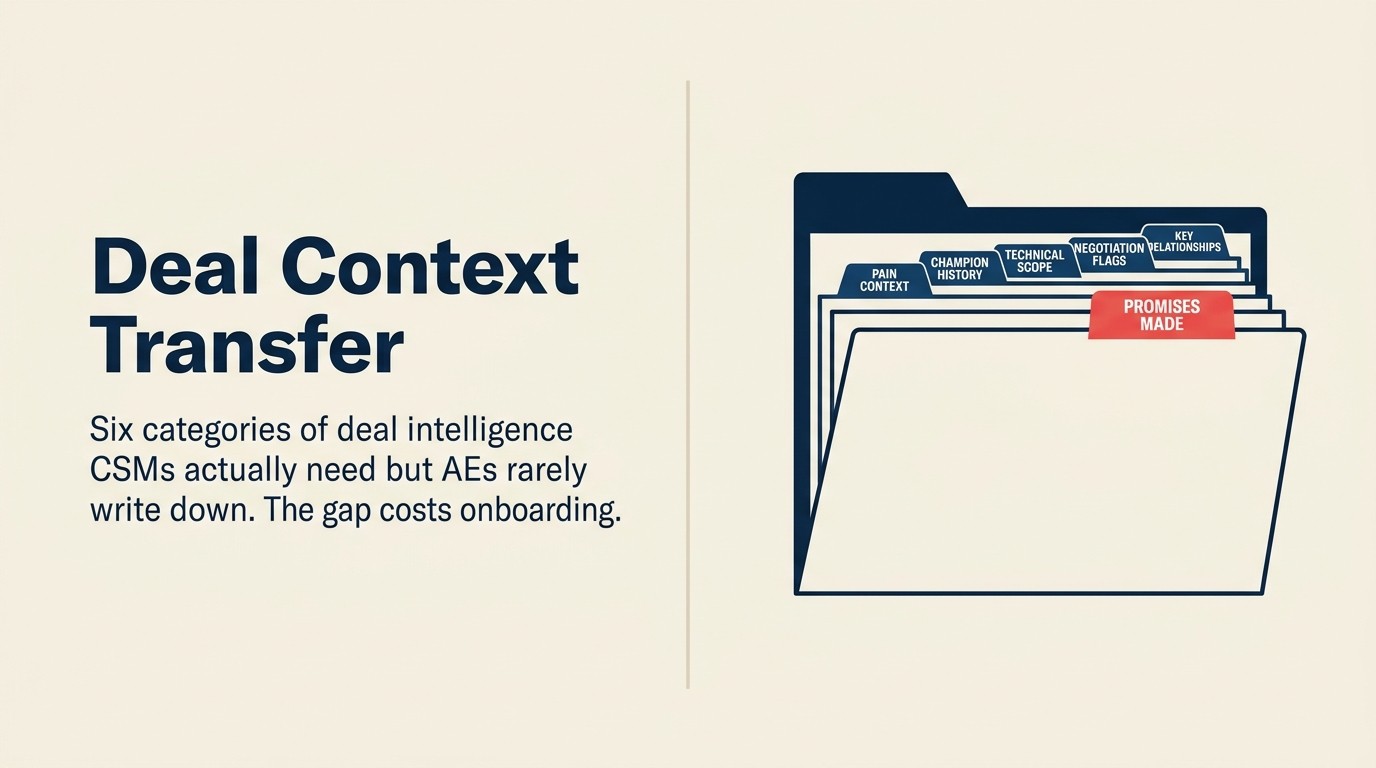
Las 6 Categorías de Contexto del Trato es la taxonomía que este artículo usa para cerrar la brecha entre lo que está en el CRM y lo que CS realmente necesita. Las seis categorías (motivación de compra, perfil del champion, promesas y compromisos, señales de alerta, panorama político, criterios de éxito) corresponden a las seis preguntas que todo CSM necesita ver respondidas antes de un kickoff. Si falta cualquiera de ellas, el CSM entra con un punto ciego que sale a la superficie en los primeros 90 días.
Dos Tipos de Conocimiento del Trato
"El 63% de los CSM afirman que el mayor obstáculo para un kickoff sólido es no saber lo suficiente sobre lo que ocurrió en el ciclo de ventas, por encima de los conflictos de agenda, las limitaciones del producto o las brechas en los recursos de onboarding. El contexto es la restricción, no la capacidad." (Totango, 2024)
Cada trato produce dos tipos de conocimiento, y solo uno de ellos vive en su CRM.
Los datos estructurados son todo lo que el sistema captura: nombre de la empresa, información de contacto, valor del contrato, productos comprados, fecha de cierre, historial de etapas del trato, quizás algunas entradas del registro de actividad. Son precisos, consultables y están disponibles para cualquiera con acceso al CRM. Pero le dicen qué ocurrió administrativamente. No por qué, no cómo, no quién.
El contexto no estructurado es lo que el AE sabe por haber trabajado el trato durante semanas o meses. La motivación detrás de la compra, no el caso de uso declarado, sino la razón real por la que compraron. La dinámica política: quién lo impulsó, quién se resistió, quién está observando la implementación. Los compromisos adquiridos informalmente que nunca llegaron al contrato. La objeción que seguía reapareciendo y se manejó de una manera que puede no sostenerse en el onboarding.
La brecha entre los datos estructurados y el contexto no estructurado es enorme. Y como es invisible (el CSM no sabe lo que no sabe), entra en las llamadas de kickoff con una confianza falsa. Se siente preparado porque leyó el CRM. No está preparado para la conversación que realmente está a punto de tener. Entonces, ¿qué es exactamente lo que falta?
Datos Clave: La Brecha de Contexto y Sus Consecuencias
- Los CSM que reciben una transferencia completa del contexto del trato (no solo datos del CRM) construyen credibilidad con los clientes 3,1 veces más rápido en los primeros 30 días, según los benchmarks GTM 2024 de Winning by Design.
- El 63% de los CSM afirman que el mayor obstáculo para un kickoff sólido es "no saber suficiente sobre lo que ocurrió en el ciclo de ventas", por encima de los conflictos de agenda, las limitaciones del producto o las brechas en los recursos de onboarding (Totango, 2024).
- Los fallos de onboarding atribuidos a desajustes de expectativas establecidos en el ciclo de ventas representan el 41% del churn del primer año en el SaaS mid-market, más que los problemas de encaje con el producto o las pérdidas ante competidores juntos (Bain & Company, 2023).
Las Seis Categorías de Contexto Que CS Realmente Necesita
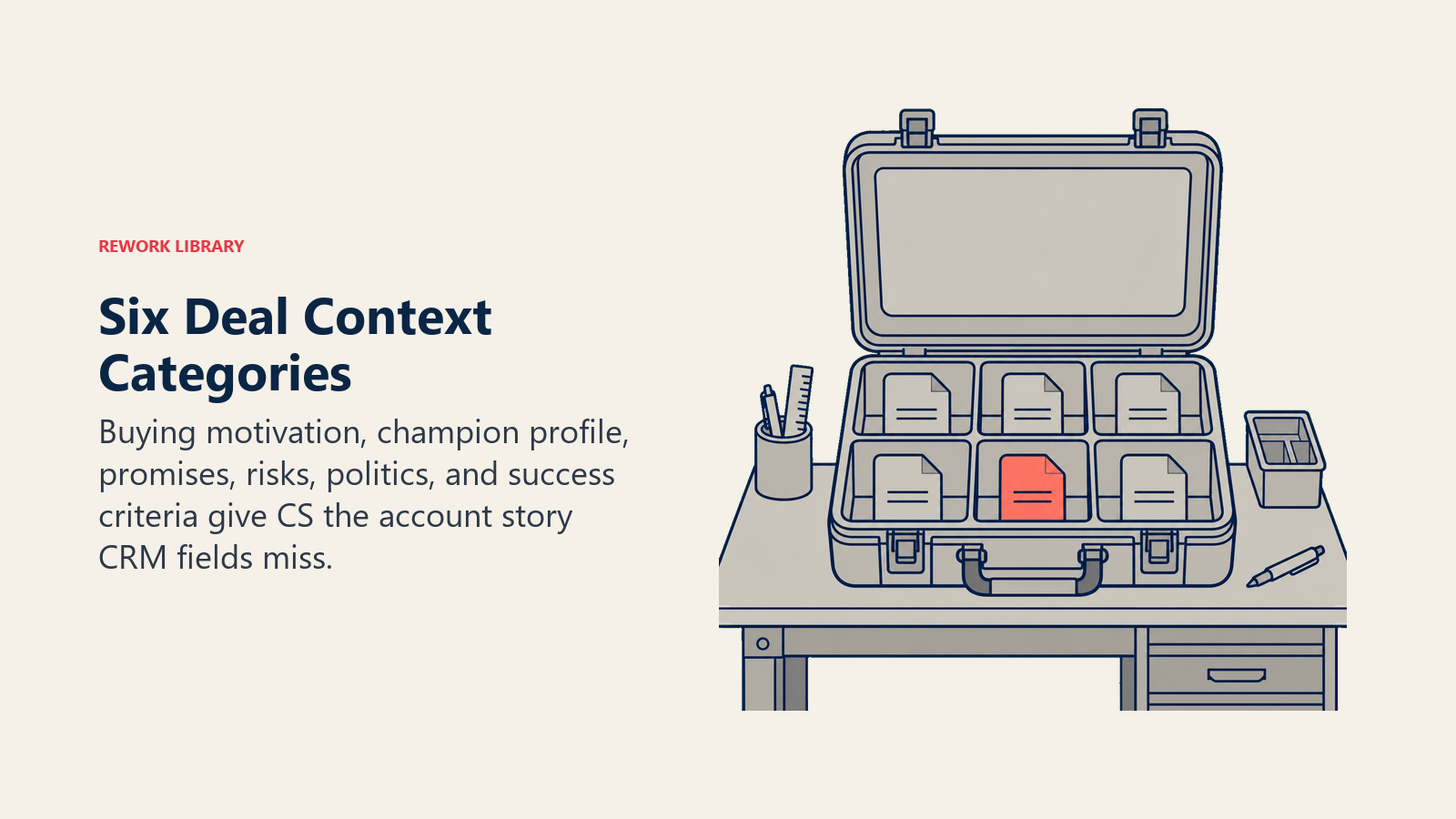
No todo el contexto no estructurado tiene el mismo valor. Estas seis categorías cubren lo que más importa para el CSM que entra a un kickoff y los primeros 90 días de una cuenta.
Categoría 1: Motivación de compra: la razón real por la que compraron
El caso de uso declarado en el CRM suele ser la versión oficial: "mejorar la visibilidad del Pipeline," "optimizar el proceso de onboarding," "consolidar nuestra pila tecnológica." La razón real suele ser más específica y más urgente: "nuestro CRO le dio al equipo un trimestre para mostrar mejoras o perderíamos headcount," o "la plataforma anterior falló durante un período crítico y el VP está buscando un proveedor que realmente responda."
La motivación real le dice al CSM qué está tratando de proteger o demostrar el cliente. Ese contexto moldea cada conversación desde el kickoff hasta la renovación.
Categoría 2: Perfil del champion: quién impulsó el trato internamente y qué está en juego para ellos
El champion no siempre es el comprador económico o el contacto principal. Es la persona que abogó internamente, construyó el business case y convenció a otros stakeholders. Tiene credibilidad personal invertida en que la implementación tenga éxito.
Lo que CS necesita saber: el nombre del champion, su título, qué está tratando de lograr personalmente y qué le ocurre si la implementación falla. Ese es el sustrato emocional de la cuenta. El CSM que lo entiende puede proteger al champion; el que no lo conoce solo lo conoce como un nombre en una cadena de correos.
Categoría 3: Promesas y compromisos: lo que se dijo y que CS debe honrar
Los ciclos de ventas implican mucha conversación. No toda llega a los contratos. Cuando el AE le dijo al cliente "probablemente podamos tener esa integración lista en sus primeros 30 días," ese compromiso no aparece en el contrato, pero el cliente lo escuchó y cuenta con ello.
Esta es la categoría de mayor riesgo para el churn temprano. Los clientes que encuentran compromisos incumplidos en el onboarding normalmente no cancelan de inmediato. Se callan. Se desvinculan del proceso de onboarding. Dejan de responder al CSM. Y en el mes 6, cuando el CSM pregunta por qué la adopción es baja, el cliente dice "nos dijeron que haría X y no lo hace." La investigación de Bain sobre por qué falla el customer success en el software identifica las expectativas incumplidas del ciclo de ventas como un impulsor principal del churn del primer año en el software enterprise.
Los AE necesitan listar estos explícitamente. No defensivamente, solo factualmente. "Les dije que tendríamos la documentación de la API lista antes del kickoff." "Impliqué que la app móvil tendría sincronización offline en 90 días." "Dije que los presentaríamos a otro cliente de su sector para una llamada de referencia." CS puede gestionar los compromisos que se sacan a la luz. No puede gestionar los que no conoce.
Categoría 4: Señales de alerta y riesgos: objeciones superadas pero no resueltas
Cada trato tiene objeciones. La mayoría se resuelven durante el proceso de ventas. Pero "resuelto" en el contexto de ventas generalmente significa "el cliente decidió avanzar de todas formas", no necesariamente que la preocupación subyacente desapareció.
La objeción sobre la complejidad de la integración que se manejó con "nuestro equipo de implementación tiene mucha experiencia" no desaparece cuando se firma el contrato. Resurge en el momento en que la implementación tiene su primer contratiempo técnico. El equipo de CS que no sabe que existía esa objeción se sorprenderá cuando el tono del cliente cambie de colaborativo a escéptico en la semana tres.
Los AE deben listar las objeciones que se superaron, especialmente las que requirieron un trabajo significativo para abordar, y señalar cómo se manejaron. Esto no es una confesión. Es inteligencia que permite a CS entrar preparado.
Categoría 5: Panorama político: quién perdió la batalla interna del presupuesto, quién es escéptico
Cada decisión de compra implica un proceso interno. Alguien tenía prioridades en competencia. Alguien prefería a un proveedor diferente. Alguien fue derrotado por el champion o el comprador económico. Esas personas siguen en la organización, siguen teniendo influencia y pueden convertirse en obstáculos en la implementación.
Saber que el Director de IT era escéptico sobre el enfoque de integración, y fue derrotado por el equipo de Operaciones, le permite al CSM anticipar de dónde vendrá la fricción y abordarla proactivamente. Saber que el CFO tenía preocupaciones presupuestarias que se resolvieron con un trato de 12 meses en lugar de 18 establece el contexto de cuán ajustada es la presión de "demostrar ROI en el año uno."
Este contexto no requiere que el AE escriba un análisis de política interna. Unas pocas oraciones son suficientes: "El equipo de IT no apoyaba esta compra. El VP de Operaciones la sacó adelante sobre sus objeciones. Espere fricción en el lado técnico."
Categoría 6: Criterios de éxito: cómo el cliente decidirá si el producto funcionó
No las métricas de éxito genéricas del contrato. La definición específica y personal de éxito que el champion lleva a la implementación. "Reducir el tiempo de onboarding de nuevos reps de 3 semanas a 10 días." "Darle al CRO un dashboard que pueda usar en la revisión de ingresos semanal." "Hacer que todo el equipo de Sales registre activamente notas en el CRM antes de fin de trimestre."
Cuando el CSM conoce estos criterios, el plan de éxito a 90 días puede construirse en torno a ellos. Cuando no los conoce, el plan se construye en torno a hitos genéricos del producto, y el check-in a los 60 días del champion revela que el proveedor está rastreando las cosas equivocadas.
"Los CSM que reciben el contexto completo del trato, no solo datos del CRM, construyen credibilidad con los clientes 3,1 veces más rápido en los primeros 30 días. El mecanismo es simple: hacen preguntas informadas en lugar de pedirle al cliente que vuelva a explicar lo que ya le dijo al AE." (Winning by Design, benchmarks GTM 2024)
"Los fallos de onboarding atribuidos a desajustes de expectativas establecidos durante el ciclo de ventas representan el 41% del churn del primer año en el SaaS mid-market, más que los problemas de encaje con el producto o las pérdidas ante competidores juntos. La expectativa se fijó en el ciclo de ventas; el desajuste aparece en el mes tres." (Bain & Company, 2023)
Por Qué los AE Documentan de Forma Insuficiente: Las Razones Estructurales
Esto no es un problema de carácter. Los AE no son descuidados o negligentes con los handoffs porque sean malas personas. Documentan de forma insuficiente porque el sistema no les da buenas razones para documentar. El handoff del ciclo de vida de AE a CSM cubre la brecha de responsabilidad estructural (quién es dueño de qué en cada punto de transición) y por qué el problema de incentivos está incrustado en la mayoría de los diseños de equipos de ingresos.
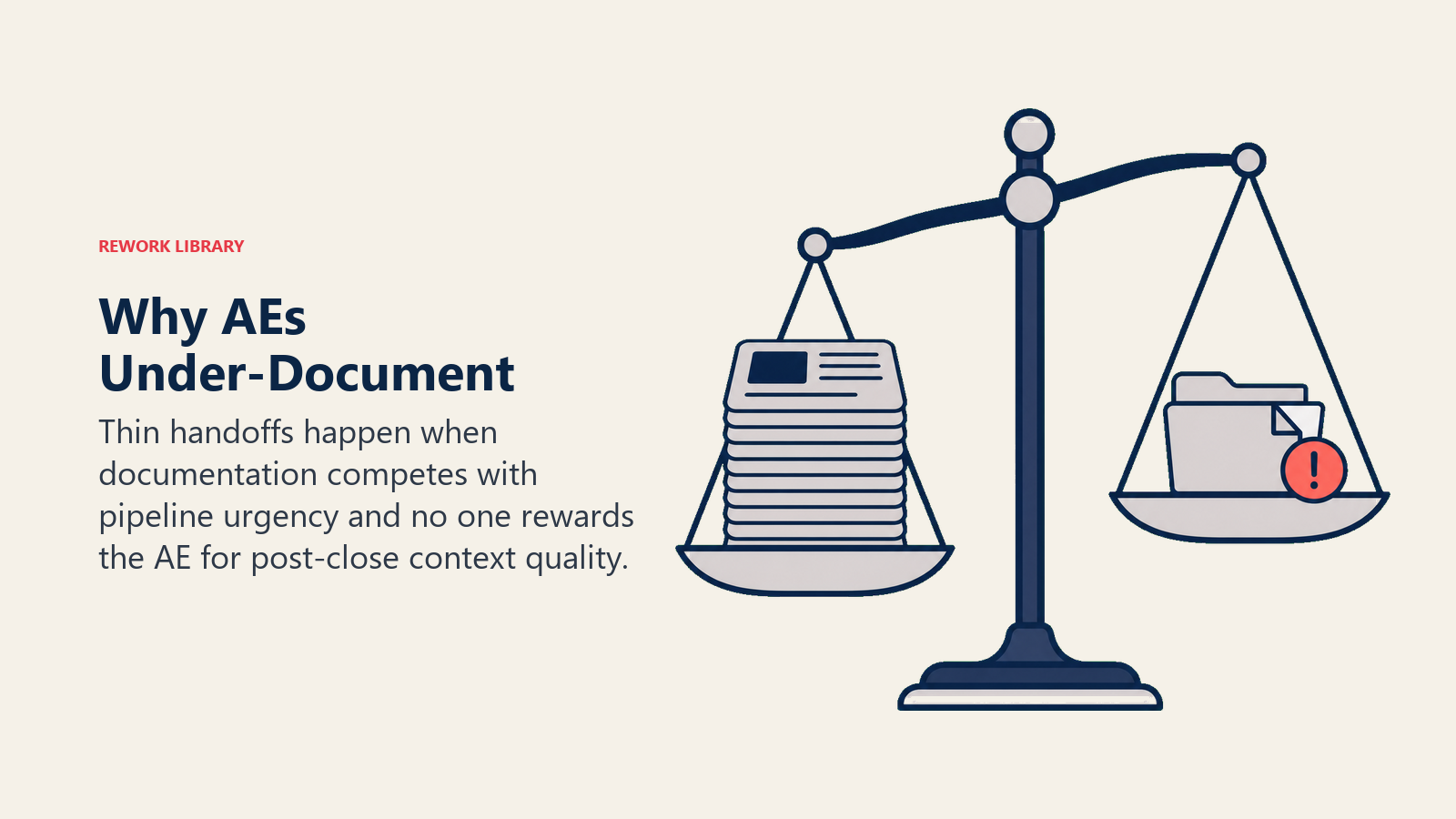
Presión de tiempo: La atención del AE inmediatamente después del cierre está en el siguiente trato del Pipeline, a menudo un trato que está cerca de la línea de llegada y necesita enfoque. El registro de handoff es trabajo retrospectivo que compite con la actividad prospectiva del Pipeline. El artículo sobre prevenir las sobrepromesas de Sales conecta esta presión con un riesgo posterior: compromisos adquiridos bajo urgencia que CS tiene que gestionar después.
Sin incentivo personal: La compensación del AE está vinculada al cierre, no al éxito del onboarding. Un registro de handoff exhaustivo no produce ningún crédito de cuota. Uno escueto no produce ninguna penalización (al menos no de inmediato, y no al AE). La investigación de McKinsey sobre customer success 2.0 sostiene que corregir esta desalineación de incentivos (para que los equipos de ventas compartan la responsabilidad por los resultados tempranos del cliente) es una de las palancas más claras para mejorar la retención en el SaaS de etapa de crecimiento.
"Ya se lo diré en la llamada": Esta es la racionalización más común. Se siente eficiente. En la práctica, la llamada de handoff se programa dos semanas después del cierre, la memoria del AE se ha desvanecido y el CSM obtiene un resumen de 20 minutos en lugar del brief de contexto de 45 minutos que la cuenta necesita.
Resolver el Problema del Incentivo
Puerta de completitud antes de la asignación del CSM: No asigne un CSM hasta que el registro de handoff alcance un umbral mínimo de completitud. Esto convierte el registro en un requisito previo para la llamada de handoff, no en un añadido posterior. El siguiente paso del AE (presentar al CSM) queda bloqueado hasta que el registro esté listo.
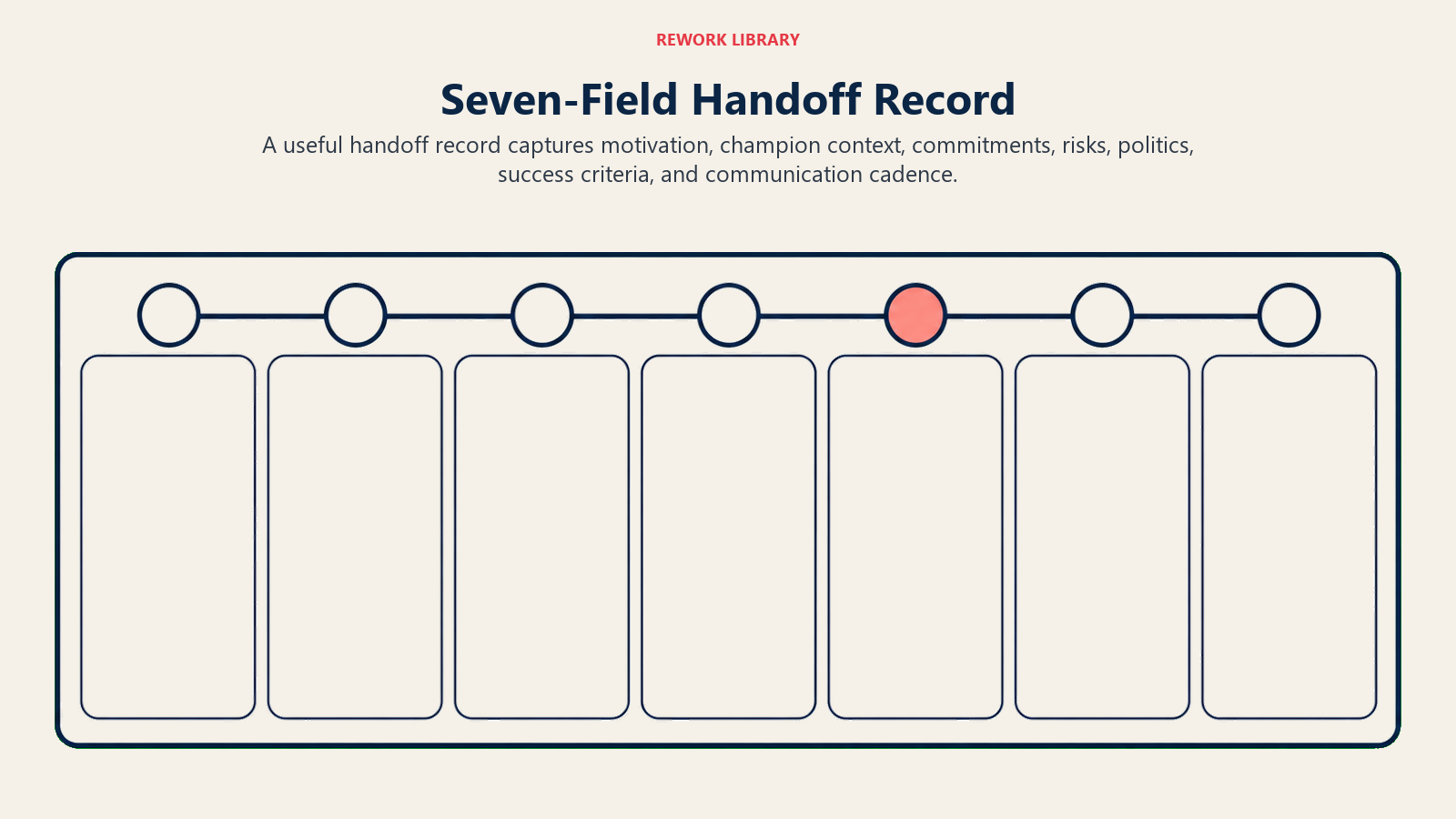
Una plantilla que tarda 15 minutos, no 60: La mayoría de los registros de handoff son demasiado largos (17 campos, la mayoría de los cuales ya están en el CRM) o demasiado vagos (notas de texto libre que producen calidad inconsistente). La plantilla de siete campos a continuación está diseñada para tomar 12-15 minutos. Es lo suficientemente corta para completarse al cierre, lo suficientemente larga para ser genuinamente útil.
Reconocimiento para los AE que documentan bien: Los líderes de CS deben construir ciclos de feedback para los managers del AE. Cuando el registro de handoff de un AE conduce a un kickoff fluido, eso debe notarse. Cuando la brecha de contexto de un AE causa un problema en el kickoff, eso debe salir a la luz, no como castigo, sino como un patrón que vale la pena abordar en el coaching.
El Registro de Handoff: Siete Campos Obligatorios
Aquí está cómo se ve un registro de handoff completo para un trato real de mid-market. La empresa es una firma de servicios profesionales de 120 personas; el producto es una plataforma de gestión del trabajo y CRM.
Cuenta: Meridian Consulting Group
ACV: $67.200
Fecha de cierre: 2026-04-28
Productos: Plataforma principal + módulo CRM
AE: James T.
CSM asignado: Priya S.
Campo 1: Motivación de compra (razón real por la que compraron)
El equipo de Operaciones ha estado gestionando el onboarding de clientes mediante hojas de cálculo desde que una herramienta de gestión de proyectos que usaban cerró hace 18 meses. La VP de Operaciones, Dana R., perdió a un cliente importante el trimestre pasado en parte debido a un fallo de coordinación que rastrearon a una visibilidad deficiente de los proyectos. Está bajo presión personal del CEO para resolver esto antes del Q3. Esto no es un "sería bueno tenerlo". Es una recuperación de un fallo embarazoso.
Campo 2: Perfil del champion
Dana R., VP de Operaciones. Impulsó toda la decisión de compra internamente. Tuvo que luchar por el presupuesto con el CFO, que era escéptico de otra inversión en software después de que la última herramienta falló. Dana es personalmente responsable de mostrar una mejora medible en la velocidad de onboarding de clientes en 90 días. Su credibilidad con el CEO está vinculada a que esto funcione.
Campo 3: Promesas y compromisos
- Le dije a Dana que podríamos tener el módulo CRM configurado para su Workflow específico de onboarding de clientes en los primeros 30 días. No prometa que esto ha ocurrido; verifique primero con Implementación.
- Mencioné que nuestro solution architect estaría disponible para una llamada de revisión técnica en la primera semana. Lo estarán esperando.
- Impliqué (no prometí explícitamente) que los conectaríamos con otra firma de servicios profesionales en nuestra base de clientes que pudiera compartir cómo estructuraron su onboarding. Sugiero que Priya lo organice proactivamente en la semana 3.
Campo 4: Señales de alerta y riesgos
- El Manager de IT, Greg P., no participó en la decisión de compra. Se enteró a través de Dana. Ha expresado preocupaciones sobre la integración con su sistema de facturación. Esta preocupación no se ha abordado; se aplazó a la fase de implementación. Espere fricción aquí.
- Dana es optimista sobre la adopción por parte de los usuarios, pero el equipo ha estado con hojas de cálculo durante 18 meses y algunos son resistentes a cambiar su Workflow. No asuma que la adopción ocurrirá automáticamente.
- El proveedor anterior (Asana) dejó un mal sabor. Los afectó un soporte deficiente durante un período crítico. Cualquier respuesta lenta de nuestra parte será notada y recordada.
Campo 5: Panorama político
El CFO (Mark L.) era escéptico de la inversión. Dana ganó el argumento, pero Mark vigilará de cerca el presupuesto. Cualquier cambio de alcance o costos adicionales necesitará la aprobación del CFO y enfrentará obstáculos. Greg en IT es un posible bloqueador en el trabajo de integración. Recomendaría un contacto directo del equipo de implementación temprano para hacerlo sentir incluido en lugar de ignorado.
Campo 6: Criterios de éxito (cómo decidirán si funcionó)
Las métricas de éxito personales de Dana: (1) reducir el tiempo promedio de onboarding de clientes de 3 semanas a menos de 10 días hábiles, (2) tener a todo el equipo de operaciones usando activamente la plataforma antes de finales del Q3, (3) darle al CEO un solo dashboard que muestre los proyectos de clientes activos y el estado del onboarding. Si alcanzamos esas tres cosas antes de septiembre, Dana considera que esto es un éxito.
Campo 7: Estilo de comunicación y preferencias de cadencia
Dana es directa, prefiere reuniones cortas con ítems de acción claros. No le gustan las llamadas de informe de estado donde nada se decide. Las actualizaciones asíncronas semanales funcionan bien; una revisión mensual de 30 minutos es apropiada. Responde rápidamente a los mensajes directos en Slack pero es más lenta por correo electrónico.
Cuándo Añadir Campos de Enriquecimiento Opcionales
Tres campos que añaden 10 minutos y mejoran de forma significativa el handoff para tratos más grandes o complejos:
- Contactos clave más allá del champion: Nombres y roles de cualquier persona que participará en la implementación. No solo el comprador económico y el champion, sino el contacto de IT, el gerente de proyecto, cualquiera que asistirá al kickoff.
- Contexto competitivo: ¿Había un proveedor competidor en la evaluación? ¿Ese proveedor hizo afirmaciones específicas con las que el cliente puede compararnos? Saber "también estaban evaluando Salesforce y casi fueron en esa dirección" cambia cómo CS habla sobre las capacidades.
- Historial de la relación: Cualquier historial inusual, como un trial previo que no convirtió, un cliente que refirió esta cuenta o una relación previa entre el AE y el cliente en una empresa anterior. Contexto que no está en el registro del trato pero que colorea la relación.
Transferencia de Contexto Verbal: Cuándo el Registro No Es Suficiente
Para tratos de más de $50K de ACV o cualquier trato con más de dos stakeholders del cliente, un registro escrito es necesario pero no suficiente. Una llamada interna de handoff entre el AE y el CSM cubre lo que las palabras en un formulario no pueden.
Cuándo requerir una llamada interna versus solo asíncrono:
- Llamada interna obligatoria: cualquier trato de más de $50K de ACV, cualquier trato con onboarding complejo, cualquier cuenta donde el AE identificó señales de alerta o complejidad política significativas
- Asíncrono aceptable: tratos SMB directos, registros de CRM limpios, ruta de onboarding simple
Lo que la llamada debe cubrir:
- El tono de la relación, no solo los hechos. ¿Fue esta una venta cálida o un trato duramente conseguido?
- Cualquier contexto del registro que necesite énfasis verbal ("Necesito asegurarme de que entiende lo importante que es el plazo de 30 días para Dana personalmente")
- Preguntas del CSM que el registro no respondió
- La lectura del AE sobre el estado emocional del champion al cierre: ¿están emocionados, nerviosos o bajo presión?
Acotar la llamada a 30 minutos: 30 minutos máximo. Si el AE necesita más de 30 minutos para informar al CSM, o bien el registro no está suficientemente completo o la cuenta es lo suficientemente compleja como para justificar un documento de contexto más extenso. No permita que las llamadas de handoff se extiendan a 60 minutos como solución alternativa a registros incompletos.
Verificar la Transferencia
Antes de que el AE se desvincule completamente de la cuenta, el CSM debe confirmar que tiene lo que necesita. Una verificación simple de tres preguntas:
- ¿Hay algo en los criterios de éxito de lo que no estoy seguro de poder entregar, que el AE y yo necesitamos alinear antes de que haga promesas al cliente?
- ¿Hay señales de alerta en el registro que se beneficiarían de un plan conjunto antes del kickoff?
- ¿Tengo suficiente contexto sobre el champion para abrir una relación personal en la llamada de kickoff?
Si la respuesta a cualquiera de estas es "no estoy seguro," la llamada de handoff ocurre antes de que salga el correo de presentación al cliente.
Opciones de Herramientas
Campos del CRM: La opción más limpia si su CRM admite campos de texto personalizado con una longitud significativa. Todo vive en el mismo lugar. Desventaja: los campos de texto largo en la mayoría de los CRM son difíciles de leer y fáciles de hojear.
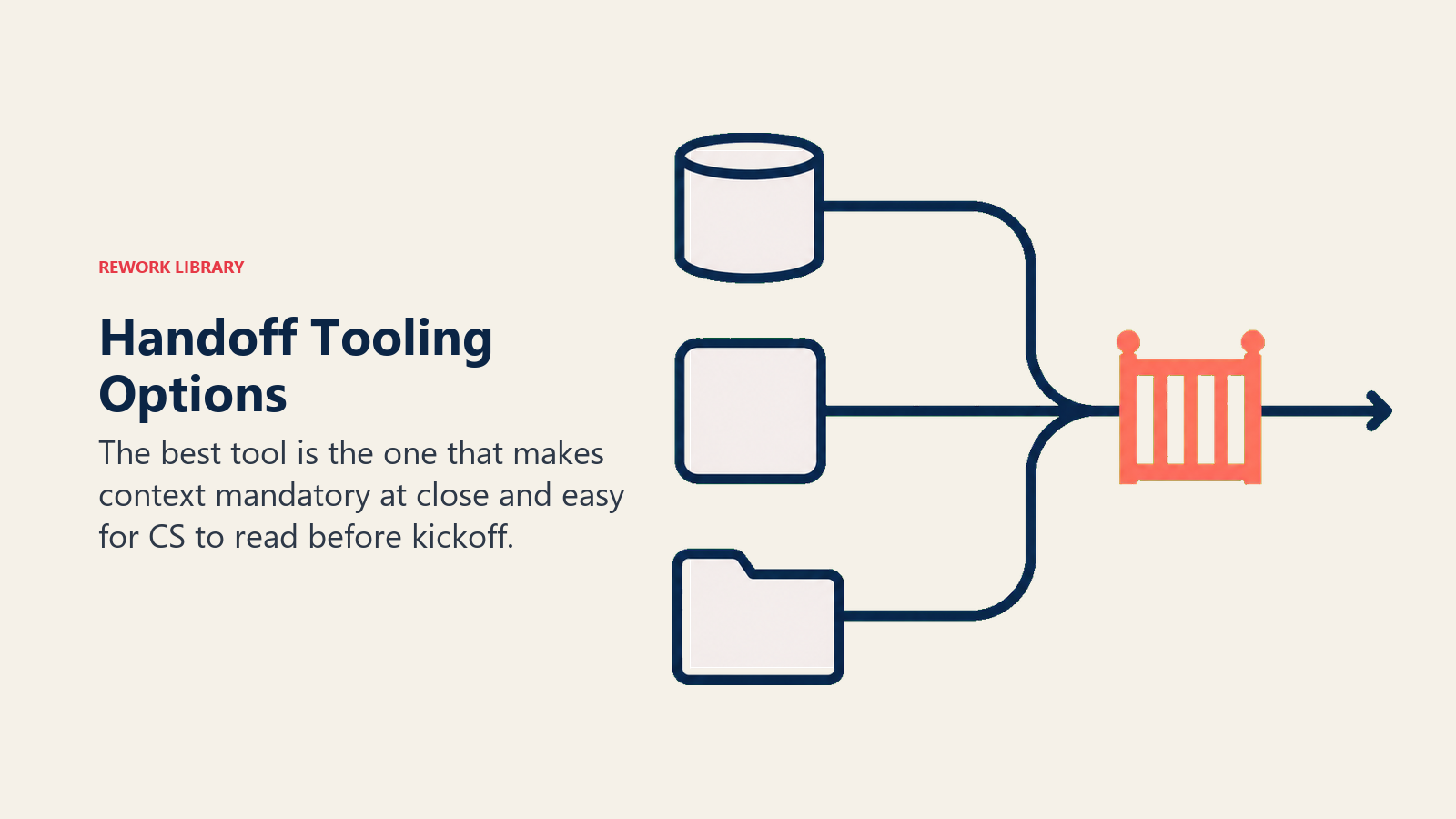
Doc de handoff vinculado desde el CRM: Un documento compartido (Google Doc, página de Notion o similar) vinculado desde el registro de oportunidad. Más fácil de leer, admite formato y tablas. Desventaja: añade un enlace más para recordar; los docs pueden quedar desactualizados si no están conectados al Workflow del CRM.
Notas integradas en un campo de handoff dedicado: Algunos equipos usan un campo de notas de handoff estructurado directamente en el registro de oportunidad con una plantilla clara en la parte superior (copiar/pegar los siete campos, completar los valores). Poca fricción, fácil de aplicar, ligeramente menos legible que un doc separado. Buen valor por defecto para equipos con menos de 50 reps.
La elección de herramienta importa menos que la aplicación. Un Google Doc bien gestionado con un requisito de enlace obligatorio supera a un campo del CRM que todo el mundo completa con resúmenes de una oración.
Para el registro de cliente como fuente única de verdad, el registro de handoff alimenta el registro continuo del cliente que CS mantiene a lo largo de la relación. Es el documento fundacional del historial de la cuenta.
El Contexto No Es un Lujo
El CSM que entra a un kickoff con el contexto completo del trato no solo parece preparado. Le demuestra al champion que el proveedor hizo el trabajo de entender la cuenta antes de presentarse, que es exactamente lo que el champion se estaba preguntando en las 72 horas entre la firma del contrato y la llamada de kickoff.
Esa primera impresión se acumula. El CSM que hace preguntas informadas construye confianza más rápido. El CSM que le pide al cliente que re-explique lo que ya le dijo al AE señala que los equipos del proveedor no se comunican entre sí.
El contexto del trato es lo que separa a un CSM que construye confianza en la primera semana de uno que pasa seis semanas ganándosela de vuelta. No es una cuestión de talento o habilidades de relación. Es una cuestión de información. Déles a los CSM la información y la confianza sigue. Retenga la información y están comenzando la relación en un hoyo que no cavaron.
La plantilla de scorecard de handoff les da a los equipos una forma estructurada de auditar la calidad del handoff a través del marco completo de contexto, útil para revisiones trimestrales y para identificar qué campos específicos los AE están omitiendo de forma consistente.
Análisis de Rework: La taxonomía de contexto del trato de 6 categorías funciona mejor cuando se incrusta como una plantilla estructurada dentro del registro de handoff en lugar de dejarse como notas de texto libre. Los campos de texto libre producen una calidad inconsistente: algunos AE escriben párrafos, otros escriben una sola oración, y los CSM no tienen una forma fiable de auditar la completitud. Los campos estructurados con etiquetas de categoría (motivación de compra, perfil del champion, promesas y compromisos, señales de alerta, panorama político, criterios de éxito) toman de 12 a 15 minutos en completarse y producen un registro que el CSM puede leer en menos de 10 minutos. La asimetría de la inversión es el argumento: 15 minutos de tiempo del AE al cierre eliminan de 6 a 8 horas de reconstrucción por parte del CSM en las primeras dos semanas. Los equipos que aplican esta plantilla como una puerta antes de la asignación del CSM ven tanto tasas más altas de completitud de registros como un tiempo hasta el primer valor para el cliente significativamente más rápido.
Preguntas Frecuentes sobre la Transferencia de Contexto del Trato
¿Qué contexto del trato necesita realmente CS de Sales?
CS necesita seis categorías de información que rara vez aparecen en los registros del CRM: la motivación de compra (la razón real por la que el cliente compró, no el caso de uso declarado), el perfil del champion (quién impulsó el trato internamente y qué está jugándose personalmente en su éxito), las promesas y compromisos (lo que el AE dijo y que CS debe honrar), las señales de alerta y riesgos (objeciones superadas pero no resueltas), el panorama político (quién perdió la batalla interna del presupuesto y quién sigue siendo escéptico) y los criterios de éxito (la definición personal y específica de éxito que el champion lleva al onboarding).
¿Qué ocurre cuando CS no recibe el contexto del trato antes del kickoff?
El CSM entra al kickoff con una confianza falsa. Ha leído el registro de oportunidad del CRM y se siente preparado, pero le falta el contexto no estructurado que realmente gobierna la cuenta: quién es realmente el champion, qué presión tiene para entregar resultados, qué compromisos adquirió el AE de manera informal y de dónde vendrá la fricción. Esa brecha sale a la superficie en los primeros 10 minutos del kickoff, cuando el cliente menciona un contexto que el CSM nunca ha escuchado. Recuperarse de una primera impresión de que "los equipos del proveedor no se comunican entre sí" suele tardar de 4 a 6 semanas.
¿Cuál de las seis categorías de contexto es la más crítica?
Las promesas y compromisos. Los clientes que encuentran compromisos incumplidos en el onboarding normalmente no cancelan de inmediato. Se desvinculan. Dejan de responder al CSM, reducen su participación en las actividades de onboarding y, en el mes seis, explican su baja adopción diciendo "nos dijeron que haría X y no lo hace." Esta es la categoría de mayor riesgo porque es la que los AE tienen más probabilidades de omitir (comprensiblemente, listar compromisos informales se siente como una confesión) y la que tiene la conexión más directa con el churn.
¿Por qué los AE documentan sistemáticamente de forma insuficiente los handoffs?
Por tres razones estructurales, no por defectos de carácter. Primero, la presión de tiempo: la atención posterior al cierre va al siguiente trato del Pipeline, y el registro de handoff es trabajo retrospectivo que compite con la actividad prospectiva del Pipeline. Segundo, la falta de incentivo personal: la compensación del AE está ligada al cierre, no al éxito del onboarding. Un registro exhaustivo no produce ningún crédito de cuota; uno escueto no produce ninguna penalización inmediata. Tercero, la racionalización: "ya se lo diré en la llamada" se siente eficiente pero produce un resumen verbal de 20 minutos semanas después en lugar de un briefing completo al cierre.
¿Cuánto debería tardar en completarse un registro de handoff?
Una plantilla bien diseñada de siete campos toma de 12 a 15 minutos en completarse. Si toma más tiempo, la plantilla es demasiado larga o demasiado vaga. Si toma menos de 10 minutos, es probable que el AE esté escribiendo resúmenes de una oración que no le servirán al CSM. El objetivo es un registro que al AE le tome 15 minutos escribir y al CSM 10 minutos leer: un CSM que entra al kickoff informado como un colega, no con un expediente entregado de golpe.
¿Cuándo se requiere una llamada de handoff verbal además del registro escrito?
Para cualquier trato de más de $50K de ACV o cualquier trato con más de dos stakeholders del cliente, un registro escrito es necesario pero no suficiente. La llamada interna de handoff cubre lo que las palabras en un formulario no pueden: el tono de la relación, el énfasis verbal en el contexto crítico y la lectura del AE sobre el estado emocional del champion al cierre. Mantenga la llamada en 30 minutos. Si el AE necesita más tiempo que eso, el registro está incompleto.
¿Qué pasa si el AE dejó la empresa antes de que se completara el registro de handoff?
Este es el caso más difícil. Empiece con los datos del CRM que existan y luego entreviste a los colegas que participaron: los sales engineers del trato, el manager del AE que pudo haber revisado la cuenta y cualquier contacto de preventa que haya hablado con el cliente. Si la relación con el champion era cálida, una conversación directa y honesta suele funcionar: "Estoy poniéndome al día con nuestra relación. ¿Puede contarme qué fue lo más importante para usted cuando tomó esta decisión?" Los champions que confían en el proveedor completarán el contexto directamente. Los que no confían lo revelarán a través de su respuesta.
Aprenda Más

Principal Solution Architect
On this page
- Dos Tipos de Conocimiento del Trato
- Las Seis Categorías de Contexto Que CS Realmente Necesita
- Por Qué los AE Documentan de Forma Insuficiente: Las Razones Estructurales
- Resolver el Problema del Incentivo
- El Registro de Handoff: Siete Campos Obligatorios
- Cuándo Añadir Campos de Enriquecimiento Opcionales
- Transferencia de Contexto Verbal: Cuándo el Registro No Es Suficiente
- Verificar la Transferencia
- Opciones de Herramientas
- El Contexto No Es un Lujo
- Aprenda Más