Transición del Champion: Cómo Hacer el Handoff de su Defensor Interno sin Perderlo
Turn this article into takeaways for your work.


Each assistant summarizes the article only for you and suggests best practices for your work.
Imagine el momento desde la perspectiva del champion. Pasó seis semanas navegando un proceso de aprobación interna. Construyó el business case para el CFO, convenció a dos VPs escépticos de sumarse y avaló personalmente a este proveedor ante su CEO. Firmó el contrato un martes por la tarde. El miércoles por la mañana, recibió un correo de alguien llamado Alex que se presentó como su nuevo Customer Success Manager y le pidió que programara una llamada de kickoff de Onboarding.
No conoce a Alex. El correo de Alex no menciona al champion por nombre. No hay nada en él que conecte con nada de lo que discutió con el AE durante el último mes y medio. Se lee como una secuencia de bienvenida activada por un sistema, porque lo es.
Y la primera impresión post-venta del champion sobre el proveedor es: obtuvieron lo que necesitaban y me pasaron a soporte al cliente.
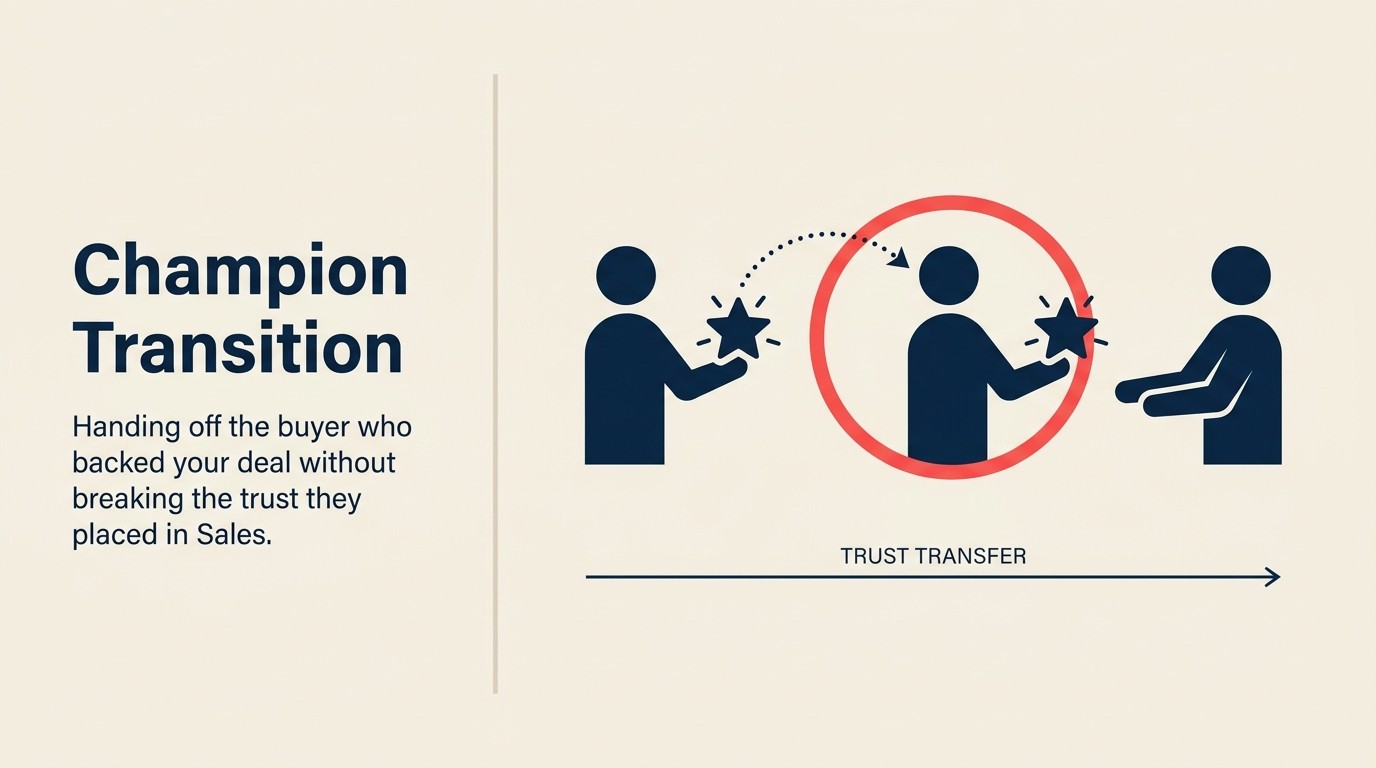
Eso es el fracaso en la transición del champion. No la falta de una llamada de handoff, ni un registro del CRM incompleto, ni un kickoff tardío. Es el momento en que la confianza que un champion extendió a un vendedor no logra transferirse al equipo de CS, porque nadie trató la transferencia como un evento de relación, no solo como un paso de proceso.
El Protocolo de Transición del Champion es la secuencia de cuatro pasos que define este artículo para transferir la relación con un champion del AE al CSM sin romper la confianza construida durante el ciclo de ventas. Paso 1: el AE prepara al champion de forma conversacional antes de que CS haga cualquier contacto. Paso 2: el AE redacta un correo de introducción personal, no una plantilla ni un hilo reenviado. Paso 3: el AE asiste a la primera llamada CSM-champion, abre con un respaldo genuino y luego da un paso atrás. Paso 4: el AE hace un único seguimiento personal a los 30 días y luego sale formalmente. La tesis central del protocolo: el objetivo no es un proceso sin fisuras. Es una relación sin fisuras.
Qué Es un Champion (y Por Qué Es Diferente)
"Los champions que se sienten bien transferidos de Ventas a CS tienen 3,4 veces más probabilidades de servir como cliente de referencia y 2,1 veces más probabilidades de referir nuevos negocios, lo que convierte la transición del champion en una de las actividades de mayor ROI del proceso post-venta." (TSIA, 2024)
Cada deal tiene contactos. No todos los contactos son champions. La distinción importa porque el enfoque de transición es diferente para cada uno.
Un champion es la persona que tiene a cargo el éxito interno de la implementación. No necesariamente el comprador económico (esa es la persona que firmó el cheque). No necesariamente el usuario principal (esa es la persona que más usará el producto). El champion es la persona que apostó por la compra internamente. Construyó el business case. Navegó el proceso de aprobación. Puso su credibilidad en juego. Cómo se desarrollan y califican los champions durante el ciclo de ventas se explica en desarrollo de champions. Esas son las habilidades que los AE usaron para construir esa relación, y lo que CS hereda en el handoff.
Tienen un valor relacional asimétrico en comparación con otros contactos. Cuando llega la conversación de renovación, el champion es la persona que re-aboga ante el CFO. Cuando un ejecutivo pregunta "¿vale la pena seguir con este proveedor?", el champion es quien responde. Cuando la empresa considera expandirse a otro departamento, la experiencia del champion es el principal punto de referencia. La investigación de Bain sobre la defensa de marca en clientes B2B muestra que los clientes que abogan activamente a nivel interno son el segmento de mayor valor tanto para la retención como para la expansión. Eso convierte la relación con el champion en la más importante comercialmente que gestiona CS.
También son la persona con mayor riesgo si la implementación falla. Son quienes dijeron "esto va a funcionar". Cuando no funciona, absorben las consecuencias internas. Esa exposición es lo que hace que la relación post-venta sea tan crítica, y tan frágil. Un champion que se siente abandonado al cierre no solo se desconecta del proveedor. Se protege distanciando silenciosamente su credibilidad del rendimiento del producto.
Datos clave: Relaciones con Champions y Economía de Retención
- Los clientes con una relación sólida con su champion CSM en los primeros 90 días tienen 2,7 veces más probabilidades de renovar y expandirse en el segundo año, según la investigación CS Impact de Gainsight.
- El 44% del Churn temprano (dentro de los 12 meses del cierre) es directamente rastreable a la "desconexión del champion": el champion deja de abogar internamente después de una mala experiencia post-venta (Totango, 2024).
- Los deals enterprise donde el AE hace una introducción personal y contextualizada a CS tienen tasas de expansión un 38% más altas en el año uno en comparación con los deals con notificaciones automáticas genéricas (KeyBank CS benchmarks, 2023).
El Vínculo AE-Champion: Lo que CS Está Heredando
El AE y el champion pasaron semanas en conversación. Llamadas de discovery, demos, manejo de objeciones, correos de seguimiento, chequeos informales cuando el proceso de aprobación encontró obstáculos. Eso no es una relación de proveedor. Es una relación de confianza profesional construida sobre un esfuerzo compartido hacia un objetivo compartido.
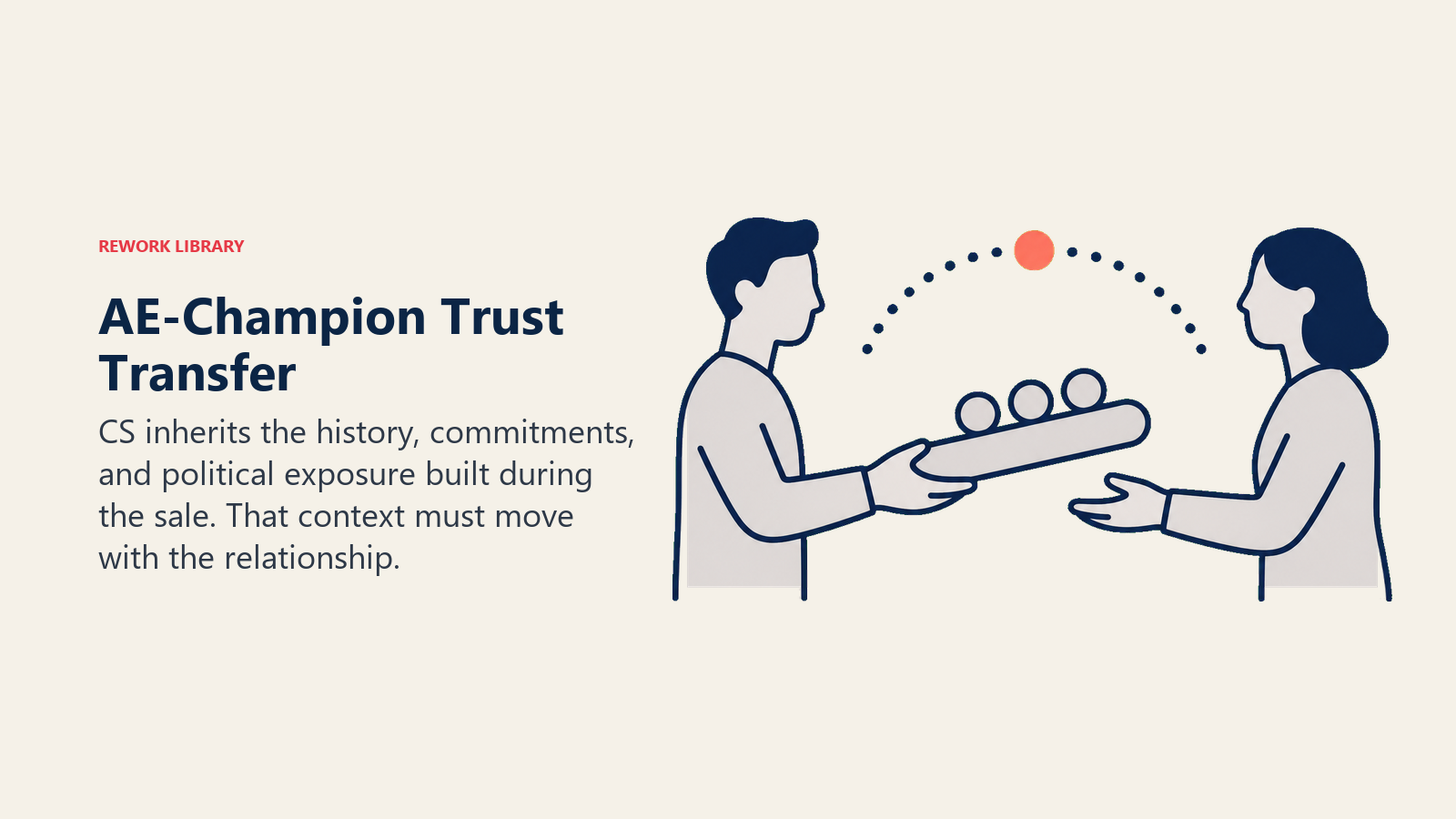
Cuando se cierra el deal, el CSM hereda varias cosas de esa relación:
Una historia de la que el CSM no formó parte. Hay referencias internas, lenguaje compartido, compromisos informales. El CSM que empieza de cero no tiene acceso a nada de esto a menos que el AE lo entregue deliberadamente. El handoff del ciclo de vida de AE a CSM muestra dónde se ubica esta responsabilidad de transferencia dentro de la estructura más amplia del equipo de ingresos.
Compromisos implícitos. Cosas que el AE dijo que nunca se escribieron. "Nos aseguraremos de que esté conectado con nuestro líder de implementación antes del kickoff." "Estaré disponible si me necesita." "Hemos hecho exactamente esta configuración para empresas como la suya." Estos compromisos son reales para el champion, aunque nunca llegaron a un contrato.
La exposición política interna del champion. El champion anuló objeciones para que esta compra sucediera. Si la implementación va mal, esas objeciones resurgen como "te lo dije". El CSM que entiende esto no solo trata al champion como una relación deseable. Entiende que es la principal protección del champion contra las consecuencias internas.
Nada de esto es una amenaza para el CSM. Es un activo. El AE construyó una base de confianza sobre la que el CSM puede seguir construyendo. Pero solo si la transferencia se maneja como un evento de relación, no como una notificación de handoff. ¿Qué rompe esa transferencia? Tres modos de falla aparecen repetidamente.
"El 44% del Churn temprano dentro de los 12 meses del cierre es directamente rastreable a la desconexión del champion. El champion deja de abogar internamente después de una mala experiencia post-venta. No canceló el contrato. Simplemente dejó de defenderlo." (Totango, 2024)
"Los deals enterprise donde el AE hace una introducción personal y contextualizada a CS tienen tasas de expansión un 38% más altas en el año uno en comparación con los deals con notificaciones automáticas genéricas. El correo de introducción no es una cortesía. Es infraestructura comercial." (KeyBank CS benchmarks, 2023)
Los Tres Modos de Falla en la Transición
Modo de Falla 1: Desconexión fría. El AE cierra el deal, actualiza el CRM y sigue adelante. El cliente recibe un correo de bienvenida automatizado. El CSM hace el primer contacto días después sin contexto personal. El modelo mental del champion sobre la relación con el proveedor pasa de "tengo un punto de contacto de confianza" a "ahora soy un número de cliente". Este es el modo de falla más común y el más recuperable, pero requiere un esfuerzo real para reparar. El análisis de HBR sobre las relaciones B2B con clientes describe cómo el período de transición post-venta es donde la confianza es más frágil. Una desconexión fría causa un daño que puede tardar meses en deshacerse. El proceso de handoff de closed-won a onboarded expone el flujo de trabajo de cuatro etapas que evita que esto ocurra.
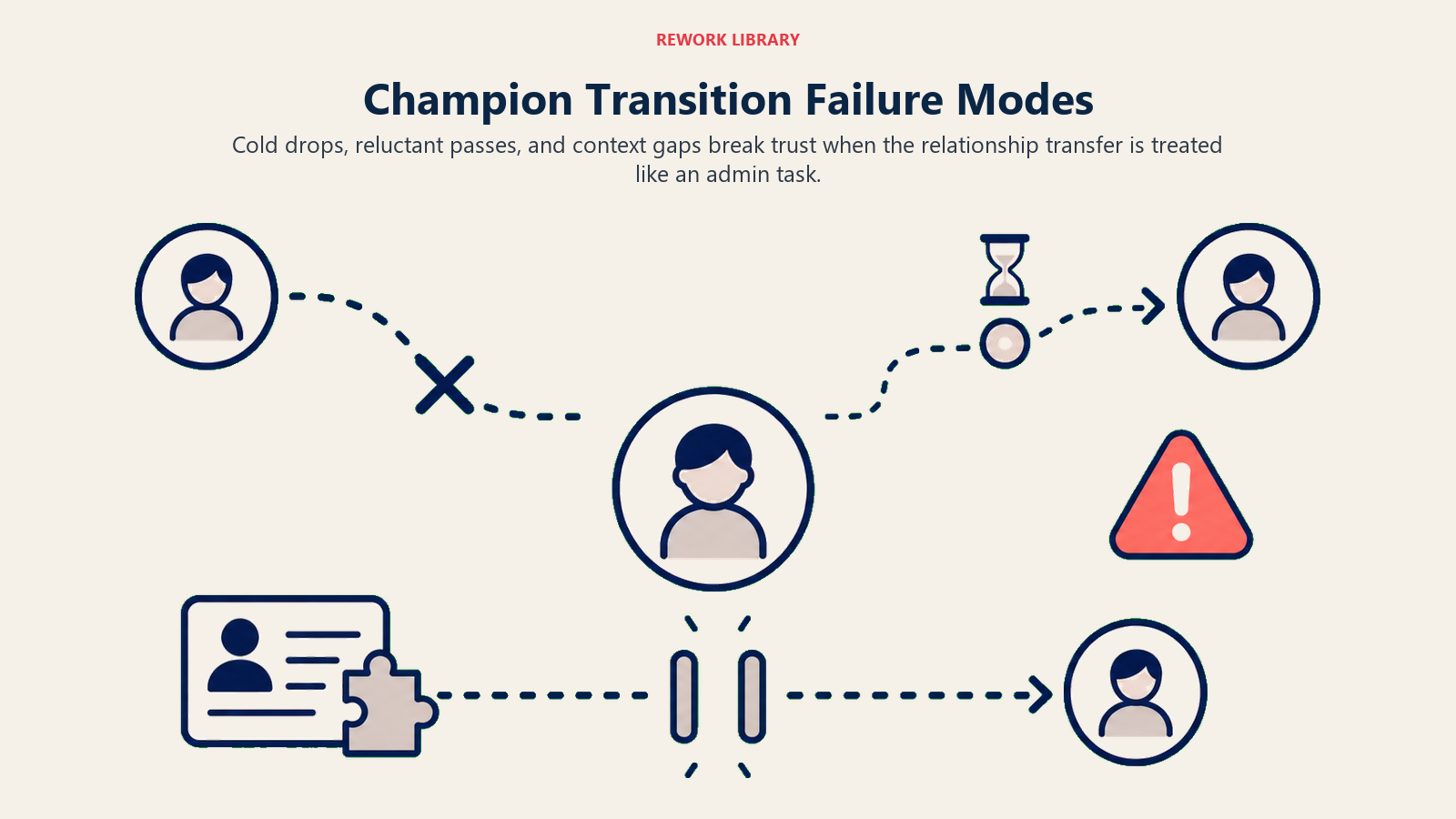
Modo de Falla 2: Paso forzado. El AE sigue involucrado demasiado tiempo. El champion sigue volviendo al AE con preguntas porque el AE es la persona que conoce y en quien confía. El CSM no puede establecer autoridad porque el AE sigue siendo la relación principal. Esto ocurre a menudo cuando los AE quieren proteger la relación para futuras conversaciones de expansión. Un instinto comprensible, una ejecución incorrecta. Un CSM que no puede establecer autoridad no puede proteger la cuenta.
Modo de Falla 3: Brecha de contexto. El CSM fue técnicamente informado, recibió un registro de handoff, quizás incluso tuvo una llamada con el AE, pero no recibió contexto personal sobre el champion específicamente. Conoce la cuenta; no conoce a la persona. Entra a la llamada de kickoff conociendo el ACV y los productos comprados y los criterios de éxito, pero no lo que el champion está tratando de lograr personalmente, qué le preocupa o cómo el AE típicamente se comunicaba con él. El CSM está relacionalmente a ciegas aunque esté técnicamente informado.
El Protocolo de Handoff Cálido
Esta es la solución a los tres modos de falla. Es una secuencia de cuatro pasos que le toma al AE aproximadamente 90 minutos a lo largo de la semana posterior al cierre.
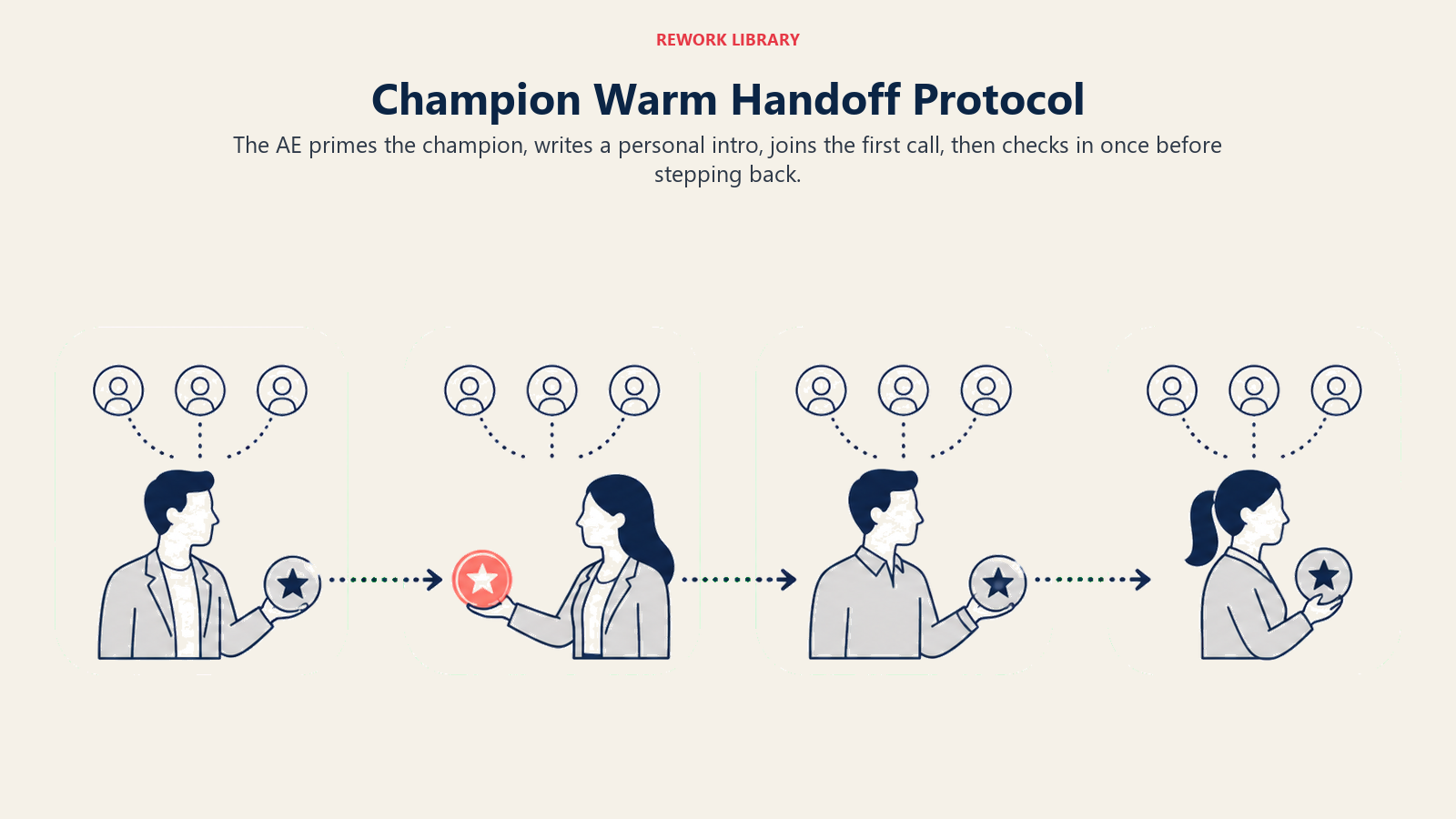
Paso 1: El AE prepara al champion
Antes de que CS haga cualquier contacto, el AE habla con el champion, ya sea en una breve llamada o en un seguimiento natural después de la firma, y establece la transición de manera conversacional. No de forma formal. No con una presentación o una explicación de organigrama. Una conversación personal que suene más o menos así:
"La persona que va a ser su principal recurso de ahora en adelante es [nombre del CSM]. He trabajado con ellos en cuentas como la suya y son excelentes, muy enfocados en la operativa, lo que encaja con lo que usted está tratando de construir. Tendrá noticias de ellos pronto. Yo estaré disponible si surge algo comercial, pero [nombre del CSM] es quien usted quiere para todo lo relacionado con la implementación."
Esto son cinco oraciones en una llamada telefónica o unas pocas líneas en un correo. Pero hace algo irremplazable: le dice al champion que el handoff fue una elección deliberada, no un activador del sistema. El proveedor eligió específicamente a esta persona. Ese encuadre convierte un proceso administrativo en una acción de relación.
Paso 2: El AE redacta un correo de introducción personal
No una plantilla. No un hilo reenviado. Un correo real del AE al champion y al CSM, presentándolos mutuamente.
Aquí hay un ejemplo para la cuenta Meridian Consulting del artículo sobre contexto del deal:
Hola Dana,
Quería presentarle personalmente a Priya Sharma, quien será su Customer Success Manager. Priya ha trabajado con varios equipos de operaciones que están pasando exactamente por el tipo de mejora de procesos que usted está impulsando, y ya está al tanto de lo que hablamos: el objetivo de Onboarding de 90 días, la sensibilidad de integración de TI y el Dashboard que necesita para la revisión del CEO. Ella se pondrá en contacto para programar su llamada de kickoff.
Sigo disponible si surge algo de mi parte. Pero Priya es su persona para hacer que esta implementación funcione, y es excelente en ello.
James
Ese correo tiene 95 palabras. Menciona al champion por nombre, reconoce algo específico de la conversación de ventas, nombra un detalle de contexto real (la integración de TI) y presenta al CSM como capaz y ya informado. El champion lo lee y se siente visto, no procesado.
Paso 3: El AE asiste a la primera llamada CSM-champion, hace la introducción y luego da un paso atrás
La primera llamada entre el CSM y el champion no debe ser una introducción fría. El AE asiste, abre con un breve comentario de contextualización, presenta al CSM personalmente ("Le he informado a Priya de todo, ya tiene el panorama completo") y luego se retira en gran medida. Responde preguntas directas si se le hacen. No dirige la llamada. El CSM dirige la llamada.
Esto tiene un propósito específico: el champion ve al AE respaldar al CSM en tiempo real. Eso es diferente a leerlo en un correo. Es el AE diciendo, con su presencia, "confío en esta persona para cuidarle". Ese respaldo transfiere la confianza relacional de manera más efectiva que cualquier comunicación escrita.
Paso 4: El AE hace un seguimiento con el champion una vez a los 30 días
Un solo seguimiento. Un breve mensaje personal, no una llamada de ventas, no un "solo verificando cómo van las cosas" disfrazado de llamada de prospección. Algo como: "Ha pasado aproximadamente un mes desde que arrancamos. Solo quería verificar que la transición al equipo de Priya haya sido fluida. Estoy disponible si hay algo que necesite de mi parte". Eso es todo. El propósito es señalar disponibilidad continua sin socavar la propiedad de CS. Este es el último punto de contacto formal del lado del AE.
Qué Necesita Saber CS sobre el Champion Específicamente
El registro de contexto del deal cubre la cuenta. El contexto específico del champion es un subconjunto de eso, y la parte más importante.
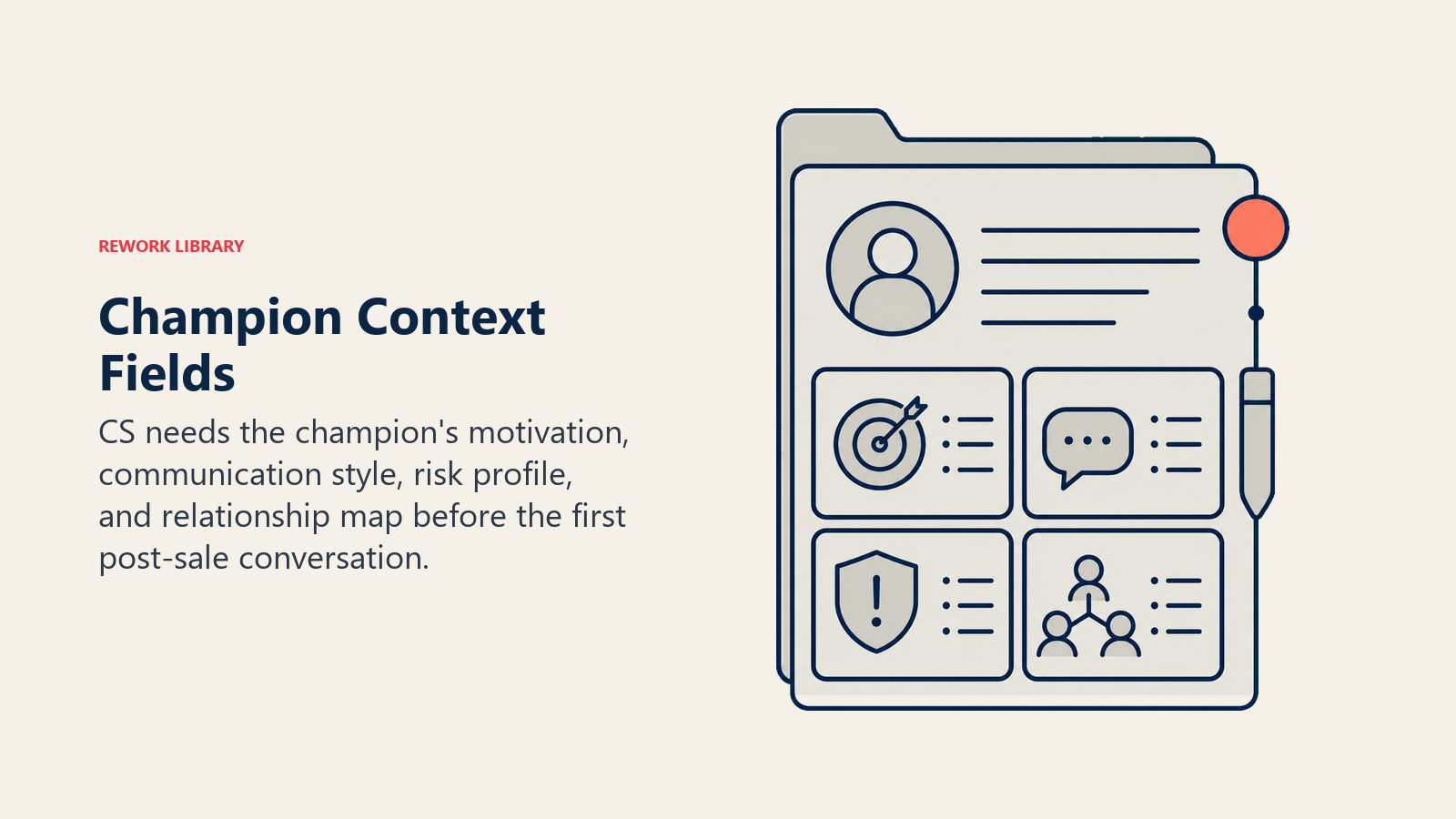
Motivación: ¿Qué gana personalmente el champion si la implementación tiene éxito? No "la empresa se beneficia de una mejor visibilidad del Pipeline". Nos referimos a la apuesta personal del champion en su carrera. Oportunidad de promoción. Credibilidad restaurada. Prueba de concepto para una iniciativa más grande.
Estilo de comunicación: ¿Cómo gestionó el AE esta relación? ¿Con mucho o poco contacto? ¿El champion prefería mensajes rápidos de Slack o agendas estructuradas de reunión? ¿El tono era formal o conversacional? CS que hereda una relación debe continuarla en el mismo registro, no imponer un nuevo estilo de comunicación que señale una ruptura con la relación anterior. Los detalles de qué capturar están en el marco de transferencia de contexto del deal. Los campos de contexto del champion allí son los más importantes de completar.
Perfil de riesgo: ¿Qué le preocupa al champion que no ha dicho en voz alta? La fricción con el Director de TI que no le ha contado al proveedor. El ejecutivo escéptico que observa desde la distancia. La presión que tiene del CEO que mencionó de pasada pero que no hizo explícita. El AE escuchó estas cosas a lo largo de semanas de conversación. El CSM necesita saberlas. La investigación de McKinsey sobre cómo ganar clientes B2B muestra que entender el contexto político interno de una compra, y no solo los criterios oficiales de decisión, es lo que separa a los proveedores que retienen a sus champions de los que los pierden en la renovación.
Relaciones entre pares: ¿En quién más de la organización confía el champion? ¿Con quién está en desacuerdo? Esto no es chisme. Es topología relacional. El CSM que sabe que el champion y el CFO tienen una relación positiva puede sugerir una revisión de ROI a los 30 días que el champion puede usar para fortalecer esa relación. El CSM que no lo sabe pierde la oportunidad.
Cuando el Champion No Es el Principal Punto de Contacto
A veces el champion impulsó el deal pero no es el contacto del día a día para la implementación. Un champion de nivel VP puede no asistir a cada llamada de kickoff. Puede delegar a un gerente de proyecto o a un colaborador individual que realmente dirigirá el Onboarding.
En este caso, el CSM está gestionando dos relaciones: el champion (periódica, estratégica) y el administrador del día a día (frecuente, operativa). La relación con el champion es la que importa en la renovación. La relación con el administrador es la que importa para la calidad del Onboarding. Ambas requieren inversión.
El protocolo de transición del champion cubre la relación estratégica. Para el contacto del día a día, el CSM establece la relación de trabajo de manera más directa, pero sigue necesitando ser informado por el AE sobre quién es esta persona, qué tan involucrado estará y cómo es su relación con el champion.
Cuando un champion se queda en silencio después de la venta, deja de responder a los seguimientos o no participa en la revisión de 30 días, CS debe escalar al AE antes de asumir desconexión. El AE puede tener contexto sobre por qué el champion no está disponible (nuevo proyecto interno, fuera de la oficina, reestructuración empresarial) que cambia el enfoque de reactivación. Ir a través del AE para reactivar a un champion silencioso suele ser más efectivo que un outreach frío de CS.
Transición del Champion para Deals con Múltiples Stakeholders
Los deals enterprise no tienen un único champion. Tienen una jerarquía de champions: un defensor principal, defensores secundarios en funciones específicas y sponsors ejecutivos que controlan el presupuesto pero delegan las decisiones.
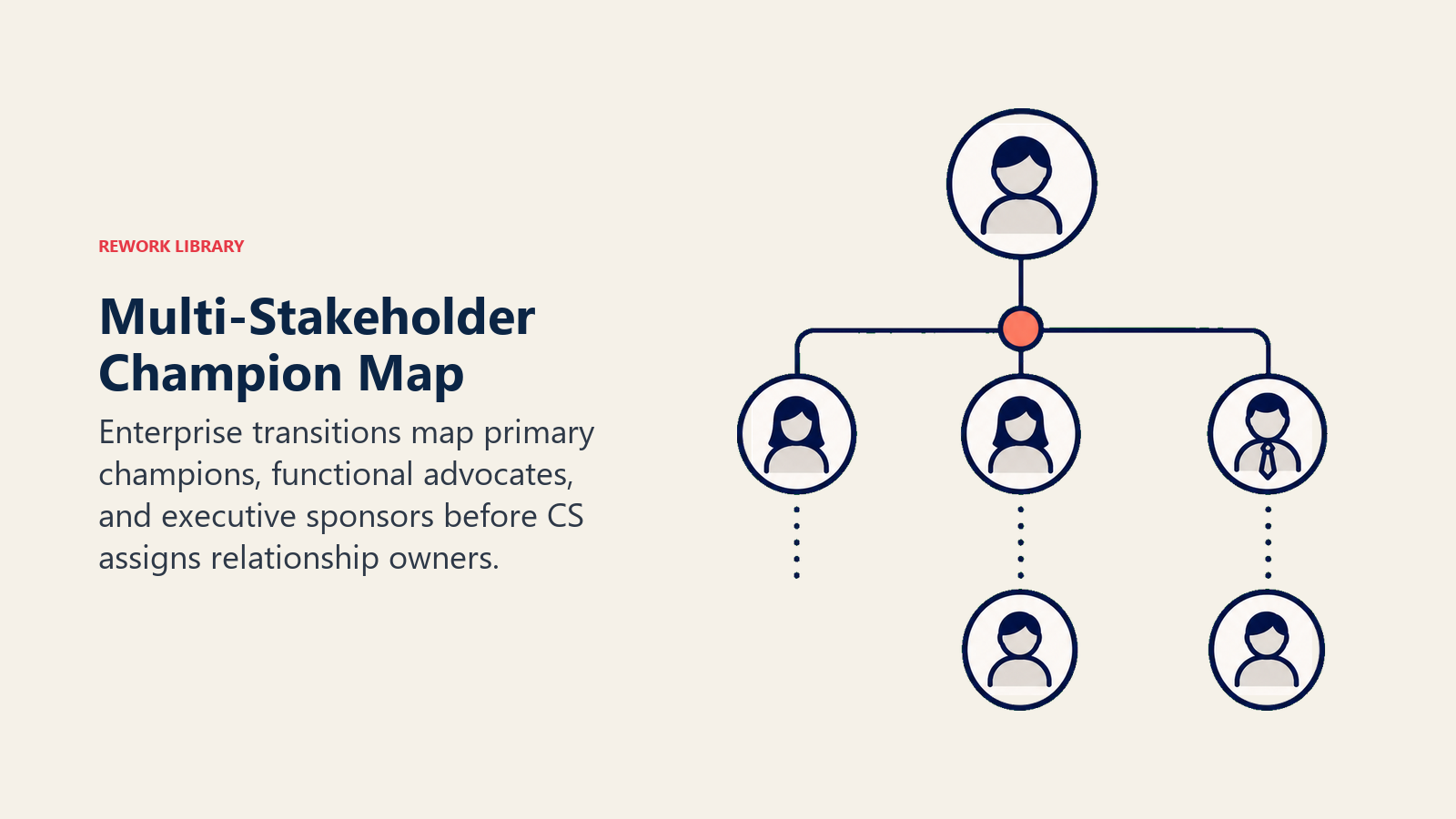
Cuando hay múltiples champions, el CSM necesita mapearlos:
- Champion principal: Recibe el protocolo completo de handoff cálido. El AE redacta el correo de introducción personal, asiste a la primera llamada y hace el seguimiento de 30 días.
- Champions secundarios (defensores funcionales): El AE los presenta por correo, el CSM hace el seguimiento de forma independiente. Menos intensivo, pero sigue siendo personal, no una notificación del sistema.
- Sponsor ejecutivo: El AE o el gerente del AE puede ser propietario de esta relación en lugar del CSM, especialmente para deals enterprise. El CSM permanece conectado pero puede no ser el propietario principal de la relación a nivel ejecutivo.
El marco de alineación de stakeholders del cierre de deals es un contexto útil aquí: la forma en que los AE construyeron alineación entre múltiples stakeholders durante el ciclo de ventas determina lo que CS hereda al cierre.
Donde hay múltiples recursos de CS (CSM + especialista en implementación + sponsor ejecutivo del lado del proveedor), mapear a cada uno con su contraparte champion. El CSM principal tiene a cargo al champion principal. Los recursos especializados tienen a cargo a sus contrapartes funcionales.
Señales de Alerta de que la Transición Falló
Cuando cualquiera de las siguientes situaciones surge en los primeros 30 días, CS debe escalar al AE en lugar de gestionar solo:
- El champion menciona al AE repetidamente por nombre en conversaciones con CS, señalando específicamente cosas que el AE "prometió"
- El engagement del champion con el outreach de CS es bajo: abrió correos pero no respondió; acordó una fecha de kickoff pero la reprogramó dos veces
- El contacto del día a día está involucrado pero dice que el champion "no ha estado muy involucrado" desde el cierre
- El champion menciona estar decepcionado por algo en el Onboarding y lo enmarca explícitamente como "esperaba que esto funcionara de manera diferente", un lenguaje de expectativas que apunta a un compromiso del ciclo de ventas
- El champion pide "tener una llamada con el equipo original" o "reconectarse con James" (o quien sea el AE)
Estas señales no son necesariamente fatales. Pero todas indican que la transición creó confusión o sacó a la superficie un compromiso no resuelto. El AE a menudo puede recuperar estas situaciones con una conversación directa, lo cual es mucho más económico que un CSM pasando tres meses tratando de reconstruir una relación que comenzó rota.
El Champion Pertenece a la Relación con el Cliente
Los AE no son propietarios de sus champions. Los CSM no los heredan como recursos. Los champions son personas que eligieron abogar por un proveedor internamente, y lo que se les debe a cambio es un proveedor que continúe mereciendo esa defensa, a través de cada transición, cada cambio de equipo, cada handoff.
El protocolo de handoff cálido no es papeleo. Es el acto de tratar una relación profesional con el cuidado que merece. Cuando funciona, el champion ni siquiera nota que ocurrió un handoff. Solo nota que las personas con las que trabaja están coordinadas, informadas y enfocadas en lo que vinieron a lograr.
Ese es el objetivo. No un proceso sin fisuras. Una relación sin fisuras.
Análisis de Rework: La falla de transición del champion más recuperable es la desconexión fría: una notificación automática genérica en lugar de una introducción personal del AE. Es recuperable porque la confianza del champion no se ha roto; simplemente aún no se ha extendido a CS. El CSM puede ganarse esa confianza en las dos primeras semanas con preguntas bien informadas, victorias tempranas en los criterios de éxito declarados y outreach proactivo antes de que surjan los problemas. Pero el reloj empieza con un déficit. La falla más difícil de recuperar es la brecha de contexto, donde el CSM fue informado técnicamente pero nunca recibió contexto personal sobre el champion. Esos CSM entran a los kickoffs técnicamente informados y relacionalmente a ciegas, haciendo preguntas que indican que los equipos del proveedor no hablaron entre sí. La solución no son más llamadas de handoff. Son campos específicos del champion en el registro de contexto del deal: motivación, estilo de comunicación y perfil de riesgo. Diez minutos de documentación del AE se traducen directamente en 11 días menos hasta la primera conversación significativa entre CSM y champion.
Preguntas Frecuentes sobre la Transición del Champion
¿Cuál es la diferencia entre una introducción cálida y una desconexión fría en la transición del champion?
Una introducción cálida es un correo personal redactado por el AE. Uno que menciona al champion por nombre, hace referencia a algo específico de la conversación de ventas, presenta al CSM con contexto genuino y plantea la transición como una elección deliberada. Una desconexión fría es lo que ocurre en su lugar: un correo de bienvenida activado por el sistema desde CS, a menudo dirigido de forma genérica, sin conexión con la situación específica del champion. El champion lee una introducción cálida y se siente visto. Lee una desconexión fría y se siente procesado. Esa primera impresión post-venta determina qué tan involucrado estará con el Onboarding durante los siguientes 90 días.
¿Cuánto tiempo debe seguir involucrado el AE después de cerrar un deal?
La participación estructurada del AE termina después de cuatro pasos: la preparación conversacional (antes de que CS haga contacto), el correo de introducción personal (dentro de las 48 horas posteriores al cierre), la asistencia a la primera llamada CSM-champion (dentro de 5 días hábiles) y un único seguimiento a los 30 días. Después de esos cuatro puntos de contacto, el AE pasa a una disponibilidad pura: accesible para preguntas comerciales, sin gestionar activamente la relación. Cualquier plazo mayor mantiene al AE como la relación de referencia principal del champion, lo que socava la autoridad de CS y mantiene al AE gestionando una cuenta cerrada en lugar de construir nuevo Pipeline.
¿Qué pasa si el champion pide explícitamente seguir trabajando con el AE?
Esto ocurre cuando la relación entre el AE y el champion era sólida y la transición se siente abrupta. La respuesta correcta es honesta: "Estaré accesible si me necesita. Pero [nombre del CSM] es su recurso principal y es excepcional en lo que hace". No haga que el champion se sienta abandonado, pero no permita que el AE siga siendo el gerente de cuenta de facto. Un champion que sigue dirigiendo sus preguntas al AE es un champion que aún no confía en CS. Esa es una señal de que la transición necesita más inversión, no de que el AE deba seguir siendo central.
¿Qué contexto personal necesita CS sobre el champion específicamente?
Tres cosas más allá de lo que hay en el registro de contexto del deal. Motivación: qué gana personalmente el champion si la implementación tiene éxito (apuesta de carrera, credibilidad restaurada, prueba de concepto para una iniciativa más grande). Estilo de comunicación: cómo gestionó el AE esta relación, qué registro prefiere el champion, si responde más rápido por Slack o por correo. Perfil de riesgo: qué le preocupa al champion que no ha dicho en voz alta (el Director de TI escéptico que no ha mencionado, la presión del CEO que ha referido de pasada pero no ha hecho explícita). Los AE reunieron todo esto a lo largo de semanas de conversación. Documentarlo toma 10 minutos.
¿Cómo se maneja la transición del champion en deals enterprise con múltiples stakeholders?
Mapee la jerarquía de champions antes de que comience el protocolo. El champion principal (la persona que apostó su credibilidad por la compra) recibe el protocolo completo de handoff cálido de cuatro pasos. Los champions funcionales secundarios reciben una introducción por correo del AE y un seguimiento independiente del CSM. Los sponsors ejecutivos pueden permanecer con el AE o con el gerente del AE, y el CSM mantiene una comunicación regular sin ser propietario de la relación ejecutiva. Donde existen múltiples recursos de CS, asigne a cada uno una contraparte champion en lugar de canalizar todas las relaciones con champions a través de un solo CSM.
¿Qué señales indican que la transición del champion falló?
Cinco señales de alerta en los primeros 30 días: el champion menciona repetidamente al AE por nombre en conversaciones con CS; el engagement con el outreach de CS es bajo (abrió pero no respondió, kickoff reprogramado dos veces); el contacto del día a día dice que el champion "no ha estado muy involucrado" desde el cierre; el champion usa lenguaje de expectativas ("esperaba que esto funcionara de manera diferente"); o el champion pide explícitamente reconectarse con el equipo de ventas original. Ninguna de estas es necesariamente fatal. Pero todas indican que la transición creó confusión o sacó a la superficie un compromiso no resuelto. El AE a menudo puede recuperarlas con una conversación directa, lo cual es más económico que meses de reparación de la relación por parte del CSM.
¿Qué pasa si el AE deja la empresa antes de completar la transición?
El champion pierde su contacto de relación principal en el peor momento posible. CS debe escalar de inmediato: asignar al CSM más senior disponible, hacer que el gerente del AE realice una introducción personal directa (no un handoff de sistema) y acelerar el calendario de la primera conversación CSM-champion. Sea transparente con el champion: "James ha pasado a otra etapa, y quiero asegurarme de que la transición no afecte su implementación". Los champions que escuchan esto manejado de forma directa responden mejor que los que lo descubren por el silencio. El contexto del champion en el registro de handoff se vuelve aún más crítico en este escenario. Lo que haya documentado el AE es el único conocimiento institucional que tiene CS.
Más Información

Principal Solution Architect
On this page
- Qué Es un Champion (y Por Qué Es Diferente)
- El Vínculo AE-Champion: Lo que CS Está Heredando
- Los Tres Modos de Falla en la Transición
- El Protocolo de Handoff Cálido
- Qué Necesita Saber CS sobre el Champion Específicamente
- Cuando el Champion No Es el Principal Punto de Contacto
- Transición del Champion para Deals con Múltiples Stakeholders
- Señales de Alerta de que la Transición Falló
- El Champion Pertenece a la Relación con el Cliente
- Más Información