Propiedad de la Expansión y Upsell Motion: Quién la Detecta, Quién la Cierra, Quién Recibe el Crédito
Turn this article into takeaways for your work.


Each assistant summarizes the article only for you and suggests best practices for your work.
El CSM está en la llamada de revisión trimestral. El cliente menciona que acaba de incorporar a un nuevo equipo, operaciones, que ha estado preguntando sobre el producto. El uso está subiendo. En la última llamada, el champion dijo algo sobre flexibilidad presupuestaria este trimestre. El CSM lo registra en las notas de su plataforma de CS: "posible expansión, equipo de ops interesado."
El AE nunca lo ve. La nota vive en Gainsight o ChurnZero o donde sea que estén los datos de la plataforma de CS. No está en el CRM. El AE no tiene razón para abrir la plataforma de CS. Pasan seis meses. El cliente necesita una solución para el equipo de ops. Han estado evaluando opciones. Compran a un competidor.
El CSM ve el nombre del competidor en la llamada de preparación de la renovación. Se lo menciona al AE. El AE dice que ojalá lo hubiera sabido antes.
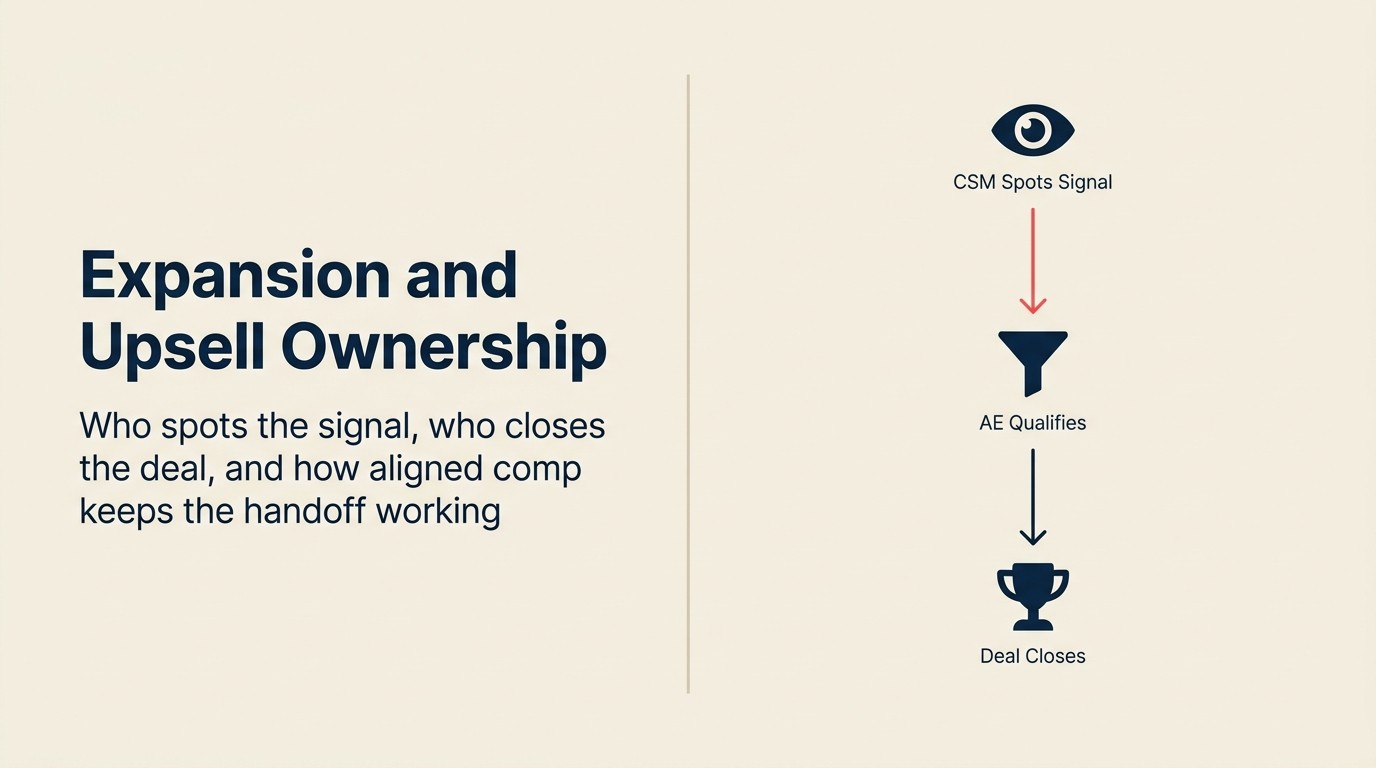
Este fallo ocurre porque las señales de expansión viven en la capa de relación de CS, y la autoridad de cierre vive en la capa comercial de Sales. Las dos capas no se comunican automáticamente. Y sin un protocolo de handoff, los ingresos se evaporan exactamente en el momento en que eran más accesibles.
Datos Clave: La Oportunidad de Ingresos de Expansión
- Un NRR (Net Revenue Retention; ver el Glosario de Alineación Sales-CS) por encima del 120% es el benchmark para las empresas SaaS de alto crecimiento, con los ingresos de expansión marcando la diferencia entre el 100% y el 120%, según los benchmarks SaaS de OpenView Partners.
- Los ingresos de expansión tienen un CAC un 60-80% menor que los ingresos de nuevos logos, porque el cliente ya conoce el producto, el equipo y la relación con el proveedor, según investigaciones de Bain & Company sobre la economía de ingresos SaaS.
- Las empresas donde CS y Sales tienen un protocolo formal de handoff de señales de expansión generan 2,3 veces más ingresos de expansión por cuenta que las empresas sin uno, según el Informe de Benchmark de la Industria de CS 2024 de Gainsight.
- El 71% de los CSM reportan haber identificado señales de expansión que no pudieron convertir porque carecían de autoridad comercial o del apoyo del AE, según una encuesta de ChurnZero a más de 500 profesionales de CS.
Por Qué la Expansión Es un Problema de Propiedad Conjunta
La matemática del NRR de la expansión es directa: los ingresos de expansión son los ingresos más baratos del modelo. El denominador del CAC no crece. No está adquiriendo un nuevo cliente. El margen es mayor que el de nuevos logos. Y las cuentas que se expanden tienen significativamente más probabilidades de renovar, porque las cuentas expandidas tienen mayor dependencia del producto y más stakeholders invertidos en la relación. El análisis de Tomasz Tunguz sobre el NDR muestra que una empresa con un NDR del 160% sería 4,2 veces más grande que una con un NDR del 120% en cinco años, únicamente por el efecto acumulativo de los ingresos de expansión sobre la misma base de clientes.
Entonces la pregunta no es si los ingresos de expansión importan. Es por qué tanto se deja sobre la mesa.
El fallo del lado de CS: Los CSM están más cerca de la cuenta. Escuchan primero las señales de expansión: el nuevo equipo incorporándose, la solicitud de función que sugiere una necesidad de nivel de pago, el comentario sobre el presupuesto que señala la autoridad de compra. Pero la mayoría de los CSM no tienen la autoridad comercial para cerrar un upsell. No pueden cotizar precios, negociar términos ni rebatir una objeción competidora. Pueden detectar la señal y hacer muy poco con ella.
El fallo del lado de Sales: Los AE tienen la capacidad de cierre. Pero rara vez están en la cuenta entre el cierre y la renovación. No saben qué dijo el cliente en el QBR del mes pasado. No saben qué equipos se han incorporado. Pueden cerrar un trato caliente, pero necesitan que la señal les llegue. Y ese handoff casi nunca ocurre de forma sistemática.
El fallo de timing: Incluso cuando un AE sí se involucra, a menudo lo hace demasiado tarde. El cliente ya ha entrado en modo de evaluación. La ventana para una expansión liderada por la relación fue hace tres meses, cuando el nuevo equipo de operaciones se incorporó. Ahora es un trato competitivo.
El marco de tres modelos a continuación le da a cada combinación de tamaño de empresa y tipo de expansión una estructura de propiedad por defecto y un protocolo de handoff definido. Se conecta directamente con la propiedad de la renovación: los mismos niveles de ACV y factores de complejidad que determinan quién coordina la renovación también determinan cómo se asigna la propiedad de la expansión.
Los Tres Modelos de Propiedad de la Expansión
Modelo A: Expansión Liderada por CS
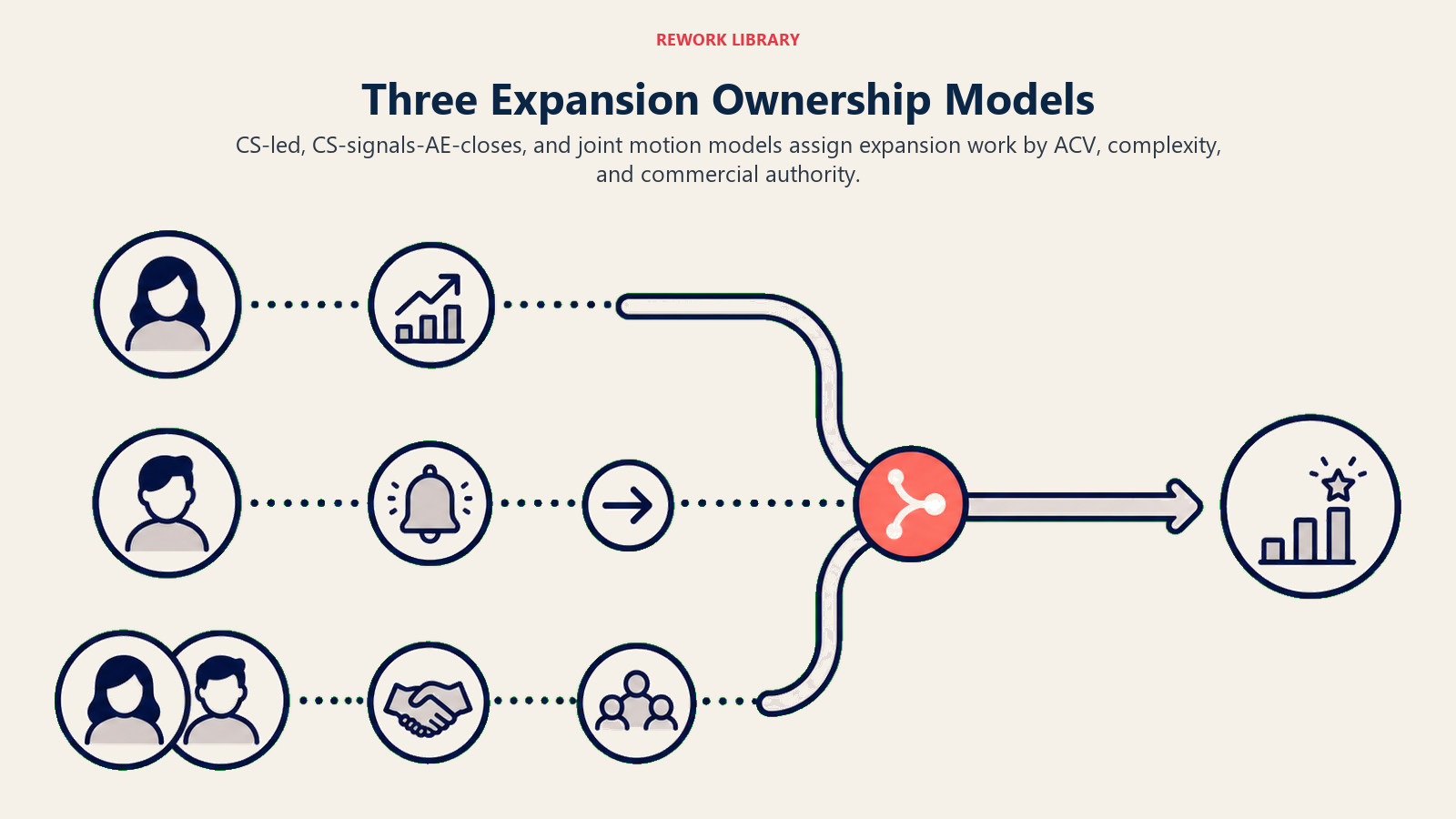
El CSM identifica y cierra tratos de expansión hasta un umbral de ACV definido. Por encima del umbral, se incorpora al AE. Por debajo de él, el CSM es dueño del proceso comercial completo.
Mejor para:
- Portfolios de SMB de alto volumen
- Expansión de baja complejidad: adición de asientos, mejoras de plan, upsells de un solo producto con precios fijos
- Equipos de CS con autoridad comercial y herramientas de precios
El umbral de ACV: Establézcalo en un nivel donde el CSM pueda cerrar razonablemente sin el apoyo del AE. Umbrales comunes: $5K-$10K para equipos de CS de SMB. Por encima del umbral, handoff automático al AE. Por debajo, el CSM maneja de principio a fin.
Implicación para la compensación: Este modelo solo funciona si el CSM tiene crédito de expansión o crédito de cuota. Si los CSM solo se miden en la retención bruta, no hay incentivo para cerrar tratos de expansión en el Modelo A. El CSM está haciendo trabajo comercial adicional sin ningún beneficio adicional en la compensación. Establezca un mecanismo formal de crédito de expansión antes de desplegar el Modelo A.
Modelo B: CS Detecta, AE Cierra
El CSM es dueño de la identificación y la relación; handoff formal al AE en un punto de activación definido. El AE es dueño del cierre comercial.
Mejor para:
- Cuentas mid-market
- Señales de expansión lideradas por el producto donde están involucrados múltiples equipos o líneas de producto
- Upsells complejos donde se requieren modificaciones de precios, contratos o la aceptación de múltiples stakeholders
El trigger del handoff: No toda señal justifica un handoff. El CSM debe calificar la señal antes de enrutarla a Sales. Una señal de expansión calificada tiene tres de las siguientes cuatro características:
- Conversación de presupuesto: el cliente mencionó disponibilidad de presupuesto o una asignación presupuestaria para este tipo de solución
- Comprador nombrado: hay una persona específica que será dueña de la decisión de expansión
- Plazo: el cliente tiene una idea de cuándo quiere actuar
- Encaje con el producto: la expansión se corresponde con un SKU o capacidad de producto específica, no con un vago "podríamos necesitar más"
Un cliente que dice "en algún momento podríamos necesitar más asientos" no es una señal calificada. Un cliente que dice "nuestro director de operaciones me pidió que averiguara sobre añadir tres equipos más antes del Q3" sí lo es.
Cómo evitar perder la señal en el handoff: El CSM registra la señal en el CRM, no en la plataforma de CS. El CRM es donde vive el AE. Un mensaje de Slack al AE no es un handoff. Un registro de oportunidad en el CRM con los campos de la señal completados y el AE asignado sí lo es.
Modelo C: Moción Conjunta
El AE y el CSM son copropietarios de la cuenta para la expansión estratégica. Comparten una cadencia de QBR, tienen carriles definidos para la conversación de expansión y ambos tienen visibilidad sobre la trayectoria comercial de la cuenta.
Mejor para:
- Cuentas enterprise (ACV $150K+)
- Expansión multiproducto donde diferentes líneas de producto se corresponden con diferentes unidades de negocio
- Cuentas estratégicas donde la expansión se trata como una moción de ventas completa, no como un upsell transaccional
La conexión con el modelo de pod: El Modelo C a menudo se combina con una estructura de pod AE-CSM dedicada para cuentas estratégicas. Para más detalles sobre cómo funciona esa pareja operativamente, vea Modelo de Pod: Parejas AE-CSM.
Identificar Señales de Expansión: Qué Busca CS
Los CSM que identifican la expansión bien no están adivinando. Están observando tres categorías de señales en cada cuenta.
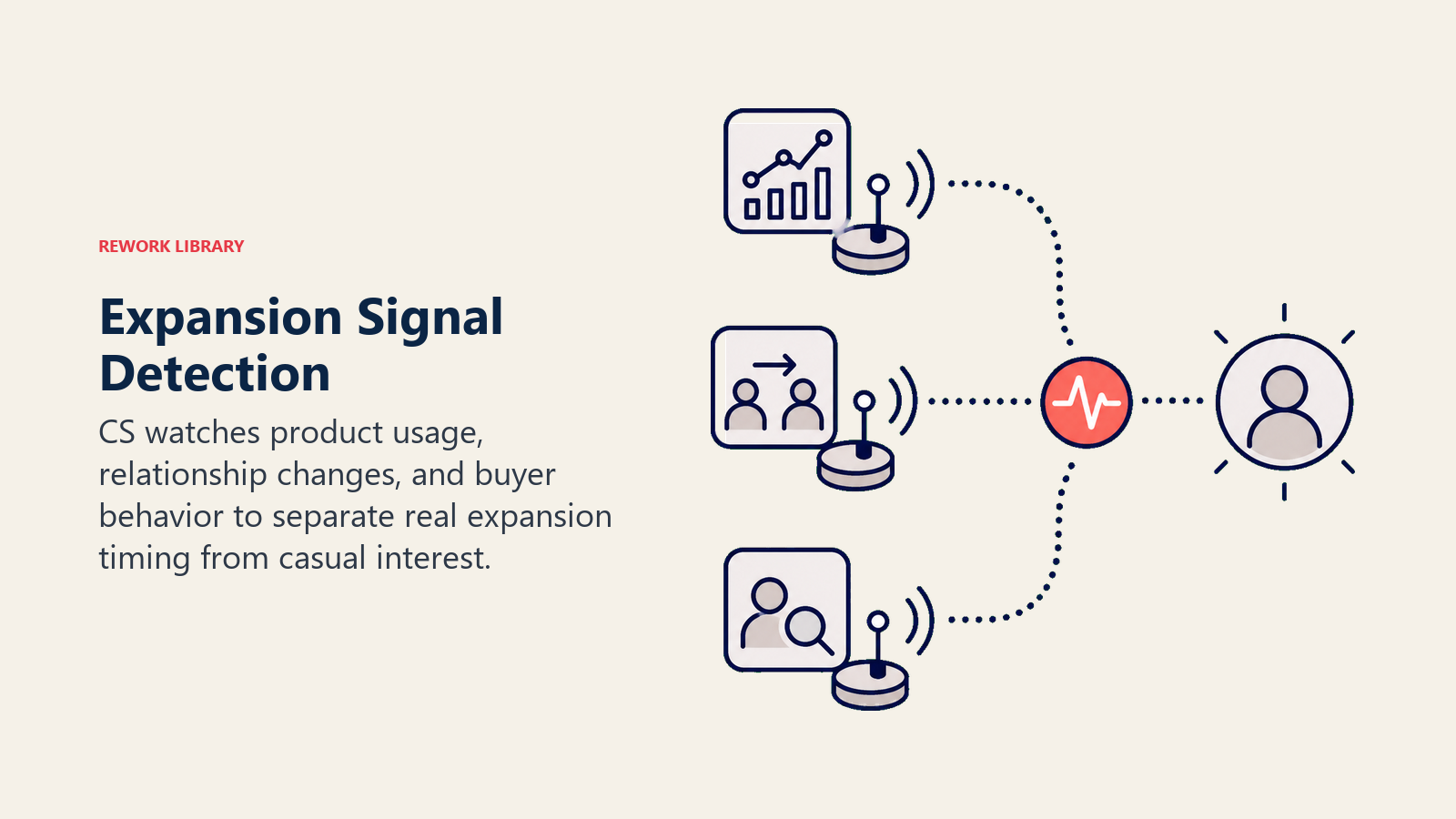
Triggers de uso del producto:
| Señal | Qué significa | Urgencia |
|---|---|---|
| Utilización de asientos por encima del 85% | Cerca de la capacidad, momento natural de expansión | Alta |
| Adopción de funciones adyacentes al nivel de pago | El cliente está chocando contra el plan actual | Media-Alta |
| Volumen de llamadas a la API cerca del límite | Indicador técnico de crecimiento | Alta |
| Nuevo equipo incorporado (en el producto) | Expansión orgánica comenzando de abajo hacia arriba | Media |
| Solicitud de función de capacidad de nivel de pago | Señal explícita de brecha en el producto | Alta |
Señales de la relación:
| Señal | Qué significa | Urgencia |
|---|---|---|
| El champion menciona disponibilidad de presupuesto | La ventana comercial está abierta | Alta |
| Nuevo equipo o división incorporado a la cuenta | Oportunidad de expansión sin una ventana cerrada aún | Media |
| Cambio en el organigrama (nuevo VP, reestructuración) | La relación comercial necesita actualización | Variable |
| Actividad de M&A en el cliente | Podría significar expansión o churn; requiere check-in inmediato | Alta |
Señales de comportamiento:
| Señal | Qué significa | Urgencia |
|---|---|---|
| El cliente pregunta sobre funciones que no tiene | Brecha explícita en el producto | Alta |
| El cliente menciona a un competidor en el QBR | Modo de evaluación, actúe ahora | Crítica |
| El cliente referencia el ROI alcanzado | Preparado para la conversación de "¿qué sigue?" | Media |
| El cliente invita a un nuevo stakeholder a las llamadas | Nuevo comprador involucrado | Media-Alta |
Cómo registrar estas señales de forma consistente: La señal debe ir al CRM: una estructura de campo o nota estandarizada, no texto libre en la plataforma de CS. El AE necesita verla donde trabaja. Una señal que solo existe en Gainsight es una señal que no llega a Sales. El artículo sobre el stack alineado: CRM, plataforma de CS y revenue intelligence cubre cómo conectar estos dos sistemas para que las señales de expansión fluyan automáticamente sin reingreso manual.
El Paso de Calificación: No Toda Señal Es una Oportunidad
El trabajo del CSM en el proceso de expansión es sacar a la superficie las señales y calificarlas, no hacer el pitch de la expansión él mismo (en el Modelo B) ni reenviar cada comentario pasajero a Sales.
Antes de enrutar una señal al AE, el CSM debe responder tres preguntas:
- ¿Hay una conversación de presupuesto, o solo interés? "Nos encantaría tener más usuarios" es interés. "Tenemos $20K en el presupuesto del Q3 y nuestro director quiere expandir" es una conversación de presupuesto.
- ¿Hay un plazo, o solo apertura? Una cuenta que está abierta a expandirse "en algún momento" es una candidata de nurturing. Una cuenta con un plazo en el Q3 es una oportunidad.
- ¿Hay un comprador nombrado, o solo un entusiasta? Que el champion esté emocionado está bien. Que el VP de Operaciones haya sido informado y esté pidiendo una propuesta es un comprador nombrado.
Si dos de tres respuestas son sí, enrúte a Sales. Si cero o una, regístrelo en el CRM como un ítem de seguimiento y vuelva a revisarlo en 30-60 días.
El CSM que enruta cada interacción positiva de la cuenta como "señal de expansión" pierde credibilidad con el AE rápidamente. La calidad de la señal importa más que el volumen.
Compensación e Incentivos en la Costura
Esta sección cubre la dinámica central de compensación. La arquitectura completa está en Compensación Alineada al NRR.
Anti-patrón 1: El AE recibe todo el crédito de expansión, el CSM no recibe nada. El CSM identificó la señal, mantuvo la relación y entregó una oportunidad caliente al AE. Si el AE recibe el 100% de la comisión de expansión y el CSM no recibe nada, la respuesta racional del CSM es dejar de enrutar señales. ¿Por qué crear trabajo que solo beneficia la cuota de otra persona?
Anti-patrón 2: CS recibe cuota de expansión pero sin autoridad comercial ni apoyo del AE. Al CSM se le pide que impulse los upsells, pero no puede cotizar precios, no puede negociar términos y el AE no responde a sus solicitudes de handoff. El objetivo de expansión está establecido; la estructura de apoyo para alcanzarlo no lo está. Esto genera frustración y rotación en CS.
Cómo se ve la compensación alineada en la costura: En el Modelo B (CS detecta, AE cierra), la estructura más sostenible es un crédito de señal para el CSM (una comisión menor o un incentivo por señales de expansión verificadas que se convierten) y crédito total de cierre para el AE en el resultado comercial. El CSM tiene incentivo para sacar a la superficie señales de calidad. El AE tiene incentivo para cerrarlas con prontitud.
Para las dinámicas de cross-sell multiproducto, especialmente donde diferentes líneas de producto tienen diferentes estructuras de comisión, vea Propiedad del Cross-Sell Multiproducto.
El Protocolo de Handoff de Expansión: Qué Estandarizar
Un handoff que vive en Slack o en la memoria de alguien no es un protocolo. Un handoff que crea una tarea en el CRM con campos definidos y un SLA sí lo es.
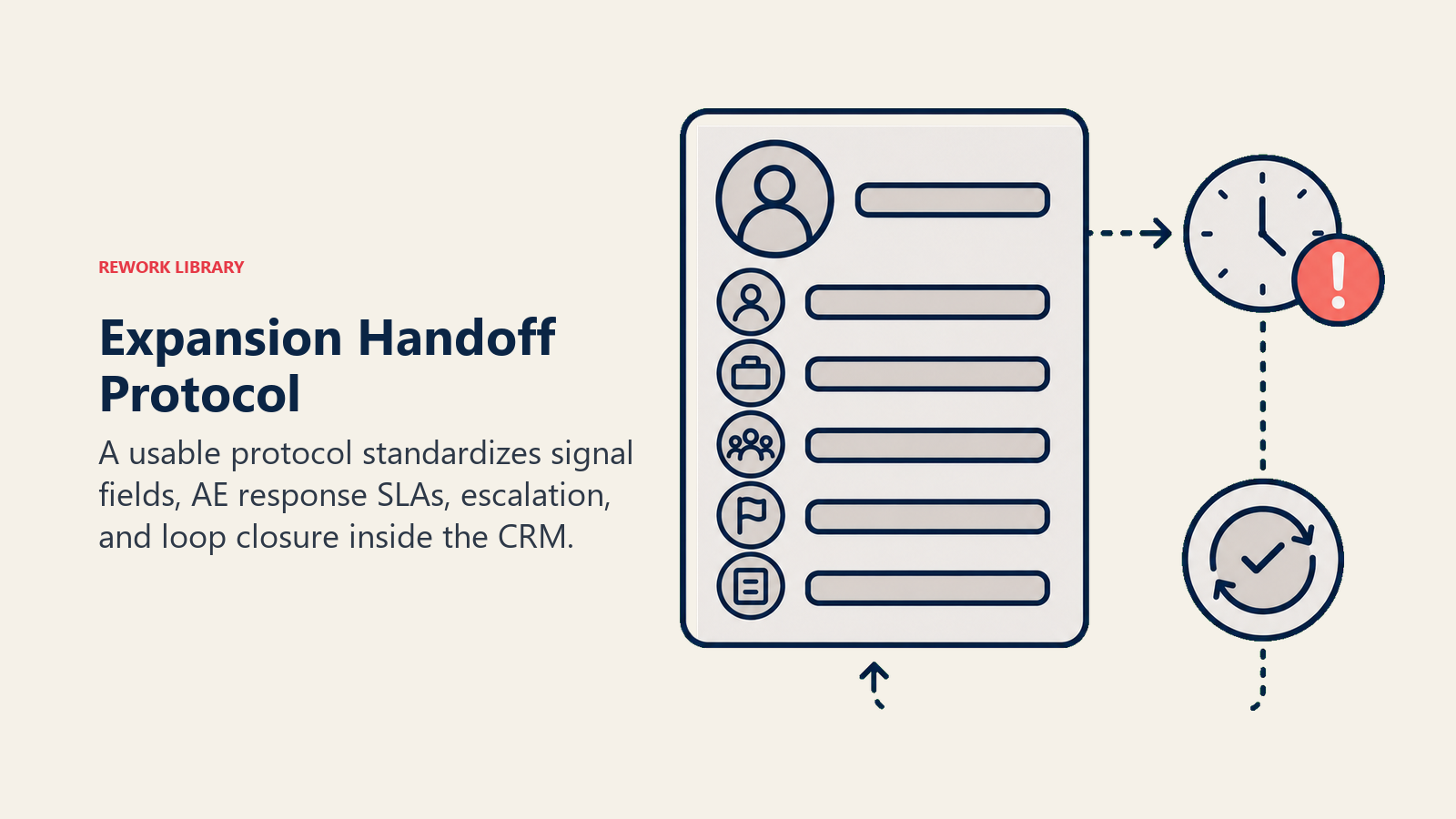
Formato de registro de señal (5 campos en CRM):
| Campo | Descripción | Ejemplo |
|---|---|---|
| Tipo de señal | Producto / relación / comportamiento | "Utilización de asientos al 89%" |
| Comprador nombrado | Nombre y título del contacto | "Jamie Reyes, VP de Operaciones" |
| Plazo | Cuándo el cliente quiere actuar | "Q3, antes del congelamiento presupuestario de julio" |
| Nota de contexto | 2-3 oraciones sobre lo que el CSM escuchó | "El champion mencionó que el equipo de ops tiene 6 personas y está creciendo" |
| Urgencia | Caliente (actuar en 24h) / Tibio (en 72h) / Seguimiento (30 días) | Caliente |
SLA para la respuesta del AE:
- Señales calientes: el AE acusa recibo en 4 horas, contacto con el cliente en 24 horas
- Señales tibias: el AE acusa recibo en 24 horas, contacto con el cliente en 72 horas
- Ítems de seguimiento: el AE los revisa en la próxima sincronización de cuenta (semanal o quincenal)
Si el AE no responde dentro del SLA: el CSM escala al manager del AE. No al CRO. No en un canal público de Slack. Un mensaje directo al manager del AE con la señal del SLA incumplido. Esto debe ser raro si el protocolo está funcionando.
Cerrar el ciclo: El AE actualiza al CSM sobre el resultado independientemente del resultado. Ganado, perdido, aplazado, cliente no listo. Esto no es opcional. El CSM necesita saber qué ocurrió con la señal que sacó a la superficie, tanto para mantener la relación con el cliente como para calibrar la calidad de sus señales futuras. Si los AE cierran tratos de expansión y nunca le dicen al CSM qué ocurrió, el CSM deja de sacar señales a la superficie.
La Matemática del NRR de Hacerlo Bien
Pongamos esto en concreto. La investigación de McKinsey sobre el NRR es consistente: las empresas con NRR en el cuartil superior superan a sus pares en eficiencia de crecimiento y período de recuperación (payback period), no solo en ingresos totales. La mecánica a continuación muestra por qué esa superioridad se acumula. Asuma un portfolio de 100 cuentas en mid-market.
- 15 cuentas tienen señales de expansión activas en el trimestre actual
- Sin un protocolo de handoff: 4 de esas señales llegan al AE a tiempo; 2 se cierran; expansión neta = 2% del ACV del portfolio
- Con un protocolo de handoff definido: 12 de 15 señales llegan al AE; 5 se cierran (un 40% de tasa de cierre en señales calificadas es realista); expansión neta = 5% del ACV del portfolio
La diferencia entre el 2% y el 5% de expansión en un libro de negocio de $3M de ARR es $90K por trimestre, o $360K anuales, del mismo portafolio de cuentas, sin adquisición de nuevos logos.
El efecto acumulativo: las cuentas que se expanden tienen significativamente más probabilidades de renovar. Una cuenta donde un segundo equipo se incorpora, usa el producto y tiene un QBR exitoso tiene más defensores internos de los que tenía al principio. La expansión construye la red de stakeholders de la que depende la retención. La investigación de Bain sobre el superdesempeño del SaaS identifica el giro hacia los modelos de ingresos recurrentes como una ventaja estructural, una que solo se materializa cuando la expansión se trata como una moción sistemática y no como una oportunista.
Hacerlo bien no se trata solo de los ingresos del upsell. Se trata de la salud de la cuenta que sigue. Para las organizaciones post-venta que quieren ver cómo encaja la expansión en el ciclo de vida completo del cliente, los modelos de negocio post-venta ofrecen el contexto estructural en el que operan las mociones de expansión.
Transición Hacia Adelante
La propiedad de la expansión, al igual que la propiedad de la renovación, depende en última instancia de que la compensación esté estructurada para apoyar la moción conjunta. Un AE que no comparte el crédito con CS no tiene razón para mantener la relación entre el cierre y la expansión. Un CSM que no recibe crédito de señal no tiene razón para sacar las señales a la superficie de forma sistemática.
La pregunta del diseño de la compensación (cómo estructurar los incentivos del AE en torno a la retención y la expansión, no solo la adquisición) es la pieza fundacional que hace que los modelos de renovación y expansión funcionen. Comisión de Sales sobre Retención cubre el marco completo.
El Marco de Propiedad de la Expansión de Tres Modelos
El Marco de Propiedad de la Expansión de Tres Modelos asigna cada escenario de expansión a una de tres estructuras de propiedad y a un protocolo de handoff definido. El Modelo A (expansión liderada por CS) encaja con el SMB de alto volumen, donde los CSM tienen autoridad comercial por debajo de un umbral de ACV definido, típicamente $5K-$10K. El Modelo B (CS detecta, AE cierra) encaja con el mid-market, donde el CSM identifica y califica las señales y luego las enruta al AE mediante el CRM con cinco campos definidos y un SLA. El Modelo C (moción conjunta) encaja con las cuentas enterprise con expansión multiproducto y multistakeholder, donde el AE y el CSM comparten una cadencia de QBR y son copropietarios de la trayectoria comercial.
El marco es complementario a la Matriz de Decisión de Propiedad de la Renovación: los mismos niveles de ACV que determinan quién coordina la renovación también determinan qué modelo de expansión aplica. Una cuenta en el Modelo B de renovación es una cuenta del Modelo B de expansión. Mantener alineados los dos marcos previene las brechas de compensación, la razón más común por la que las señales de expansión mueren en el handoff.
Análisis de Rework: La matemática del NRR del protocolo de handoff es concreta. En un portfolio mid-market de $3M de ARR con 100 cuentas: sin un handoff formal, 4 de 15 señales por trimestre llegan a tiempo al AE; 2 se cierran; expansión neta = 2% del ACV del portfolio. Con un formato de handoff de cinco campos en el CRM y SLAs definidos, 12 de 15 señales llegan al AE; 5 se cierran con una tasa de cierre realista del 40% en señales calificadas; expansión neta = 5% del ACV del portfolio. La diferencia de $90K por trimestre ($360K anuales) proviene de la misma base de cuentas, sin adquisición de nuevos logos.
Citas destacadas:
"Los ingresos de expansión tienen un CAC un 60-80% menor que los ingresos de nuevos logos porque el cliente ya conoce el producto, el equipo y la relación con el proveedor, lo que convierte a la expansión en la moción de ingresos de mayor margen disponible para una empresa SaaS." (investigación de Bain & Company sobre la economía de ingresos SaaS)
"Las empresas donde CS y Sales tienen un protocolo formal de handoff de señales de expansión generan 2,3 veces más ingresos de expansión por cuenta que las empresas sin uno. El multiplicador proviene íntegramente de señales que de otro modo quedarían sin enrutar." (Informe de Benchmark de la Industria de CS 2024 de Gainsight)
"El 71% de los CSM reportan haber identificado señales de expansión que no pudieron convertir porque carecían de autoridad comercial o del apoyo del AE, lo que significa que la mayor parte de la pérdida de ingresos de expansión es un fallo de proceso, no un fallo de señal." (encuesta de ChurnZero a más de 500 profesionales de CS)
Aprenda Más

Principal Solution Architect
On this page
- Por Qué la Expansión Es un Problema de Propiedad Conjunta
- Los Tres Modelos de Propiedad de la Expansión
- Modelo A: Expansión Liderada por CS
- Modelo B: CS Detecta, AE Cierra
- Modelo C: Moción Conjunta
- Identificar Señales de Expansión: Qué Busca CS
- El Paso de Calificación: No Toda Señal Es una Oportunidad
- Compensación e Incentivos en la Costura
- El Protocolo de Handoff de Expansión: Qué Estandarizar
- La Matemática del NRR de Hacerlo Bien
- Transición Hacia Adelante
- El Marco de Propiedad de la Expansión de Tres Modelos
- Aprenda Más