El QBR Conjunto de Sales y CS: Cómo AE y CSM Ejecutan una Revisión Trimestral que Realmente Mueve las Renovaciones
Turn this article into takeaways for your work.


Each assistant summarizes the article only for you and suggests best practices for your work.
Aquí está el QBR que no lleva a ningún lado: CS construye una presentación llena de métricas de uso. El AE está en la lista de asistentes pero se une 40 minutos después, justo cuando el cliente está terminando de dar feedback. El comprador económico envió a un coordinador en su lugar. CS repasa lo que pasó el trimestre pasado. Nadie dice nada incómodo. El AE agradece al cliente por la asociación. Todos acuerdan "sincronizarse sobre los próximos pasos". No se definen próximos pasos.
Seis semanas después, CS está persiguiendo la renovación y nadie tiene una lectura clara de si esta cuenta va a cerrar.
Ese QBR no falló porque los datos eran incorrectos o la presentación era mala. Falló porque el AE y CS no se habían alineado antes de la llamada: ni sobre qué querían que el cliente creyera cuando se fuera, ni sobre quién iba a introducir la conversación de renovación, ni sobre qué hacer si el comprador económico no estaba en la sala. La desalineación en momentos como estos es una de las 8 señales de alerta de quiebre entre Sales y CS que conviene conocer antes de que un QBR se descarrile. La investigación de Forrester sobre los QBR plantea la revisión trimestral como un punto de control estructurado esencial para la alineación go-to-market, no como un repaso pasivo de lo que pasó el trimestre pasado.
La reunión en sí es el último 10% de un QBR conjunto. La preparación es donde se decide el resultado.
Por Qué "Conjunto" Importa Aquí (y Qué No es Este Artículo)
Este no es una guía general de QBR. Hay muchas de esas. Este es específicamente sobre qué cambia cuando el AE y el CSM se presentan juntos, y qué necesita ocurrir entre ellos antes de que el cliente se una a la llamada.
El valor específico de la presencia conjunta es estrecho pero real. Cuando el AE está en la sala, le señala al comprador económico seriedad comercial. Dice que la empresa, no solo la función de soporte, está invertida en esta cuenta. El AE también escucha la voz del cliente directamente, no filtrada a través de un resumen del CSM dos semanas después. Esa es inteligencia que cambia cómo el AE maneja la conversación de renovación. También alimenta directamente la voz del cliente de vuelta al mensaje de Sales: el QBR es una de las fuentes más ricas de lenguaje de cliente sin filtrar en todo el ciclo de vida de la cuenta.
Y para CS hay un beneficio diferente: la relación de pares del AE con el champion original tiene credibilidad en la sala que CS construye durante meses. Cuando el AE valida algo que CS ha estado diciendo, aterriza de manera diferente. Esta dinámica es lo que hace que valga la pena proteger en la relación post-venta el trabajo de alineación de stakeholders ganado durante el deal.
Pero esos beneficios solo se materializan si el AE y CS llegan alineados. Si no han hablado antes de la llamada, la presencia conjunta crea riesgo en lugar de valor: señales en competencia, solicitudes contradictorias, un cliente que no puede discernir quién realmente es propietario de su cuenta.
Datos Clave: Impacto del QBR en los Resultados de Renovación
- Los clientes que participan en QBR estructurados renuevan a tasas del 22 al 28% más altas que aquellos sin revisiones ejecutivas regulares, según la investigación de benchmark de Customer Success de Gainsight.
- Solo el 35% de los QBR resultan en un próximo paso o compromiso claro del cliente, según los datos de engagement de clientes B2B de Forrester. La mayoría termina con conclusiones vagas de "hagamos seguimiento".
- Las cuentas donde el AE y el CSM co-presentan en los QBR muestran tasas de expansión 1,4 veces mayores en los 90 días posteriores a la revisión en comparación con las revisiones solo de CS, según los datos de ingresos por expansión de TSIA.
Citable: "Los clientes que participan en QBR estructurados renuevan a tasas del 22 al 28% más altas que aquellos sin revisiones ejecutivas regulares. Pero solo el 35% de los QBR resultan en un próximo paso o compromiso claro, según los datos de engagement de clientes B2B de Forrester. La brecha entre esas cifras es la preparación, no la participación."
La Alineación Pre-Reunión (La Parte que la Mayoría de los Equipos Omite)
Cuarenta y ocho horas antes del QBR, el AE y el CSM deben sincronizarse durante 20-30 minutos. No para revisar la presentación (CS es propietario de la presentación). Para acordar cuatro cosas:
Postura de renovación. ¿Cuál es la lectura honesta de esta cuenta en este momento? ¿Es la renovación muy probable, incierta o genuinamente en riesgo? La respuesta cambia todo sobre cómo participa el AE. Si la renovación es incierta, el AE necesita comprometerse más. Si es muy probable, el rol del AE es más liviano: mostrar presencia, no interrumpir lo que CS ha construido.
Qué queremos que el cliente crea cuando se vaya. No las métricas. La creencia. "Deberían irse creyendo que la plataforma es integral para su plan de operaciones del Q3." "Deberían irse sabiendo que tomamos en serio su issue de soporte abierto y tenemos un cronograma." "Deberían irse listos para tener la conversación de renovación." Articular esto obliga a ambos equipos a acordar el objetivo antes de que se establezca la agenda.
La solicitud. ¿Están apuntando a un compromiso de renovación en esta reunión? ¿Un iniciador de conversación de expansión? ¿Un re-engagement del sponsor ejecutivo? Solo puede haber una solicitud principal. Múltiples solicitudes crean una llamada sin foco y un cliente confundido. El AE y el CSM acuerdan la solicitud antes de que comience la reunión, y acuerdan quién la entrega.
Quién habla cuándo. En la llamada en sí, no hay voces en competencia. El CSM lidera a menos que un momento específico haya sido cedido al AE. El AE no llena el silencio pivoteando a temas comerciales. Ambos equipos saben de antemano qué momentos les corresponden. Esto suena como sobre-preparación. No lo es. Es la única manera de que una presentación conjunta no derive en un trabajo en equipo incómodo.
Agenda de Muestra del QBR: El Formato Conjunto de 60 Minutos
Framework Nombrado: La Agenda del QBR Conjunto de 60 Minutos Esta agenda asigna propiedad clara a cada bloque para que el AE y el CSM lleguen sabiendo exactamente cuándo liderar y cuándo apoyar. La estructura está diseñada para cuentas de mercado medio con un comprador económico y al menos un product champion en la sala. Para cuentas Enterprise con múltiples stakeholders, amplíe los bloques 2 y 5 en 10 minutos cada uno. Para cuentas SMB donde el champion y el comprador económico son la misma persona, combine los bloques 3 y 5 y ejecute una versión de 45 minutos.
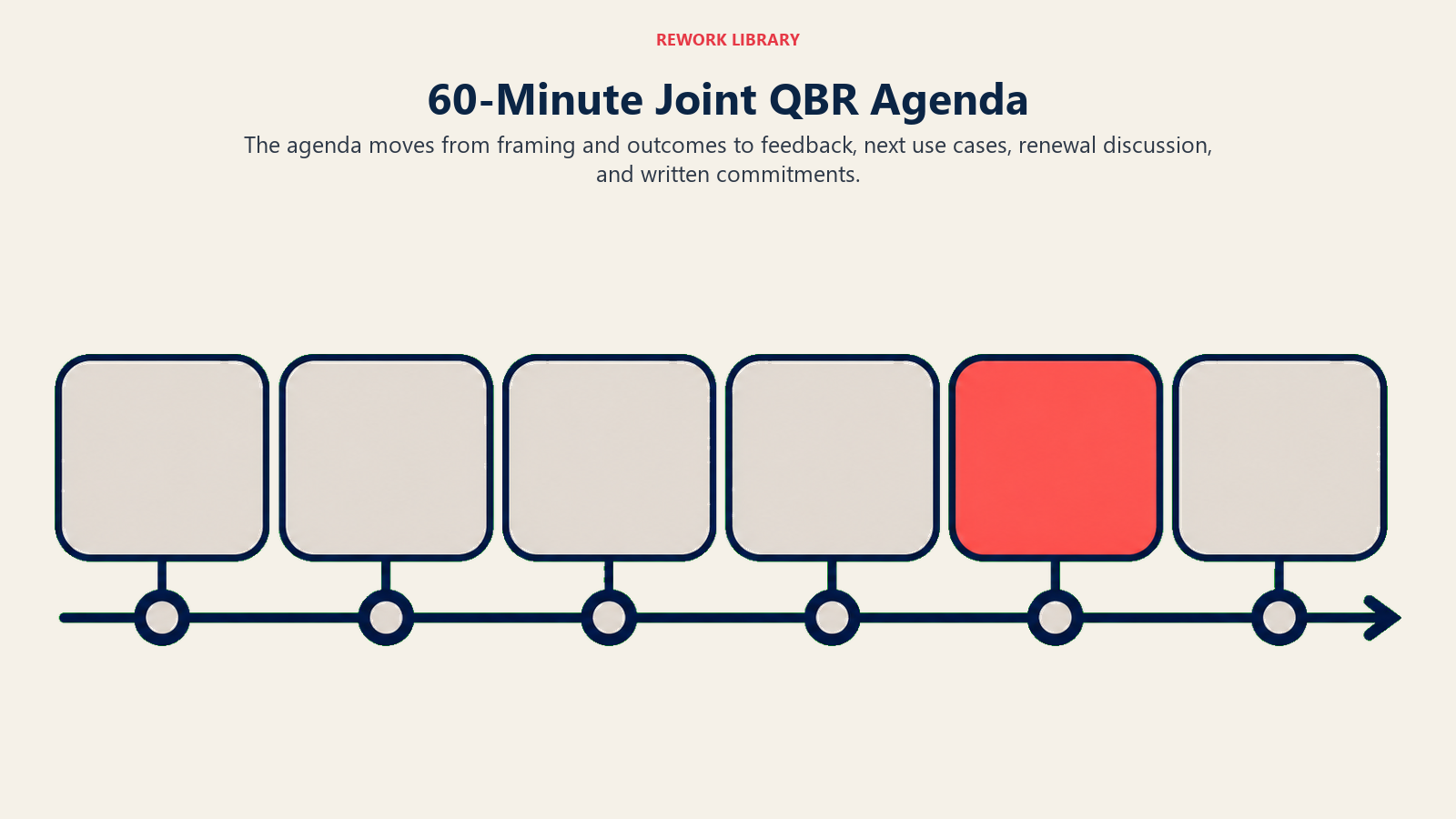
| Tiempo | Bloque | Propietario | Propósito |
|---|---|---|---|
| 0-5 min | Bienvenida y encuadre | CSM | Establecer contexto, confirmar asistentes, declarar el objetivo de la sesión |
| 5-20 min | Progreso frente a criterios de éxito | CSM | Revisar resultados vs. metas establecidas en el kickoff. Datos de uso, hitos de adopción, victorias |
| 20-30 min | Feedback del cliente e issues abiertos | Ambos (CSM lidera) | Escuchar al cliente. El AE escucha y toma notas. Sin pivotes todavía |
| 30-40 min | Lo que sigue: relevancia del roadmap y próximos casos de uso | El AE introduce, el CSM valida | El AE revela valor adyacente. El CSM lo ancla en la capacidad actual y el ajuste |
| 40-50 min | Discusión de renovación / expansión | El AE lidera, el CSM apoya | El AE entrega la solicitud. El CSM proporciona datos de respaldo sobre el valor realizado |
| 50-60 min | Compromisos y próximos pasos | El CSM es propietario del registro | Próximos pasos específicos, propietarios nombrados, fechas. El CSM los escribe en tiempo real |
Bloque 1 (0-5 min): El CSM abre. Encuadre simple: "Gracias por estar aquí. El objetivo hoy es ver qué funcionó, qué sigue abierto y hacia dónde queremos llevar las cosas durante el próximo trimestre. Nos aseguraremos de dejar tiempo al final para hablar sobre lo que sigue." Sin diapositivas todavía si puede evitarlo. Primero contacto visual y voz.
Bloque 2 (5-20 min): CS es propietario de este bloque por completo. Métricas de uso, progreso frente a los criterios de éxito que se establecieron en el kickoff (si se establecieron; si no, esta es una brecha que hay que corregir antes del próximo QBR), y dos o tres victorias específicas que el cliente ha visto. Este bloque debería sentirse como un reporte al cliente, no como una presentación al cliente.
Bloque 3 (20-30 min): Este es el bloque más importante y el más omitido. Pregunte al cliente qué no está funcionando. Pregunte qué está tomando más tiempo de lo esperado. Pregunte qué desearían que fuera diferente. Déjelos hablar. El AE no debería hablar en este bloque excepto para hacer una pregunta aclaratoria. Escuche. Tome notas. Esta es la inteligencia más valiosa que produce la llamada.
Bloque 4 (30-40 min): El AE introduce lo que viene: elementos del roadmap del producto relevantes para el caso de uso de esta cuenta, capacidades adyacentes que no están usando actualmente, nuevas integraciones que encajan en su stack tecnológico. Pero el AE no hace un pitch. El AE encuadra: "Hemos estado construyendo X, que creo que es directamente relevante para lo que mencionó sobre Y. ¿Puede [nombre del CSM] mostrarle cómo se vería eso en su configuración?" CS valida el valor adyacente en términos operativos. Esto es un pase, no un pivote.
Bloque 5 (40-50 min): El AE lidera la solicitud de renovación o expansión. No es una sorpresa: tanto el cliente como CS sabían que este momento venía desde el encuadre del bloque 1. Una solicitud directa: "Nos encantaría hablar sobre cómo se ve el próximo año. ¿Está listo para tener esa conversación hoy, o sería más útil programar una llamada dedicada?" No entierre la solicitud en una diapositiva. Dígalo directamente.
Bloque 6 (50-60 min): El CSM escribe cada compromiso hecho en la llamada, por el cliente, por el AE y por CS, en voz alta, en tiempo real. "Déjeme asegurarme de que tengo los próximos pasos correctos: [nombre del cliente] va a reunir los requisitos de IT para el día 15, [nombre del AE] va a enviar los términos de renovación esta semana, y yo haré seguimiento al ticket de soporte abierto para el final de la semana." Leerlo de vuelta cierra el ciclo en la sala.
Las Métricas que Pertenecen a un QBR Conjunto
No todos los datos son datos de QBR. Las métricas que pertenecen a esta reunión son las que le importan al comprador económico, no las que son fáciles de extraer.
Uso vs. asientos contratados. ¿Los asientos contratados están realmente en uso? Si 60 de 100 asientos están activos, hay una conversación de renovación esperando. CS proporciona estos datos. El AE necesita verlos antes de la llamada. La investigación de Forrester sobre retención de clientes señala que los clientes existentes representan el 61% de los ingresos B2B a través de renovaciones y expansiones, lo que convierte la utilización de asientos en una de las métricas más accionables en la sala.
Valor realizado vs. criterios de éxito del kickoff. Esta es la métrica más difícil de producir, y la más importante. Si no había criterios de éxito documentados en el kickoff, el QBR no tiene ancla. Empiece a construir esto para la próxima cohorte: el AE y el CSM acuerdan 2-3 resultados medibles al cierre de cada deal, documentados en el CRM. El framework de criterios de onboarding exitoso es el lugar correcto para definirlos desde el inicio, de modo que el QBR tenga una línea base fija contra la cual medir.
Narrativa de ROI para el sponsor ejecutivo. El comprador económico necesita justificar esta renovación internamente. El AE encuadra la historia de ROI, no en términos de producto, sino en términos de negocio. CS la sustancia con datos reales de resultados. Este es el artefacto colaborativo de los bloques 4 y 5.
Señales de expansión. ¿Qué equipos en la cuenta no están en la plataforma todavía? ¿Qué casos de uso adyacentes mencionó el cliente en el bloque 3 que el producto podría abordar? Tanto el AE como el CSM contribuyen a esto. Se convierte en el insumo para la conversación de expansión, ya sea en este QBR o en la próxima ventana de 90 días. Para estructurar esa señal de expansión en un motion formal, el playbook de propiedad de la expansión y upsell continúa donde el QBR termina.
Leyendo la Sala: Lo que el AE y el CSM Observan por Separado
El AE y el CSM deberían estar observando señales diferentes durante la llamada y comparando notas inmediatamente después.
El CSM observa: ¿El product champion está genuinamente comprometido, o asistiendo educadamente? ¿Están haciendo referencia a uso real, o hablando de manera general? ¿Mencionaron alguna frustración específica en el bloque 3 que no habían planteado en llamadas regulares? ¿La dinámica interna se ve estable, o ha habido cambios de personal que CS no conoce aún?
El AE observa: ¿El comprador económico está comprometido, o fue delegado a un coordinador? ¿El comprador económico está haciendo contacto visual con el champion cuando se presentan las métricas de éxito, o parece escéptico? ¿Están preguntando sobre precios o términos del contrato espontáneamente? ¿Están preguntando sobre competidores, aunque sea casualmente?
La señal desajustada (champion entusiasta, comprador económico escéptico o desinteresado) es la señal de advertencia más común de que una renovación es más débil de lo que parece. Cuando la lectura del CSM es "les encanta el producto" y la lectura del AE es "el comprador parecía distraído y mencionó que están haciendo una revisión de proveedores en Q3", esas señales necesitan compararse en el debrief post-llamada antes de actualizar el forecast.
Después de la Llamada: El Debrief Conjunto
Dentro de las 24 horas del QBR, el AE y el CSM hacen un debrief de 15 minutos. Cuatro preguntas:
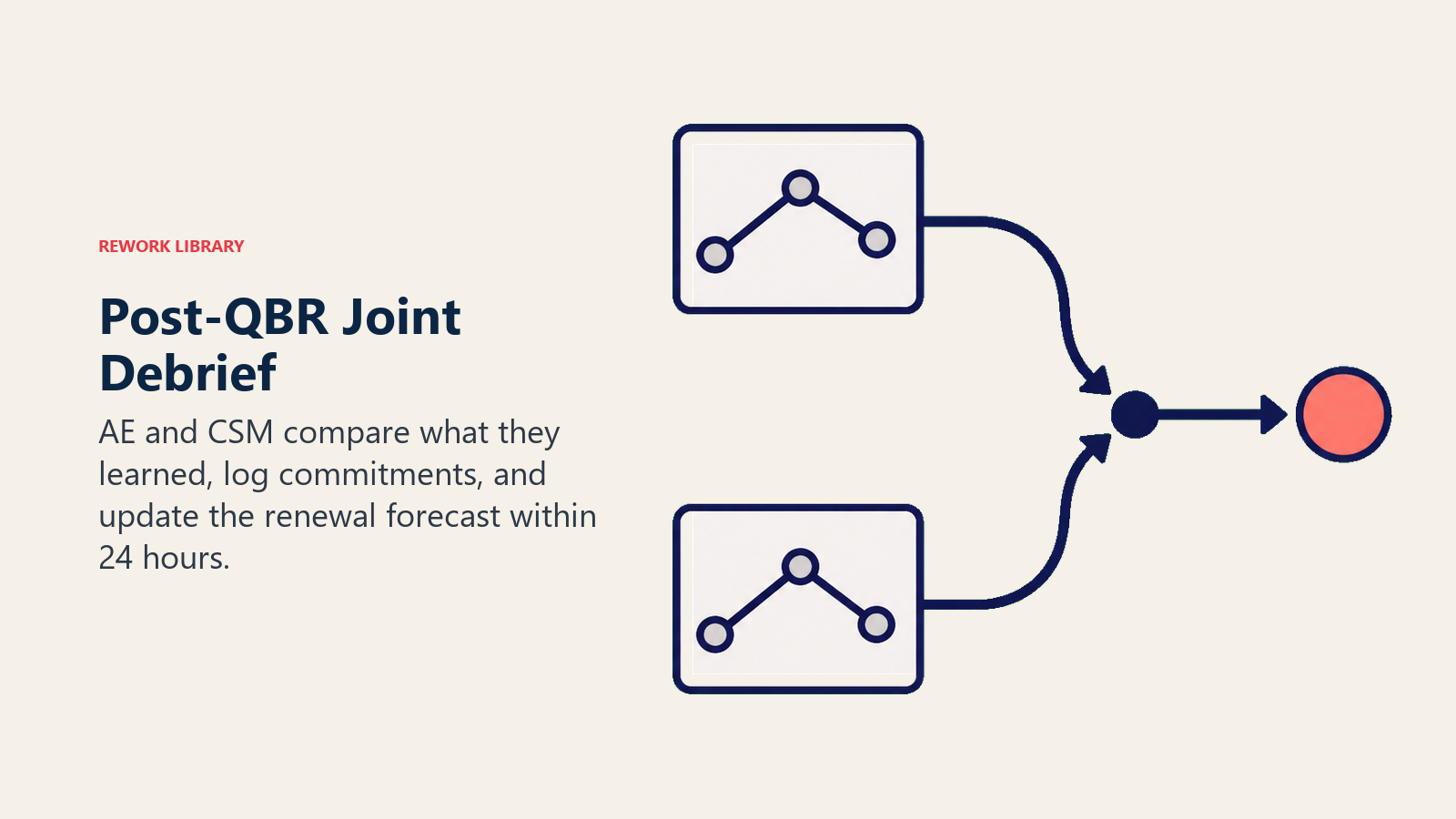
1. ¿Qué aprendimos sobre el riesgo de renovación o la disposición para la expansión? No lo que presentamos. Lo que aprendimos. El feedback sincero del cliente en el bloque 3, el lenguaje corporal del comprador económico en el bloque 5, el comentario al final sobre una revisión de presupuesto.
2. ¿Qué compromisos hizo el AE? Incluso los informales. "Miraré esa pregunta de precios" es un compromiso. Debería estar en el CRM para el final del día.
3. ¿Qué compromisos hizo CS? La misma regla. La lista escrita del CSM del bloque 6 es el punto de partida. Confirmar cuáles necesitan registrarse versus cuáles ya están en la plataforma de CS.
4. ¿Cómo cambia esto el forecast de renovación? Si el AE tenía esta renovación pronosticada como "probable" y el comprador económico parecía desinteresado, ¿se mueve a "en riesgo"? Si hubo una señal de expansión espontánea en el bloque 4, ¿se registra como una nueva oportunidad? Esta decisión pertenece tanto al AE como al CSM juntos, no al AE actualizando su pipeline de forma aislada. El proceso de forecast conjunto de NRR es donde estas señales post-QBR se formalizan en un número compartido del que ambos equipos son propietarios.
Cuándo Omitir el Formato Conjunto
No todos los QBR necesitan al AE presente. De hecho, requerir la presencia del AE para todos los QBR a escala SMB crea un problema de programación que matará la cadencia.
QBR solo de CS: Apropiado para cuentas donde la renovación es muy probable, la relación es saludable, no hay señal de expansión en juego, y la cuenta está por debajo de un cierto umbral de ARR. El AE no necesita estar ahí. CS puede representar la asociación.
QBR liderado por el AE: Apropiado para cuentas donde hay una gran oportunidad de expansión, la renovación está en disputa, o el comprador económico es nuevo y no ha conocido al AE desde el deal original. CS participa pero el AE lidera. Repasar las tácticas de engagement ejecutivo de la etapa del deal es útil aquí. Los mismos principios para volver a involucrar a un comprador senior durante la venta aplican cuando un comprador económico necesita reactivarse en la renovación.
Formato de nivel ejecutivo: Para cuentas estratégicas, agregue un sponsor ejecutivo de su empresa (VP CS o CRO) para espejear la presencia ejecutiva del cliente. Esto cambia el proceso de alineación pre-reunión: ahora hay una sincronización de tres personas en lugar de dos. La estructura de la agenda se mantiene, pero los bloques 4 y 5 tienen más tiempo.
El factor decisivo es la importancia estratégica de la cuenta combinada con el puntaje de riesgo de renovación. Construya una matriz simple: nivel de ARR × puntaje de riesgo de renovación. ARR alto, riesgo alto = conjunto con AE. ARR bajo, riesgo bajo = CS solo. La investigación de McKinsey sobre NRR muestra que las empresas SaaS B2B del cuartil superior sostienen un NRR mediano del 130%, un benchmark que requiere motions de expansión deliberados, no solo renovaciones reactivas.
Citable: "Las cuentas donde el AE y el CSM co-presentan en los QBR muestran tasas de expansión 1,4 veces mayores en los 90 días posteriores a la revisión en comparación con las revisiones solo de CS, según los datos de ingresos por expansión de TSIA. Pero solo cuando ambos roles tienen momentos definidos en la agenda en lugar de superponerse durante toda la llamada."
Análisis de Rework: En los QBR conjuntos donde los roles del AE y el CSM están explícitamente definidos por bloque de agenda, la tasa de participación del comprador económico es medible y notablemente mayor que en las revisiones sin estructura. El patrón se sostiene porque una estructura definida señala seriedad organizacional. Un comprador económico que ve una presentación coordinada es menos propenso a delegar su asistencia en un coordinador. La Agenda del QBR Conjunto de 60 Minutos descrita arriba está diseñada en torno a esta señal: el AE entra en el bloque 4 (no en el minuto 0) precisamente para anclar el momento comercial sin desplazar la credibilidad de relación que CS ha construido en los bloques 1-3.
Implementación: Ejecutar los Primeros Tres Juntos Antes de Estandarizar
No implemente el formato de QBR conjunto a todo el equipo de una vez. Ejecute los primeros tres de forma conjunta. El AE y el CSM revisan la agenda, ambos se presentan preparados, ambos hacen el debrief post-llamada. Use esas tres llamadas para calibrar antes de hacerlo práctica estándar.
Después de la primera llamada: identifique cuál bloque se extendió (usualmente el bloque 3, si lo dejó). Después de la segunda llamada: identifique si la solicitud en el bloque 5 se hizo con claridad o quedó enterrada. Después de la tercera llamada: compare las señales de resultado de renovación con los cambios en el forecast. Para la tercera llamada, el formato debería sentirse operativo en lugar de costoso.
El framework de propiedad de renovaciones define qué cuentas reciben qué formato de QBR. Y si una cuenta pasa de saludable a en riesgo entre QBR, el playbook en cuando Sales es convocado a una cuenta en riesgo toma el control antes de la próxima revisión trimestral.
Preguntas Frecuentes sobre el QBR Conjunto de Sales y CS
¿Qué es el Formato de QBR Conjunto?
El Formato de QBR Conjunto (también llamado QBR Conjunto de 60 Minutos) es una revisión trimestral de negocio estructurada donde el AE y el CSM son propietarios de bloques específicos de la agenda, llegan con un brief de alineación pre-reunión y salen con próximos pasos documentados. Se diferencia de un QBR estándar dirigido por CS en que el AE está presente en momentos definidos, específicamente los bloques 4 y 5 que cubren la relevancia del roadmap y la solicitud de renovación, en lugar de unirse al final o asistir pasivamente. El formato produce una señal clara de expansión o renovación de la reunión en lugar de diferirla a un seguimiento.
¿Con qué frecuencia debe realizarse un QBR conjunto?
La cadencia depende del nivel de la cuenta y del riesgo de renovación. Para cuentas de ARR alto y riesgo alto, un QBR conjunto cada trimestre es apropiado. Para cuentas saludables de mercado medio, un formato conjunto dos veces al año (con check-ins solo de CS entre ellos) es una práctica común. Las cuentas SMB por debajo de un umbral de ARR definido típicamente ejecutan QBR solo de CS, porque requerir la presencia del AE a escala crea una fricción de programación que mata la cadencia por completo. La regla clave: defina la cadencia por tipo de cuenta de antemano en lugar de decidir caso por caso cuando termina el trimestre.
¿Quién debe asistir a un QBR conjunto?
Obligatorios del lado del cliente: el comprador económico (la persona que controla el presupuesto de renovación) y el product champion (el usuario diario que impulsa la adopción). Si el comprador económico no asiste, la reunión debe reprogramarse o reformatearse. La conversación de renovación del bloque 5 requiere al comprador económico en la sala. Del lado del proveedor: CSM y AE como mínimo. Para cuentas estratégicas, agregue un CS Manager o VP para espejear la presencia ejecutiva. Para cuentas SMB donde el champion y el comprador económico son la misma persona, ejecute una versión comprimida de 45 minutos.
¿Qué resultados debe producir un QBR conjunto?
Tres resultados específicos: una señal de renovación (la disposición o el cronograma declarado por el cliente para la conversación de renovación), próximos pasos documentados con propietarios nombrados y fechas (no "haremos seguimiento"), y un forecast actualizado tanto del AE como del CSM que refleje lo que aprendieron sobre la verdadera postura de renovación de la cuenta. Si no se genera ninguno de estos resultados, el QBR produjo reportes pero no movimiento. El debrief post-llamada dentro de las 24 horas es donde el AE y el CSM comparan lo que observaron y acuerdan qué significa realmente la señal.
¿Cuál es el mayor modo de fallo en los QBR conjuntos?
Que el comprador económico no esté en la sala. Ocurre en el 52% de los QBR de mercado medio, según la investigación de engagement de clientes de SiriusDecisions. Cuando el comprador económico envía a un coordinador, el AE no puede entregar la solicitud de renovación a la persona correcta y la reunión no produce ninguna señal de decisión. La prevención es una verificación pre-reunión: el CSM confirma la asistencia del comprador económico al menos 48 horas antes de la llamada. Si el comprador económico cancela y no ofrece una reunión de reemplazo, el QBR debe reprogramarse en lugar de ejecutarse sin el tomador de decisiones presente.
¿Cómo deben prepararse el AE y el CSM para un QBR conjunto?
Una sincronización pre-reunión de 20-30 minutos, 48 horas antes de la llamada, que cubra cuatro preguntas: ¿cuál es la postura honesta de renovación? ¿Qué queremos que el cliente crea cuando se vaya? ¿Cuál es la única solicitud principal? ¿Y quién habla sobre qué? El CSM es propietario de la presentación y lidera los bloques 1-3. El AE entra en el bloque 4 y lidera la solicitud de renovación en el bloque 5. Ninguno improvisa su momento. Ambos saben de antemano cuándo hablan y qué van a decir. Esto no es sobre-preparación. Es la diferencia entre una llamada conjunta productiva y un trabajo en equipo incómodo.
Más Información

Principal Solution Architect
On this page
- Por Qué "Conjunto" Importa Aquí (y Qué No es Este Artículo)
- La Alineación Pre-Reunión (La Parte que la Mayoría de los Equipos Omite)
- Agenda de Muestra del QBR: El Formato Conjunto de 60 Minutos
- Las Métricas que Pertenecen a un QBR Conjunto
- Leyendo la Sala: Lo que el AE y el CSM Observan por Separado
- Después de la Llamada: El Debrief Conjunto
- Cuándo Omitir el Formato Conjunto
- Implementación: Ejecutar los Primeros Tres Juntos Antes de Estandarizar
- Más Información