El Stack Alineado: Cómo el CRM, la Plataforma de CS y la Inteligencia de Ingresos Trabajan Juntos en la Conexión entre Ventas y CS
Turn this article into takeaways for your work.


Each assistant summarizes the article only for you and suggests best practices for your work.
El cliente recibe dos llamadas en la misma semana. El ejecutivo de cuentas (AE) llama para explorar el apetito de expansión. El customer success manager (CSM) llama para hablar de una escalada de soporte. Ninguno sabe que el otro llamó. El cliente, que lleva tres meses evaluando a un competidor, tiene ahora un dato más que confirma que los equipos internos del proveedor no se están comunicando entre sí.
Esta situación es más común de lo que la mayoría de los líderes de ingresos quiere reconocer. Y casi siempre es un problema de infraestructura, no de personas.
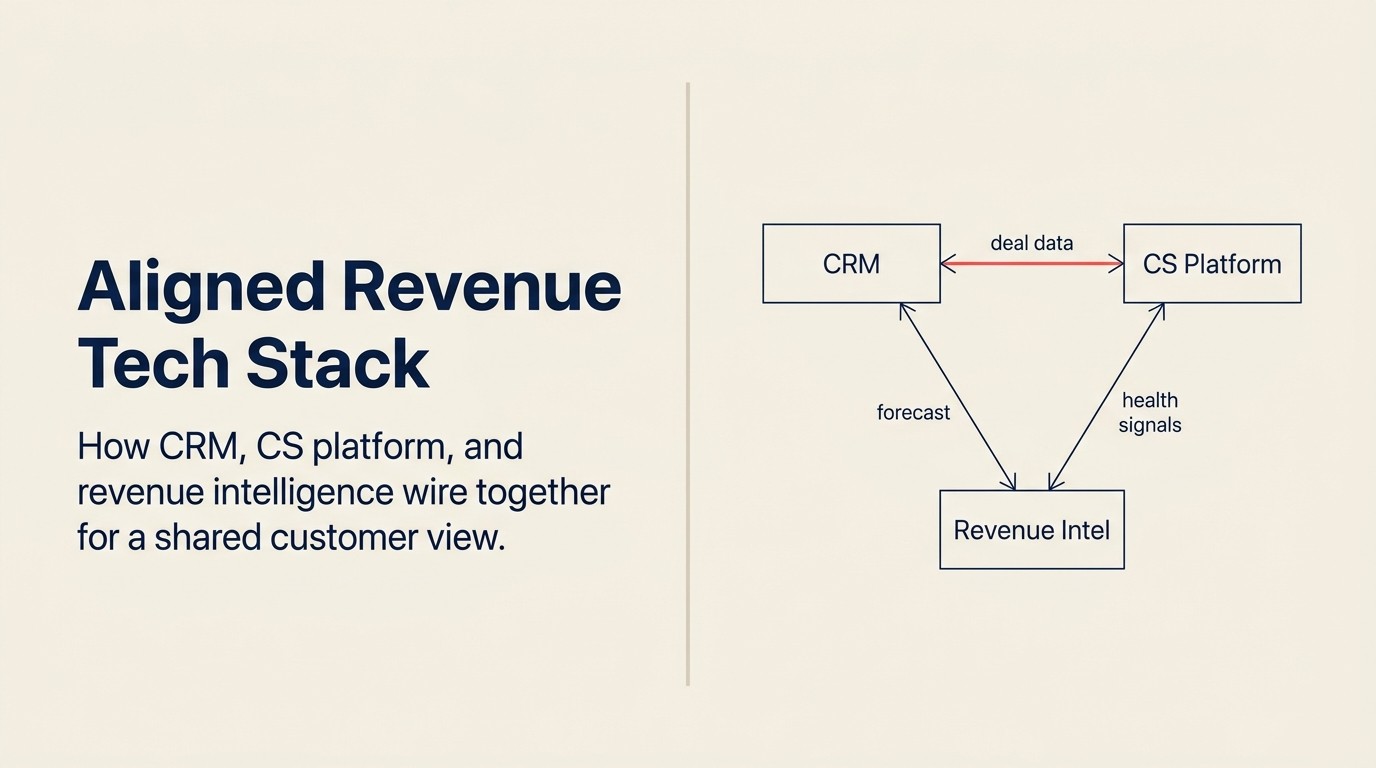
Ventas vive en el CRM. CS vive en la plataforma de CS. La inteligencia de ingresos se supone que debe unir ambas, pero en la mayoría de las implementaciones se trata como una herramienta de coaching para Ventas que CS nunca llega a ver. El resultado son dos equipos operando con dos versiones distintas del mismo cliente, y la brecha aparece exactamente cuando más importa.
Este artículo trata de arreglar esa conexión. No de elegir al mejor proveedor en cada categoría. Los proveedores mencionados son ejemplos ilustrativos de lo que existe en cada categoría. El foco está en la arquitectura de integración que hace que estas herramientas trabajen juntas en la conexión entre Ventas y CS.
Las Tres Categorías de Herramientas en la Conexión
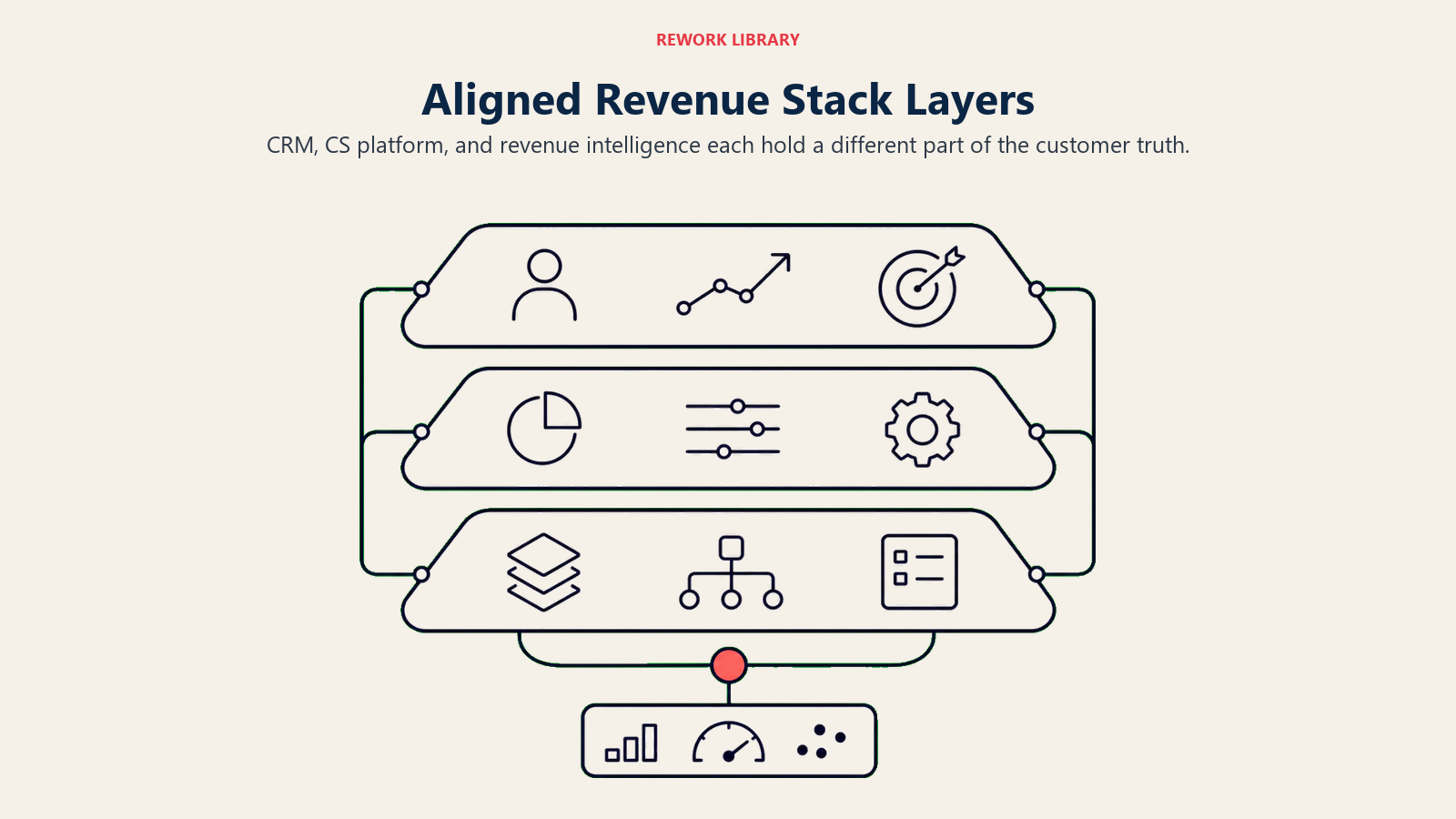
Análisis de Rework: La mayoría de las fallas del stack entre Ventas y CS no son problemas de selección de proveedor. Son problemas de arquitectura de integración. El Stack de Ingresos Alineado de 3 Capas (CRM + plataforma de CS + inteligencia de ingresos) es tan fuerte como sus tres puntos de integración en la conexión. Reemplazar una herramienta de categoría suele costar de 3 a 6 meses de migración y rara vez corrige la brecha en el flujo de datos que causó la desalineación. Configurar correctamente los puntos de integración existentes es el primer movimiento de mayor palanca en la gran mayoría de las implementaciones de mercado medio.
Antes de entrar en la arquitectura de integración, conviene tener claro qué hace bien cada categoría y dónde se detiene.
Datos clave: Integración del stack de ingresos
- Solo el 26% de las empresas B2B SaaS reporta que su CRM y su plataforma de CS comparten datos bidireccionales en tiempo real a nivel de cuenta, según el informe State of Customer Success 2024 de Gainsight.
- La empresa mid-market promedio usa 6 a 8 herramientas de ingresos pero logra una integración significativa en menos de la mitad, según Gartner.
- Las plataformas de inteligencia de ingresos se usan principalmente para coaching de ventas en el 61% de las implementaciones, lo que significa que el equipo de CS nunca accede a los datos de conversaciones con compradores y clientes que justificaron la inversión (encuesta interna de Gong, 2024).
CRM: Sistema de Registro para Deals y Actividad de Ventas
El CRM es el registro oficial del Pipeline, los contactos, las oportunidades y la actividad de Ventas. Captura la historia completa antes del cierre: cómo se originó el deal, quiénes participaron, qué se prometió, cuáles fueron los factores de ganancia, qué objeciones surgieron.
Dónde se detiene: la mayoría de los CRM están diseñados para flujos de trabajo previos al cierre. Los datos de salud post-cierre (adopción, historial de soporte, tendencias de engagement) generalmente no viven allí por defecto. El CRM sabe todo lo que ocurrió antes de firmar. A menudo sabe sorprendentemente poco sobre lo que pasó después.
Ejemplos de lo que vive en esta categoría: Salesforce, HubSpot CRM, Pipedrive, Microsoft Dynamics. Estos son ejemplos ilustrativos de la categoría, no un ranking ni una recomendación. El Gartner Magic Quadrant para Plataformas de Automatización de la Fuerza de Ventas es la fuente de referencia para evaluar la madurez de los proveedores en esta categoría.
Plataforma de CS: Sistema de Registro para la Salud Post-Venta
La plataforma de CS monitorea lo que ocurre después del cierre del deal: progreso del Onboarding, hitos de adopción, health scores, estado de los QBR, plazos de renovación y las notas de relación continua del CSM. Está diseñada alrededor del ciclo de vida del cliente, no del ciclo de vida del deal.
Dónde se detiene: las plataformas de CS suelen ser débiles en el contexto del deal. El CSM abre una cuenta y ve datos de salud, pero frecuentemente no tiene visibilidad sobre qué prometió el AE en el proceso de ventas, cuál fue el ICP fit score original, qué objeciones competitivas se plantearon o qué conversaciones de expansión ya se intentaron.
Ejemplos de lo que vive en esta categoría: Gainsight, ChurnZero, Catalyst, Totango, ClientSuccess. Ilustrativos de la categoría, no es una comparación ni una recomendación. El Gartner Magic Quadrant para Plataformas de Gestión de Customer Success ofrece la visión del analista sobre el posicionamiento de los proveedores en este espacio.
Inteligencia de Ingresos: Señales de Conversación en Ambos Equipos
Las plataformas de inteligencia de ingresos capturan y analizan conversaciones de Ventas y CS (llamadas, correos, reuniones) y detectan señales sobre la salud del deal, riesgos, menciones de competidores y patrones de engagement. En teoría, esta capa une Ventas y CS al darle a ambos equipos acceso a los mismos datos de conversación.
En la práctica, se usa como herramienta de coaching de ventas y revisión de deals en la mayoría de las implementaciones, con un acceso limitado o nulo por parte de CS.
Ejemplos de lo que vive en esta categoría: Gong, Chorus (ZoomInfo), Clari Copilot, Jiminny.
La Capa de Apoyo: Datos de Facturación y Uso del Producto
Esta no es una "categoría de herramienta" en el sentido tradicional. Es la señal honesta que los datos del CRM y la plataforma de CS a menudo no pueden proporcionar. Los datos de uso del producto reflejan lo que el cliente realmente hace con el producto, independientemente de lo que le dijo al CSM en el último QBR o del health score que el CSM asignó.
Los datos de facturación añaden precisión financiera: si el pago está al día, si el uso está encaminado hacia un exceso que señala una expansión, si se ha solicitado un downgrade que aún no se ha procesado.
Las empresas que integran datos de uso y facturación en su proceso de renovación antes de tiempo tienen una ventaja estructural en la renovación. La señal es objetiva, no requiere que un humano la actualice y frecuentemente detecta el riesgo antes de que el cliente diga algo a cualquiera de los dos equipos.
Los Tres Puntos de Integración que Realmente Importan
Las arquitecturas de integración de cinco puntos lucen elegantes en presentaciones y fracasan en la práctica. Hay que enfocarse en tres puntos de integración que mueven la aguja en el alineamiento de la conexión.
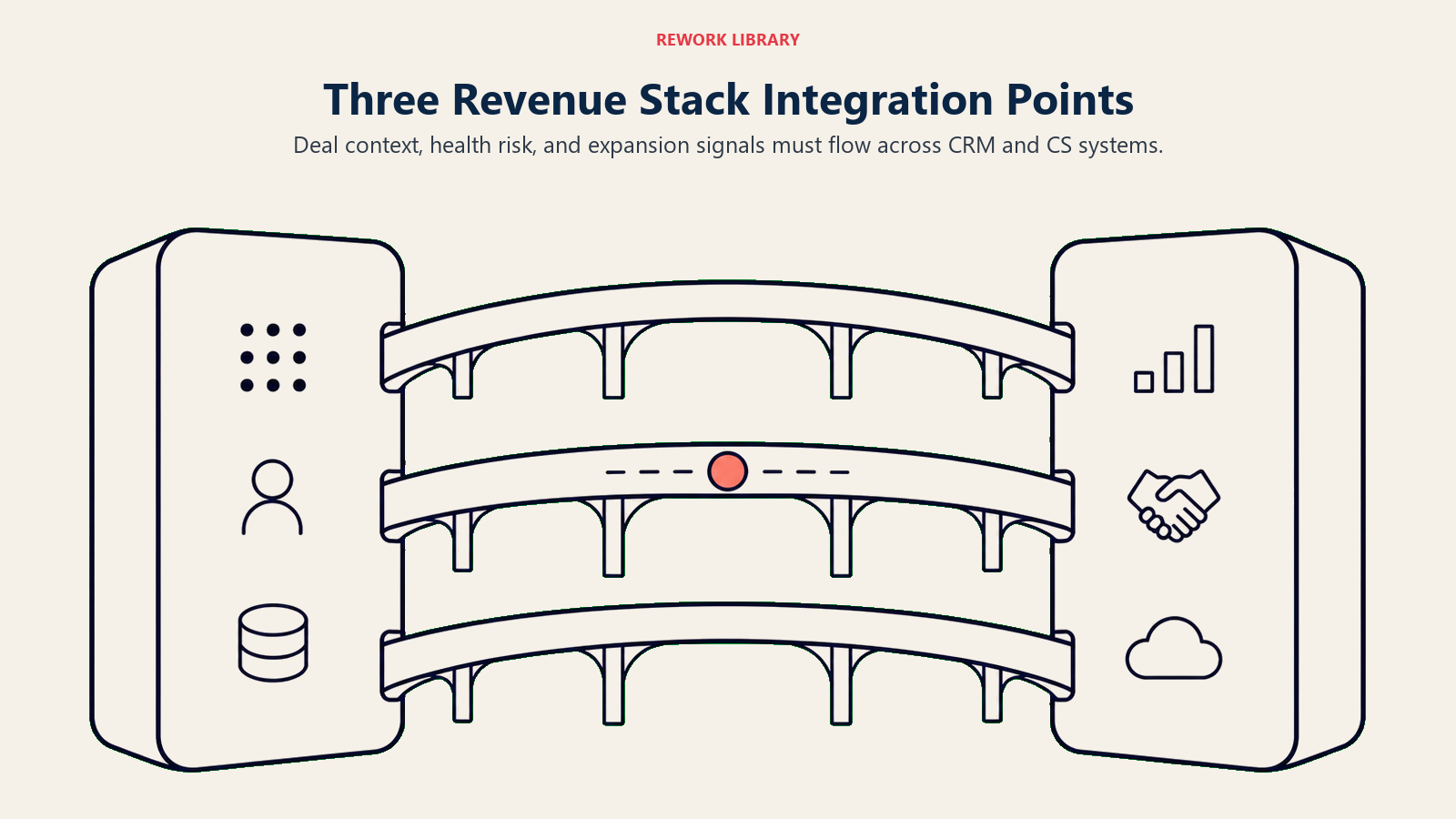
Framework Nombrado: El Stack de Ingresos Alineado de 3 Capas El Stack de Ingresos Alineado de 3 Capas define las tres categorías de herramientas que unen Ventas y CS: Capa 1 (CRM: sistema de registro para deals y actividad de Ventas), Capa 2 (plataforma de CS: sistema de registro para la salud post-venta) y Capa 3 (inteligencia de ingresos: señales de conversación en ambos equipos), además de los tres puntos de integración que las hacen trabajar juntas. Integración 1: el contexto del deal que fluye hacia la plataforma de CS al cierre. Integración 2: el health score y el riesgo de renovación que se muestran en el CRM. Integración 3: las señales de expansión de la plataforma de CS que activan el outreach del AE en el CRM. Un cuarto componente (datos de facturación y uso del producto) alimenta objetivamente las Capas 1 y 2 como la señal honesta que ningún equipo puede manipular. Los tres puntos de integración deben fluir de forma bidireccional a nivel de cuenta y contacto. Las integraciones solo a nivel de cuenta pierden las señales individuales que hacen precisos el análisis de conversión, la detección de riesgos y el timing del Upsell.
Integración 1: El contexto del deal que fluye hacia la plataforma de CS al cierre
Cuando se cierra un deal, un paquete de contexto del deal debe poblar automáticamente el registro de cuenta en la plataforma de CS. Esto incluye: notas del AE sobre el deal, caso de uso original, promesas hechas durante el proceso de ventas, ICP fit score, contexto competitivo (¿se evaluó activamente a un competidor?), stakeholders clave y sus roles, y cualquier compromiso de producto o entrega hecho para ganar el deal.
Sin esto, el CSM comienza el Onboarding con una cuenta en blanco y tiene que reconstruir retroactivamente lo que se vendió. Esa brecha es donde nacen las situaciones de "se prometió más de lo que se entregó".
Qué se requiere: un conjunto definido de campos del CRM obligatorios antes de que un deal avance a Closed Won, y un flujo de trabajo que empuje esos campos al registro de cuenta de la plataforma de CS al cambio de estado. RevOps es propietario de esta configuración, pero el VP de Ventas debe hacer cumplir la higiene de campos. Una puerta de etapa del CRM sobre "notas del deal" que los reps pueden saltarse hace que esta integración no sirva de nada. El checklist de transferencia de contexto del deal detalla exactamente qué campos importan más.
Integración 2: El health score y el riesgo de renovación que se muestran en el CRM
El AE debe poder ver el health score de la cuenta, el nivel de riesgo de renovación y la disposición de expansión sin salir del CRM. No un correo de resumen. No un mensaje de Slack del CSM. Un campo en vivo en el registro de cuenta del CRM, actualizado con la cadencia con que la plataforma de CS lo refresca.
Sin esta integración, la única ventana del AE hacia la salud de la cuenta es lo que el CSM le cuenta. Eso es un problema de latencia (el CSM puede no informar al AE hasta que algo ya está mal) y un problema de cobertura (el AE no puede detectar proactivamente señales de expansión en todo su portafolio sin preguntarle individualmente a cada CSM).
Qué se requiere: la plataforma de CS empujando el health score, el nivel de riesgo de renovación y el indicador de expansión al registro de cuenta del CRM vía API. RevOps es propietario del mapeo de campos y la cadencia de sincronización. La mayoría de las principales plataformas de CS admiten esto de forma nativa o mediante middleware. Para que el health scoring sea significativo aquí, debe incorporar las señales comerciales del lado de Ventas. El artículo sobre health scoring del cliente con contexto de Ventas cubre ese modelo.
Integración 3: Las señales de expansión que activan la acción del AE en el CRM
Cuando se dispara una señal de expansión en la plataforma de CS (umbral de uso del producto alcanzado, champion promovido, QBR que produjo un resultado específico), esa señal debe crear una tarea u oportunidad en el CRM para que el AE actúe, sin que el CSM tenga que enviar un mensaje al AE de forma manual.
Sin esto, las señales de expansión mueren en la plataforma de CS. El CSM lo registra. Quizás envía un correo al AE. Quizás el AE está trabajando un deal de nuevo logo y no responde en una semana. Para cuando el AE se involucra, la ventana de expansión se ha reducido.
Qué se requiere: criterios definidos de señales de expansión en la plataforma de CS (umbrales de uso, eventos de engagement, resultados de QBR) configurados para activar la creación de tareas u oportunidades en el CRM. Este es el punto de integración donde la mayoría de los equipos hace el trabajo conceptual pero nunca completa la configuración técnica.
Facturación y Uso del Producto como la Señal Honesta
Los datos del CRM tienen la forma de las ventas: reflejan la historia que el AE contó sobre la cuenta. Los datos de la plataforma de CS tienen la forma del CSM: reflejan el health score que el CSM asignó, que puede ir rezagado respecto a la realidad o reflejar el optimismo del CSM sobre una cuenta difícil. Ambos son útiles. Ninguno es completamente objetivo.
Los datos de uso del producto no mienten. Reflejan lo que el cliente realmente hace con el producto: qué asientos están activos, qué funciones se usan, qué flujos de trabajo se configuraron y luego se abandonaron, y cómo es la trayectoria de adopción mes a mes. El informe de Bain de 2024 sobre customer success encontró que la retención neta de ingresos (NRR) ha disminuido en el 75% de las empresas de software a pesar de una mayor inversión en CS. La razón: la mayoría de los equipos de CS carece de acceso a las señales honestas que proporcionan los datos de uso.
Los datos de facturación añaden precisión financiera: si una solicitud de downgrade está en proceso antes de que la plataforma de CS se haya actualizado, si el uso está tendiendo hacia una actualización de nivel que señala expansión, si el pago está al día.
Las empresas que integran estos datos en su forecast conjunto de NRR antes de tiempo construyen una ventaja estructural en la renovación. La señal es objetiva, se actualiza continuamente y no requiere que un humano decida cómo representarla.
En la práctica: esto generalmente implica conectar la base de datos del producto o el sistema de facturación al CRM o la plataforma de CS (o a ambos), y definir las métricas específicas que se muestran a cada equipo. RevOps o ingeniería es propietario de esto, pero debería estar en la lista de verificación de evaluación del stack antes de cualquier compra de plataforma de CS. Qué puntos de integración importan más depende de su segmento. La siguiente sección lo aborda directamente.
El Objetivo del Registro Único de Cliente
El objetivo no es un único sistema. Es una visión compartida.
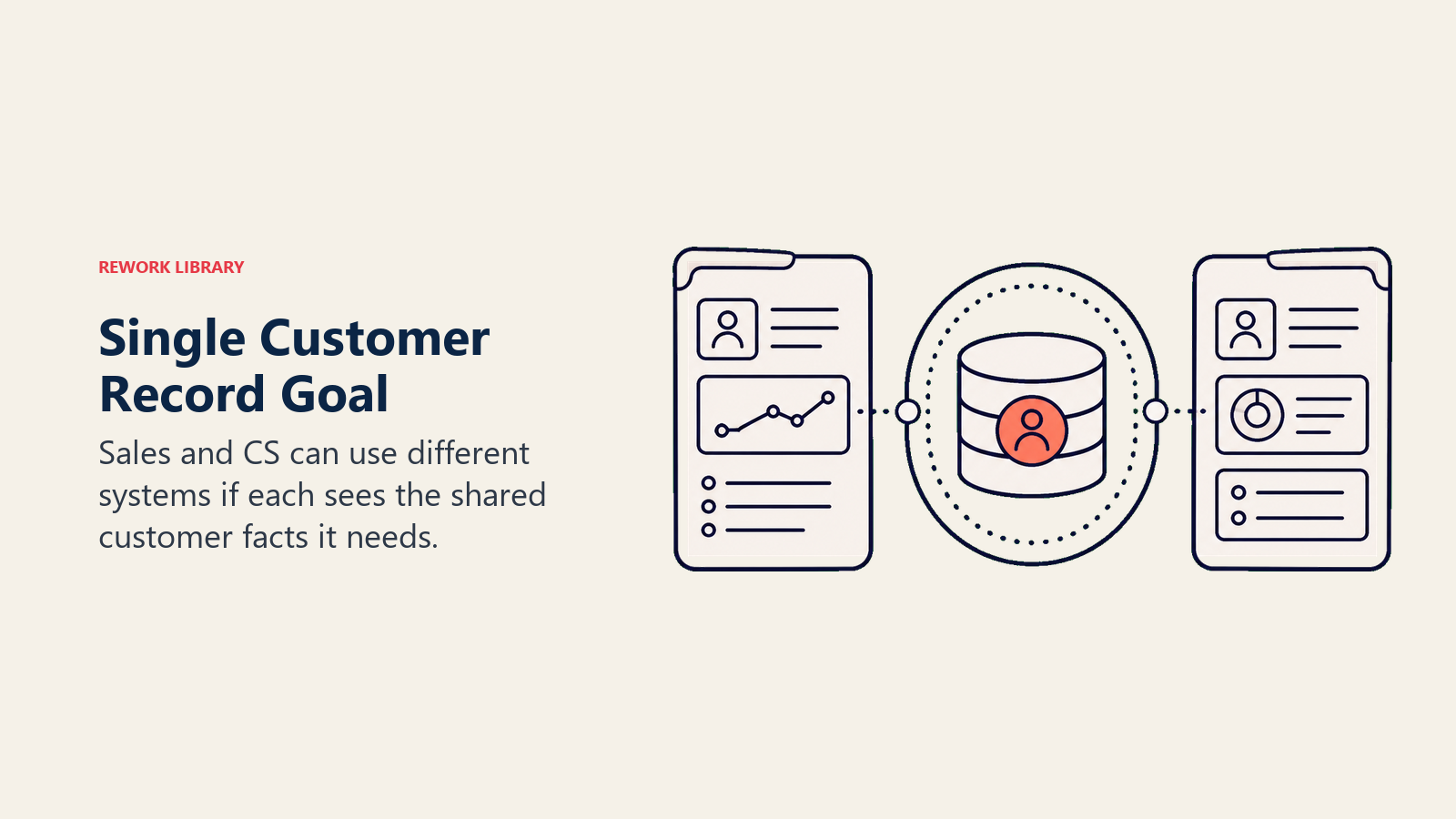
Ventas siempre querrá trabajar principalmente en el CRM. CS siempre querrá trabajar principalmente en la plataforma de CS. Eso está bien. Cada sistema está diseñado para el flujo de trabajo de su equipo. El objetivo es garantizar que los datos que cada equipo necesita sobre el cliente sean visibles en el sistema que realmente usan, actualizados con la frecuencia suficiente para ser accionables.
Lo que esto significa en la práctica para cada equipo:
Lo que el AE necesita en el CRM:
- Health score actual y tendencia (de la plataforma de CS)
- Nivel de riesgo de renovación y días para la renovación
- Indicador de expansión (¿está CS viendo disposición de expansión?)
- Fecha del último contacto del CSM con el cliente
- Escaladas de soporte abiertas marcadas como riesgo comercial
Lo que el CSM necesita en la plataforma de CS:
- Notas originales del deal y promesas hechas
- Fecha del último contacto ejecutivo del AE
- Contexto competitivo del proceso de ventas
- Pipeline de expansión abierto que está trabajando el AE (para que el CSM no lo socave)
- Autoridad comercial del AE para las conversaciones de renovación
El artículo sobre arquitectura del registro compartido de cliente profundiza en las decisiones específicas del modelo de datos. Aquí, el principio es: definir qué necesita cada equipo del otro y luego construir la integración para entregarlo. No al revés.
Modos de Falla Comunes
Estos son los patrones que aparecen con más frecuencia cuando el stack no está bien conectado.
Contactos duplicados que generan outreach en conflicto. El CRM tiene un registro de contacto para el comprador económico. La plataforma de CS tiene un registro de contacto separado para el usuario del día a día. Ninguno está vinculado al otro. Se ejecutan dos secuencias de outreach en paralelo. El cliente recibe contacto del AE y del CSM en la misma semana sobre temas diferentes. Este es un problema de integración: los contactos deben sincronizarse de forma bidireccional entre el CRM y la plataforma de CS a nivel de persona, no solo de cuenta. También es un síntoma de un proceso de handoff de Closed Won a Onboarding roto, donde los datos de contacto nunca se transfieren limpiamente al cierre del deal.
Health scores que CS actualiza pero Ventas nunca ve. El CSM bajó el nivel de una cuenta de verde a rojo hace tres semanas. El AE acaba de cotizar una expansión. El cliente está confundido: ¿por qué el equipo de ventas intenta expandir una cuenta que ya le dijo a CS que se va a ir? Este es el Punto de Integración 2 fallando: los cambios en el health score no están apareciendo en el CRM.
Notas del deal que viven en Slack o en la cabeza del AE. El CSM comienza el Onboarding de una cuenta sin contexto del deal porque las notas del AE nunca se escribieron en el CRM. El CSM descubre seis meses después que el producto se vendió exagerando sus capacidades. Para entonces, el cliente ya formó su opinión. Este es el Punto de Integración 1 fallando antes de comenzar: un problema de puerta de etapa del CRM, no un problema de integración técnica.
Resúmenes de inteligencia de ingresos que son ricos pero nunca se actúan. La plataforma de inteligencia de ingresos tiene transcripciones de cada llamada con el cliente con menciones de competidores, temas de objeciones y señales de salud. CS no tiene acceso. Los insights nunca llegan a marketing. Los datos competitivos nunca informan al producto. La plataforma es una herramienta de coaching de ventas y nada más. La solución es acceso y proceso, no tecnología. Pero requiere que el CRO exija acceso de marketing y CS como requisito de despliegue. La inteligencia de ingresos se vuelve especialmente valiosa cuando se combina con ciclos de feedback de voz del cliente hacia los mensajes de Ventas.
Señales de expansión que mueren en la plataforma de CS. Un umbral de uso que debería activar el outreach del AE se dispara en la plataforma de CS. El CSM lo ve. No hay ninguna tarea automática en el CRM. El CSM envía un mensaje de Slack al AE. El AE está en un QBR. Pasan tres días. La ventana de expansión se reduce. Este es el Punto de Integración 3 fallando: la señal fue capturada pero nunca se convirtió en acción.
Diagnóstico de Cinco Preguntas para RevOps y CROs
Use estas preguntas para evaluar si su stack actual está creando alineamiento o fricción en la conexión.
1. ¿Puede un AE ver el health score actual y el nivel de riesgo de renovación para cualquier cuenta de su portafolio, sin salir del CRM ni preguntarle al CSM? Si no, el Punto de Integración 2 está incompleto.
2. Cuando se cierra un deal, ¿el CSM recibe automáticamente un paquete estructurado de contexto del deal (caso de uso, promesas hechas, ICP fit score, mapa de stakeholders) o tiene que pedírselo al AE? Si es lo segundo, el Punto de Integración 1 está incompleto.
3. Cuando los datos de la plataforma de CS muestran una señal de expansión, ¿se crea automáticamente una tarea u oportunidad en el CRM para el AE? Si no, el Punto de Integración 3 está incompleto.
4. ¿El equipo de CS tiene acceso a los datos de conversación de la plataforma de inteligencia de ingresos (no solo clips de coaching de ventas, sino alertas de palabras clave sobre menciones de competidores y temas de objeciones)? Si no, la plataforma de inteligencia de ingresos está siendo insuficientemente utilizada y el equipo de CS está operando parcialmente a ciegas en la dinámica competitiva.
5. ¿El AE y el CSM tienen registros de contacto consistentes para las mismas cuentas, sincronizados de forma bidireccional entre el CRM y la plataforma de CS a nivel de persona? Si no, el modo de falla de outreach en conflicto está en su stack y el cliente probablemente ya lo está experimentando.
Construir vs. Integrar vs. Reemplazar
Cuando el diagnóstico revela brechas, la decisión es generalmente una de tres opciones.
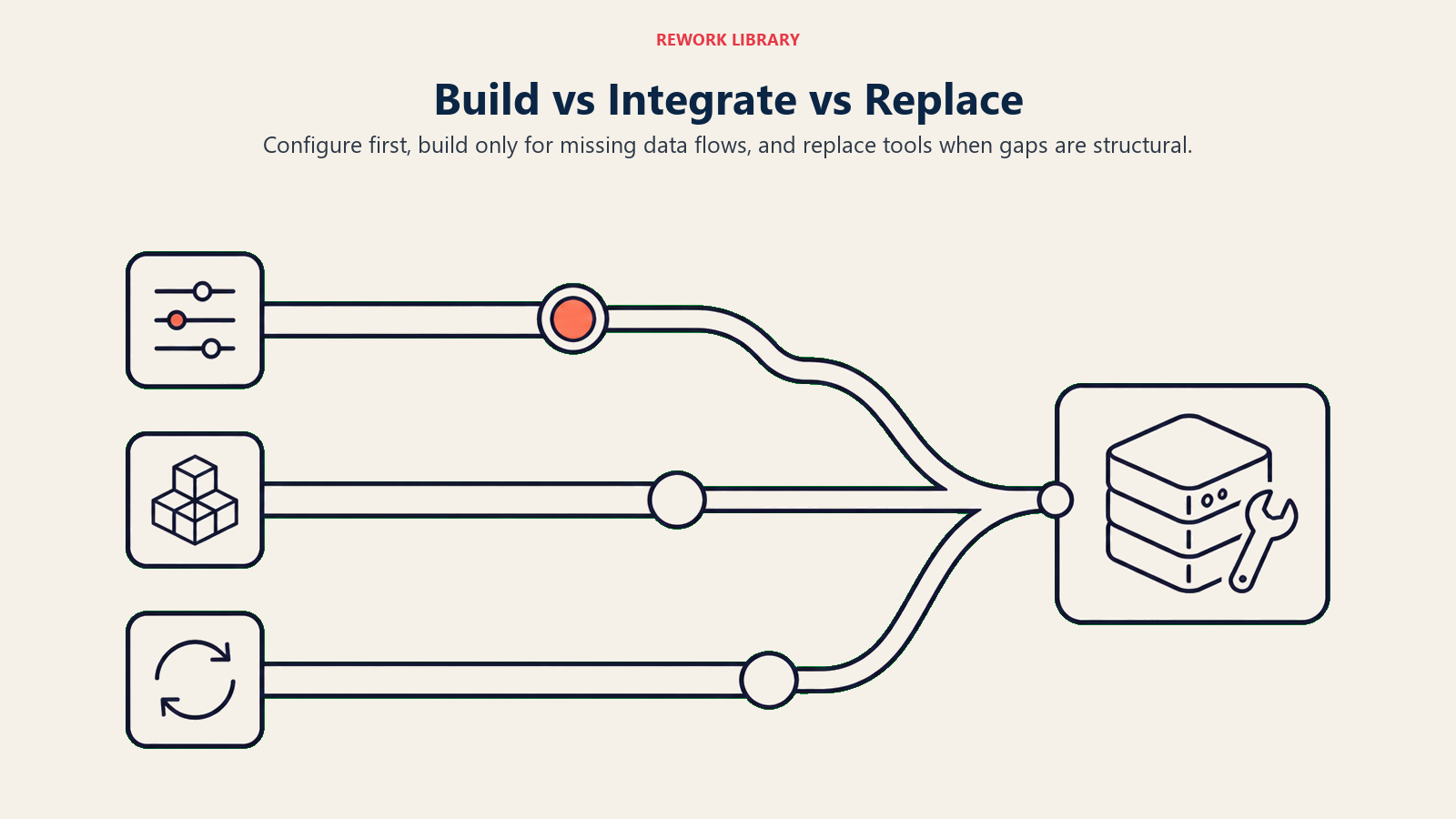
Configurar las integraciones existentes: La mayoría de las combinaciones principales de CRM y plataforma de CS tienen integraciones nativas o conectores de primera parte que cubren los tres puntos de integración, parcial o totalmente. Antes de comprar middleware o construir conectores personalizados, revise si la integración nativa está configurada para entregar los flujos de datos descritos anteriormente. A menudo no lo está, pero la configuración es más barata que construir.
Construir sincronización personalizada: Cuando las integraciones nativas no admiten los flujos de datos específicos necesarios (comúnmente el caso para datos de facturación/uso, que no tienen conector nativo), una integración API personalizada es la vía adecuada. Ingeniería la construye; RevOps define el modelo de datos y el mapeo de campos. Este suele ser el camino correcto para el Punto de Integración 3 (señal de expansión a creación de tarea en el CRM) y para la integración de datos de uso/facturación.
Reemplazar una herramienta de categoría: Reemplazar una herramienta de categoría por brechas de integración debe ser el último recurso. No porque sea incorrecto, sino porque es lento y disruptivo. Se reemplaza cuando las brechas de integración son fundamentales para la arquitectura de la herramienta (algunas plataformas de CS más antiguas tienen APIs cerradas que hacen que la sincronización bidireccional sea estructuralmente difícil) o cuando la herramienta ha llegado al fin de su vida útil de soporte. De lo contrario, configure y construya primero.
Cita destacada: Solo el 26% de las empresas B2B SaaS tiene intercambio de datos bidireccional en tiempo real entre su CRM y su plataforma de CS a nivel de cuenta, lo que significa que el 74% de los equipos de ingresos trabaja con dos versiones distintas del mismo cliente (Gainsight, 2024).
Cita destacada: Las plataformas de inteligencia de ingresos se usan principalmente para coaching de ventas en el 61% de los despliegues, lo que deja a los equipos de CS sin acceso a las señales competitivas, los temas de objeciones y los datos de conversaciones con clientes que fueron la principal justificación de la inversión (encuesta interna de Gong, 2024).
Cita destacada: Las empresas que integran datos de uso del producto en su forecast de renovación ven un NRR 18% mayor que las que dependen únicamente de health scores asignados por el CSM. Los datos de uso no tienen sesgo de optimismo. Los health scores sí (investigación de Totango, 2024).
La Responsabilidad de Integración es de RevOps
El stack de alineamiento solo entrega valor cuando las integraciones funcionan. Y las integraciones solo funcionan cuando alguien las tiene a cargo.
RevOps es propietario de la arquitectura de integración en la conexión. No Sales ops (la construirán para los casos de uso de Ventas y CS no obtendrá los datos que necesita). No CS ops (mismo problema en sentido inverso). RevOps, con aporte explícito de requerimientos tanto del VP de Ventas como del VP de CS.
Si aún no tiene una función de RevOps, el trabajo de integración es lo primero para contratar o tercerizar. Dos sistemas parcialmente conectados son a menudo peores que un sistema limpio. Crean la ilusión de una visión compartida mientras en realidad ocultan la brecha. El rol de RevOps como la función que mantiene todo unido se describe en detalle en el modelo de RevOps como pegamento de la alineación de la colección de alineación entre marketing y ventas. Los principios se aplican igualmente en la conexión entre Ventas y CS.
Preguntas Frecuentes sobre El Stack Alineado
¿Qué es el Stack de Ingresos Alineado de 3 Capas?
El Stack de Ingresos Alineado de 3 Capas es un framework de arquitectura neutral entre proveedores para las tres categorías de herramientas que unen Ventas y CS: el CRM (sistema de registro para deals y actividad de Ventas), la plataforma de CS (sistema de registro para la salud post-venta) y la inteligencia de ingresos (señales de conversación en ambos equipos). Un cuarto componente (datos de facturación y uso del producto) alimenta objetivamente ambas capas como la señal honesta que ningún equipo puede asignar ni ajustar. El framework se centra en la arquitectura de integración, no en ningún proveedor o producto específico.
¿Cuáles son los tres puntos de integración en la conexión que todo equipo de ingresos necesita?
El Punto de Integración 1 es el contexto del deal que fluye del CRM a la plataforma de CS al cierre, para que el CSM comience con la historia completa de Ventas (caso de uso, promesas, ICP fit, contexto competitivo) en lugar de una cuenta en blanco. El Punto de Integración 2 es el health score y el riesgo de renovación que se muestran en el CRM, para que los AEs puedan ver la salud de la cuenta sin entrar a la plataforma de CS ni preguntarle al CSM. El Punto de Integración 3 son las señales de expansión de la plataforma de CS que crean automáticamente tareas u oportunidades en el CRM para el AE, para que las ventanas de expansión no se pierdan esperando un mensaje de Slack.
¿Deberíamos construir una integración personalizada o configurar la existente?
Configure primero. La mayoría de las combinaciones principales de CRM y plataforma de CS tienen integraciones nativas o conectores de primera parte que cubren los tres puntos de integración en la conexión parcial o totalmente, pero a menudo no están configurados para entregar los flujos de datos específicos descritos aquí. Configurar es más rápido y barato que construir. Construya conexiones personalizadas solo cuando las integraciones nativas no admitan el flujo de datos necesario (con mayor frecuencia para la integración de datos de facturación/uso). Reemplace una herramienta de categoría solo cuando las brechas de integración sean estructurales a la arquitectura de la herramienta, no como primera respuesta a un problema de configuración.
¿Cómo se aplica el Stack de Ingresos Alineado de 3 Capas a SMB frente a enterprise?
Para SMB, la prioridad es el Punto de Integración 1 (contexto del deal al cierre) y el Punto de Integración 2 (health score en el CRM), porque el movimiento de expansión suele ser menor y la sobrecarga de coordinación del Punto de Integración 3 puede superar su valor. Para enterprise, los tres puntos de integración son críticos porque la expansión es una línea de ingresos material y el costo de perder una señal de expansión es alto. La capa de facturación y uso del producto es valiosa en todos los tamaños: proporciona la señal honesta que los health scores y los datos del Pipeline no pueden dar.
¿De qué es propietario RevOps en el stack alineado?
RevOps es propietario de la arquitectura de integración en la conexión, no Sales ops (que construye para los casos de uso de Ventas) ni CS ops (que construye para los casos de uso de CS). RevOps define el mapeo de campos y la cadencia de sincronización para los tres puntos de integración, hace cumplir la higiene de las puertas de etapa del CRM que hace funcionar el Punto de Integración 1 y configura los disparadores de señales de expansión en la plataforma de CS que impulsan el Punto de Integración 3. El aporte del CRO o conjunto del VP de Ventas y el VP de CS define qué datos necesita cada equipo; RevOps lo traduce en la configuración técnica.
¿Cuáles son los modos de falla más comunes cuando el stack no está bien conectado?
Los cinco modos de falla más comunes son: (1) contactos duplicados que generan outreach en conflicto del AE y del CSM al mismo cliente; (2) bajadas de health score que CS actualiza pero que los AEs nunca ven en el CRM; (3) notas del deal que viven en Slack o en la memoria del AE en lugar del CRM, lo que deja al CSM iniciar el Onboarding con una cuenta en blanco; (4) datos de conversación de inteligencia de ingresos que son ricos pero accesibles solo para Ventas, no para CS; y (5) señales de expansión que se disparan en la plataforma de CS pero nunca se convierten en una tarea del CRM para el AE, lo que le cuesta ARR de expansión por deriva de timing.
Más Información
- Fuente Única de Verdad: El Registro Compartido de Cliente
- Arquitectura del Registro Compartido de Cliente
- Operaciones Basadas en Cuenta: Dashboards Tier-1
- Forecast Conjunto de NRR
- Glosario de Alineación entre Ventas y Customer Success
- Transferencia de Contexto del Deal a CS
- Health Scoring del Cliente con Contexto de Ventas
- Voz del Cliente a los Mensajes de Ventas

Principal Solution Architect
On this page
- Las Tres Categorías de Herramientas en la Conexión
- CRM: Sistema de Registro para Deals y Actividad de Ventas
- Plataforma de CS: Sistema de Registro para la Salud Post-Venta
- Inteligencia de Ingresos: Señales de Conversación en Ambos Equipos
- La Capa de Apoyo: Datos de Facturación y Uso del Producto
- Los Tres Puntos de Integración que Realmente Importan
- Facturación y Uso del Producto como la Señal Honesta
- El Objetivo del Registro Único de Cliente
- Modos de Falla Comunes
- Diagnóstico de Cinco Preguntas para RevOps y CROs
- Construir vs. Integrar vs. Reemplazar
- La Responsabilidad de Integración es de RevOps
- Más Información