Operaciones Basadas en Cuentas: Cómo Construir un Dashboard Compartido de Cuentas Tier 1 para AE y CSM
Turn this article into takeaways for your work.


Each assistant summarizes the article only for you and suggests best practices for your work.
La mayoría de las empresas tienen Dashboards. Los AEs tienen su vista de Pipeline. Los CSMs tienen su tablero de puntuación de salud. Los líderes de ingresos tienen su Dashboard de CRO.
Pero cuando el VP de Ventas y el VP de CS se sientan a revisar las 15 cuentas que representan $3M en ARR (aquellas donde un único evento de Churn movería el NRR un punto porcentual completo), están extrayendo información de dos sistemas separados, dos modelos de datos diferentes y dos vistas que no coinciden en lo que significa estar "en riesgo".
El AE ve un Pipeline saludable para la renovación. El CSM sabe que el champion no ha iniciado sesión en 45 días. Ninguno de los dos tiene la información del otro antes de esa reunión de revisión. Y la cuenta que debería haberse marcado tres semanas atrás se señala en la reunión, cuando ya es más difícil de corregir.
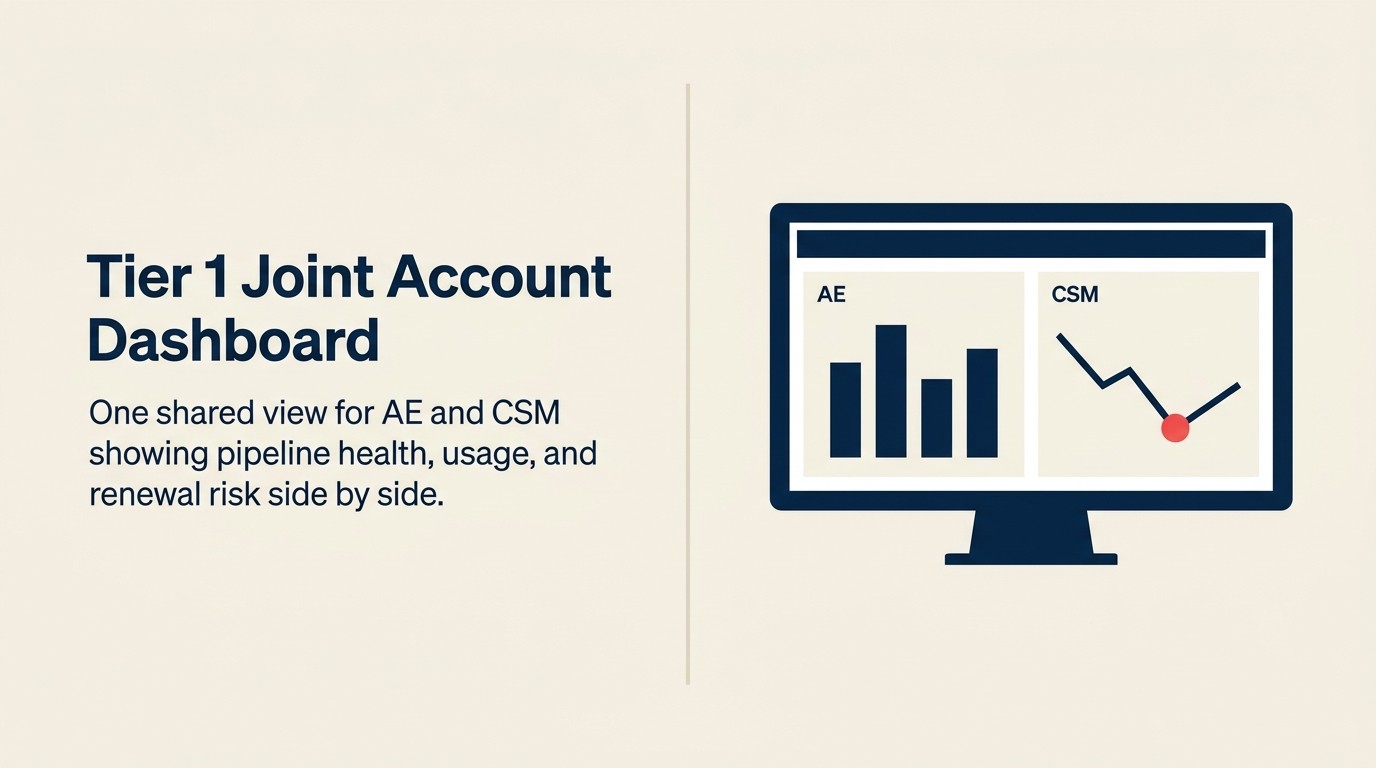
El Dashboard conjunto Tier 1 es la corrección operativa. No un artefacto de reporte. Una capa de coordinación que da al AE y al CSM visibilidad compartida sobre las cuentas que más importan, para que la acción ocurra antes de la reunión en lugar de durante ella. Los 8 Dashboards compartidos que ejecutan los equipos de ingresos de alto rendimiento cubren el ecosistema más amplio de Dashboards entre marketing y ventas; el Dashboard de cuentas Tier 1 descrito aquí es la capa extendida a CS que lo completa en la unión posventa.
La Especificación de Dashboard Tier 1 de 8 Paneles es un marco concreto de visibilidad conjunta para la coordinación AE-CSM en cuentas de alto valor. Cada uno de los ocho paneles (Identidad de la Cuenta, Puntuación de Salud, Estado del Contrato, Línea de Tiempo de Compromiso, Elementos Pendientes, Mapa del Champion, Señales de Expansión y Marcas de Riesgo) tiene un propietario definido, una cadencia de actualización definida y un uso definido en el ritual de revisión de cuatro cadencias (actualización semanal independiente, revisión quincenal de líderes de equipo, revisión mensual de VPs, preparación trimestral del QBR). La especificación está diseñada para implementarse en la plataforma que el equipo de cuenta ya usa a diario, no como una herramienta independiente.
Por Qué las Cuentas Tier 1 Necesitan Su Propia Vista
Los Dashboards estándar están construidos para el volumen. Están optimizados para mostrar patrones en un portafolio de 50, 100 o 500 cuentas. Son buenos para identificar qué decil de cuentas está bajo rendimiento, qué segmentos necesitan atención, qué CSMs tienen demasiada carga.
Pero las cuentas Tier 1 no necesitan detección de patrones. Necesitan profundidad. Y la necesitan semanalmente, no trimestralmente.
Tres cosas hacen que las operaciones Tier 1 sean diferentes. La investigación de McKinsey sobre el crecimiento de cuentas clave encontró que las cuentas clave representan entre el 30 y el 50 por ciento de los ingresos y del margen de muchas empresas, y que la calidad de la coordinación AE-CS en esas cuentas determina si esos ingresos crecen o se estancan:
El costo de la desalineación es asimétrico. Perder una cuenta de $30K en ARR es un mal mes. Perder una cuenta de $300K en ARR es una conversación de directorio. Cuando el AE y el CSM no coordinan en cuentas de alto valor, cuando el AE está planeando un discurso de expansión mientras el CSM gestiona una escalada activa con el mismo contacto, la desalineación no es solo operativamente ineficiente. Es financieramente peligrosa.
Los Dashboards estándar optimizan para la señal equivocada. Un Dashboard de puntuación de salud que muestra que el 87% de sus cuentas están en verde le dice algo útil sobre su portafolio. No le dice nada sobre si una de sus cuentas de $500K está a punto de hacer Churn porque el champion cambió de rol el mes pasado. Las operaciones Tier 1 optimizan para alertas tempranas en cuentas específicas, no patrones estadísticos en todas las cuentas.
La complejidad de la relación en Tier 1 es mayor. Las cuentas más grandes tienen más stakeholders, casos de uso más complejos, más compromisos pendientes del ciclo de ventas y más historial que rastrear. Los datos que el AE y el CSM tienen sobre una cuenta Tier 1 son mayores en volumen y de mayor riesgo que para una cuenta SMB típica. Sin una vista compartida, esa complejidad crea fallos de coordinación.
Datos clave: Visibilidad de cuentas Tier 1 e impacto en ingresos
- El 20% superior de cuentas por ARR típicamente representa el 60-70% de los ingresos totales en SaaS B2B de mercado medio, según los Benchmarks SaaS de OpenView Partners. Las sorpresas en el NRR de este nivel son desproporcionadamente costosas.
- Las empresas con visibilidad conjunta AE-CSM sobre cuentas Tier 1 ven un 34% menor Churn en ese nivel frente a empresas con reportes en silos, según el Benchmark de la Industria de Customer Success de Gainsight.
- Los AEs que revisan las puntuaciones de salud antes de las conversaciones de renovación cierran 22% más negocios de expansión que los que entran sin datos de CS, según la investigación de Revenue Operations de Forrester.
Definiendo Tier 1: Los Criterios Que Determinan la Inclusión en el Dashboard
Tier 1 significa cosas diferentes en diferentes empresas. Los criterios deben ser establecidos por RevOps, aprobados por el VP de Ventas y el VP de CS, y revisados trimestralmente. Pero aquí hay un marco práctico de partida para SMB a mercado medio:
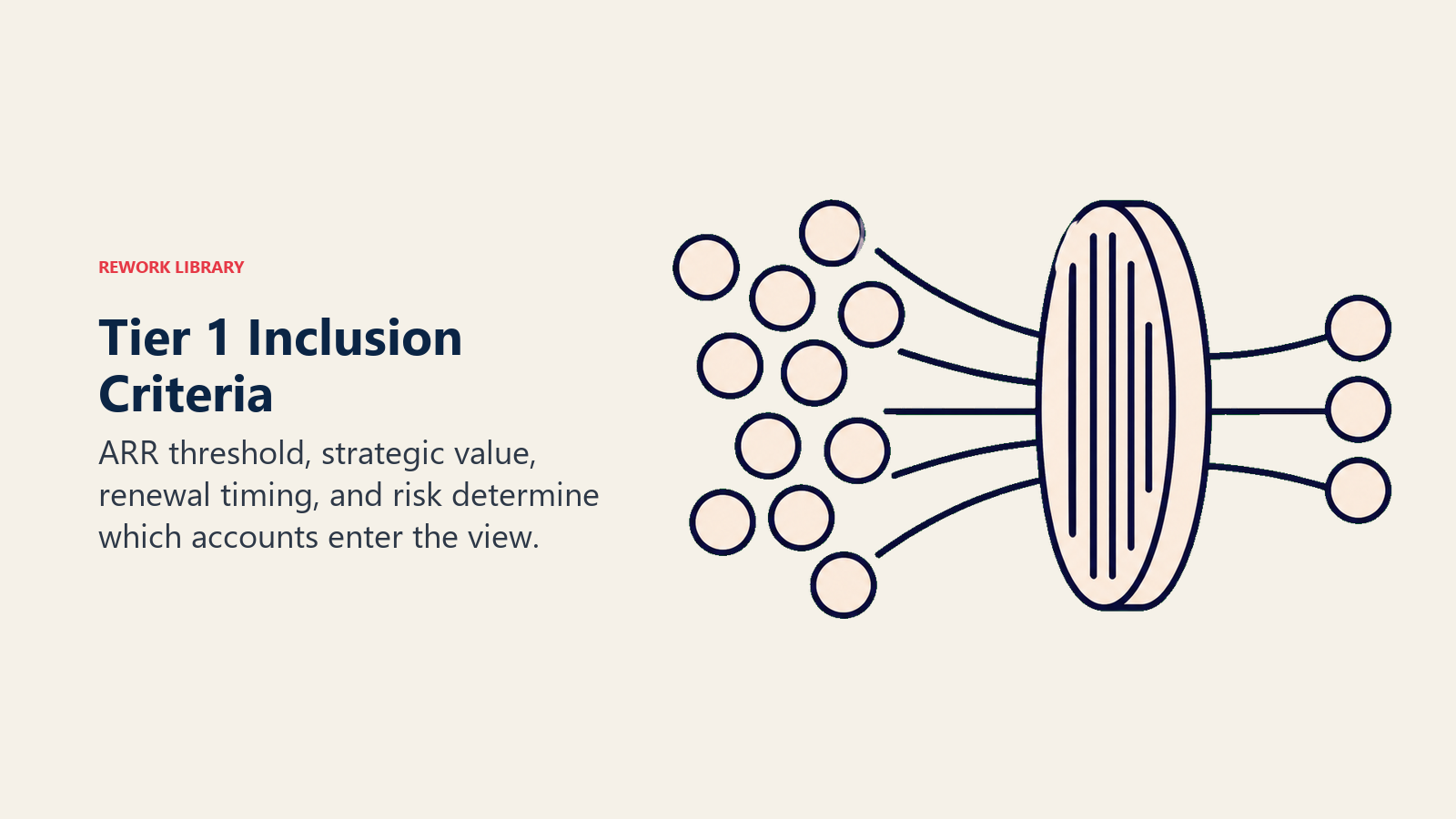
Umbral de ARR. El 20% superior de cuentas por valor de contrato anual. En una empresa con 200 clientes, eso son 40 cuentas. En una empresa con 500 clientes, son 100. La investigación de Bain sobre gestión de cuentas clave muestra que las empresas con segmentación de cuentas por niveles y planes de tratamiento diferenciados superan de forma consistente a las que aplican una cobertura uniforme en todo su portafolio. El umbral no es sagrado. Ajústelo para la distribución de su portafolio, pero el concepto es que el Dashboard cubre las cuentas donde un evento de Churn duele materialmente.
Nivel estratégico. Cuentas en una vertical prioritaria a la que apunta para expansión, cuentas inscritas en un programa de clientes de referencia, o cuentas nombradas en una campaña ABM. Estas cuentas pueden estar fuera del 20% superior por ARR hoy, pero representan valor estratégico que justifica visibilidad semanal.
Anulación por riesgo. Cuentas fuera del umbral normal de ARR de Tier 1 que han sido señaladas con riesgo de Churn elevado. Una cuenta de $50K con una puntuación de salud en el decil inferior y una renovación próxima en 60 días recibe designación temporal de Tier 1 hasta que el riesgo se resuelva. Esta categoría la establece el CSM y la aprueba el líder del equipo de CS. No es una marca automática, es una decisión de criterio. La revisión conjunta de cuentas en riesgo es la sesión recurrente en la que las anulaciones por riesgo se revisan formalmente con el AE y el CSM presentes.
Lo que Tier 1 no es: todas las cuentas. En el momento en que el Dashboard cubre el 40% de su portafolio, deja de ser un Dashboard Tier 1 y se convierte en una herramienta de monitoreo general. El objetivo es profundidad en las cuentas que más importan, no cobertura amplia.
Los Ocho Paneles de un Dashboard Conjunto Tier 1
A continuación, una especificación concreta de lo que muestra el Dashboard. Cada panel tiene un propietario: la persona responsable de mantener esa sección actualizada.
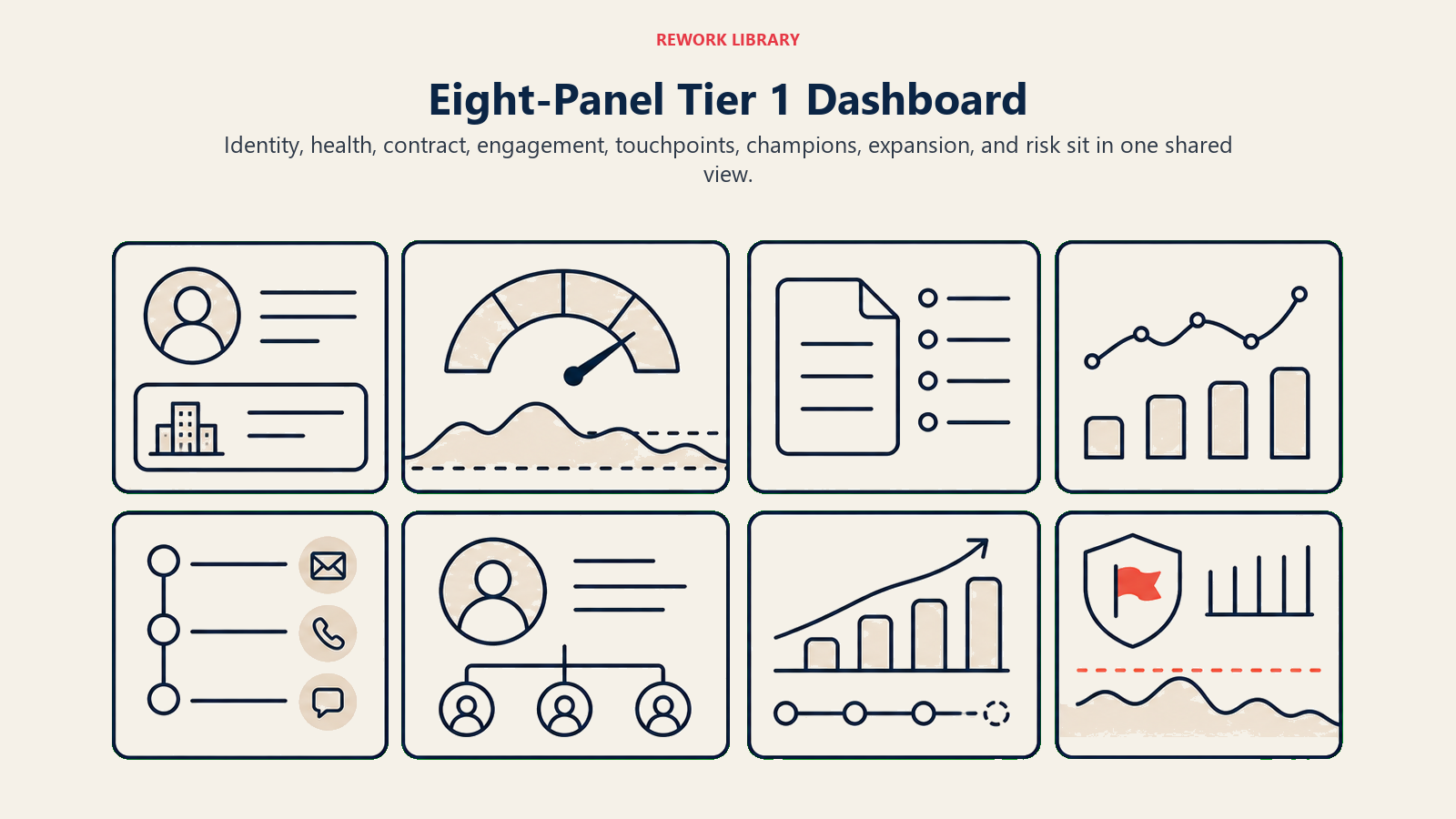
Panel 1: Identidad de la cuenta. Nombre de la empresa, segmento de mercado, ARR, fecha de renovación, propietario AE, propietario CSM. Los hechos básicos que permiten a ambos equipos orientarse antes de mirar cualquier otra cosa. Propiedad de RevOps; actualizado automáticamente desde el CRM. Si este panel es incorrecto, todo lo demás es cuestionable.
Panel 2: Puntuación de salud. La puntuación de salud compuesta de la plataforma CS, incluyendo la capa de contexto del negocio descrita en Puntuación de Salud del Cliente con Contexto de Ventas. Esto no es solo uso del producto. Incorpora factores de riesgo del contexto del negocio (marcas de over-promise, casos límite de ICP, estabilidad del champion) junto con datos de compromiso y adopción. Propiedad del CSM; actualizado al menos semanalmente.
Panel 3: Estado del contrato. ARR, potencial de expansión basado en el uso actual y los casos de uso declarados, probabilidad de renovación (estimación del CSM) y fecha de vencimiento del contrato. Tanto el AE como el CSM necesitan esto para coordinar el timing de renovación y las conversaciones de expansión. Propiedad de RevOps (ARR, fecha de vencimiento del contrato) y CSM (probabilidad de renovación, potencial de expansión). Actualizado mensualmente o cuando cambian los términos del contrato.
Panel 4: Línea de tiempo de compromiso. Último contacto del AE (llamada, correo o reunión), último contacto del CSM, último contacto iniciado por el cliente y próximo punto de contacto programado para cada uno. Este es el panel de alerta temprana para la negligencia de la relación. Cuando una cuenta Tier 1 no ha tenido contacto del AE en 30 días y ningún contacto iniciado por el cliente en dos semanas, esa es una marca, antes de que la puntuación de salud lo refleje. Propiedad de ambos AE y CSM; actualizado automáticamente desde las actividades registradas en el CRM y la plataforma CS.
Panel 5: Elementos pendientes. Compromisos del AE aún pendientes (funcionalidades prometidas, presentaciones comprometidas, documentación de seguimiento debida), tareas abiertas del CSM y bloqueos reportados por el cliente. Este es el panel de rendición de cuentas. Si un AE se comprometió a una presentación al equipo de producto hace seis semanas y aún está pendiente, el CSM necesita saberlo. El cliente lo sabe, y está afectando la relación. Propiedad del AE (sus compromisos) y CSM (sus tareas y bloqueos reportados por el cliente). Actualizado semanalmente. Los compromisos que provienen del ciclo de ventas normalmente se capturan en el proceso de transferencia de contexto del negocio a CS. El Panel 5 es donde esos compromisos permanecen visibles después del cierre.
Panel 6: Mapa del champion. Champion principal, sponsor ejecutivo, detractores conocidos y fecha del último contacto de cada persona en el mapa. Incluir a los detractores no es opcional. Las cuentas donde un detractor tiene más influencia que el champion son las que le sorprenden en la renovación. Propiedad de ambos AE y CSM; el AE actualiza antes del cierre, el CSM actualiza después del cierre. Este panel es de mantenimiento conjunto, lo que significa que se queda obsoleto si ninguno de los dos equipos tiene una rutina para él. Incorpore la actualización en el ritual de actualización semanal de paneles.
Panel 7: Señales de expansión. Tendencias de crecimiento de uso, asientos añadidos desde el onboarding, adopción de funcionalidades frente a casos de uso comprometidos y cualquier declaración explícita del cliente sobre ampliar el alcance. Este es el panel que convierte los datos de relación del CSM en oportunidad de Pipeline para el AE. Cuando un CSM ve que el uso crece en una parte del producto que no estaba en el negocio original, actualiza el Panel 7. El AE lo ve en el Dashboard y reserva una conversación de expansión. Esa secuencia no requiere una reunión de handoff. Requiere un Dashboard compartido. Propiedad del CSM; revisado por el AE semanalmente. El artículo sobre propiedad de la expansión y el movimiento de upsell cubre quién lleva adelante el negocio de expansión una vez que el Panel 7 señala una oportunidad real.
Panel 8: Marcas de riesgo. Factores de riesgo del contexto del negocio del ciclo de ventas que aún están activos: marcas de over-promise (compromisos que el AE hizo y que CS aún está gestionando en las expectativas), notas de casos límite de ICP (esta cuenta estaba en el borde del perfil objetivo), historial de cambios de champion (si el champion original ya ha cambiado una vez). Este panel se conecta de vuelta a la capa de contexto del negocio de la arquitectura de registro compartido del cliente. Propiedad de ambos. Cualquier equipo puede levantar una marca, ambos deben reconocerla.
Quién Es Propietario de Cada Panel: Propiedad de Campos a Nivel de Dashboard
Los Dashboards compartidos fracasan cuando la propiedad es ambigua. Aquí está el desglose claro:
| Panel | AE es propietario | CSM es propietario | RevOps es propietario | Co-propiedad |
|---|---|---|---|---|
| Identidad de la cuenta | n/d | n/d | Todos los campos | n/d |
| Puntuación de salud | n/d | Puntuación, señales subyacentes | n/d | n/d |
| Estado del contrato | n/d | Probabilidad de renovación, potencial de expansión | ARR, fecha de vencimiento del contrato | n/d |
| Línea de tiempo de compromiso | Fechas de contacto del AE | Fechas de contacto del CSM, contactos iniciados por el cliente | n/d | Próximo punto de contacto programado |
| Elementos pendientes | Compromisos del AE | Tareas del CSM, bloqueos del cliente | n/d | n/d |
| Mapa del champion | ID del champion (pre-cierre) | Actualizaciones del champion (post-cierre), detractores | n/d | Todas las actualizaciones post-onboarding |
| Señales de expansión | Notas de oportunidad de expansión | Señales de uso, adopción de funcionalidades | n/d | n/d |
| Marcas de riesgo | Marcas del contexto del negocio | Marcas basadas en salud | n/d | Todas las marcas (cualquiera puede levantar) |
Las reglas clave: RevOps es propietario de los datos estructurales que ni el AE ni el CSM deberían poder cambiar sin un proceso. El AE y el CSM co-poseen el mapa del champion porque ambos equipos interactúan con las mismas personas en momentos diferentes. Las marcas de riesgo son el único lugar donde cualquier equipo tiene plena autoridad para levantar una. No requiere el permiso del otro equipo para señalar una cuenta. Pero la propiedad solo importa si el Dashboard vive en un lugar que ambos equipos realmente consultan.
Dónde Vive el Dashboard: Opciones de Plataforma y Compromisos
La elección de ubicación importa porque determina qué equipo tiene acceso nativo y cuál tiene que iniciar sesión en algo fuera de su flujo de trabajo diario.
Opción A: CRM (ubicación principal). Los datos de salud y compromiso de la plataforma CS deben sincronizarse. Esta es la elección correcta si el CRM ya es el entorno de trabajo tanto para el AE como para el CSM, lo que requiere que la arquitectura de registro compartido del cliente esté funcionando. La ventaja: el AE ya está en el CRM, por lo que la fricción de adopción del lado del AE es casi cero. El riesgo: si los datos de la plataforma CS no se sincronizan de manera confiable, el Panel 2 (puntuación de salud) y el Panel 7 (señales de expansión) se quedan obsoletos.
Opción B: Plataforma CS (ubicación alternativa). Los datos de contexto del negocio y la actividad del AE deben sincronizarse desde el CRM. Esta es la elección correcta si los CSMs usan la plataforma CS como su entorno diario principal y los AEs ya la usan para revisiones de cuentas. El riesgo es el espejo de la Opción A: la adopción del AE requiere que trabajen en una herramienta que normalmente no usan.
Opción C: BI independiente (Looker, Tableau o similar). Máxima flexibilidad: puede extraer tanto del CRM como de la plataforma CS, construir exactamente el diseño que desee y controlar la frecuencia de actualización para cada panel. El costo: esto requiere un pipeline de datos funcional de ambos sistemas, mantenimiento continuo de BI y generalmente un ingeniero de RevOps para gestionarlo. Para la mayoría de las empresas SMB y de mercado medio, esta es más infraestructura de la que requiere el problema.
Recomendación: Si la arquitectura de registro compartido del cliente está funcionando (el CRM y la plataforma CS están en sincronía), la Opción A es el hogar natural. El Dashboard vive donde viven los negocios. Ambos equipos lo ven en el contexto de la relación comercial completa. Si la arquitectura aún no está funcionando, si los datos aún se concilian manualmente entre sistemas, construir el Dashboard Tier 1 antes de corregir el esquema es poner el techo antes de la base. Corrija el esquema primero.
Cómo Se Usa: La Revisión de Cuatro Cadencias
El Dashboard es solo la mitad de la intervención. La otra mitad es el ritual que lo convierte en una herramienta de coordinación en lugar de un reporte que nadie lee.
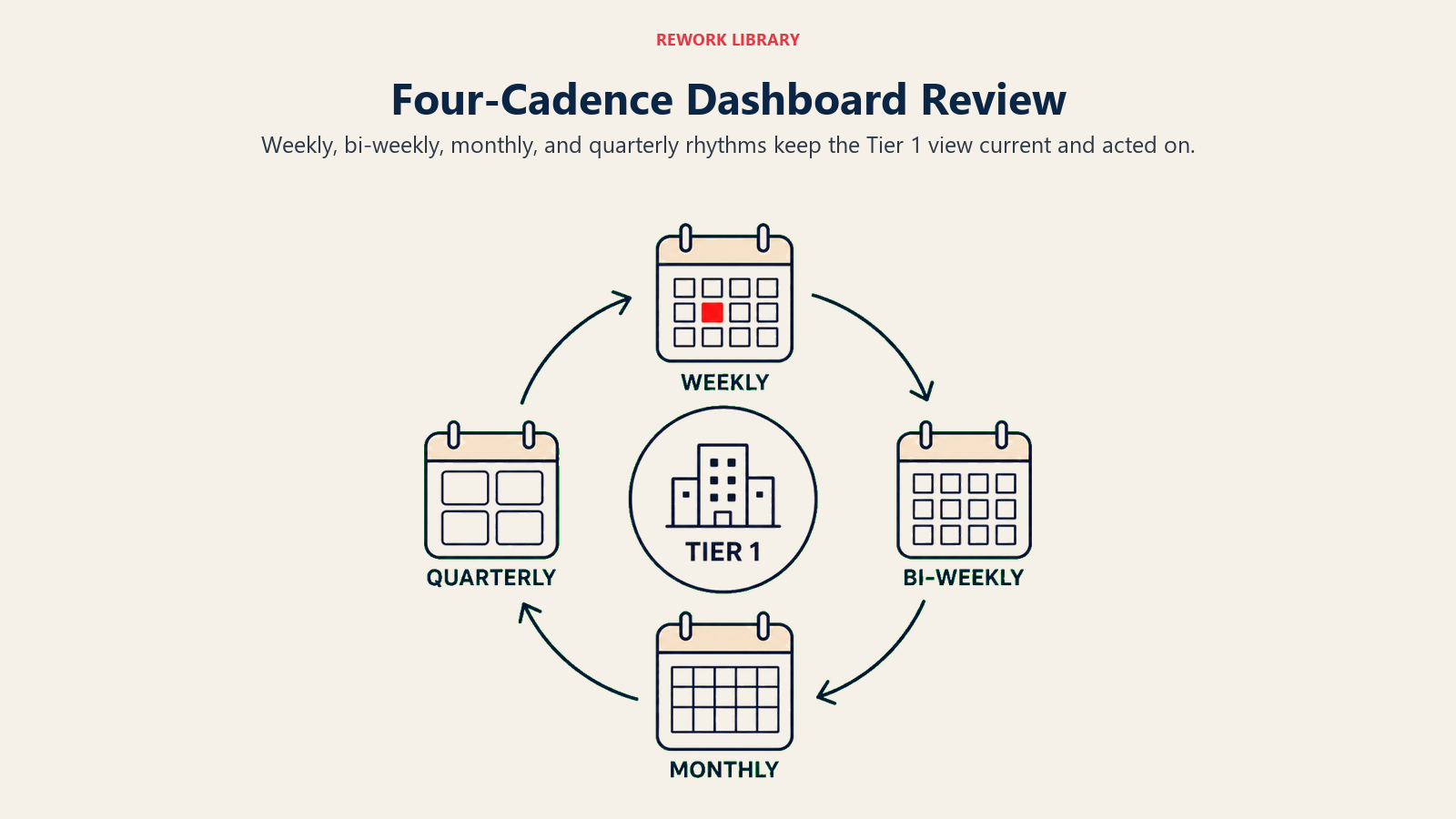
| Cadencia | Quién | Qué ocurre | Tiempo requerido |
|---|---|---|---|
| Semanal | AE + CSM de forma independiente | Cada uno actualiza sus paneles de propiedad. El AE revisa las señales de expansión del CSM. El CSM revisa los compromisos pendientes del AE. Las marcas se levantan de inmediato si un panel muestra una preocupación. | 5 minutos por cuenta |
| Quincenal | Líderes de equipo AE + CSM | Revisan juntos la lista completa Tier 1. Las cuentas con múltiples condiciones de marca se escalan al nivel VP. Las cuentas donde las señales de expansión están creciendo se marcan para alcance del AE. | 30 minutos para la lista completa |
| Mensual | VP de Ventas + VP de CS | Revisan el Dashboard a nivel de liderazgo. Las oportunidades de expansión y las cuentas en riesgo obtienen elementos de acción explícitos con propietarios y plazos. Aquí es donde se identifican las cuentas que necesitan patrocinio ejecutivo. | 45-60 minutos |
| Trimestral | Equipo completo de cuenta (AE + CSM + liderazgo) | Usan el Dashboard para prepararse para los QBRs de clientes. El Panel 7 (señales de expansión) impulsa la conversación de expansión. El Panel 5 (elementos pendientes) impulsa la revisión de rendición de cuentas. El Panel 8 (marcas de riesgo) impulsa la discusión de mitigación de riesgos. | 60 minutos de preparación por cuenta principal |
La actualización semanal no es una reunión. Son cinco minutos por cuenta, cada persona actualizando sus paneles de propiedad de forma independiente. Si tanto el AE como el CSM lo hacen, la revisión quincenal se ejecuta con datos precisos. Si cualquiera de los dos equipos lo omite, la revisión quincenal se gasta determinando qué está actualizado en lugar de decidir qué hacer. El espacio trimestral en particular debe alinearse con la preparación conjunta del QBR: los mismos datos de cuenta que impulsan la revisión interna alimentan la conversación de cara al cliente.
Cómo Luce el Éxito: Tres Comportamientos Que el Dashboard Habilita
El AE ve una caída de salud antes de su llamada de renovación y contacta al CSM primero. El Panel 2 (puntuación de salud) cae de 82 a 61 en las dos semanas antes de que el AE planeara enviar la propuesta de renovación. El AE lo ve en la revisión de paneles del lunes, le escribe al CSM antes de enviar cualquier cosa al cliente y se entera de que una integración clave se rompió hace dos semanas y el cliente está frustrado. La conversación de renovación se retrasa dos semanas mientras CS corrige la integración. La renovación cierra. Sin el Dashboard, el AE envía la propuesta, el cliente responde con la queja de la integración rota y la renovación se convierte en una negociación en lugar de una formalidad.
El CSM ve una señal de expansión y la enruta al AE con contexto. El Panel 7 muestra que una cuenta Tier 1 ha añadido 12 usuarios a un módulo que no era parte del contrato original, y el champion mencionó en el último QBR que "hemos estado pensando en desplegarlo a nuestro equipo de soporte también". El CSM lo marca en el Panel 7 con la nota textual. El AE lo ve en el Dashboard y reserva una llamada de expansión con el contexto ya cargado. No se requiere reunión de handoff. La expansión cierra en el mismo trimestre.
RevOps identifica dos cuentas Tier 1 donde el contacto con el champion está vencido y lo marca sin esperar a la próxima reunión de sincronización. Durante un pase semanal de mantenimiento del Dashboard, RevOps nota que el Panel 6 (mapa del champion) muestra sin contacto con el sponsor ejecutivo en dos cuentas en los últimos 45 días. RevOps levanta una marca de riesgo en el Panel 8 para ambas cuentas. Tanto el AE como el CSM reciben la notificación de marca. El AE programa una llamada con el sponsor ejecutivo. El CSM da seguimiento al champion. Ninguna de las dos cuentas hace Churn en la renovación.
Citas Destacadas
"El 43% de los churns evitables de Tier 1 ocurre porque ni el AE ni el CSM vieron la señal de riesgo con suficiente antelación. La señal existía en un sistema, pero no en el que la otra persona consulta, según el estudio de análisis de retención de Totango."
Análisis de Rework: El modo de fallo más común de los Dashboards Tier 1 no es un problema de tecnología. Es un problema de cadencia. La Especificación de Dashboard Tier 1 de 8 Paneles puede construirse en la mayoría de los CRM o plataformas CS en una semana. Lo que determina si funciona es si tanto el AE como el CSM hacen la actualización semanal de 5 minutos por cuenta que mantiene los paneles al día. Los equipos que tratan la actualización como una reunión a la que asisten en lugar de un ritual del que son dueños ven el Dashboard quedar obsoleto en 60 días. Los equipos que la tratan como una responsabilidad individual, donde cada persona es dueña de sus paneles, los actualiza el lunes y señala preocupaciones sin esperar a la revisión quincenal, ven el retorno en negocios de expansión detectados a tiempo y en churns que no ocurren.
Anti-Patrones
Construir el Dashboard pero omitir la cadencia de revisión. Un Dashboard que nadie actualiza se convierte en un artefacto histórico en 60 días. La investigación de McKinsey sobre la gestión digital de cuentas clave encontró que la disciplina estructural de las revisiones de cuenta programadas, y no los Dashboards en sí, es lo que separa a los equipos de gestión de cuentas de alto rendimiento de aquellos que tienen las herramientas pero no los resultados. El ritual semanal de actualización de cinco minutos por cuenta es lo que lo mantiene actualizado. Sin la cadencia, los paneles se quedan obsoletos, ambos equipos dejan de confiar en los datos y el Dashboard se convierte en un proyecto bien intencionado que no funcionó en lugar de una herramienta de coordinación que sí funcionó.
Incluir todas las cuentas en la vista Tier 1. Cuando un VP de CS aboga por añadir "solo unas pocas cuentas más" y la lista crece de 40 a 120, el Dashboard pierde su valor. La profundidad requiere restricción. Si todas las cuentas reciben tratamiento Tier 1, ninguna lo recibe realmente. Establezca los criterios, mantenga la línea y cree un proceso claro para el nivel de anulación por riesgo en lugar de expandir la base.
Dejar que el Dashboard diverja del registro operativo. Si la puntuación de salud en el Panel 2 no coincide con la puntuación de salud en la plataforma CS, ambos equipos dejan de confiar en él. El Dashboard es solo tan confiable como los sistemas subyacentes que lo alimentan. Cuando la arquitectura de registro compartido del cliente está funcionando y la sincronización está actualizada, este problema es poco frecuente. Cuando la sincronización no es confiable, el Dashboard se convierte en un pasivo en lugar de un activo.
Ejecutar la revisión como un reporte de estado en lugar de una reunión de decisión. La revisión quincenal debe producir elementos de acción, no actualizaciones. "La puntuación de salud de la Cuenta X es 61" no es un elemento de acción. "La puntuación de salud de la Cuenta X cayó de 82 a 61, el CSM está manejando el problema de integración, el AE debe pausar la propuesta de renovación hasta la próxima semana" sí es un elemento de acción con propietarios y un timeline. La estructura de la reunión debe requerir explícitamente una próxima acción para cada panel marcado.
Preguntas Frecuentes sobre Operaciones Basadas en Cuentas
¿Qué es la Especificación de Dashboard Tier 1 de 8 Paneles?
Es un marco concreto de visibilidad conjunta para la coordinación AE-CSM en cuentas de alto valor. Los ocho paneles son: Identidad de la Cuenta (datos básicos de la empresa, propiedad de RevOps), Puntuación de Salud (señal compuesta de CS, propiedad del CSM), Estado del Contrato (datos de ARR y renovación, co-propiedad de RevOps y CSM), Línea de Tiempo de Compromiso (últimos y próximos puntos de contacto, co-propiedad de AE y CSM), Elementos Pendientes (compromisos pendientes y bloqueos del cliente, co-propiedad de AE y CSM), Mapa del Champion (champion principal, sponsor ejecutivo, detractores, co-propiedad), Señales de Expansión (crecimiento de uso y apetito de upsell, propiedad del CSM, revisado por el AE) y Marcas de Riesgo (riesgos del contexto del negocio y de salud, cualquier equipo puede levantarlas). Juntos dan al AE y al CSM visibilidad compartida sobre todo lo que afecta la salud y la trayectoria de crecimiento de una cuenta Tier 1.
¿Qué califica a una cuenta para la designación Tier 1?
Tres criterios determinan la inclusión en Tier 1, establecidos por RevOps y aprobados trimestralmente por el VP de Ventas y el VP de CS. Primero: umbral de ARR, típicamente el 20% superior de cuentas por valor de contrato anual. Segundo: nivel estratégico, es decir, cuentas en una vertical prioritaria, un programa de clientes de referencia o una campaña ABM que justifican visibilidad semanal independientemente del ARR actual. Tercero: anulación por riesgo, que cubre cuentas fuera del umbral normal pero señaladas con riesgo de Churn elevado, a las que se da designación temporal de Tier 1 hasta que el riesgo se resuelva. Tier 1 nunca debería ampliarse para cubrir más del 20-25% del portafolio. En el momento en que cubre el 40%, deja de ser una herramienta de profundidad y se convierte en otra vista de monitoreo general.
¿En qué plataforma debería vivir el Dashboard Tier 1: el CRM o la plataforma CS?
Si la arquitectura de registro compartido del cliente está funcionando y los datos del CRM y de la plataforma CS están sincronizados de forma confiable, el CRM es el hogar natural: los AEs ya viven ahí, la fricción de adopción es casi cero y ambos equipos pueden revisar los datos de la cuenta en el contexto de la relación comercial completa. Si los datos aún se concilian manualmente entre sistemas, construir el Dashboard Tier 1 antes de corregir el esquema es poner el techo antes de la base. Para los equipos que aún no están listos para el CRM como hogar principal, la plataforma CS o una herramienta de BI independiente (Looker, Tableau) son alternativas viables, con el compromiso de requerir que los AEs trabajen fuera de su entorno principal.
¿Cuál es la cadencia de revisión de los Dashboards Tier 1?
Cuatro cadencias. Semanal: cada AE y CSM actualiza de forma independiente sus paneles de propiedad, cinco minutos por cuenta, sin necesidad de reunión. Quincenal: los líderes de equipo de AE y CSM revisan juntos la lista completa Tier 1, 30 minutos para la lista completa, escalando al nivel VP las cuentas con múltiples condiciones de marca. Mensual: el VP de Ventas y el VP de CS revisan el Dashboard, 45-60 minutos, con elementos de acción y propietarios explícitos para las cuentas en riesgo y de expansión. Trimestral: el equipo completo de cuenta usa el Dashboard para prepararse para los QBRs de clientes, con el Panel 7 (señales de expansión) impulsando la conversación de expansión y el Panel 5 (elementos pendientes) impulsando la revisión de rendición de cuentas.
¿Qué umbral de ARR debería determinar la designación Tier 1?
El umbral específico depende del tamaño de su portafolio y de la distribución de ARR. Un punto de partida práctico es el 20% superior de cuentas por valor de contrato anual. En una empresa con 200 clientes, eso son 40 cuentas. En una empresa con 500 clientes, son 100. La restricción clave es que el Dashboard debe cubrir un conjunto de cuentas lo bastante pequeño como para permitir profundidad: revisión semanal detallada, propiedad a nivel de panel, coordinación real entre AE y CSM. La investigación de Bain sobre gestión de cuentas clave muestra que las empresas con segmentación por niveles y tratamiento diferenciado superan de forma consistente a las que aplican una cobertura uniforme, pero solo cuando la lista Tier 1 se mantiene disciplinada. Si Tier 1 crece hasta el 40% del portafolio, la profundidad desaparece y se convierte en otro tablero de salud general.
¿Cómo conecta el Panel 7 (Señales de Expansión) al CSM con la creación de Pipeline del AE?
El Panel 7 es el mecanismo que convierte la inteligencia de relación del CSM en oportunidades de expansión para el AE sin requerir una reunión de handoff. Cuando un CSM ve que el uso crece en un área del producto que no estaba en el negocio original, o escucha a un cliente mencionar la ampliación a otro equipo en un QBR, actualiza el Panel 7 con la señal específica y una nota textual. El AE revisa el Panel 7 en la actualización semanal del Dashboard y reserva una conversación de expansión con el contexto ya cargado. Todo el handoff ocurre a través del panel compartido: sin hilo de Slack, sin reunión programada, sin señal perdida en la traducción. Las señales de expansión documentadas en el Panel 7 con contexto específico cierran más rápido que las que surgen de manera informal, porque el AE entra a la conversación ya conociendo la intención declarada del cliente.
Aprenda Más

Principal Solution Architect
On this page
- Por Qué las Cuentas Tier 1 Necesitan Su Propia Vista
- Definiendo Tier 1: Los Criterios Que Determinan la Inclusión en el Dashboard
- Los Ocho Paneles de un Dashboard Conjunto Tier 1
- Quién Es Propietario de Cada Panel: Propiedad de Campos a Nivel de Dashboard
- Dónde Vive el Dashboard: Opciones de Plataforma y Compromisos
- Cómo Se Usa: La Revisión de Cuatro Cadencias
- Cómo Luce el Éxito: Tres Comportamientos Que el Dashboard Habilita
- Citas Destacadas
- Anti-Patrones
- Aprenda Más