SendGrid vs Mailgun: Which Email API Actually Fits Your Product in 2026?
Turn this article into takeaways for your work.


Each assistant summarizes the article only for you and suggests best practices for your work.
Updated August 2026
If you're a developer, engineering lead, or product manager choosing a transactional email API in 2026, SendGrid and Mailgun are the two names that show up on nearly every shortlist. Both send order confirmations, password resets, and receipts at scale. Both offer a REST API and SMTP relay. Both let you authenticate a domain, warm up an IP, and watch delivery events roll in through a webhook. On paper, picking between them looks like a coin flip.
It isn't, and the place where they diverge hardest is exactly the place most comparisons get wrong: what happens before you pay a dollar. SendGrid quietly retired its free Email API plan in May 2025. Mailgun didn't. That single fact changes how a solo developer or an early-stage product should even start evaluating these two, and it's a detail that's stale in a lot of the advice still circulating. This comparison works through the free tier reversal, real pricing at the volumes you'll actually hit, and the technical details, deliverability tooling, log retention, inbound routing, compliance, that decide whether either API is the right one to build on.
TL;DR
| SendGrid (Email API) | Mailgun | |
|---|---|---|
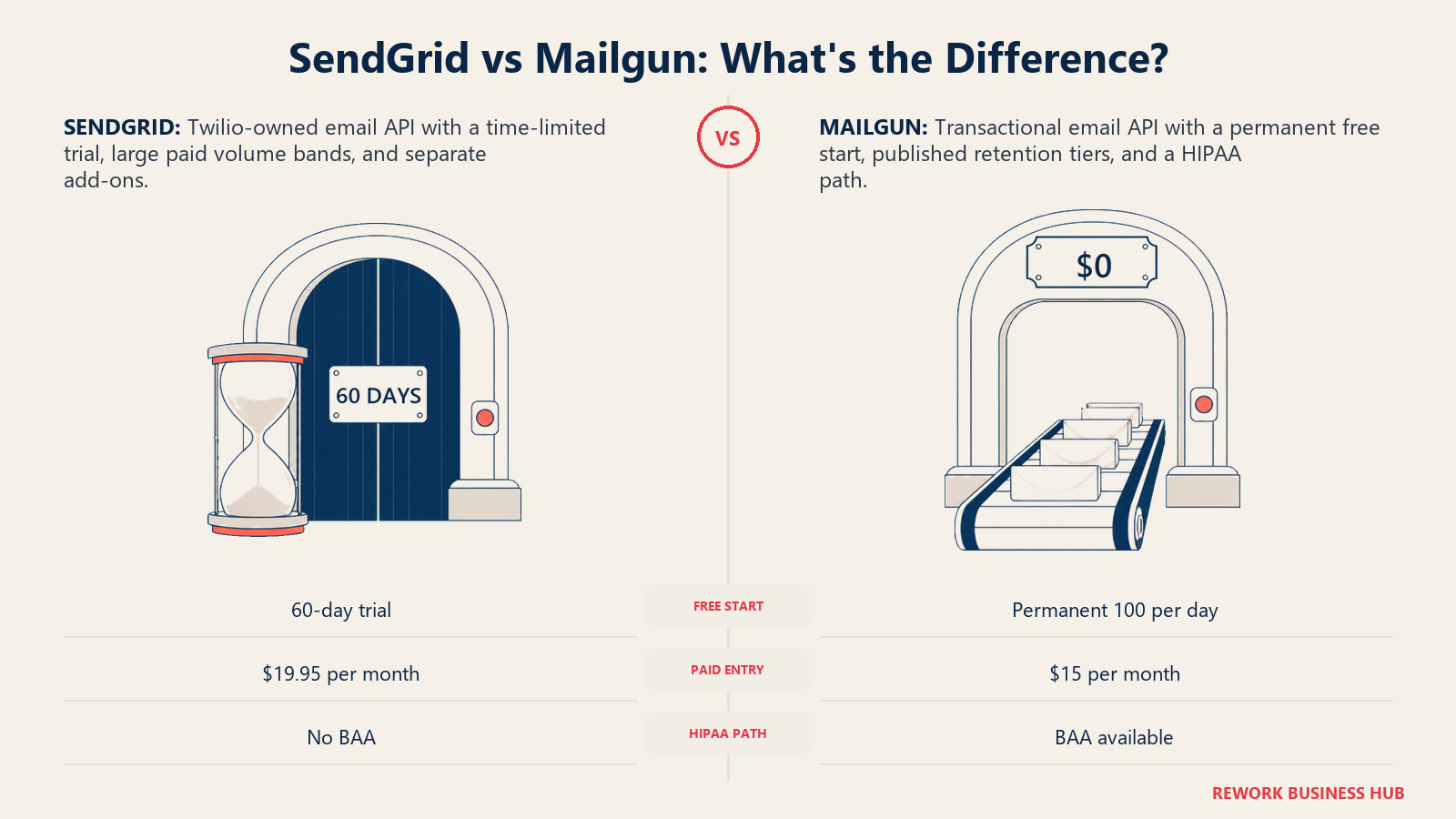
| Free tier | None. Retired 27 May 2025; replaced by a 60-day trial (100 emails/day, 100 contacts) | Yes, permanent: 100 emails/day, 1-day log retention |
| Entry paid price | Essentials from $19.95/mo, 50K-100K emails/mo | Basic $15/mo, 10,000 emails/mo |
| Mid tier | Pro from $89.95/mo, 100K-2.5M emails/mo, 1,000 seats, 1 dedicated IP | Foundation $35/mo, 50,000 emails/mo, 5-day log retention |
| Top published tier | Premier, custom pricing | Scale $90/mo, 100,000 emails/mo, 30-day log retention, dedicated IP included |
| Log retention range | Short default window; 30-day Email Activity History sold as an add-on | 1 day (Basic) up to 30 days (Scale), tied directly to the plan |
| HIPAA support | No. SendGrid does not sign a BAA | Yes, via a published HIPAA Business Associate Addendum |
| Inbound email routing | Inbound Parse Webhook, MX-based, 30MB message size limit | Tiered by plan: 1 route (free), 5 (Basic), full access (Foundation and up) |
| Email validation | Separate add-on API, priced per validation | Bundled: 5,000 validations/mo included from Foundation up |
| Best for | Teams that want one seat-based bill for a small team, or need 1,000 teammate seats at Pro | Teams that want to start free, need HIPAA email, or want validation and templates bundled into the plan |
Key Facts
- SendGrid's Free Email API and Free Marketing Campaigns plans were retired effective 27 May 2025; existing free accounts kept access for 60 days before sending was paused, per Twilio's own SendGrid changelog.
- The global email inbox placement rate reached 87.2% in 2025, a 3.7% year-over-year improvement, according to Agile Brand Guide's coverage of Validity's 2026 Email Deliverability Benchmark Report.
- Triggered emails, the exact category SendGrid and Mailgun exist to send, made up only 2% of total email volume but drove 37% of all email-driven sales, generating 10 to 15 times more revenue per message than standard campaigns, per the same Validity-sourced report.
- Senders transmitting more than 5,000 messages a day to Gmail must keep spam complaints under 0.30% (Google recommends under 0.10%) and implement SPF, DKIM, DMARC, and one-click unsubscribe, a mandate in force since February 2024, according to Google's own bulk sender guidelines.
- UK marketers report an average email marketing ROI of £41 for every £1 spent, per Marwick Marketing's coverage of the DMA's Marketer Email Tracker 2026, a 250-marketer survey.
Who Each Platform Is Built For
SendGrid, now owned by Twilio, sells its Email API as a seat-based product. Essentials and Pro both include a set number of teammates (1 on Essentials, 1,000 on Pro), and the pricing ladder is built around monthly volume bands rather than a single per-email rate. That structure suits a company that wants one predictable bill tied to a small number of people managing the account, and that's already comfortable adding a validation add-on or a dedicated IP as a separate line item when it needs one.
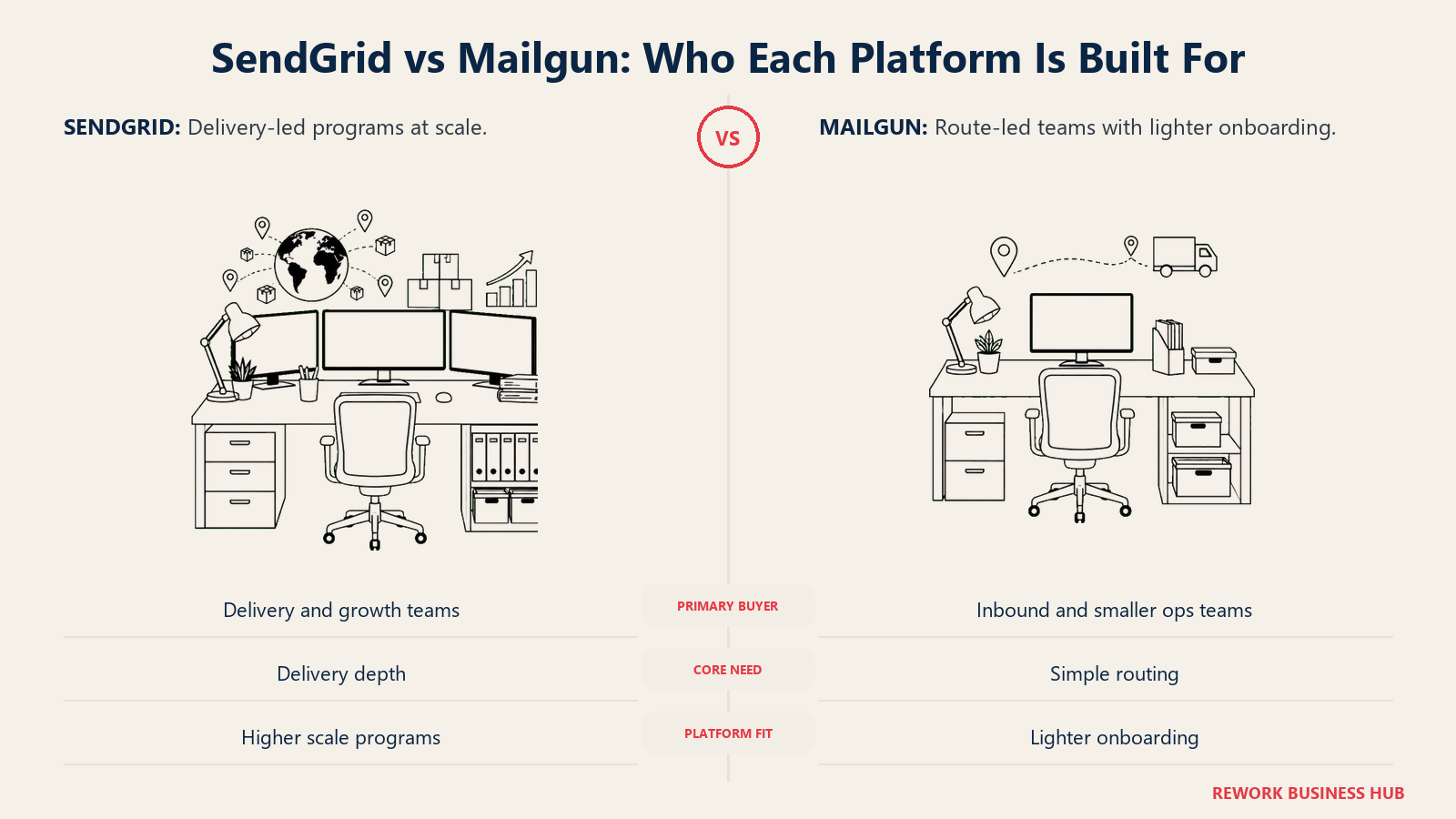
Mailgun, part of Sinch, structures its tiers around the same volume bands but bundles more into each one by default: email validations, a template builder, and full inbound routing all show up starting at the Foundation tier rather than as separate purchases. Mailgun's free tier also means a solo developer or a side project can integrate and test in production without a trial clock running out, which SendGrid's 60-day trial doesn't allow.
| SendGrid Email API | Mailgun | |
|---|---|---|
| Ownership | Twilio | Sinch |
| Pricing structure | Volume bands (Essentials, Pro, Premier), seat-based teammate limits | Volume bands (Basic, Foundation, Scale), features bundled per tier |
| Sweet-spot buyer | Teams that want a single API/SMTP bill with clear seat counts, especially at Pro's 1,000-seat allowance | Solo developers, early-stage products, and teams that want validation and templates included rather than metered separately |
| Where it starts | 60-day trial, then Essentials at $19.95/mo | Permanent free tier at 100 emails/day, then Basic at $15/mo |
| Marketing-side product | Separate Marketing Campaigns line (Basic from $15/mo, Advanced from $60/mo) | No separate marketing product; Mailgun stays focused on transactional and API-driven sending |
If your team also needs to reach customers by SMS or WhatsApp alongside email, our best SMS marketing software roundup for 2026 covers the platforms built for that side of the stack, since neither SendGrid nor Mailgun sends anything but email.
Free Tier and Entry Pricing: The Fact Most Comparisons Get Backwards
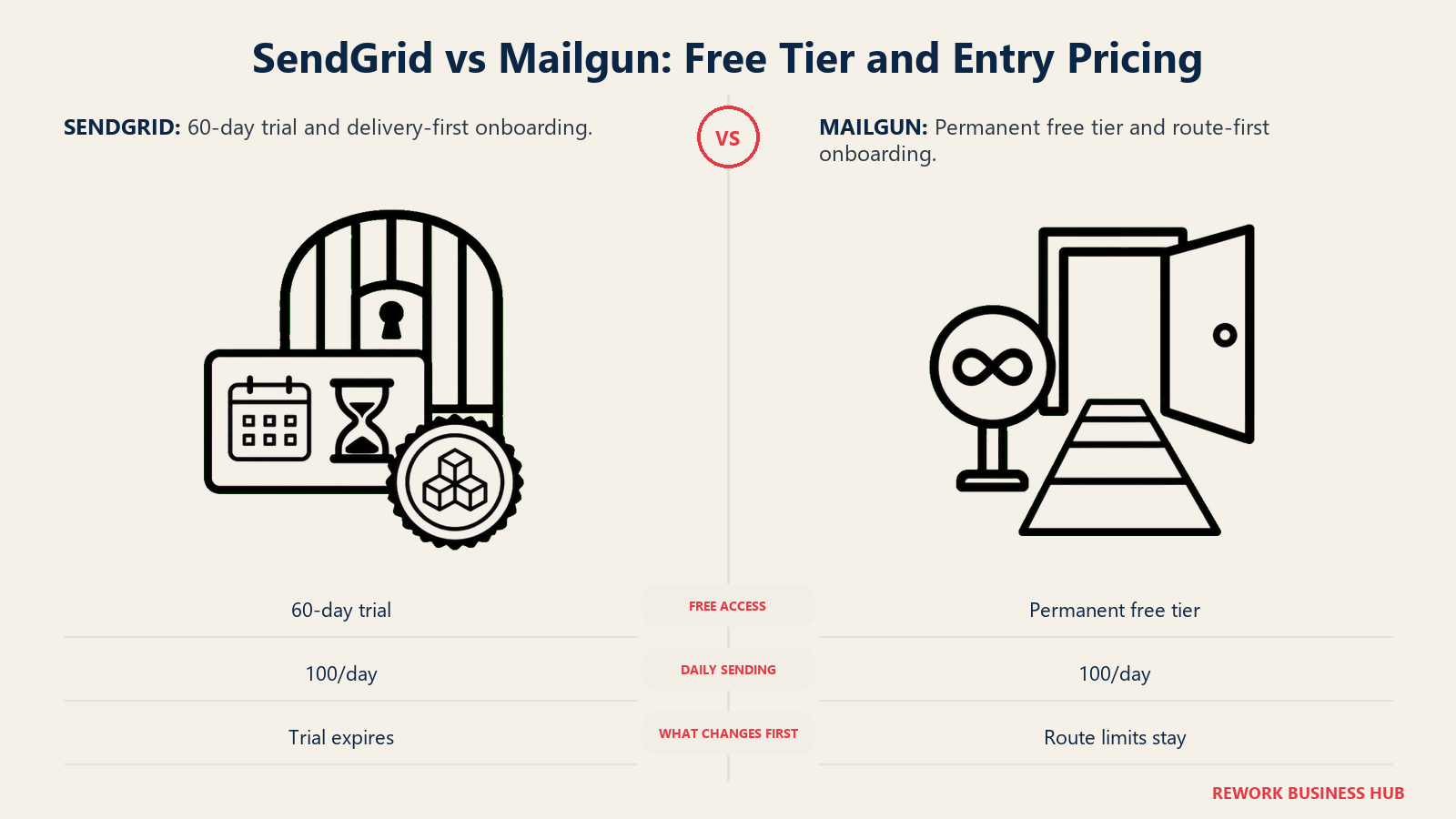
Here's the single most important fact in this comparison, and it's the one still missing from most of the advice floating around: SendGrid does not have a free plan any more. According to Twilio's own SendGrid changelog, the Free Email API and Free Marketing Campaigns plans were retired effective 27 May 2025. Existing free accounts kept access for 60 days, after which, in the changelog's own words, "email sending will be paused for accounts on all free plans." What replaced it is a 60-day free trial: 100 emails a day, 100 contacts, then you're on a paid plan or you stop sending.
That reversal matters because the old reputation, 100 free emails a day forever, is still what most developers expect walking in. One caveat: SendGrid's Marketing Campaigns pricing page still carries older copy referencing 2,000 contacts and 6,000 free emails a month. The changelog is the more recent and more authoritative statement, so treat the retirement as current fact and don't assume an ongoing free Marketing Campaigns plan is still available.
Mailgun took the opposite path. Its published pricing page still lists a $0/mo Free plan: 100 emails a day, one custom sending domain, one inbound route, RESTful API and SMTP relay access, and ticket support, with a catch worth flagging on its own, only 1-day log retention and 1-day bounce classification. So it's genuinely free and genuinely usable for testing or a low-volume side project, but you're working nearly blind if something goes wrong more than a day after you sent it.
| SendGrid Email API | Mailgun | |
|---|---|---|
| Free tier | None (retired 27 May 2025) | Yes, permanent: 100 emails/day |
| What you get instead | 60-day trial: 100 emails/day, 100 contacts | Same free tier, no trial clock |
| Log retention on the free option | Not applicable (trial only) | 1 day |
| Entry paid tier | Essentials, $19.95/mo, 50K-100K emails/mo, 1 teammate seat | Basic, $15/mo, 10,000 emails/mo |
| Overage on entry tier | $0.0013-$0.0009 per email (Essentials/Pro range) | From $1.80 per 1,000 emails |
Practically, this decides who should even start a free evaluation on which platform. If you're prototyping something today with no card on file and no 60-day deadline, Mailgun is the one that lets you do that indefinitely. If you're past prototyping and ready to commit to a paid plan on day one, the free-tier gap stops mattering and the comparison moves to which paid tier fits your volume, which is the next section.
Pricing at Real Sending Volume: 10K, 50K, 100K, and 1M Emails a Month
Sticker prices don't tell you what you'll actually pay, since both vendors price in volume bands rather than a flat per-seat rate. Here's what each platform costs at four sending volumes a growing product is likely to pass through.
| Monthly volume | SendGrid Email API | Mailgun |
|---|---|---|
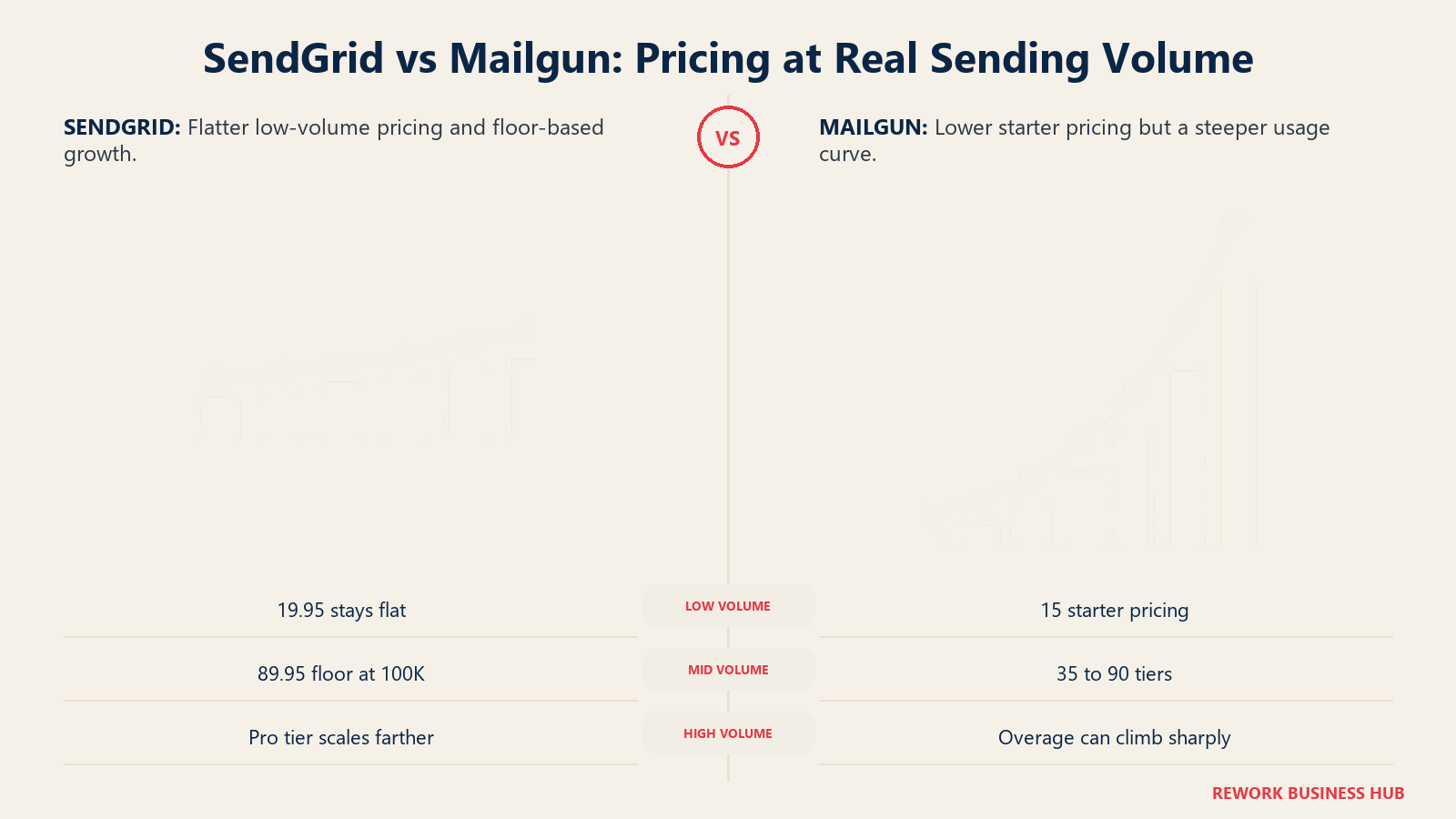
| 10,000 emails/mo | $19.95/mo (Essentials' floor covers up to 50K, so a 10K sender is paying for headroom it isn't using yet) | $15/mo (Basic's included volume, no overage) |
| 50,000 emails/mo | $19.95/mo (top of Essentials' 50K-100K band at its published entry rate) | $35/mo (Foundation's included volume, no overage) |
| 100,000 emails/mo | $89.95/mo (Pro's entry price; Pro's range runs 100K-2.5M) | $90/mo (Scale's included volume, no overage) |
| 1,000,000 emails/mo | Falls within Pro's 100K-2.5M band. SendGrid doesn't publish a granular per-step price inside that band, only Pro's $89.95 floor and an overage range of $0.0013-$0.0009/email; get a quote for your exact number rather than assuming a linear rate | Beyond Scale's included 100K, so priced as Scale's $90/mo base plus Scale's own overage rate of $1.10 per 1,000 emails: $90 + (900,000 / 1,000 x $1.10) = roughly $1,080/mo, though confirm this holds at 1M rather than tipping into an Enterprise quote |
Two things stand out in that table. First, at low volume (10K-50K a month), SendGrid's Essentials plan is a flat $19.95 across that whole range, so a team sending 12,000 emails a month and a team sending 48,000 pay the identical price, while Mailgun's tiered structure means the same growth triggers a jump from $15 (Basic, 10K) to $35 (Foundation, 50K). Second, at higher volume, the comparison flips: Mailgun's Scale tier at $90/mo for 100,000 emails undercuts SendGrid Pro's $89.95 floor only marginally at the exact 100K mark, but SendGrid's banded pricing beyond that point isn't transparent the way Mailgun's per-1,000 overage rate is, so budgeting past 100K is easier to do with confidence on Mailgun and requires a sales conversation to pin down on SendGrid.
Neither vendor publishes a clean linear rate across their entire range, so treat the 1M figures above as your starting point for a real quote, not your final number.
Deliverability and Reputation Tooling
Deliverability isn't a feature you can shop for on a checkbox list; it's the entire reason either of these products exists. Both handle the baseline: SPF, DKIM, and DMARC authentication, IP warmup guidance, and direct connections into the major mailbox providers. Where they diverge is in dedicated IPs and the depth of the reporting layer sitting on top.
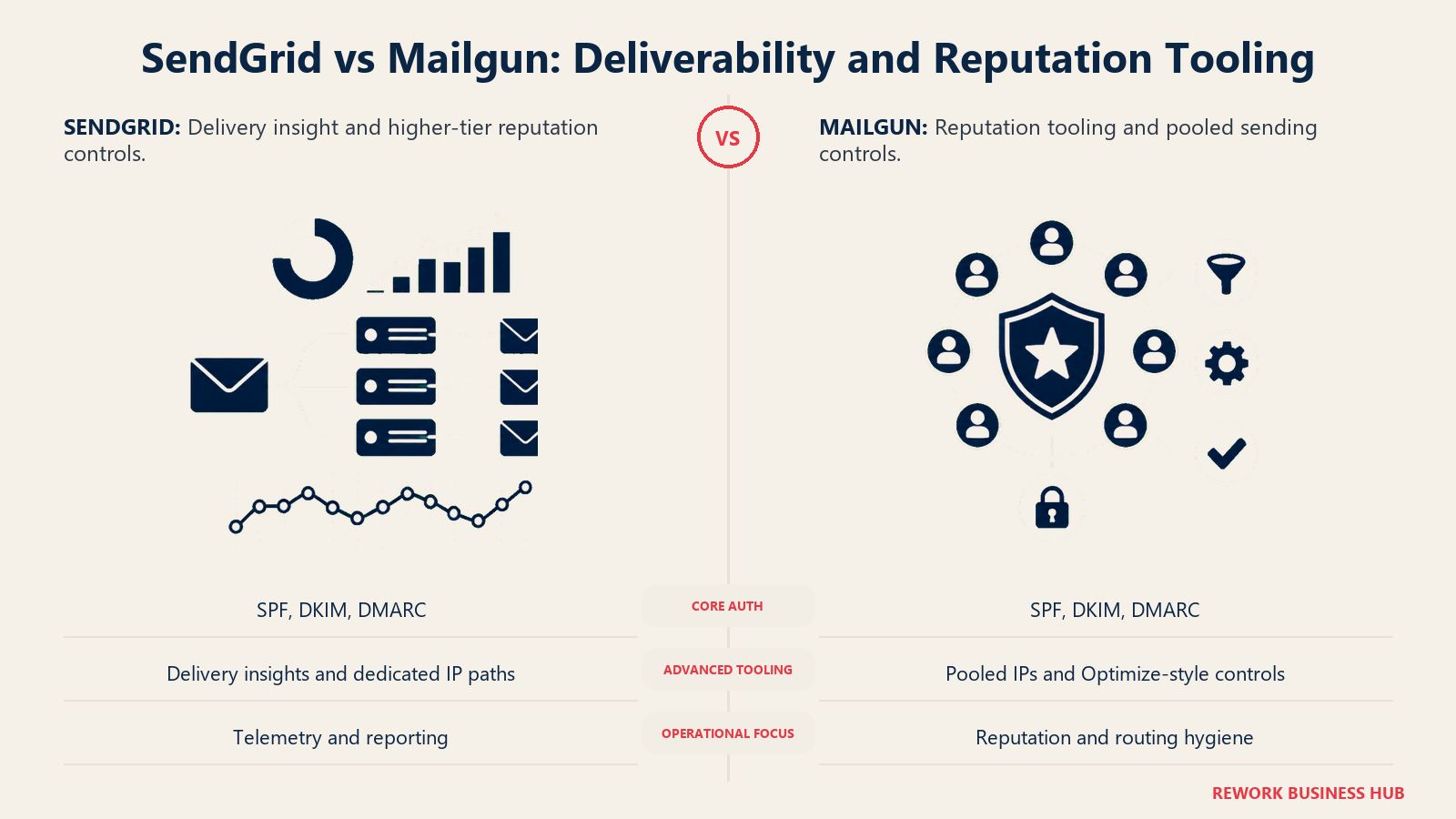
SendGrid gates its dedicated IP behind the Pro tier and up: Essentials doesn't include one, so a sender on the entry plan is sharing IP reputation with SendGrid's broader pool. SendGrid pairs that with a Deliverability Insights dashboard on paid tiers that tracks performance across individual mailbox providers, plus Twilio's own claim of direct peering relationships with Google, Yahoo, Apple, and Microsoft.
Mailgun ties dedicated IPs to volume rather than a flat tier cutoff: the option becomes available once you're sending around 50,000 emails a month (in practice, from Foundation up), and Scale includes one dedicated IP plus access to dedicated IP pools. Mailgun also sells a separate Optimize product line focused specifically on deliverability improvement and send-time optimization, which Scale-tier customers get access to as part of the plan.
| SendGrid Email API | Mailgun | |
|---|---|---|
| Sender authentication | SPF, DKIM, DMARC, TLS | SPF, DKIM, DMARC (via domain setup) |
| Dedicated IP availability | From Pro ($89.95/mo) up | From roughly 50K/mo volume (Foundation), included on Scale |
| IP pools | Not specified on the public pricing page | Yes, on Scale |
| Deliverability analytics dashboard | Deliverability Insights, included on paid tiers | Send time optimization and analytics tied to Mailgun Optimize |
| Direct mailbox provider relationships | Twilio states direct peering with Google, Yahoo, Apple, Microsoft | Not specified on the public pricing or product pages |
If your team's real bottleneck is the spam-complaint math Google and Yahoo now enforce (senders over 5,000 messages a day must stay under a 0.30% complaint rate per Google's own bulk sender rules), the deciding factor usually isn't which vendor has a prettier dashboard. It's whether you've earned a dedicated IP and warmed it correctly, which both platforms support but neither can do for you automatically.
Log Retention and Analytics
Log retention is the detail that only matters the day you actually need it, and by then it's too late to go back and extend it. This is where Mailgun's pricing page is refreshingly specific and SendGrid's is comparatively vague.
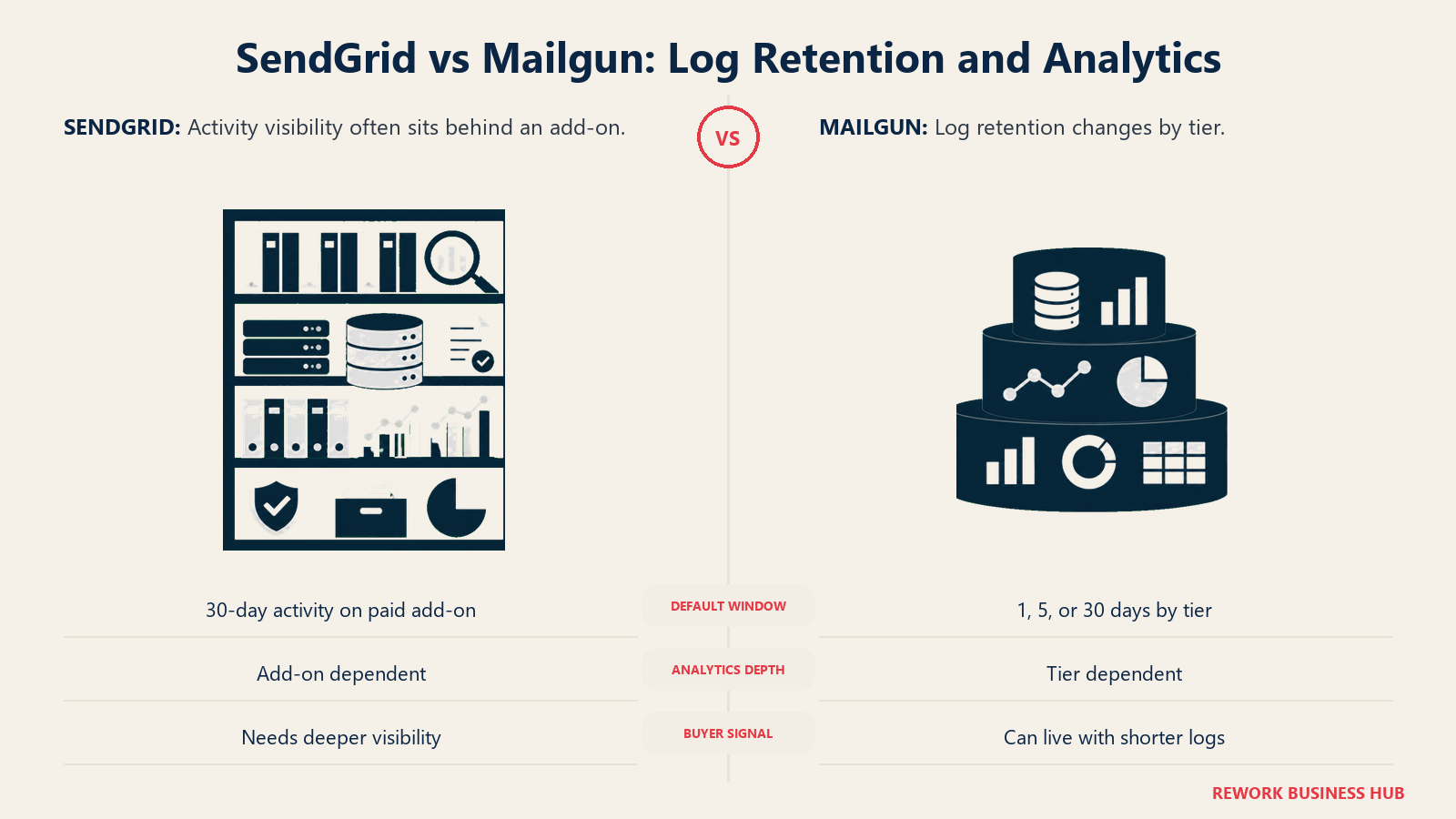
Mailgun states its retention windows directly on the pricing page, tied to plan: 1 day of log retention and 1 day of bounce classification on both the free plan and Basic ($15/mo), 5 days on Foundation ($35/mo), and 30 days on Scale ($90/mo). That 1-day window on Mailgun's entry tiers is a real constraint: if a delivery issue surfaces two days after the fact, the free plan and Basic have already lost the event data you'd need to debug it.
SendGrid's approach is less tied to a specific published number per tier. Twilio's own documentation confirms that its Email Activity History add-on extends the feed to 30 days, but that's described as a purchasable add-on rather than a number included automatically at Essentials or Pro. If your team relies on being able to look back at delivery events from weeks ago without paying for an extra add-on, confirm the current default window with a SendGrid rep before assuming parity with Mailgun's Scale tier.
| SendGrid Email API | Mailgun | |
|---|---|---|
| Free / entry tier log retention | Not tied to a published per-tier number; short default window | 1 day (free plan and Basic) |
| Mid tier | Same short default, extendable | 5 days (Foundation) |
| Top published tier | 30-day Email Activity History available as a paid add-on | 30 days (Scale), included in the tier price |
| Bounce classification retention | Not separately published | 1 day (free/Basic) up to 30 days (Scale), mirrors log retention |
| Analytics dashboard | Deliverability Insights + Email Activity Feed | Tracking, analytics, and webhooks on every tier including free |
The practical read: if debugging a delivery problem from a week or two ago is something your team needs to do without a support ticket, Mailgun's Scale tier gives you that for a published $90/mo. Getting the equivalent window on SendGrid means budgeting for the Email Activity History add-on on top of your seat price, and confirming its current cost directly, since it isn't listed as a fixed line item on the public pricing page.
API, SMTP, and SDK Coverage
Both vendors give you a real choice between a REST API and a plain SMTP relay, which matters if you're migrating off a legacy mail server rather than building fresh. SendGrid's REST API (v3) and Mailgun's RESTful API both support programmatic sending, and both expose an SMTP endpoint so you can drop in credentials without rewriting your mail-sending code.
On official SDKs, the two are close to parity. SendGrid publishes and maintains libraries for Python, Go, Node.js, Ruby, PHP, Java, and C#, plus a Perl library and community-maintained options beyond that. Mailgun publishes official SDKs for Python, Ruby, PHP, Java, C#, Node.js, and Go, the same seven-language core. Neither vendor has a meaningfully deeper SDK bench than the other for the mainstream backend languages a product team is likely to already be using.
| SendGrid Email API | Mailgun | |
|---|---|---|
| REST API | Yes, v3 | Yes |
| SMTP relay | Yes, on every tier | Yes, on every tier including free |
| Official SDK languages | Python, Go, Node.js, Ruby, PHP, Java, C#, plus Perl | Python, Ruby, PHP, Java, C#, Node.js, Go |
| Batch sending | Personalizations API supports multi-recipient sends | Supports batch sending up to 1,000 personalized emails per API call |
| API keys included | Varies by tier | 2 API keys on free and Basic tiers |
If your stack is already built around one of the seven common backend languages, this section won't be the deciding factor between the two. Where it can matter is API key management at low tiers: Mailgun's public pricing page states 2 API keys on its free and Basic plans, worth checking against your own team structure if you need separate keys per environment (staging, production, a QA sandbox) rather than sharing one key across all three.
Inbound Email Routing
If your product needs to receive email, not just send it, reply-to-comment threads, support ticket creation from an inbound address, parsing attachments off an incoming message, both platforms offer a route, but they gate it differently.
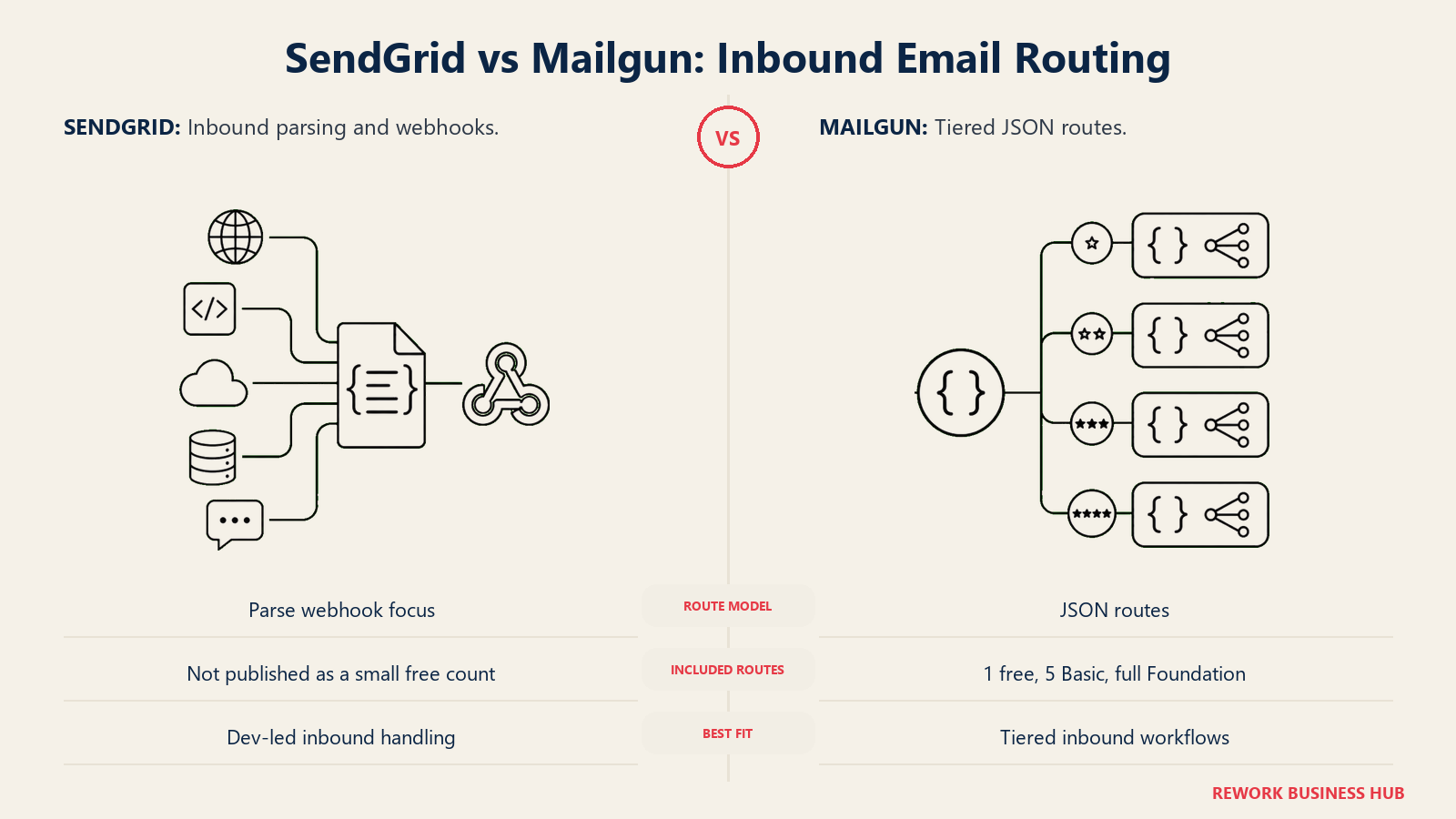
SendGrid's Inbound Parse Webhook works by pointing a domain or subdomain's MX record to mx.sendgrid.net, then associating that hostname with a URL in your Parse API settings. SendGrid breaks the incoming email into its components (headers, body, attachments) and POSTs the result to your endpoint. The total message size limit, body plus attachments combined, is 30MB per Twilio's current documentation, and your endpoint needs to return a 2xx response or SendGrid will retry delivery.
Mailgun ties inbound routing directly to your plan tier rather than treating it as a single feature everyone gets equally. The free plan includes 1 inbound route, Basic ($15/mo) includes 5, and Foundation ($35/mo) and up include full access to inbound routing without a route-count ceiling. Mailgun parses incoming email streams into UTF-8 JSON for easier integration into your own systems.
| SendGrid Email API | Mailgun | |
|---|---|---|
| Mechanism | MX record pointed to mx.sendgrid.net, parsed and POSTed to your URL | Inbound routes parsed into UTF-8 JSON |
| Gated by plan | No route-count limit published; available via Inbound Parse setup | Yes: 1 route (free), 5 (Basic), full access (Foundation and up) |
| Message size limit | 30MB total (message plus attachments) | Not specified on the public pricing page |
| Setup complexity | Requires DNS MX record change plus endpoint configuration | Requires domain routing setup plus endpoint configuration |
If your product's inbound volume is genuinely small, a support alias or two, a reply-by-email feature, either platform's entry tier likely covers it. If you're building something that needs many distinct inbound addresses at once (per-customer inbound routing, for example), Mailgun's route-count ceiling on its lower tiers is worth checking against your actual number before committing to Basic over Foundation.
Email Validation
Cleaning a list before you send to it is cheaper than paying the deliverability cost of a bounce-heavy send later, and both vendors sell validation, but they price it differently relative to the plans you're already paying for.
SendGrid treats email validation as its own add-on product, separate from the Email API plan itself. Pro plans include 2,500 free validations a month bundled in, and Premier includes 5,000. Below Pro, validation is an added purchase rather than something folded into the base seat price.
Mailgun bundles validation credits directly into its main tiers instead of running it as a separate product: Foundation ($35/mo) and Scale ($90/mo) both include 5,000 email validations a month as part of the plan price, with additional validations available via API or bulk list upload beyond that allowance.
| SendGrid Email API | Mailgun | |
|---|---|---|
| Included on entry tier | None on Essentials | None on free/Basic; available as an add-on |
| Included on mid/upper tiers | 2,500/mo on Pro, 5,000/mo on Premier | 5,000/mo on Foundation and Scale alike |
| Sold as | A separate validation product | Bundled allowance inside the main plan |
| Method | Real-time API validation | API or bulk list upload |
The practical difference: if you're already paying for Mailgun Foundation or Scale, you're not shopping for validation separately, it's already in the number you signed up for. On SendGrid, validation credits only show up once you're on Pro, so an Essentials customer who wants to validate a list is pricing a second product on top of their existing plan.
Templates and Marketing Features
Templating is where the two products' underlying identities show through. SendGrid runs two separate lines: the Email API (transactional, developer-facing, the focus of this comparison) and a distinct Marketing Campaigns product (Basic from $15/mo, Advanced from $60/mo) built for drag-and-drop newsletters and campaign sends aimed at marketers rather than developers. The Email API side includes Dynamic Transactional Templates using a Handlebars-style syntax for personalizing subject lines and body content per recipient.
Mailgun stays a single product built around transactional and API-driven sending. From Foundation up, it includes an email template builder plus API access to that builder, letting you design a reusable template visually and then populate it programmatically. Mailgun doesn't run a separate marketing-campaigns product the way SendGrid does; if your team needs a full newsletter/campaign tool with list segmentation, that's a different category of software than either of Mailgun's tiers cover.
| SendGrid | Mailgun | |
|---|---|---|
| Transactional template engine | Dynamic Transactional Templates (Handlebars-style) | Template builder + API, from Foundation up |
| Separate marketing/campaigns product | Yes, Marketing Campaigns (Basic $15/mo, Advanced $60/mo) | No, single product line |
| Drag-and-drop editor | Available in Marketing Campaigns, not the Email API line | Available in the template builder from Foundation |
| Best fit | Teams that want transactional API and marketing newsletters under one vendor, priced separately | Teams that only need transactional/API-driven email and don't want to pay for a marketing product they won't use |
If your team is actually shopping for a newsletter and campaign tool rather than a transactional API, that's a different buying decision than this one. Our best email marketing software roundup for 2026 covers the platforms built specifically for that job, and our guides to Klaviyo alternatives, Mailchimp alternatives, and Omnisend alternatives go deeper on that category than either SendGrid or Mailgun does as a transactional-first product.
Compliance and Regional Data Residency
This is the section to read closely if you're sending anything that touches health data, and it's also where the two vendors take clearly different positions rather than converging on the same answer.
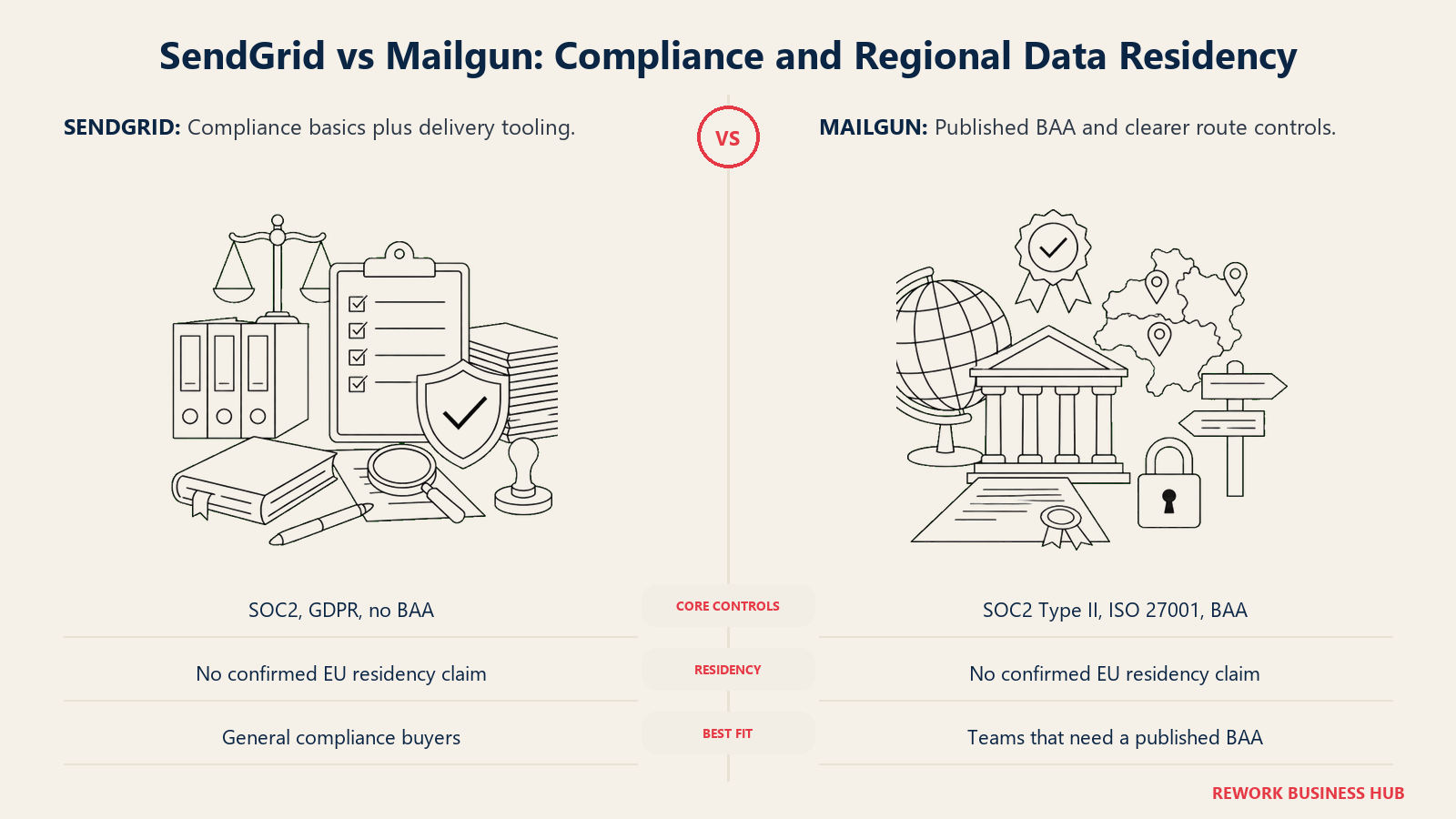
SendGrid maintains SOC 2 compliance and states it meets GDPR requirements, but Twilio explicitly does not sign Business Associate Agreements for SendGrid. SendGrid's own documentation states it is not a HIPAA-eligible service and does not natively support HIPAA-compliant transmission. Practically, that means a healthcare product handling Protected Health Information should not run PHI through SendGrid, encryption in transit doesn't substitute for a signed BAA under HIPAA.
Mailgun holds SOC 2 Type II and ISO/IEC 27001 certification, states GDPR compliance backed by a Data Processing Agreement using EU Model Standard Contractual Clauses, and, unlike SendGrid, publishes a HIPAA Business Associate Addendum that customers can sign directly. That's a real differentiator if PHI is anywhere in your email content. On regional data residency specifically, Mailgun's own GDPR documentation describes its GDPR program and cross-border transfer safeguards but doesn't name a specific EU-region data center option the way some competitors do, so if data residency inside a specific country or region is a hard requirement, confirm the current setup directly with Mailgun rather than assuming a regional hosting choice exists.
| SendGrid | Mailgun | |
|---|---|---|
| SOC 2 | Yes | Yes, SOC 2 Type II |
| ISO 27001 | Not stated on public pages | Yes |
| GDPR | States compliance | States compliance, backed by a published DPA with EU Model SCCs |
| HIPAA / BAA | No. Twilio does not sign BAAs for SendGrid | Yes, a published HIPAA Business Associate Addendum is available |
| EU-specific data residency | Not confirmed on public pages | Not confirmed as a named region-choice option; ask directly |
If HIPAA is a requirement for your product at all, this table alone should end the debate: Mailgun has a path to a signed BAA, and SendGrid has explicitly stated it does not. For everything short of PHI, both vendors clear the more common SOC 2 and GDPR bar, and the choice comes back to the pricing and feature sections above rather than compliance.
Support Tiers
Both vendors follow the familiar pattern of gating live support behind the higher tiers, and both start free/entry customers on ticket-only support with no SLA.
SendGrid's escalation ladder runs from ticket support on the trial, to live chat on Essentials, to phone support (via a callback request system) plus chat on Pro, to a dedicated customer success manager and prioritized support on Premier.
Mailgun's ladder is similar but the jump to live support happens later: ticket support only on free and Basic, ticket support still (no phone) on Foundation, and live phone plus chat support only from Scale ($90/mo) up. Mailgun's Enterprise tier adds custom features on top of Scale, including what its pricing page calls Deliverability Services and a Rapid Fire Burst Sending SLA.
| SendGrid Email API | Mailgun | |
|---|---|---|
| Free / trial | Ticket support only | Ticket support only |
| Entry paid tier | Live chat (Essentials) | Ticket support only (Basic) |
| Mid tier | Phone + chat (Pro) | Ticket support only (Foundation) |
| Top published tier | Dedicated CSM + priority support (Premier) | Live phone and chat (Scale) |
| SLA | Not published below Premier | None below Scale; Enterprise adds a named SLA |
The practical difference: SendGrid gets you to phone support one tier earlier (Pro, $89.95/mo) than Mailgun does (Scale, $90/mo), and both land at essentially the same price point for that jump. If live support access by a specific dollar amount matters to your evaluation, that's close enough to a wash; the bigger factor is still which plan's included volume and features fit what you're actually sending.
Migrating Between SendGrid and Mailgun
Whichever direction you're migrating, the work is close to identical, since both platforms rely on the same underlying DNS and authentication mechanics. That's the part a buyer actually has to live through, not the sales pitch.
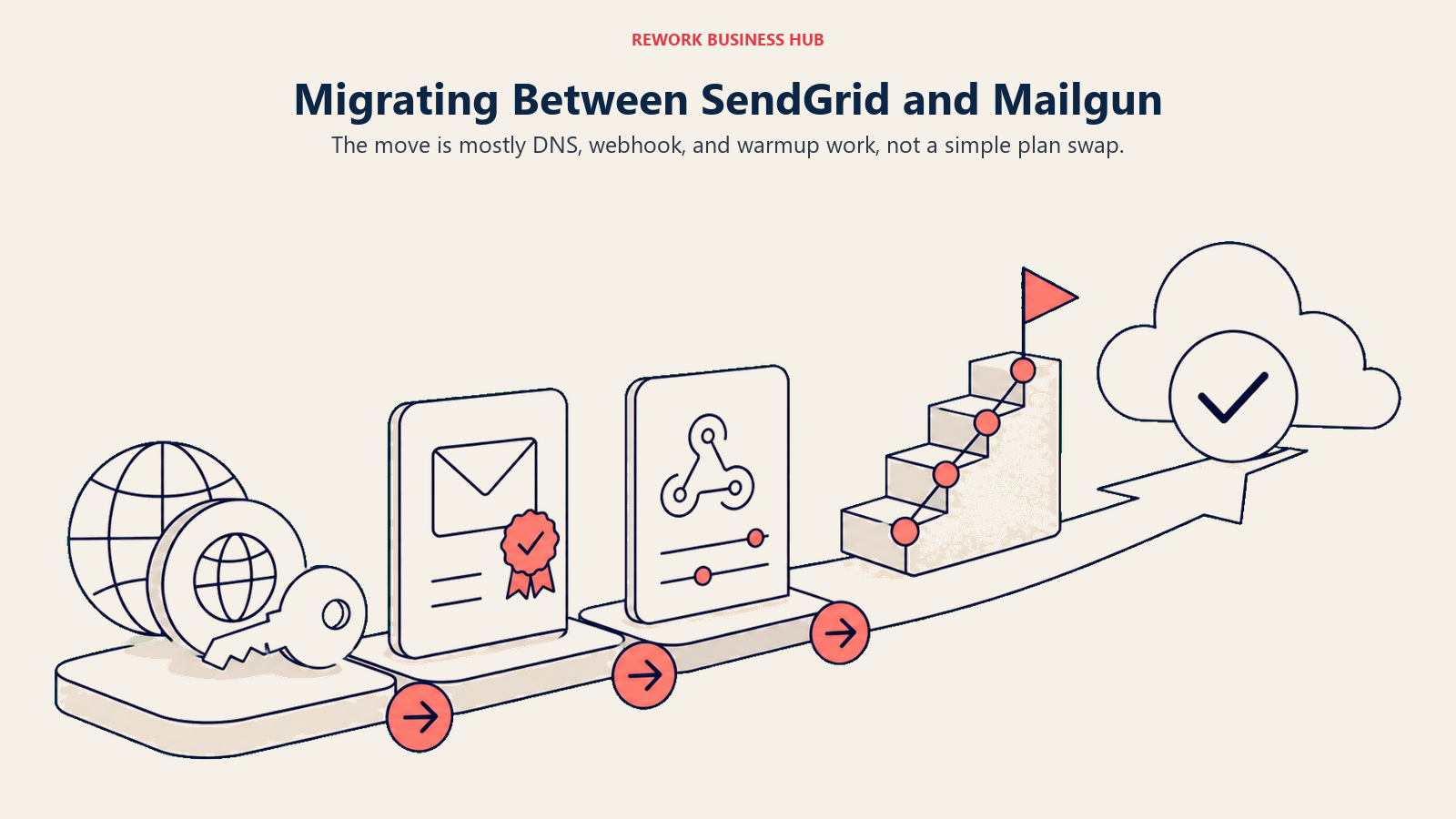
Domain authentication and DNS. Both vendors require you to add SPF, DKIM, and (recommended) DMARC records to your sending domain's DNS before mail from that domain is trusted. If you're moving providers, you'll add the new vendor's DKIM records alongside or in place of the old one, and you generally want both providers authenticated during the transition so you can roll back if something breaks. Don't remove the old provider's DNS records until the new one is fully sending and verified.
IP warm-up. If you're moving to a dedicated IP on either platform (SendGrid Pro and up, Mailgun from roughly 50K/mo volume), that new IP starts with no sending reputation and needs a gradual warm-up: low volume in week one, increasing over roughly 2-4 weeks depending on your total send volume. Skipping warm-up on a fresh dedicated IP is one of the most common causes of a deliverability drop right after a migration, not a platform bug.
Webhook and event rewiring. Your application code almost certainly listens for delivery events, opens, clicks, bounces, spam complaints, via each vendor's webhook format, and those payloads are not interchangeable. Budget real engineering time to rewrite your webhook handler for the new vendor's event schema rather than assuming a drop-in swap.
SMTP relay changes. If your application sends through SMTP rather than each vendor's REST API, the migration is often just credential and hostname changes (SendGrid's SMTP host versus Mailgun's), but confirm your code isn't relying on any SendGrid-specific or Mailgun-specific SMTP extensions before assuming a clean swap.
| Migration step | What changes |
|---|---|
| DNS / domain authentication | Add new provider's SPF/DKIM records; keep old provider's active until cutover is verified |
| IP warm-up | Required again if moving to a new dedicated IP; plan 2-4 weeks of gradual volume increase |
| Webhook rewiring | Event payload schemas differ between vendors; rewrite handlers, don't assume compatibility |
| SMTP relay | Usually just host/credential changes if you're not using vendor-specific extensions |
| API code | REST API calls need a full rewrite; the two vendors don't share a request/response format |
None of this is unusually hard for a team that's migrated an email provider before, but none of it is a config-file swap either. Plan for a real testing window running both providers in parallel before you cut traffic over entirely.
When SendGrid Is the Right Call
- You want your transactional email and marketing newsletters under one vendor. SendGrid runs the Email API and Marketing Campaigns as sibling products, so a team that needs both a developer-facing API and a drag-and-drop newsletter tool can buy both from Twilio rather than stitching two vendors together.
- You need 1,000 teammate seats without changing plans. Pro's teammate allowance is generous for a larger engineering or growth org that wants many people with dashboard access under one account.
- Phone support at a known price matters to you. Pro ($89.95/mo) gets you a callback-based phone line plus chat, and that's a defined price point rather than a custom quote.
- You've already built around SendGrid's SDKs or Handlebars-style templates. If your codebase already integrates SendGrid's Dynamic Transactional Templates, there's a real switching cost to re-platform that isn't worth paying unless another factor (like HIPAA) forces the move.
When Mailgun Is the Right Call
- You want to start free and stay free until you actually need to pay. Mailgun's 100 emails/day free plan has no trial clock. If you're prototyping or running a genuinely low-volume side project, this alone can be the deciding factor.
- HIPAA is a real requirement. Mailgun offers a published HIPAA Business Associate Addendum. SendGrid has explicitly stated it does not sign BAAs, so this isn't a close call if PHI is anywhere in your email content.
- You want validation and templates bundled instead of purchased separately. Foundation and Scale both fold 5,000 monthly validations and a template builder into the base plan price, versus SendGrid selling validation as a distinct add-on product below Pro.
- Longer log retention matters and you want it published, not negotiated. Scale's 30-day log and bounce retention is stated directly on the pricing page for $90/mo, versus SendGrid's Email Activity History being sold as a separate add-on with no fixed public price.
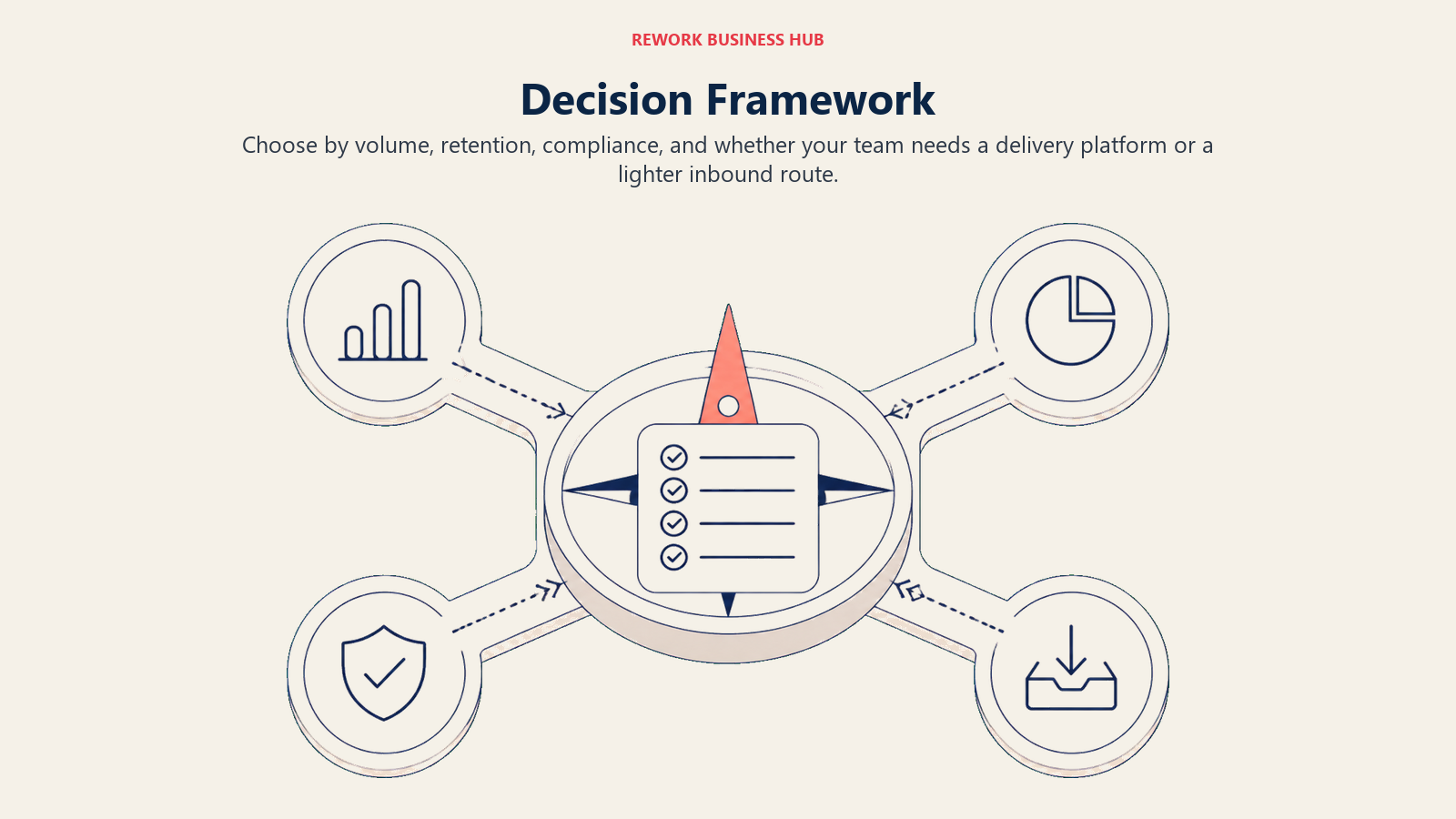
Decision Framework
| If this is your situation | Pick |
|---|---|
| You want to start free with no trial deadline | Mailgun, permanent 100 emails/day free plan |
| You need to send transactional email that could contain PHI | Mailgun, published HIPAA BAA available; SendGrid doesn't sign one |
| You want validation and template building bundled into your plan price | Mailgun, both included from Foundation up |
| You need 1,000 teammate seats and one dashboard for a larger org | SendGrid, Pro's teammate allowance |
| You also want a marketing newsletter product from the same vendor | SendGrid, Marketing Campaigns runs alongside the Email API |
| You want published, tier-tied log retention rather than an add-on you have to price separately | Mailgun, 1/5/30-day retention stated directly by tier |
| You're already deep in one vendor's SDK and templates with no forcing function to move | Stay put, the switching cost outweighs the marginal differences above |
| Neither shape fits and you want the rest of the field | Best SMS marketing software in 2026 |
Frequently Asked Questions about SendGrid vs Mailgun
Which one is actually free, SendGrid or Mailgun?
Mailgun. It has a permanent free plan at 100 emails per day. SendGrid retired its Free Email API and Free Marketing Campaigns plans effective 27 May 2025; what SendGrid offers now is a 60-day trial (100 emails/day, 100 contacts), after which you need a paid plan to keep sending.
What does SendGrid cost after the trial ends?
Essentials starts at $19.95/mo for 50,000 to 100,000 emails a month with 1 teammate seat. Pro starts at $89.95/mo for 100,000 to 2.5 million emails a month, with 1,000 teammate seats and 1 dedicated IP. Premier is custom-priced above that.
What does Mailgun cost beyond the free tier?
Basic is $15/mo for 10,000 emails a month with 1-day log retention. Foundation is $35/mo for 50,000 emails a month with 5-day retention. Scale is $90/mo for 100,000 emails a month with 30-day retention and one dedicated IP included.
Does either platform support HIPAA-compliant email?
Mailgun does, through a published HIPAA Business Associate Addendum customers can sign. SendGrid explicitly does not sign BAAs and states its Email API is not a HIPAA-eligible service, so it should not be used to transmit Protected Health Information.
How long are delivery logs kept on each platform?
Mailgun publishes exact numbers by tier: 1 day on the free plan and Basic, 5 days on Foundation, 30 days on Scale. SendGrid's default retention isn't published as a fixed number per tier; a 30-day Email Activity History window is available as a separate paid add-on.
Does either vendor include email validation in the base price?
Mailgun does, bundling 5,000 validations a month into both Foundation and Scale. SendGrid sells validation as a separate product, though Pro includes 2,500 free validations a month and Premier includes 5,000.
Which one is cheaper at high volume, like 1 million emails a month?
Neither vendor publishes a clean linear rate that far out. Mailgun's Scale tier plus its published overage rate works out to roughly $1,080/mo at 1 million emails, calculated from its own stated $1.10-per-1,000 overage. SendGrid's Pro tier covers up to 2.5 million emails in one band starting at $89.95/mo, but SendGrid doesn't publish where inside that band 1 million lands, so get a direct quote before assuming either estimate is your final number.
Can I migrate between SendGrid and Mailgun without much engineering work?
Expect real work, not a config swap. You'll need to update DNS records for domain authentication, re-warm any new dedicated IP over 2-4 weeks, and rewrite your webhook handler since the two vendors use different event payload formats. SMTP relay changes are usually lighter, often just a hostname and credential swap, if your code isn't using vendor-specific extensions.
What to Do Next
- Pull your actual monthly send volume, not your best guess. Check your current mail server or ESP dashboard for the last three months of sent volume. That number, not a feature checklist, decides which pricing band you're really comparing.
- Check whether PHI touches any email your product sends. If it does, this decision is close to made for you: Mailgun has a published HIPAA BAA path, SendGrid does not sign one.
- Decide whether you need validation and templates bundled or are fine buying them separately. If bundled matters to your budget process, Mailgun's Foundation and Scale tiers already include both. If you're fine pricing them as add-ons, SendGrid's structure isn't a blocker.
- Test both on their free tiers before committing. Mailgun's free plan has no deadline; SendGrid's 60-day trial does. Run a real integration test, not just a hello-world send, so you see webhook events, inbound routing, and validation behavior before you're locked into a paid plan.
- If you're evaluating the wider channel mix, not just email, see our best SMS marketing software roundup for 2026 and our best SendGrid alternatives guide if neither platform in this comparison ends up fitting once you've run your real numbers.
Related Resources:

Principal Product Marketing Strategist
On this page
- TL;DR
- Key Facts
- Who Each Platform Is Built For
- Free Tier and Entry Pricing: The Fact Most Comparisons Get Backwards
- Pricing at Real Sending Volume: 10K, 50K, 100K, and 1M Emails a Month
- Deliverability and Reputation Tooling
- Log Retention and Analytics
- API, SMTP, and SDK Coverage
- Inbound Email Routing
- Email Validation
- Templates and Marketing Features
- Compliance and Regional Data Residency
- Support Tiers
- Migrating Between SendGrid and Mailgun
- When SendGrid Is the Right Call
- When Mailgun Is the Right Call
- Decision Framework
- What to Do Next