Best Omnisend Alternatives in 2026: 12 Email and SMS Marketing Tools for Ecommerce

Turn this article into takeaways for your work.


Each assistant summarizes the article only for you and suggests best practices for your work.
Omnisend built a genuinely good product for Shopify and WooCommerce merchants who want email and SMS under one roof without hiring a specialist. It ships ecommerce-native automation, solid pre-built flows, and a clean UI that a solo founder can learn in a weekend. But it hits friction at scale. Contact-based pricing climbs steeply past 10,000 contacts, SMS became an add-on-only feature for new Pro subscribers after May 2026, and the automation depth falls short of what a DTC brand doing serious segmentation and revenue attribution needs. If you're comparing Omnisend seriously, you're probably a growing Shopify store, a WooCommerce merchant chasing more sophisticated flows, or a mid-size retailer whose list has outgrown the pricing comfort zone.
This guide covers 12 real alternatives, all with current 2026 pricing. Each tool gets an honest ICP call so you can match your store size, team size, and marketing maturity to the right platform.
Quick Comparison Table
| Tool | Best For | Starting Price | Key Strength | Key Limitation |
|---|---|---|---|---|
| Klaviyo | DTC and mid-market ecommerce | Free up to 250 profiles; $20/mo for 500 | Deep ecommerce data model, revenue attribution | Price climbs fast past 25K contacts |
| Mailchimp | Early-stage stores wanting a known brand | Free up to 250 contacts; $20/mo Standard | Huge ecosystem, easy setup | Charges unsubscribed contacts; automation locked to Standard |
| Brevo | High-volume senders with large lists | Free (300/day); $9/mo Starter | Send-based pricing, not contact-based | Ecommerce integrations shallower than Klaviyo |
| ActiveCampaign | Stores that blend B2C and lifecycle CRM | $15/mo Starter; $49/mo Plus | Best-in-class automation builder | Steeper learning curve; SMS limited |
| GetResponse | Stores wanting email plus funnels and webinars | $15/mo (annual) | All-in-one: email, webinars, landing pages | Ecommerce data model less native than Klaviyo |
| Drip | Shopify/WooCommerce brands wanting revenue attribution | $39/mo for 2,500 contacts | Visual workflows, full feature parity from $1 | No free plan; pricier under 2,500 contacts |
| MailerLite | Budget-first small stores | Free up to 250 subs; $12/mo Comfort | Clean UI, affordable pricing | Limited deep ecommerce segmentation |
| Sendlane | Mid-size ecommerce wanting unified email/SMS/reviews | $100/mo entry (unlimited profiles) | Single platform, advanced segmentation | High entry price for small stores |
| Constant Contact | Non-tech teams and brick-and-mortar with an online store | $12/mo Lite for 500 contacts | Excellent support, event tools | Aggressive price jumps past 1,000 contacts |
| Moosend | Bootstrapped and budget-conscious stores | $7/mo annual; $9/mo monthly for 500 | Unlimited sends, cheap at scale | Smaller native integrations library |
| Postscript | SMS-first DTC brands on Shopify | Usage-based, starts from ~$100/mo | Best-in-class Shopify SMS | Email is secondary; no email focus |
| Yotpo (SMS/Email) | Loyalty-heavy brands on Shopify | Custom pricing (contact Yotpo) | Loyalty, reviews, SMS in one stack | Note: Yotpo shut down standalone email in 2024; verify current offering |
1. Klaviyo: The Strongest Ecommerce Alternative
Klaviyo is purpose-built for ecommerce in a way that Omnisend approaches but doesn't fully match. Where Omnisend offers a contact-based model with ecommerce overlays, Klaviyo's entire data model is built around order history, browsing behavior, product catalogs, and predictive lifetime value. That difference shows in segmentation: you can build a segment for "purchased twice in the last 90 days, browsed a product in the last 7 days, but hasn't bought in 30" and trigger a personalized flow off it.
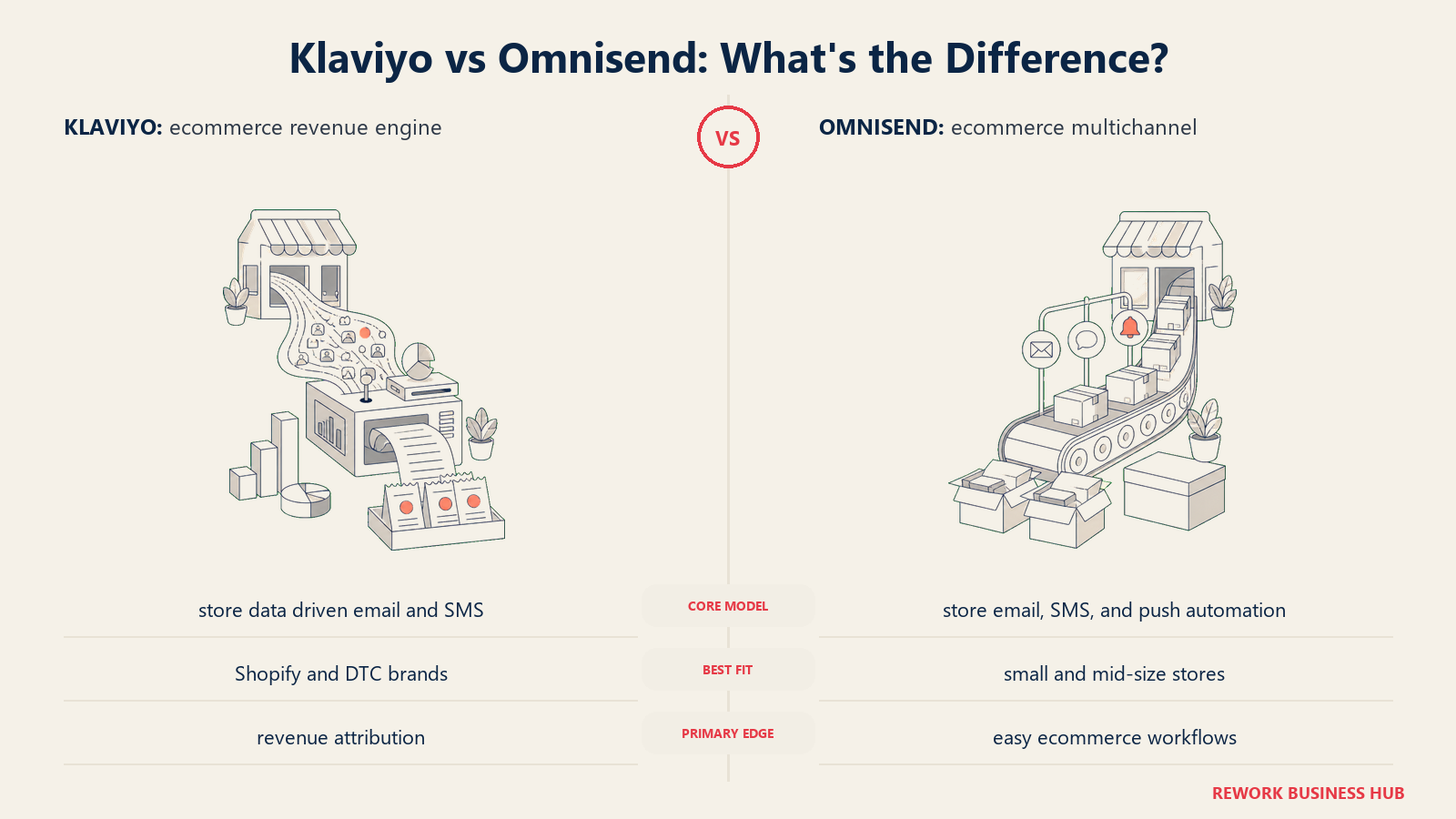
The free plan covers up to 250 active profiles and 500 email sends. Paid starts at $20/month for 500 profiles, scaling to $150/month at 10,000 profiles and roughly $720/month at 50,000. Email plus SMS plans run about $15/month more per tier. As of early 2025, Klaviyo switched from total contacts to active profiles for billing, which helps merchants with large dormant lists.
For stores between $500K and $20M in annual revenue, Klaviyo is usually the right answer. It's harder to set up than Omnisend, the onboarding curve is real, and the price does climb, but the revenue attribution and segmentation depth pay back the investment for any brand running more than basic welcome and cart flows.
If you're already researching Klaviyo specifically, see our full Klaviyo alternatives guide for a peer comparison of that platform.
| Pros | Cons |
|---|---|
| Deepest ecommerce data model available | Price scales steeply above 50K contacts |
| Predictive analytics and LTV scoring | Steeper learning curve than Omnisend |
| Native Shopify, WooCommerce, BigCommerce | SMS credits charged separately |
| Revenue attribution per flow and campaign | Overkill for stores under $200K revenue |
Pricing: Free for 250 profiles; $20/mo for 500; $150/mo for 10K profiles (email only, annual billing) Best for: DTC and Shopify brands generating $500K+ in revenue who need real segmentation and revenue tracking
2. Mailchimp: The Familiar Name with Hidden Costs
Mailchimp is the default choice for merchants who don't want to think too hard about their email tool early on. It integrates with almost every platform, the template library is large, and brand recognition makes procurement approvals easy. But there are real gotchas for ecommerce buyers.
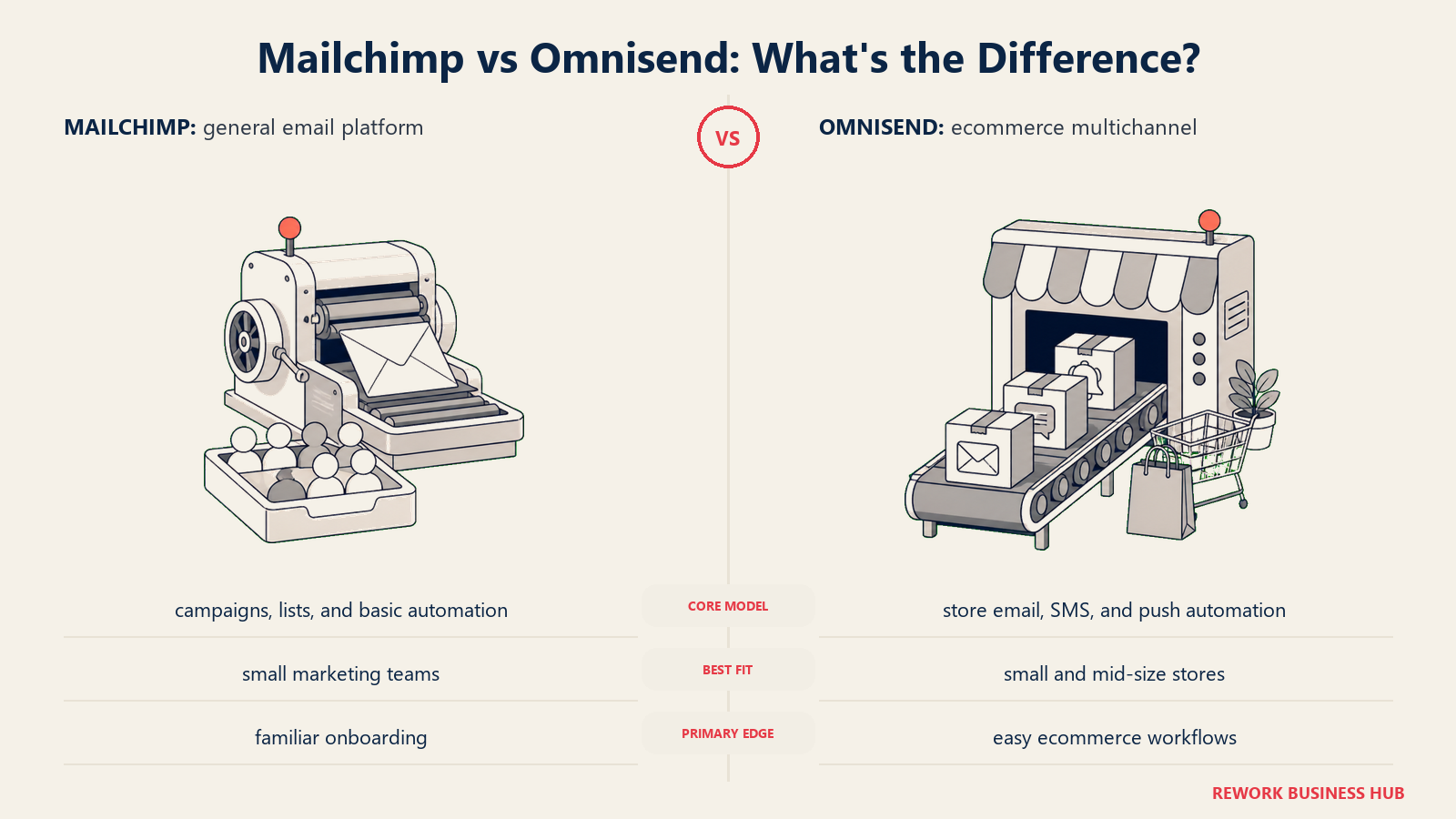
Multi-step automation is locked to the Standard plan ($20/month at 500 contacts). The free plan and Essentials plan cap you at single-step automations, which means no abandoned cart recovery, no full welcome series, and no post-purchase flows without upgrading. And Mailchimp counts unsubscribed contacts toward your billing tier, which is a meaningful hidden cost once your list ages.
At 5,000 contacts, Standard runs $100/month. At 10,000 contacts, you're looking at around $135/month, though the Standard plan doesn't include multivariate testing. That's comparable to Klaviyo's pricing at the same scale but with less ecommerce-specific depth.
For stores in the early stages ($0-$500K revenue) who want a well-supported platform with a huge ecosystem of freelancers and agencies, Mailchimp works. For anyone prioritizing automation sophistication or growing past 10K contacts without a big budget, there are better options on this list.
For a deeper peer comparison of Mailchimp's strengths and weaknesses, see our Mailchimp alternatives guide.
| Pros | Cons |
|---|---|
| Huge template and integration library | Charges for unsubscribed contacts |
| Wide ecosystem of certified partners | Automation locked behind Standard plan |
| Generous name recognition for procurement | Ecommerce depth below Klaviyo and Drip |
| Strong transactional email via Mandrill | Mandrill is a separate paid add-on |
Pricing: Free up to 250 contacts; Essentials $13/mo; Standard $20/mo for 500 contacts (annual) Best for: Early-stage stores wanting broad ecosystem support and a recognized brand
3. Brevo: Best for Large Lists on a Budget
Brevo (formerly Sendinblue) prices by email volume sent, not by contacts stored. That makes it a fundamentally different value proposition from Omnisend for merchants with large, lower-engagement lists. You can store 100,000 contacts on the free plan and pay based on how many emails you actually send each month. The free tier allows 300 emails per day; the Starter plan runs $9/month for 5,000 emails per month.
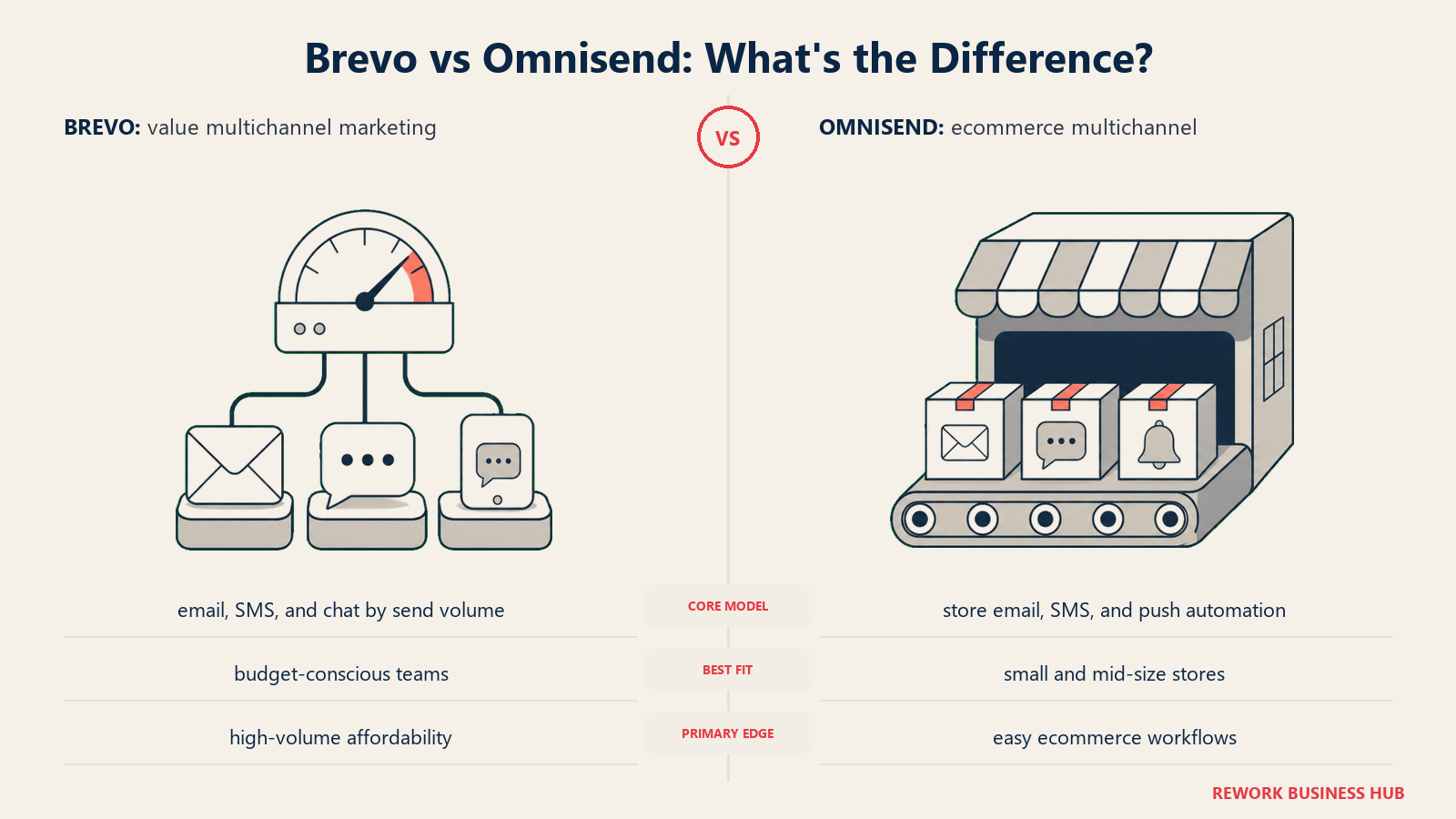
SMS pricing is usage-based at roughly $0.013 per US message, which is competitive. The Standard plan adds automation, A/B testing, and send-time optimization starting at $18/month for 5,000 emails.
What Brevo gives up is ecommerce depth. The Shopify integration exists but the behavioral data model and segmentation isn't as granular as Klaviyo or Drip. If your flows are relatively standard (welcome, cart abandonment, post-purchase) and you're more cost-sensitive than automation-sensitive, Brevo is an excellent pick. A store with 50,000 contacts but moderate monthly volume pays far less than it would on Omnisend.
More detail on how Brevo stacks up against peers is in our Brevo alternatives guide.
| Pros | Cons |
|---|---|
| Contact-unlimited pricing on most plans | Ecommerce segmentation less deep than Klaviyo |
| Competitive SMS pricing | UI less polished than Omnisend or Klaviyo |
| Good transactional email included | Automation depth catches up at Standard only |
| Multi-channel: email, SMS, WhatsApp | Reporting less visual than top-tier tools |
Pricing: Free (300 emails/day); Starter from $9/mo; Standard from $18/mo (5K emails/month) Best for: High-volume senders with large contact lists who prioritize cost over deep ecommerce segmentation
4. ActiveCampaign: Best for Stores with Lifecycle CRM Needs
ActiveCampaign sits at the intersection of email marketing and CRM, which makes it slightly awkward as a pure ecommerce recommendation but genuinely excellent for stores that blend B2C and B2B, sell subscription products, or need detailed customer lifecycle tracking beyond what an ESP typically offers.
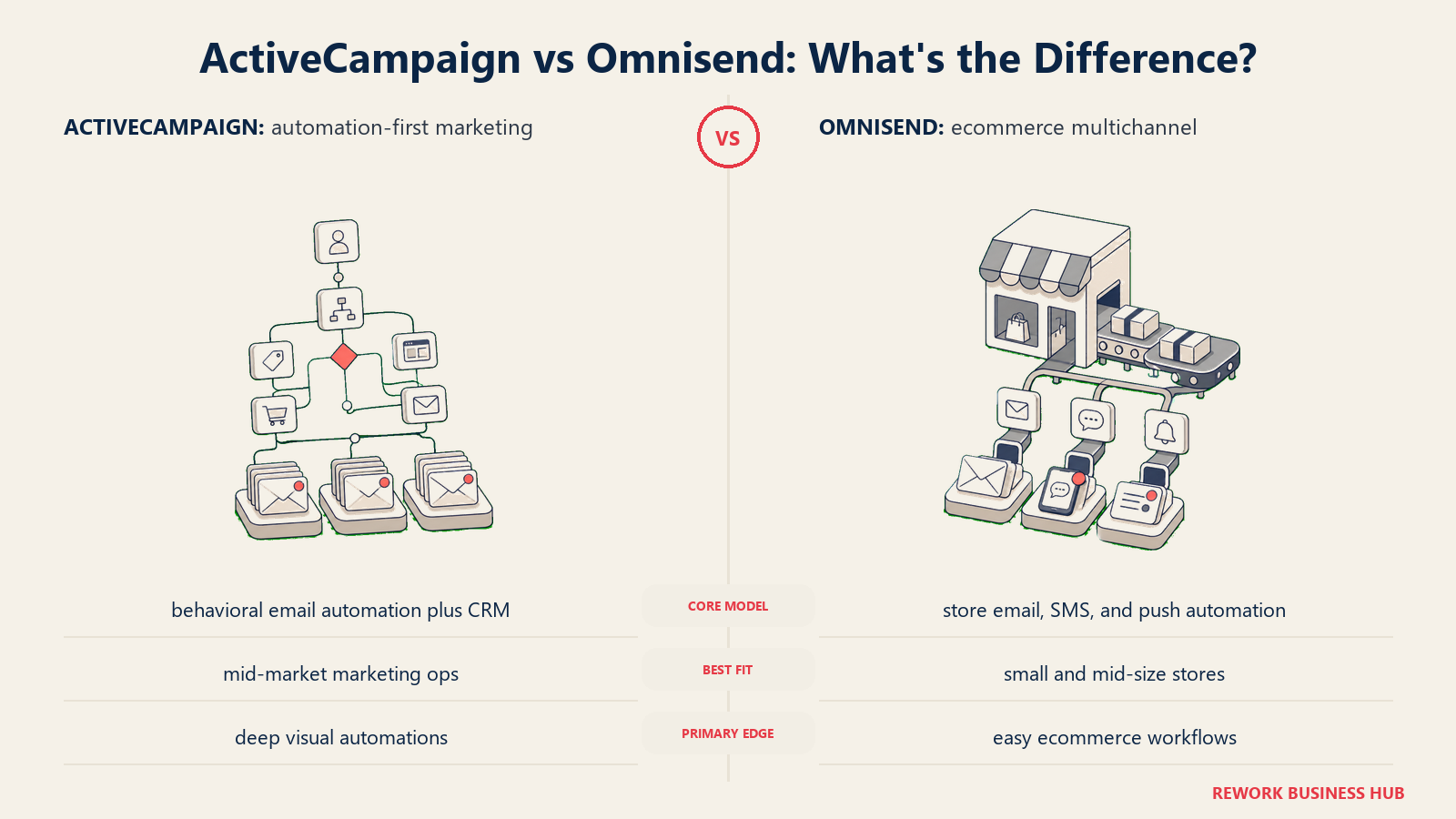
The automation builder is the best in class for complexity: conditional branches, probabilistic send time, lead scoring, and cross-channel triggers that few platforms match. Shopify, WooCommerce, and BigCommerce integrations are all solid on the Plus plan ($49/month annual).
The Starter plan at $15/month is limited. You want Plus for serious ecommerce automation. At 10,000 contacts, Plus runs around $150/month, which is Klaviyo territory. The trade-off is that ActiveCampaign gives you a built-in CRM and deals pipeline that Klaviyo doesn't, making it more defensible for stores running outbound sales alongside email marketing.
For brands comparing ActiveCampaign against its own alternatives, see our ActiveCampaign alternatives guide.
| Pros | Cons |
|---|---|
| Most powerful automation builder in this list | SMS features limited compared to Omnisend/Klaviyo |
| Built-in CRM suits hybrid B2B/B2C stores | Plus plan required for real ecommerce depth |
| Predictive sending and conditional content | Steeper learning curve than most on this list |
| Deep segmentation with lead scoring | Can feel like overkill for pure product stores |
Pricing: Starter $15/mo; Plus $49/mo for 1K contacts; Enterprise from $145/mo (annual) Best for: Subscription commerce, hybrid B2B/B2C brands, or stores wanting lifecycle CRM plus email
5. GetResponse: Best All-in-One for Stores Wanting Funnels
GetResponse has evolved from a straightforward email tool into a full marketing platform that includes landing pages, webinars, conversion funnels, and paid ad integration. For ecommerce stores that run frequent promotions and want one tool handling email, landing pages, and funnel tracking, it covers more ground than Omnisend.
The Creator plan at $58/month adds abandoned cart recovery, product recommendation engines, and ecommerce segmentation. Email Marketing starts at $15/month (annual) but doesn't include ecommerce automation at that tier. Webinars and funnels are the real differentiator here: no other platform on this list bundles them without a separate subscription.
If your marketing motion involves product launches, webinars, or sales funnels, GetResponse is worth a serious look. If you need deep behavioral segmentation on par with Klaviyo, it's not there yet. See our GetResponse alternatives guide for a full peer comparison.
| Pros | Cons |
|---|---|
| Webinars, funnels, and landing pages bundled | Ecommerce segmentation less granular than Klaviyo |
| Competitive entry-level pricing | Automation builder slightly less flexible than AC |
| Solid Shopify and WooCommerce integration | Ecommerce automation requires Creator plan ($58/mo) |
| SMS marketing available | Feature breadth can feel overwhelming for small teams |
Pricing: Email Marketing from $15/mo; Marketer $51/mo; Creator $58/mo (annual, 1K contacts) Best for: Stores that want email, landing pages, webinars, and funnels under one subscription
6. Drip: Best Pure Ecommerce Platform for Shopify and WooCommerce
Drip is built entirely for ecommerce and doesn't pretend otherwise. It's a customer data platform and email/SMS tool with visual workflow automation, revenue attribution, and behavioral segmentation that rivals Klaviyo. Every feature is available from day one, no tiering, which is a meaningful contrast to tools that gate automation behind higher plans.
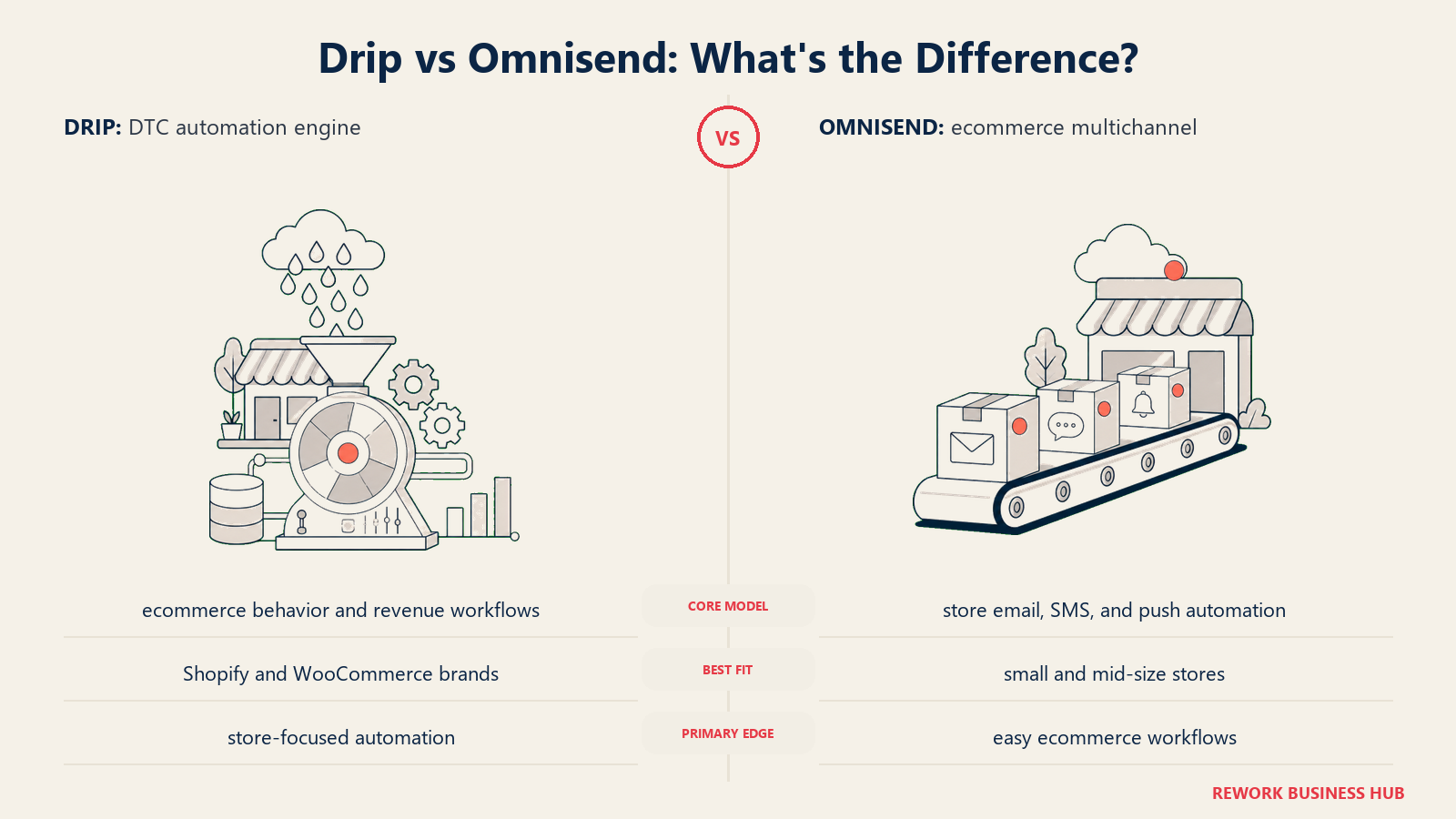
Pricing starts at $39/month for 2,500 contacts, which is more expensive than Omnisend at that tier. But the full feature parity from $1 and the clean revenue attribution per workflow makes it worth it for stores generating $1M or more. At 10,000 contacts, Drip runs $154/month; at 25,000, $369/month.
Drip doesn't have a free plan. That's a genuine barrier for early-stage stores. But for a $2M-$10M DTC brand that has hit the limits of Omnisend's automation and wants to see exactly which flows are generating revenue, Drip is a top-three option alongside Klaviyo.
| Pros | Cons |
|---|---|
| All features unlocked at every price tier | No free plan; $39/mo minimum |
| Visual workflow builder with revenue attribution | Smaller template library than Klaviyo or Mailchimp |
| Deep Shopify, WooCommerce, BigCommerce data model | Less name recognition (harder agency sourcing) |
| Simple flat pricing, no feature gating | SMS features less mature than Klaviyo |
Pricing: $39/mo for 2,500 contacts; $154/mo for 10K; $369/mo for 25K Best for: Mid-size DTC brands on Shopify or WooCommerce who want full feature access without plan upgrades
7. MailerLite: Best Budget Option for Small Stores
MailerLite competes on price and simplicity. The free plan covers 250 subscribers and 2,500 emails per month with automation included, a usable starting point for early-stage stores. Comfort starts at $12/month (500 subscribers, 5,000 emails), and Power starts at $25/month (500 subscribers, unlimited monthly email sends).
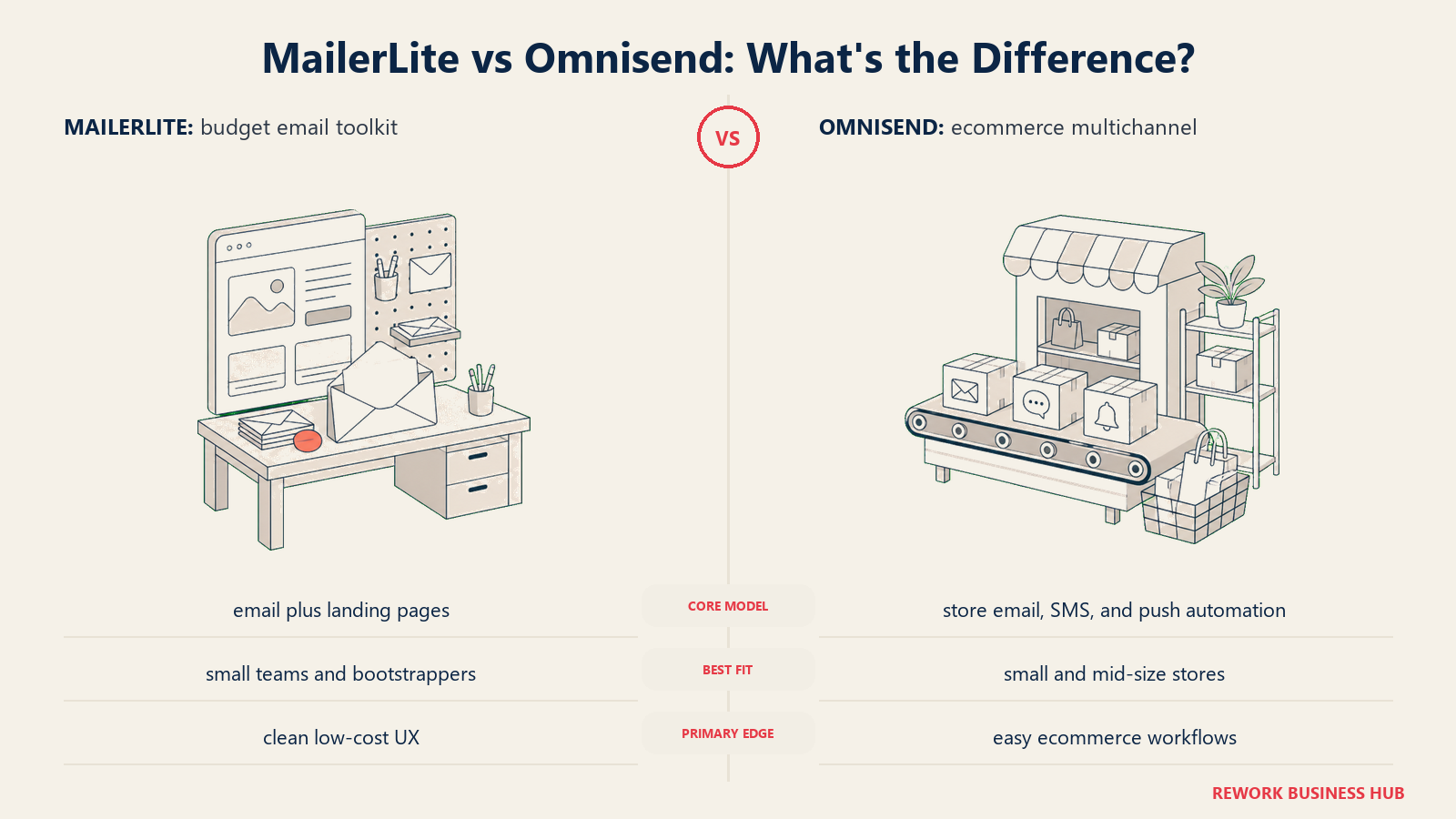
Ecommerce features are present: Shopify integration, product blocks in emails, automation triggers for purchases and abandoned carts. But the segmentation and behavioral data depth is limited compared to Klaviyo or Drip. MailerLite is optimized for stores that want clean emails fast, not for brands running 15-step behavioral journeys.
If you're pre-revenue or under $100K, MailerLite is one of the best value email tools available. Once your list exceeds 10,000 subscribers and you want real revenue attribution, you'll likely need to migrate.
| Pros | Cons |
|---|---|
| Free plan covers 250 subs, automation included | Ecommerce segmentation is basic |
| Clean drag-and-drop editor | No built-in SMS (third-party required) |
| Unlimited sends on the Power plan | Limited behavioral trigger depth |
| Very affordable at all list sizes | Reporting less detailed than Klaviyo |
Pricing: Free up to 250 subscribers; Comfort from $12/mo (500 subscribers); Power from $25/mo (500 subscribers, unlimited emails). See mailerlite.com/pricing. Best for: Bootstrapped stores under $500K revenue who prioritize cost and simplicity
8. Sendlane: Best Unified Platform for Mid-Size Ecommerce
Sendlane takes a unified platform approach: email, SMS, reviews, and forms under one account, one data layer, and one support team. It's designed for stores that are frustrated by stitching together separate tools for each channel.
Pricing shifted in 2026 to a flat model: $100/month for unlimited profiles, with additional charges based on email volume and SMS credits at $0.009 per message. That's a high floor for small stores but competitive for merchants with 25,000+ contacts who would otherwise pay $300-500/month on Klaviyo or Drip.
The advanced segmentation is genuinely strong: behavioral triggers, multi-channel attribution, and predictive analytics are all present. Support quality is a consistent differentiator in user reviews.
| Pros | Cons |
|---|---|
| Unified email, SMS, reviews in one platform | $100/mo floor makes it expensive for small stores |
| Advanced segmentation and behavioral triggers | Smaller market share means fewer agency resources |
| Single data layer across all channels | Email overage charges add up at high volume |
| Dedicated support on all tiers | Less third-party integration breadth than Klaviyo |
Pricing: $100/mo base (unlimited profiles); email volume and SMS usage billed separately Best for: Stores with 15,000+ contacts that want email, SMS, and reviews consolidated at a flat rate
9. Constant Contact: Best for Non-Technical Teams
Constant Contact is the right answer when the person managing email is not a dedicated marketer. The platform is designed for usability above all else, and the support (phone and chat) is legitimately good. It also has event management tools that no other platform on this list bundles natively.
The pricing model scales aggressively: from $12/month for 500 contacts on Lite to $50/month for 1,000 contacts, a 317% jump. At 5,000 contacts, Standard runs over $100/month. That aggressive scaling is the main reason ecommerce brands look elsewhere once their lists grow.
Ecommerce automation is limited to Standard and Premium. The Standard plan at $35/month for 500 contacts gives you three pre-built automation workflows and basic segmentation. For stores with low-complexity marketing run by a non-specialist, Constant Contact is genuinely well-suited. For growth-stage DTC brands, the cost-to-capability ratio breaks down quickly.
For a full peer review of Constant Contact's strengths, see our Constant Contact alternatives guide.
| Pros | Cons |
|---|---|
| Excellent phone and live chat support | Aggressive price scaling past 1,000 contacts |
| Event management tools built in | Limited ecommerce automation depth |
| Very easy UI for non-technical teams | No free plan (60-day trial only) |
| Strong template library | SMS not included; requires add-on |
Pricing: Lite $12/mo; Standard $35/mo; Premium $80/mo (all at 500 contacts, annual) Best for: Brick-and-mortar retailers with an online presence, non-tech teams, event-driven brands
10. Moosend: Best Budget-to-Scale Option
Moosend offers one of the most compelling value propositions on this list: unlimited email sends at every tier, ecommerce automation (cart abandonment, product recommendations, purchase triggers) on all paid plans, and pricing that starts at $7/month annual ($9 monthly) for 500 contacts. At 5,000 contacts, you're paying $38-48/month, which undercuts almost every comparable platform.
Native integrations include Shopify, WooCommerce, BigCommerce, and Magento. The automation builder includes 32 triggers, 18 pre-built recipes, and an AI writer for copy and subject lines.
Moosend was acquired by Constant Contact from Sitecore in June 2025. As of mid-2026, both platforms still operate independently with no announced pricing or feature merges. That corporate transition is worth monitoring, but Moosend currently remains an independent value proposition.
| Pros | Cons |
|---|---|
| Unlimited sends on all paid plans | Corporate ownership transition (post-Sitecore/CC) |
| Strong automation for the price | Smaller native integration library vs Klaviyo |
| AI writer and 130+ templates included | Reporting less sophisticated at enterprise scale |
| Competitive at every list size | Brand awareness lower than Klaviyo/Mailchimp |
Pricing: $7/mo annual ($9/mo monthly) for 500 contacts; $38/mo annual for 5K contacts Best for: Budget-conscious growing stores that want unlimited sends and automation without the Klaviyo price tag
11. Postscript: Best SMS-First Tool for Shopify Brands
Postscript is not an Omnisend equivalent. It's a Shopify-native SMS platform that does one thing exceptionally well: text marketing for ecommerce. If your complaint with Omnisend is specifically around SMS credit costs, limited SMS segmentation, or SMS automation depth, Postscript solves all three without compromises.
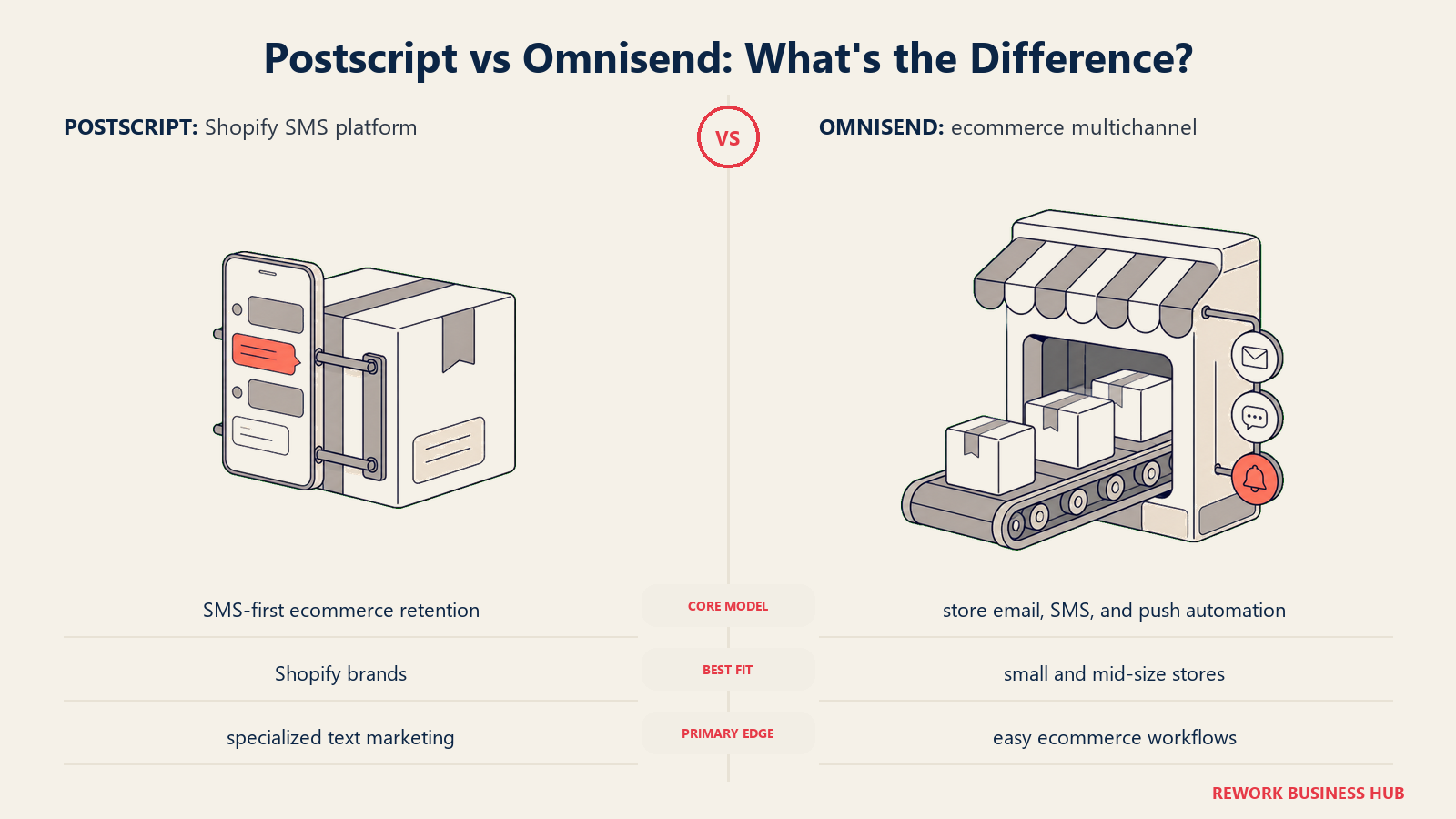
Email is not Postscript's primary focus. It offers email as a secondary channel, but you'd typically pair Postscript with a dedicated email tool (Klaviyo or Drip) rather than replacing your full stack with it.
Pricing is usage-based and contact-driven, with plans running from roughly $100/month for smaller Shopify stores through to enterprise contract pricing. Shopify is a hard requirement: Postscript doesn't support WooCommerce or other platforms at the same depth.
| Pros | Cons |
|---|---|
| Best-in-class Shopify SMS segmentation | Email is a secondary feature |
| Native Shopify data model for SMS flows | Shopify-only at meaningful depth |
| Two-way conversational SMS support | Needs a paired email tool for full stack |
| Strong compliance tools | Usage-based pricing can be hard to forecast |
Pricing: Usage-based; plans from ~$100/mo (contact Postscript for current rates) Best for: Shopify stores with SMS as a primary revenue channel who want dedicated SMS tooling
12. Mailjet: Best for Technical Teams Needing API-First Email
Mailjet is an API-first email platform built for transactional and marketing email, with a pricing model based on monthly email volume. For ecommerce brands with development resources who want programmatic email control alongside marketing campaigns, Mailjet offers more flexibility than Omnisend without the Klaviyo complexity.
The free plan covers 6,000 emails per month (200/day limit). The Essential plan starts at $17/month for 15,000 emails, and Premium at $27/month adds automation, A/B testing, and segmentation.
Mailjet's ecommerce integrations are solid but lighter than Klaviyo or Drip. It's best suited for stores where a developer is actively involved in marketing email, not for marketing teams who want visual drag-and-drop flows with behavioral commerce data.
| Pros | Cons |
|---|---|
| Strong API and developer tooling | Less ecommerce-native than Klaviyo or Drip |
| Volume-based pricing (not contact-based) | Marketing automation less visual/powerful |
| Good transactional and marketing email in one | Smaller template library |
| Generous free tier (6K/month) | SMS not a core feature |
Pricing: Free (6K/month); Essential from $17/mo for 15K emails; Premium from $27/mo Best for: Technical teams needing programmatic email control plus basic marketing campaigns
Stage Fit Matrix
| Store Stage | Revenue Range | Recommended Tools | Avoid |
|---|---|---|---|
| Pre-launch / Early | Under $100K | MailerLite, Moosend, Brevo (free tiers) | Sendlane, Postscript (high floor) |
| Growing | $100K-$1M | Omnisend, Klaviyo (entry), Drip, GetResponse | Enterprise-only tools |
| Mid-market | $1M-$10M | Klaviyo, Drip, Sendlane, ActiveCampaign | MailerLite (limited depth) |
| Scaling DTC | $10M-$50M | Klaviyo, Drip, Sendlane | Mailchimp, Constant Contact |
| Enterprise | $50M+ | Klaviyo Enterprise, Salesforce Marketing Cloud, custom | Most SMB tools |
Sizing and Persona Table
| List Size | Buyer Persona | Top Picks | Why |
|---|---|---|---|
| Under 1,000 | Founder, solo operator | MailerLite, Moosend, Brevo | Low cost, full automation |
| 1,000-10,000 | Ecommerce marketer or founder | Klaviyo, Drip, Omnisend | Ecommerce depth at manageable price |
| 10,000-50,000 | Head of growth, email manager | Klaviyo, Drip, Sendlane | Revenue attribution, segmentation |
| 50,000+ | Marketing director, DTC ops | Klaviyo Enterprise, Sendlane, Brevo | Scale pricing, dedicated support |
| Large list, low send frequency | Any | Brevo, Moosend | Volume-based pricing saves budget |
| SMS-primary, Shopify | DTC operator | Postscript (plus paired email tool) | Best SMS segmentation for Shopify |
How to Choose: Decision Framework
| If you need... | Pick... |
|---|---|
| The deepest ecommerce data model and revenue attribution | Klaviyo |
| The lowest price for a large contact list with moderate sends | Brevo or Moosend |
| Email, SMS, and reviews unified in one account | Sendlane |
| An all-in-one with webinars, funnels, and landing pages | GetResponse |
| The best SMS segmentation specifically on Shopify | Postscript |
| A powerful automation builder that also handles B2B/CRM | ActiveCampaign |
| The most user-friendly tool for a non-technical team | Constant Contact or MailerLite |
| Full feature access from day one, no plan gating | Drip |
What to Do Next
Start by mapping your current pain with Omnisend to the specific gap you're trying to close. If it's pricing, Brevo and Moosend solve that without sacrificing automation basics. If it's segmentation and revenue attribution, Klaviyo or Drip are the right moves. If you want SMS and email truly unified under one data layer, Sendlane is worth a serious eval. And if the problem is really that your team isn't technical enough to get value from any of these, Constant Contact's support model is hard to beat.
Most of these platforms offer a free plan or trial. Klaviyo, MailerLite, Moosend, and Brevo all let you start without a credit card. Drip and Sendlane offer 14-day free trials. Running a short pilot with your actual flow templates (welcome series, cart abandonment, post-purchase) is the fastest way to confirm fit before migrating your full list.
If you're evaluating specific platforms in more depth, our related guides cover Klaviyo alternatives, Mailchimp alternatives, ActiveCampaign alternatives, and Brevo alternatives.

Principal Product Marketing Strategist
On this page
- Quick Comparison Table
- 1. Klaviyo: The Strongest Ecommerce Alternative
- 2. Mailchimp: The Familiar Name with Hidden Costs
- 3. Brevo: Best for Large Lists on a Budget
- 4. ActiveCampaign: Best for Stores with Lifecycle CRM Needs
- 5. GetResponse: Best All-in-One for Stores Wanting Funnels
- 6. Drip: Best Pure Ecommerce Platform for Shopify and WooCommerce
- 7. MailerLite: Best Budget Option for Small Stores
- 8. Sendlane: Best Unified Platform for Mid-Size Ecommerce
- 9. Constant Contact: Best for Non-Technical Teams
- 10. Moosend: Best Budget-to-Scale Option
- 11. Postscript: Best SMS-First Tool for Shopify Brands
- 12. Mailjet: Best for Technical Teams Needing API-First Email
- Stage Fit Matrix
- Sizing and Persona Table
- How to Choose: Decision Framework
- What to Do Next