Best Customer.io Alternatives in 2026: 12 Tools for Behavioral Messaging and Lifecycle Marketing
Turn this article into takeaways for your work.


Each assistant summarizes the article only for you and suggests best practices for your work.
Customer.io is one of the best-built behavioral messaging platforms in the market. If you run a SaaS product, you already know what makes it compelling: real-time event triggers wired to your product data, a visual workflow builder that handles genuinely complex branching logic, and multi-channel reach across email, push, SMS, and in-app without stitching together separate tools. The profile-based data model gives technical marketers precise control over who gets what message and exactly when. For product-led teams at B2B and B2C SaaS companies, it's hard to fault the core experience.
But teams leave Customer.io for predictable reasons. Profile-based pricing climbs steeply as your active user count grows, sometimes doubling costs between funding rounds. Setup requires engineering involvement, which creates a bottleneck for smaller teams without a dedicated marketing engineer. Some teams want a simpler visual journey builder without writing event schemas. Others have outgrown a pure messaging platform and need a CRM, lead routing, or sales handoff layer built in. And a few are moving in the opposite direction, up to enterprise lifecycle suites like Braze or Iterable that handle millions of monthly active users with enterprise SLAs. If any of those describe your situation, this guide covers 13 honest alternatives with current 2026 pricing, target ICP, and a straight answer on fit.
Quick Comparison Table
| Tool | Best For | Starting Price | Key Strength | Key Limitation |
|---|---|---|---|---|
| Braze | Enterprise consumer/mobile lifecycle engagement at scale | Custom, from ~$50K/yr | Real-time omnichannel: push, email, SMS, in-app, WhatsApp | Enterprise-only pricing; not suitable for teams under 200 employees |
| Iterable | Growth-stage and enterprise SaaS and consumer brands | Custom, from ~$36K/yr | Cross-channel journey orchestration with strong data integrations | Custom pricing only; requires sales process to evaluate |
| Klaviyo | Ecommerce brands running email and SMS revenue campaigns | Free for 250 profiles; $20/mo for 500 | Deep Shopify/WooCommerce native data model and revenue attribution | Built for ecommerce; weak fit for SaaS lifecycle or B2B demand gen |
| Brevo | High-volume senders wanting per-send pricing | Free; $9/mo Starter | Contact-unlimited pricing model; email + SMS + WhatsApp | Automation depth and behavioral trigger sophistication below Customer.io |
| ActiveCampaign | Mid-market teams wanting deep email automation with CRM | $15/mo Starter (1K contacts, annual) | Best visual automation builder in the mid-market price range | CRM is secondary, not co-equal; SMS limited on entry plans |
| HubSpot | Inbound-led teams wanting full marketing and sales suite | Free CRM; Marketing Hub Starter from $15/seat/mo | End-to-end: landing pages, email, CRM, attribution, and sales handoff | Professional tier requires $3,000 onboarding; costs scale steeply |
| OneSignal | Teams wanting push and in-app notifications plus email | Free for 10K subs; Growth from $19/mo + usage | Generous free tier; developer-friendly multi-channel API | Email and SMS are secondary to push; not a full lifecycle platform |
| MoEngage | Mid-market consumer brands wanting AI-driven engagement | From $999/mo for 10K MAUs | AI-powered send-time and channel optimization; strong mobile push | High floor price; overkill for teams under 50K MAUs |
| Loops | SaaS teams wanting clean product and marketing email unified | Free for 1K contacts; $49/mo Starter | Purpose-built for SaaS email: onboarding, activation, transactional | No push or SMS; narrower than Customer.io for multi-channel |
| Encharge | SaaS and digital product teams wanting behavioral flows + CRM integrations | $79/mo Growth (2K contacts, annual) | Deep HubSpot, Salesforce, Stripe, Segment integrations; unlimited users | Smaller platform; fewer native mobile channels than Customer.io |
| Mailchimp | Small teams wanting simple email with broad ecosystem support | Free for 250 contacts; $13/mo Essentials | Easiest onboarding; 300+ integrations; large agency network | Behavioral trigger depth well below Customer.io; not built for SaaS lifecycle |
| Marketo | Enterprise B2B demand gen teams needing ABM and lead scoring | Custom, from ~$1,500/mo | Sophisticated lead scoring, multi-stage nurture, ABM orchestration | Not a behavioral product messaging platform; built for demand gen, not SaaS lifecycle |
1. Braze: Enterprise Omnichannel Lifecycle Engagement
Braze is what you move to when Customer.io works but you've scaled past what it handles comfortably. It's built for consumer-facing companies and mobile-first SaaS brands running lifecycle messaging at millions of monthly active users, where the engineering investment in a proper CDP is already in place and the team has dedicated lifecycle marketers managing the platform.
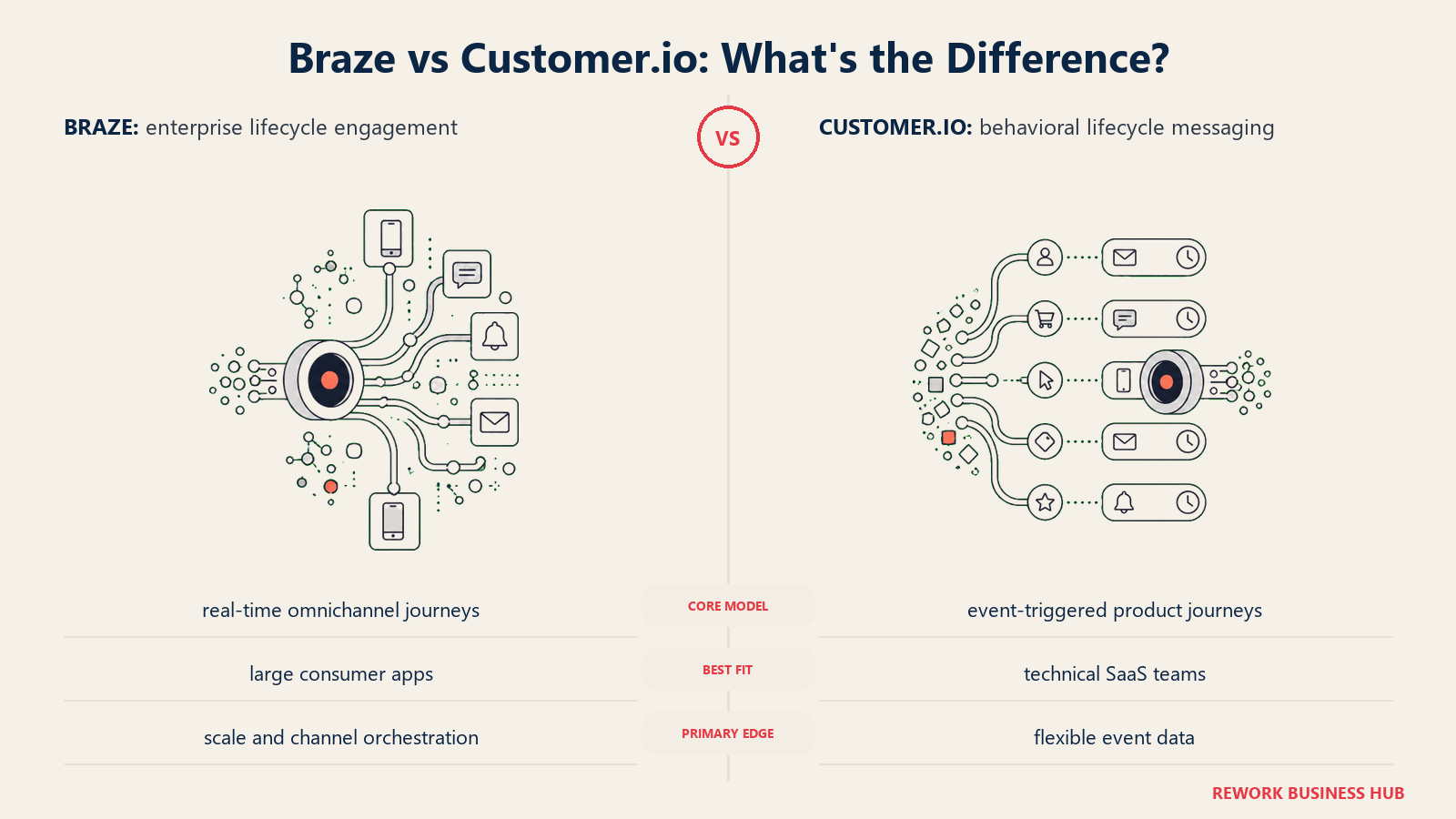
The Canvas visual workflow builder is among the best in the market: multi-branch branching, experiment groups, connected content personalization, predictive churn and action scores, and real-time triggering across push, email, SMS, in-app messages, WhatsApp, and Content Cards. All of it fires off live behavioral events from your product with sub-second latency on enterprise infrastructure.
What separates Braze from Customer.io operationally is scale and channel depth. Customer.io handles complexity well for teams in the 10K to 500K MAU range. Braze is designed for 500K to 100M+ MAUs with SLAs, dedicated infrastructure, and compliance capabilities that mid-market platforms don't need to offer.
Methodology / Vision: Real-time, customer-centric lifecycle engagement across every channel. Braze bets that effective messaging meets users at the moment of intent, not on a scheduled campaign cadence.
Target Audience: Consumer SaaS, mobile app companies, fintech, media, and B2C subscription businesses. Requires 200+ employees and dedicated lifecycle marketing teams to get full value.
Sizing Fit: Mid-market minimum. Most annual contracts start around $50,000 and scale to $500,000+ based on MAUs and channels enabled.
Stage Fit: Growth through enterprise. Requires mature event tracking infrastructure and a CDP or data warehouse integration to deliver full value from day one.
Team vs. Company-Wide: Lifecycle marketing and growth engineering teams. Not a cross-functional company-wide platform.
| What you get | What you don't |
|---|---|
| Real-time omnichannel triggers: push, email, SMS, in-app, WhatsApp | Accessible self-serve pricing for teams under 200 employees |
| Canvas visual builder with multi-branch experiment support | B2B lead scoring or sales pipeline routing |
| Predictive churn and action scores with AI personalization | Simple plug-and-play setup (requires engineering) |
| Enterprise SLAs, dedicated infrastructure, global data residency | A CRM or sales handoff layer for B2B demand gen |
Pricing: Custom only. Annual contracts typically start around $50,000 and scale to $5M+ for large enterprise deployments. Contact braze.com for a quote.
Best for: Consumer-facing and mobile-first companies running omnichannel lifecycle messaging at 500K+ MAUs where Customer.io's ceiling has become visible.
2. Iterable: Cross-Channel Journey Orchestration for Growth and Enterprise SaaS
Iterable sits between Customer.io and Braze on the maturity curve. It's designed for growth-stage and enterprise SaaS and consumer brands that need sophisticated cross-channel journey orchestration without jumping to Braze's enterprise contract minimums or starting from scratch on infrastructure design.
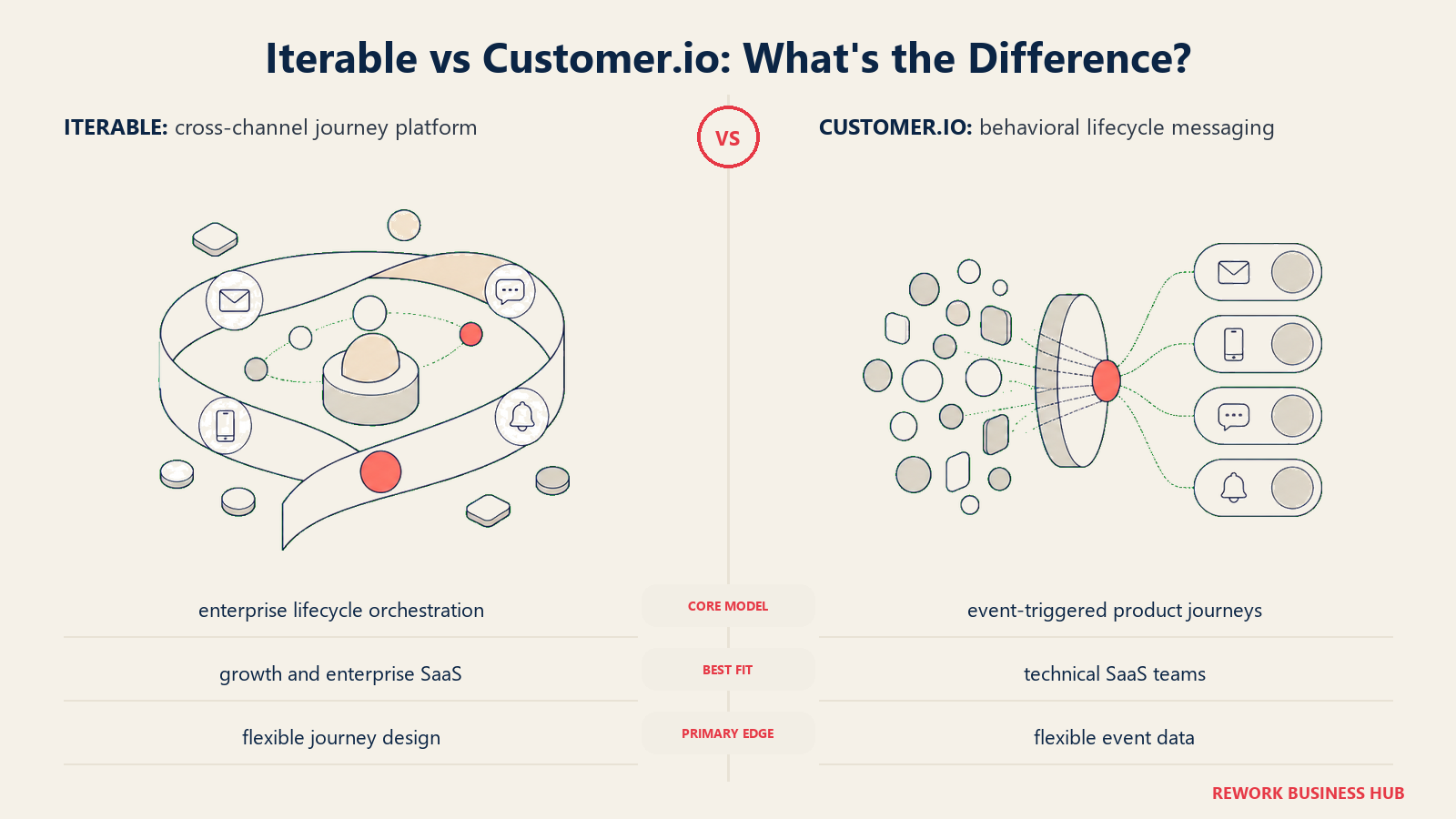
The platform's journey orchestration is its differentiator. Iterable's Studio lets marketing teams design multi-channel sequences with experiment branches, holdout groups, and personalization powered by user attributes and event data from Segment, Snowflake, or direct API. Email, push, SMS, in-app, and web push are all first-class channels, not add-ons. And unlike Customer.io, Iterable's data model is built to handle both B2C engagement patterns (high-volume, real-time) and B2B SaaS lifecycle journeys (lower volume, event-driven, longer duration) in the same workspace.
Teams typically move to Iterable from Customer.io when they need better experimentation infrastructure, stronger data connector depth (especially Snowflake or Redshift reverse ETL), or more enterprise governance over team access and template management.
Methodology / Vision: Cross-channel orchestration built for data-driven growth teams. Iterable's bet is that great lifecycle marketing requires flexible journey design, rigorous experimentation, and a clean integration layer to wherever your data lives.
Target Audience: Growth-stage through enterprise SaaS and consumer brands, typically 50 to 2,000 employees, with a dedicated lifecycle or marketing ops team and established event tracking.
Sizing Fit: Growth through enterprise. The Growth tier works from roughly $36,000/year for smaller teams; mid-market contracts run $72,000 to $180,000 annually.
Stage Fit: Growth through mature. Best adopted once a team has outgrown Customer.io's experimentation depth or needs stronger data warehouse connectivity.
Team vs. Company-Wide: Lifecycle marketing and growth teams. Not a full GTM platform.
| What you get | What you don't |
|---|---|
| First-class cross-channel orchestration: email, push, SMS, in-app, web push | Transparent self-serve pricing (requires sales process) |
| Journey Studio with holdout groups and experiment branches | Simple setup for teams without dedicated marketing engineers |
| Deep integrations with Segment, Snowflake, Redshift, and CDP platforms | A CRM or lead routing layer for B2B sales handoff |
| Enterprise governance: template management, team permissions, audit logs | Entry-level pricing accessible for startups under 25 employees |
Pricing: Custom. Growth tier buyers with 10K to 50K MAUs often pay $3,000 to $6,000 per month. Mid-market runs $72,000 to $180,000 annually. Enterprise starts at $200,000+. Contact iterable.com directly.
Best for: SaaS and consumer brands that have outgrown Customer.io's experimentation depth or need stronger data warehouse connectivity in their lifecycle stack.
3. Klaviyo: Ecommerce Email and SMS with Real Revenue Attribution
Klaviyo is on this list because ecommerce teams sometimes land on Customer.io looking for behavioral email, then discover it's not purpose-built for their use case. Customer.io is designed around SaaS product event data. Klaviyo is designed around ecommerce transaction data: order history, product views, cart abandonment, repurchase prediction, and lifetime value scoring. If you sell through Shopify, WooCommerce, or BigCommerce, Klaviyo's native integrations pull that data directly into your segments and automation triggers.

Revenue attribution per flow is built in and accurate. You can see exactly how much your abandoned cart sequence generated last month, down to the individual order. That's not something Customer.io is designed to give you, because it's optimized for product event data, not ecommerce transaction data.
For B2B SaaS teams, Klaviyo isn't the right switch. But for DTC and ecommerce brands running what felt like behavioral email on Customer.io, Klaviyo is the purpose-built replacement. If you're comparing Klaviyo to its own category, our Klaviyo alternatives guide covers the peer comparison.
Methodology / Vision: Revenue-first email and SMS for ecommerce. Every send should be tied to measurable revenue, not open rates.
Target Audience: DTC brands, Shopify and WooCommerce merchants, ecommerce retailers from boutique to mid-market. Not the right fit for B2B SaaS lifecycle teams.
Sizing Fit: Works at any ecommerce team size. Pricing scales with active profiles but remains accessible from early stage.
Stage Fit: Startup through enterprise, specifically for ecommerce. Strong once a brand has enough transaction history for segmentation to produce meaningful groups.
Team vs. Company-Wide: Marketing team tool for ecommerce operators. Not a cross-functional GTM platform.
| What you get | What you don't |
|---|---|
| Native Shopify/WooCommerce integration with revenue attribution | SaaS product event data model (Segment, SDK integration) |
| Abandoned cart, win-back, and post-purchase flows out of the box | B2B lead scoring or sales pipeline integration |
| Email plus SMS in one platform with shared audience data | Push notifications or in-app messages |
| Predictive LTV and purchase-date segmentation | Affordable pricing above 50K active profiles |
Pricing: Free for 250 active profiles. Email plan from $20/mo for 500 profiles; $130/mo for 10K profiles. Email plus SMS from $35/mo. See klaviyo.com/pricing.
Best for: Ecommerce and DTC brands that need email and SMS revenue automation tied to purchase data, not a SaaS product event model.
4. Brevo: High-Volume Sending Without Per-Profile Cost Pain
Brevo's core proposition is pricing model arbitrage. While Customer.io charges based on the number of profiles stored, Brevo charges based on email volume sent, not contacts stored. A team with 200,000 contacts who sends campaigns to 40,000 of them monthly pays for 40,000 sends, not for all 200,000 profiles. That structural difference is the main reason teams switch from Customer.io to Brevo when their database has grown faster than their active engagement rates.
The honest trade-off is automation depth. Brevo's workflow builder is functional but not sophisticated by Customer.io standards. Real-time product event triggers, complex branching based on in-app behavior, and fine-grained segmentation against event properties aren't what Brevo is built for. It covers the essentials well: welcome sequences, drip campaigns, contact segment-based triggers, and transactional email. SMS, WhatsApp, and push are all available. But if the reason you chose Customer.io was the behavioral event architecture, Brevo won't replicate that. For more on where Brevo fits against its own alternatives, see our Brevo alternatives guide.
Methodology / Vision: Affordable multi-channel marketing for growing teams. Per-send pricing removes the contact-database penalty that pushes teams off profile-based tools.
Target Audience: SMBs and mid-market teams from 5 to 500 employees. Especially useful for teams with large contact databases and moderate send frequency.
Sizing Fit: Startup through growth. Strongest value when per-profile pricing at Customer.io or Klaviyo creates a prohibitive cost as the database outpaces active engagement.
Stage Fit: Startup through growth. Works long-term for teams with relatively simple automation needs and high contact-to-send ratios.
Team vs. Company-Wide: Marketing-focused. The built-in CRM can support a small sales team but isn't competitive with dedicated lead routing tools.
| What you get | What you don't |
|---|---|
| Per-send pricing (not per-profile or per-contact) | Real-time product event triggers from a SDK or Segment |
| Email, SMS, WhatsApp, push, and live chat in one tool | Automation sophistication matching Customer.io's branching depth |
| Free tier with 300 emails/day for testing and iteration | In-app messaging channel |
| Transactional email included in paid plans | Deep segmentation against event property values |
Pricing: Free (300 emails/day). Starter from $9/mo for 5,000 sends. Standard from $18/mo. Business from $18/mo with automation. See brevo.com/pricing.
Best for: Teams with large contact databases and moderate send frequency who need email, SMS, and transactional messaging without profile-based pricing penalties.
5. ActiveCampaign: Best Visual Automation Builder in the Mid-Market
ActiveCampaign is the right move for teams that bought Customer.io primarily for its visual workflow builder and behavioral email automation, but found the engineering dependency and event schema management too heavy. ActiveCampaign's automation builder is the strongest in its price tier: conditional branches, goal tracking, split testing on sequences, and CRM-triggered actions that most tools reserve for $1,000+/month plans.
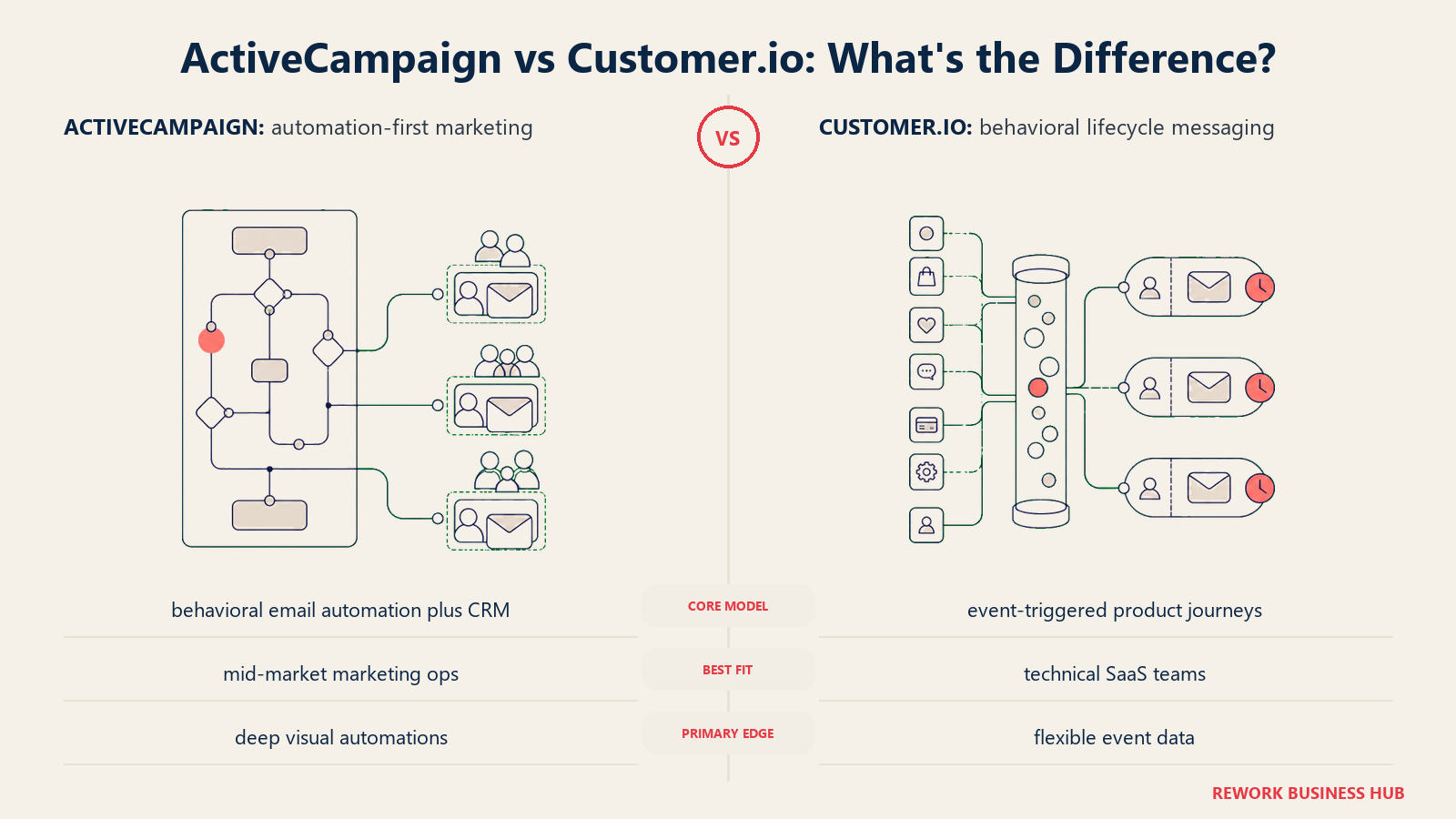
Where ActiveCampaign differs from Customer.io is the data model. Customer.io is designed around real-time product events from your application. ActiveCampaign is designed around contact behavior in email and web, augmented by a CRM. You can't wire it to your product event stream the same way, and in-app messaging isn't a native channel. But if you were using Customer.io primarily for sophisticated email workflows triggered by web behavior, form fills, and contact list states, ActiveCampaign replaces that functionality with a gentler setup curve.
The built-in CRM (Deals) is a meaningful add for B2B teams that also need a lightweight sales pipeline alongside their email automation. It's bolted on architecturally, not native, but functional for teams that don't need Salesforce depth. For a full peer view of ActiveCampaign against its category, see our ActiveCampaign alternatives guide.
Methodology / Vision: Behavior-driven automation for the mid-market. The bet is that personalized, event-triggered email shouldn't require an enterprise budget or a marketing engineer to configure.
Target Audience: Marketing teams from 5 to 500 employees, especially in SaaS, ecommerce, and professional services where the buying journey is email-heavy and segment-driven.
Sizing Fit: Works at startup scale. Strongest in the 10 to 200 employee range. Shows architecture limits above 500 as marketing-sales data sharing needs grow.
Stage Fit: Startup through mid-market. Strong when the team has defined email sequences but hasn't yet needed account-based programs or multi-channel attribution depth.
Team vs. Company-Wide: Primarily a marketing tool. The CRM serves sales as a secondary use case, not a co-equal architecture.
| What you get | What you don't |
|---|---|
| Best visual automation builder in the mid-market price range | Native real-time product event triggers (Segment, SDK) |
| Deep behavioral triggers from email, web, and form interactions | In-app or push notification channels |
| Built-in CRM and deals pipeline for B2B teams | Native two-way CRM-marketing data model at entry tiers |
| 900+ integrations including Salesforce, Shopify, and Stripe | Consistent support quality across all tiers per recent reviews |
Pricing: Starter from $15/mo (1,000 contacts, annual); Plus $49/mo; Pro $79/mo; Enterprise $145/mo. Monthly billing adds roughly 20%. See activecampaign.com/pricing.
Best for: Mid-market marketing teams that need sophisticated behavioral email automation without engineering dependency or Customer.io's profile-based pricing model.
6. HubSpot Marketing Hub: Full Inbound Suite with Native CRM
HubSpot is the natural landing spot for B2B SaaS teams leaving Customer.io who decide they actually need marketing automation tied to a CRM rather than a pure messaging platform. The product covers the full inbound stack: landing pages, forms, email marketing, nurture workflows, lead scoring, social publishing, and attribution reporting, all wired natively to the HubSpot CRM. Sales and marketing share one contact record without a sync to configure.
The honest cost accounting matters here. Marketing Hub Starter at $15/seat/month is accessible. But running real nurture campaigns and lead scoring requires Marketing Hub Professional at $890/month, plus a mandatory $3,000 onboarding fee. At 10,000 contacts, you add contact-tier pricing on top of the platform fee. A 50-person company using both Marketing Hub Pro and Sales Hub Pro can realistically land between $3,000 and $8,000 per month. That's not a cost reduction from Customer.io for active SaaS teams, it's a trade of one cost structure for another.
Methodology / Vision: The inbound flywheel. HubSpot's thesis is that marketing, sales, and service are one connected loop that compounds over time, with the CRM as the connective tissue.
Target Audience: Marketing-led B2B companies, typically 20 to 1,000 employees, with meaningful content, ads, or inbound programs that feed a sales pipeline.
Sizing Fit: Free tier works for small teams. Professional is the sweet spot for growth and mid-market. Enterprise competes on price with Marketo.
Stage Fit: Startup through mature. Works across all stages with different cost profiles at each.
Team vs. Company-Wide: Full GTM platform. Marketing, sales, and service each have dedicated hubs that share one CRM.
| What you get | What you don't |
|---|---|
| Full inbound suite: landing pages, forms, email, CRM, attribution | Transparent per-seat pricing as contacts and hubs scale |
| Native CRM with deal tracking, forecasting, and marketing attribution | Real-time product event triggers from a SDK (requires custom integration) |
| Large partner and integration ecosystem (1,500+ integrations) | In-app product messaging natively |
| Free CRM for small teams getting started | Simple lead routing at entry tiers without add-ons |
Pricing: Free CRM. Marketing Hub Starter from $15/seat/mo. Marketing Hub Professional at $890/mo (plus $3,000 mandatory onboarding). Enterprise from $3,600/mo. See hubspot.com/pricing/marketing.
Best for: B2B SaaS teams whose primary gap from Customer.io was the absence of a CRM and sales handoff layer, not more sophisticated behavioral messaging.
7. OneSignal: Developer-Friendly Push and In-App Notifications with Email
OneSignal is built around push notifications first, everything else second. If the reason you're leaving Customer.io is specifically that push and in-app notifications are not first-class channels there, OneSignal is worth a serious look. The platform has a generous free tier (up to 10,000 web push subscribers, unlimited push sends), a developer-friendly REST API that takes hours to integrate rather than days, and a dashboard that works for non-technical marketers once setup is done.
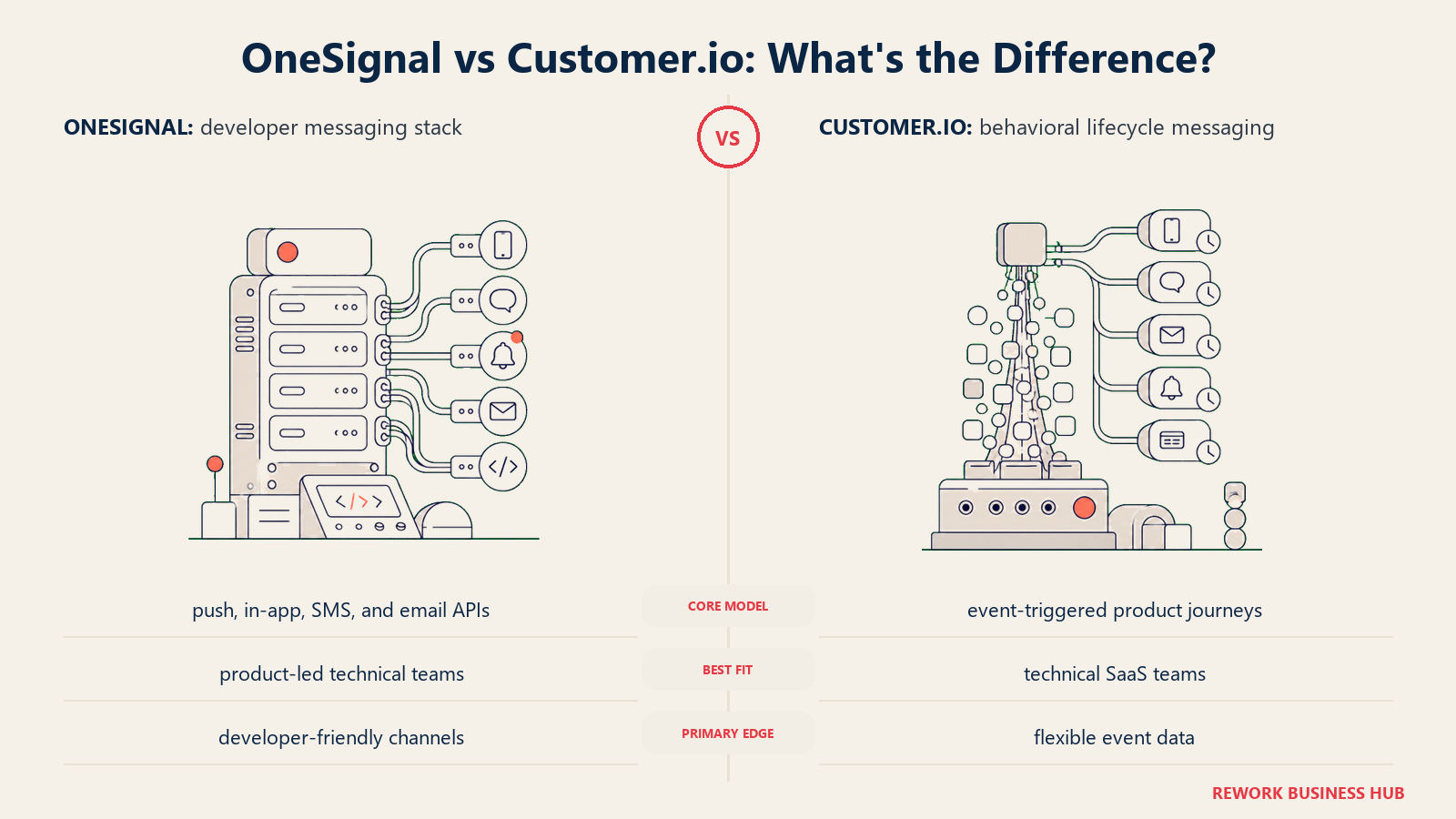
Email and SMS are available but feel secondary to the push core. OneSignal's email doesn't have the behavioral depth or journey complexity of Customer.io. But as a multi-channel notification layer for product teams that need push and in-app as primary channels with email supplementing, it's one of the most accessible tools at any budget.
The Growth plan at $19/month plus usage covers 20,000 free emails per month, web push, mobile push, and in-app messages. Usage charges apply beyond those thresholds. Professional and Enterprise tiers are annual contract only.
Methodology / Vision: Developer-first engagement across push, in-app, email, and SMS. OneSignal bets that the best engagement platform starts with a clean API, not a complex campaign builder.
Target Audience: Product teams and growth engineers at SaaS and mobile app companies, particularly those where push and in-app notifications are higher priority than complex email journeys.
Sizing Fit: Works from solo developers to large enterprise teams. The free tier is genuinely useful for early-stage products.
Stage Fit: Startup through enterprise. Best adopted when a team needs fast push and in-app integration without the engineering overhead of Customer.io's full event schema design.
Team vs. Company-Wide: Product and growth engineering primarily. Marketers can operate the dashboard once engineering sets up the integration.
| What you get | What you don't |
|---|---|
| Generous free tier: 10K push subscribers, unlimited sends | Email behavioral depth matching Customer.io's journey builder |
| Developer-friendly REST API with fast integration | A full lifecycle platform (push-first, not lifecycle-first) |
| Web push, mobile push, in-app, email, and SMS under one account | Advanced segmentation against product event properties |
| Usage-based pricing that stays accessible at small scale | Custom data integrations without engineering work |
Pricing: Free for 10,000 push subscribers. Growth from $19/mo plus usage ($0.012/MAU for mobile push; 20K emails free/mo then $2 per 1,000). Professional and Enterprise are annual contracts. See onesignal.com/pricing.
Best for: Product teams that need push and in-app notifications as primary channels with email as a supplement, especially at early to mid-stage where the free tier covers meaningful scale.
8. MoEngage: AI-Powered Engagement for Mid-Market Consumer Brands
MoEngage is an insights-led customer engagement platform that competes with Customer.io at the mid-market and with Braze at the enterprise. Its differentiator is AI: predictive send-time optimization, AI-powered segmentation ("Sherpa"), and channel affinity scoring that decides whether a given user should get an email, a push notification, or an SMS based on their historical engagement patterns.
The platform covers email, push, in-app, SMS, WhatsApp, and web push as co-equal channels, with a strong mobile SDK that makes it popular with consumer apps and fintech companies. For companies with meaningful mobile app engagement, MoEngage's mobile-first architecture outperforms Customer.io's mobile channel support.
The honest limitation is cost floor. MoEngage's Standard plan starts at $999/month for 10,000 MAUs. That's a meaningful jump from Customer.io's Essentials at $100/month for 5,000 profiles. For teams at the right scale (50,000+ MAUs), the AI layer and mobile depth can justify it. For smaller teams, it's difficult to justify unless the AI-driven send-time optimization is a specific gap you're trying to close.
Methodology / Vision: Insights-led engagement. MoEngage's thesis is that AI should decide the right message, channel, and time for each user, not the marketer's intuition.
Target Audience: Mid-market consumer brands, fintech, media, and consumer SaaS companies with 50 to 2,000 employees and a meaningful mobile app user base.
Sizing Fit: Mid-market minimum. The $999/month floor makes it inaccessible for teams under 10,000 MAUs. Sweet spot is 50,000 to 2,000,000 MAUs.
Stage Fit: Growth through enterprise. Best adopted by teams with established mobile apps and behavioral data infrastructure already in place.
Team vs. Company-Wide: Lifecycle marketing, mobile growth, and product teams. Not a full GTM or B2B demand gen platform.
| What you get | What you don't |
|---|---|
| AI-powered send-time optimization and channel affinity scoring | Entry-level pricing accessible to early-stage teams |
| Mobile-first architecture with strong push and in-app SDK | A CRM or B2B lead scoring layer |
| Email, SMS, WhatsApp, push, in-app as first-class channels | Self-serve simplicity (requires onboarding support) |
| Analytics dashboards and funnel analysis for engagement programs | Transparent pricing without a sales conversation |
Pricing: Standard from $999/mo for 10K MAUs. Growth from $4,999+/mo. Enterprise pricing custom. Contact moengage.com directly.
Best for: Mid-market consumer brands and fintech companies with 50,000+ MAUs that want AI-driven channel optimization and strong mobile push as primary channels.
9. Loops: SaaS-Specific Email for Product and Marketing Teams
Loops is built from the ground up for SaaS teams who find Customer.io too complex and Mailchimp too basic. The core premise is that a SaaS company sends three types of email: product email (onboarding, activation, account notifications), marketing email (newsletters, feature announcements, campaigns), and transactional email (receipts, password resets, billing). Loops handles all three from one platform, with one contact record, without stitching together three separate tools.
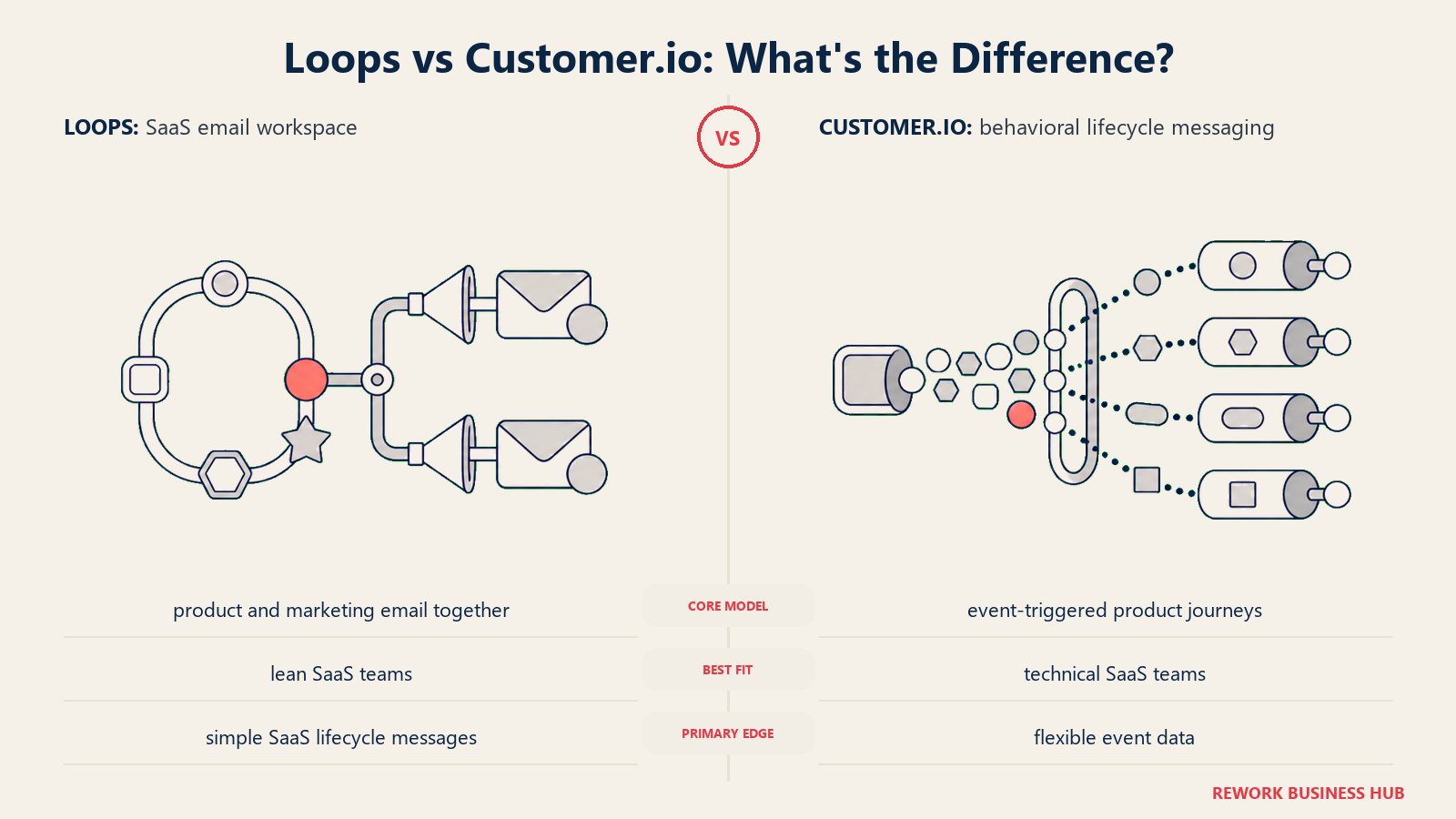
The setup is genuinely faster than Customer.io. There's no event schema to design upfront. You connect Loops to your product via a simple API or native integrations (Segment, Stripe, Vercel, Supabase), define your loops and events, and marketing teams can build journeys from a visual editor without engineering involvement on every change.
The honest limitation is channel breadth. Loops does email and email only, no push or SMS. That makes it the right switch from Customer.io for teams whose use of Customer.io was 95% email and whose primary frustration was complexity and engineering dependency, not channel count.
Methodology / Vision: One email platform for everything a SaaS company sends. The bet is that splitting product, marketing, and transactional email across different tools creates contact sync errors, inconsistent brand voice, and unnecessary engineering overhead.
Target Audience: SaaS teams from 1 to 500 employees where product and marketing both need to manage email from one place, and where a developer-light setup is a meaningful requirement.
Sizing Fit: Startup through mid-market. Works well for teams from seed stage through Series B. Above 500K subscribers, custom pricing applies.
Stage Fit: Startup through growth. Best adopted at the moment when a team recognizes they need more than Mailchimp but less than Customer.io's full event-driven complexity.
Team vs. Company-Wide: Product and marketing teams jointly. Positioning is specifically for SaaS companies where both teams share email ownership.
| What you get | What you don't |
|---|---|
| Unified product, marketing, and transactional email in one tool | Push notifications or SMS channels |
| Fast setup via Segment, Stripe, Supabase, or Vercel integrations | Real-time in-app messaging |
| Visual journey builder without event schema design upfront | Customer.io's full event property segmentation depth |
| Unlimited contacts and emails on paid plans | Enterprise governance and team permission controls |
Pricing: Free for 1,000 contacts and 4,000 sends/month. Starter $49/mo; Growth from $99 to $249/mo; Scale $399/mo. All paid tiers include unlimited emails. See loops.so/pricing.
Best for: SaaS teams that need product, marketing, and transactional email unified without the engineering overhead of Customer.io's event architecture.
10. Encharge: Behavioral Flows and Deep CRM Integrations for SaaS
Encharge occupies a specific niche: behavioral marketing automation for SaaS and digital product teams that need deep native integrations with HubSpot, Salesforce, Stripe, and Segment, but don't want Customer.io's engineering setup cost. The platform combines email automation flows, contact scoring, and broadcast campaigns with an integration layer that's unusually deep for its price point.
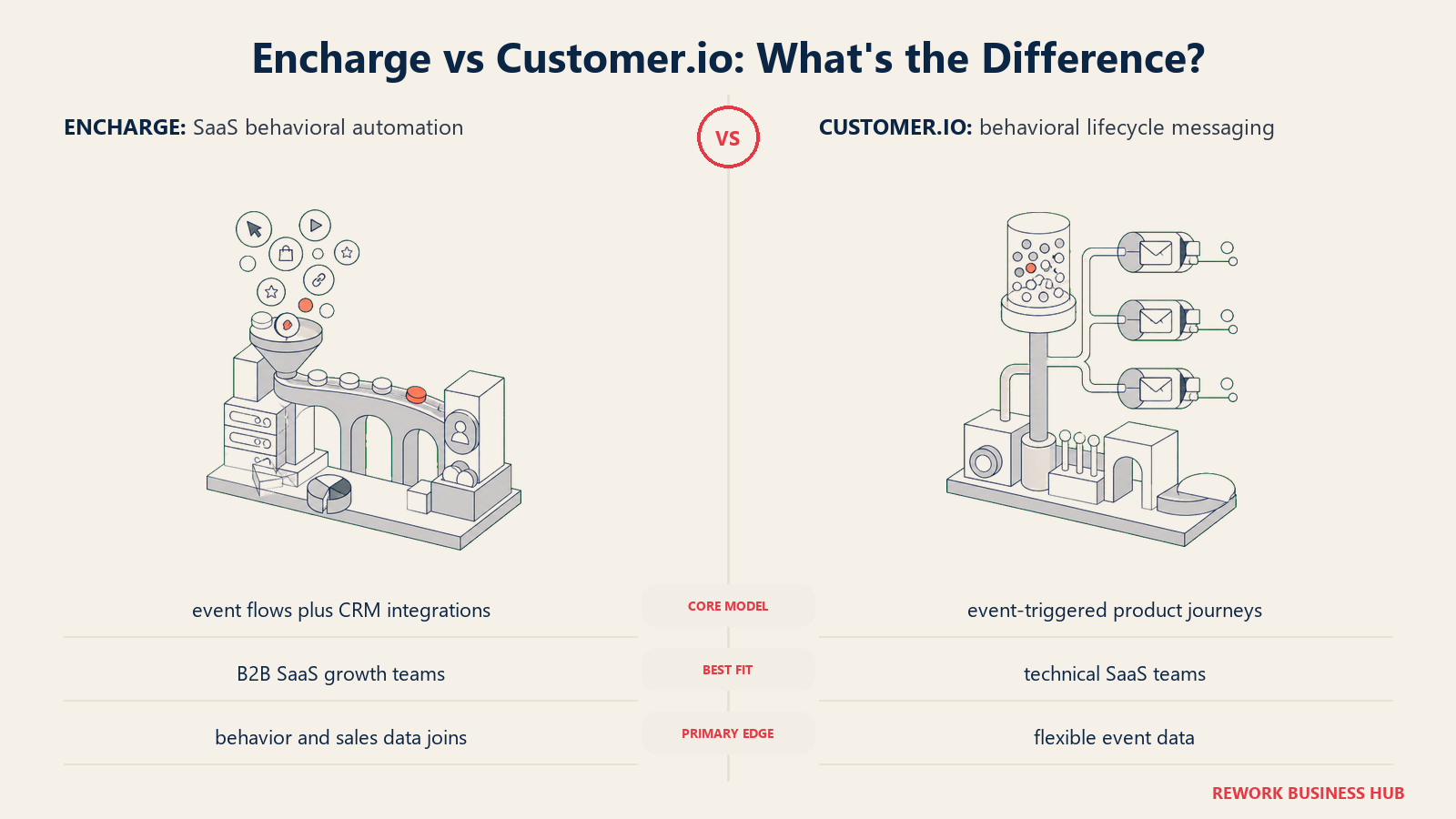
The Stripe integration is a standout: you can trigger flows based on trial started, subscription upgraded, payment failed, or churned, directly from Stripe events without writing custom webhook code. The HubSpot and Salesforce integrations sync contact data bidirectionally, making Encharge a practical middle layer between your CRM and your messaging for B2B SaaS teams that want lifecycle email to stay in sync with the deal pipeline.
Unlimited users across all plans is a genuine differentiator. Customer.io, ActiveCampaign, and many tools in this price range charge per seat. Encharge doesn't, which matters for early-stage teams where everyone needs access without adding a per-user line item.
Methodology / Vision: Behavior-driven lifecycle automation with the integration depth of an enterprise tool at mid-market pricing. The bet is that SaaS teams deserve Segment, Stripe, HubSpot, and Salesforce integrations without a six-figure contract.
Target Audience: B2B SaaS companies from 5 to 500 employees, particularly those already using HubSpot or Salesforce as their CRM and Stripe as their billing system.
Sizing Fit: Startup through mid-market. The unlimited-user model works well for early-stage teams. At 50,000+ contacts, the cost starts approaching Customer.io Essentials territory.
Stage Fit: Growth through mature. Best value unlocks when a team has both a CRM (HubSpot or Salesforce) and a billing system (Stripe) that they want connected to lifecycle email without custom engineering.
Team vs. Company-Wide: Marketing and product teams. The CRM integration makes it practical for sales to see lifecycle email activity on the contact record without leaving their CRM.
| What you get | What you don't |
|---|---|
| Deep native integrations: HubSpot, Salesforce, Stripe, Segment | Push notifications or in-app messaging channels |
| Unlimited users on all plans (no per-seat charges) | Customer.io's real-time event property depth |
| Behavioral flows triggered by Stripe events without webhook code | SMS as a native channel |
| Broadcast campaigns plus automated flows in one tool | A mobile SDK for consumer app event tracking |
Pricing: Growth from $79/mo annual ($99/mo monthly) for 2,000 contacts; Premium from $129/mo annual for 2,000 contacts. At 10,000 contacts, Growth runs approximately $279/mo (annual). See encharge.io/pricing.
Best for: B2B SaaS teams already running HubSpot, Salesforce, or Stripe that want lifecycle email automation connected to their CRM and billing data without custom engineering.
11. Mailchimp: Familiar Name, Limited Behavioral Depth
Mailchimp belongs on this list for a specific reason: some SaaS teams bought Customer.io because they outgrew Mailchimp, then discovered Customer.io's event architecture was more than they needed. If that's your arc, going back to Mailchimp or a comparable tool isn't a step backward. It's a calibration.
Mailchimp's multi-step journey automation on the Standard plan handles welcome sequences, drip campaigns, and basic behavior triggers from email interactions. It doesn't handle real-time product events, doesn't have push or in-app messaging, and its segmentation against custom event properties is not in the same league as Customer.io. But for SaaS teams whose lifecycle motion is primarily broadcast newsletters plus a welcome sequence, the $20/month Standard plan covers the ground that matters.
The free plan dropped to 250 contacts and 500 sends in early 2026, with legacy plan prices rising 11 to 13% in April 2026. If contact-based pricing is already a concern, check our Mailchimp alternatives guide before committing. For teams that genuinely need simplicity above all else, though, Mailchimp's ecosystem of certified agencies, templates, and integrations is unmatched at its price.
Methodology / Vision: Simple email marketing for everyone. The original and durable bet is that any business should be able to send professional email without a marketing engineering background.
Target Audience: Small businesses, early-stage SaaS startups, and solo marketers. Not the right fit for SaaS teams with meaningful product event data.
Sizing Fit: Strongest from solo to early growth. Shows automation limits once a team needs real behavioral triggers or multi-channel sequences.
Stage Fit: Early startup. Strong as a first email tool. Teams typically move past it when behavioral product data becomes a segmentation input.
Team vs. Company-Wide: Marketing team tool. No meaningful CRM or sales pipeline layer.
| What you get | What you don't |
|---|---|
| Fastest onboarding in this list; near-zero learning curve | Real-time product event triggers or in-app messaging |
| 300+ integrations including Shopify, Stripe, and Salesforce | Native lead scoring or B2B pipeline integration |
| Clean template builder; large certified agency network | Predictable contact-based pricing as list grows |
| Multi-step journeys on Standard and Premium plans | SMS or push notification channels |
Pricing: Free (250 contacts, 500 sends/mo). Essentials from $13/mo. Standard from $20/mo (500 contacts). Premium from $350/mo. See mailchimp.com/pricing/marketing.
Best for: Early-stage SaaS teams whose lifecycle motion is simple broadcast campaigns and a welcome sequence, and who don't need product event-triggered automation.
12. Marketo: Enterprise B2B Demand Gen When Lifecycle Messaging Isn't the Problem
Marketo is on this list for a specific team profile: B2B SaaS companies that used Customer.io for lead nurture rather than product lifecycle messaging, and have now scaled to the point where they need enterprise-grade B2B marketing automation, lead scoring against firmographic data, account-based marketing, and native Salesforce integration. That's a genuinely different product category from Customer.io, and Marketo is one of the best options in it.
The honest call is that most teams moving from Customer.io don't need Marketo. Customer.io is a product messaging tool. Marketo is an enterprise demand gen platform. But if your Customer.io usage was primarily lead nurture, campaign tracking, and marketing-to-sales handoff for a B2B pipeline, and you've outgrown ActiveCampaign or HubSpot, Marketo is a legitimate next step.
The cost reality: most mid-market deployments run $1,500 to $3,000 per month. Enterprise teams with large databases exceed $6,000 per month. Implementation takes months. The interface has a steep learning curve. And it's not designed for product event-triggered messaging at all. If Customer.io's behavioral architecture was what you valued, Marketo won't give you that. For a full peer comparison of Marketo against alternatives, see our Marketo alternatives guide.
Methodology / Vision: Enterprise marketing automation with lead scoring, multi-stage nurture, and ABM at the center. Adobe's bet is that large enterprise demand gen requires dedicated infrastructure that general-purpose tools can't match.
Target Audience: Enterprise and upper mid-market B2B companies, typically 200+ employees, with dedicated marketing ops teams running complex demand-gen programs at scale.
Sizing Fit: Mid-market minimum. Most value unlocks above 100 employees with a dedicated Marketo admin. Solo or small team use is not practical.
Stage Fit: Mature through enterprise. Best adopted when a team has a well-defined demand-gen playbook and the headcount to configure and maintain the platform.
Team vs. Company-Wide: Marketing ops and demand gen. Requires Salesforce or a comparable CRM as the backbone.
| What you get | What you don't |
|---|---|
| Sophisticated lead scoring against behavioral and firmographic signals | Real-time product event triggers or in-app messaging |
| Multi-stage nurture programs with dynamic content | Accessible self-serve pricing or fast implementation |
| Account-based marketing orchestration | A modern, fast UI (dated interface with a steep learning curve) |
| Deep Adobe and Salesforce CRM integration | Simple setup without a dedicated Marketo admin |
Pricing: Custom. Mid-market deployments typically $1,500 to $3,000/month ($18,000 to $36,000/year). Enterprise exceeds $6,000/month. Contact Adobe directly. See the Marketo alternatives guide for context on the full enterprise MAP category.
Best for: Enterprise B2B demand gen teams running ABM, multi-stage nurture, and sophisticated lead scoring tied to Salesforce, where Customer.io was used for demand gen rather than product lifecycle messaging.
Stage Fit Matrix
| Company Stage | MAU / Team Size | Recommended Tools | Likely Overkill |
|---|---|---|---|
| Seed / Pre-product-market fit | Under 10K MAUs | Loops, Encharge, OneSignal (free), Brevo | MoEngage, Braze, Iterable |
| Early growth / Series A | 10K to 100K MAUs | Customer.io Essentials, Loops, Encharge, ActiveCampaign | Braze, Iterable, Marketo |
| Growth / Series B-C | 100K to 1M MAUs | Customer.io Premium, Iterable, MoEngage, HubSpot | Oracle Eloqua |
| Mid-market scaling | 1M to 10M MAUs | Iterable, Braze (entry), MoEngage | Mailchimp, Loops |
| Enterprise | 10M+ MAUs | Braze, Iterable Enterprise | Most SMB tools |
| B2B SaaS, lead-gen focused | Any size, sales-led | HubSpot, ActiveCampaign, Marketo | Customer.io (wrong category) |
| Ecommerce / DTC | Any list size | Klaviyo, Brevo, Mailchimp | Customer.io (wrong data model) |
Sizing and Persona Table
| Tool | Ideal Team Size | Who Buys It |
|---|---|---|
| Braze | 200+ employees | VP Lifecycle Marketing, Head of Growth, Mobile Marketing Lead |
| Iterable | 50 to 2,000 employees | Head of Lifecycle, Marketing Engineer, VP Growth |
| Klaviyo | 5 to 500 employees | Ecommerce CMO, DTC Brand Owner, Email/SMS Marketer |
| Brevo | 5 to 500 employees | Marketing Manager, Growth Marketer, Solo Marketer |
| ActiveCampaign | 5 to 500 employees | Marketing Director, Marketing Manager, Growth Marketer |
| HubSpot | 20 to 1,000 employees | CMO, Marketing Ops, RevOps, VP Sales |
| OneSignal | 5 to 500 employees | Product Engineer, Growth Engineer, Mobile Developer |
| MoEngage | 50 to 2,000 employees | Head of Lifecycle, Mobile Growth Lead, VP Engagement |
| Loops | 5 to 500 employees | SaaS Founder, Product Marketer, Growth Engineer |
| Encharge | 5 to 500 employees | SaaS Marketing Manager, Growth Marketer, Marketing Ops |
| Mailchimp | 1 to 100 employees | Marketing Manager, Founder, Small Business Owner |
| Marketo | 200+ employees | Marketing Ops Director, Demand Gen Lead, CMO |
How to Choose: Decision Framework
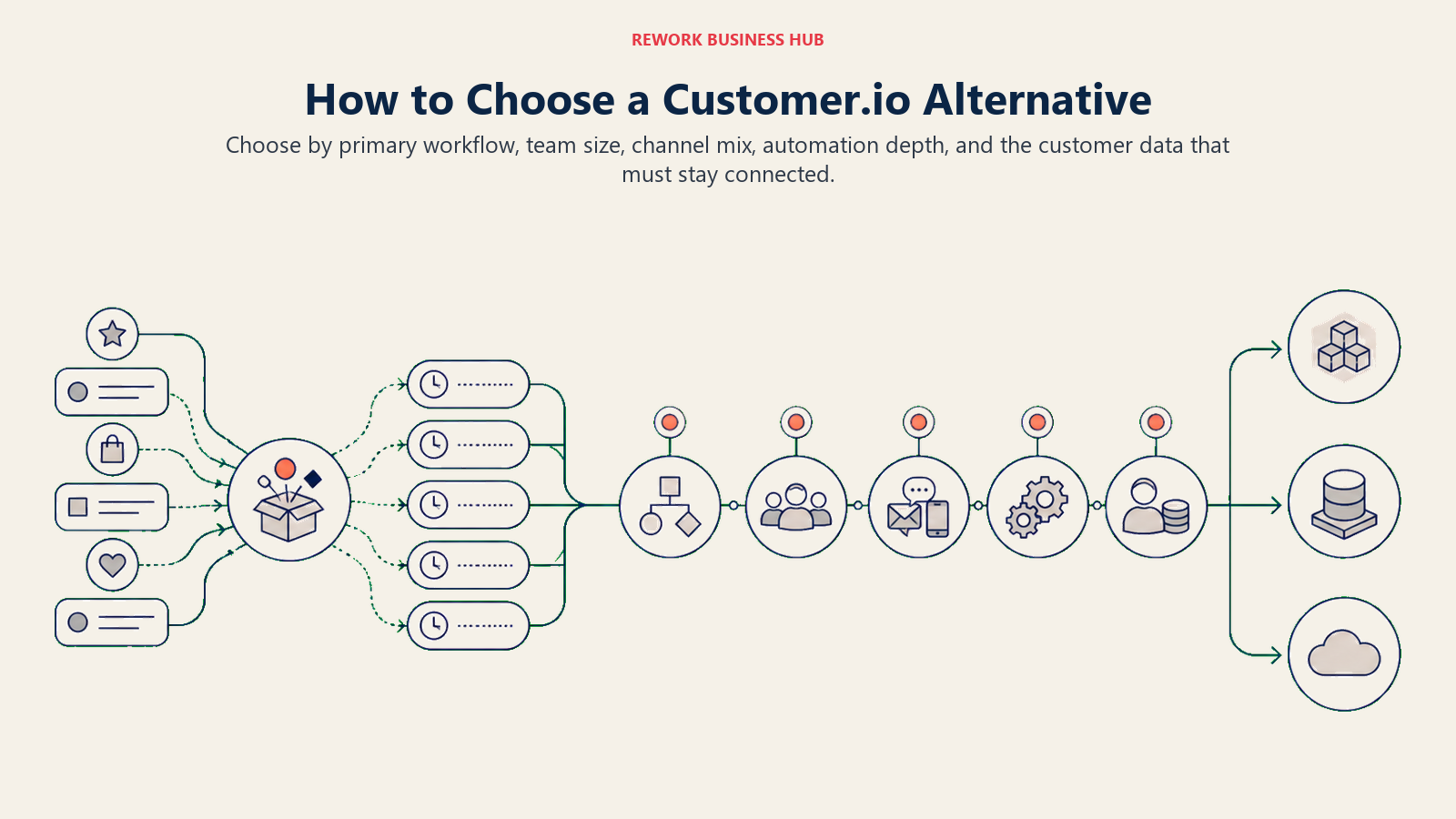
Use these criteria to narrow the field by workflow, team size, channel mix, automation depth, and connected customer data.
| If you need... | Pick... |
|---|---|
| Behavioral product messaging at 1M+ MAUs with enterprise SLAs | Braze |
| Cross-channel journey orchestration with strong data warehouse connectivity | Iterable |
| Email and SMS revenue automation tied to Shopify or WooCommerce purchase data | Klaviyo |
| High-volume email and SMS without per-profile pricing penalties | Brevo |
| The most sophisticated visual automation builder in the mid-market price range | ActiveCampaign |
| A full inbound marketing suite with landing pages, CRM, and attribution in one | HubSpot Marketing Hub |
| Push and in-app notifications as the primary channel with email as a supplement | OneSignal |
| AI-driven channel and send-time optimization for a mobile-first consumer app | MoEngage |
| Product, marketing, and transactional email unified for a SaaS team without engineering overhead | Loops |
| Behavioral flows connected natively to HubSpot, Salesforce, Stripe, and Segment | Encharge |
| Simple email campaigns for an early-stage team that doesn't need event-triggered automation | Mailchimp |
| Enterprise B2B demand gen with ABM, multi-stage nurture, and Salesforce CRM integration | Marketo |
| The comparison of Klaviyo against its own peer category | Klaviyo alternatives |
| The comparison of Brevo against its own peer category | Brevo alternatives |
| The comparison of ActiveCampaign against its own peer category | ActiveCampaign alternatives |
| The comparison of Marketo against its own peer category | Marketo alternatives |
What to Do Next
Start by naming exactly what frustrated you about Customer.io. If it's the profile-based pricing as your user base grows, Brevo solves that structurally without changing your channel mix. If it's the engineering dependency for every flow change, Loops or Encharge gives you behavioral automation with a faster self-serve setup. If you've genuinely outscaled Customer.io and need enterprise infrastructure, Iterable is the natural next step before Braze. And if the honest truth is that your team was using Customer.io for lead nurture and sales follow-up rather than product lifecycle messaging, HubSpot Marketing Hub solves the actual problem, with a native CRM built in.
Most tools on this list offer a free plan or trial. OneSignal and Brevo both have genuinely useful free tiers. Loops, Encharge, and Mailchimp all offer free plans or 14-day trials. ActiveCampaign has a 14-day free trial. Build one real flow with your actual contact data before committing. The setup experience will tell you more than any vendor demo.
For additional context as you evaluate specific platforms, our related guides cover Marketo alternatives, ActiveCampaign alternatives, Klaviyo alternatives, Brevo alternatives, Mailchimp alternatives, GetResponse alternatives, and ConvertKit alternatives for side-by-side comparisons within those specific categories.

Principal Product Marketing Strategist
On this page
- Quick Comparison Table
- 1. Braze: Enterprise Omnichannel Lifecycle Engagement
- 2. Iterable: Cross-Channel Journey Orchestration for Growth and Enterprise SaaS
- 3. Klaviyo: Ecommerce Email and SMS with Real Revenue Attribution
- 4. Brevo: High-Volume Sending Without Per-Profile Cost Pain
- 5. ActiveCampaign: Best Visual Automation Builder in the Mid-Market
- 6. HubSpot Marketing Hub: Full Inbound Suite with Native CRM
- 7. OneSignal: Developer-Friendly Push and In-App Notifications with Email
- 8. MoEngage: AI-Powered Engagement for Mid-Market Consumer Brands
- 9. Loops: SaaS-Specific Email for Product and Marketing Teams
- 10. Encharge: Behavioral Flows and Deep CRM Integrations for SaaS
- 11. Mailchimp: Familiar Name, Limited Behavioral Depth
- 12. Marketo: Enterprise B2B Demand Gen When Lifecycle Messaging Isn't the Problem
- Stage Fit Matrix
- Sizing and Persona Table
- How to Choose: Decision Framework
- What to Do Next