Best SendGrid Alternatives in 2026: 11 Email API and Marketing Tools Compared
Turn this article into takeaways for your work.


Each assistant summarizes the article only for you and suggests best practices for your work.
Updated August 2026
If you're comparing SendGrid alternatives because you just found out the free plan is gone, you're not imagining things: Postmark and Mailgun are the two best replacements for developers who just want reliable transactional email, Brevo and Customer.io are the two best replacements if you're actually running marketing campaigns, and Amazon SES is the cheapest option if you're sending at real volume and don't mind managing more of the setup yourself.
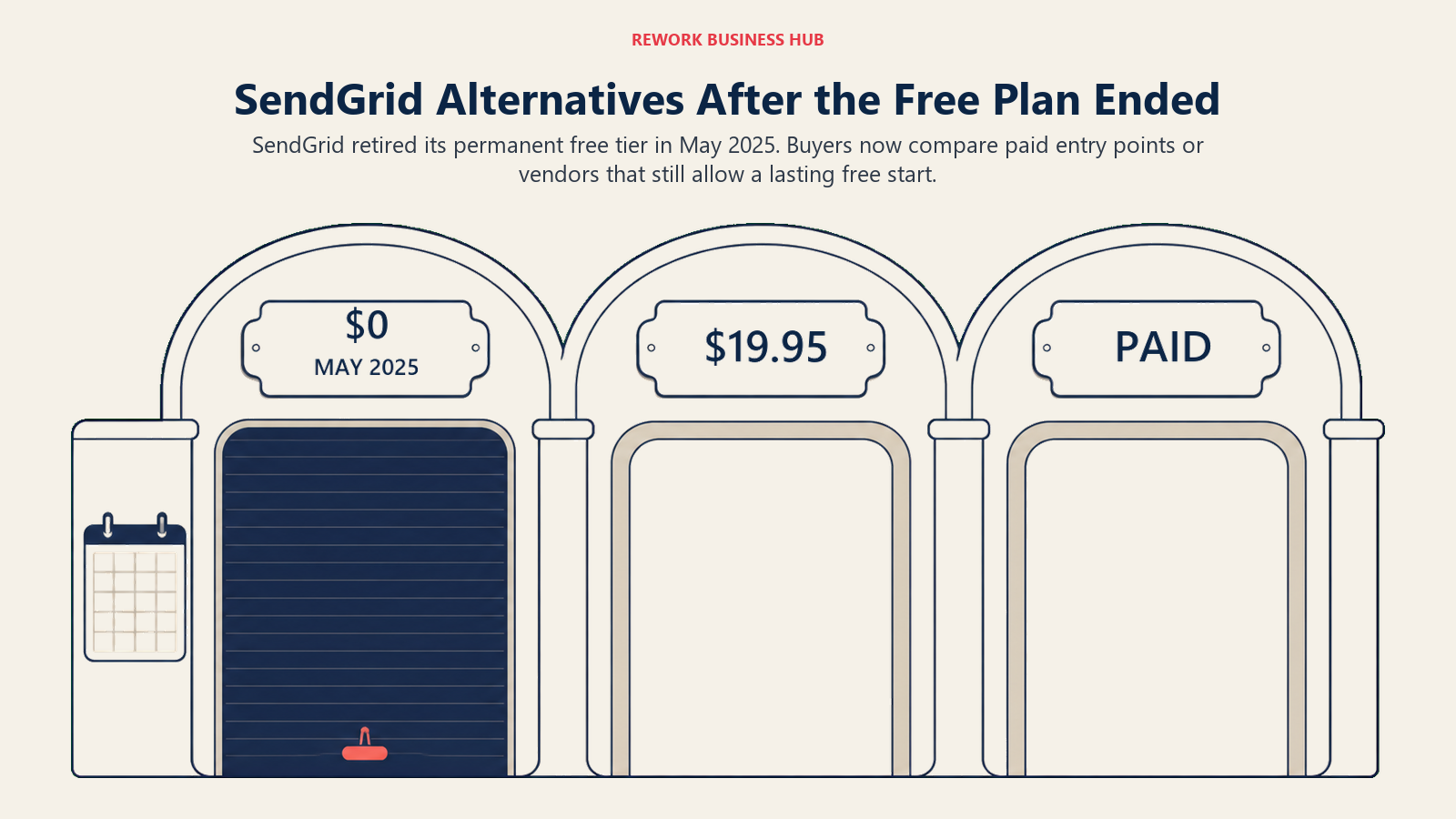
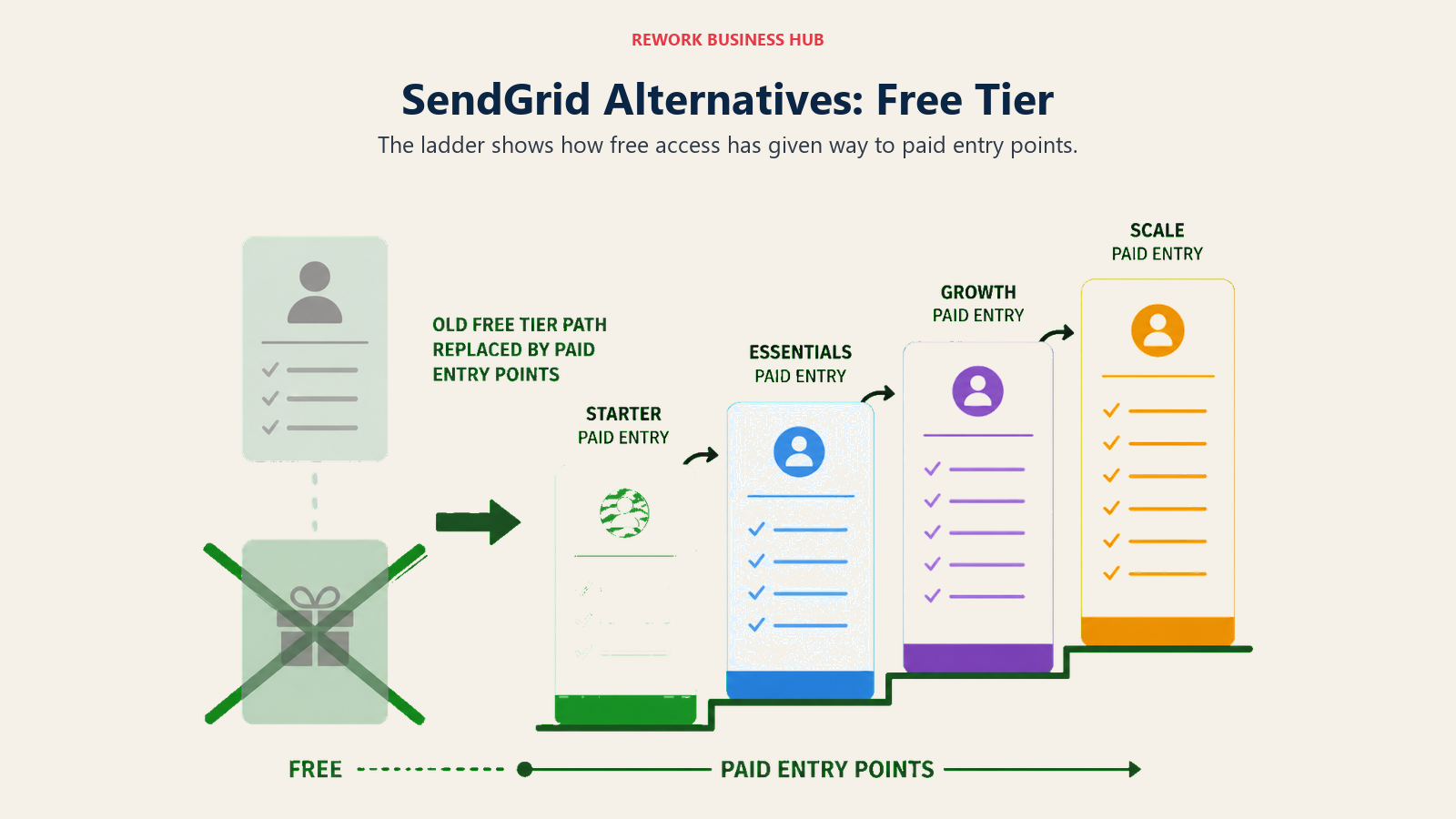
Here's the thing everyone gets wrong first: SendGrid used to be the default answer to "which email API should I use" partly because it was free to start. That's no longer true. Twilio retired the Free Email API and Free Marketing Campaigns plan effective May 27, 2025, and existing free accounts got a 60 day grace period before sending paused entirely. What replaces it is a 60 day free trial capped at 100 emails a day and 100 contacts, not a permanent free tier. That single change is why so many teams are shopping for a replacement right now. We verified every price below against each vendor's own pricing page in August 2026, not a third-party estimate.
Key Facts
- SendGrid retired its Free Email API and Free Marketing Campaigns plans on May 27, 2025; the replacement is a 60 day trial, not a permanent free tier (Twilio changelog).
- Global email inbox placement reached 87.2% in 2026, up 3.7 percentage points year over year (Validity 2026 Email Deliverability Benchmark Report).
- B2B delivered rates climbed from 90.7% to 95.6% over the same period, one of the sharpest gains of any sector tracked (Validity's analysis of the 2026 DMA benchmark data).
- Transactional emails get roughly 8x more opens and clicks, and generate about 6x more revenue, than standalone marketing campaigns (Experian data cited by Campaign Monitor).
- 74% of consumers say they prefer email specifically for transactional messages like order confirmations and shipping updates, and 71% would dig through a spam folder to find one that went missing (Mailgun consumer survey, 2,000+ respondents across five countries).
Two Shortlists: Email API vs. Marketing Campaigns
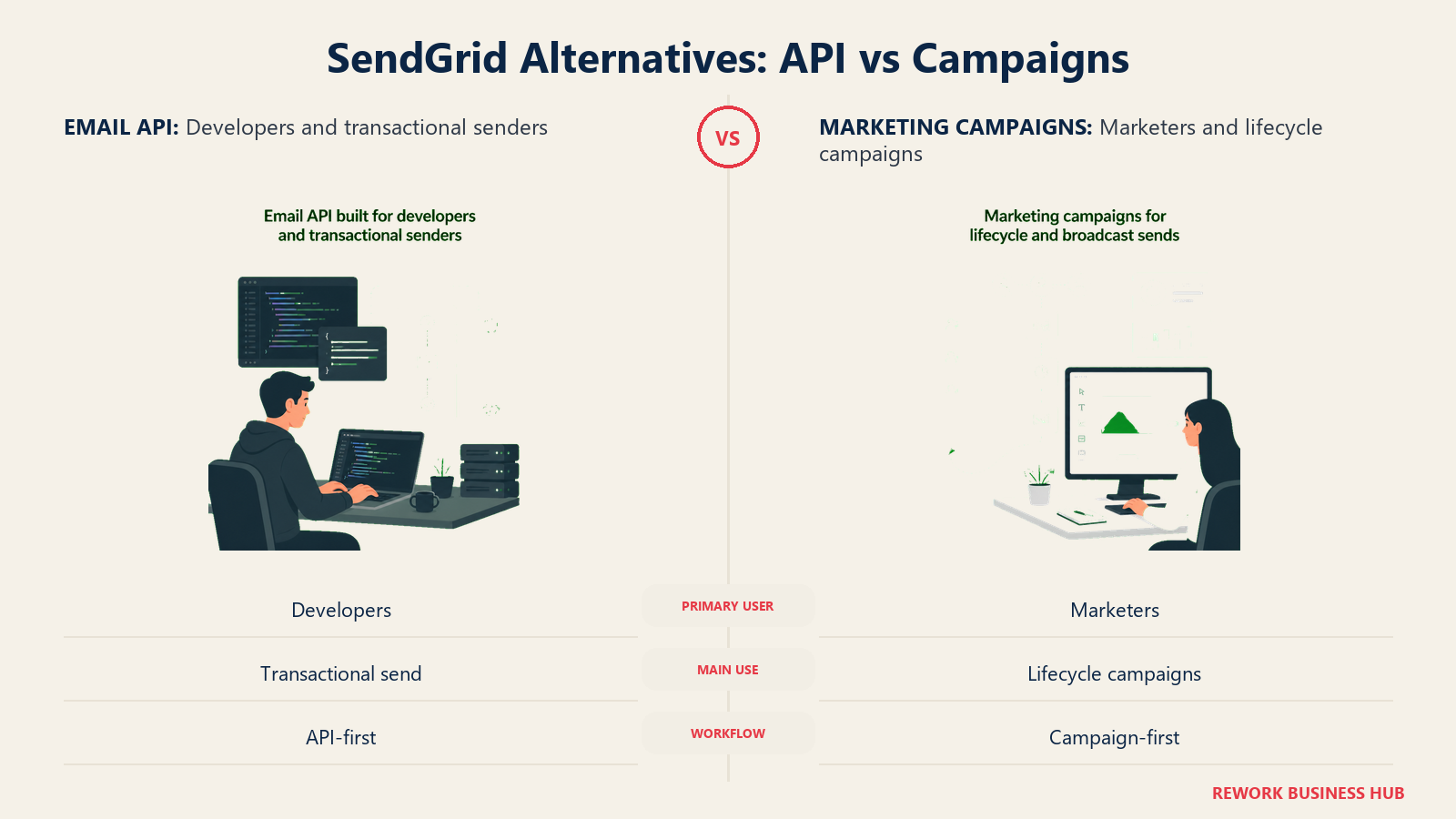
SendGrid is really two products wearing one brand name, and that matters more than usual when you're picking a replacement. SendGrid Email API is the developer-facing SMTP relay and REST API: password resets, receipts, order confirmations, one-time codes. SendGrid Marketing Campaigns is the separate contact management and broadcast tool: newsletters, promotions, drip sequences. A team leaving SendGrid because of the pricing change is usually only replacing one of these, not both, so don't shop the wrong list.
| If you're replacing... | You want | Start with |
|---|---|---|
| SendGrid Email API | Deliverability, logs, an SMTP relay, a simple REST API | Postmark, Resend, Mailgun, Amazon SES, MailerSend, SMTP2GO |
| SendGrid Marketing Campaigns | A campaign builder, contact segmentation, drip automation | Brevo, Mailjet, Customer.io |
| Both, in one tool | A single vendor that does transactional and marketing email well | Brevo, Mailjet |
| Product and lifecycle messaging for a SaaS app | Behavioral triggers, in-app plus email plus push from one event stream | Customer.io, Loops |
If neither shortlist quite matches your use case, the best SMS marketing software roundup covers the messaging side of this cluster, and the best email marketing software guide is a deeper dive into the Marketing Campaigns replacement question specifically.
Quick Comparison Table
| Tool | Best For | Starting Price | Key Strength | Key Limitation |
|---|---|---|---|---|
| Postmark | Transactional-only apps, clean deliverability | Basic $15/mo (10,000 emails/mo) | Dedicated transactional focus, long retention on higher tiers | No bulk/marketing sending; free tier caps at 100/month |
| Resend | Developer teams on React/Next.js | Pro $20/mo (50,000 emails/mo) | Clean DX, React Email templates | Marketing is a separate, extra-cost plan |
| Mailgun | SendGrid-style scale with a real free tier | Basic $15/mo (10,000 emails/mo) | Free tier still exists (100/day), flexible routing/validation | Entry paid tier keeps only 1 day of log retention |
| Amazon SES | High-volume senders already on AWS | $0.10 per 1,000 emails (pay as you go) | Cheapest at real scale, deep AWS integration | No dashboard UX; deliverability tooling costs extra |
| MailerSend | Budget teams that also want SMS | Hobby $5.60/mo (5,000 emails/mo) | Email and SMS in one API | Free tier is 500/month, not the 12,000 it used to be |
| SMTP2GO | Drop-in SMTP relay, minimal setup | Starter $10/mo (10,000 emails/mo) | Simplest SMTP swap, 5 verified senders on free plan | Smaller ecosystem than Mailgun or SendGrid |
| Loops | Transactional plus lifecycle email for SaaS | Priced on contacts, dollar figure not published | One tool for both send types | Paid pricing unpublished; free plan has a footer badge |
| Bird | Teams needing email today, more channels later | Startup $15-$30/mo (50K-100K emails/mo) | Usage-based pricing, free tier needs no card | SMS and WhatsApp are "Coming soon," not live |
| Brevo | Transactional and marketing email in one plan | Starter $9/mo (5,000 emails/mo, 500 contacts) | One plan covers both API and campaign builder | Steep step up from Starter once volume grows |
| Mailjet | A real free tier for both send types | Starter $9/mo (8,000 emails/mo) | Free tier covers 6,000 emails/month | Fewer automation features than dedicated marketing tools |
| Customer.io | Behavior-triggered lifecycle messages | Essentials (5,000 profiles, 1M emails/mo), price not published | Event-based triggers across email, push, SMS, in-app | Overkill, and pricing unpublished, for pure transactional needs |
Free Tier and Entry Price Comparison
This is the table to check first if you're here because of the pricing change. SendGrid is listed as a reference row so you can see exactly what changed and what the closest replacements charge instead.
| Tool | Free Tier | Entry Paid Price (monthly) | Entry Paid Price (annual) |
|---|---|---|---|
| SendGrid Email API (reference) | None. Retired May 27, 2025. 60-day trial: 100/day, 100 contacts | Essentials from $19.95/mo (50K-100K emails/mo) | Not published separately |
| Postmark | 100 emails/month, no expiry, no overages | Basic $15/mo (10,000 emails/mo) | Not published separately |
| Resend | 3,000 emails/mo, capped at 100/day, 3 domains | Pro $20/mo (50,000 emails/mo) | Not published separately |
| Mailgun | 100 emails/day, permanent, 1-day log retention | Basic $15/mo (10,000 emails/mo) | Not published separately |
| Amazon SES | None; new accounts get up to $200 in AWS Free Tier credits | $0.10 per 1,000 emails, pay as you go | Same rate, billed by usage |
| MailerSend | 500 emails/month | Hobby $5.60/mo | $67.20/yr |
| SMTP2GO | 1,000 emails/mo, capped at 200/day, 5 verified senders | Starter $10/mo (10,000 emails/mo) | $100/yr |
| Loops | 1,000 contacts, 4,000 sends/mo, "Powered by Loops" footer | Priced on contacts; not published | Not published |
| Bird | 1,000 emails/mo, shared IP, no card required | Startup $15-$30/mo (50K-100K emails/mo) | Not published separately |
| Brevo | $0/mo, unlimited contacts, capped around 300/day once approved | Starter $9/mo (5,000 emails/mo, 500 contacts) | $8.08/mo (about $96.96/yr) |
| Mailjet | 6,000 emails/mo, capped at 200/day | Starter $9/mo (8,000 emails/mo) | Saves 10% |
| Customer.io | None; qualifying startups (raised under $10M) get a full year free | Essentials (5,000 profiles, 1M emails/mo); not rendered on the page | Not published |
The contrast worth sitting with: Mailgun and SendGrid used to have nearly identical reputations for "generous free tier, scales to enterprise," and now only one of them still has a free tier at all. Amazon SES never had a real free-forever allowance either, despite the "62,000 free emails a month from EC2" claim that still circulates. That's gone from AWS's own pricing page; what's there is a one-time $200 credit for new accounts, not an ongoing monthly grant.
Stage Fit Matrix
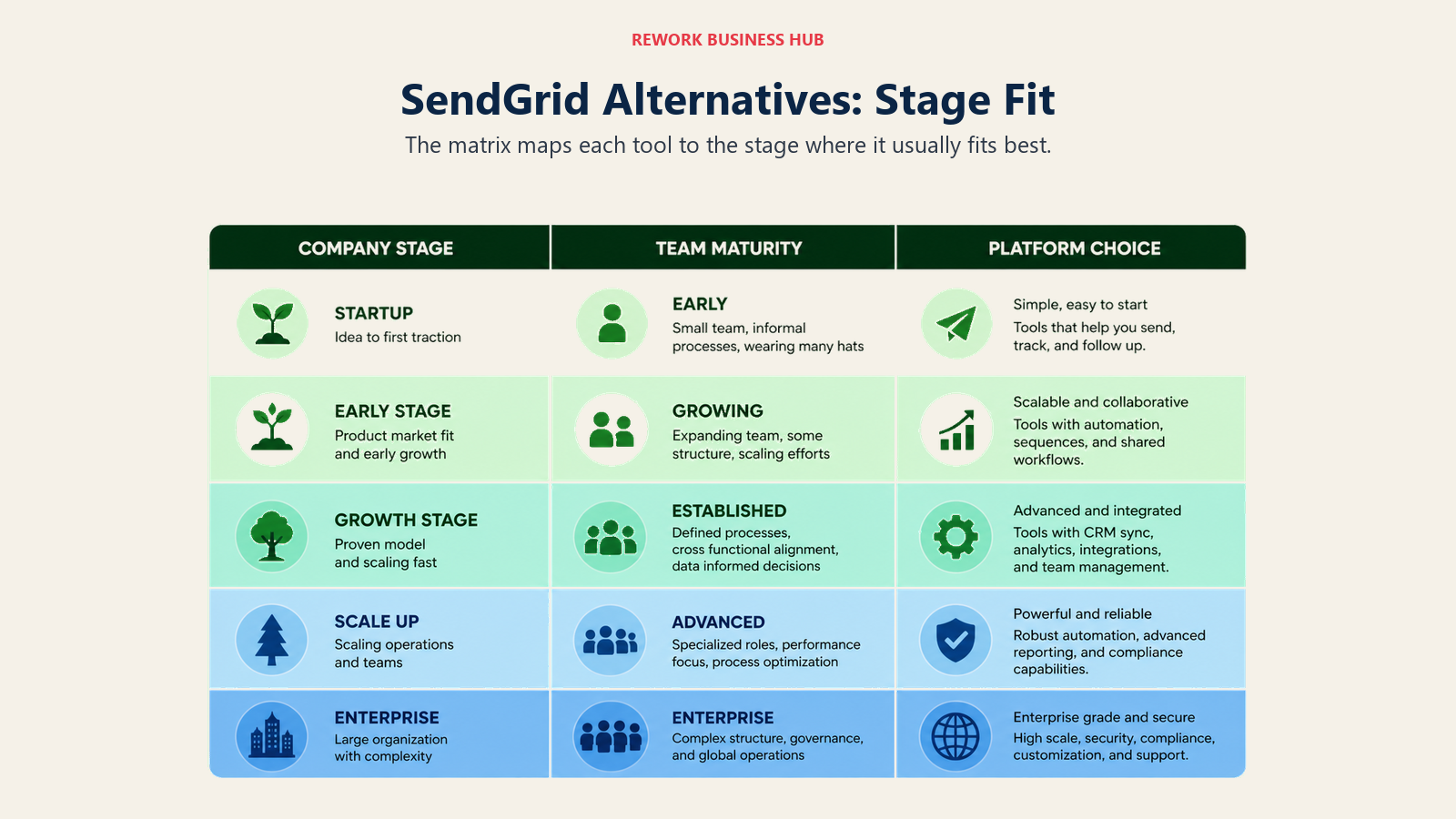
The matrix maps each tool to the stage where it usually fits best.
| Tool | Startup (1-10) | Growth (10-50) | Mid-Market (50-200) | Enterprise (200+) |
|---|---|---|---|---|
| Postmark | Good fit | Strong fit | Strong fit | Partial fit |
| Resend | Strong fit | Strong fit | Good fit | Partial fit |
| Mailgun | Good fit | Strong fit | Strong fit | Good fit |
| Amazon SES | Possible | Good fit | Strong fit | Strong fit |
| MailerSend | Strong fit | Good fit | Weak fit | Not ideal |
| SMTP2GO | Strong fit | Good fit | Weak fit | Not ideal |
| Loops | Strong fit | Good fit | Possible | Not ideal |
| Bird | Possible | Good fit | Good fit | Possible |
| Brevo | Strong fit | Good fit | Weak fit | Not ideal |
| Mailjet | Strong fit | Good fit | Good fit | Possible |
| Customer.io | Possible | Good fit | Strong fit | Strong fit |
Sizing and Persona Table
| Tool | Team Size Sweet Spot | Primary Buyer | Team vs Company-Wide |
|---|---|---|---|
| Postmark | 1-100 | Backend or platform engineer | Engineering team |
| Resend | 1-75 | Frontend or full-stack developer | Engineering team |
| Mailgun | 5-300 | Backend engineer, DevOps lead | Engineering team |
| Amazon SES | 10-1,000+ | Cloud or platform engineer | Engineering / infrastructure |
| MailerSend | 1-50 | Solo developer, small dev team | Engineering team |
| SMTP2GO | 1-50 | IT admin, ops generalist | Small IT / ops team |
| Loops | 1-40 | SaaS founder, growth engineer | Product + marketing (small team) |
| Bird | 1-75 | Developer, marketing ops (email only today) | Engineering / marketing |
| Brevo | 1-75 | Marketing manager, founder | Marketing team |
| Mailjet | 5-150 | Marketing ops lead, developer | Marketing + engineering |
| Customer.io | 10-300 | Lifecycle or growth marketer, PM | Product + growth team |
1. Postmark - the specialist that keeps transactional email away from marketing noise
Postmark's whole design starts from one idea: transactional and marketing email shouldn't share an IP pool or a sending reputation. The platform simply doesn't let you send newsletters or promotional blasts through it. By keeping every message a password reset, a receipt, or an alert, Postmark keeps its deliverability numbers high, which is exactly what a developer replacing SendGrid's Email API usually wants.
The ICP is an engineering team, not a marketing team: a backend or platform engineer who needs codes and confirmations to land reliably, with message-level logs to debug a "did it actually send" ticket in minutes. Log retention scales with plan, from 45 days on Basic up to 365 days on Platform.
| What you get | What you don't |
|---|---|
| Clean, transactional-only sending reputation | Marketing or bulk email sending on the same account |
| Message-level logs and detailed bounce data | A visual campaign builder |
| Long log retention on higher tiers | A generous free tier (100 emails/month, no more) |
Pricing: Basic $15/mo for 10,000 emails/month (overage $1.80 per 1,000, 45-day retention). Pro $16.50/mo adds inbound email and extends retention to 365 days (overage $1.30). Platform $18/mo lowers overage further to $1.20. Free tier: 100 emails/month, no expiry, no overage charges.
Best for: engineering teams that want the cleanest possible transactional-only deliverability record and don't need a marketing tool bundled in.
2. Resend - the email API built for developers who live in React
Resend's pitch is simple: email should feel like a normal API call, not a legacy dashboard. It ships an SDK for every major language, a React Email component library for building templates in JSX instead of table-based HTML, and a developer console that reads more like Vercel or Stripe than a marketing tool.
The ICP is a frontend or full-stack developer at a startup or growth-stage team who owns both the app and its emails, and wants the two to share a codebase. Resend also sells a separate Marketing plan (from $40/mo for 5,000 contacts) for campaigns, but it's priced apart from the transactional Pro plan, so budget for both if you need both.
| What you get | What you don't |
|---|---|
| React Email templates and a modern developer console | A single plan covering both transactional and marketing sends |
| SDKs for every major language, generous docs | The largest ecosystem of third-party integrations |
| A workable free tier for side projects and staging | Long-term enterprise deliverability tooling in-house |
Pricing: Free tier covers 3,000 emails/month, capped at 100/day, across 3 domains. Pro starts at $20/mo for 50,000 emails/month (10 domains, 30-day retention), scaling to $35/mo for 100,000. Scale plans run $90 to $1,150/mo for 100,000 to 2.5 million emails. Marketing plans are billed separately, from $40 to $650/mo for 5,000 to 150,000 contacts.
Best for: developer teams building with React or Next.js who want transactional email to feel like part of the codebase, not a bolted-on service.
3. Mailgun - the closest like-for-like swap, and one of the last with a real free tier
Mailgun and SendGrid have been compared to each other for over a decade because they solve the same problem the same way: a REST API and SMTP relay with validation, routing rules, and inbound parsing built in. The difference that matters most in 2026: Mailgun still gives you 100 emails a day for free, permanently. SendGrid does not.
The ICP overlaps heavily with SendGrid's own base: backend engineers and DevOps leads sending anywhere from a few thousand to tens of millions of emails a month, who want validation and suppression list management handled by the platform. Log retention is thin on the entry paid tier (just 1 day on Basic), so budget for Foundation or Scale if you need to debug delivery issues later. For a full head-to-head, see the SendGrid vs Mailgun comparison.
| What you get | What you don't |
|---|---|
| A permanent free tier (100 emails/day) | Long log retention on the entry paid plan |
| Built-in email validation and inbound routing | A marketing campaign builder as capable as Brevo or Mailjet |
| Pricing and features that map closely onto SendGrid's own | The newest developer experience on this list |
Pricing: Basic $15/mo for 10,000 emails/month (overage from $1.80 per 1,000, 1-day log retention). Foundation $35/mo for 50,000 emails (5-day retention). Scale $90/mo for 100,000 emails (30-day retention). Free tier: 100 emails/day, permanent.
Best for: teams that want the most direct, lowest-friction replacement for SendGrid's Email API, and specifically want a vendor that still has a free tier.
4. Amazon SES - the cheapest email at real volume, if you're willing to do the setup yourself
Amazon SES isn't a product in the SendGrid sense so much as a utility: a sending endpoint priced at $0.10 per 1,000 emails, with no dashboard-driven template builder and no customer success team unless you pay separately for one. What you get in exchange is the lowest per-email cost on this list, provisioned entirely through infrastructure-as-code alongside the rest of an AWS stack.
The old reputation, "62,000 free emails a month from EC2," is gone from AWS's own pricing page. What's there now is a one-time credit of up to $200 in AWS Free Tier value for new accounts, not an ongoing monthly grant. Dedicated IPs cost $24.95/mo each, and Virtual Deliverability Manager, Amazon's own deliverability monitoring layer, runs $1,250/mo, which shows where the real cost of "cheap at scale" tends to hide.
| What you get | What you don't |
|---|---|
| The lowest per-email cost on this list at real volume | A dashboard-first setup experience |
| Deep native integration with the rest of AWS | Built-in deliverability monitoring (it's a $1,250/mo add-on) |
| Full infrastructure-as-code control | A permanent free sending allowance |
Pricing: $0.10 per 1,000 emails sent, pay as you go, plus $0.12/GB for attachment data. Dedicated IPs $24.95/mo each. New accounts get up to $200 in AWS Free Tier credits, not an ongoing free email allowance.
Best for: high-volume senders already running on AWS who have the engineering capacity to manage their own deliverability tooling in exchange for the lowest cost per email.
5. MailerSend - the budget option that bundles SMS into the same API
MailerSend's angle is simplicity at a low price, plus a feature most transactional email APIs don't include by default: SMS sending from the same account and API key, so a one-time code can fail over from email to text without a second vendor.
Reputation check before you sign up: MailerSend used to be known for a 12,000-email-a-month free tier. That's not the current offer: the free plan is now 500 emails a month. It's still fine for a side project, but budget for Hobby almost immediately in production. Starter and Professional both include 50,000 emails/month plus 100 SMS/month at $0.90 per 1,000 overage, though the pricing page renders those tiers as a slider rather than a fixed dollar figure, so confirm your own quote.
| What you get | What you don't |
|---|---|
| SMS and email from one API and one account | The 12,000/month free tier it used to have (now 500) |
| A low entry price for small production workloads | Published Starter/Professional dollar pricing (rendered as a slider) |
| Straightforward overage pricing | Deep marketing campaign tooling |
Pricing: Hobby $5.60/mo ($67.20/yr) for 5,000 emails/month, overage $1.50 per 1,000. Starter and Professional both include 50,000 emails/month plus 100 SMS/month, overage $0.90 per 1,000 emails, with the monthly dollar price not confirmed on the pricing page. Free tier: 500 emails/month.
Best for: small, budget-conscious dev teams that want transactional email and occasional SMS from a single account.
6. SMTP2GO - the drop-in SMTP relay for teams that don't want to touch their code
SMTP2GO's whole reason to exist is minimizing migration effort. If your app already sends through SMTP, pointing it at SMTP2GO instead of SendGrid is often a credentials swap and nothing else, no API rewrite, no new SDK.
The ICP is an IT admin or generalist ops person who wants delivery handled reliably without becoming a deliverability expert. Five verified sending domains come included even on the free plan, more headroom than most competitors give away for nothing. The tradeoff is a smaller feature set: no marketing automation depth like Brevo or Mailjet, and no API-first tooling like Resend's.
| What you get | What you don't |
|---|---|
| The simplest possible SMTP relay migration | Marketing campaign tools or automation depth |
| 5 verified senders included on the free tier | The largest ecosystem of integrations |
| Predictable, low-friction pricing | API-first developer tooling like Resend's |
Pricing: Starter $10/mo ($100/yr) for 10,000 emails/month, overage $1 per 1,000. Professional $75/mo ($750/yr) for 100,000 emails, overage $0.85 per 1,000. Premier is custom, starting from $75/mo. Free tier: 1,000 emails/month, capped at 200/day, 5 verified senders.
Best for: small IT or ops teams that want the lowest-effort SMTP swap and don't need marketing features.
7. Loops - transactional and lifecycle email in one contact-based tool, built for SaaS
Loops sits in an unusual spot: it charges by subscribed contacts rather than by emails sent, and doesn't meter transactional sends separately on paid plans. For an early-stage SaaS product sending both "your export is ready" messages and "here's what's new" lifecycle emails, that removes the mental math of tracking two separate send-volume meters.
The ICP is a SaaS founder or growth engineer at a small team who wants one tool instead of stitching together an API and a separate marketing platform. Seats are free, which matters for a founder who wants a teammate helping with campaigns without a per-seat fee. The free Early Stage plan works for a pre-revenue product, but ships with a "Powered by Loops" footer, and paid pricing isn't published, so confirm your own quote.
| What you get | What you don't |
|---|---|
| One contact-based price for both transactional and lifecycle email | Published paid-tier dollar pricing |
| Free seats for teammates | The maturity of Mailgun or SendGrid's infrastructure |
| A generous free tier for early-stage products | A dedicated enterprise deliverability team |
Pricing: Priced on subscribed contacts; sends aren't metered separately on paid plans, and seats are free. Free Early Stage plan: 1,000 contacts, 4,000 sends/month, with a "Powered by Loops" footer.
Best for: early-stage SaaS teams that want transactional and lifecycle marketing email unified in one contact-based tool.
8. Bird - a usage-priced email API from a name best known for SMS, with the rest still "coming soon"
Bird carries the reputation of its former name, MessageBird, as a mature omnichannel provider covering SMS, WhatsApp, and email under one roof. That reputation is ahead of where the product is today: Bird's own pricing page prices email only, and marks SMS and WhatsApp "Coming soon," each shipping as a new API. Judge it on the email product in front of you, not on what the old name used to promise.
The ICP is a team that needs reliable email now, values usage-based pricing with no monthly minimum, and is comfortable adding SMS or WhatsApp later. If multichannel messaging today, not eventually, is the requirement, look at a platform built for that from day one, like the best ManyChat alternatives roundup.
| What you get | What you don't |
|---|---|
| Usage-based email pricing with a free tier and no card required | SMS or WhatsApp sending today (both listed "Coming soon") |
| A path to add channels later without switching vendors | The omnichannel maturity the MessageBird name implies |
| Straightforward per-thousand-email pricing tiers | A large third-party integration ecosystem |
Pricing: Startup $15 to $30/mo for 50,000 to 100,000 emails/month, an effective $0.30 per 1,000 at the entry point, with overage charged at $0.90 per 1,000. Growth $80 to $1,039/mo for 100,000 to 2.5 million emails. Enterprise is custom. Free tier: 1,000 emails/month, shared IP, no card required.
Best for: teams that want usage-based email pricing today and are willing to wait for Bird's SMS and WhatsApp APIs to actually launch before relying on them.
9. Brevo - the closest one-tool replacement if you're leaving both SendGrid products at once
Brevo (formerly Sendinblue) is one of the few tools here that genuinely covers both halves of what SendGrid sells: a transactional email API with SMTP relay and a visual campaign builder with contact segmentation, in the same account and bill. For a small team that doesn't want to run two vendors, that consolidation is the whole appeal.
The ICP is a marketing manager or founder at a small company who wants email marketing and transactional sending under one login, without enterprise-scale send volume yet. The free plan carries unlimited contacts but caps sending, and Starter begins small: 5,000 emails/month and 500 contacts for $9/mo, or $8.08/mo billed annually. The honest limitation: the steps get steeper as you climb, with Standard at $18/mo and the tiers above it priced well beyond that, so model your real volume before committing. For more on where teams tend to outgrow it, see the best Brevo alternatives guide.
| What you get | What you don't |
|---|---|
| Transactional API and campaign builder in one account | Deep automation branching logic at the entry tiers |
| Unlimited contacts, even on the free plan | A gentle step up to enterprise pricing (Professional jumps to $499/mo) |
| A genuinely low entry price for both send types | The largest send-volume ceiling on this list |
Pricing: Free $0/mo, unlimited contacts, sending capped around 300 emails/day once your account is approved. Starter $9/mo ($8.08/mo billed annually, about $96.96/yr) for 5,000 emails/month and 500 contacts. Standard $18/mo ($16.17/mo billed annually). Professional from $499/mo ($449.08/mo billed annually) for 150,000+ emails/month with 10 seats included. Enterprise is custom, aimed at companies with 1 million-plus contacts.
Best for: small teams that want transactional email and marketing campaigns from a single, low-cost account, and haven't yet outgrown a few hundred thousand emails a month.
10. Mailjet - the most generous free tier for teams doing both transactional and marketing send
Mailjet's free plan is the widest safety net here for a team that hasn't decided how much it will actually send: 6,000 emails a month, capped at 200 a day, with transactional and marketing sending on the same account from day one, a longer runway than Brevo, Resend, or SMTP2GO give away.
The ICP is a marketing ops lead or developer at a small-to-mid-size company that wants both send types in one account without committing to a bigger platform like Customer.io yet. Paid tiers scale predictably: Starter $9/mo for 8,000 emails, Essential $17/mo for 15,000, Premium $27/mo for 15,000 plus advanced features. Annual billing saves 10% across the board. The tradeoff is depth: Mailjet's automation builder isn't close to ActiveCampaign or Customer.io's branching logic, and its integration ecosystem is smaller than the bigger marketing platforms it competes with.
| What you get | What you don't |
|---|---|
| The largest free tier on this list (6,000 emails/month) | Deep automation branching logic |
| Transactional and marketing sending in one account | The integration ecosystem of larger marketing platforms |
| Predictable, low-cost paid tiers with an annual discount | Advanced CRM sync out of the box |
Pricing: Free: 6,000 emails/month, capped at 200/day. Starter $9/mo for 8,000 emails/month. Essential $17/mo for 15,000 emails. Premium $27/mo for 15,000 emails plus advanced features. Annual billing saves 10% on any paid tier.
Best for: small-to-mid-size teams that want a real free tier covering both transactional and marketing email while they figure out their actual send volume.
11. Customer.io - behavior-triggered messaging for product and growth teams, not just email
Customer.io's model is event-driven rather than campaign-driven: you send it data about what a user did (signed up, upgraded, abandoned a cart, went inactive for 14 days) and it triggers email, push, SMS, or in-app messages off that behavior. That's a fundamentally different job than "send this newsletter to this list," and it's why product and growth teams reach for it instead of a traditional ESP.
The ICP is a lifecycle or growth marketer, often paired with a PM, at a company past "just send transactional email" and into onboarding, retention, or win-back messaging built on real usage data. Essentials includes 5,000 profiles and 1 million monthly emails, though the monthly dollar price isn't rendered on the pricing page; tiers run Essentials through Enterprise, with overages at $0.009 per profile and $0.12 per 1,000 emails. Companies that raised under $10 million qualify for a startup program giving a full year free. See the best Customer.io alternatives guide, or the best Braze alternatives roundup if you're weighing enterprise-scale customer engagement platforms instead.
| What you get | What you don't |
|---|---|
| Event-based triggers across email, push, SMS, and in-app | Published tier pricing on the vendor's own page |
| A startup program: one year free for companies that raised under $10M | A good fit if you only need simple transactional sending |
| A data model built around user behavior, not just contact lists | The lowest entry price on this list |
Pricing: Essentials tier includes 5,000 profiles and 1 million monthly emails; the monthly dollar price is not published on the pricing page. Overages: $0.009 per profile, $0.12 per 1,000 emails, $10 per 100,000 AI credits. Free trial available. Startup program: a full year free for companies that have raised under $10 million.
Best for: product and growth teams that need behavior-triggered lifecycle messaging across multiple channels, not just a transactional API.
Where SendGrid Still Wins
None of this means SendGrid became a bad product the day it retired its free plan. It's worth being fair about what it's still good at, because "everyone is switching" isn't quite the same as "nobody should stay."
SendGrid still scales to genuinely enormous volume, with Pro and Premier tiers built for senders moving millions of emails a month and needing dedicated IPs, warmup guidance, and a support relationship to match. Its deliverability tooling, including detailed analytics, engagement-based suppression, and dedicated IP management, is mature and well-documented after over a decade at scale. And because it's part of Twilio, teams already using Twilio for SMS, WhatsApp, or voice get shared authentication, shared billing, and a consistent API pattern a standalone email vendor can't match. If you're deep in the Twilio ecosystem and sending real volume, the free-plan retirement is a real cost increase to budget for, but it isn't automatically a reason to migrate everything.
How to Choose: Decision Framework
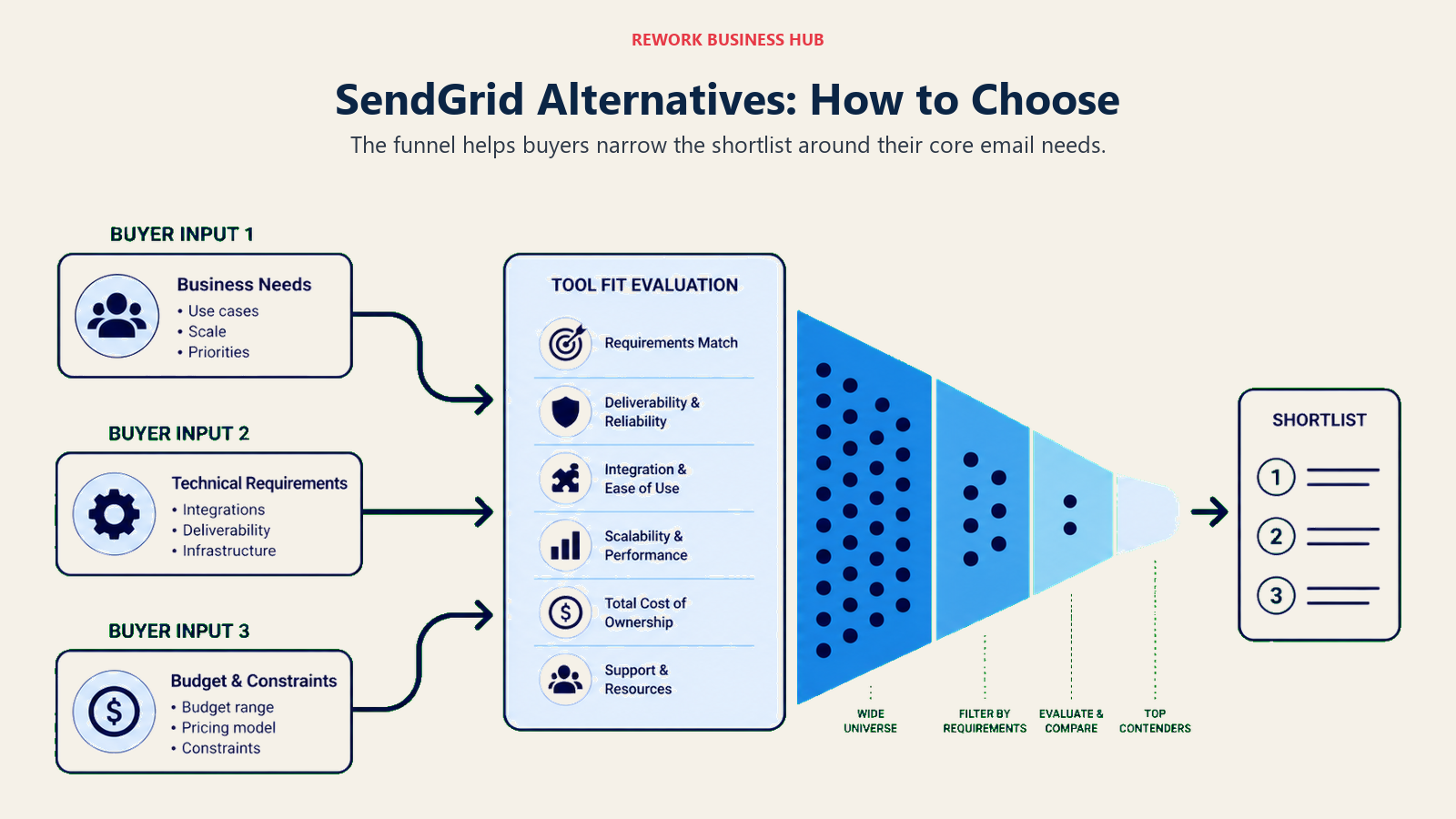
The funnel helps buyers narrow the shortlist around their core email needs.
| If you need... | Pick this |
|---|---|
| The cleanest transactional-only deliverability reputation | Postmark |
| The most direct like-for-like SendGrid replacement, with a real free tier | Mailgun |
| A modern developer experience built around React/Next.js | Resend |
| The lowest cost per email at real volume, and you're on AWS | Amazon SES |
| Email plus SMS from one budget-friendly API | MailerSend |
| The simplest SMTP relay swap with no code changes | SMTP2GO |
| Transactional and lifecycle email in one contact-priced tool for a SaaS product | Loops |
| Usage-based email pricing today, with more channels coming later | Bird |
| Transactional API and a campaign builder in one low-cost account | Brevo |
| The most generous free tier for combined transactional and marketing sending | Mailjet |
| Behavior-triggered messaging across email, push, SMS, and in-app | Customer.io |
| Enormous scale, mature deliverability tooling, and Twilio ecosystem integration | Staying on SendGrid |
Frequently Asked Questions about SendGrid Alternatives
Does SendGrid still have a free plan?
No. Twilio retired the Free Email API and Free Marketing Campaigns plans effective May 27, 2025. Existing free accounts kept access for 60 days before sending paused. The entry point now is a 60-day free trial capped at 100 emails a day and 100 contacts, then Essentials pricing starts at $19.95/mo.
What is the cheapest SendGrid alternative that still has a permanent free tier?
Mailgun (100 emails/day, no expiry) and Postmark (100 emails/month, no expiry) both still offer permanent free tiers. Mailjet's is the largest at 6,000 emails/month, capped at 200 a day.
Is Amazon SES really free to use?
Not on an ongoing basis. New accounts get up to $200 in AWS Free Tier credits, not specific to email. Past that, SES bills at $0.10 per 1,000 emails sent, with no permanent monthly free allowance.
What's the difference between SendGrid's Email API and Marketing Campaigns products?
Two separate products under one brand. Email API is the developer-facing transactional and SMTP relay tool. Marketing Campaigns is contact management and broadcast for newsletters and promotions. Both had their free plans retired in 2025, and most teams only need to replace one, not both.
Which alternative is best if I need both transactional and marketing email in one tool?
Brevo and Mailjet both combine a transactional API with a campaign builder in the same account. Brevo is cheaper at scale up to Standard; Mailjet's free tier is more generous if you're still testing volume.
Is Bird a good SMS alternative to pair with a transactional email provider?
Not yet. Bird's own pricing page prices email only and marks SMS and WhatsApp "Coming soon." Judge it on the email product today, and look at dedicated SMS platforms if you need text messaging now.
Can I migrate away from SendGrid without rewriting my application code?
Often, yes, if your app sends through SMTP rather than a vendor-specific SDK. SMTP2GO, Mailgun, Postmark, and Mailjet all support standard SMTP relay, so migration can be closer to swapping credentials than rewriting integration code.
How much does it cost to send 100,000 emails a month with these alternatives?
Roughly: Mailgun's Scale plan is $90/mo, SMTP2GO's Professional is $75/mo, Resend's Pro tier scales to $35/mo at that volume, and Amazon SES runs about $10 in pure sending cost, plus any add-ons like dedicated IPs.
What to Do Next
Start by figuring out which SendGrid product you're actually replacing, Email API or Marketing Campaigns, using the shortlist table near the top of this guide. Then pick two candidates and run a real test: send your actual transaction types (or a representative campaign) through each vendor's free tier or trial for a week, and compare inbox placement, not just whether the send succeeded. If you're leaving because of the free-plan retirement and just need reliable transactional sending, start with Mailgun or Postmark. If you're leaving because you need marketing campaigns and never really used SendGrid's transactional side, start with Brevo or Mailjet instead.
A couple of adjacent decisions worth making at the same time: if SMS is part of your plan, pricing splits enough between vendors like Klaviyo (email and SMS billed separately) that it's worth reading the best Klaviyo alternatives guide first. And whichever email API you land on, pairing it with the right CRM is usually the next decision after the vendor itself.

Principal Product Marketing Strategist
On this page
- Key Facts
- Two Shortlists: Email API vs. Marketing Campaigns
- Quick Comparison Table
- Free Tier and Entry Price Comparison
- Stage Fit Matrix
- Sizing and Persona Table
- 1. Postmark - the specialist that keeps transactional email away from marketing noise
- 2. Resend - the email API built for developers who live in React
- 3. Mailgun - the closest like-for-like swap, and one of the last with a real free tier
- 4. Amazon SES - the cheapest email at real volume, if you're willing to do the setup yourself
- 5. MailerSend - the budget option that bundles SMS into the same API
- 6. SMTP2GO - the drop-in SMTP relay for teams that don't want to touch their code
- 7. Loops - transactional and lifecycle email in one contact-based tool, built for SaaS
- 8. Bird - a usage-priced email API from a name best known for SMS, with the rest still "coming soon"
- 9. Brevo - the closest one-tool replacement if you're leaving both SendGrid products at once
- 10. Mailjet - the most generous free tier for teams doing both transactional and marketing send
- 11. Customer.io - behavior-triggered messaging for product and growth teams, not just email
- Where SendGrid Still Wins
- How to Choose: Decision Framework
- What to Do Next