Best Mailchimp Alternatives in 2026: 11 Email Marketing Tools for Growing Teams
Turn this article into takeaways for your work.


Each assistant summarizes the article only for you and suggests best practices for your work.
Mailchimp built its reputation on one idea: email marketing that doesn't require a developer. For years it delivered on that promise, especially for small businesses sending newsletters, promotional blasts, and simple drip sequences. Then Intuit acquired it, the free tier shrank, pricing restructured around contact thresholds, and the tool that felt affordable at 500 subscribers started looking expensive at 10,000. Mailchimp's pricing reflects that contact-tier model clearly.
If you're re-evaluating Mailchimp, you're probably in one of a few situations: your contact list grew past a tier break and pricing jumped faster than your revenue; you need automation sequences that Mailchimp handles only at higher tiers; your CRM and email tool are disconnected and you're manually syncing segments; or you're a creator who wants a platform built for your audience model, not a small-business marketing tool wearing a creator hat. All of those are valid reasons to look. Here are 11 alternatives worth a serious evaluation.
Quick Comparison Table
| Tool | Best For | Starting Price | Key Strength | Key Limitation |
|---|---|---|---|---|
| Brevo | Budget-conscious teams needing email + SMS + chat | Free tier; paid from $9/mo | Email + SMS + live chat at one price, not per-contact billing | Automation depth thinner than ActiveCampaign |
| ActiveCampaign | Growth-stage teams wanting deep automation + CRM | From $15/mo (500 contacts) | Most powerful automation builder in the mid-market | Gets expensive quickly; UI complexity increases with depth |
| Klaviyo | E-commerce brands running email + SMS revenue campaigns | Free up to 250 contacts; from $20/mo | Revenue attribution, Shopify/WooCommerce native | Priced for e-commerce; weak outside that context |
| ConvertKit (Kit) | Creators, newsletter writers, solopreneurs | Free up to 10,000 subscribers; from $25/mo | Creator-native: paid newsletters, tip jars, subscriber tagging | Limited CRM depth; not built for B2B sales workflows |
| Constant Contact | Small businesses wanting hands-on support | From $12/mo | Strong phone/chat support, event management tools | Limited automation; interface feels dated |
| HubSpot Marketing Hub | Mid-to-large teams wanting a full marketing suite | Free CRM; Marketing Hub from $15/mo | Full funnel: landing pages, ads, email, forms, CRM together | Hub pricing multiplies fast at Professional/Enterprise |
| Campaign Monitor | Design-focused teams wanting beautiful email templates | From $11/mo | Best-in-class template designer, reliable deliverability | Automation limited on base plans; no native SMS |
| MailerLite | Budget-conscious small teams needing email + landing pages | Free up to 250 subscribers; from $12/mo | Clean UI, built-in landing pages | Limited integrations; no native CRM |
| Drip | E-commerce brands wanting workflow-heavy email automation | From $39/mo (2,500 contacts) | Deep e-commerce workflow automation, revenue tracking | Expensive relative to Klaviyo for similar use cases |
| Omnisend | E-commerce brands wanting email + SMS + push combined | Free up to 250 contacts; from $16/mo | Multi-channel automation across email, SMS, push, and web | Outside e-commerce, the tool's focus narrows significantly |
| Beehiiv | Newsletter publishers and media creators | Free up to 2,500 subscribers; from $39/mo | Built for growth: referral programs, paid subscriptions, analytics | Not an email marketing tool for businesses; pure newsletter platform |
Stage Fit Matrix
| Tool | Startup (1-10) | Growth Stage (10-100) | Mid-Market (100-500) | Enterprise (500+) |
|---|---|---|---|---|
| Brevo | Good fit | Good fit | Works | Limited depth |
| ActiveCampaign | Works | Strong fit | Good fit | Gets complex |
| Klaviyo | Works (e-com) | Strong fit (e-com) | Good fit (e-com) | Works |
| ConvertKit (Kit) | Strong fit | Works (creators) | Not ideal | Not designed for it |
| Constant Contact | Strong fit | Works | Limited | Not designed for it |
| HubSpot | Works (free) | Good fit | Strong fit | Enterprise tier |
| Campaign Monitor | Works | Good fit | Works | Limited automation |
| MailerLite | Strong fit | Works | Limited | Not designed for it |
| Drip | Works (e-com) | Good fit (e-com) | Works | Limited |
| Omnisend | Works (e-com) | Strong fit (e-com) | Good fit | Limited |
| Beehiiv | Strong fit | Strong fit (creators) | Works (media co) | Not designed for it |
Sizing and Buyer Persona Table
| Tool | Typical Company Size | Who Buys It |
|---|---|---|
| Brevo | 1-200 employees | Marketing Manager, Small Business Owner |
| ActiveCampaign | 10-500 employees | Marketing Director, Growth Marketer, Marketing Ops |
| Klaviyo | 5-500 employees | E-commerce Owner, DTC Brand CMO, Email Marketer |
| ConvertKit (Kit) | 1-20 (solo to small creator teams) | Creator, Newsletter Writer, Online Course Seller |
| Constant Contact | 1-50 employees | Small Business Owner, Office Manager |
| HubSpot | 20-1,000 employees | CMO, Marketing Ops, RevOps, Sales Director |
| Campaign Monitor | 5-500 employees | Email Designer, Marketing Coordinator, Agency |
| MailerLite | 1-100 employees | Small Business Owner, Blogger, Course Creator |
| Drip | 5-200 employees | E-commerce CMO, Email Marketing Manager |
| Omnisend | 5-500 employees | E-commerce Marketing Manager, DTC Brand Owner |
| Beehiiv | 1-50 (media/creator teams) | Newsletter Founder, Content Marketer, Publisher |
1. Brevo: Email + SMS + Chat at One Price
Brevo (formerly Sendinblue) made a deliberate bet against contact-based billing. Instead of charging you per subscriber, Brevo charges per email sent. That single difference changes the economics for businesses with large, infrequently mailed lists. If you have 50,000 contacts but only email 10,000 per month, Brevo's cost is a fraction of what Mailchimp would charge.
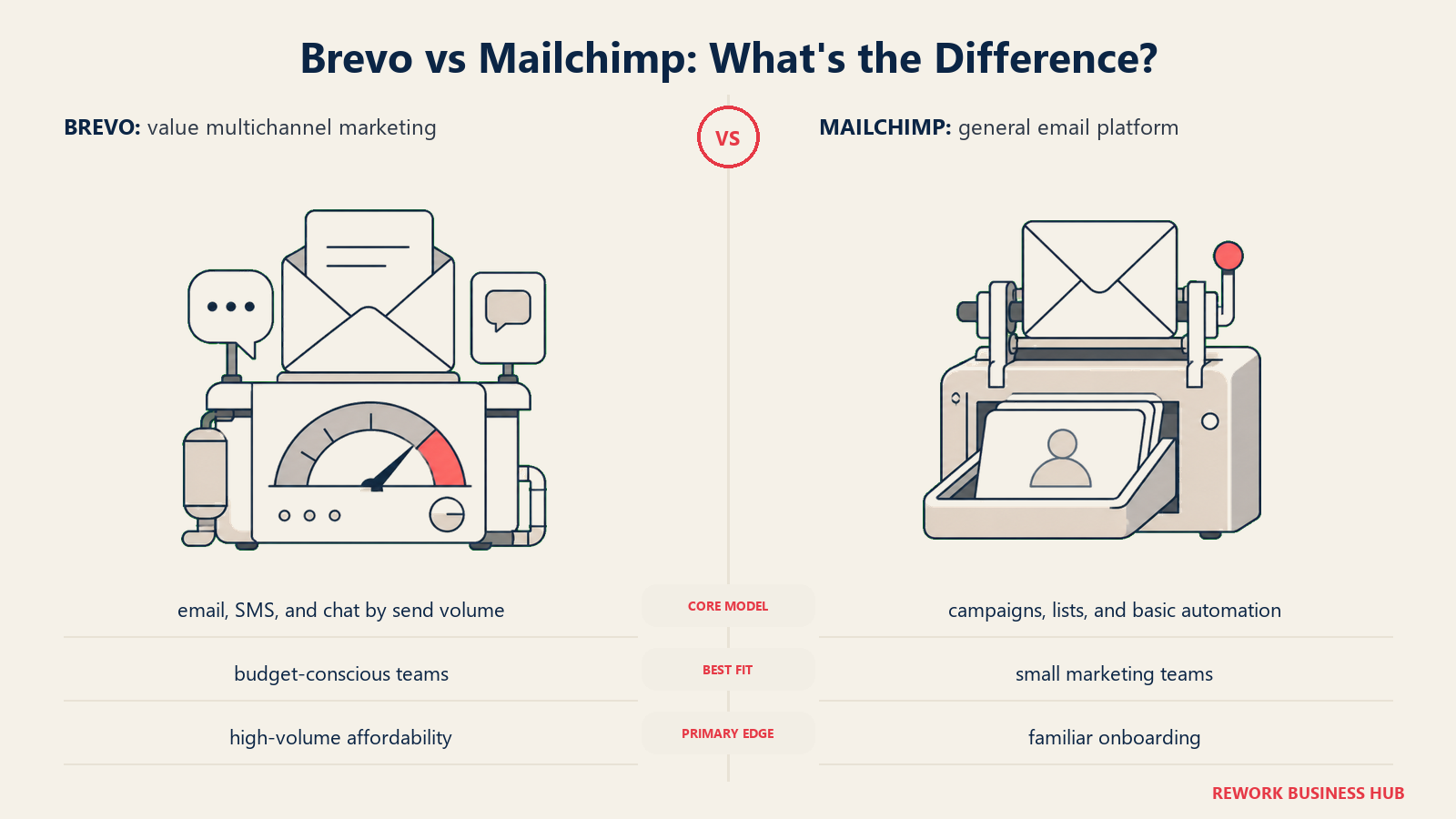
The platform covers email campaigns, transactional email, SMS, WhatsApp, live chat, and marketing automation under one roof. The automation builder is functional, with triggered sequences, conditional branching, and lead scoring available at mid-tier plans. It's not as deep as ActiveCampaign but covers the workflows most growth-stage marketing teams actually run.
The CRM built into Brevo is lightweight. It handles contact management and pipeline visibility, but it's not a replacement for a full CRM if your sales team needs quota tracking, territory routing, or deep activity logging. Think of it as a contact database with deal stages, not a revenue operations tool.
| What you get | What you don't |
|---|---|
| Email, SMS, WhatsApp, live chat in one pricing model | Deep sales CRM with pipeline and quota tracking |
| Contact-count-agnostic pricing (pay per send, not per subscriber) | ActiveCampaign-level automation depth |
| Transactional email included (not a separate add-on) | Large integration marketplace |
| Free plan for up to 300 emails/day | Klaviyo-grade e-commerce revenue attribution |
Pricing: Free for up to 300 emails/day. Starter from $9/month, Business from $18/month (annual, unlocks automation and A/B testing), Brevo Plus on request.
Best for: SMBs and growth-stage teams with large, infrequently mailed lists who want email + SMS without per-contact billing penalties.
2. ActiveCampaign: Automation Powerhouse
ActiveCampaign is what Mailchimp's automation wants to be. The visual automation builder supports multi-branch logic, conditional wait steps, goal tracking, split testing of automation sequences, and CRM-triggered actions that most tools reserve for enterprise tiers. If ActiveCampaign is your frontrunner and you want to understand its own ceiling, the best ActiveCampaign alternatives covers where teams typically outgrow it. If you've hit the ceiling of Mailchimp's automation and need sequences that respond to behavior, not just timers, ActiveCampaign is the most capable tool in this list for that use case.
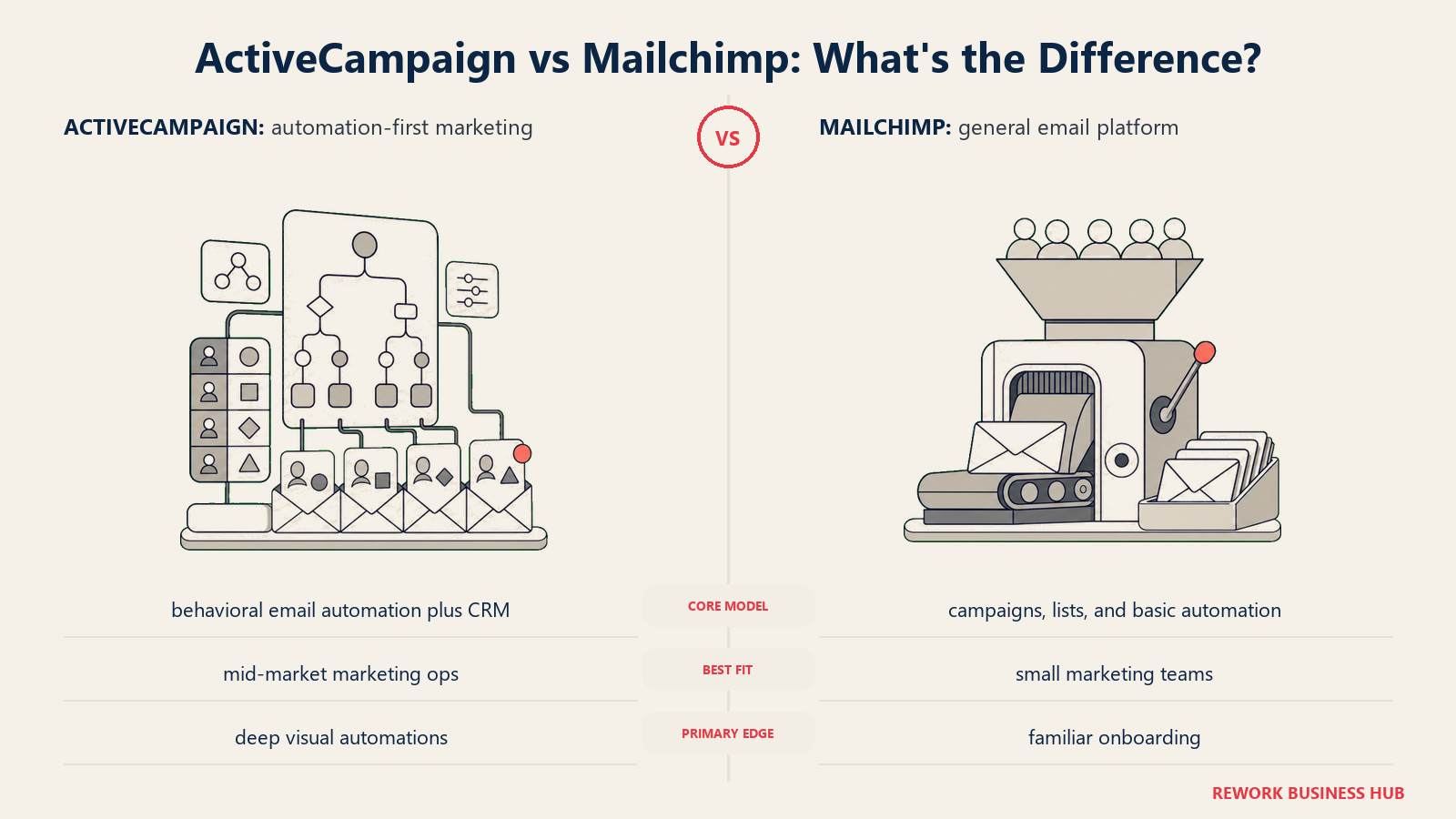
The CRM (called Deals) is included at higher tiers and handles pipeline management, contact scoring, and sales automation alongside marketing workflows. The integration between email behavior and CRM actions is tighter than in most bundled tools. Sales reps can see exactly which emails a contact opened and what links they clicked, with that history surfaced inside the deal record.
The honest limitation is complexity-to-cost. ActiveCampaign's free trial is 14 days. The pricing is contact-based like Mailchimp, so your bill grows with your list. And the automation depth that makes it powerful also creates a learning curve: new users frequently describe spending weeks building their first multi-branch sequence correctly.
| What you get | What you don't |
|---|---|
| Most powerful automation builder in the mid-market | Mailchimp's brand recognition and beginner friendliness |
| CRM (Deals) included at Plus tier and above | Simple, flat pricing that doesn't grow with contacts |
| Predictive sending and content AI at higher tiers | Native WhatsApp or Instagram DM inbox |
| 900+ integrations including Salesforce, Shopify, WordPress | A quick onboarding path for non-technical marketers |
Pricing: Starter from $15/month (1,000 contacts), Plus from $49/month, Pro from $79/month, Enterprise from $145/month (annual). Prices scale with contact count.
Best for: Growth-stage B2B and B2C teams that need sophisticated automation sequences and want CRM + marketing automation in one product at mid-market pricing.
3. Klaviyo: E-Commerce Email + SMS Revenue Engine
Klaviyo dominates the Shopify ecosystem for good reason. Its integration with Shopify, WooCommerce, BigCommerce, and Magento is native and deep: product feeds, cart events, order history, and predicted lifetime value all flow into segmentation and triggers without custom setup. The revenue attribution dashboard shows you, per campaign and flow, how much money each email generated. That's the metric e-commerce marketers actually care about, and Klaviyo reports it better than almost anyone.
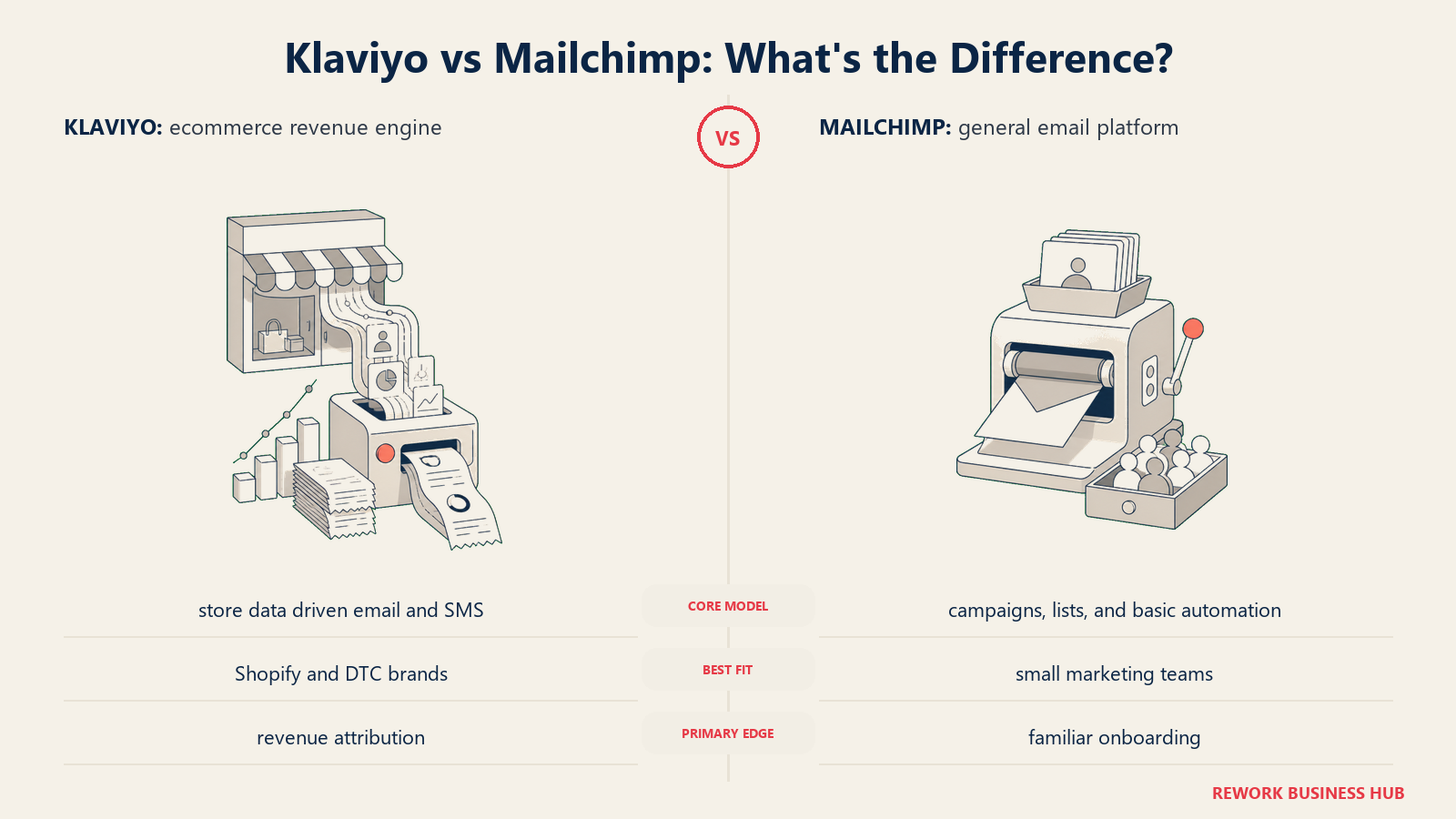
Beyond e-commerce, Klaviyo's value proposition narrows considerably. The CRM functionality is contact management, not sales pipeline. The automation builder is excellent for behavior-driven e-commerce sequences but less natural for B2B nurture programs. And the pricing, which is per active profile, becomes expensive fast for high-volume sender lists.
| What you get | What you don't |
|---|---|
| Native Shopify/WooCommerce integration with full order history | A B2B sales CRM or pipeline tool |
| Revenue-per-email attribution out of the box | Affordable pricing at high contact volumes |
| SMS + email in one workflow | A strong solution outside e-commerce |
| Predictive analytics (CLV, churn probability) | Deep multi-channel inbox (chat, social DMs) |
Pricing: Free up to 250 contacts and 500 emails/month. Email plan from $20/month (500 contacts), Email + SMS from $35/month. Scales by active profiles.
Best for: DTC e-commerce brands on Shopify or WooCommerce that want revenue-focused email + SMS automation with native store data integration.
4. ConvertKit (Kit): Creator-Native Email
ConvertKit, now rebranding as Kit, made a single-minded product bet: build for creators, not businesses. That focus shows throughout the product. Paid newsletter support, tip jars, digital product sales, subscriber tagging by interest, and a visual content map for planning email sequences all exist natively. The subscriber model (not a contact model) reflects how creators think about their audience, not how a sales team thinks about a CRM.
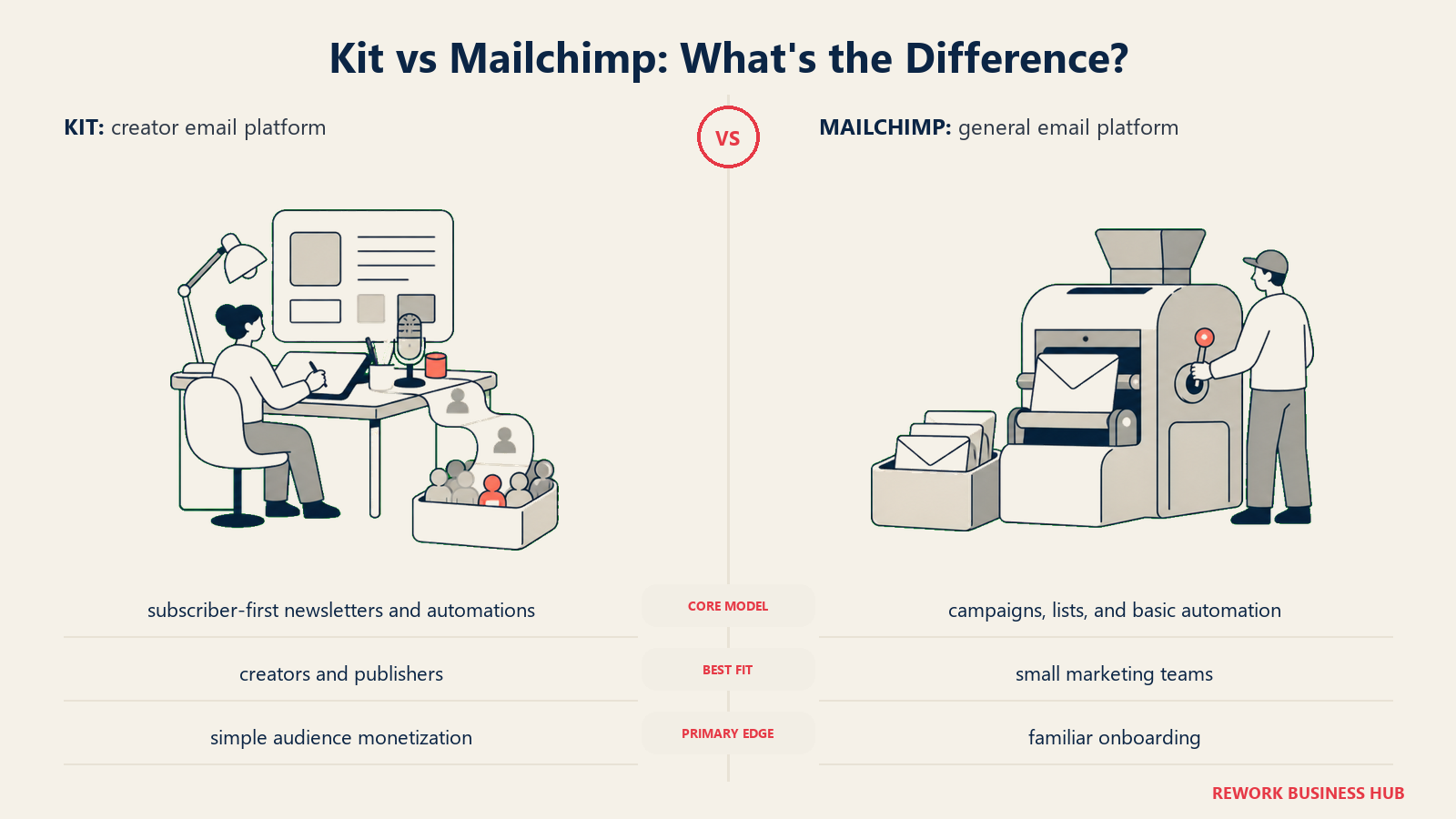
The free plan up to 10,000 subscribers is genuinely generous and includes broadcasts, one automation sequence, and the ability to sell digital products. For a creator just starting out, it's the most generous free tier on this list.
Where Kit falls short is B2B depth. There's no sales pipeline, no lead distribution, no CRM contact timeline. It's designed for one-to-many creator communication, not one-to-one sales engagement. If your team has both a newsletter and a sales motion, you'll need another tool alongside it.
| What you get | What you don't |
|---|---|
| Free plan for up to 10,000 subscribers | A B2B sales CRM or pipeline |
| Paid newsletters, digital product sales built in | Multi-channel inbox or SMS |
| Creator-native UX (subscriber tagging, content map) | Deep automation branching |
| Visual automation sequences | Contact-level behavioral scoring |
Pricing: Free up to 10,000 subscribers (limited automations). Creator plan from $25/month (1,000 subscribers), Creator Pro from $50/month (1,000 subscribers), scaling by subscriber count.
Best for: Individual creators, newsletter writers, online educators, and solopreneurs who want an email platform built around audience ownership rather than marketing campaigns.
5. Constant Contact: Simple Email for Small Business
Constant Contact has been in the email marketing space since 1995. That longevity shows in its support infrastructure: phone support, live chat, and an onboarding call are available even on base plans, which is unusual at this price point. For small business owners who want a human to talk to when something breaks, that matters.
The product itself is reliable and approachable. Template builder, list management, basic automation, event marketing tools, and social media posting all exist under one roof. It's not trying to be ActiveCampaign. The automation stays simple by design, which is either a feature or a limitation depending on what you need.
The honest assessment: Constant Contact has not kept pace with competitors on automation depth or CRM integration. If you've outgrown Mailchimp because you need more sophisticated sequences, Constant Contact is unlikely to solve that problem.
| What you get | What you don't |
|---|---|
| Phone + chat support on all plans | Deep automation or conditional logic |
| Event marketing tools (registration, RSVPs, ticketing) | Native CRM with pipeline tracking |
| Reliable deliverability track record | Modern pricing model (it's still contact-based) |
| Social media posting built in | Strong e-commerce revenue attribution |
Pricing: Lite from $12/month, Standard from $35/month, Premium from $80/month (annual). Pricing scales by contact count.
Best for: Small businesses and nonprofits that prioritize support access and simple, reliable email over automation depth.
6. HubSpot Marketing Hub: Full Marketing Suite
HubSpot's strength is scope. Marketing Hub connects email campaigns, landing pages, forms, blog publishing, social media tools, ad management, SEO recommendations, and the HubSpot CRM into a single platform. If your team is already evaluating HubSpot's full suite, the best HubSpot alternatives covers where its pricing model breaks down relative to mid-market alternatives. For teams that want one tool to manage the entire top-of-funnel, including where visitors come from, what they convert on, and how they flow into a sales pipeline, HubSpot is the most complete package. HubSpot Marketing Hub pricing is worth checking directly. The Professional tier jump is where teams usually get surprised.
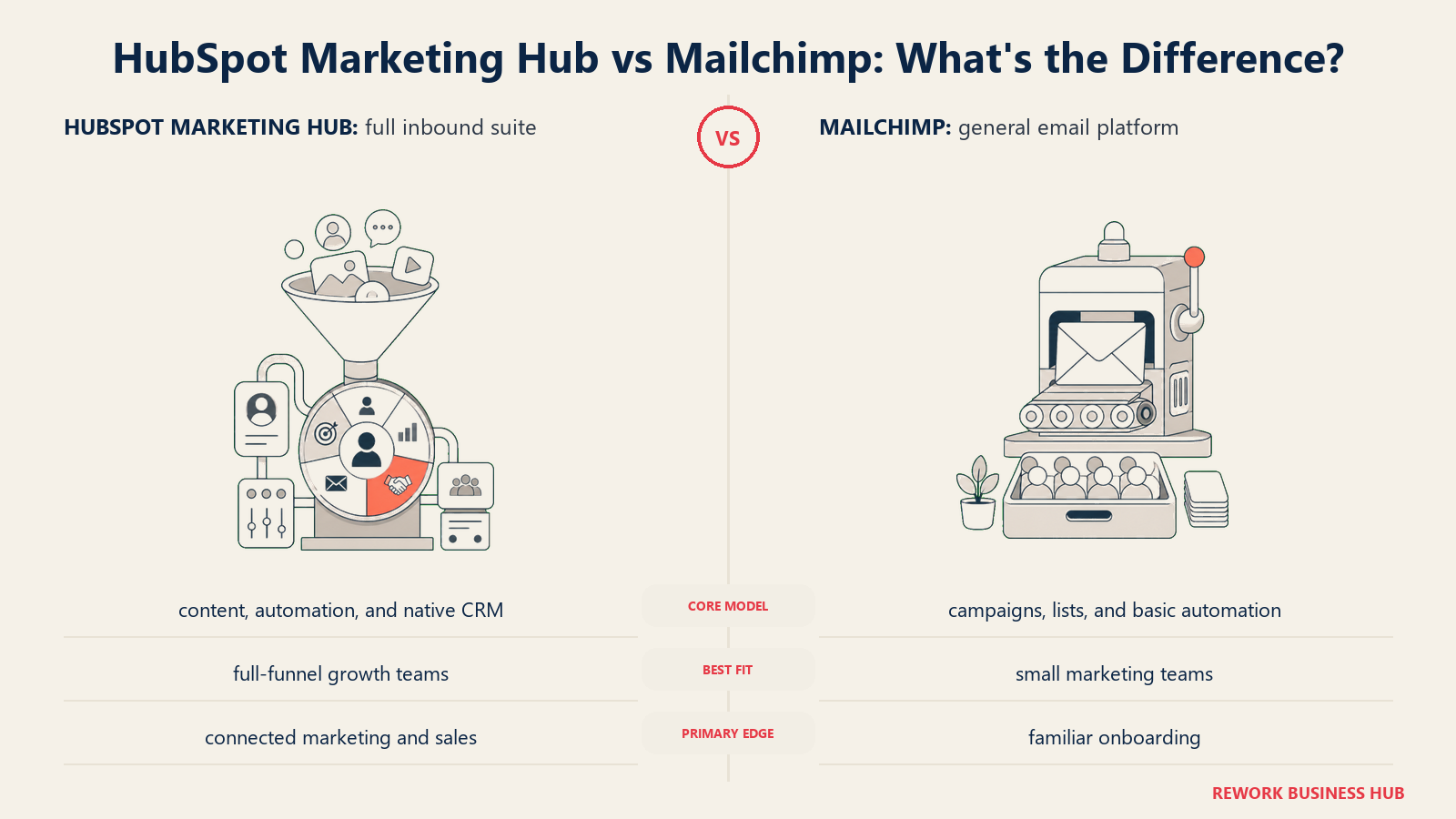
The pricing model is where it gets complicated. The free CRM and basic email tools are genuinely useful and free. But the features most growing marketing teams actually need (A/B testing, behavioral email automation, advanced segmentation, attribution reporting, custom reporting) are locked behind Marketing Hub Starter ($15/seat/month) or Professional ($800/month flat, regardless of seat count). Professional is where HubSpot starts to earn its reputation as expensive.
| What you get | What you don't |
|---|---|
| Full marketing suite: email, landing pages, ads, blog, SEO | Simple pricing that doesn't compound |
| Native CRM + sales pipeline in the same product | Core automation features without a Professional subscription |
| Strong onboarding ecosystem (HubSpot Academy, certified partners) | Flexibility outside the HubSpot orbit |
| Contact-based marketing attribution back to pipeline | A lean, focused email tool |
Pricing: Free CRM (limited). Marketing Hub Starter at $15/seat/month. Marketing Hub Professional at $800/month (flat, up to 3 seats, 2,000 contacts included). Enterprise at $3,600/month.
Best for: Mid-size marketing teams that want a complete inbound marketing platform and are willing to pay for the Professional tier to unlock its full capability.
7. Campaign Monitor: Design-Focused Email
Campaign Monitor's reputation is built on one thing: beautiful emails. The template designer and drag-and-drop builder are consistently rated among the best in the market, and deliverability has been strong for over a decade. For brands where email design quality is a brand expression and not just a delivery mechanism, that matters.
The platform covers standard campaign management, basic segmentation, triggered automation, and transactional email. Journey Designer handles multi-step automation sequences with a visual canvas. What it lacks is CRM depth, SMS native integration (available via third-party apps), and the advanced automation branching that ActiveCampaign provides.
| What you get | What you don't |
|---|---|
| Best-in-class template designer | Deep automation or conditional split logic |
| Strong deliverability track record | Native SMS or multi-channel inbox |
| Journey Designer for visual automation | CRM with sales pipeline |
| Flexible per-campaign pricing option | Generous free tier |
Pricing: Basic from $11/month (500 contacts, 2,500 sends), Unlimited from $19/month (500 contacts, unlimited sends), Premier from $149/month. Scales by subscriber count.
Best for: Brands and agencies that prioritize email design quality, reliable deliverability, and clean UX over deep CRM or advanced automation features.
8. MailerLite: Affordable Email + Landing Pages
MailerLite targets the sweet spot between Mailchimp's ease-of-use and Brevo's affordability. The free tier covers 250 subscribers and 2,500 emails per month. The paid plans are priced well below Mailchimp for equivalent contact volumes. And the feature set covers what most small-to-mid marketing teams actually need: campaigns, automation sequences, landing pages, signup forms, pop-ups, and basic A/B testing.
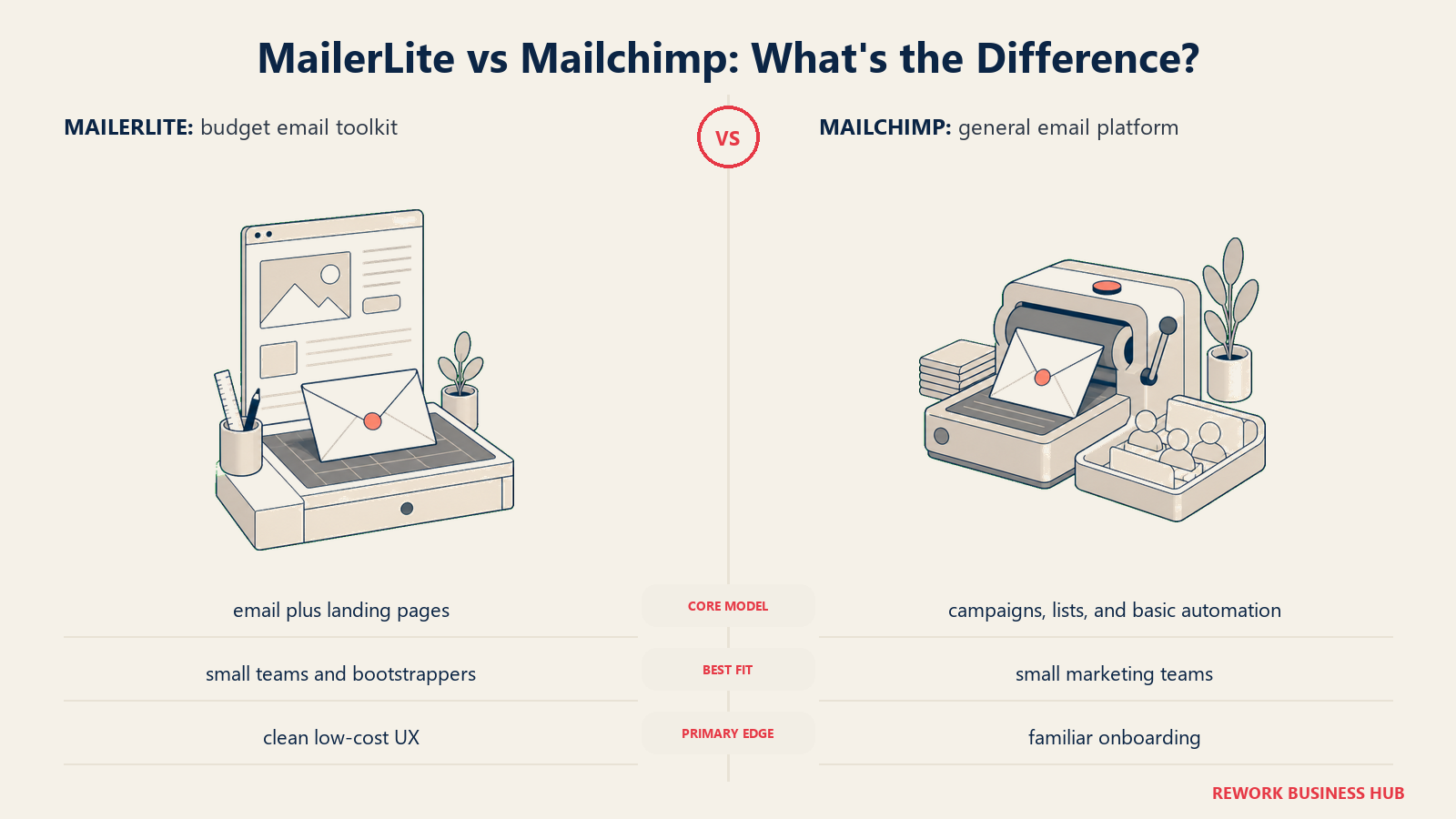
The limitations show up when teams scale. The integration library is smaller than HubSpot or ActiveCampaign. The automation builder handles standard triggered sequences but lacks advanced branching. There's no native CRM. And custom HTML email editing has had inconsistencies reported by technical users.
| What you get | What you don't |
|---|---|
| Free tier covers 250 subscribers, 2,500 emails/month | Deep CRM or sales pipeline |
| Built-in landing pages and pop-up forms | Large integration ecosystem |
| Clean, simple UX with minimal learning curve | Advanced automation branching |
| Affordable pricing vs Mailchimp at equivalent volumes | Reliable custom HTML editing |
Pricing: Free up to 250 subscribers and 2,500 emails/month. Comfort from $12/month (500 subscribers), Power from $25/month (500 subscribers, unlimited emails). Scales by subscriber count. See mailerlite.com/pricing.
Best for: Small businesses, bloggers, and early-stage startups that want a clean, affordable email tool with landing pages included, without needing CRM or advanced automation.
9. Drip: E-Commerce Email Automation
Drip positions itself as the e-commerce CRM. Its automation workflows are designed around the purchase journey: abandoned cart, post-purchase sequences, win-back campaigns, VIP segmentation by spend, and revenue reporting per workflow. The visual workflow builder handles conditional logic well and the e-commerce event tracking is solid.
Compared to Klaviyo, Drip tends to appeal to teams that want slightly more flexibility in their automation builder and don't need Klaviyo's predictive analytics. Compared to Mailchimp, it's significantly more powerful for e-commerce automation but starts at a higher price floor.
| What you get | What you don't |
|---|---|
| Strong e-commerce workflow automation (cart, post-purchase, win-back) | The predictive LTV analytics of Klaviyo |
| Revenue tracking per automation flow | A native SMS product (available via integrations) |
| Visual workflow builder with conditional branching | A strong B2B use case |
| Shopify, WooCommerce, Magento integrations | A competitive free tier |
Pricing: From $39/month for 2,500 contacts, scaling by contact count. No free plan beyond a 14-day trial.
Best for: E-commerce brands that want workflow-heavy email automation with revenue tracking and prefer Drip's workflow model over Klaviyo's profile-centric approach.
10. Omnisend: E-Commerce Multi-Channel Marketing
Omnisend competes directly with Klaviyo in the e-commerce space and differentiates on multi-channel native support. Email, SMS, push notifications, and web push all exist within the same automation workflow, and the pricing includes SMS credits on higher plans rather than charging them as a separate line item. For e-commerce brands that want a single tool to coordinate all owned marketing channels, Omnisend is a more integrated option than Mailchimp.
The platform has strong Shopify integration, a straightforward automation builder for e-commerce use cases, and a free plan that includes SMS alongside email. Outside e-commerce, the product's value narrows. There's no B2B CRM, no lead management, and the automation is optimized around commerce events.
| What you get | What you don't |
|---|---|
| Email + SMS + push notifications in one automation workflow | A B2B sales or lead management tool |
| SMS credits included at higher tiers (not a separate add-on) | Deep automation branching for non-commerce use cases |
| Free plan includes SMS sends | The predictive analytics depth of Klaviyo |
| Strong Shopify + WooCommerce native integration | A large enterprise feature set |
Pricing: Free up to 250 contacts (500 emails, 60 SMS/month). Standard from $16/month, Pro from $59/month (annual). Scales by contact count.
Best for: E-commerce brands on Shopify or WooCommerce wanting email + SMS + push notifications coordinated in one automation platform without separate SMS billing.
11. Beehiiv: Newsletter Platform for Creators
Beehiiv is not an email marketing tool. It's a newsletter publishing platform. That distinction matters when evaluating alternatives. Beehiiv gives newsletter creators everything they need to grow, monetize, and analyze their publication: referral programs, paid subscription tiers, ad network access, a beautiful web-hosted archive, subscriber segmentation, and analytics designed around open rates and audience growth, not sales pipeline conversion.
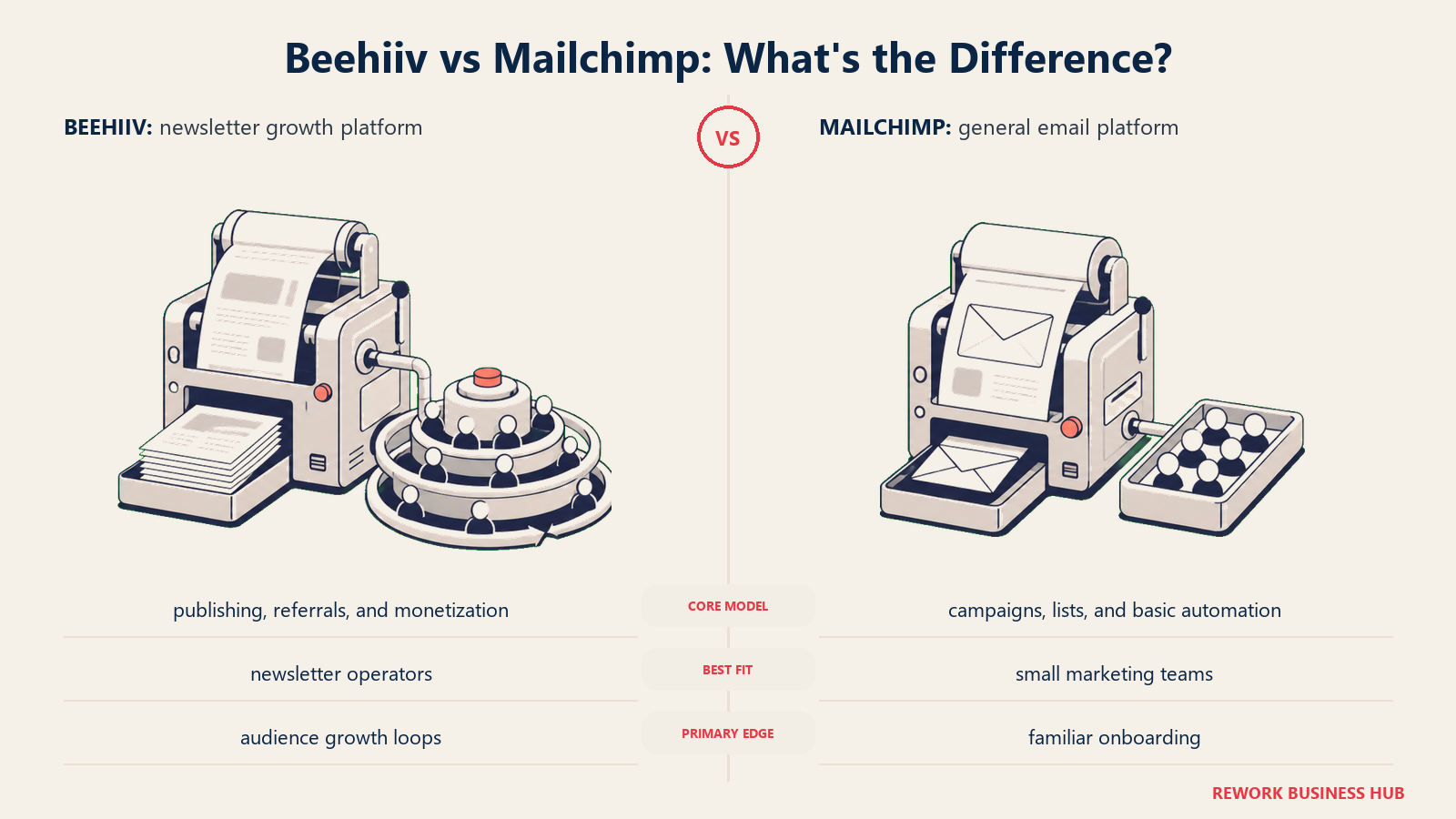
The product is not trying to be Mailchimp. It doesn't have landing page builders for lead gen campaigns, CRM pipeline views, or marketing-to-sales handoff workflows. If you're a business using Mailchimp to run drip campaigns that feed into a sales motion, Beehiiv won't replace that. If you're a business using Mailchimp because you happen to send a newsletter and wish the platform were built around newsletter growth, Beehiiv likely fits better.
| What you get | What you don't |
|---|---|
| Built-in paid subscriptions and tip jar | A marketing campaign tool for business lead gen |
| Referral programs and audience growth tools | CRM, pipeline, or sales workflow features |
| Ad network access to monetize your audience | Advanced marketing automation sequences |
| Beautiful web-hosted newsletter archive | Transactional email or e-commerce flows |
Pricing: Free up to 2,500 subscribers (Beehiiv branding). Launch from $39/month, Grow from $77/month, Scale from $159/month (annual). No per-send charges.
Best for: Newsletter founders, media companies, and content creators who want a platform purpose-built for audience ownership, monetization, and newsletter growth.
How to Choose: Decision Framework
| If your primary need is... | Pick this |
|---|---|
| Email + SMS at affordable per-send pricing (not per-contact) | Brevo |
| The most powerful automation builder in the mid-market | ActiveCampaign |
| E-commerce email + SMS with native Shopify revenue attribution | Klaviyo or Omnisend |
| Creator newsletter with paid subscriptions and audience growth tools | Beehiiv or ConvertKit (Kit) |
| Simple email with phone support and an easy setup | Constant Contact |
| Full inbound marketing suite (email + landing pages + ads + CRM) | HubSpot Marketing Hub |
| Beautiful email design and reliable deliverability | Campaign Monitor |
| Clean, affordable UX for a small list | MailerLite |
| E-commerce automation with flexible workflow builder | Drip |
| Multi-channel e-commerce (email + SMS + push, inclusive pricing) | Omnisend |
Why People Leave Mailchimp
Worth naming clearly, because the reason you're leaving shapes which alternative actually fits.
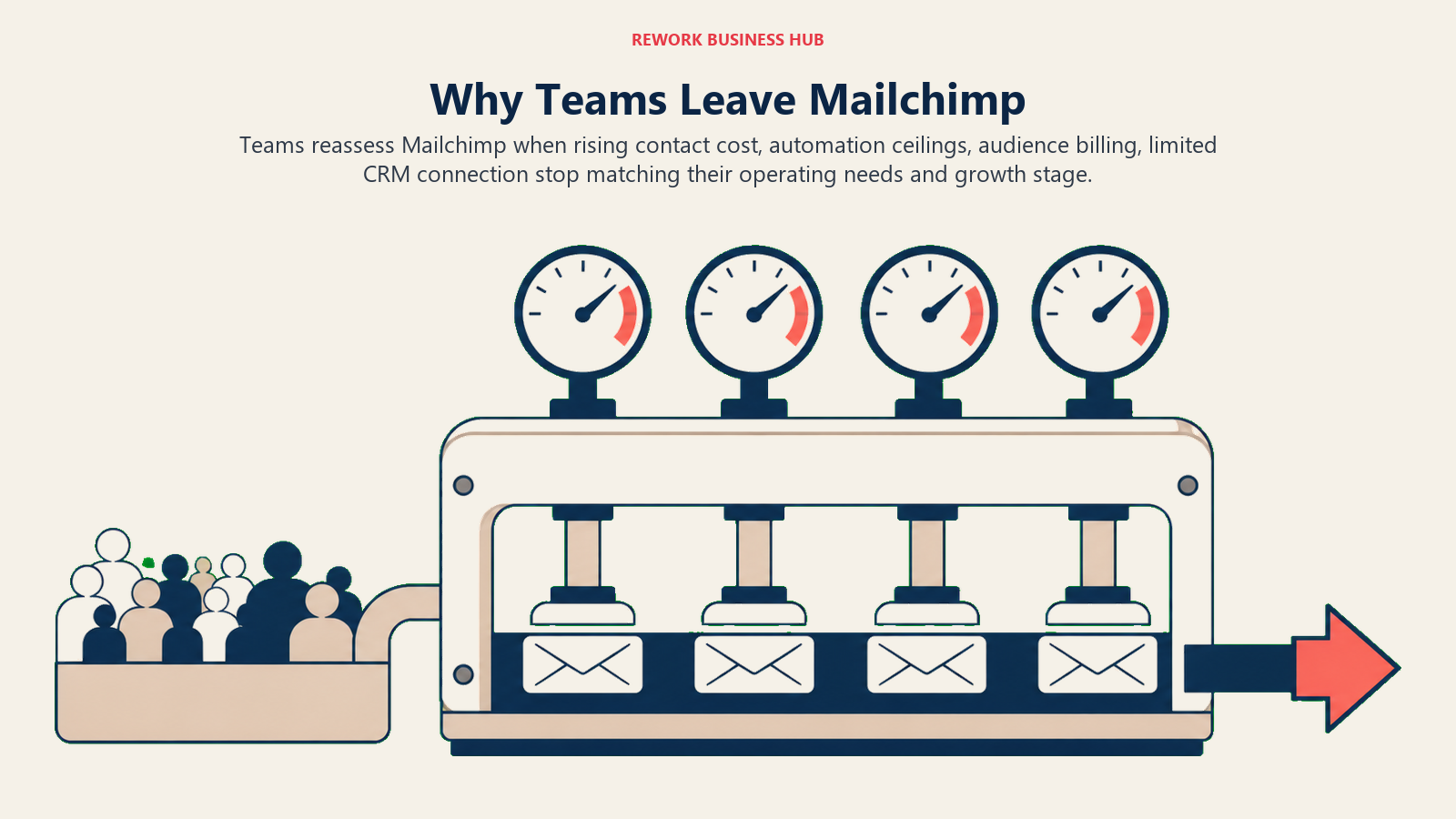
| Reason for leaving | Best alternatives to consider |
|---|---|
| Pricing jumped at a contact tier break | Brevo (per-send pricing), MailerLite, ConvertKit |
| Automation too limited for multi-branch sequences | ActiveCampaign, HubSpot Marketing Hub |
| CRM is bolted-on, not native; sales and marketing disconnected | HubSpot, ActiveCampaign |
| Intuit acquisition changed the product direction or pricing | Brevo, MailerLite, Campaign Monitor |
| Running an e-commerce brand and need revenue attribution | Klaviyo, Omnisend, Drip |
| Creator who wants audience ownership + monetization tools | Beehiiv, ConvertKit (Kit) |
| Contact-based billing too expensive for large, infrequently mailed lists | Brevo, MailerLite |
What to Do Next
Pick your top two from the table above, and run a two-week pilot with real contacts from your current list. Teams focused on closing the marketing-to-sales handoff gap should also review how lead capture automation feeds into a CRM pipeline, which shows where email tools end and proper lead management begins. Most tools on this list offer free plans or free trials long enough to run one actual campaign sequence. The setup friction you hit in week one is usually a reliable signal of the ongoing maintenance burden.
For Klaviyo-specific comparisons, the best Klaviyo alternatives covers the e-commerce-specific landscape. If you're also evaluating all-in-one agency platforms as an alternative to stacking individual email tools, see best GoHighLevel alternatives. And for teams sorting out how leads flow from ads into their email sequences, Meta Lead Ads to CRM is the practical guide.
For context on what's actually driving email marketing ROI in 2026, Mailchimp's own Email Marketing Benchmarks report shows industry-level open and click rates by sector, worth checking before you assume switching tools will solve a list-quality or audience-fit problem.

Principal Product Marketing Strategist
On this page
- Quick Comparison Table
- Stage Fit Matrix
- Sizing and Buyer Persona Table
- 1. Brevo: Email + SMS + Chat at One Price
- 2. ActiveCampaign: Automation Powerhouse
- 3. Klaviyo: E-Commerce Email + SMS Revenue Engine
- 4. ConvertKit (Kit): Creator-Native Email
- 5. Constant Contact: Simple Email for Small Business
- 6. HubSpot Marketing Hub: Full Marketing Suite
- 7. Campaign Monitor: Design-Focused Email
- 8. MailerLite: Affordable Email + Landing Pages
- 9. Drip: E-Commerce Email Automation
- 10. Omnisend: E-Commerce Multi-Channel Marketing
- 11. Beehiiv: Newsletter Platform for Creators
- How to Choose: Decision Framework
- Why People Leave Mailchimp
- What to Do Next