Best ManyChat Alternatives in 2026: 10 Chat Automation Tools for Lead Generation Teams
Turn this article into takeaways for your work.


Each assistant summarizes the article only for you and suggests best practices for your work.
The best ManyChat alternatives in 2026 are Respond.io, Tidio, Chatfuel, Rework, WATI, MobileMonkey, Crisp, Drift, Freshchat, and Sleekflow. The right pick depends on whether you need a CRM-connected lead pipeline, the widest messaging-channel coverage, or simple Meta-only bot automation. This guide compares all ten on pricing, strengths, and fit.
ManyChat built a legitimate product category. Visual bot flows on Facebook Messenger, Instagram DM, WhatsApp, and SMS that qualify leads, deliver content, and trigger follow-up sequences without a human in the loop. It works. For DTC brands, course creators, coaching businesses, and local services running social ad campaigns, ManyChat's playbook delivers real conversion lifts. The free plan is generous enough that even small teams can test it without a budget conversation.
But lead generation teams at growing companies increasingly run into ManyChat's edges. The platform lives entirely inside Meta's ecosystem: Instagram, Facebook, and WhatsApp. There's no email automation built in. There's no CRM. When a lead moves out of the bot flow, they land in whatever tool you've stitched to ManyChat via Zapier or a native integration, and that handoff is often where the lead goes quiet. For teams handling more than a few hundred conversations a month across multiple channels, and for ops or sales leaders who want one system connecting capture through close, ManyChat starts to feel like a capable piece of a puzzle that still needs assembling. If that's where you are, this list is for you.
Quick Comparison Table
| Tool | Best For | Starting Price | Key Strength | Key Limitation |
|---|---|---|---|---|
| Respond.io | High-volume WhatsApp + social messaging for sales and CS operations | $79/mo (Team) | Best multi-channel inbox for messaging-heavy markets; strong API | No native CRM or sales pipeline |
| Tidio | SMBs and e-commerce wanting AI chatbot + live chat | Free; paid from $29/mo | Fast setup, Lyro AI, Shopify-native | Limited for B2B CRM or multi-team lead routing |
| Chatfuel | No-code bot automation on Facebook and Instagram for Meta-first teams | Free; paid from $14.99/mo | Simple visual bot builder; Meta-specific features and direct API access | Narrower than ManyChat; Meta-only |
| Rework | Mid-size teams needing CRM + multi-channel inbox + lead capture | From $159/mo billed yearly, 5 marketing + 5 sales seats (rework.com/pricing) | WhatsApp, Messenger, IG DM, TikTok, web chat in one inbox tied to lead routing and a sales pipeline | No comment-to-DM growth tools or free plan; overkill for solo creators and DTC social campaigns |
| WATI | WhatsApp Business API for lead gen and customer notifications | From $49/mo | WhatsApp-native automation + broadcast + API at accessible pricing | WhatsApp-only channel coverage |
| MobileMonkey / Customers.ai | Cross-platform chat marketing for B2C and mid-market growth teams | From $199/mo | Multi-channel bot outreach: web, Messenger, SMS, Instagram | Pricing jump from basic to full-featured tiers |
| Crisp | Small teams wanting affordable multi-channel chat | Free; Pro from $25/mo | Honest value, multi-channel at low cost | Outgrown quickly past 20-30 agents |
| Drift | B2B sales teams running conversational marketing playbooks | From ~$2,500/mo | Best ABM chatbot + Salesforce integration for enterprise | Enterprise pricing; not viable for growth-stage |
| Freshchat | Freshworks users needing messaging + support in one suite | Free; from $15/agent/mo | WhatsApp, social channels, Freddy AI (inside Freshworks stack) | Limited standalone value without Freshworks |
| Sleekflow | Social commerce teams in APAC wanting unified messaging + automation | From $79/mo | WhatsApp, Messenger, WeChat, LINE, Telegram in one inbox | Smaller enterprise track record than Respond.io |
Why Teams Are Leaving ManyChat
The reasons teams outgrow ManyChat cluster around a few consistent patterns. Naming them matters, because the right alternative depends entirely on which problem is driving the switch.
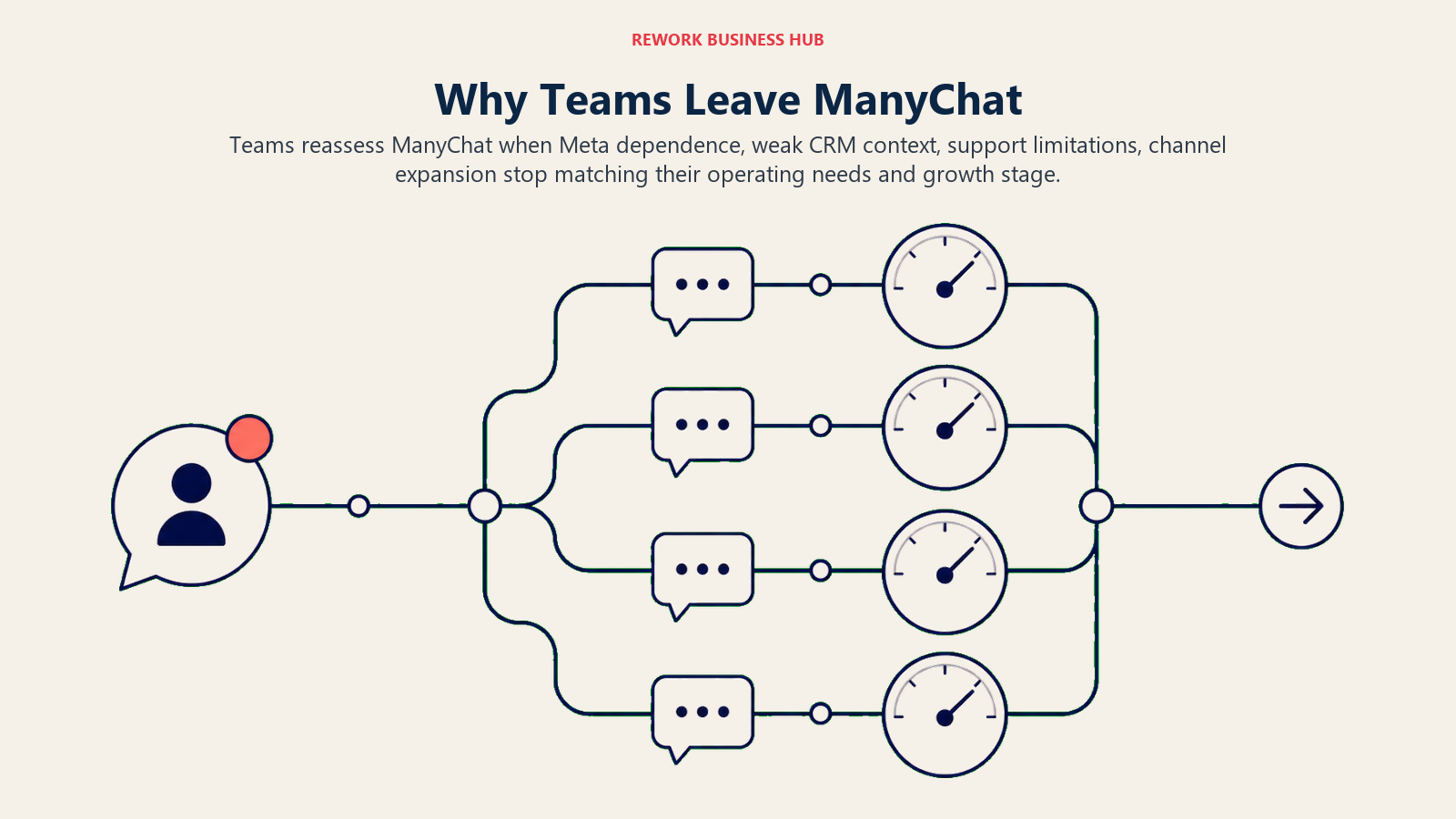
Meta-dependency is a real risk. ManyChat's automation runs on Facebook, Instagram, and WhatsApp. Every flow lives inside Meta's platform policies, API terms, and algorithm decisions. When Meta changes messaging rules (which happens), ManyChat teams wake up to broken flows or restricted accounts. Teams that discovered this the hard way are now looking for platforms not structurally dependent on a single network's goodwill.
No native email or SMS. ManyChat has added SMS and email as channels, but they're add-ons with separate pricing layers, not first-class tools built for lead nurture sequences. Teams trying to run a true multi-channel lead gen workflow (DM to email to SMS follow-up) find themselves assembling that through Zapier or Make, which adds fragility. For the alternative approach, ad-to-chat funnels shows how a connected funnel should actually work.
No CRM means lead data lives nowhere useful. ManyChat captures lead data inside its own contacts view. Getting that data to Salesforce, HubSpot, or a spreadsheet requires integration work. For sales teams that need lead context when they pick up a conversation, "the data is in ManyChat" is not a workable answer.
Automation gets complex fast at scale. The visual flow builder is intuitive for simple sequences. But large catalogs of products, complex conditional branching based on CRM data, or multi-team routing logic quickly produce flows that are hard to maintain. Teams with 50+ active flows often describe ManyChat's canvas as something only the person who built it can navigate.
No unified inbox for support. ManyChat's orientation is outbound automation and lead capture. Customer service teams trying to use it as a support inbox for incoming WhatsApp and Instagram messages run into the tool's structural limitations. There's no SLA tracking, no agent assignment logic at any depth, and no ticket-style resolution flow.
Stage Fit Matrix
| Tool | Startup (1-20) | Growth Stage (20-200) | Mid-Market (200-1000) | Enterprise (1000+) |
|---|---|---|---|---|
| Respond.io | Good fit | Good fit | Good fit | Good at volume |
| Tidio | Sweet spot | Works for SMB | Limited | Not designed for enterprise |
| Chatfuel | Sweet spot | Works well | Limited | Not designed for enterprise |
| Rework | Too much for very small teams | Sweet spot | Strong fit | Limited for F500-level governance |
| WATI | Good fit | Good fit | Moderate | Limited |
| MobileMonkey / Customers.ai | Small to mid | Growth stage | Moderate | Limited |
| Crisp | Sweet spot | Small scale only | Too light | Not viable |
| Drift | Not viable | Stretch (budget) | Good fit | Sweet spot |
| Freshchat | Good fit | Good fit | Moderate | Limited without enterprise Freshworks |
| Sleekflow | Good fit | Good fit | Growing | Early enterprise track |
Sizing and Persona Table
| Tool | Team Size Sweet Spot | Primary Buyer | Team or Company-Wide? |
|---|---|---|---|
| Respond.io | 5-500 employees | Head of Customer Comms, Sales Ops | Sales + CS; messaging-ops teams |
| Tidio | 1-100 employees | Founder, E-commerce Manager | Small support or e-commerce teams |
| Chatfuel | 1-100 employees | Social Media Manager, Growth Marketer | Marketing; Meta-first automation teams |
| Rework | 20-500 employees | COO, Head of Revenue, RevOps | Cross-team: sales, marketing, CS, ops |
| WATI | 5-200 employees | Head of Marketing, Sales Manager | Sales + marketing; WhatsApp-first teams |
| MobileMonkey / Customers.ai | 10-500 employees | CMO, Head of Growth, Digital Marketing Lead | Marketing-led; multi-channel campaigns |
| Crisp | 1-50 employees | Founder, Customer Support Lead | Small support + marketing teams |
| Drift | 200-5,000 employees | VP Sales, Demand Gen, RevOps | Sales + marketing; Salesforce orgs |
| Freshchat | 10-500 employees | Head of Support, IT Manager | CS + support inside Freshworks |
| Sleekflow | 5-300 employees | Head of Comms, E-commerce Manager | Sales + CS; messaging-heavy APAC teams |
1. Respond.io: Enterprise Multi-Channel Messaging
Respond.io is built for one job done at high volume: unify every messaging channel your customers use (WhatsApp Business API, Facebook Messenger, Instagram DM, Telegram, LINE, Viber, WeChat, web chat) into a single team inbox, and automate routing, assignment, and follow-up across all of them.
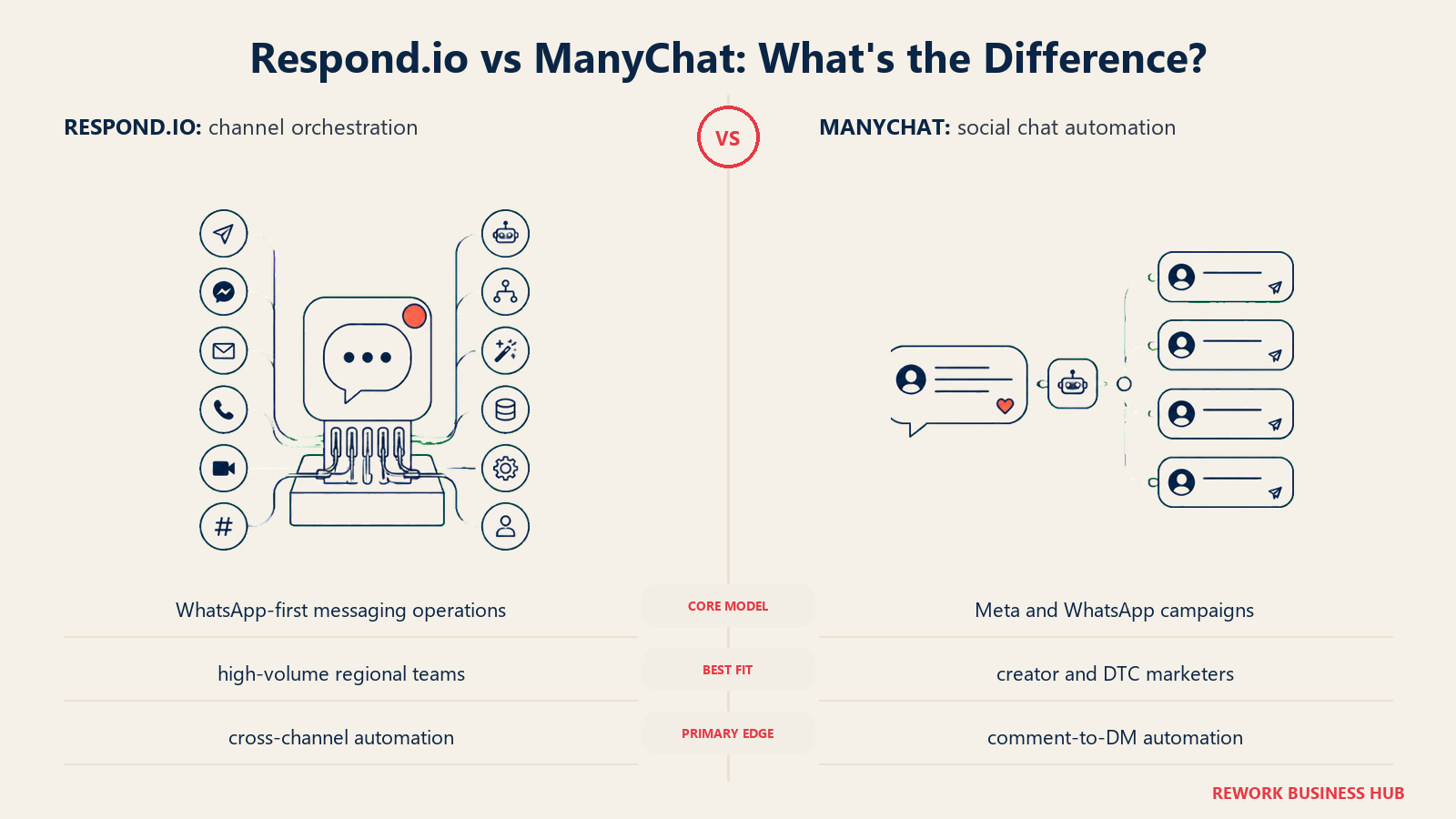
The product philosophy is messaging operations at scale. Respond.io doesn't try to build a CRM or a sales pipeline. It assumes your CRM lives elsewhere and builds deep API connectivity to sync contact data, trigger workflows from CRM events, and push conversation outcomes back to Salesforce, HubSpot, or whatever you're using. If you're evaluating Respond.io specifically, the Respond.io vs ManyChat B2B sales comparison goes deeper on how the two platforms handle B2B lead workflows differently. That separation is intentional. Respond.io focuses on being genuinely excellent at the messaging layer rather than competing as a CRM.
The channel coverage is the deepest on this list. No other tool in this comparison connects as many messaging channels natively. And the inbox is clean enough that agents can handle high volumes without losing context. For teams in Southeast Asia, the Middle East, or Latin America where WhatsApp, LINE, and Telegram are the primary inbound channels, Respond.io addresses the channel reality that Western-built tools routinely miss. The best Respond.io alternatives guide is worth reading if you want to see how it compares on price and automation depth.
The limitation is that it's a communications tool, not a go-to-market platform. Lead scoring, pipeline management, forecasting, and deal tracking live in your CRM. Respond.io handles the conversation layer.
| What you get | What you don't |
|---|---|
| Widest native channel coverage on the list: WhatsApp, Telegram, LINE, WeChat, Viber + more | Built-in CRM, deal pipeline, or lead management |
| Broadcasting and bulk messaging across compliant channels | Account-level targeting or ABM logic |
| Strong assignment automation and API for custom CRM integrations | A go-to-market platform that handles end-to-end revenue ops |
| Clean agent inbox for high-volume operations | Competitive pricing at growth stage relative to capability |
Pricing: Team $79/mo (5 users). Business $249/mo (10 users). Enterprise on request. See Respond.io's pricing page for current plans.
Best for: Operations and sales teams running high-volume conversations across WhatsApp and messaging channels, particularly in markets where Meta-platform messaging drives the majority of inbound leads.
2. Tidio: AI Chatbot + Live Chat for E-Commerce and SMBs
Tidio's differentiation is Lyro, its AI chatbot, and its tight Shopify and WooCommerce integration. The product philosophy is: help small businesses handle customer questions and capture leads without hiring a dedicated support team. Lyro handles a meaningful percentage of repetitive questions automatically, and the live chat interface lets human agents step in when the bot reaches its limits.
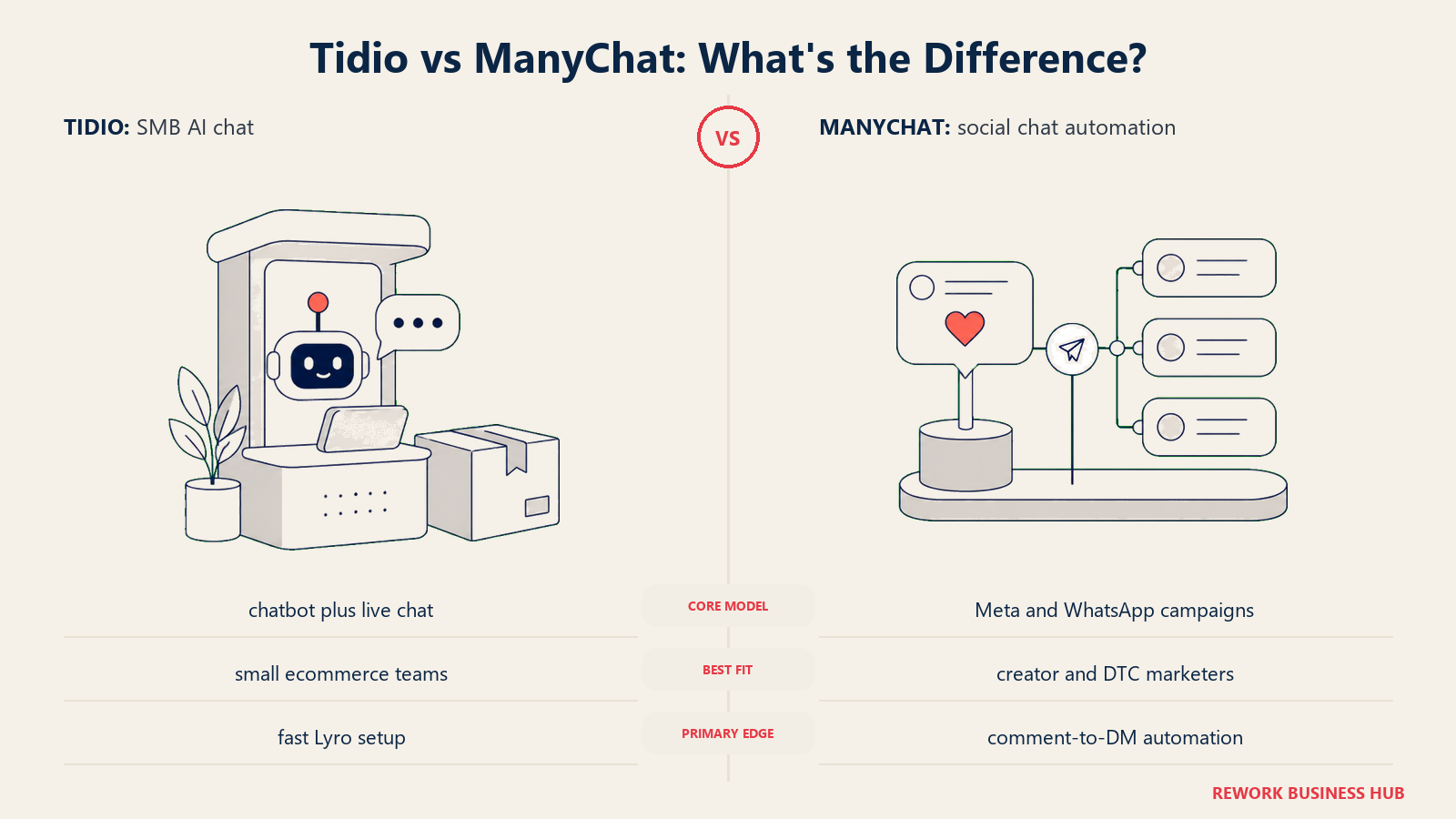
The target audience is clear: e-commerce brands, small service businesses, and SMBs that want chat automation without enterprise complexity or pricing. Setup is fast. A Shopify store with Lyro configured for product FAQs can be live in under an hour. The free tier covers basic functionality for very small teams, making it accessible without a budget conversation.
What Tidio doesn't do is B2B lead routing or CRM connectivity at any depth. There's no lead scoring, no round-robin assignment logic, no pipeline management. And the AI capabilities, while genuinely useful at small scale, don't match what Intercom's Fin or enterprise chatbot platforms deliver. Tidio is the right tool when ManyChat was overfit for your business and you mostly needed a faster answer engine for incoming questions. If you've outgrown Tidio, the best Tidio alternatives guide covers what comes next.
| What you get | What you don't |
|---|---|
| Fast Shopify / WooCommerce integration with Lyro AI chatbot | B2B routing, lead scoring, or CRM integration depth |
| Free tier that covers real use cases for small teams | Multi-team assignment logic or SLA tracking |
| Visual email automation builder on higher tiers | Complex conditional bot flows for large catalogs |
| Clean live chat interface with low onboarding friction | Competitive fit at mid-market or enterprise scale |
Pricing: Free tier (50 live chat conversations/mo). Starter $29/mo. Growth $59/mo. Tidio+ from $749/mo for Lyro at volume. See Tidio's pricing page for current details.
Best for: E-commerce brands and small service businesses that want AI chat deflection and lead capture without the overhead of a full chat automation platform.
3. Chatfuel: No-Code Chatbot for Meta
Chatfuel is a direct ManyChat competitor. Both tools build no-code bot automations for Facebook Messenger, Instagram, and WhatsApp. The product philosophy is nearly identical: visual flow builder, lead capture via conversational sequence, qualification logic, and handoff to human agents or CRM via integration. Chatfuel's interface is arguably cleaner for straightforward bot builds, and its direct Meta Business API partnership gives it access to features and higher message throughput on some tiers.
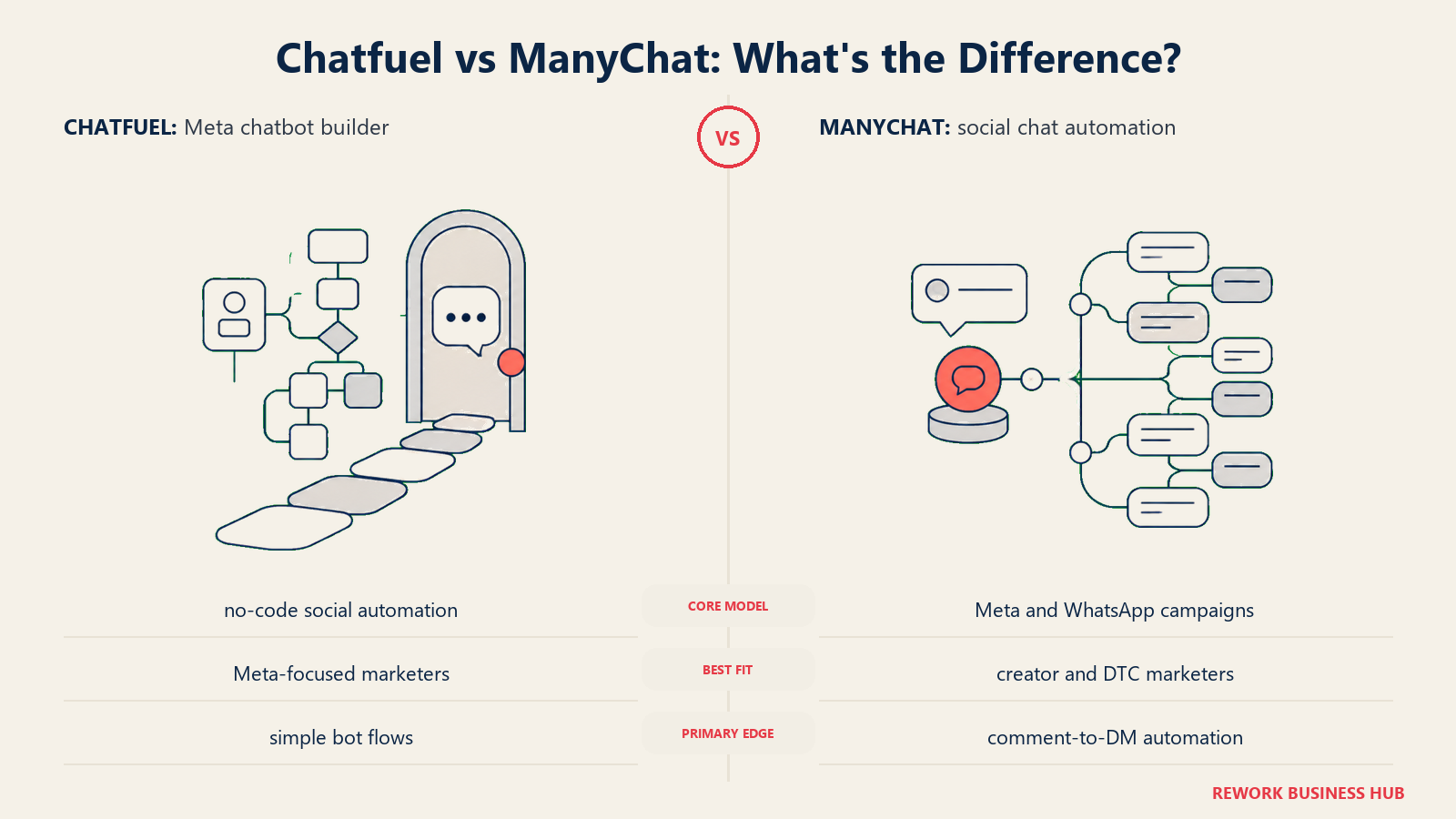
Where Chatfuel differs from ManyChat in practice is scope and ecosystem. ManyChat has a larger partner ecosystem and more third-party integrations. Chatfuel has invested more heavily in Meta-native features and WhatsApp Business API connectivity. For teams where WhatsApp is the primary lead channel (versus Messenger or Instagram DM), Chatfuel's WhatsApp focus is worth evaluating directly against ManyChat.
The limitation is the same one ManyChat has: the platform is Meta-only. No email automation, no web chat beyond bot embeds, no unified inbox that connects social DMs to email and phone. Teams that want to graduate from social bot automation to a full lead management workflow will hit the same ceiling here.
| What you get | What you don't |
|---|---|
| Clean no-code visual bot builder for Meta channels | Channels outside Meta's ecosystem |
| Strong WhatsApp Business API connectivity | Native email, SMS, or web chat inbox |
| Direct Meta partnership for higher throughput and API features | Built-in CRM or sales pipeline |
| Competitive pricing on basic tiers | A larger integration ecosystem than ManyChat |
Pricing: Free plan available. Entrepreneur $14.99/mo. Startup $24.99/mo. Small Business $59.99/mo. WhatsApp-specific plans from $47.99/mo. See Chatfuel's pricing page for current options.
Best for: Small to mid-size businesses that run Meta-focused lead capture and want a clean, focused alternative to ManyChat for Messenger, Instagram, and WhatsApp bot automation.
4. Rework: Chat Inbox Connected to Lead Routing and a Sales Pipeline
Rework is not a ManyChat-style growth tool. It has no comment-to-DM campaigns or creator growth widgets, and it isn't built for a solo creator or a one-person shop. What it does is put the chat channels a sales team works (WhatsApp, Messenger, Instagram DMs, TikTok, Telegram, LINE, Zalo and web chat) into one inbox with one profile per person, then hand those leads to a lead pipeline and CRM inside the same product.
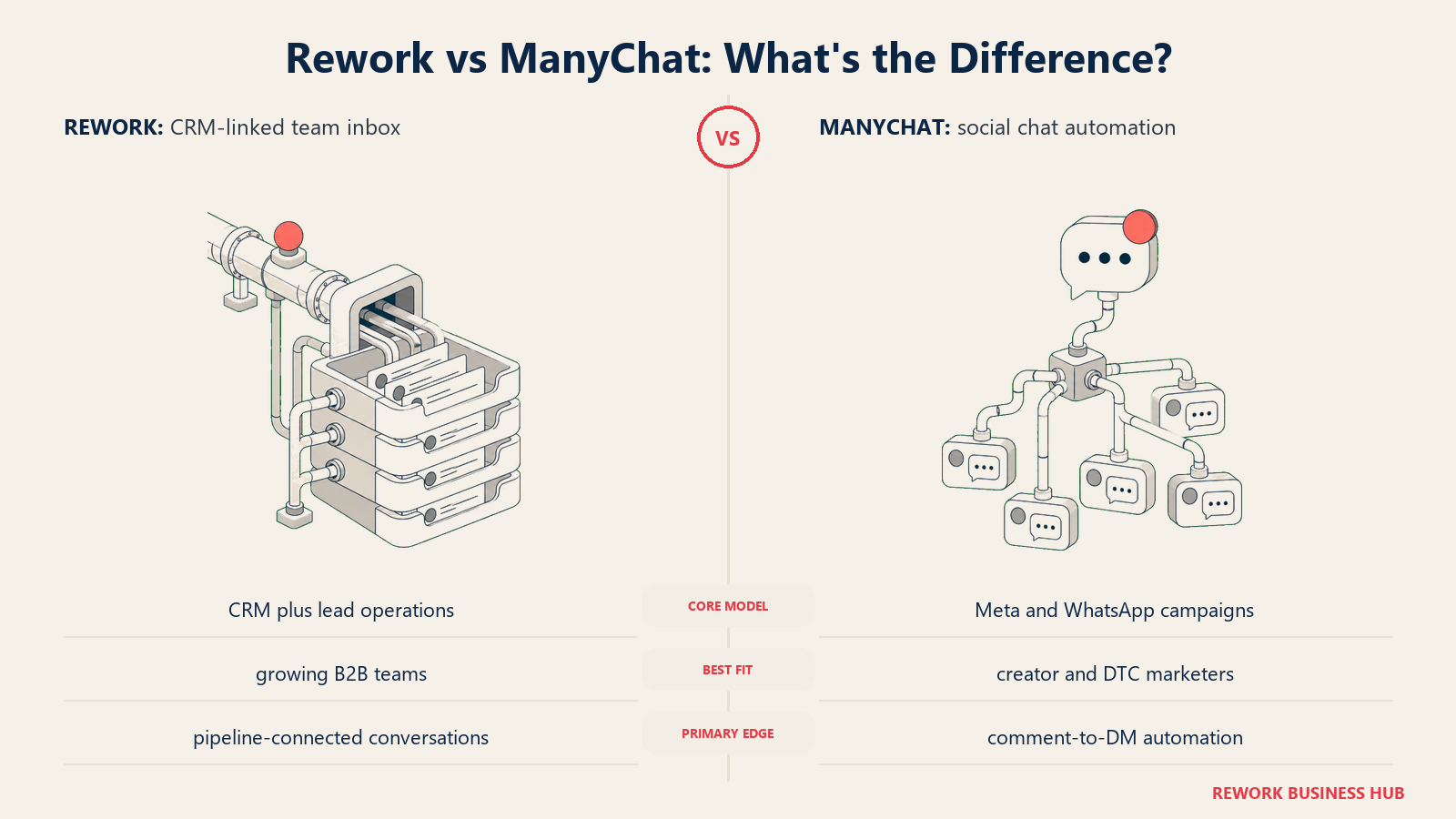
That makes it a fit for a narrower reader than the top three: lead generation teams of 20 or more where a DM has to become an assigned, followed-up deal. Scripted conversation flows ask questions, branch on answers, update fields and assign an agent, and AI agents (in beta) answer routine questions from a knowledge base. Leads from chat, forms and ad platforms are scored, routed by round-robin or rule-based routers with an SLA clock, and moved into a sales pipeline without an export step. The Respond.io alternatives guide covers how it compares with messaging-first platforms, and building a ManyChat qualification flow shows how teams bridge from social bot automation into a proper lead pipeline.
Where it falls short for a ManyChat reader: no free plan, no SMS or email in the chat inbox, broadcasts send on WhatsApp Business only, and the setup is heavier than a Meta bot builder you can launch in an afternoon.
| What you get | What you don't |
|---|---|
| WhatsApp, Messenger, IG DM, TikTok, Telegram, LINE, Zalo, web chat in one inbox | ManyChat-style growth tools such as comment-to-DM campaigns |
| Lead capture, scoring, round-robin distribution and SLA routing | SMS or email inside the chat inbox |
| Chat, lead and deal on shared records across marketing and sales | A fit for solo creators or one-person DTC shops |
| Pipeline from chat conversation to closed deal | A free plan (only a 14-day trial) |
Pricing: Revenue Engine (inbox, lead capture and CRM) is $159/month billed yearly ($1,908/year) or $190 month to month, with 5 marketing and 5 sales seats included. The inbox and lead tools alone are the Marketing Engine, from $99/month billed yearly. 14-day free trial. See rework.com/pricing.
Best for: Teams of roughly 20-500 people where social DMs feed a sales team, and the problem is leads going quiet between the chat and the pipeline rather than building bot campaigns.
5. WATI: WhatsApp Business API Platform
WATI is purpose-built for WhatsApp Business API: automation, broadcasts, shared team inbox, chatbots, and two-way conversation management, all within a single WhatsApp-native platform. The product methodology is clear: if WhatsApp is your primary sales and support channel, WATI gives you more depth on that channel than any multi-channel competitor.
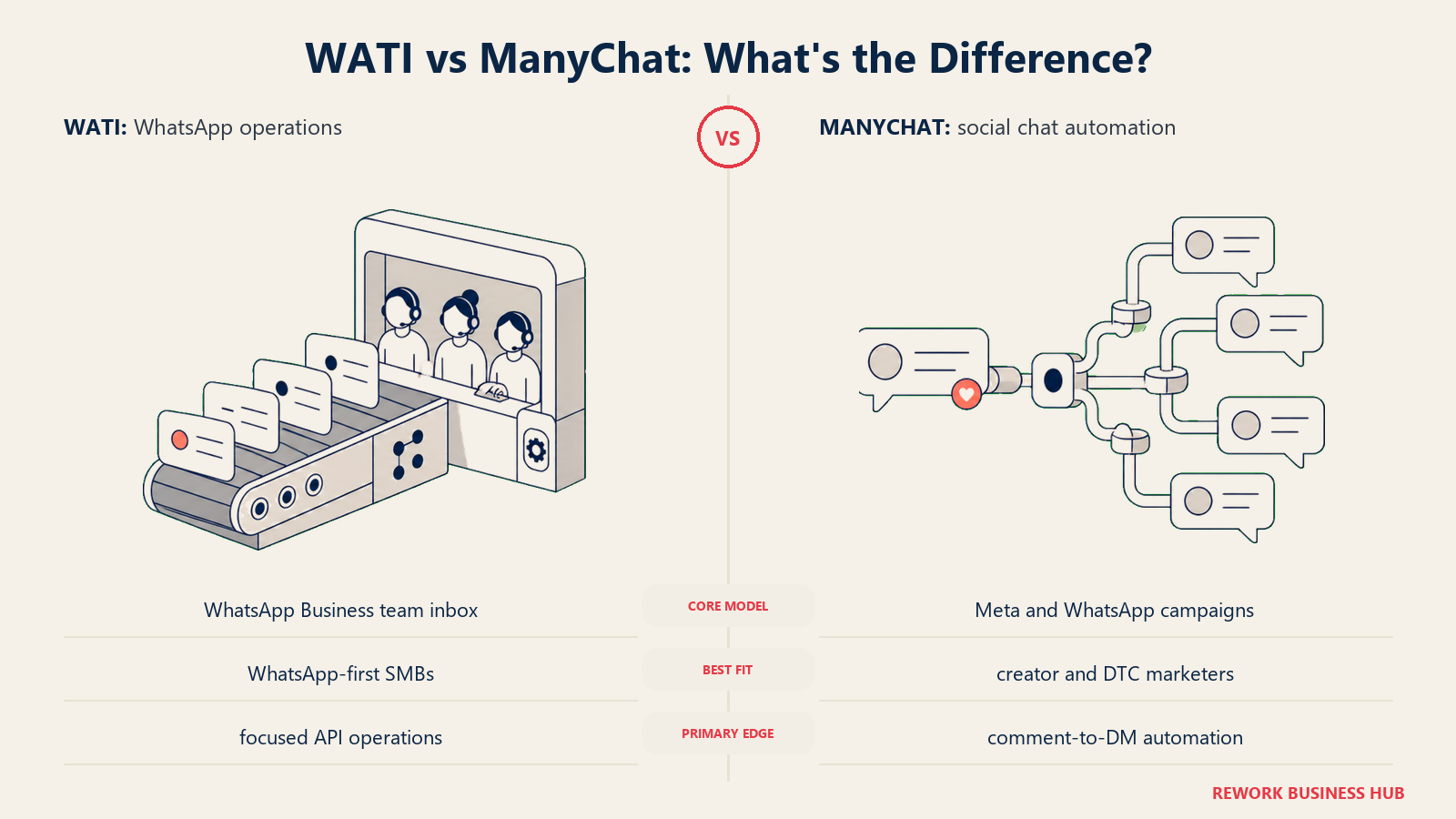
The team inbox is well-designed for small to mid-size customer-facing teams. Multiple agents can manage incoming WhatsApp conversations with assignment rules, auto-replies, and chatbot handoffs. The broadcast tool handles bulk messaging to opted-in contact lists within WhatsApp's policy limits. And the catalog integration lets e-commerce teams share product lists and payment links directly inside conversations.
WATI's limitation is the one the name implies: it's WhatsApp-only. If your leads come in via Instagram DM, Messenger, email, or web chat (and they increasingly do), WATI handles none of that. It's also not a CRM. Lead data lives in WATI's contact records and syncs to your CRM through integrations, but there's no pipeline, scoring, or deal management native to the platform. For teams considering a WhatsApp-first strategy more broadly, WhatsApp in B2B sales is worth reading before you commit.
| What you get | What you don't |
|---|---|
| Deep WhatsApp Business API tooling: broadcasts, chatbots, team inbox | Any channel beyond WhatsApp |
| Product catalog sharing and payment link support in-chat | Built-in CRM or pipeline management |
| Accessible pricing for SMB and growth-stage teams | Enterprise-grade routing or multi-team assignment logic |
| Pre-approved template management for broadcast compliance | Visitor intelligence or ABM targeting |
Pricing: Growth $49/mo (5 users). Pro $99/mo (5 users). Business $299/mo (10 users). Additional users billed per seat. See WATI's pricing page for details.
Best for: E-commerce, service businesses, and B2B teams in markets where WhatsApp is the dominant customer communication channel and the team needs more automation depth than ManyChat provides on WhatsApp specifically.
6. MobileMonkey (Customers.ai): Multi-Platform Chat Marketing
MobileMonkey, now operating under the Customers.ai brand, takes a broader approach to chat marketing than ManyChat. The product methodology is cross-platform lead generation: build bot flows and automated sequences across Instagram, Messenger, web chat, and SMS, with an emphasis on retargeting website visitors and converting social traffic into owned contact lists.
The Customers.ai positioning adds a data intelligence layer on top of the chat automation. The platform identifies website visitors (including anonymous visitors through data enrichment), and then routes them into chat sequences or SMS follow-ups. For growth-stage marketing teams spending on paid social and wanting to connect web traffic to messaging outreach, that visitor-identification capability is the differentiator.
The limitation is pricing clarity and product positioning complexity. The platform has gone through significant repositioning over the past two years, and the product's strengths depend on which plan tier you're evaluating. The entry-level offering is functional but limited; meaningful lead-gen features (visitor identification, full multi-channel sequences) require higher tiers that represent a meaningful monthly commitment for a team that was on ManyChat's $15/mo plan.
| What you get | What you don't |
|---|---|
| Cross-platform automation: Messenger, Instagram, web chat, SMS | WhatsApp Business API (limited coverage vs WATI or Respond.io) |
| Website visitor identification and retargeting into chat sequences | CRM, pipeline, or sales operations depth |
| Strong focus on growing owned contact lists from social traffic | A simple per-channel pricing model at growth stage |
| Integration hooks for email and CRM platforms | The stability of a narrowly focused product category |
Pricing: Starter plans from around $199/mo for meaningful features. Contact sales for full platform access.
Best for: Growth-stage marketing teams running paid social campaigns that want to connect web visitor data to automated chat and SMS sequences, and have budget for a full multi-channel marketing automation stack.
7. Crisp: Chat + Helpdesk for Small Teams
Crisp competes on pricing honesty and genuine multi-channel coverage for small teams. The free plan covers two agents with live chat, email integration, and a basic CRM-lite contact view. The Pro plan at $25/month per workspace adds chatbot automation, knowledge base, and multi-channel coverage across Messenger, Telegram, and email. The Unlimited plan at $95/month gives a small team a complete setup.
The product philosophy is straightforward: give growing companies a real multi-channel customer communication tool without forcing them into enterprise pricing before they've earned it. Crisp doesn't try to be an automation powerhouse or an ABM platform. It's a team inbox with a bot builder and a knowledge base layered on top.
For teams leaving ManyChat because they need a real inbox where agents can handle incoming conversations (not just outbound bot sequences), Crisp addresses that gap at a price point that doesn't require a budget conversation at small scale. The limitations become visible past 20-30 agents and when CRM depth or sales pipeline management becomes necessary. See Crisp's pricing page for current plan details.
| What you get | What you don't |
|---|---|
| Genuine multi-channel value: Messenger, Telegram, email, web chat | Social bot automation for Messenger or Instagram DM campaigns |
| Honest workspace-based pricing that doesn't scale with contact volume | CRM depth or sales pipeline for teams beyond 20 people |
| Knowledge base + chatbot builder included in mid-tier | Enterprise-grade routing, SLA management, or AI deflection |
| Clean inbox UX that agents learn quickly | Viable scaling path for fast-growing teams |
Pricing: Free (2 seats). Pro $25/mo per workspace. Unlimited $95/mo per workspace. Workspace-based pricing, not per seat.
Best for: Startups and bootstrapped teams under 30 people that need real multi-channel inbox capabilities and basic chatbot automation at a price that doesn't require enterprise budget approval.
8. Drift: Conversational Marketing for B2B Sales Teams
Drift sits at the opposite end of the spectrum from ManyChat. Where ManyChat targets social ad campaigns and DTC funnels, Drift's methodology is B2B sales engagement: use website chatbots to identify and qualify high-value visitors, route them to the right rep, and accelerate pipeline velocity through real-time conversations. For a full Drift comparison that includes its post-Salesloft acquisition positioning, see the Drift alternatives guide. The Salesloft acquisition positioned Drift even further into enterprise sales territory.
For B2B teams that need what ManyChat fundamentally can't provide (website-based lead qualification connected to a sales team with Salesforce data in context), Drift is the direct answer. The account intelligence features, rep paging on high-intent visitors, and meeting booking flows are still distinctive capabilities in the conversational marketing category.
But the pricing is a genuine barrier for growth-stage teams. Essentials plans run around $2,500/month, and the features that justify Drift's positioning sit on tiers above that. Teams with a $500-1,000/month budget for chat automation are not in Drift's customer profile anymore. And Drift is still web-chat-centric. It doesn't handle WhatsApp, Messenger, or Instagram DM natively.
| What you get | What you don't |
|---|---|
| Best-in-class website ABM chat with visitor intelligence | Affordable pricing for growth-stage companies |
| Salesforce-native integration with deal and account context in chat window | Any channel coverage beyond web chat |
| Rep paging, real-time conversations with high-intent accounts | A standalone roadmap independent of Salesloft's priorities |
| Meeting booking with intelligent rep routing | CRM replacement; Drift integrates with, not replaces, your CRM |
Pricing: Essentials from ~$2,500/mo. Premium and Enterprise on request. Salesforce strongly preferred.
Best for: Enterprise and upper-mid-market B2B companies (200+ employees) running account-based sales with Salesforce, dedicated SDR or AE teams, and genuine need for real-time visitor engagement on a paid website traffic strategy.
9. Freshchat: Freshworks Messaging
Freshchat is Freshworks' messaging product and earns its place on this list primarily for teams already invested in the Freshworks stack. The product handles web chat, WhatsApp Business API, Messenger, Instagram DM, LINE, and Apple Business Chat inside a unified inbox. Freddy AI manages deflection and basic routing. And the integration with Freshsales CRM gives a connected contact and deal record without a separate integration project.
The platform philosophy is consistent with the rest of Freshworks' portfolio: enterprise-grade features at a price point accessible to mid-market companies, delivered as a coherent suite rather than a best-of-breed point solution. For teams that are evaluating Freshsales or Freshdesk alongside a chat platform, getting messaging in the same subscription is a real operational simplification.
Outside the Freshworks ecosystem, the value proposition is weaker. Freshchat as a standalone product is functional but not exceptional compared to Respond.io for multi-channel messaging depth or Intercom for AI-driven support. The enterprise features exist but require premium Freshworks tiers. And the Freddy AI capabilities lag behind Intercom's Fin in resolution quality.
| What you get | What you don't |
|---|---|
| WhatsApp + social channels included in Freshworks subscription | Exceptional standalone performance outside Freshworks stack |
| CRM tie-in via Freshsales with no separate integration project | Intercom-level AI resolution quality |
| Freddy AI for basic deflection and smart routing | An independent roadmap separate from Freshworks' broader priorities |
| Affordable per-agent pricing at growth and mid-market tiers | The messaging-channel depth Respond.io offers |
Pricing: Free tier available. Growth $15/agent/mo. Pro $39/agent/mo. Enterprise $69/agent/mo. Annual pricing.
Best for: Teams already using or evaluating Freshsales, Freshdesk, or other Freshworks products who want messaging, support, and CRM on the same platform without a separate integration project.
10. Sleekflow: Social Commerce Messaging
Sleekflow is purpose-built for social commerce: unify WhatsApp, Messenger, Instagram DM, WeChat, LINE, and Telegram into a team inbox, add automation and chatbot flows, and connect to e-commerce platforms like Shopify and WooCommerce to share products and close sales inside conversations. The product's methodology is built around the reality that in Southeast Asia, Hong Kong, and parts of LATAM and the Middle East, customers research, ask questions, and make purchase decisions entirely within messaging apps.
The target customer is a retail or e-commerce brand, or a service business, that has moved meaningful revenue through social DMs and WhatsApp and needs to scale that without scaling headcount linearly. The inbox handles multi-agent operations, the automation layer handles FAQ deflection and cart recovery sequences, and the catalog integration lets agents share products and payment links natively inside conversations.
Sleekflow's limitation relative to Respond.io is enterprise track record. The platform is growing its mid-market and enterprise customer base but has fewer large-scale deployments than Respond.io, and the team inbox features are less mature for operations above 50 agents. It's an excellent fit for the size it was designed for: 5-100 person teams running social-commerce-first operations.
| What you get | What you don't |
|---|---|
| Strong APAC channel coverage: WhatsApp, WeChat, LINE, Telegram, Messenger, IG DM | The enterprise-scale deployment track record of Respond.io |
| Shopify and WooCommerce integration for in-chat product sharing | Built-in CRM depth or sales pipeline management |
| Multi-agent inbox with assignment automation and chatbot builder | B2B ABM or website visitor intelligence features |
| Broadcast and campaign messaging inside messaging apps | A large Western market partner ecosystem |
Pricing: Starter $79/mo (3 users). Pro $299/mo (5 users). Enterprise on request.
Best for: E-commerce brands and service businesses in APAC or messaging-heavy markets (LATAM, Middle East) that run a meaningful share of sales through WhatsApp, WeChat, and social DMs and need to automate and scale those conversations.
Channel Coverage Comparison
Channel coverage matters most when the platform handles the conversations buyers actually use without brittle handoffs.
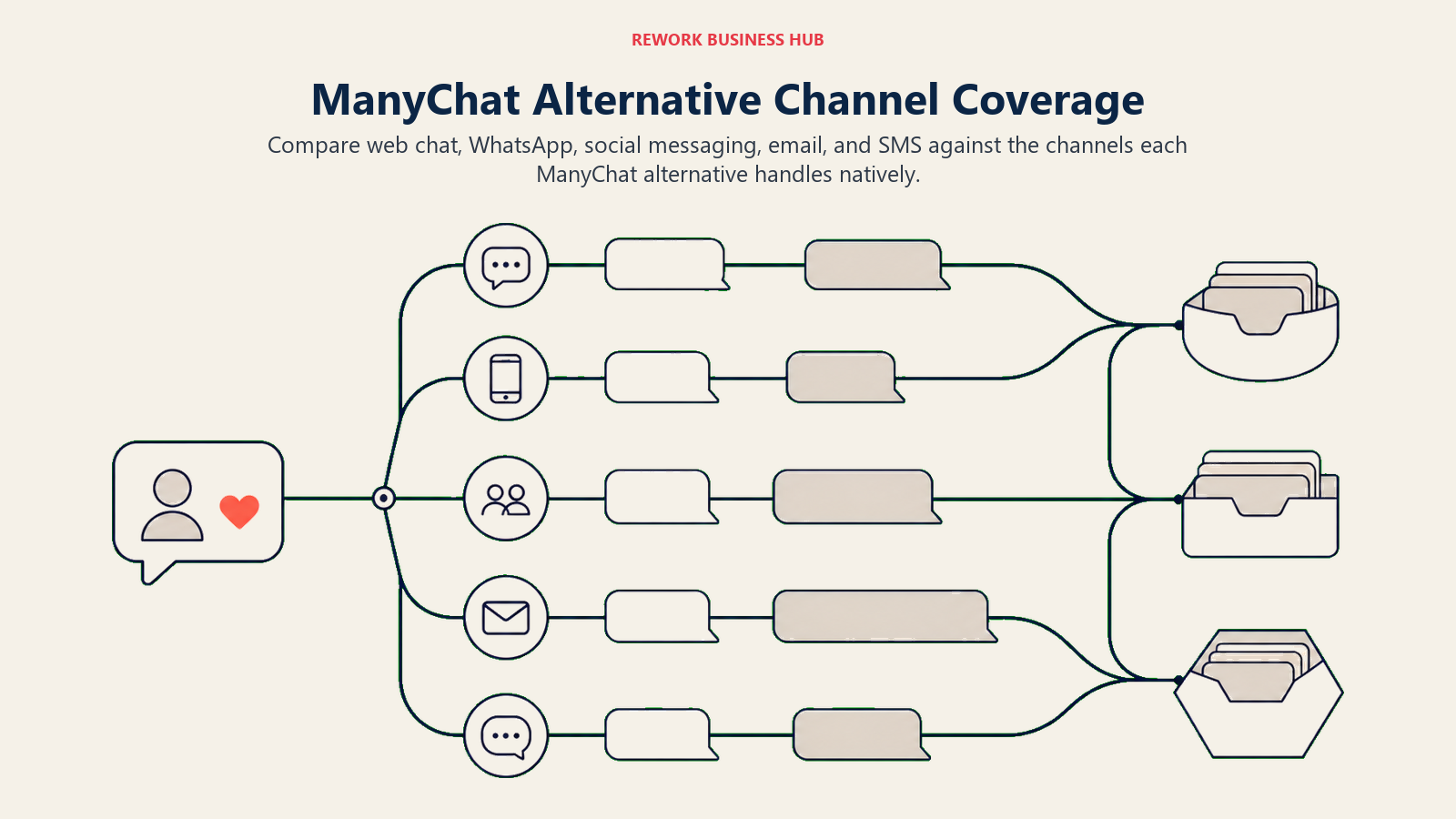
| Channel | Rework | Respond.io | WATI | Sleekflow | Freshchat | MobileMonkey | Chatfuel | Tidio | Crisp | Drift |
|---|---|---|---|---|---|---|---|---|---|---|
| Web chat | Native | Native | No | Native | Native | Native | No | Native | Native | Native |
| Native | Native | Native | Native | Native | Limited | Native | Integration | No | No | |
| Messenger | Native | Native | No | Native | Native | Native | Native | Integration | Native | No |
| Instagram DM | Native | Native | No | Native | Native | Native | Native | Integration | No | No |
| Email inbox | No | Native | No | No | Native | Native | No | Native | Native | No |
| SMS | No | Native | No | No | Paid add-on | Native | No | No | No | No |
| Telegram | Native | Native | No | Native | No | No | No | No | Native | No |
| No | Native | No | Native | No | No | No | No | No | No | |
| LINE | Native | Native | No | Native | Native | No | No | No | No | No |
Lead Management Capability Comparison
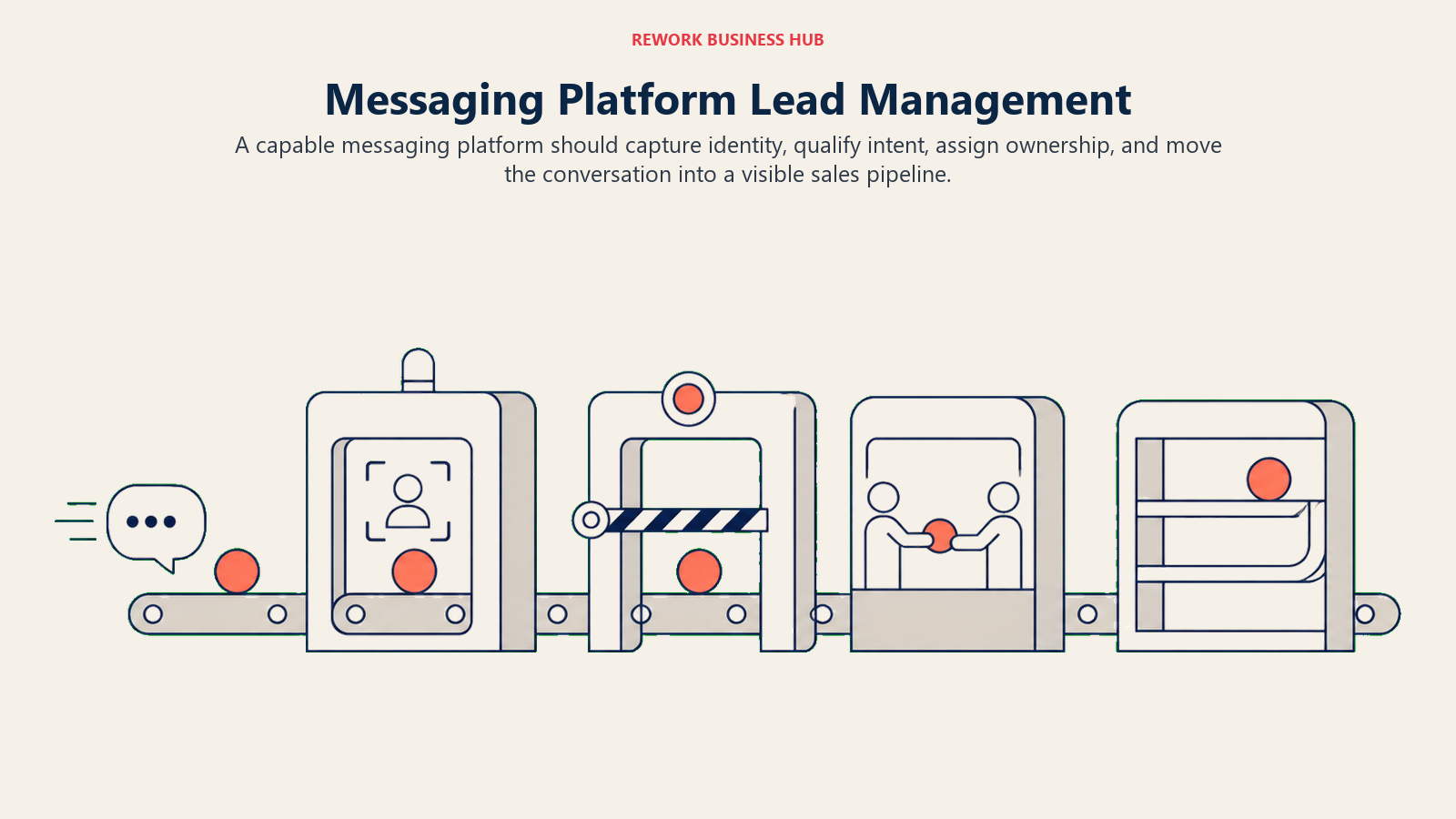
This is the table that matters most for teams switching from ManyChat because they need their chat to connect to a real lead pipeline.
| Capability | Rework | Respond.io | WATI | Chatfuel | ManyChat |
|---|---|---|---|---|---|
| Lead capture forms | Native | Via integration | Limited | No | No |
| Lead scoring | Native | No | No | No | No |
| Round-robin assignment | Native | Native | Limited | No | No |
| Territory routing | Native | No | No | No | No |
| SLA-based routing | Native | Native | No | No | No |
| Marketing-to-sales handoff | Native | Via CRM integration | No | No | No |
| Sales pipeline | Native | No (CRM required) | No | No | No |
| Attribution back to pipeline | Native | Via integration | No | No | No |
Automation Capability Comparison
| Capability | Rework | Respond.io | MobileMonkey | WATI | Chatfuel | Tidio |
|---|---|---|---|---|---|---|
| Visual flow builder | Yes | Yes | Yes | Yes | Yes | Yes |
| Conditional branching on CRM data | Yes | Via API | Limited | No | No | No |
| Cross-channel sequence | Yes | Yes | Yes | No | No | Limited |
| Broadcast / bulk messaging | WhatsApp only | Yes | Yes | Yes | Yes | No |
| AI-assisted routing | AI agent handoff (beta) | Yes | No | No | No | Yes (Lyro) |
| Webhook / API triggers | Yes | Yes | Yes | Yes | Yes | Limited |
Pricing Reference Table
| Tool | Entry Plan | Mid-Tier Plan | Notes |
|---|---|---|---|
| Respond.io | $79/mo (5 users) | $249/mo (10 users) | Per-workspace pricing |
| Tidio | Free | $59/mo | Lyro AI volume on higher tiers |
| Chatfuel | Free | $24.99/mo | WhatsApp plans separate |
| Rework | From $159/mo billed yearly (Revenue Engine) | rework.com/pricing | Yearly or monthly billing |
| WATI | $49/mo | $99/mo | Per-workspace + per-user add-ons |
| MobileMonkey/Customers.ai | ~$199/mo | Contact sales | Significant pricing step-up |
| Crisp | Free | $95/mo (Unlimited) | Workspace-based; not per-seat |
| Drift | ~$2,500/mo | Enterprise on request | Enterprise-only; no SMB path |
| Freshchat | Free | $39/agent/mo | Per-agent; best inside Freshworks |
| Sleekflow | $79/mo | $299/mo | Per-workspace |
How to Choose: Decision Framework
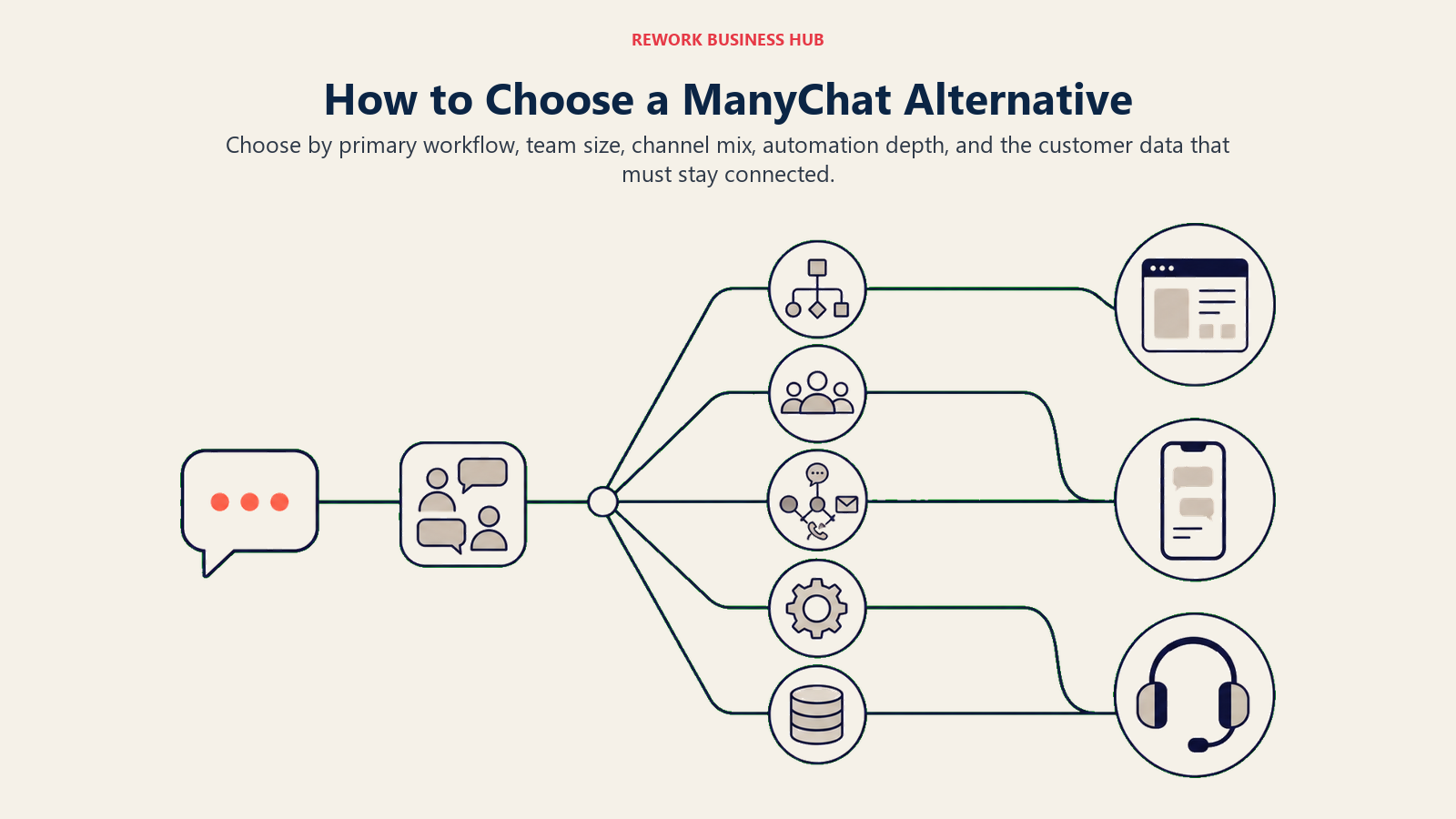
Use these criteria to narrow the field by workflow, team size, channel mix, automation depth, and connected customer data.
| If you need this... | Pick this |
|---|---|
| Multi-channel inbox (WhatsApp, Messenger, IG DM, TikTok, Zalo, web chat) unified with CRM and full lead management pipeline | Rework |
| Widest channel coverage for messaging-heavy markets (WhatsApp, Telegram, LINE, WeChat) with strong API | Respond.io |
| Deep WhatsApp-only automation, broadcasts, and team inbox at accessible pricing | WATI |
| Social commerce messaging in APAC markets with WeChat and LINE support | Sleekflow |
| No-code Meta bot automation and you're coming from ManyChat's exact use case | Chatfuel |
| Website ABM chat for enterprise B2B with Salesforce and a $2,500+/mo budget | Drift |
| AI chatbot + live chat for a Shopify or WooCommerce store | Tidio |
| Multi-channel chat at SMB pricing without committing to per-seat enterprise plans | Crisp |
| Cross-platform chat marketing with website visitor identification for social ad campaigns | MobileMonkey / Customers.ai |
| Messaging + support and you're already on the Freshworks stack | Freshchat |
What to Do Next
Before picking a ManyChat alternative, answer three questions. Which channels do your leads actually use: Instagram DMs, WhatsApp, web chat, email, or a mix? Does your team need the chat tool to connect to a CRM and a sales pipeline, or is the chat layer enough? And how many agents need to work inside the tool simultaneously?
Those three answers narrow the list quickly. Teams running social ad campaigns that are primarily B2C, DM-focused, and Meta-centric should look at Chatfuel first. Teams in messaging-heavy markets running WhatsApp at volume should evaluate WATI and Respond.io. Teams that have outgrown both and need chat to connect to a real lead pipeline with routing, scoring, and a unified contact record should talk to Rework.
Run a two-week pilot with your top two options using real incoming conversations, not test data. The routing logic, inbox usability, and integration friction either work in your actual workflow or they don't. Teams building lead handoff workflows should also review how form-to-CRM lead capture automation works, which shows where chat tools end and a proper lead lifecycle begins. Two weeks of real use tells you more than any feature comparison table.
According to G2's chatbot software category, ManyChat ranks highest for ease-of-use in the SMB segment, but drops significantly on CRM connectivity and multi-team workflow ratings, which maps exactly to why teams look for alternatives as they scale.
Frequently Asked Questions
What is the best ManyChat alternative overall? There's no single best for everyone. Respond.io is the strongest all-round pick for teams moving to a multi-channel messaging inbox, especially across WhatsApp, Telegram, and LINE. For a clean Meta-only bot builder like ManyChat itself, Chatfuel is the closest swap, and Tidio suits stores that mostly need AI chat on their website. If leads captured in chat must flow into a CRM pipeline with routing and scoring, Rework covers that in one system for teams of 20 or more.
Why do teams switch away from ManyChat? The common triggers are Meta-platform dependency, no native CRM, weak email and SMS automation, and no unified support inbox. ManyChat works well for DTC and social ad funnels, but lead generation teams outgrow it once they need leads to flow into a sales pipeline with routing, scoring, and a shared contact record.
Is there a free ManyChat alternative? Yes. Tidio, Chatfuel, Crisp, and Freshchat all offer free tiers that cover real use cases for small teams. Free plans are best for low conversation volume; most teams move to a paid tier once they need multi-agent assignment, deeper automation, or CRM connectivity.
Which ManyChat alternative is best for WhatsApp? WATI is purpose-built for the WhatsApp Business API with broadcasts, chatbots, and a shared team inbox at accessible pricing. Respond.io and Sleekflow are stronger if you also need other channels like Messenger, Instagram DM, LINE, or WeChat alongside WhatsApp.
Do I need a CRM-connected chat tool or just a chat layer? Answer this before you choose. If leads captured in chat need to be routed to reps, scored, and tracked through close, pick a platform with native lead management like Rework so there's no fragile export step. If you only need to answer incoming questions and capture basic contact details, a focused chat layer such as Tidio or Crisp is enough.

Senior Implementation Consultant
On this page
- Quick Comparison Table
- Why Teams Are Leaving ManyChat
- Stage Fit Matrix
- Sizing and Persona Table
- 1. Respond.io: Enterprise Multi-Channel Messaging
- 2. Tidio: AI Chatbot + Live Chat for E-Commerce and SMBs
- 3. Chatfuel: No-Code Chatbot for Meta
- 4. Rework: Chat Inbox Connected to Lead Routing and a Sales Pipeline
- 5. WATI: WhatsApp Business API Platform
- 6. MobileMonkey (Customers.ai): Multi-Platform Chat Marketing
- 7. Crisp: Chat + Helpdesk for Small Teams
- 8. Drift: Conversational Marketing for B2B Sales Teams
- 9. Freshchat: Freshworks Messaging
- 10. Sleekflow: Social Commerce Messaging
- Channel Coverage Comparison
- Lead Management Capability Comparison
- Automation Capability Comparison
- Pricing Reference Table
- How to Choose: Decision Framework
- What to Do Next
- Frequently Asked Questions