Best Braze Alternatives in 2026: 11 Tools for Cross-Channel Customer Engagement
Turn this article into takeaways for your work.


Each assistant summarizes the article only for you and suggests best practices for your work.
Updated August 2026.
Braze remains the strongest pick for consumer and mobile-first brands running real-time, cross-channel engagement at genuine scale, with Iterable, MoEngage, and Insider as the closest enterprise-tier peers, and Customer.io or OneSignal as the honest downgrade for teams that don't need Braze's ceiling. This guide covers 11 alternatives, evaluated on channel depth, pricing model, implementation lift, and who each tool actually fits. Every price below was checked against the vendor's own site in August 2026.
Teams leave Braze for predictable reasons. Pricing is built on Monthly Active Users (MAU) plus an Action Credits model, so the bill climbs whenever your product grows, whether or not engagement grows with it. Contracts are annual and enterprise-shaped from the first call. Implementation runs months, not weeks, and every new event or audience segment usually needs an engineer to wire it up correctly. None of that makes Braze a bad product. Canvas is one of the best visual journey builders in the category, cross-channel orchestration fires in real time across push, email, SMS, WhatsApp, and in-app, and mobile push depth is hard to match below the enterprise tier. If your team has genuinely outgrown a lighter tool and needs that ceiling, Braze earns its price. If you're paying enterprise rates for features you use at mid-market volume, one of the 11 tools below is probably a better fit. For the wider category, our SMS marketing software guide covers buyer-guide fundamentals across the full messaging stack.
Key Facts
- Marketers say they often or always personalize engagement 91% of the time, but only 56% of their customers agree they feel it (Twilio's State of Customer Engagement Report, twilio.com/en-us/state-of-customer-engagement/2023/trend-2).
- 93% of marketing leaders believe AI helps them accurately understand customer needs, while only 53% of consumers feel brands are actually predicting what they want (Braze's 2026 Customer Engagement Review, a vendor benchmark from a survey of 2,200 marketing executives and 4,000 consumers).
- 43% of consumers say they would stop engaging with a brand entirely if it misused their personal data (Braze's 2026 Customer Engagement Review).
- A Forrester Total Economic Impact study commissioned by Braze found a composite organization achieved 457% ROI over three years with payback in under six months (braze.com/resources/articles/2026-forrester-tei-of-braze, a vendor-commissioned study).
- Marketers use only about a third of their martech stack's capability, down from 42% in 2022 and 58% in 2020 (Gartner's Martech Report, cited via martech.org).
Quick Comparison Table
| Tool | Best For | Starting Price | Key Strength | Key Limitation |
|---|---|---|---|---|
| Iterable | Growth-stage and enterprise brands wanting flexible cross-channel journey design | No published pricing, contact sales | Strong experimentation tooling and Snowflake/Redshift connectors | No self-serve tier; requires a sales cycle before you see a number |
| MoEngage | Mobile-first consumer and fintech brands wanting AI-driven send optimization | No published pricing ("Let's Talk") | AI channel and send-time optimization, deep mobile SDK | High realistic floor; not built for teams under 50K MAU |
| Insider | Enterprise retail and travel brands wanting one platform across web, app, and messaging | No published pricing, demo required | Broadest channel list here, including on-site personalization | Heaviest implementation lift of any tool on this list |
| Bloomreach Engagement | Commerce brands already running Bloomreach Discovery who want engagement in one contract | No published pricing, sales-led | Native product-catalog and search data feeding segmentation | Setup assumes you're already catalog-heavy; not a lightweight add-on |
| CleverTap | Mobile apps wanting MAU-based pricing with a visible entry number | $85/mo Core, up to 5,000 MAU | The only enterprise-tier competitor here with a published starting price | Core tier caps out fast; Pro and Ultimate still go custom |
| Airship | Mobile-first brands wanting push and in-app heritage with a self-serve tier | No published pricing; Essentials has self-serve signup | Long track record in push/in-app plus native SMS, email, and RCS | Company-wide rollout still needs the enterprise AXP tier |
| Customer.io | Technical mid-market SaaS teams wanting event-based messaging without Braze's minimums | Essentials from 5,000 profiles and 1M emails/mo, tier price not published | Lighter setup than Braze; usage-based overages instead of a contract floor | Weaker mobile push depth than Braze or MoEngage |
| OneSignal | Product teams that need push and in-app first, everything else second | Free for 10K email sends/mo; Growth from $19/mo plus usage | The most generous free tier on this list; fast API integration | Email and SMS feel secondary to the push core |
| Klaviyo | Ecommerce brands wanting engagement tied directly to revenue and purchase data | Free for 250 profiles; Email from $30/mo (1K profiles); SMS from $15/mo (1,250 credits) | Native Shopify/WooCommerce revenue attribution | Not built for SaaS product-event data or B2B lifecycle work |
| Attentive | Ecommerce and DTC brands that treat SMS/MMS as a primary revenue channel | No published pricing, usage-based | Deep SMS/MMS deliverability and compliance tooling | No self-serve tier or published entry point |
| Twilio (build-your-own) | Engineering-led teams that want to own the messaging layer instead of buying a platform | $0.0083 per SMS (US), pay-as-you-go, no platform fee | Full control over every channel; you pay only for what you send | You build the orchestration, journeys, and segmentation yourself |
Channel Coverage Matrix
The channel matrix highlights where each tool covers push, email, SMS, and more.
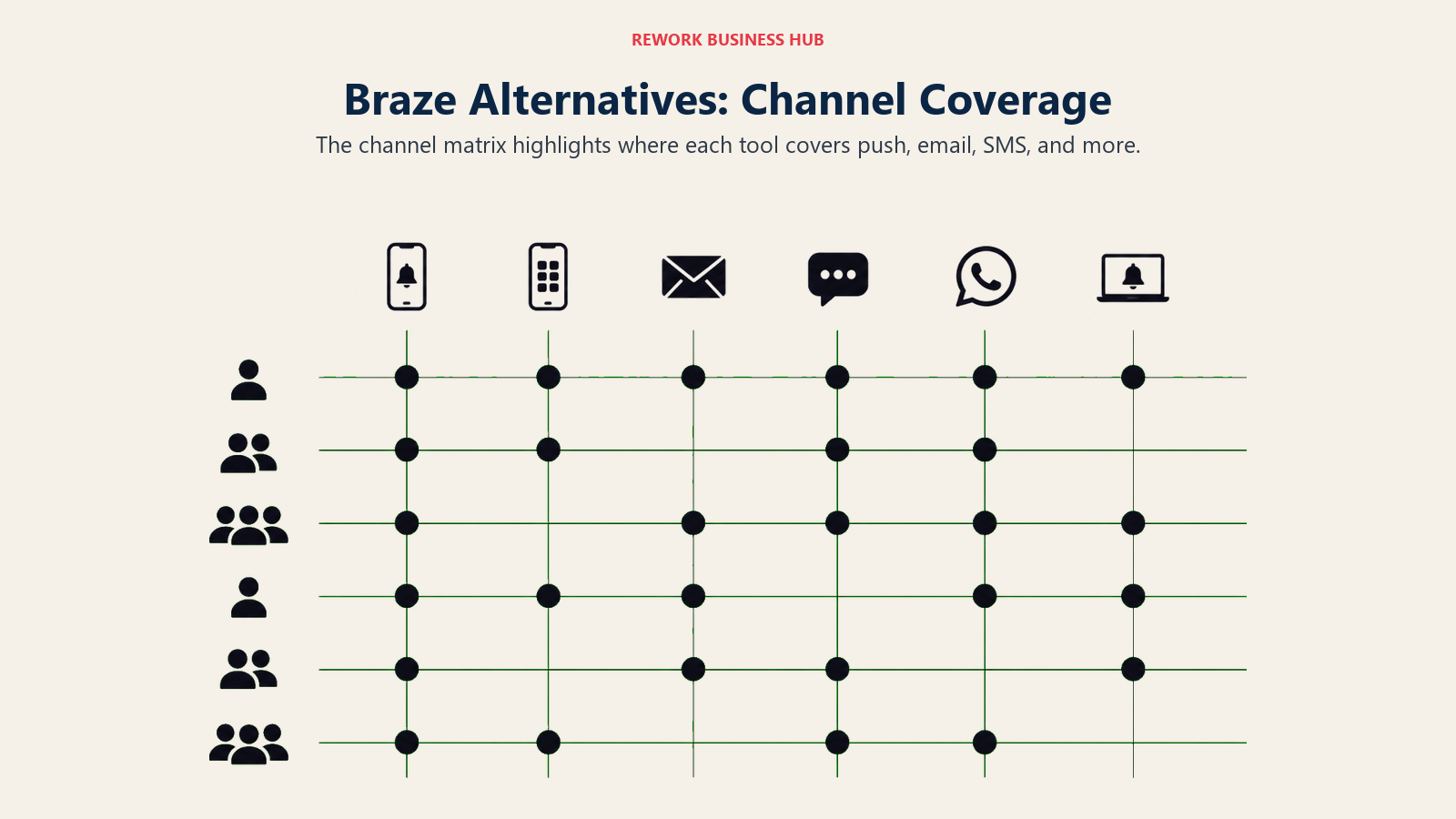
| Tool | Push | In-App | SMS | Web Push | ||
|---|---|---|---|---|---|---|
| Braze | Yes | Yes | Yes | Yes | Yes | Yes |
| Iterable | Yes | Yes | Yes | Yes | Via partner integration | Yes |
| MoEngage | Yes | Yes | Yes | Yes | Yes | Yes |
| Insider | Yes | Yes | Yes | Yes | Yes | Yes |
| Bloomreach Engagement | Yes | Yes | Yes | Via partner | Via partner | Yes |
| CleverTap | Yes | Yes | Yes | Yes | Yes | Yes |
| Airship | Yes | Yes | Yes | Yes | Not listed; RCS instead | Yes |
| Customer.io | Yes | Yes | Yes | Yes | No native channel | Yes |
| OneSignal | Yes | Yes | Yes | Via sales | No native channel | Yes |
| Klaviyo | No | No | Yes | Yes | Yes (added 2025) | No |
| Attentive | No | No | Limited (add-on) | Yes | No | No |
| Twilio | Via Notify (basic) | No | Yes (SendGrid) | Yes | Yes (API) | No |
1. Iterable: The Closest Peer for Cross-Channel Orchestration
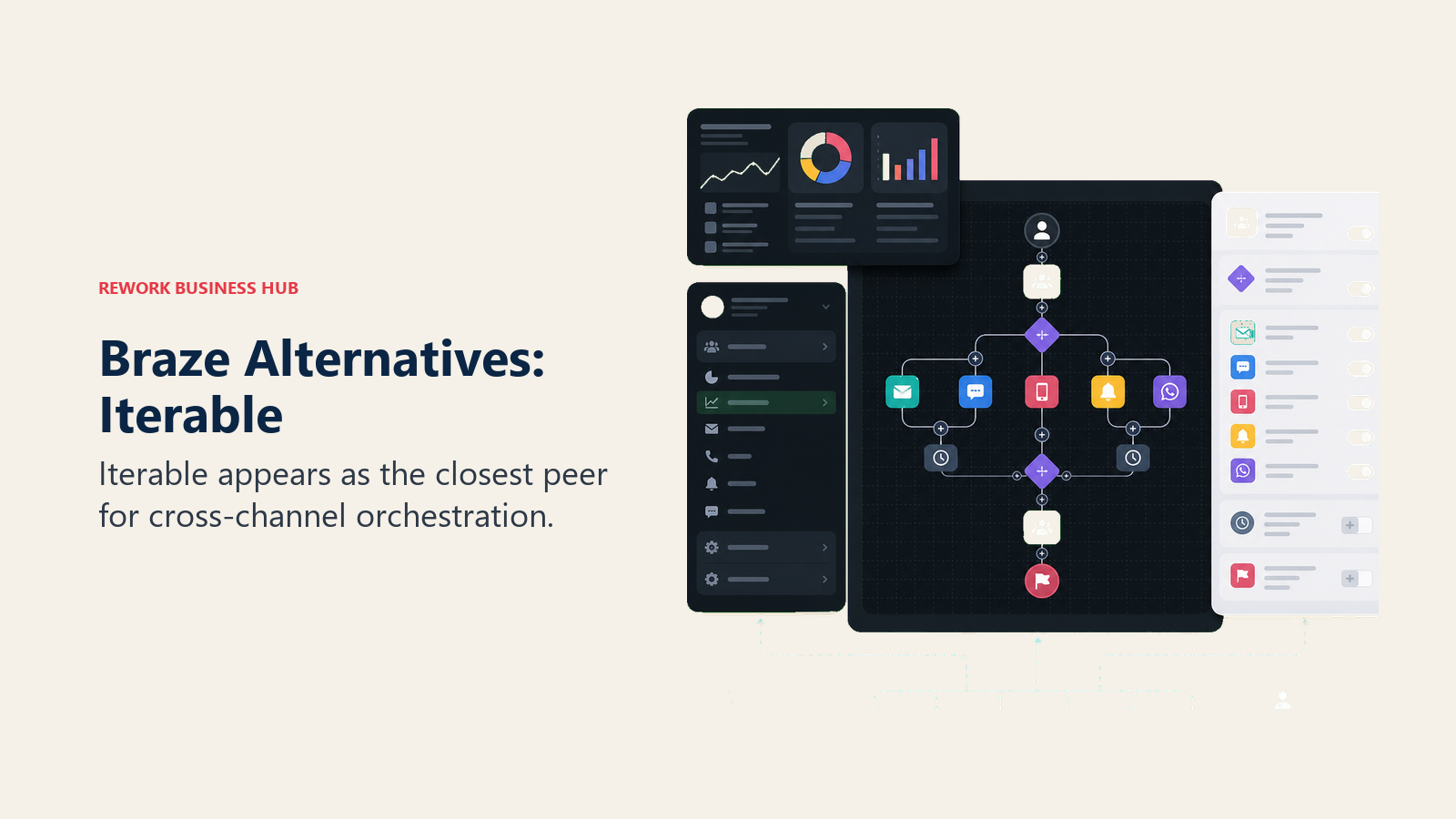
Iterable sits closest to Braze on the maturity curve of anyone on this list. Its Studio journey builder handles multi-branch sequences, holdout groups, and experimentation across email, push, SMS, in-app, and web push as first-class channels, not bolted-on add-ons. Where Braze leans on Canvas and a mobile-first heritage, Iterable's differentiator is data connector depth: native Snowflake and Redshift reverse ETL make it a stronger fit for teams whose source of truth already lives in a warehouse rather than a mobile SDK.
Iterable does not publish pricing any more than Braze does. A Forrester Total Economic Impact study commissioned by Iterable found a composite customer achieved 700% ROI, driven partly by a 20% increase in abandoned cart recovery and a 15% year-over-year increase in message volume after switching. Take the number as a vendor-funded data point, not a guarantee, but it's a fair signal that the platform earns its keep once implemented.
Methodology / Vision: Cross-channel orchestration for data-driven growth teams, with experimentation and warehouse connectivity as the core bet.
Target Audience: Growth-stage through enterprise SaaS and consumer brands, typically 50 to 2,000 employees, with an established event-tracking pipeline.
Sizing Fit: Same tier as Braze. Not a downgrade in scope, more a different data-architecture assumption.
Stage Fit: Growth through enterprise, once a team already has clean event data flowing somewhere.
| What you get | What you don't |
|---|---|
| First-class cross-channel orchestration and Studio journey builder | Transparent self-serve pricing; still a sales-led process |
| Deep Snowflake, Redshift, and Segment connectors | A lighter onboarding than Braze; setup is comparably heavy |
| Experimentation infrastructure: holdouts, multi-arm tests | Braze's specific mobile SDK maturity |
Pricing: No published pricing. Contact iterable.com/contact-sales for a quote.
Best for: Teams that want Braze-caliber orchestration but a data model built around a warehouse rather than a mobile SDK.
2. MoEngage: AI-Driven Optimization for Mobile-First Brands
MoEngage competes with Braze on mobile depth and adds an AI layer Braze doesn't fully match: predictive send-time optimization, AI-driven segmentation, and channel affinity scoring that decides whether a given user should get a push, an email, or an SMS based on how they've responded historically. Four product lines, MoEngage Inform, Growth, Enterprise, and Personalize, cover everything from basic messaging to full AI-driven engagement, and all of them route to a "Let's Talk" quote request with no free tier or trial listed.
The honest trade is implementation support versus flexibility. MoEngage's mobile SDK is genuinely strong for consumer apps and fintech brands with meaningful app usage, but the platform assumes a similar scale commitment to Braze. Teams under roughly 50,000 MAU will find the sales process disproportionate to what they need.
Methodology / Vision: Insights-led engagement, where AI decides the channel, message, and timing rather than a marketer's manual rule.
Target Audience: Mid-market and enterprise consumer brands, fintech, and media companies with a meaningful mobile app footprint.
Sizing Fit: Enterprise-leaning, similar floor to Braze.
Stage Fit: Growth through enterprise, with established mobile event tracking already in place.
| What you get | What you don't |
|---|---|
| AI-powered send-time and channel-affinity optimization | Published pricing or a self-serve trial |
| Strong mobile push and in-app SDK | Entry-level accessibility for smaller teams |
| Email, SMS, WhatsApp, push, and in-app as co-equal channels | A lighter setup lift than Braze |
Pricing: No published pricing. Contact moengage.com for a quote.
Best for: Mobile-first consumer and fintech brands that want AI-driven channel selection layered on top of Braze-level channel coverage.
3. Insider: The Broadest Channel List for Retail and Travel
Insider (now trading as Insider One) markets itself as an AI-native growth management platform, and the channel list backs that up: web personalization, mobile app, WhatsApp, RCS, email, SMS, and push all sit under one segmentation model. For retail and travel enterprises that need on-site personalization wired to the same customer profile as their messaging, Insider covers more ground natively than Braze does.
That breadth comes at a cost. Insider does not publish pricing anywhere on its own site (confirmed directly against insiderone.com), and buyers report the implementation timeline runs longer than Braze's, largely because the on-site personalization layer requires its own integration work on top of the messaging setup. This is not the tool for a team that just wants to replace Braze's messaging function; it's for a team that wants to replace messaging and on-site personalization at once.
Methodology / Vision: One AI platform across every customer touchpoint, web, app, and messaging, rather than a messaging platform with web add-ons.
Target Audience: Enterprise retail, ecommerce, and travel brands, typically 500+ employees.
Sizing Fit: Enterprise. Not a fit for teams under a few hundred employees.
Stage Fit: Mature, with dedicated growth and lifecycle teams to run the platform.
| What you get | What you don't |
|---|---|
| Broadest native channel list on this list, including on-site personalization | Published pricing at any tier |
| WhatsApp and RCS as native channels alongside push, SMS, and email | A lighter implementation than Braze; often heavier |
| AI-driven segmentation across web and messaging in one model | Accessibility for teams that only need messaging |
Pricing: No published pricing. Request a demo at insiderone.com.
Best for: Retail and travel enterprises that want on-site personalization and messaging unified in one AI platform.
4. Bloomreach Engagement: Commerce-Native for Catalog-Heavy Brands
Bloomreach Engagement makes the most sense for brands that already run Bloomreach Discovery for search and merchandising and want their engagement layer fed by the same product-catalog data, rather than stitching a separate messaging platform to their commerce stack. Segmentation draws on product views, search behavior, and catalog attributes natively, which is a genuinely different data model than Braze's generic event architecture.
Pricing is sales-led with no self-serve tier, and Bloomreach's own pricing page routes every visitor to a "Request Pricing" form rather than showing a number. Third-party estimates for Bloomreach Engagement vary widely enough (from low five figures to well over $100,000 annually, depending on catalog size and event volume) that none of them are trustworthy enough to repeat here as a fact. Budget for a sales conversation, not a self-serve checkout.
Methodology / Vision: Commerce experience unified with engagement, using the same catalog and search data for both.
Target Audience: Mid-market to enterprise commerce and retail brands, especially those already on Bloomreach Discovery.
Sizing Fit: Mid-market through enterprise, scaled by catalog size and event volume rather than headcount.
Stage Fit: Growth through mature, once product catalog and search data are already structured.
| What you get | What you don't |
|---|---|
| Native product-catalog and search data feeding segmentation | A published price or self-serve signup |
| One contract if you already run Bloomreach Discovery | A fit for teams without a commerce catalog |
| Commerce-specific personalization Braze doesn't build for | Braze's broader B2C, non-commerce use case coverage |
Pricing: No published pricing. Request pricing at bloomreach.com/en/pricing/engagement.
Best for: Commerce brands already invested in Bloomreach's catalog and search products who want engagement in the same contract.
5. CleverTap: The Only Enterprise-Tier Competitor With a Published Price
CleverTap is the rare mobile-first engagement platform in Braze's weight class that actually publishes a starting number. Core runs $85/mo for up to 5,000 MAU, with a 30-day trial before billing kicks in. That single fact makes it worth a look for teams that want to evaluate a real number before booking a call, something Braze, MoEngage, Insider, and Bloomreach all require a sales conversation to get.
Channel coverage matches Braze closely: push, in-app, email, SMS, WhatsApp, and web push all sit natively in the platform, priced against MAU. The honest limitation is that Core caps out quickly at real B2C scale, and CleverTap's Pro and Ultimate tiers revert to the same "get a demo" model as everyone else on this list once you outgrow the entry plan.
Methodology / Vision: MAU-based mobile engagement with a transparent entry point, then custom pricing at scale.
Target Audience: Mobile apps from early growth through mid-market, particularly those wanting to test the platform before a sales call.
Sizing Fit: Strong from early growth to roughly 5,000 to 20,000 MAU. Enterprise scale reverts to custom quotes.
Stage Fit: Growth stage, with a founder or growth lead who wants to self-serve the first evaluation.
| What you get | What you don't |
|---|---|
| A published entry price and self-serve trial | Enterprise-tier transparency once you exceed Core's cap |
| Push, in-app, email, SMS, WhatsApp, and web push natively | Braze's depth of AI personalization at entry pricing |
| Faster time-to-first-campaign than sales-gated competitors | A published number for Pro or Ultimate |
Pricing: Core $85/mo for up to 5,000 MAU (billed after a 30-day trial). Pro and Ultimate are custom. See clevertap.com/pricing. CleverTap periodically discounts Core to as low as $8.50/mo under time-boxed promotions; treat $85/mo as the number to plan around.
Best for: Mobile apps that want to see a real number and try the platform before committing to a sales process.
6. Airship: Push and In-App Heritage With a Self-Serve Entry Point
Airship has one of the longer track records in mobile push, and it shows in the depth of the push and in-app tooling: native email, SMS, RCS, and mobile wallet sit alongside push and in-app messaging as first-class channels, all wired into the same cross-channel journey builder. Airship also ships two distinct offerings rather than one: the self-serve Essentials tier for teams that want to get started without a sales call, and the enterprise Airship Experience Platform (AXP) for company-wide rollouts.
That split is the main practical difference from Braze, which doesn't offer a comparable self-serve on-ramp at all. The trade-off is that Essentials is scoped for smaller teams and a narrower use case; once you need AXP's enterprise governance and scale, you're back in the same sales process as Braze.
Methodology / Vision: Mobile-first cross-channel engagement with a self-serve on-ramp before the enterprise tier.
Target Audience: Mobile-first brands from early growth (Essentials) through enterprise (AXP).
Sizing Fit: Essentials works for smaller teams; AXP assumes enterprise scale similar to Braze.
Stage Fit: Growth through enterprise, depending on which product line you land in.
| What you get | What you don't |
|---|---|
| Self-serve Essentials tier with no sales call required to start | AXP-level enterprise features on Essentials pricing |
| Native email, push, in-app, SMS, RCS, and mobile wallet | A native WhatsApp channel (Airship offers RCS instead) |
| Long operating history in mobile push specifically | Braze's breadth of AI-driven personalization tooling |
Pricing: No published pricing for either tier. Essentials has a self-serve "Start with Essentials" signup; AXP requires a quote request. See airship.com/pricing.
Best for: Mobile-first brands that want a self-serve starting point in the same category as Braze, with room to grow into an enterprise contract later.
7. Customer.io: Event-Based Messaging Without Braze's Contract Minimums
Customer.io is the practical downgrade for teams that adopted Braze expecting Canvas-level orchestration but are actually running SaaS product messaging at a fraction of Braze's typical MAU floor. The event-driven data model is conceptually similar (real-time triggers wired to product events across email, push, SMS, in-app, and web push), but the pricing structure is usage-based rather than an enterprise contract, and the platform's setup, while still requiring engineering to design the event schema, is noticeably lighter than Braze's onboarding.
Customer.io's Essentials tier includes 5,000 profiles and 1 million monthly emails, with published overage rates rather than an opaque enterprise number: profiles at $0.009 each and email at $0.12 per 1,000 beyond the included volume. Startups that have raised under $10 million qualify for a full year free, which is a meaningful on-ramp Braze doesn't offer at any tier. For a full peer comparison of Customer.io against its own category, see our Customer.io alternatives guide.
Methodology / Vision: Event-triggered messaging for product and growth teams, priced on usage rather than an enterprise contract.
Target Audience: Technical mid-market SaaS teams with existing event infrastructure but without Braze's budget or MAU scale.
Sizing Fit: Startup through mid-market. Above roughly 500,000 profiles, Customer.io's own pricing starts approaching Braze's territory.
Stage Fit: Growth stage, once product event tracking exists but before the team needs Braze's enterprise SLAs.
| What you get | What you don't |
|---|---|
| Published overage rates instead of an opaque enterprise contract | Braze's mobile push depth or Canvas-level experimentation |
| A full free year for startups that raised under $10M | A free tier for companies past that threshold |
| Real-time event triggers across email, push, SMS, and in-app | Native WhatsApp as a channel |
Pricing: Essentials includes 5,000 profiles and 1 million monthly emails; the tier's dollar price is not published on the current pricing page. Overages run $0.009 per profile and $0.12 per 1,000 emails. See customer.io/pricing. If profile-based pricing itself is the real pain rather than the channel mix, our Brevo alternatives guide covers per-send pricing models that avoid it entirely.
Best for: Technical SaaS teams that want Braze's event-driven logic without Braze's contract floor.
8. OneSignal: Push and In-App First, the Most Generous Free Tier Here
OneSignal is built around push notifications first and treats everything else as a supporting channel. For teams leaving Braze specifically because push and in-app were overkill for what they actually needed, OneSignal's developer-friendly REST API and genuinely useful free tier (10,000 monthly email sends and unlimited mobile and web push) make it the fastest, cheapest on-ramp on this list.
Growth-tier pricing starts at $19/month plus usage: mobile push at $0.012 per MAU, web push at $0.004 per subscriber, and email at $1.50 per 1,000 sends beyond the first 20,000 free per month. SMS exists as a channel but is priced through sales rather than published. The honest limitation is that OneSignal's email and SMS depth doesn't approach Braze's behavioral sophistication; it's a push-first tool that added other channels, not a lifecycle platform that happens to include push.
Methodology / Vision: Developer-first engagement starting from a clean push API, with other channels layered on top.
Target Audience: Product and growth engineering teams at SaaS and mobile app companies where push and in-app outrank complex email journeys.
Sizing Fit: Works from solo developers through large enterprise; the free tier is genuinely useful at early stage.
Stage Fit: Startup through enterprise, fastest to integrate of anything on this list.
| What you get | What you don't |
|---|---|
| The most generous free tier on this list: unlimited push, 10K email sends/mo | Email or SMS depth matching Braze's behavioral engine |
| Fast REST API integration, hours rather than weeks | A full lifecycle platform; push is still the center of gravity |
| Usage-based pricing that stays accessible at small scale | Native WhatsApp support |
Pricing: Free for 10,000 monthly email sends and unlimited push. Growth from $19/mo plus usage ($0.012/MAU mobile push, $0.004/subscriber web push, $1.50/1,000 emails after 20K free). Professional and Enterprise are annual contracts. SMS pricing is available on request. See onesignal.com/pricing.
Best for: Product teams that need push and in-app as primary channels with email as a supplement, especially where the free tier covers real volume.
9. Klaviyo: Ecommerce Revenue Engine, Not a SaaS Lifecycle Platform
Klaviyo belongs on this list because some ecommerce and DTC teams end up evaluating Braze for lifecycle messaging and discover it's the wrong data model entirely. Braze is built around generic product events; Klaviyo is built around ecommerce transaction data (order history, cart abandonment, repurchase timing) with native Shopify and WooCommerce integrations that pull that data directly into segmentation and flows. Revenue attribution per flow is accurate down to the individual order, which isn't something Braze is designed to surface.
Email and SMS are separate plans that stack. Email starts free for 250 active profiles, then $30/mo at 1,000 profiles; SMS starts separately at $15/mo for 1,250 credits, with 150 free credits included per billing cycle on any account. Klaviyo added a native WhatsApp channel in 2025, closing part of the channel gap with Braze, though push and in-app messaging still aren't part of the platform. For the full peer comparison within its own category, see our Klaviyo alternatives guide; for a broader ecommerce messaging comparison, our Omnisend alternatives guide covers similar ground.
Methodology / Vision: Revenue-first messaging for ecommerce, where every send should tie to measurable purchase behavior.
Target Audience: DTC brands, Shopify and WooCommerce merchants, and ecommerce retailers from boutique to mid-market.
Sizing Fit: Works at any ecommerce team size; pricing scales with active profiles.
Stage Fit: Startup through enterprise, specifically for ecommerce rather than B2B SaaS lifecycle work.
| What you get | What you don't |
|---|---|
| Native Shopify/WooCommerce data with accurate revenue attribution | A product-event data model suited to SaaS lifecycle messaging |
| Email, SMS, and WhatsApp under one audience model | Push notifications or in-app messaging |
| Predictive LTV and purchase-based segmentation | Braze's cross-channel breadth for non-commerce use cases |
Pricing: Free for 250 active profiles. Email from $30/mo at 1,000 profiles. SMS from $15/mo for 1,250 credits (a separate plan that stacks with email). See klaviyo.com/pricing.
Best for: Ecommerce and DTC brands that need purchase-data-driven email, SMS, and WhatsApp, not a generic product-event platform.
10. Attentive: SMS-First for Ecommerce and DTC Revenue
Attentive is the right alternative when the actual reason a team looked at Braze was SMS and MMS revenue messaging for an ecommerce business, not cross-channel orchestration for a broader product. Its deliverability and compliance tooling for high-volume SMS (carrier relationships, opt-in management, TCPA-aware sending) is deeper than what Braze, or most general-purpose engagement platforms, build natively for the channel.
Attentive does not publish pricing. The company says rates depend on message volume, subscriber list size, channels used, and which AI tools you enable, and it routes buyers to a demo rather than a self-serve signup. There's no reliable third-party figure worth repeating here; budget for a sales conversation and negotiate on your actual send volume. For the dedicated comparison of Attentive against its direct peers, see our Attentive alternatives guide.
Methodology / Vision: SMS and MMS as the primary revenue channel for ecommerce, with email and AI tools layered around it.
Target Audience: Ecommerce and DTC brands where SMS is (or should be) the highest-converting channel.
Sizing Fit: Works from mid-market ecommerce upward; pricing scales with subscriber list and message volume.
Stage Fit: Growth through mature ecommerce brands with an established SMS subscriber list.
| What you get | What you don't |
|---|---|
| Deep SMS/MMS deliverability and compliance tooling | A published price or self-serve tier |
| AI tools for message optimization and journeys | Push, in-app, or WhatsApp as native channels |
| Purpose-built for ecommerce revenue messaging | Braze's broader B2C lifecycle scope beyond ecommerce |
Pricing: No published pricing. Rates depend on message volume, subscriber list size, and channels/AI tools enabled. Request a demo at attentive.com/pricing.
Best for: Ecommerce and DTC brands that treat SMS/MMS as their primary revenue channel, not a supporting one.
11. Twilio: Build Your Own Instead of Buying a Platform
Twilio is the honest answer for engineering-led teams that would rather own the messaging layer than pay a platform fee on top of it. There's no orchestration UI, no Canvas equivalent, and no built-in segmentation: you're working directly against the SMS API, the WhatsApp API, and SendGrid for email as separate products, each billed on its own usage-based rate. What you get in exchange is control and a cost structure with no MAU tax at all.
SMS runs $0.0083 per message sent or received in the US, the same rate across long code, toll-free, and short code numbers. MMS costs $0.022 to send and $0.0165 to receive on long or short code (or $0.02 on toll-free). Phone numbers add their own line item: local numbers at $1.15/mo, toll-free at $2.15/mo, and short codes from $1,000 per quarter. A2P 10DLC registration fees apply on top of that and aren't published as a flat figure. For email specifically, Twilio's SendGrid product is a separate purchase with its own pricing; see our SendGrid alternatives guide for that comparison. If the gap you're trying to close is connecting these raw APIs to the rest of your stack without writing custom glue code, tools covered in our Zapier alternatives guide are a more realistic starting point than building it all from scratch.
Methodology / Vision: Own the infrastructure, pay only for usage, build the orchestration layer yourself.
Target Audience: Engineering-led teams with the capacity to build and maintain journey logic, segmentation, and campaign tooling in-house.
Sizing Fit: Any size, but the build cost only pays off once your message volume or customization needs are large enough to justify the engineering investment.
Stage Fit: Any stage, provided there's a dedicated engineer or team to own the build.
| What you get | What you don't |
|---|---|
| No MAU-based platform fee; pay only for messages sent | Journey builder, segmentation UI, or campaign tooling |
| Full control over every channel and every message | Any orchestration logic out of the box; you build it |
| Usage-based pricing with no annual contract minimum | A support model comparable to Braze's account management |
Pricing: SMS at $0.0083/message (US, send or receive). MMS at $0.022 send / $0.0165 receive. Local numbers $1.15/mo, toll-free $2.15/mo. See twilio.com/en-us/sms/pricing/us.
Best for: Engineering-led teams that want full control over messaging infrastructure and no MAU-based fee, and are willing to build the orchestration layer themselves.
Stage Fit Matrix
The stage fit board shows which alternative tends to suit each company size.
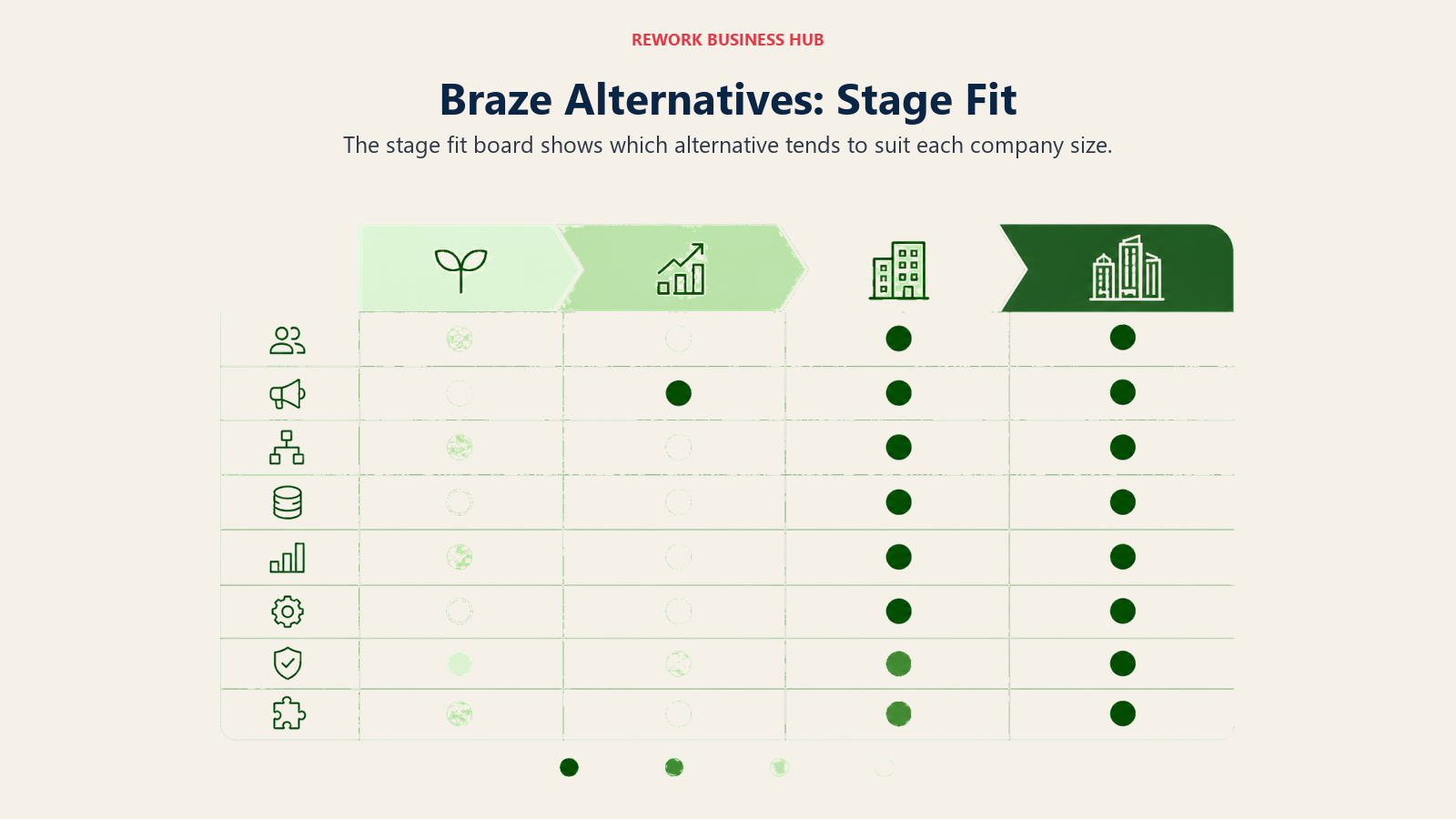
| Company Stage | MAU / Team Size | Recommended Tools | Likely Overkill |
|---|---|---|---|
| Seed / pre-PMF | Under 10K MAU | OneSignal (free), Customer.io, CleverTap | Braze, MoEngage, Insider |
| Early growth | 10K to 100K MAU | Customer.io, CleverTap, OneSignal, Klaviyo (ecommerce) | Braze, Insider, Bloomreach |
| Growth / Series B-C | 100K to 1M MAU | Iterable, MoEngage, CleverTap Pro | Bloomreach unless catalog-heavy |
| Mid-market scaling | 1M to 10M MAU | Braze (entry), Iterable, Insider | OneSignal alone, Attentive alone |
| Enterprise | 10M+ MAU | Braze, Iterable Enterprise, Insider, MoEngage Enterprise | Most self-serve tools on this list |
| Ecommerce / DTC | Any list size | Klaviyo, Attentive, Bloomreach (catalog-heavy) | Braze (wrong data model) |
| Engineering-led, build-first | Any size with dedicated engineering | Twilio | Any platform with a heavy UI layer you won't use |
Sizing and Persona Table
| Tool | Ideal Team Size | Who Buys It |
|---|---|---|
| Iterable | 50 to 2,000 employees | Head of Lifecycle, Marketing Engineer, VP Growth |
| MoEngage | 50 to 2,000 employees | Head of Lifecycle, Mobile Growth Lead, VP Engagement |
| Insider | 500+ employees | VP Growth, CMO, Head of Digital Experience |
| Bloomreach Engagement | 200 to 2,000 employees | Head of Ecommerce, VP Marketing, Merchandising Lead |
| CleverTap | 10 to 500 employees | Growth Marketer, Mobile Product Lead, Founder |
| Airship | 20 to 1,000 employees | Mobile Growth Lead, VP Engagement |
| Customer.io | 5 to 500 employees | Marketing Engineer, Growth Marketer, Head of Lifecycle |
| OneSignal | 1 to 500 employees | Product Engineer, Growth Engineer, Mobile Developer |
| Klaviyo | 5 to 500 employees | Ecommerce CMO, DTC Brand Owner, Email/SMS Marketer |
| Attentive | 20 to 1,000 employees | VP Ecommerce, DTC Marketing Director |
| Twilio | Any size with engineering capacity | Engineering Lead, CTO, Platform Engineer |
How to Choose: Decision Framework
| If you need... | Pick... |
|---|---|
| Cross-channel orchestration at Braze's scale, with stronger warehouse connectors | Iterable |
| AI-driven send-time and channel optimization for a mobile-first consumer app | MoEngage |
| A published starting price from an enterprise-tier engagement platform | CleverTap |
| Event-based messaging without Braze's contract minimums, for a technical team | Customer.io |
| Push and in-app as the primary channel, with the most generous free tier here | OneSignal |
| Email and SMS revenue automation tied to Shopify or WooCommerce purchase data | Klaviyo |
| SMS/MMS as your primary ecommerce revenue channel | Attentive |
| To own the messaging layer yourself with no MAU-based platform fee | Twilio |
Frequently Asked Questions about Braze Alternatives
How much does Braze cost?
Braze does not publish pricing. It offers four editions, Braze Go, Braze Select, Braze Pro, and Braze Enterprise, priced on Monthly Active Users (MAU) plus an Action Credits model that meters usage across channels and AI features. You need a sales conversation to get an actual number.
What is the best free alternative to Braze?
OneSignal has the most generous free tier of any tool on this list: 10,000 monthly email sends and unlimited mobile and web push at no cost. Customer.io and Klaviyo also offer usable free tiers at lower ceilings, and Klaviyo's free plan caps at 250 profiles and 500 sends per month.
Which Braze alternative is closest in capability?
Iterable is the closest peer on cross-channel orchestration and journey design, with a mature Studio builder and strong Snowflake and Redshift connectors. It doesn't publish pricing either, so you still need a sales conversation to compare real numbers.
Do any Braze alternatives support WhatsApp?
Yes. MoEngage, Insider, and CleverTap all support WhatsApp Business messaging natively, and Klaviyo added a native WhatsApp channel in 2025. Airship has not added WhatsApp as of this writing and offers RCS instead.
Is Braze worth it for a smaller company?
Usually not below a few hundred thousand MAU with an in-house engineering team to maintain event tracking. Braze's contract minimums and implementation lift assume a team already running a CDP or data warehouse. Below that scale, Customer.io, OneSignal, or CleverTap deliver most of the same channel coverage at a fraction of the setup cost.
What is Braze's Action Credits pricing model?
Action Credits are Braze's usage unit for messages sent across channels and AI features, layered on top of the MAU-based platform fee. Braze does not publish the credit rate or conversion table, so the only way to model your actual cost is through a sales quote.
Which alternative is best for ecommerce brands leaving Braze?
Klaviyo and Attentive are both purpose-built for ecommerce, tying messaging directly to purchase and cart data rather than generic product events. If SMS is your primary revenue channel, Attentive's SMS-first architecture and deliverability tooling fit that use case more precisely than Braze's broader lifecycle model.
Can I replace Braze with Twilio's raw APIs?
Only if you have engineering capacity to build the orchestration layer yourself. Twilio's SMS, WhatsApp, and SendGrid email APIs give you full control and no MAU-based platform fee, but you own journey logic, segmentation, and campaign tooling that Braze, Iterable, or MoEngage would otherwise provide out of the box.
What to Do Next
Start by naming the actual reason Braze felt wrong. If it's the MAU-based pricing climbing faster than your engagement, Customer.io or CleverTap solve that structurally with usage-based or published pricing. If it's the engineering dependency for every event and segment, OneSignal gets you a working integration in hours rather than months. If you've genuinely outgrown a lighter tool and need Braze's ceiling, Iterable, MoEngage, and Insider are the honest peers to put in the same sales process. And if your actual use case was ecommerce revenue messaging tied to purchase data rather than generic product events, Klaviyo or Attentive will fit better than any general-purpose engagement platform, Braze included.
Shortlist two or three tools from this list based on your channel priorities and your team's engineering capacity, then run each through an actual sales conversation with your real volume numbers before committing. Most of the enterprise-tier tools here (Braze, Iterable, MoEngage, Insider, Bloomreach) won't give you a usable price without one, so treat that conversation as part of the evaluation, not a formality after you've already decided. For the broader messaging category and other tools in this cluster, our SMS marketing software guide and email marketing software guide cover adjacent buying decisions worth lining up against whatever you pick here.

Principal Product Marketing Strategist
On this page
- Key Facts
- Quick Comparison Table
- Channel Coverage Matrix
- 1. Iterable: The Closest Peer for Cross-Channel Orchestration
- 2. MoEngage: AI-Driven Optimization for Mobile-First Brands
- 3. Insider: The Broadest Channel List for Retail and Travel
- 4. Bloomreach Engagement: Commerce-Native for Catalog-Heavy Brands
- 5. CleverTap: The Only Enterprise-Tier Competitor With a Published Price
- 6. Airship: Push and In-App Heritage With a Self-Serve Entry Point
- 7. Customer.io: Event-Based Messaging Without Braze's Contract Minimums
- 8. OneSignal: Push and In-App First, the Most Generous Free Tier Here
- 9. Klaviyo: Ecommerce Revenue Engine, Not a SaaS Lifecycle Platform
- 10. Attentive: SMS-First for Ecommerce and DTC Revenue
- 11. Twilio: Build Your Own Instead of Buying a Platform
- Stage Fit Matrix
- Sizing and Persona Table
- How to Choose: Decision Framework
- What to Do Next