Best Event Management Software in 2026: 16 Tools for Event Marketers and Ops Teams
Turn this article into takeaways for your work.


Each assistant summarizes the article only for you and suggests best practices for your work.
The best event management software in 2026 depends on what kind of program you actually run, not which vendor has the flashiest onsite hardware demo. Cvent wins for enterprise portfolios that need venue sourcing alongside registration. Bizzabo wins for flagship conferences where the onsite experience is the brand. Swoogo wins when you run dozens of events a year with a small team and want unlimited registrations under one license. Eventbrite wins for public and ticketed programs that need a discovery audience, not just a registration form. Stova wins for enterprise buyers consolidating the old Aventri and MeetingPlay stack. Further down the list, Accelevents and Eventzilla win on published, budget-friendly pricing, and Rework wins when the real problem is that your event registrations, your CRM and your sales pipeline live in three different systems.
This guide ranks 16 platforms for event marketers, marketing ops, conference and association organizers, and the COO or RevOps person who signs the contract, at companies roughly 10 to 200 people through to enterprise event portfolios. Evaluation criteria: what a program actually costs at your event volume, whether registration data lands anywhere useful afterward, how much the platform can do onsite versus through add-ons, and what happens to the quote once you pass the entry tier.
Key Facts
- The global event management software market is projected to grow from $11.31 billion in 2026 to $32.62 billion by 2034, a 14.16% CAGR, according to Fortune Business Insights.
- 78% of event organizers say in-person conferences, summits and conventions are their organization's most impactful marketing channel, per Bizzabo's 2026 State of Events research.
- Only 40% of organizers now report difficulty proving event ROI, down from 70% just a year earlier, as measurement and analytics tooling improved, according to the same Bizzabo report.
- 95% of event organizers expect their use of AI in events to increase in 2026, with 35% anticipating a significant increase, per Bizzabo's Event Industry Trends 2026.
- 70% of attendees rank in-person events as their top source of professional learning, ahead of webinars and on-demand content, based on a Freeman survey of more than 4,700 attendees and 185 organizers published April 2026 (source).
Quick Comparison Table
| Tool | Best For | Starting Price | Key Strength | Key Limitation |
|---|---|---|---|---|
| Cvent | Enterprise portfolios needing venue sourcing plus registration | Quote only (reported: roughly $19,550 to $79,000+/year) | Full lifecycle: strategy, sourcing, registration, onsite, reporting | No published price anywhere, heavy implementation cost |
| Bizzabo | Flagship conferences where onsite experience is the brand | $499/user/mo, 3-user minimum, so $17,999/year floor | Klik SmartBadge hardware and a genuine "event OS" | Per-user pricing with a 3-seat floor, most depth is paid add-ons |
| Swoogo | Teams running many events a year with a small staff | $11,800/year (Professional, 1 Full User + 1 Reporting User) | Unlimited events and registrations, no per-registration fee | License is per user, not per team, Enterprise is quote-only |
| Eventbrite | Public and ticketed events needing a discovery audience | Free for free events; paid tickets 3.7% + $1.79 + 2.9% processing; Pro from $15/mo | Built-in attendee discovery and marketplace reach | Eventbrite-branded checkout and marketplace; fees compound at volume |
| Stova | Enterprise buyers consolidating Aventri and MeetingPlay | Quote only, no published figures | End-to-end enterprise platform inherited from three brands | No self-serve pricing, demo-gated from the first click |
| Rework | Teams that need events on the same record as CRM and pipeline | Event top-up from $43/mo billed yearly, needs the Lead app (rework.com/pricing) | Event data lands on the same contact timeline as the CRM | No virtual or hybrid streaming platform, not built for public ticketing |
| Whova | Conferences and associations wanting a strong attendee app | Quote only, request-a-price form | Attendee networking and agenda app people actually open | Zero published pricing, no way to self-estimate before a demo |
| Webex Events | Hybrid events inside a company already standardized on Cisco | Quote only, per event or per program | Sits inside the same procurement as Webex Meetings and Calling | No published Events pricing, easy to confuse with Webex Meetings rates |
| RingCentral Events | Virtual and hybrid programs run by a single organizer | $99/organizer/mo (Events Pro), monthly or annual | Unlimited events and registrations at the entry tier | Only the entry tier is public, two higher tiers are sales-gated |
| Splash | Marketing teams running many brand-consistent smaller events | Quote only (reported: roughly $12,500 to $36,500+/year) | Branded, on-template event pages built for a marketing org | No published pricing, plus transaction and onboarding fees |
| Accelevents | Mid-market teams that want a published entry price | $7,500 for one event (Professional); $13,500 for unlimited (Business) | Rare in this category: real numbers on the pricing page | Enterprise and White Label still require a quote |
| EventMobi | Associations and non-profits running annual member events | $3,000 per event, or $8,900 per year unlimited | No registration fees on free or paid tickets, either model | Hardware, badges and streaming are separate line items |
| Brella | Conferences where AI-driven networking is the point | Quote only, contact-sales only | Matchmaking and meeting-booking depth few competitors match | Zero pricing transparency, narrower feature set outside networking |
| Eventzilla | Budget-conscious teams paying per registration | $1.50/registration (Basic), or $1,999/year for 500 regs with no fee | Cheapest credible entry point in the category | Fees scale with paid tiers, Plus adds 2.9% plus $1.50 |
| Zoho Backstage | Small teams already inside the Zoho ecosystem | Free plan (100 attendees); Essentials US$99/mo annually or US$299/event | Real free tier with verified, generous session limits | Per-event licences get costly for teams running many small events |
| Virtual PRO (formerly Hubilo) | Enterprise virtual and hybrid programs, post-Brandlive | $15,000/year (PRO 1), scaling to quote-only PRO MAX | Purpose-built virtual and hybrid experience layer | Hubilo brand retired, buyers must know it as Virtual PRO now |
What Changed in This Category in 2026
Three changes matter for anyone building a shortlist this year, and older comparison pages still carry the outdated facts.
| Change | What happened | What it means for your shortlist |
|---|---|---|
| Hubilo became Virtual PRO | Brandlive acquired Hubilo in September 2025 and relaunched the product as Virtual PRO in January 2026. hubilo.com/pricing now redirects to virtualpro.com, and existing Hubilo customers were migrated onto the new platform |
If a rep or an old blog post still pitches "Hubilo," ask whether they mean Virtual PRO. The standalone Hubilo product no longer exists to buy |
| Event budgets got more cautious | 40% of organizers expect budget growth in 2026, down from 53% expecting growth in 2025, per Bizzabo's research; 40% plan to run more events than last year, down from 66% in 2025 | Budget conversations are tighter this cycle. Published, predictable pricing (Accelevents, Eventzilla, RingCentral Events) has more leverage in a procurement review than it did two years ago |
| AI moved from pilot to default | 95% of organizers expect their AI use in events to increase in 2026, with 35% anticipating a significant increase, per Bizzabo | Vendors are shipping AI matchmaking (Brella), AI agenda tools and AI reporting across the board. Ask what's actually shipped versus roadmap before it factors into a decision |
The underlying pattern: consolidation. Aventri, MeetingPlay and eventcore became Stova. Hubilo became Virtual PRO under Brandlive. Hopin became RingCentral Events. Socio became Webex Events under Cisco. Fewer independent platforms exist than did three years ago, and the ones still standalone (Cvent, Bizzabo, Swoogo, Eventbrite) are the ones worth anchoring a shortlist on.
Stage Fit Matrix
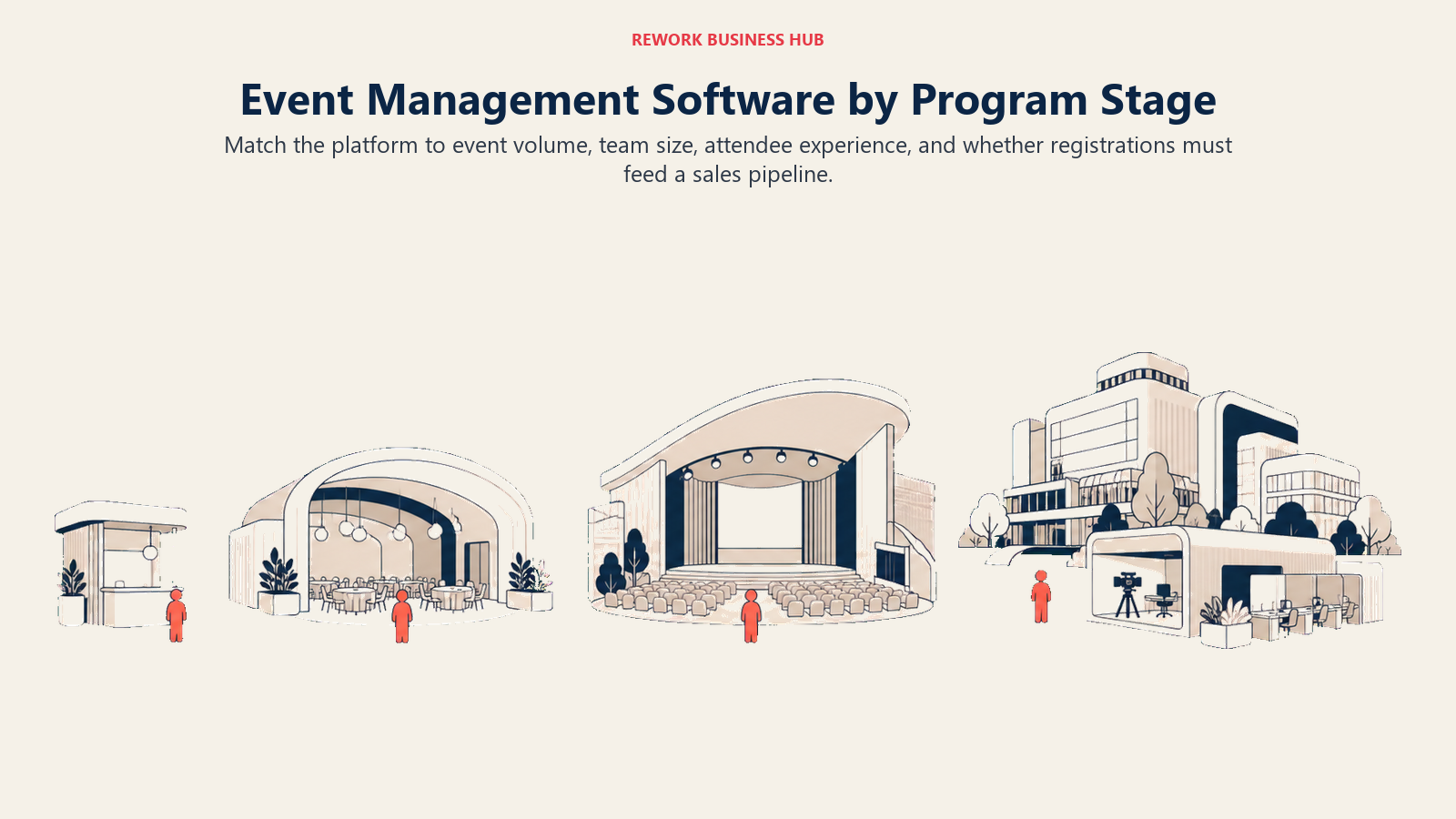
Program scale changes what event management means, from one registration page to portfolio sourcing, hybrid delivery, or CRM-linked follow-up.
| Program stage | What event management actually means here | Best fits |
|---|---|---|
| Occasional single event | One registration page and a spreadsheet for the guest list | Eventzilla, EventMobi (per-event), Zoho Backstage free tier |
| A handful of events a year, one owner | Registration, a simple website, basic email reminders | Eventzilla, Accelevents Professional, Zoho Backstage |
| Regular event calendar, small team | Unlimited registrations matter more than any single event's polish | Swoogo, Accelevents Business, RingCentral Events |
| Flagship annual conference, marketing-led | Onsite experience, branding and mobile app carry the program's reputation | Bizzabo, Whova, Splash |
| Multi-track enterprise portfolio | Venue sourcing, approvals, budget rollups across dozens of events | Cvent, Stova |
| Events feeding a sales pipeline | Registrations need to land on a CRM record, not a CSV export | Rework, plus whichever registration tool it sits behind |
| Association or membership body | Recurring annual conference, member directory, sponsor management | Whova, EventMobi, Zoho Backstage |
| Enterprise hybrid and virtual | Streaming, broadcast production, virtual networking at scale | Webex Events, Virtual PRO, RingCentral Events |
Sizing and Persona Table
| Who owns the event program | Their real problem | What to buy | What to skip |
|---|---|---|---|
| Solo marketer or founder | Getting one event live without a procurement fight | Eventzilla, Zoho Backstage free tier, Eventbrite for a free event | Anything with a five-figure annual floor |
| Events team of 1 to 3, many events a year | Paying per-registration fees that punish success | Swoogo, Accelevents Business | Per-registration pricing at any real volume |
| Marketing team running brand events | Every event page looking like a different vendor built it | Splash, Bizzabo | Tools with no templating or brand controls |
| Association or membership organization | One annual conference carries the whole budget | Whova, EventMobi, Zoho Backstage | Enterprise platforms priced for a full-time program team |
| RevOps or marketing ops, events feed pipeline | Leads from events sitting in a spreadsheet instead of the CRM | Rework, or a registration tool with a clean CRM sync | Any platform without a real integration or export path |
| Enterprise events team, portfolio of programs | Venue sourcing, approvals and reporting across dozens of events | Cvent, Stova | Point tools built for a single event, not a portfolio |
| IT or procurement-led buyer already on Cisco or RingCentral | Consolidating vendor spend under an existing contract | Webex Events, RingCentral Events | A new standalone vendor relationship |
1. Cvent: The Enterprise Standard, Priced Behind a Wall
Cvent is what most enterprise event teams end up shortlisting first, because it is the only platform on this list that genuinely spans the full lifecycle: strategy and budgeting, venue sourcing through its marketplace, registration and websites, onsite check-in and badges, and post-event reporting. For an events team running dozens of programs a year with different owners across regions, having one system of record for all of it is the entire pitch.
Cvent does not publish pricing anywhere on its site. The pricing page names Professional and Enterprise packages and states plainly that pricing is customized to the organization, with no figures shown. Third-party procurement research (docket.io and eventcloud.io pricing analyses) puts full enterprise programs in a range of roughly $19,550 per year at the median to $79,000 or more per year, plus $7 to $12 per registrant per event for the Attendee Hub product, plus $5,000 to $50,000 in year-one implementation. Treat all of that as (reported), not vendor-confirmed, and get your own quote before budgeting. If Cvent is priced out of reach, the field around it is covered in best Cvent alternatives, and the closest head-to-head sits in Cvent vs Bizzabo.
| Pros | Cons |
|---|---|
| Only platform here with a real venue sourcing marketplace | Zero published pricing, budgeting requires a sales call |
| Handles portfolio-scale programs across regions | Implementation and ramp time are both substantial |
| Deep reporting built for board-level rollups | Interface and workflows carry real legacy weight |
| Established in enterprise procurement processes | Overkill for anything under a true event portfolio |
Best for: Enterprise organizations running a portfolio of events that need venue sourcing alongside registration. Sizing fit: Enterprise, typically 1,000+ employees. Stage fit: Late-stage private and public companies.
2. Bizzabo: The Experience OS, Priced Per Seat With a Floor
Bizzabo's pitch is the event experience end to end: registration, a website builder, a branded mobile app, onsite badge printing and its own Klik SmartBadge wearables for networking and lead capture. For a flagship annual conference where the onsite moment is the brand, that combination is hard to match, and 24/7/365 support is included at every tier rather than sold as an add-on. The closest head-to-head, and the one most Bizzabo shortlists come down to, is Bizzabo vs Swoogo.
Pricing is $499 per user per month, billed annually, with a three-user minimum, which puts the real entry floor at $17,999 per year, not the $499 headline. That includes unlimited events and unlimited registrations, contact management, ticketing, email campaigns, the website builder, the mobile app and reporting. What it does not include: Klik SmartBadge wearables, which are quoted separately, plus virtual streaming, advanced onsite tools, CRM integrations, networking features and custom branding, all sold as paid add-ons. Multiply the per-user rate across a five-person events team before you compare it to a flat-fee competitor. The alternatives worth weighing against it are in best Bizzabo alternatives.
| Pros | Cons |
|---|---|
| Genuine hardware story with Klik SmartBadge | Per-user pricing with a hard 3-seat floor |
| Unlimited events and registrations included | Most of the platform's depth is a paid add-on |
| Strong branded mobile app and website builder | $17,999/year floor prices out smaller teams |
| 24/7/365 support included at every tier | CRM integrations cost extra on top of the seat price |
Best for: Marketing-led teams running one or two flagship conferences a year where onsite experience matters. Sizing fit: Mid-market to enterprise. Stage fit: Growth stage through public company.
3. Swoogo: Unlimited Registrations, Licensed Per User
Swoogo's specialty is narrow and deliberate: fast event websites and a registration engine built for teams running a high volume of events without a high headcount. The pitch is that once you're on Professional, running your fortieth event this year costs the same as running your first, because there's no per-registration fee. Where that flat-license model runs into a per-seat one, Bizzabo vs Swoogo works the seat math through in full.
Professional runs $11,800 per year, billed annually, and includes one Full User plus one Reporting User, with unlimited events and unlimited registrations. That "unlimited" claim is real but narrower than it sounds: it covers events and registrations, not seats. A five-person events team needs additional Full User licenses on top of the $11,800 base, so don't budget a whole team at the headline price. Add-ons include Go Onsite Pro, the Go Attend mobile app, Premium Support, extra custom domains, SSO, sub-accounts and Call for Speakers. Enterprise is quote-only above Professional. Note the domain is swoogo.events, not .com. For teams comparing it against the field, see best Swoogo alternatives.
| Pros | Cons |
|---|---|
| No per-registration fee at any volume | License is per user, not per team, at $11,800 for two seats |
| Fast, template-driven event website builder | Enterprise pricing above Professional is quote-only |
| Purpose-built for organizers running many events a year | Onsite tools, mobile app and SSO are separate add-ons |
| Predictable annual cost regardless of registration growth | Smaller brand recognition than Cvent or Bizzabo with executives |
Best for: Small events teams running a high volume of events a year who want registration costs to stay flat. Sizing fit: SMB to mid-market. Stage fit: Series A through established mid-market.
4. Eventbrite: Public Ticketing With Built-In Discovery
Eventbrite earns its place on this list for one reason other platforms can't match: a public marketplace where people who have never heard of your event can find it. For meetups, public conferences, community programs and smaller B2B events that want discovery reach alongside registration, that audience is the actual product, not just the registration form behind it. If you'd rather own the audience than rent the marketplace, Eventbrite vs Ticket Tailor is the fee-by-fee version of that trade.
Free events publish at no cost, full stop. Paid ticketing is where the real economics live: Eventbrite charges 3.7% plus a $1.79 service fee per ticket, plus 2.9% payment processing per order, and those fees can be absorbed by the organizer or passed to attendees. Eventbrite Pro starts at $15 per month and adds email marketing with up to 10,000 daily sends. High-volume or complex programs route through a sales conversation rather than self-serve pricing. The qualifier matters: Eventbrite is free to list an event, not free to sell tickets on. Anyone who tells you otherwise is quoting the free-event case only. For the field around it, see best Eventbrite alternatives.
| Pros | Cons |
|---|---|
| Free to publish and promote free events | Paid ticket fees (3.7% + $1.79 + 2.9%) add up fast at volume |
| Built-in public discovery audience | Not built for private, invite-only enterprise programs |
| Low-friction self-serve setup, no sales call needed | Branding and website customization are limited versus Bizzabo or Swoogo |
| Pro tier adds real email marketing for $15/month | Complex, multi-track programs outgrow it quickly |
Best for: Public, ticketed and community events that benefit from a built-in discovery audience. Sizing fit: Solo organizer through mid-market. Stage fit: Any stage, best for public-facing programs.
5. Stova: The Enterprise Rollup of Aventri and MeetingPlay
Stova is what's left after three formerly separate enterprise platforms, Aventri, MeetingPlay and eventcore, consolidated into one brand. The pitch to enterprise buyers is that you now get the combined feature set (registration, event apps, virtual and hybrid tooling, lead retrieval) under a single vendor relationship instead of three separate contracts and three separate support lines.
Stova does not publish pricing anywhere on its site. The pricing path is a demo request, with no tiers, no figures and no self-serve estimate available. That opacity is consistent with the rest of the enterprise tier of this category (Cvent, Whova, Brella), so budget for a genuine sales cycle rather than a quick self-serve comparison.
The honest read: Stova makes sense for organizations that already had a relationship with one of the three predecessor brands and want continuity, or for enterprise buyers who specifically want the combined virtual-plus-in-person feature set under one roof. For anyone comparing it against a platform with at least some published numbers, Cvent and Bizzabo are the more common shortlist partners.
| Pros | Cons |
|---|---|
| Combines three formerly separate enterprise platforms | Zero published pricing, demo-gated from the first page |
| Virtual, hybrid and in-person tooling under one brand | Brand transition can confuse buyers who knew Aventri or MeetingPlay |
| Built for complex, multi-stakeholder enterprise programs | Harder to build an initial budget range than Cvent or Bizzabo |
| Lead retrieval and reporting carried over from legacy products | Less market visibility than the category's more prominent names |
Best for: Enterprise organizations consolidating a legacy Aventri or MeetingPlay relationship. Sizing fit: Enterprise. Stage fit: Late-stage private and public companies.
6. Rework: Events on the Same Record as Your CRM
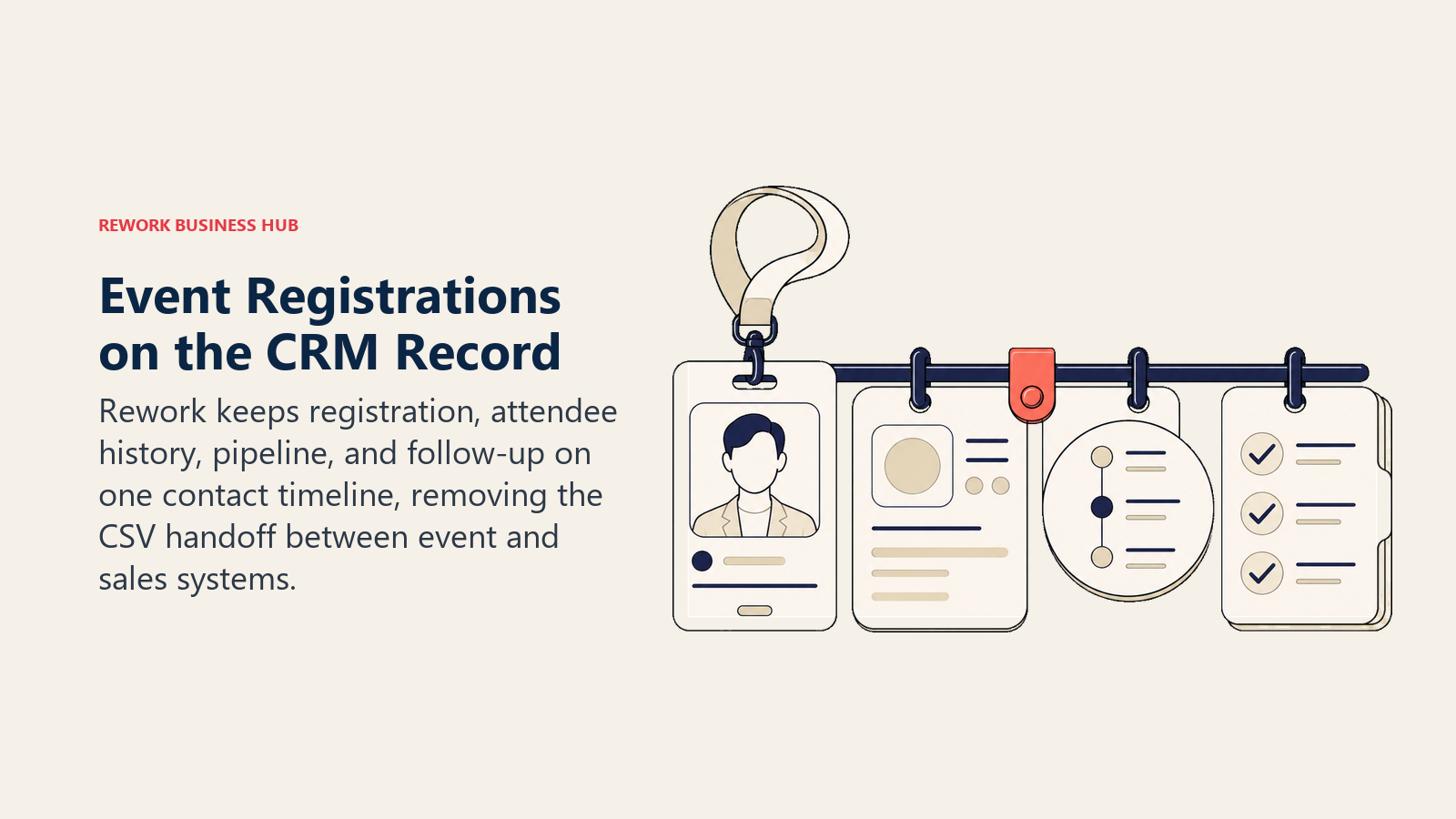
Rework's Event module is enterprise event management (registration, event websites, agenda and session planning, attendee records, approvals and resource booking) running inside the same platform as Sales Ops (CRM and pipeline), Lead management, Work Ops and the People app. The argument is consolidation, not event-tech depth: when someone registers for your event, that registration lands on the same contact timeline as their CRM record, so a sales rep sees the event history without anyone exporting a CSV and re-importing it. If your team already tracks pipeline in Rework's CRM or is weighing a move off HubSpot, that's the case worth evaluating on its own terms.
Rework sells Event as a top-up on its pricing page: $43/month billed yearly, or $50 month to month, at the base size (5 events). It needs the Lead app, which comes with the Marketing Engine ($99/month billed yearly) or the Revenue Engine ($159/month billed yearly), and people working in Event use marketing seats, which come in blocks of 5. See rework.com/pricing.
Be direct about the gaps. Rework's Live module, the virtual and hybrid event experience layer with streaming and a broadcast studio, is not live. Rework does not currently ship a virtual event platform, and this isn't a "coming soon" hedge, it simply isn't available. There's no audience polling or quizzing layer of the Slido or Mentimeter kind, no public ticket marketplace or consumer discovery audience of the Eventbrite kind, and no hotel or venue sourcing marketplace of the Cvent kind. Not ideal for: solo operators, virtual-first programs, or any team whose event needs a public ticketing audience. The fit is roughly 10 to 200 person organizations that already run (or plan to run) their commercial operations on Rework and want event data to stop living in a separate silo, feeding directly into post-event nurture through email marketing.
| Pros | Cons |
|---|---|
| Event registrations land on the same CRM contact record | No virtual or hybrid streaming platform (Live module not live) |
| One platform instead of separate CRM, lead and event logins | No public ticket marketplace or consumer discovery audience |
| No published price means no per-user math to game | No venue sourcing marketplace or room-block tooling |
| Fits teams already standardized on Rework for CRM/Work Ops | Not built for solo operators or 1-user event programs |
Best for: 10 to 200 person organizations that want event registrations on the same record as their CRM and pipeline. Not ideal for: Solo operators, virtual-only programs, or teams needing public ticket discovery. Sizing fit: 10 to 200 people. Stage fit: Any stage already running commercial operations on Rework.
7. Whova: Conferences and Associations, Priced Behind a Form
Whova's reputation is built on the attendee app: an agenda, in-app messaging, a community board and networking tools that attendees actually open during a conference instead of ignoring after download. For associations and academic or professional conferences where the attendee experience during the event matters as much as registration before it, that adoption rate is the reason it keeps showing up on shortlists. For teams that need more platform than an attendee app, the field is laid out in best Whova alternatives.
Whova does not publish tiers or figures. The pricing page is a "Price Quote Request" form paired with an offer for a 20-minute demo, with nothing self-serve available. Budget a real sales conversation, and don't let anyone quote you a number that didn't come from Whova directly.
| Pros | Cons |
|---|---|
| Attendee app with genuinely high in-event engagement | Zero published pricing, no self-serve estimate |
| Strong fit for academic and professional conferences | Registration and website tooling less polished than Bizzabo or Swoogo |
| Community and networking features built into the app | Every evaluation starts with a demo request, not a trial |
| Established base in the association and conference market | Enterprise-scale portfolio management is not the focus |
Best for: Conferences and associations that need a high-adoption attendee app more than a registration platform. Sizing fit: SMB to mid-market. Stage fit: Any stage, strongest for recurring annual conferences.
8. Webex Events: Hybrid Events Inside the Cisco Stack
Webex Events is the product formerly known as Socio, folded into Cisco's collaboration suite alongside Webex Meetings, Webinars and Calling. The case for it is procurement simplicity: an organization already buying Cisco for meetings and calling can add event capability under the same vendor relationship instead of onboarding a new one.
Cisco does not publish per-event Webex Events pricing. This is a case worth being careful with: Cisco does publish rates for Webex Meetings and Webinars, and it's easy to find a Meetings per-user number and mistakenly present it as the Events price. Those are different products with different pricing. Webex Events is quoted per event or per program through a Cisco sales conversation, and no public rate card exists for it.
| Pros | Cons |
|---|---|
| Sits inside existing Cisco procurement for teams already there | No published Events pricing, easy to confuse with Meetings rates |
| Hybrid event tooling built for the Cisco collaboration ecosystem | Weaker standalone brand recognition than Bizzabo or Cvent |
| Enterprise-grade security and IT posture inherited from Cisco | Feature depth for pure in-person events trails specialists |
| Useful consolidation play for existing Webex customers | Every quote requires a sales cycle, no self-serve path |
Best for: Organizations already standardized on Cisco Webex for meetings and calling that want hybrid events under the same contract. Sizing fit: Mid-market to enterprise. Stage fit: Established companies with existing Cisco spend.
9. RingCentral Events: Virtual and Hybrid, Priced Per Organizer
RingCentral Events is the former Hopin, acquired by RingCentral in 2023 and still actively sold, not shut down as some outdated comparisons still claim. The platform is built around virtual and hybrid delivery: live sessions, breakout networking, expo halls and streaming, run by a single event organizer managing the program.
Events Pro starts at $99 per organizer per month, available monthly or annual, with annual billing saving up to 16%. That entry tier includes unlimited events and unlimited registrations, and a 30-day free trial is available with limited registrations for testing. Two additional paid per-organizer tiers exist above Pro, but only the $99 entry point is published; everything above it routes through sales.
| Pros | Cons |
|---|---|
| Unlimited events and registrations at the $99 entry tier | Only the entry tier has a public price, higher tiers are sales-gated |
| Purpose-built for virtual and hybrid delivery at scale | Weaker in-person, onsite tooling than Cvent or Bizzabo |
| 30-day free trial available before committing | Per-organizer pricing scales awkwardly for a multi-person team |
| Backed by RingCentral's broader communications platform | Brand confusion lingers from the Hopin acquisition |
Best for: Single-organizer teams running virtual or hybrid programs who want a published entry price. Sizing fit: SMB to mid-market. Stage fit: Any stage running virtual-first or hybrid programs.
10. Splash: Event Marketing Pages for Teams Running Many Small Events
Splash is built for a different buyer than most of this list: not the events team running one flagship conference, but the marketing team running dozens of smaller branded events (dinners, roadshows, webinars, regional meetups) that all need to look like they came from the same company. Templated, brand-consistent event pages that a marketer can spin up without a designer are the core pitch.
Splash does not publish pricing. Third-party marketplace data (Vendr) reports annual plans in a range of roughly $12,500 to $36,500 or more, plus transaction and onboarding fees on top. Treat that range as (reported), not vendor-confirmed, since Splash's own site routes every prospect to a sales conversation.
| Pros | Cons |
|---|---|
| Fast, brand-consistent event page creation at volume | No published pricing anywhere on the vendor's site |
| Built for marketing teams, not dedicated events teams | Reported pricing spans a wide $12,500 to $36,500+ range |
| Good fit for many smaller, repeatable event formats | Less venue sourcing and onsite depth than Cvent or Bizzabo |
| Integrates event data back into marketing workflows | Transaction and onboarding fees add to the quoted range |
Best for: Marketing teams running many smaller, brand-consistent events rather than one large annual program. Sizing fit: Mid-market. Stage fit: Growth stage through enterprise marketing orgs.
11. Accelevents: Published Pricing in a Category Full of Quotes
Accelevents stands out in this list for a simple reason: it actually shows numbers on its pricing page, which is rare enough in event tech to be a selling point on its own. The platform covers registration, virtual and hybrid delivery, and onsite check-in, aimed at mid-market teams that want to model a real budget before picking up the phone.
Professional starts at $7,500 for one event. Business starts at $13,500 and covers unlimited events. Enterprise and White Label tiers are quote-only above that. The vendor's page doesn't explicitly state whether the published tiers are annual or one-time charges, so the accurate way to describe it is "starting at $7,500 for a single event," not "$7,500 a year." All tiers include 24/7 support.
| Pros | Cons |
|---|---|
| Rare, genuinely published entry pricing in this category | Billing period (annual vs. one-time) isn't stated on the page |
| Business tier's unlimited events at $13,500 is a clear number | Enterprise and White Label still require a sales quote |
| 24/7 support included even at the entry tier | Feature depth trails Cvent or Bizzabo at the top end |
| Covers registration, hybrid delivery and onsite in one platform | Smaller brand footprint than the category's established names |
Best for: Mid-market teams that want to see real numbers before a sales call. Sizing fit: SMB to mid-market. Stage fit: Series A through established mid-market.
12. EventMobi: Two Pricing Models for Associations and Non-Profits
EventMobi built its base with associations and non-profits running a recurring annual conference on a fixed budget, and its pricing reflects that buyer directly: two clean models instead of a maze of add-ons. Per event starts at $3,000. Per year starts at $8,900 for unlimited events, and includes a dedicated Event Success Manager, a level of hand-holding smaller teams often need and rarely get at this price.
Neither model charges a registration fee, on free or paid tickets, which matters for a non-profit selling tickets to a fundraiser and trying to keep more of the revenue. What isn't included: pre-printed badges run from $3.99 each, hardware rental (roughly two iPads and printers on a 7-day rental) starts around $1,000, and streaming or video storage add-ons start at $500 per event. Custom pricing applies above 10,000 attendees.
| Pros | Cons |
|---|---|
| No registration fees on free or paid tickets, either model | Hardware, badges and streaming are all separate line items |
| Dedicated Event Success Manager included on the annual plan | Per-event model at $3,000 can undercount total cost fast |
| Two clear pricing models instead of an add-on maze | Feature depth for large multi-track programs trails Cvent |
| Strong track record with associations and non-profits | Custom pricing kicks in above 10,000 attendees |
Best for: Associations and non-profits running one to a few recurring annual conferences on a fixed budget. Sizing fit: SMB to mid-market. Stage fit: Any stage, strongest for membership organizations.
13. Brella: AI Matchmaking as the Whole Point
Brella exists for one job most of this list treats as a feature, not a foundation: getting the right attendees to meet each other. AI-driven matchmaking recommends connections based on stated goals and interests, and built-in meeting booking turns those recommendations into scheduled 1:1s during the event, which is the actual ROI conversation for a networking-heavy conference.
Brella does not publish pricing. Every path on its site leads to a contact-sales form, with no tiers, no figures and no self-serve estimate. Budget for a real sales cycle, and get the number in writing before comparing it to a platform with published rates.
| Pros | Cons |
|---|---|
| Matchmaking and meeting-booking depth few competitors match | Zero pricing transparency, contact-sales only |
| Strong fit for networking-first conferences and summits | Narrower feature set outside networking and matchmaking |
| AI recommendations tied directly to attendee-stated goals | Not built as a full registration-to-onsite platform on its own |
| Meeting booking reduces the manual networking coordination | Smaller brand footprint than the category's larger names |
Best for: Conferences where structured networking and AI matchmaking are the primary value, not a bonus feature. Sizing fit: SMB to mid-market. Stage fit: Any stage running networking-focused events.
14. Eventzilla: The Cheapest Credible Entry Point
Eventzilla is the budget option that still functions as a real platform, not a stripped-down freemium tool. Its pricing is built around per-registration fees that scale with the features you need, which rewards small, occasional organizers and punishes anyone running high-volume paid ticketing without switching to the annual plan.
Basic costs $1.50 per registration (free events are free, limited to one paid ticket type). Pro adds 1.9% plus $1.50 per registration. Plus adds 2.9% plus $1.50 per registration and unlocks white labeling, virtual event support, exhibitor management and up to 10 account users. The better move at real volume: the annual plan starts at $1,999 per year with zero per-registration fees, including 500 registrations. Fees on any tier can be passed to attendees.
| Pros | Cons |
|---|---|
| Cheapest credible entry point in the entire category | Per-registration fees add up fast without the annual plan |
| Annual plan at $1,999/year removes fees entirely up to 500 regs | Plus tier's 2.9% + $1.50 rivals pricier competitors at volume |
| Free events cost nothing on any tier | Feature depth well behind Cvent, Bizzabo or Swoogo |
| Fees can be passed to attendees to protect margin | Limited to one paid ticket type on the cheapest Basic tier |
Best for: Small and occasional organizers who want the lowest real cost per event. Sizing fit: Solo organizer to SMB. Stage fit: Any stage, best for budget-constrained programs.
15. Zoho Backstage: A Real Free Tier Inside the Zoho Ecosystem
Zoho Backstage is the obvious pick for any team already running Zoho CRM, Zoho Books or the wider Zoho suite, and it's one of the only platforms on this list with a genuinely usable free tier rather than a crippled trial. Free supports 100 attendees, 300 RSVP invites, 3 sessions up to 45 minutes each and 3 speakers, enough to actually run a small event, not just evaluate the product.
Zoho publishes both tier limits and prices, though the figures render client-side and need a rendered fetch to read. Every paid plan is sold two ways, as a subscription billed annually or as a one-off per-event licence valid for a year: Essentials at US$99 per month billed annually or US$299 per event, Premium at US$208 per month or US$599 per event, Ultimate at US$416 per month or US$1,499 per event, with a stated 17% annual discount against monthly. Essentials steps up to 200 attendees, 800 invites, unlimited sessions up to 8 hours, 25 speakers, 15 sponsors and 0% commission ticketing. Premium reaches 1,000 attendees, 5,000 invites, 100 speakers, 50 sponsors, AI matchmaking and lead capture. Ultimate scales to 5,000 attendees, 30,000 invites, 200 speakers, 100 sponsors and a white-label mobile app. Check which of the two billing shapes fits your event calendar before budgeting, since a team running one event a year and a team running six pay very differently.
| Pros | Cons |
|---|---|
| Genuinely usable free tier, not a crippled trial | Prices above Free are third-party reported, not vendor-confirmed |
| 0% commission ticketing built into Essentials and above | Feature depth trails dedicated enterprise platforms |
| One ecosystem with Zoho CRM, Books and the wider suite | Less brand recognition outside the existing Zoho customer base |
| Clear, generous tier limits published directly by Zoho | AI matchmaking gated behind Premium, not available on Essentials |
Best for: Small teams already inside the Zoho ecosystem running events under 1,000 attendees. Sizing fit: Solo organizer to SMB. Stage fit: Any stage, strongest for existing Zoho customers.
16. Virtual PRO (formerly Hubilo): Enterprise Virtual, Post-Brandlive
Virtual PRO is what Hubilo became after Brandlive acquired it in September 2025 and relaunched the product in January 2026, migrating existing Hubilo customers onto the new platform in the process. The pitch is unchanged from Hubilo's original one: a purpose-built virtual and hybrid experience layer, streaming, breakout networking and engagement tooling, aimed at enterprise programs rather than a single-organizer virtual event. Anyone re-evaluating after that transition should start with best Hubilo alternatives, which covers what the rebrand changed and who the realistic replacements are.
PRO 1 starts at $15,000 per year, scaling by admin seats and audience capacity up through a quote-only PRO MAX tier for the largest programs. If you evaluated Hubilo before September 2025, re-verify: the old brand, its old pricing page and any quote you received under that name no longer apply.
| Pros | Cons |
|---|---|
| Purpose-built virtual and hybrid experience at enterprise scale | Brand transition means old Hubilo research and quotes are stale |
| Backed by Brandlive's broader video and streaming platform | $15,000/year entry prices out smaller virtual programs |
| Scales by seats and audience capacity through PRO MAX | PRO MAX above the entry tier is quote-only |
| Engagement tooling built specifically for virtual attendees | Weaker in-person, onsite feature set than Cvent or Bizzabo |
Best for: Enterprise organizations running large virtual or hybrid programs who already knew this platform as Hubilo. Sizing fit: Mid-market to enterprise. Stage fit: Established companies with recurring virtual programs.
How to Choose: Decision Framework
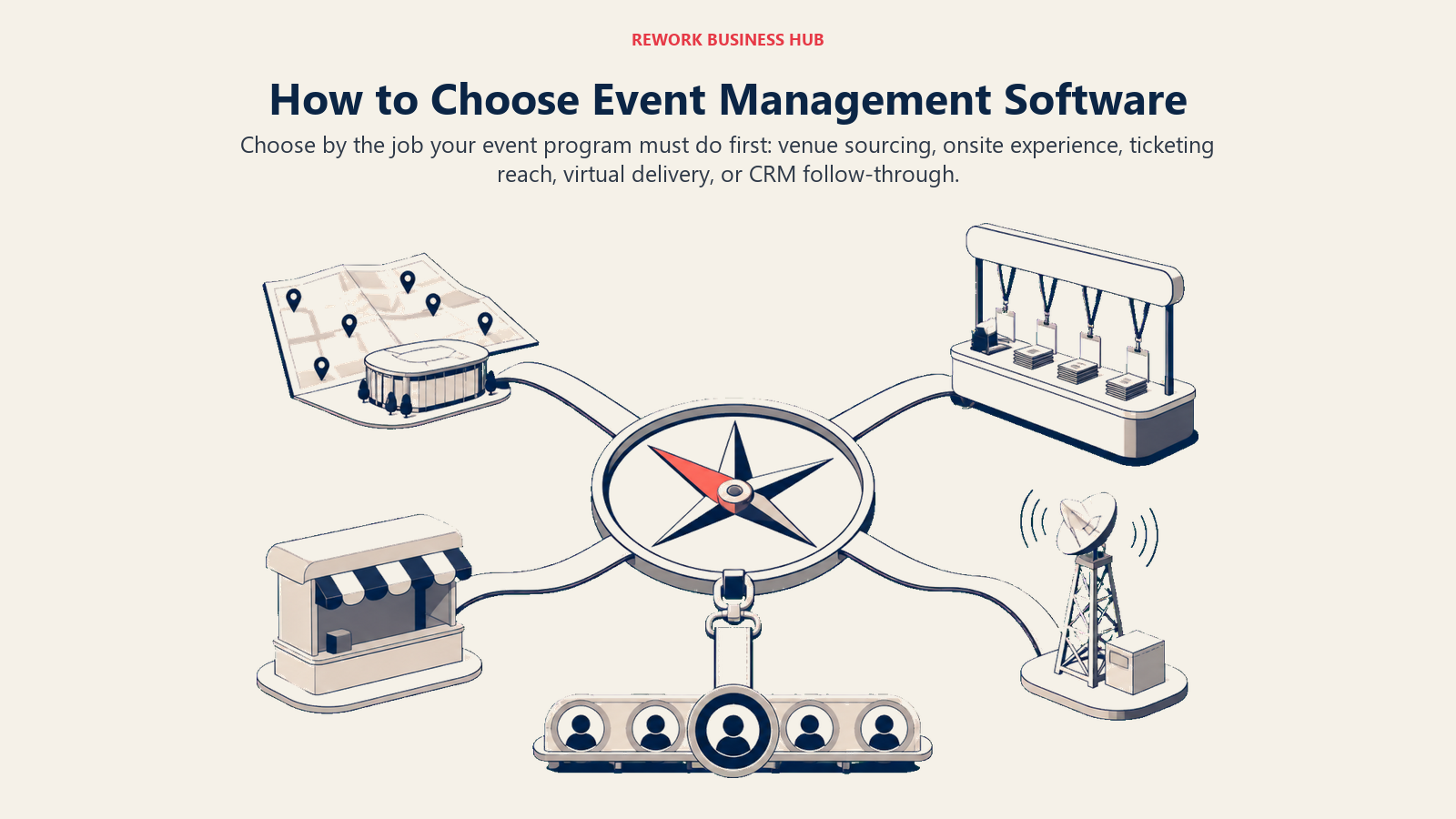
Start with the job the event program must do best, then choose the platform whose operating model and pricing match that job.
| If you need... | Pick... | Why |
|---|---|---|
| Venue sourcing plus registration across a full event portfolio | Cvent | Only platform here spanning strategy, sourcing, registration and onsite |
| A flagship conference where the onsite moment is the brand | Bizzabo | Klik hardware, branded app and website builder in one experience OS |
| Unlimited registrations at a flat annual cost | Swoogo | No per-registration fee, licensed per user instead |
| A public audience that can discover your event | Eventbrite | Built-in marketplace discovery, free to publish free events |
| Consolidating a legacy Aventri or MeetingPlay relationship | Stova | Combined feature set from three formerly separate platforms |
| Event registrations landing on the same record as your CRM | Rework | Consolidation, not event-tech depth: one contact timeline |
| An attendee app people actually open during the conference | Whova | High in-event engagement for associations and conferences |
| Hybrid events under an existing Cisco contract | Webex Events | Sits inside the same procurement as Webex Meetings and Calling |
| A published entry price for virtual or hybrid delivery | RingCentral Events | $99/organizer/month, unlimited events and registrations |
| Brand-consistent pages for many smaller marketing events | Splash | Templated event pages built for a marketing team, not an events team |
| Real numbers on the pricing page before you call sales | Accelevents | $7,500 for one event, $13,500 for unlimited, both published |
| No registration fees on a fixed annual association budget | EventMobi | $8,900/year unlimited, Event Success Manager included |
| AI-driven networking and matchmaking as the core value | Brella | Matchmaking and meeting-booking depth built for that job specifically |
| The lowest real cost per registration | Eventzilla | $1.50/registration on Basic, or $1,999/year with zero fees |
| A usable free tier inside an ecosystem you already run | Zoho Backstage | Free supports 100 attendees with real session limits |
| Enterprise virtual and hybrid delivery, post-Hubilo | Virtual PRO | The Brandlive-owned successor, purpose-built for scale |
What to Do Next
Pick two platforms, not five, and make them genuinely different from each other: one that matches your actual event volume and budget today, and one a tier up you'd grow into if the program scales. Then run both through the same three checks before anyone signs anything.
First, register a test attendee end to end in each trial or demo account, using your real ticket types, your real branding and your real registration questions. If the platform can't model your actual event without a workaround, cross it off. Second, get the fully loaded first-year number in writing, base license, per-registration fees if any, hardware or add-on costs, and implementation, not just the headline price from the pricing page. Third, ask where your registration data goes after the event: does it land in your CRM automatically, export as a manual CSV, or stay locked in the platform? That answer determines whether the marketing and sales team downstream, using tools like a project management platform to run follow-up tasks or marketing automation to nurture the leads, can actually use what the event produced.
If the shortlist still feels too wide, name the real problem first. Venue sourcing, onsite branding, public ticketing reach, virtual delivery and CRM consolidation are five different jobs, and no single platform on this list is built to be best at all five.

Principal Product Marketing Strategist
On this page
- Key Facts
- Quick Comparison Table
- What Changed in This Category in 2026
- Stage Fit Matrix
- Sizing and Persona Table
- 1. Cvent: The Enterprise Standard, Priced Behind a Wall
- 2. Bizzabo: The Experience OS, Priced Per Seat With a Floor
- 3. Swoogo: Unlimited Registrations, Licensed Per User
- 4. Eventbrite: Public Ticketing With Built-In Discovery
- 5. Stova: The Enterprise Rollup of Aventri and MeetingPlay
- 6. Rework: Events on the Same Record as Your CRM
- 7. Whova: Conferences and Associations, Priced Behind a Form
- 8. Webex Events: Hybrid Events Inside the Cisco Stack
- 9. RingCentral Events: Virtual and Hybrid, Priced Per Organizer
- 10. Splash: Event Marketing Pages for Teams Running Many Small Events
- 11. Accelevents: Published Pricing in a Category Full of Quotes
- 12. EventMobi: Two Pricing Models for Associations and Non-Profits
- 13. Brella: AI Matchmaking as the Whole Point
- 14. Eventzilla: The Cheapest Credible Entry Point
- 15. Zoho Backstage: A Real Free Tier Inside the Zoho Ecosystem
- 16. Virtual PRO (formerly Hubilo): Enterprise Virtual, Post-Brandlive
- How to Choose: Decision Framework
- What to Do Next