Best Cvent Alternatives in 2026: 14 Tools for Teams That Don't Need Cvent's Full Enterprise Stack
Turn this article into takeaways for your work.


Each assistant summarizes the article only for you and suggests best practices for your work.
Cvent is the platform every other event management tool gets compared against, and for a lot of buyers it's still the right answer. If your team sources hotel room blocks across a dozen cities a year, or needs one system tying registration, Attendee Hub, and a roughly 340,000-property venue marketplace together, nothing here replicates that footprint. That's not a knock on the 14 tools covered, it's just a different job.
Most readers land here for a narrower reason: the quote came back higher than expected, implementation dragged into its third month, or the team doesn't run enough multi-city programs to need venue sourcing at all. This guide covers 14 alternatives, evaluated on published pricing where it exists, real implementation weight, and fit for teams running smaller or more marketing-led programs than Cvent's core buyer. Rework sits at #6 for teams whose real gap isn't event-tech depth, it's that event data lives apart from the CRM and pipeline it should feed. For the wider category, see the Best Event Management Software in 2026 roundup.
Key Facts
Cvent and the Enterprise Event Management Category
- Cvent was named a Leader in the 2026 Gartner Magic Quadrant for Event Marketing and Management Platforms for the third consecutive year, ranked highest of all vendors evaluated on Ability to Execute. (Cvent)
- The Cvent Supplier Network gives planners searchable access to roughly 340,000 hotels and venues worldwide, a footprint almost nothing else on this list attempts to match. (Cvent)
- Cvent reports more than 445,000 users across 34,000-plus organizations, including 89% of the Fortune 100. (Cvent)
- Cvent carries a 4.3 out of 5 rating (G2 Score of 89) across G2's Event Marketing and Management category. (G2)
- The global event management software market is valued at $18.6 billion in 2026 and is projected to reach $36.8 billion by 2031, a 14.6% compound annual growth rate. (MarketsandMarkets, via PR Newswire)
Quick Comparison Table
| Tool | Best For | Starting Price | Key Strength | Key Limitation |
|---|---|---|---|---|
| Bizzabo | Enterprise event experience, premium onsite hardware | $499/user/mo, 3-user min. (from $17,999/yr) | Klik SmartBadge wearables, full event-experience OS | Per-user with a 3-seat floor; add-ons stack fast |
| Swoogo | Registration and websites at unlimited volume | $11,800/yr (1 Full + 1 Reporting User) | Unlimited events/registrations, no per-reg fee | Per-user license; a 5-person team costs more |
| Eventbrite | Public, ticketed events with a discovery audience | Free for free events; paid tickets 3.7% + $1.79 + 2.9% processing; Pro from $15/mo | Built-in attendee marketplace, consumer discovery | Not built for private, invite-only programs |
| Stova | End-to-end enterprise, replacing Aventri/MeetingPlay | Quote-only | Full lifecycle platform from three merged tools | No published pricing; a Cvent-like sales cycle |
| Whova | Conferences and associations wanting a strong app | Quote-only (demo required) | High-rated mobile app, in-app networking | No self-serve pricing; not built for public ticketing |
| Rework | Event data on the same platform as CRM and ops | Quote on request | Registrations on the same timeline as CRM/pipeline | No venue sourcing, room blocks, air, or virtual platform |
| Webex Events | Hybrid events inside an existing Cisco/Webex stack | Quote-only | Deep integration with Webex Meetings/Webinars | Pricing and features opaque outside a Cisco relationship |
| RingCentral Events | Virtual/hybrid on per-organizer pricing | $99/organizer/mo | Published entry price, unlimited events/registrations | Built virtual-first; weaker for large in-person programs |
| Splash | Marketing-led event pages matching brand design | Quote-only (reported $12,500-$36,500+/yr) | Fast, on-brand event page builder | Not built for complex, multi-session agendas |
| Accelevents | Mid-market teams wanting a published entry price | $7,500 for one event | Transparent per-event pricing, all-in-one platform | $7,500 buys one event, not a year of programs |
| EventMobi | Associations/nonprofits running recurring events | $3,000/event or $8,900/yr | No registration fees on free or paid tickets | Hardware, streaming, badges are separate add-ons |
| Eventzilla | Budget teams running high-volume registration | $1.50/registration, or $1,999/yr flat | Simple per-registration pricing, flat annual option | Thin on enterprise workflow and approvals |
| Zoho Backstage | Teams already inside the Zoho ecosystem | Free plan; Essentials US$99/mo billed annually or US$299/event | Deep Zoho CRM and suite integration | Attendee/speaker limits scale with each paid tier |
| Virtual PRO | Enterprise virtual/hybrid events post-Hubilo | $15,000/yr (PRO 1) | Enterprise virtual/hybrid depth from Hubilo | Newly rebranded; shorter track record under the name |
Stage Fit Matrix
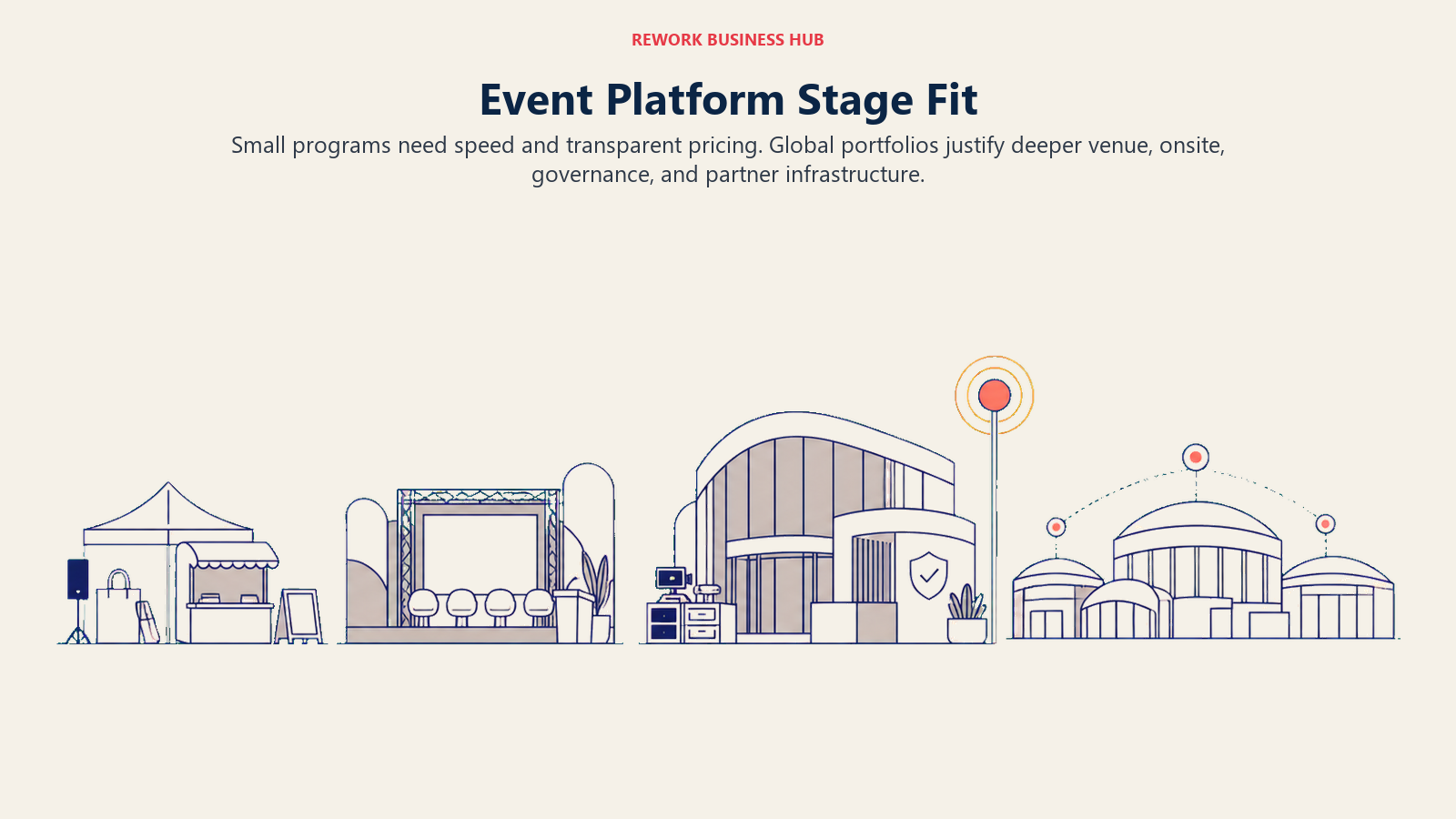
Fit shifts with both organization size and event-program complexity: lighter registration tools dominate early stages, while global programs justify heavier enterprise suites.
| Tool | Startup/SMB (1-50) | Growth (50-500) | Enterprise (500-5,000) | Global Enterprise (5,000+) |
|---|---|---|---|---|
| Bizzabo | Limited | Good | Best fit | Good |
| Swoogo | Good | Best fit | Good | Limited |
| Eventbrite | Best fit | Good | Limited | Not ideal |
| Stova | Not ideal | Good | Best fit | Best fit |
| Whova | Best fit | Best fit | Good | Limited |
| Rework | Good | Best fit | Good | Limited |
| Webex Events | Not ideal | Good | Best fit | Best fit |
| RingCentral Events | Good | Best fit | Good | Limited |
| Splash | Good | Best fit | Good | Limited |
| Accelevents | Best fit | Good | Limited | Not ideal |
| EventMobi | Best fit | Good | Good | Limited |
| Eventzilla | Best fit | Good | Limited | Not ideal |
| Zoho Backstage | Best fit | Good | Limited | Not ideal |
| Virtual PRO | Limited | Good | Best fit | Good |
Sizing and Persona Table
| Tool | Team Size Sweet Spot | Primary Buyer | Use Case Fit |
|---|---|---|---|
| Bizzabo | Flagship events, 100-2,000 attendees | VP Marketing, Head of Events | Premium in-person conferences with onsite hardware |
| Swoogo | 20-500 employees | Events Manager, Marketing Ops | High-volume registration, no per-registration fee |
| Eventbrite | Any size, consumer-facing | Community Manager, Marketing | Public ticketed events, open registration |
| Stova | 500-10,000+ employees | VP Events, Global Events Director | Enterprise programs migrating off Aventri/MeetingPlay |
| Whova | Conferences and associations | Conference Chair, Association Director | Recurring conferences, strong attendee networking |
| Rework | 10-200 employees | COO, RevOps, Marketing Ops | Event data feeding the same CRM and pipeline |
| Webex Events | 500-10,000+ employees, Cisco shops | IT/Events, Corporate Communications | Hybrid events inside an existing Webex deployment |
| RingCentral Events | 20-500 employees | Events Manager, Marketing | Virtual and hybrid programs, published pricing |
| Splash | 50-2,000 employees | Field Marketing, Demand Gen | Brand-consistent event marketing pages at volume |
| Accelevents | 20-500 employees | Events Manager, Marketing Ops | Mid-market all-in-one, published entry pricing |
| EventMobi | Associations, nonprofits, 5-200 staff | Association Director, Programs Manager | Recurring conferences, no per-registration fees |
| Eventzilla | 5-200 employees | Small Business Owner, Solo Planner | Budget registration and ticketing at volume |
| Zoho Backstage | 5-500 employees, Zoho customers | Marketing Ops, Zoho Admin | Events tied to an existing Zoho deployment |
| Virtual PRO | 500-5,000 employees | Head of Virtual Events | Enterprise virtual/hybrid, post-Hubilo migration |
1. Bizzabo: Enterprise Event Experience OS With Premium Onsite Hardware
Bizzabo positions itself less as a registration tool and more as an event-experience operating system, and the onsite hardware backs that up. Its Klik SmartBadge wearables (RFID badges for networking and lead capture) are a genuine differentiator that few platforms here, Cvent included, offer natively. For teams running flagship conferences where the in-person networking experience is the product, Bizzabo's mix of registration, mobile app, and hardware is hard to match. See Cvent vs Bizzabo for the direct head-to-head, or the best Bizzabo alternatives guide if Bizzabo's per-user floor doesn't fit either.
| What you get | What you don't |
|---|---|
| Klik SmartBadge wearables for networking and lead capture | A price that includes streaming, onsite tools, or CRM sync |
| Unlimited events and registrations on every plan | A flat team price; the license is per user with a 3-seat floor |
| A modern, well-reviewed event website and app builder | Enterprise venue sourcing at Cvent's scale |
| 24/7/365 support included at every tier | A published Enterprise price beyond the $17,999 floor |
Pricing: $499 per user per month, billed annually, with a 3-user minimum, so the real floor is $17,999 per year. That includes unlimited events and registrations, contact management, ticketing, email campaigns, website builder, mobile app, and reporting. Klik SmartBadge wearables are quoted separately, and virtual streaming, advanced onsite tools, CRM integrations, networking, and custom branding are paid add-ons. (bizzabo.com/pricing)
Best for: Marketing and events teams running a handful of flagship in-person conferences a year where onsite hardware and attendee experience matter as much as registration. Not ideal for: Teams running many smaller programs; the per-user floor and add-on structure add up fast across a full calendar.
2. Swoogo: Unlimited Registrations Without a Per-Registration Fee
Swoogo built its pitch around one specific complaint teams have with usage-based event platforms: a per-registration fee that punishes success. Its Professional plan includes unlimited events and unlimited registrations for one flat annual price, no matter how many people show up.
| What you get | What you don't |
|---|---|
| Unlimited events and registrations, no per-registration fee | A price that scales with team size beyond the included users |
| Strong, flexible event website and registration form builder | Klik-style onsite hardware or a physical wearable badge |
| Fast setup without a lengthy enterprise sales cycle | Deep venue sourcing or room-block negotiation tools |
| A published annual price for the Professional tier | An Enterprise price; that tier is quote-only |
Pricing: Professional is $11,800 per year (billed annually), including one Full User and one Reporting User, with unlimited events and unlimited registrations and no per-registration fee. Enterprise is quote-only. Paid add-ons include Go Onsite Pro, the Go Attend mobile app, Premium Support, extra custom domains, SSO, sub-accounts, and Call for Speakers. (swoogo.events/pricing)
Best for: Teams that run frequent registration-heavy events (webinars, roadshows, recurring meetups) and want a flat price instead of a per-attendee fee that grows with attendance. Not ideal for: Teams of five or more that need full platform access for everyone; Professional's license covers one Full User, and a bigger team adds cost fast. The best Swoogo alternatives guide covers that gap in more depth.
3. Eventbrite: Public Ticketing With a Built-In Discovery Audience
Eventbrite solves a different problem than Cvent's enterprise program management: public discovery. Its marketplace surfaces events to people actively looking for something to attend, something no enterprise-focused platform here, Cvent included, tries to replicate. For open or community events, that built-in audience beats deeper program-management features. If the per-ticket fee stack is what pushed you off Eventbrite in the first place, the best Eventbrite alternatives guide runs that math in detail.
| What you get | What you don't |
|---|---|
| A public marketplace that surfaces events to new attendees | A free platform; paid ticketing carries real fees |
| Free publishing for free events, no platform fee | Enterprise program governance across a multi-event calendar |
| Eventbrite Pro adds email marketing from $15/month | Venue sourcing, room blocks, or private-event tooling |
| A simple, fast setup without an enterprise sales cycle | A fit for private, invite-only enterprise conferences |
Pricing: Free events publish at no cost. Paid ticketing costs 3.7% plus $1.79 per ticket, plus 2.9% payment processing per order; those fees can be absorbed by the organizer or passed to attendees. Eventbrite Pro, which adds email marketing with up to 10,000 daily emails, starts at $15 per month. High-volume or complex programs go through a sales conversation. (eventbrite.com/organizer/pricing)
Best for: Public, ticketed, or community events where discoverability matters as much as registration logistics, and teams whose main draw is the built-in Pro email tool rather than a dedicated email marketing platform. Not ideal for: Private, invite-only enterprise programs; Eventbrite's whole value proposition is public discovery, which doesn't apply to a closed conference.
4. Stova: End-to-End Enterprise, Built From Three Merged Platforms
Stova is the newer name for three merged enterprise platforms: Aventri, MeetingPlay, and eventcore. For a team evaluating Cvent because it wants one enterprise-grade system end to end, Stova is the closest like-for-like alternative in ambition, covering registration, virtual/hybrid delivery, and onsite tools under one roof.
| What you get | What you don't |
|---|---|
| A single platform spanning registration, virtual, hybrid, and onsite | Published pricing anywhere on the vendor's site |
| Enterprise-grade features inherited from three merged platforms | A track record as long as Cvent's under the unified Stova name |
| A dedicated fit for global, multi-event enterprise calendars | A venue-sourcing marketplace at Cvent's scale |
| Onsite check-in, badge printing, and lead retrieval built in | A fast, self-serve sales process; expect a demo-first cycle |
Pricing: Stova does not publish pricing. The site offers demo requests only, with no tiers or figures listed. Expect an enterprise sales process similar to Cvent's own.
Best for: Enterprise events teams migrating off Aventri, MeetingPlay, or eventcore specifically, or any large team wanting one merged platform instead of stitching point tools together. Not ideal for: Teams that want a number before a sales call; Stova's pricing opacity mirrors the exact friction driving readers to look past Cvent in the first place.
5. Whova: The Attendee App Conferences and Associations Actually Use
Whova built its reputation from the attendee side up. Where Cvent's strength is program management across a whole calendar, Whova's is a highly rated mobile app and in-app networking that academic conferences and associations rely on year after year.
| What you get | What you don't |
|---|---|
| A consistently well-reviewed mobile app for attendee networking | Self-serve or published pricing; a demo is required first |
| Strong fit for recurring academic and association conferences | Cvent's depth of enterprise program and venue-sourcing tools |
| Built-in agenda, speaker, and session management | A large in-house implementation team of its own |
| A short demo path instead of a lengthy enterprise sales cycle | Room-block, air, or multi-city venue coordination |
Pricing: Whova's pricing page is a quote-request form paired with a 20-minute demo offer. No tiers or figures are published; pricing is quoted per event after that call.
Best for: Conference organizers and associations running annual or recurring meetings where attendee app quality and in-app networking matter more than enterprise-wide program management. Not ideal for: Teams needing venue sourcing, room blocks, or multi-event enterprise governance across a whole calendar year.
6. Rework: Event Registrations on the Same Timeline as CRM and Pipeline
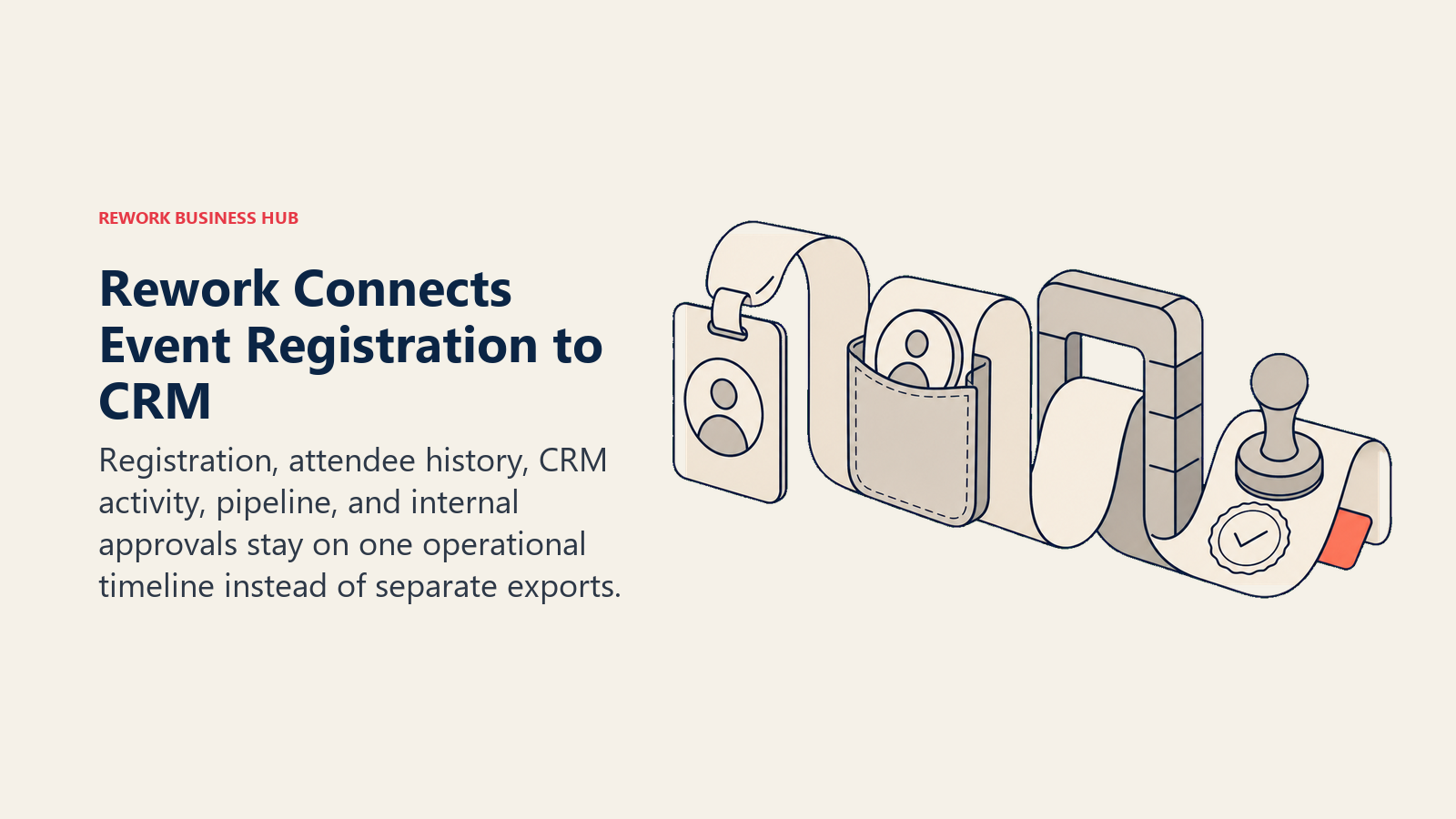
Rework is the right pick when the actual problem with Cvent isn't feature depth, it's that event data lives in a separate system from the CRM and pipeline it's supposed to feed. Rework's Event module runs registration, event websites, agenda and session planning, attendee records, and approvals and resource booking inside the same platform as Sales Ops (CRM and pipeline), Lead management, Work Ops, and the People app. An event-sourced lead lands on the same contact timeline as the CRM record instead of a CSV export into a separate system.
| What you get | What you don't |
|---|---|
| Event registrations on the same contact timeline as CRM and pipeline | A venue-sourcing marketplace of the kind Cvent runs |
| Work Ops approval routing for event budgets and vendor sign-off | Room-block or air management for multi-city programs |
| One platform instead of separate event, CRM, and ops logins | A virtual or hybrid streaming platform (Live isn't live yet) |
| Packaged annual pricing, not a per-registrant enterprise contract | Audience polling, quizzing, or a public ticket marketplace |
Pricing: Rework does not publish a price for the Event module. Rework sells packaged plans, not per-user or per-registrant licenses, and Event is quoted per organization. See rework.com/pricing for the published Sales Ops, Lead Ops, and Work Ops lines, or ask the team for an Event quote. For the CRM side of that argument, the Best CRM Software in 2026 roundup covers the pipeline side event data should be landing in.
Best for: Mid-size sales-led or marketing-heavy businesses (roughly 10-200 people) that want event registrations, CRM, and internal approvals on one platform instead of stitching Cvent to a separate CRM. Not ideal for: Teams that need venue sourcing, room-block and air management, or a virtual and hybrid event platform. Rework's Live module isn't live yet, and there's no audience-engagement layer or public ticket marketplace. Those teams are better served by Cvent itself, Bizzabo, or a dedicated virtual platform like Webex Events or Virtual PRO.
7. Webex Events (formerly Socio): Hybrid Events Inside the Cisco Stack
Webex Events makes the most sense as an extension, not a starting point. If your organization already runs Webex Meetings and Webinars, adding Webex Events keeps hybrid programs inside one Cisco relationship instead of introducing a new vendor.
| What you get | What you don't |
|---|---|
| Integration with the Webex Meetings and Webinars stack a team already runs | Published per-event or per-program pricing anywhere online |
| Cisco's enterprise security and IT-department familiarity | A fast, self-serve setup outside an existing Cisco relationship |
| Hybrid event tools inherited from the former Socio platform | Venue sourcing or room-block management |
| A single vendor relationship for meetings, webinars, and events | Marketing-forward event page design of the kind Splash offers |
Pricing: Cisco does not publish per-event or per-program Webex Events pricing. The public Webex pricing pages cover Meetings and Webinars, not Events; expect a quote through Cisco sales for the Events product specifically.
Best for: Enterprises already standardized on Webex Meetings and Webinars that want hybrid event capability without adding a new vendor relationship. Not ideal for: Teams starting from zero on video infrastructure; the integration advantage disappears if Webex isn't already the standard.
8. RingCentral Events (formerly Hopin): Virtual and Hybrid on Simple Per-Organizer Pricing
RingCentral acquired Hopin in 2023, and it's still alive under the RingCentral Events name, not shut down as some outdated commentary implies. Its pitch is straightforward per-organizer pricing for virtual and hybrid programs, a contrast to Cvent's quote-only model.
| What you get | What you don't |
|---|---|
| A published entry price: $99 per organizer per month | Cvent's depth of in-person venue sourcing and room-block tools |
| Unlimited events and registrations at that tier | Full pricing transparency; higher tiers are sales-quoted |
| Up to 16% savings on annual versus monthly billing | The onsite hardware story Bizzabo offers with Klik SmartBadge |
| A 30-day free trial to test the platform before buying | Deep enterprise program governance across a full event portfolio |
Pricing: Events Pro starts at $99 per organizer per month, billed monthly or annually (annual saves up to 16%), including unlimited events and registrations. A 30-day free trial with limited registrations is available. Two additional per-organizer tiers exist above Pro; only the $99 entry price is published, and the rest go through sales. (ringcentral.com/pricing/events)
Best for: Teams running primarily virtual or hybrid programs that want a published starting price instead of a quote-only sales process. Not ideal for: Large in-person, multi-city programs; RingCentral Events was built virtual-first, and it shows in the feature depth for onsite logistics.
9. Splash: Marketing-Led Event Pages at Brand Scale
Splash solves a narrower problem than Cvent: fast, on-brand event landing pages for a marketing team running many smaller events, from happy hours to regional roadshows, where design consistency matters more than session-level program management.
| What you get | What you don't |
|---|---|
| Fast, branded event page creation without a design team | Published pricing; the vendor doesn't list figures |
| A tool built for marketing and demand-gen teams specifically | Cvent's depth of registration workflow or venue sourcing |
| Templates that keep event pages on-brand at volume | Room-block, air, or multi-city enterprise program tools |
| Integrations built for the marketing stack, not just events | A fit for complex, multi-session conference agendas |
Pricing: Splash does not publish pricing. Third-party marketplace data reports annual plans in the range of $12,500 to $36,500-plus, plus transaction and onboarding fees. (reported, Vendr marketplace data)
Best for: Field marketing and demand-gen teams running a high volume of smaller, brand-forward events who need pages that match campaign design, not full conference program management. If the rest of the marketing stack is also under review, the best Marketo alternatives guide covers the automation side that usually sits next to a tool like Splash. Not ideal for: Large, multi-session conferences with complex agendas and approval chains; Splash is built for event marketing pages, not enterprise program management.
10. Accelevents: Published Entry Pricing for Mid-Market Teams
Accelevents is one of the few platforms here, alongside Eventbrite and Eventzilla, that puts an actual number on its pricing page instead of routing every visitor to a sales call, which matters if Cvent's quote-only process is part of what's driving the search.
| What you get | What you don't |
|---|---|
| A published starting price for a single event | Unlimited events without moving up to Business or higher |
| An all-in-one virtual, hybrid, and in-person platform | Cvent-level venue sourcing or room-block management |
| 24/7 support included on every tier | A stated billing period; the site doesn't say if $7,500 is annual |
| A clear jump to unlimited events at the Business tier | Enterprise governance across a large, multi-brand event portfolio |
Pricing: Professional starts at $7,500 for one event. Business starts at $13,500 and includes unlimited events. Enterprise and White Label are quote-only. All tiers include 24/7 support. The page doesn't state whether the $7,500 figure is a one-time or annual charge, so treat it as the price of a single event rather than a yearly plan. (accelevents.com/pricing)
Best for: Mid-market teams that want a published price to budget against and run enough events a year to justify moving to the unlimited Business tier. Not ideal for: Teams running just one or two events a year, where $7,500 to $13,500 doesn't pencil out against a lighter, per-registration tool like Eventzilla.
11. EventMobi: Per-Event or Per-Year Pricing for Associations and Nonprofits
EventMobi built its base among associations and nonprofits running the same recurring conference every year, and its two pricing models, per event or per year, reflect that: per-year makes sense once an organization runs more than two or three events annually.
| What you get | What you don't |
|---|---|
| Two clear pricing paths: per event or per year | No registration fees on free or paid tickets |
| A dedicated Event Success Manager on the annual plan | Cvent's venue-sourcing marketplace or room-block tools |
| No per-registration fees at any volume | Streaming, hardware rental, and badges bundled at no charge |
| Custom pricing above 10,000 attendees for larger programs | A fit for enterprise, multi-brand event portfolios |
Pricing: Per event starts at $3,000. Per year starts at $8,900 for unlimited events with a dedicated Event Success Manager. Pre-printed badges run $3.99 each; hardware rental (two iPads and printers, seven-day rental) starts around $1,000; streaming and video storage add-ons start at $500 per event. Custom pricing applies above 10,000 attendees. (eventmobi.com/pricing)
Best for: Associations and nonprofits running two or more recurring annual conferences that want to avoid per-registration fees as attendance grows. Not ideal for: One-off event teams where the per-event price doesn't amortize, or large enterprises needing venue sourcing across many simultaneous programs.
12. Eventzilla: Budget Registration and Ticketing at Volume
Eventzilla is the straightforward answer for a team whose only real Cvent complaint is paying enterprise prices for what amounts to registration and ticketing. Its per-registration model, with a flat annual option once volume justifies it, is built for that narrower job.
| What you get | What you don't |
|---|---|
| Free registration for free events, with tiers scaling by fee structure | Enterprise workflow, approvals, or venue sourcing |
| A flat annual plan ($1,999/yr) with zero per-registration fees | Onsite hardware, badge wearables, or a mobile networking app |
| Up to 10 account users on the Plus tier | Deep reporting or multi-event portfolio governance |
| Simple, published pricing with no sales call required | A fit for complex, multi-session conference programs |
Pricing: Basic is $1.50 per registration (free events are free, one paid ticket type). Pro adds 1.9% plus $1.50 per registration. Plus adds 2.9% plus $1.50 per registration, with white label, virtual event tools, exhibitor management, and up to 10 account users. An annual plan is available from $1,999 per year with zero per-registration fees, including 500 registrations. Fees can be passed to attendees on any tier. (eventzilla.net/pricing)
Best for: Budget-conscious teams running high-volume registration and ticketing without needing enterprise workflow depth. Not ideal for: Teams that need approval chains, venue sourcing, or onsite hardware; Eventzilla intentionally stays in its lane as a registration and ticketing tool.
13. Zoho Backstage: Events Tied to an Existing Zoho Deployment
Zoho Backstage's real pitch isn't event features in isolation, it's what happens when event data connects to a Zoho CRM deployment a team already runs. For an organization standardized on Zoho, that integration depth is worth more than a feature checklist against Cvent.
| What you get | What you don't |
|---|---|
| Deep integration with Zoho CRM and the wider Zoho suite | Published per-plan pricing that resolves cleanly on the vendor site |
| A free tier for small events (100 attendees, 3 sessions) | Cvent's venue sourcing, room-block, or air management |
| AI matchmaking and lead capture at the Premium tier | Unlimited attendee or speaker caps on any tier |
| 0% commission ticketing at every paid tier | A strong standalone fit outside the Zoho ecosystem |
Pricing: Free supports up to 100 attendees, 300 RSVP invites, 3 sessions of up to 45 minutes, and 3 speakers. Essentials, Premium, and Ultimate scale those limits, adding unlimited session length, AI matchmaking, lead capture, and a white-label app at the top tier. Zoho publishes a subscription and a pay-per-event price for each paid plan: Essentials at US$99 per month billed annually or US$299 per event, Premium at US$208 per month billed annually or US$599 per event, and Ultimate at US$416 per month billed annually or US$1,499 per event, with a stated 17% annual discount against monthly.
Best for: Teams already running Zoho CRM or the broader Zoho suite that want event registration data flowing into the same ecosystem without a separate integration project. Not ideal for: Teams outside the Zoho ecosystem; the integration advantage that justifies Backstage over a standalone tool disappears without it.
14. Virtual PRO (formerly Hubilo): Enterprise Virtual and Hybrid, Post-Brandlive
Virtual PRO is the platform formerly known as Hubilo. Brandlive acquired Hubilo in September 2025 and relaunched it as Virtual PRO in January 2026, migrating existing customers to the new name. The product and its virtual/hybrid depth carried over; only the name and ownership did not.
| What you get | What you don't |
|---|---|
| Enterprise virtual and hybrid event depth inherited from Hubilo | A long track record under the current Virtual PRO name |
| A published entry price for PRO 1 | Cvent-level in-person program tools or venue sourcing |
| Pricing that scales predictably with admin seats and audience size | A published price above PRO 1; PRO MAX is quote-only |
| Continuity for existing Hubilo customers through the migration | Onsite hardware or badge wearables |
Pricing: PRO 1 starts at $15,000 per year, scaling by admin seats and audience capacity. PRO MAX, for larger enterprise deployments, is quote-only. (virtualpro.com)
Best for: Enterprise teams that evaluated Hubilo for virtual and hybrid events and want continuity under new ownership, with a published starting price instead of a blind quote. Not ideal for: In-person-first programs; Virtual PRO's depth, like Hubilo's before it, is built for virtual and hybrid delivery, not onsite logistics or venue sourcing.
Why Teams Look Beyond Cvent
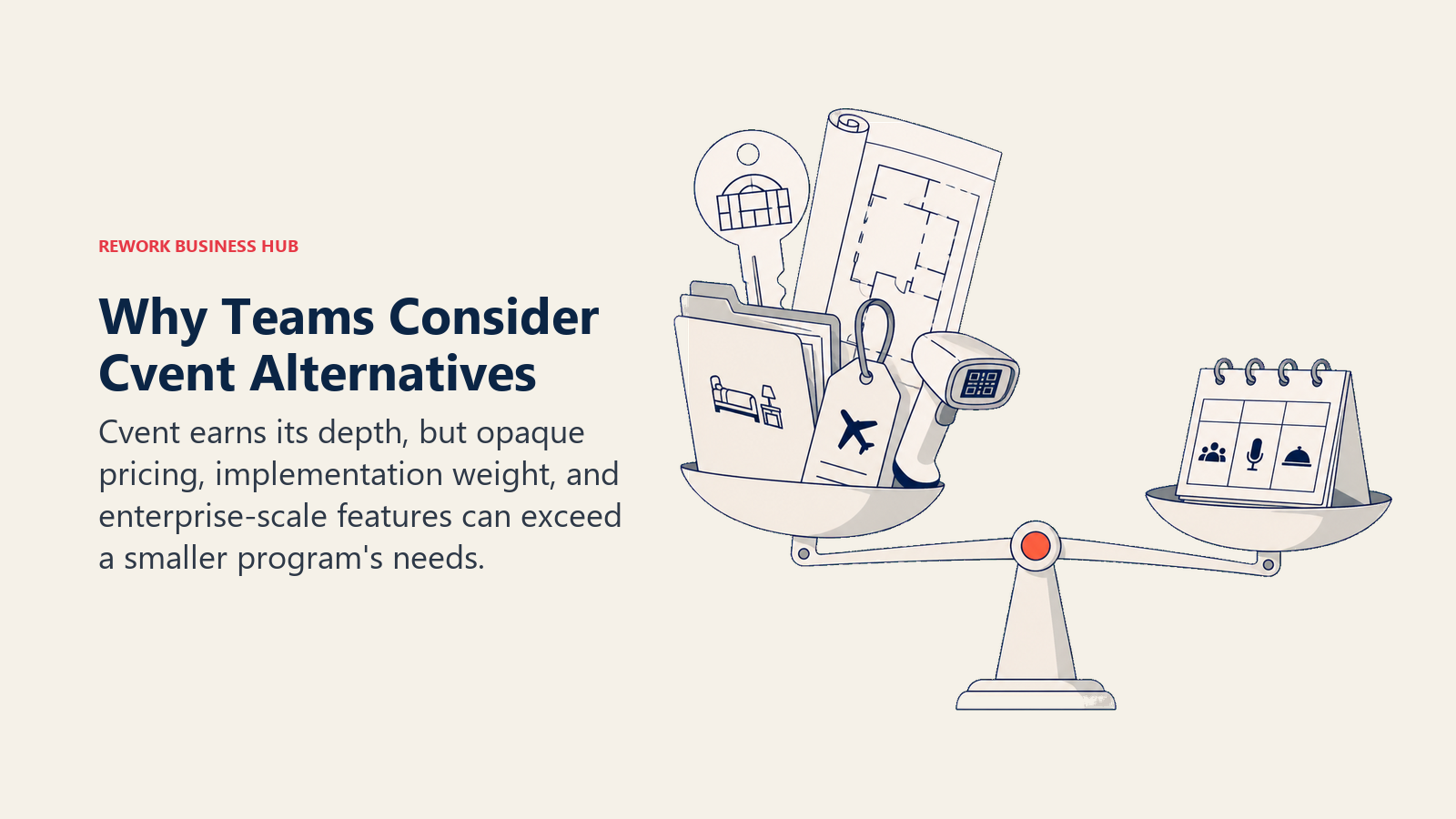
Cvent earns its position honestly. Gartner named it a Leader in the Magic Quadrant for Event Marketing and Management Platforms for the third straight year in 2026, ranking it highest on Ability to Execute, and its Supplier Network's roughly 340,000 hotels and venues is a moat almost nothing here attempts to replicate. Most teams looking for alternatives aren't fleeing a broken product. They're running into the cost of a platform built for a bigger program than the one they run.
Pricing is opaque by design. Cvent's pricing page names Professional and Enterprise packages and shows no figures anywhere: "Your events, your team, and your goals are unique. Your pricing should be too." Third-party research puts typical 12-month contracts around $19,550 a year on the low end and $79,000-plus for full enterprise programs, on top of a $7 to $12 per-registrant Attendee Hub fee and $5,000 to $50,000 in Year-1 implementation costs. (docket.io)
Implementation is a real project, not a sign-up. Technical implementation typically runs 4 to 8 weeks, but reaching full team proficiency realistically takes 3 to 6 months, even for experienced event professionals. (docket.io) That's the right trade for a global events calendar, and a heavy lift for a team running four regional meetups a year.
The platform is built for volume most teams don't have. Venue sourcing across roughly 340,000 properties, room-block negotiation, air booking, and event diagramming are valuable for a company running dozens of multi-city programs. A team running one flagship conference and a handful of webinars is paying for capability it never touches.
Reviewers rate it well, with a consistent caveat. Cvent holds a 4.3 out of 5 on G2 (G2 Score 89); users praise Attendee Hub's customizability, and the recurring complaint is restricted customization for smaller design needs. (G2)
None of this makes Cvent the wrong choice for a large, multi-event enterprise program. The question this guide answers is what to run instead when that isn't the program you have.
Migrating Off Cvent: What You Lose and What to Export
Be honest about what a Cvent replacement won't do before switching. Venue sourcing is the biggest gap: the Cvent Supplier Network's roughly 340,000-property marketplace and RFP workflow has no real equivalent among registration-first tools like Swoogo, Eventzilla, or Rework. If your team still needs to source hotel room blocks and negotiate group rates, plan to keep a manual RFP process, use a dedicated sourcing tool, or keep Cvent for that workflow even after moving registration elsewhere. Room-block management and air booking fall into the same category; nothing here, including Rework, Bizzabo, or Stova, replicates Cvent's group-business sourcing function.
What you should export before cutting over: the full attendee and registrant database (contact records, custom fields, session attendance history), event diagrams and floor plans you'll need again, historical reporting and budget data for year-over-year comparisons, and any integration mappings to your CRM or marketing automation platform. Export in stages, not all at once, and run your next event on the new platform while Cvent stays live in read-only mode for one full reporting cycle so nobody discovers a missing field mid-renewal season.
If the CRM side of that migration is also under review, not just the event tool, the best Salesforce alternatives and best HubSpot alternatives guides cover that adjacent decision. And if the actual bottleneck is coordinating the migration project itself, a lightweight project management tool to track the cutover checklist is worth setting up before the first event goes live on the new platform.
How to Choose: Decision Framework
Start with the event job you cannot compromise on, then shortlist the platform built around that job instead of buying the broadest stack.
| If you need... | Best pick |
|---|---|
| Event data on the same platform as CRM, pipeline, and ops | Rework |
| Premium onsite hardware and a full event-experience OS | Bizzabo |
| Unlimited registrations without a per-registration fee | Swoogo |
| Public ticketing with a built-in discovery audience | Eventbrite |
| A merged, end-to-end enterprise platform after Aventri or MeetingPlay | Stova |
| The attendee app academic conferences and associations actually use | Whova |
| Hybrid events inside an existing Cisco/Webex deployment | Webex Events |
| A published starting price for virtual and hybrid programs | RingCentral Events |
| On-brand event marketing pages at high volume | Splash |
| A published entry price for a mid-market, all-in-one platform | Accelevents |
| Recurring annual conferences with no per-registration fees | EventMobi |
| Budget registration and ticketing at high volume | Eventzilla |
| Event data flowing into an existing Zoho deployment | Zoho Backstage |
| Enterprise virtual and hybrid depth carried over from Hubilo | Virtual PRO |
Frequently Asked Questions about Cvent Alternatives
What's the biggest reason teams look for Cvent alternatives?
Fit, more than dissatisfaction. Cvent's pricing is quote-only, third-party research puts typical contracts from roughly $19,550 to $79,000-plus a year plus per-registrant Attendee Hub fees, and full team proficiency realistically takes 3 to 6 months. That's the right trade for a large, multi-event calendar, and a heavy one for a team running a handful of smaller programs a year.
Does Cvent publish pricing anywhere?
No. Cvent's pricing page names Professional and Enterprise packages and states "Your events, your team, and your goals are unique. Your pricing should be too," with every rate gated behind a quote request. Any dollar figure in this guide comes from third-party pricing research, not from Cvent itself.
Which Cvent alternative has the most transparent, published pricing?
Eventbrite, Eventzilla, RingCentral Events, and Accelevents all publish at least an entry-level price on their own sites. Swoogo and Bizzabo also publish clear per-user or per-year figures, even though the total climbs with team size.
Which alternative fits a team that wants event data tied to CRM and other business ops, not just event logistics?
Rework. Its Event module keeps registrations on the same contact timeline as CRM, pipeline, Work Ops, and People data, something none of the dedicated event platforms here attempt; they're built to stand alone as event systems.
Is it worth switching if the team only runs two or three events a year?
Usually not to a platform built for Cvent-scale volume. EventMobi's per-year plan, Accelevents' Business tier, or staying on a lighter per-event tool like Eventzilla will pencil out better than a platform sized for a full annual calendar.
What happened to Hubilo and Hopin, and are they still around?
Both changed hands and names, not disappeared. Brandlive acquired Hubilo in September 2025 and relaunched it as Virtual PRO in January 2026. RingCentral acquired Hopin in 2023 and still sells it as RingCentral Events.
When does it make sense to stay on Cvent instead of switching?
Cvent remains the strongest choice for a large organization running a global, multi-event calendar that needs venue sourcing, room-block negotiation, air booking, and event diagramming in one system. Gartner has named it a Magic Quadrant Leader for three consecutive years running. Teams that don't run programs at that scale are the ones this guide is for.
What to Do Next
Pick two tools based on which specific part of Cvent is actually costing you time today, not which demo looks best. If it's pricing opacity, put Accelevents and RingCentral Events head to head; both publish an entry price you can compare without a sales call. If it's onsite experience for a flagship conference, trial Bizzabo against your next event with real attendees, not a sandbox account.
If the actual problem is that event data lives apart from the CRM and pipeline it should feed, start with Rework. Pricing for the Event module is quoted per organization; see rework.com/pricing. And if venue sourcing, room blocks, or air management are still part of the job, read the "what you lose" section above before you commit, that's the one gap none of these 14 tools fully close. For the wider category beyond this list, the Best Event Management Software in 2026 roundup covers additional platforms and use cases.

Principal Product Marketing Strategist
On this page
- Key Facts
- Quick Comparison Table
- Stage Fit Matrix
- Sizing and Persona Table
- 1. Bizzabo: Enterprise Event Experience OS With Premium Onsite Hardware
- 2. Swoogo: Unlimited Registrations Without a Per-Registration Fee
- 3. Eventbrite: Public Ticketing With a Built-In Discovery Audience
- 4. Stova: End-to-End Enterprise, Built From Three Merged Platforms
- 5. Whova: The Attendee App Conferences and Associations Actually Use
- 6. Rework: Event Registrations on the Same Timeline as CRM and Pipeline
- 7. Webex Events (formerly Socio): Hybrid Events Inside the Cisco Stack
- 8. RingCentral Events (formerly Hopin): Virtual and Hybrid on Simple Per-Organizer Pricing
- 9. Splash: Marketing-Led Event Pages at Brand Scale
- 10. Accelevents: Published Entry Pricing for Mid-Market Teams
- 11. EventMobi: Per-Event or Per-Year Pricing for Associations and Nonprofits
- 12. Eventzilla: Budget Registration and Ticketing at Volume
- 13. Zoho Backstage: Events Tied to an Existing Zoho Deployment
- 14. Virtual PRO (formerly Hubilo): Enterprise Virtual and Hybrid, Post-Brandlive
- Why Teams Look Beyond Cvent
- Migrating Off Cvent: What You Lose and What to Export
- How to Choose: Decision Framework
- What to Do Next