Best Whova Alternatives in 2026: 15 Tools for Conference Teams That Need More Than an Attendee App

Turn this article into takeaways for your work.


Each assistant summarizes the article only for you and suggests best practices for your work.
If you're looking at Whova alternatives, the right answer depends on which half of your problem is bigger. If you need a published number before you'll book a call, EventMobi, Accelevents and RingCentral Events are the three that give you one. If you need registration, event websites and marketing depth that reaches well past the app, Swoogo and Cvent are the serious options. And if your actual complaint is that everything you learn about an attendee dies inside the event tool, Rework is the one worth a look. This guide evaluates 15 alternatives on pricing transparency, registration and website depth, virtual and hybrid coverage, and where attendee data ends up; pricing was.
Whova earns its reputation honestly, and it's worth being clear about that before listing anything else. The attendee-facing app is the product: personalized agendas, in-app messaging, business-card and QR-code networking, live polls, session Q&A, and abstract or call-for-speakers management that academic programs genuinely depend on. Whova's own site names Google, Microsoft and Ford alongside universities, government agencies and associations, which tells you the app scales from a 100-person meetup to a corporate all-hands without retooling. Nothing below is a knock on that. It's a map of where to look when the quote-only pricing, the registration and marketing ceiling, or the per-event sales conversation stop working for your program.
Key Facts
The Event Technology Category, By the Numbers
- The global event management software market is worth about $18.6 billion in 2026 and is projected to reach $36.8 billion by 2031, a 14.6% compound annual growth rate. (MarketsandMarkets, via PR Newswire)
- 89% of businesses that use event technology say it saves them around 200 hours per year. (Research Nester, cited in Cvent's 2026 event statistics report)
- 72% of meeting professionals use dedicated technology or software to manage most or all of their meetings programs. (Amex GBT 2026, cited in Cvent's 2026 event statistics report)
- 68% of marketers use an event platform that integrates with the rest of their tech stack, including their CRM. (Splash Events Outlook Report 2025, cited in Cvent's 2026 event statistics report)
- About one-quarter of large enterprises spend more than $250,000 a year on event technology and run six or more separate event tech tools at once. (Forrester, cited in Cvent's 2026 event statistics report)
Quick Comparison Table
| Tool | Best For | Starting Price | Key Strength | Key Limitation |
|---|---|---|---|---|
| Cvent | Enterprise programs that also source venues | Quote only (reported $19,550 to $79,000+/yr) | Venue sourcing, room blocks, full program management | No published pricing at all, long implementation |
| EventMobi | Associations wanting a published per-event price | From $3,000/event or $8,900/yr unlimited | Two real published prices, zero registration fees | Badges, hardware and streaming are separate add-ons |
| Bizzabo | Enterprise experience with onsite badge hardware | $499/user/mo billed annually, 3-user minimum | Klik SmartBadge wearables, polished attendee app | $17,999/yr floor, most extras are paid add-ons |
| Accelevents | Mid-market teams that want a number up front | From $7,500 for one event; $13,500 unlimited | Published entry pricing, rare in this category | Entry tier is single-event, not an annual program |
| Swoogo | Deep registration forms and branded event sites | $11,800/yr (Professional) | Unlimited events and registrations, no per-reg fee | Includes only one Full User and one Reporting User |
| Rework | Attendee data landing on the CRM contact timeline | Quote on request (rework.com/pricing) | Registrations sit beside CRM, pipeline and Work Ops | No onsite badge hardware, no virtual streaming layer |
| Brella | Matchmaking-first conferences and trade shows | Quote only, no published figures | Networking depth that beats most reg-first tools | Not a registration or event-website replacement |
| Webex Events | Hybrid events inside an existing Cisco stack | Quote only, no published figures | Sits inside a Webex relationship many already own | No published rates; Meetings prices are not Events prices |
| RingCentral Events | Virtual and hybrid on a published per-seat rate | From $99 per organizer per month | Published entry price, monthly or annual billing | Only the entry tier is public; the rest is sales-gated |
| Virtual PRO | Broadcast-quality virtual and hybrid production | $15,000/yr (PRO 1), $50,000 (PRO 4) | Published annual tiers with clear audience caps | The Hubilo brand it grew from has been retired |
| vFairs | Virtual, hybrid and onsite from one vendor | Quote only, demo-gated | Broad virtual plus onsite coverage in one product | Same quote-only wall you're leaving Whova over |
| Stova | End-to-end enterprise programs | Quote only, demo-gated | Breadth inherited from Aventri and MeetingPlay | No pricing transparency to compare against |
| Splash | Branded event marketing across many small events | Quote only (reported $12,500 to $36,500+/yr) | Marketing-team-friendly page builder at portfolio scale | Reported figures are not vendor-confirmed |
| Eventzilla | Budget programs priced per registration | From $1.50 per registration; $1,999/yr flat option | Cheapest real entry point on this list | Thin attendee-app experience next to Whova's |
| Eventbrite | Public and ticketed events needing discovery | Free events free; paid tickets 3.7% + $1.79 per ticket | A consumer audience actively browsing for events | Per-ticket fees compound fast at volume |
Why Teams Look Beyond Whova
Pricing opacity is the number one trigger, and it's more complete than most people expect. Plenty of event platforms hide their enterprise tiers. Whova hides everything. The Whova pricing page is a price quote request form asking for your event type, duration, expected attendance and how often you run events, paired with an offer to book a 20-minute demo. There are no tier names, no ranges, no "starting at" figure anywhere. You cannot build a budget line, get internal approval, or compare Whova to a shortlist without first getting on a call. For an association board that needs a number in a meeting packet next week, that's a real blocker rather than an inconvenience.
Quoting is per event, which turns a program into a series of sales conversations. The quote form asks how many events you run annually, but nothing Whova publishes points to a portfolio tier or an annual unlimited plan. A team running one flagship conference barely notices. A team running eight regional chapter events a year notices every time. Platforms like EventMobi ($8,900 a year for unlimited events) and Swoogo ($11,800 a year, also unlimited events and registrations) publish exactly the annual shape that a multi-event calendar wants, which is why they come up so often in this comparison. Our Stova vs Accelevents vs Eventzilla breakdown covers the same annual-versus-per-event question from the mid-market side.
Whova is app-first, and registration plus marketing is where the ceiling sits. Registration, an event website and onsite check-in all exist in Whova. They're just not what the product is optimized around. If your bottleneck is a 40-field application form with conditional logic, a custom domain per event, sponsor-tier registration paths, or a design-controlled microsite for every program on the calendar, Whova will do the job adequately while Swoogo or Cvent will do it properly. The three-way EventMobi vs Whova vs Cvent comparison walks through exactly where that line falls at 200, 1,000 and ten-events-a-year scale.
There's no venue sourcing, no room blocks, no ticket marketplace. If your event depends on finding and contracting hotels, Cvent's Supplier Network is the only real answer on this list. If it depends on strangers discovering your event and buying a ticket, that's Eventbrite's territory. Whova sells neither, which is a scoping decision rather than a flaw, but it does mean a chunk of teams shopping "Whova alternatives" are actually shopping for a different category.
Integration depth is narrower than the app quality suggests. Whova added a native HubSpot integration, but it's a one-way export of registrant data rather than a live two-way sync, and Salesforce runs through Zapier. That gap matters more than it used to: 68% of marketers now run an event platform that integrates with the rest of their stack including their CRM, per the Splash Events Outlook Report cited in Cvent's event statistics roundup. If registrant data has to be reconciled by hand after every event, you're paying for the app twice.
On security, Whova holds up fine. It renewed its SOC 2 Type 2 certification for a third consecutive year after first certifying in 2022, and carries PCI DSS and GDPR compliance, per Whova's own announcement. That clears most standard mid-market procurement reviews. It's the commercial model, not the security posture, that sends teams looking.
None of this makes Whova a bad choice. For a recurring conference where in-app networking is the reason people renew, it's still one of the strongest attendee experiences you can buy. The question is whether the parts you can't see before a demo are the parts that decide your purchase.
Stage Fit Matrix
Fit shifts as a program matures, moving from a single annual conference to a branded multi-event calendar, then to hybrid delivery, venue contracting and global governance.
| Tool | Startup/SMB (1-50) | Growth (50-500) | Enterprise (500-5,000) | Global Enterprise (5,000+) |
|---|---|---|---|---|
| Cvent | Not ideal | Limited | Best fit | Best fit |
| EventMobi | Good | Best fit | Good | Limited |
| Bizzabo | Limited | Good | Best fit | Good |
| Accelevents | Best fit | Best fit | Limited | Not ideal |
| Swoogo | Good | Best fit | Good | Limited |
| Rework | Good | Best fit | Good | Limited |
| Brella | Good | Best fit | Good | Not ideal |
| Webex Events | Limited | Good | Best fit | Best fit |
| RingCentral Events | Best fit | Good | Good | Limited |
| Virtual PRO | Limited | Good | Best fit | Good |
| vFairs | Good | Best fit | Good | Limited |
| Stova | Not ideal | Limited | Best fit | Best fit |
| Splash | Limited | Best fit | Good | Limited |
| Eventzilla | Best fit | Good | Not ideal | Not ideal |
| Eventbrite | Best fit | Good | Limited | Not ideal |
Sizing and Persona Table
| Tool | Team Size Sweet Spot | Primary Buyer | Use Case Fit |
|---|---|---|---|
| Cvent | 500-10,000+ | VP Events, Head of Meetings | Enterprise programs where venue sourcing and compliance drive the buy |
| EventMobi | 10-300 | Association Executive, Program Manager | Associations and non-profits wanting a published price and no reg fees |
| Bizzabo | 100-3,000 | VP Marketing, Events Director | Enterprise events wanting wearable badges and a polished onsite flow |
| Accelevents | 10-300 | Events Manager, Marketing Coordinator | Mid-market teams that need a number before booking a demo |
| Swoogo | 20-500 | Event Marketing Manager, Registration Lead | High-volume registration with deep forms and branded event sites |
| Rework | 10-200 | COO, VP Marketing, RevOps | Events tied to CRM, pipeline, and cross-team operations |
| Brella | 20-500 | Conference Organizer, Trade Show Director | Events where attendee matchmaking is the core value proposition |
| Webex Events | 200-5,000 | IT-aligned Events Manager | Hybrid programs for enterprises already standardized on Cisco |
| RingCentral Events | 20-300 | Marketing Manager, Events Coordinator | Virtual and hybrid programs on a published per-organizer rate |
| Virtual PRO | 100-2,000 | Head of Communications, Broadcast Producer | Large virtual town halls and hybrid programs needing production polish |
| vFairs | 20-500 | Events Manager, Career Fair Organizer | Virtual career fairs, expos and hybrid trade shows |
| Stova | 200-5,000 | Head of Meetings, Events Director | Enterprise programs migrating off Aventri or MeetingPlay |
| Splash | 50-1,000 | Field Marketing Manager, Demand Gen Lead | Branded event marketing across a portfolio of smaller programs |
| Eventzilla | 1-100 | Small Business Owner, Chapter Organizer | Budget events priced per registration, not per platform seat |
| Eventbrite | 1-500 | Marketing Manager, Community Manager | Public, ticketed and community events needing discovery |
Pricing Model Comparison: What You're Actually Paying For
Whova's model is the thing you're really replacing. Because nothing is published, you can't tell whether you're comparing a per-event fee, an attendee-band fee, or an annual license until a salesperson tells you. Every alternative below at least declares its shape, and several declare the actual number.
| Tool | Pricing Model | What Determines Your Bill |
|---|---|---|
| Whova (for reference) | Custom quote, per event | Event type, duration, expected attendance, and events per year; nothing published |
| Cvent | Custom annual license plus per-registrant fees | Program scope, modules licensed, and Attendee Hub registrant volume |
| EventMobi | Published per-event floor or annual unlimited plan | Event size and selected products, or a flat annual plan for unlimited events |
| Bizzabo | Flat per-user license, 3-seat minimum, billed annually | Number of user seats, plus paid add-ons for virtual, onsite and integrations |
| Accelevents | Published starting prices per event or per year | Whether you need one event or unlimited events, plus tier features |
| Swoogo | Flat per-user annual license | Number of Full and Reporting User seats, not events or registrations |
| Rework | Packaged plan, quoted per organization | Not a per-seat or per-registration model; see rework.com/pricing |
| Brella | Custom quote | Event size and matchmaking scope; nothing published |
| Webex Events | Custom quote | Per event or per program; Cisco publishes no Events rates |
| RingCentral Events | Per-organizer monthly or annual license | Number of organizer seats, from a published entry tier |
| Virtual PRO | Published annual tiers by admin seats and audience cap | Which of PRO 1, PRO 4, PRO 10 or PRO MAX your audience size requires |
| vFairs | Custom quote | Event format, attendee count and modules; demo-gated |
| Stova | Custom quote | Program scope and modules, not disclosed publicly |
| Splash | Custom quote (reported annual plan) | Program scope; third-party reports only |
| Eventzilla | Per-registration fee, or a flat annual custom plan | Registration volume and which fee tier you're on |
| Eventbrite | Per-ticket fees, plus an optional subscription | Paid ticket volume; free events cost nothing to publish |
Two things fall out of that table. First, only five tools here (EventMobi, Bizzabo, Accelevents, Swoogo, RingCentral Events, Virtual PRO and Eventzilla) let you build a budget without a sales call, and that alone narrows the list for a lot of teams. Second, the models aren't comparable on price per se. A per-registration tool looks cheap at 300 attendees and expensive at 8,000. A per-seat license looks expensive to a two-person team and cheap to one running fifteen events. Work out your own shape before you compare any two numbers on this page.
1. Cvent: The Enterprise Standard With Venue Sourcing Built In
Cvent is the enterprise standard next to Whova's app-first approach, reaching into venue sourcing, RFPs and full program management that Whova doesn't attempt at any tier.
| What you get | What you don't |
|---|---|
| A venue-sourcing marketplace and RFP workflow, absent from Whova entirely | Whova's polished, in-app attendee networking experience |
| Full program management: agenda, budget, travel, Attendee Hub | A quick self-serve setup; Cvent's sales and implementation cycle runs long |
| Deep CRM, marketing automation and travel-system integrations | Any published price to compare against Whova's quote form |
Pricing: Cvent's own pricing page names Professional and Enterprise packages but publishes no figures. Third-party procurement analyses report roughly $19,550/year median to $79,000-plus/year for full enterprise programs, plus $7 to $12 per registrant for Attendee Hub, plus $5,000 to $50,000 in Year-1 implementation, all labeled (reported), never vendor-confirmed.
Best for: Enterprise teams whose real bottleneck is venue sourcing and full program management, not just an attendee app. If Cvent itself turns out to be more platform than the team needs, the Best Cvent Alternatives guide covers the reverse comparison. Not ideal for: Teams that just want Whova's networking depth without a venue-sourcing sales cycle attached; Cvent's implementation timeline dwarfs a Whova quote call.
2. EventMobi: Published Per-Event and Per-Year Pricing for Associations
EventMobi is the closest match to what a lot of Whova shoppers actually want: a real published price and an attendee app that covers agenda, networking and gamification without a demo gate.

| What you get | What you don't |
|---|---|
| Two published prices to choose from, no quote form required | Whova's academic-conference pedigree and call-for-speakers depth |
| Zero registration fees on free or paid tickets, either pricing path | A flat single number; badges, hardware and streaming stack on top |
| A dedicated Event Success Manager on the annual plan | Whova's scale-proven client roster of large enterprises and universities |
Pricing: Per event starts at $3,000. Per year starts at $8,900 for unlimited events, including a dedicated Event Success Manager. No registration fees apply on free or paid tickets under either model. Pre-printed badges run $3.99 each, hardware rental starts around $1,000 for two iPads and printers on a 7-day rental, and streaming or video storage add-ons start at $500 per event. Custom pricing applies above 10,000 attendees.
Best for: Associations and non-profits that want Whova-style attendee engagement with a number they can put in a budget line today, not after a call. Not ideal for: Teams that need a single flat number with zero add-ons; EventMobi's real cost still depends on which extras (badges, hardware, streaming) the event needs.
3. Bizzabo: Enterprise Event Experience With Onsite Badge Hardware
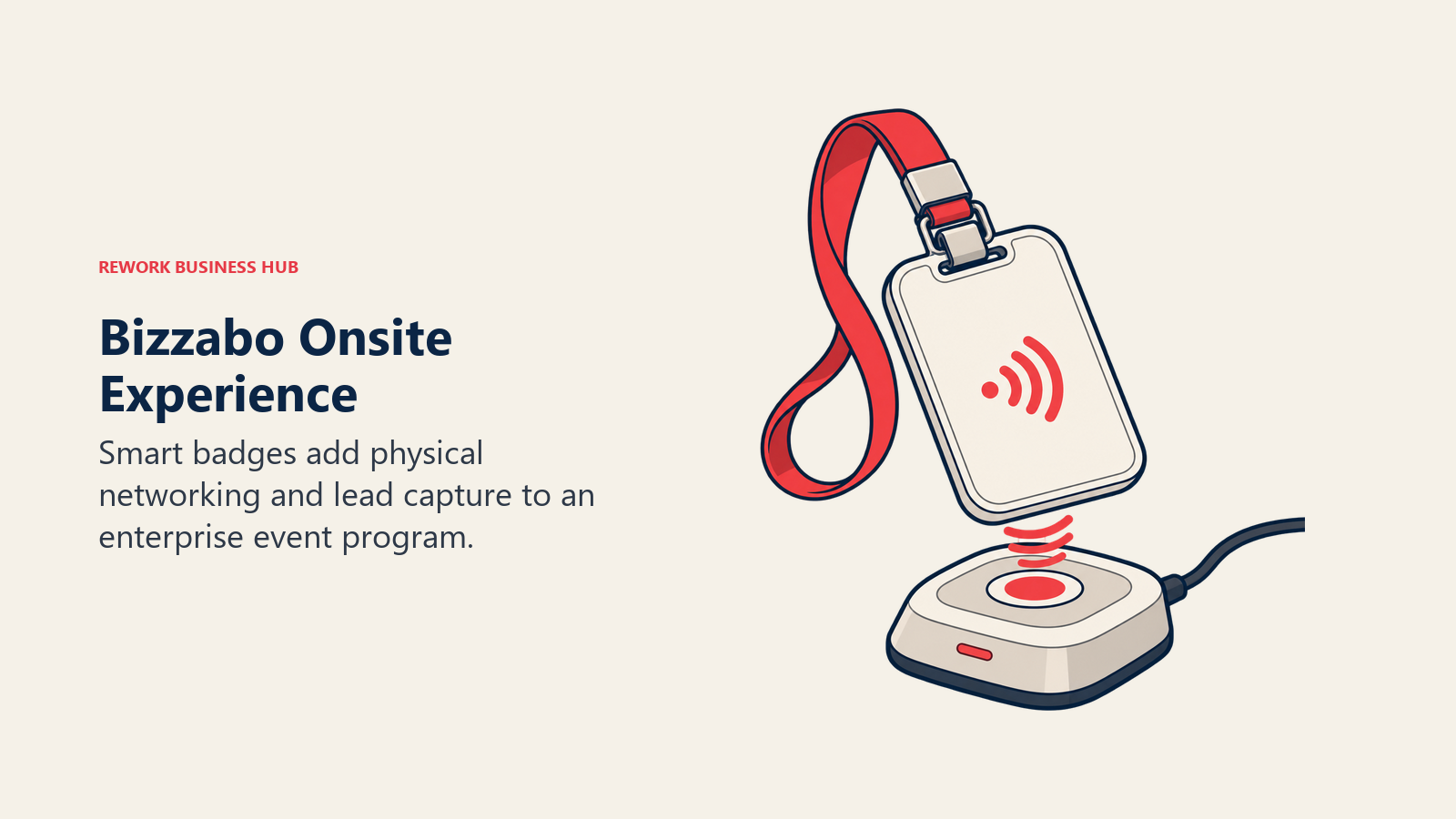
Bizzabo goes the opposite direction from EventMobi: the same per-seat opacity Whova has around price, but paired with enterprise-grade onsite hardware Whova doesn't sell at all.
| What you get | What you don't |
|---|---|
| Klik SmartBadge wearables for onsite networking and lead capture | Whova's per-event, no-minimum-seat pricing conversation |
| Unlimited events and registrations on the base license | A published number before a 3-user, $17,999/year floor |
| A more design-polished attendee mobile app out of the box | Freedom from a sales-gated quote; Bizzabo requires one too |
Pricing: $499 per user per month, billed annually, with a 3-user minimum, which Bizzabo's own pricing page states as "starting at $17,999 per year." That includes unlimited events and registrations, contact management, ticketing, email campaigns, the website builder, mobile app and reporting. Virtual streaming, advanced onsite tools, CRM integrations, networking and custom branding are paid add-ons, and Klik SmartBadge pricing is quote-only.
Best for: Enterprise teams that want Whova-caliber attendee experience plus onsite badge hardware, and can absorb a six-figure annual floor at scale. The Best Bizzabo Alternatives guide covers the reverse comparison. Not ideal for: Small conference or association teams; Bizzabo's 3-seat, $17,999/year floor is a different budget conversation than Whova's per-event quote.
4. Accelevents: A Real Starting Price Without a Demo First
Accelevents solves the one problem Whova refuses to solve: it puts a real number on the page before anyone talks to sales.
| What you get | What you don't |
|---|---|
| Transparent published starting prices, rare in this category | Whova's specific strength in academic call-for-speakers workflows |
| A published path from single-event to unlimited-events pricing | A confirmed annual-vs-per-event framing on the entry tier |
| A genuinely self-serve starting point for smaller teams | Whova's scale-proven roster of large enterprise and university clients |
Pricing: Professional starts at $7,500 for a single event. Business starts at $13,500 for unlimited events. Enterprise and White Label are quote-only. Accelevents' page doesn't state whether the published tiers are annual or one-time, so treat $7,500 as the price for one event and $13,500 as the unlimited-events starting point, not confirmed annual figures.
Best for: Mid-market teams that want a published starting price before committing to any sales process, especially for a single flagship conference. Not ideal for: Teams running a heavy academic or association program where Whova's abstract management and call-for-speakers tooling is the actual requirement; Accelevents doesn't compete there.
5. Swoogo: Registration and Event-Website Depth Whova Doesn't Attempt
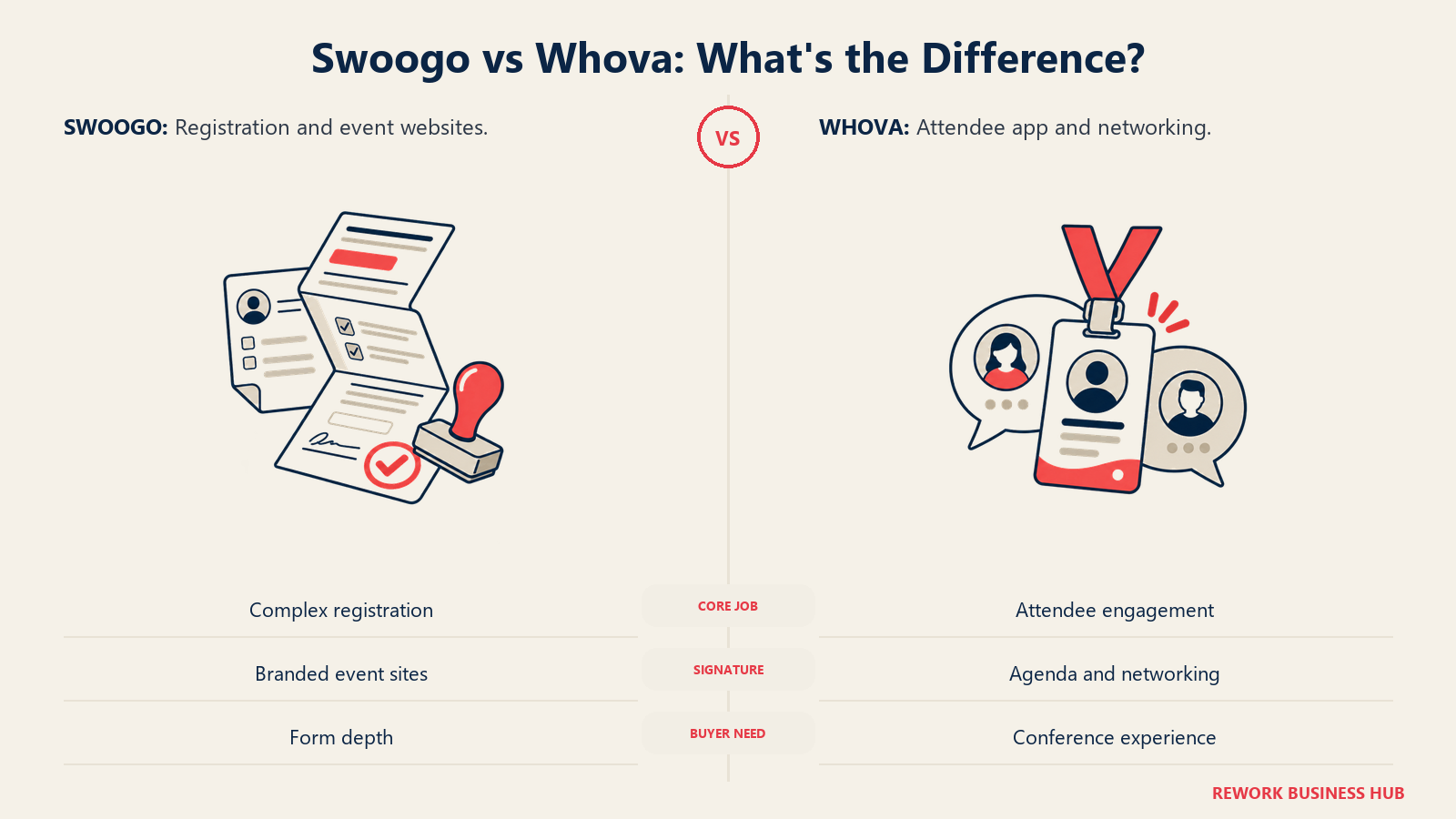
Where Whova's product is the attendee app, Swoogo's product is the registration form and event website, built for teams whose real bottleneck is a 40-field application with conditional logic, not in-app networking.
| What you get | What you don't |
|---|---|
| One of the deepest form and website builders in the category | Whova's in-app attendee networking, agenda or session Q&A |
| A flat annual license with unlimited events and registrations | A number of included seats past one Full User and one Reporting User |
| Custom domains and approval workflows for branded event sites | A conference-app experience attendees open on their phones |
Pricing: Professional is $11,800 per year, including 1 Full User and 1 Reporting User, unlimited events, unlimited registrations, the check-in app, 30-plus integrations, one custom domain and approval workflows. Enterprise is quote-only. "Unlimited" covers events and registrations, not seats: Swoogo does not publish a rate for additional Full User licenses, so a five-person events team should expect a sales call to price the rest of the team's access.
Best for: Teams whose bottleneck is registration and event-website depth rather than in-app attendee experience. The full Best Swoogo Alternatives guide covers the reverse comparison in detail. Not ideal for: Conferences and associations where in-app networking, agenda personalization and session Q&A are the reason attendees show up; that's Whova's job, not Swoogo's.
6. Rework: Attendee Data on the Same Timeline as CRM, Leads, and Work Ops
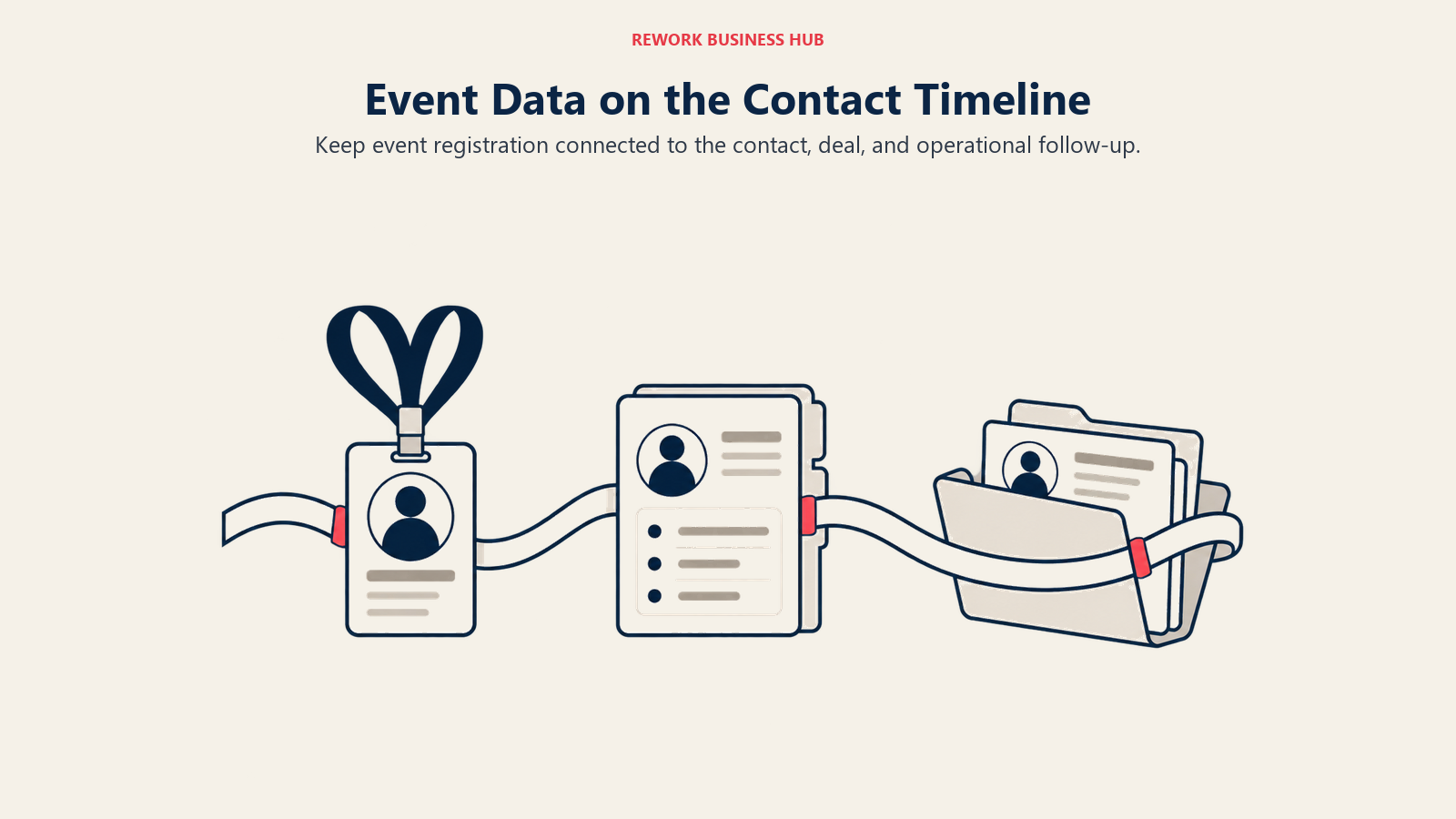
Rework is the relevant pick when the problem with Whova isn't the attendee app, it's that a great networking experience still produces registration and engagement data that has to be reconciled against the CRM by hand afterward. Rework's Event module runs registration, event websites, agenda planning, attendee records and approvals inside the same platform as Sales Ops (CRM and pipeline), Lead management, Work Ops and the People app, so an event-sourced lead lands on the same contact timeline as their deal history instead of an export waiting to be matched back to the CRM.
| What you get | What you don't |
|---|---|
| Registrations tied to the CRM contact and deal record, not a standalone export | Whova's in-app attendee networking, business-card exchange or session Q&A |
| Work Ops approval routing for event sign-off and vendor tasks | A virtual or hybrid event platform; the Live module isn't live yet |
| One timeline across event, sales and ops history | A conference-app experience attendees carry on their phones |
| Packaged annual pricing, not a per-event quote conversation like Whova's | Abstract management or call-for-speakers tooling for academic programs |
Pricing: Rework does not publish a price for the Event module. Rework sells packaged plans, not per-user licenses or per-event quotes, and Event is quoted per organization. See rework.com/pricing for the published Sales Ops, Lead Ops and Work Ops lines, or ask the team for an Event quote.
Best for: Mid-size sales-led or marketing-led teams (roughly 10-200 people) whose real problem is that registrations and event engagement don't reach the CRM, pipeline or Work Ops without manual work. Not ideal for: Conferences and associations where in-app attendee networking is the reason people keep coming back; that's Whova's actual strength, and Rework doesn't compete there. Rework also doesn't ship a virtual event platform, so a program running fully virtual sessions needs a second tool for streaming today.
7. Brella: Matchmaking as the Product, Not a Feature
Brella isn't trying to out-app Whova on breadth, it's betting that matchmaking quality alone is worth a dedicated tool, at the cost of everything Whova bundles around it.
| What you get | What you don't |
|---|---|
| AI-driven attendee matchmaking and meeting scheduling | Whova's session Q&A, live polls or call-for-speakers tooling |
| A strong fit for community and networking-first conferences | Any published pricing; every path leads to contact sales |
| Meeting-booking tools that go deeper than a basic directory | A standalone registration or event-website replacement |
Pricing: No public pricing. Brella's site uses contact-sales calls to action only, with no published tiers or figures anywhere.
Best for: Conference and community organizers whose top priority is attendee networking quality specifically, likely paired with a separate registration tool the way Whova pairs its app with a lighter registration flow. Not ideal for: Teams that want one platform covering registration, agenda and networking together the way Whova does; Brella covers only the networking piece well.
8. Webex Events: Hybrid Events Inside the Cisco Stack
Webex Events, formerly Socio, makes sense as an extension of infrastructure a team already pays for, not as a direct swap for Whova's attendee app.
| What you get | What you don't |
|---|---|
| Native hybrid delivery inside a Webex stack many enterprises already own | Whova's in-app networking depth or academic call-for-speakers tooling |
| One vendor relationship spanning meetings, webinars and events | Published per-event or per-program pricing anywhere public |
| Enterprise-grade security and IT familiarity from the Cisco umbrella | A quick, self-serve setup outside an existing Cisco relationship |
Pricing: No public pricing. Cisco quotes Webex Events per event or per program. Published Webex figures that exist publicly cover Meetings and Webinars, not Events, and shouldn't be treated as Events pricing.
Best for: Enterprises already running Cisco Webex for meetings that want hybrid events on the same vendor relationship instead of adding Whova plus a separate streaming tool. Not ideal for: Teams with no existing Cisco footprint; there's little reason to adopt Webex Events as a standalone platform over a purpose-built alternative.
9. RingCentral Events: Per-Organizer Pricing From $99 a Month
RingCentral Events, the former Hopin, gives Whova shoppers something Whova's page never will: a real number, published, before anyone books a demo.

| What you get | What you don't |
|---|---|
| A published starting price, unlike Whova and most of this list | Whova's in-app networking depth for in-person conferences |
| Unlimited events and registrations from the entry tier | Onsite hardware or badge-printing tooling for in-person programs |
| Native virtual and hybrid delivery, streaming included | Full pricing transparency; only the entry tier is public |
| A 30-day free trial with limited registrations to test first | A fit for teams running mostly in-person, non-streamed events |
Pricing: Events Pro starts at $99 per organizer per month, billed monthly or annually, with annual billing saving up to 16%, and unlimited events and registrations. Three paid per-organizer tiers exist; only the $99 entry tier is published, and Events Pro+ and Events Enterprise go through sales.
Best for: Mid-market teams running virtual or hybrid programs that want a published entry price instead of Whova's quote-only wall. Not ideal for: In-person-first teams; RingCentral Events' strength is streaming and virtual delivery, not the in-app networking that makes Whova's reputation.
10. Virtual PRO (formerly Hubilo): Broadcast Production Meets Engagement
Virtual PRO is what Hubilo became after Brandlive acquired the company in September 2025 and relaunched the product under a new name in January 2026, with existing Hubilo customers migrated onto the new platform automatically. Anyone still comparing "Hubilo pricing" against Whova is comparing against a brand that no longer exists: hubilo.com/pricing now redirects straight to virtualpro.com.
| What you get | What you don't |
|---|---|
| Published annual tiers with clear admin-seat and audience-cap limits | Whova's in-person conference networking and business-card exchange |
| Broadcast-quality virtual and hybrid production, Whova's weak spot | A per-event quote path; pricing is annual license only |
| A clear upgrade path as audience size grows, tier to tier | The brand recognition Hubilo built before the rename |
Pricing: PRO 1 is $15,000 per year for 1 admin seat and a 1,000-person audience cap. PRO 4 is $50,000 per year for 4 admin seats and a 4,000-person cap. PRO 10 is $125,000 per year for 10 admin seats and a 10,000-person cap. PRO MAX is contact-sales only, with unlimited admin seats and a 40,000-person cap. All tiers include unlimited events.
Best for: Teams running large virtual town halls or hybrid programs that need broadcast-grade production quality, and can plan around a published annual tier instead of Whova's per-event quote. The dedicated Best Hubilo Alternatives guide covers this transition and the resulting shortlist in more depth. Not ideal for: Small in-person conferences; Virtual PRO's pricing and production depth are built for large virtual audiences, not the 100-person meetup Whova handles comfortably.
11. vFairs: Virtual, Hybrid and Onsite From One Vendor
vFairs pitches itself as one vendor covering virtual, hybrid and onsite formats, a broader format range than Whova attempts.
| What you get | What you don't |
|---|---|
| Virtual, hybrid and onsite event formats from one vendor | Whova's specific in-app attendee networking polish |
| Career-fair and expo tooling many general platforms skip | Published pricing anywhere; every path leads to a demo |
| Non-profit discounts mentioned on the vendor's own site | A number to compare against Whova's quote form without a call |
Pricing: No published pricing. vFairs' own page states "no bloated bundles, you pay only for what your events actually need" and routes every visitor to a demo request. No tiers or figures are published.
Best for: Teams running virtual career fairs, expos or hybrid trade shows that need format breadth beyond a single conference app. Not ideal for: Anyone trying to leave Whova specifically because of its quote-only pricing; vFairs has the identical wall.
12. Stova: End-to-End Enterprise Programs
Stova is the product of three merged enterprise platforms, Aventri, MeetingPlay and eventcore, inheriting their combined breadth well past what a single attendee app like Whova covers.
| What you get | What you don't |
|---|---|
| Broad feature coverage from three merged enterprise platforms | Published pricing anywhere on the site |
| Native virtual and hybrid delivery alongside in-person tooling | Whova's specific, focused attendee-app experience |
| A migration path for existing Aventri or MeetingPlay customers | A fast self-serve setup; enterprise sales cycles apply |
Pricing: No public pricing. Stova's site uses demo-request calls to action only, with no published tiers or figures.
Best for: Enterprise teams already on Aventri, MeetingPlay or eventcore, or evaluating a single end-to-end platform that covers registration through virtual delivery. Not ideal for: Smaller teams wanting pricing transparency before a sales call; Stova offers exactly as little as Whova does on that front.
13. Splash: Event Marketing Pages for Demand Gen Teams
Splash treats events as a marketing motion rather than a logistics or networking problem, a different angle from Whova's attendee-app focus entirely.
| What you get | What you don't |
|---|---|
| A marketing-friendly, brand-consistent event page builder | Whova's in-app networking, agenda personalization or Q&A |
| Tight positioning around demand gen and pipeline attribution | Published pricing on the vendor's own site |
| Fast page creation for high-volume, repeatable event formats | Venue sourcing, onsite hardware or a dedicated attendee app |
Pricing: No public pricing. Third-party reports (Vendr marketplace data) put annual plans at roughly $12,500 to $36,500-plus, plus transaction and onboarding fees, labeled (reported).
Best for: Marketing teams running a high volume of branded, demand-gen-focused events who care more about page design speed than in-app networking. Not ideal for: Conferences where attendee experience and networking, not page design, are the reason people register; that's Whova's territory.
14. Eventzilla: The Cheapest Per-Registration Entry Point Here
Eventzilla strips the category down to the cheapest possible entry point, the opposite instinct from Whova's feature-rich, quote-gated app.
| What you get | What you don't |
|---|---|
| The cheapest published per-registration entry point on this list | Whova's in-app networking, business-card exchange or live polls |
| A flat annual plan option with zero per-registration fees | Deep conditional-logic form building or custom-domain branding |
| A genuinely low-cost entry for small or first-time organizers | Any attendee-app experience worth naming |
Pricing: Basic is $1.50 per registration flat, supporting a single ticket type (free events cost nothing on every tier). Pro is 1.9% plus $1.50 per registration. Plus is 2.9% plus $1.50 per registration and adds white label, virtual and exhibitor management, plus up to 10 account users. An annual plan starts at $1,999 per year with zero per-registration fees, including 500 registrations. Fees can be passed to attendees.
Best for: Small teams or infrequent organizers who want a published number and don't need Whova's attendee-app depth. Not ideal for: Conferences where in-app networking and engagement tooling matter; Eventzilla is a registration tool first, not an attendee-experience platform.
15. Eventbrite: Public Ticketing and Consumer Discovery
Eventbrite solves a problem neither Whova nor most of this list attempts: a built-in audience of people actively browsing for events to attend.

| What you get | What you don't |
|---|---|
| A public marketplace of event-goers actively searching for events | Whova's in-app networking, business-card exchange or session Q&A |
| Free publishing for free events, no cost to list, no fees | A private, invite-only registration experience by default |
| Eventbrite Pro from $15/month for email marketing tooling | Any published platform subscription tier price beyond that |
Pricing: Free events publish at no cost, unlimited. Paid tickets cost 3.7% plus $1.79 service fee per ticket, plus a 2.9% payment processing fee per order; those fees are passed to buyers by default, though the organizer can choose to absorb them. Eventbrite Pro starts at $15 per month for email marketing up to 10,000 daily emails. No standalone monthly platform subscription tier prices are published beyond that.
Best for: Public, community or ticketed events where consumer discovery is part of the value, not an in-app networking experience. The Best Eventbrite Alternatives guide covers the reverse comparison. Not ideal for: Private, invite-only B2B conferences where Whova's networking and agenda tools are the actual requirement; Eventbrite doesn't compete on that ground.
How to Choose: Decision Framework
Match the alternative to the job the program actually needs, from a published price to venue sourcing, onsite hardware, CRM continuity and virtual production.
| If you need... | Best pick |
|---|---|
| A published price before any sales call | EventMobi or Accelevents |
| Venue sourcing and RFP management bundled with the app | Cvent |
| Onsite badge hardware and a polished enterprise experience | Bizzabo |
| Deep registration forms and a branded event website | Swoogo |
| Registration and engagement data on the same timeline as CRM, deals and Work Ops | Rework |
| Matchmaking as the core value proposition, not a feature | Brella |
| Broadcast-quality virtual town halls at large audience scale | Virtual PRO |
| The cheapest possible per-registration ticketing for small events | Eventzilla |
Frequently Asked Questions about Whova Alternatives
Does Whova publish any pricing at all?
No. Whova's pricing page is a "Price Quote Request" form paired with an offer to book a 20-minute demo. There are no tier names, no price ranges and no free plan published anywhere on the site, which is the single biggest reason teams start comparing alternatives.
Is Whova priced per event or per year?
Whova quotes per event, based on event type, duration, expected attendance and how often you run events, according to its own quote-request form. Nothing published points to an annual unlimited plan, so a team running several events a year should expect a separate sales conversation for each one.
What's the biggest gap in Whova besides pricing?
Registration and marketing depth. Whova's attendee app, agenda, networking and messaging are strong, but the registration forms, event website and marketing tooling sit well behind dedicated platforms like Swoogo or Cvent. Integration is also narrower than it looks: the HubSpot connection is a one-way export, and Salesforce runs through Zapier.
Which alternative is easiest to price without talking to sales?
EventMobi and Accelevents both publish real starting prices you can act on immediately. RingCentral Events publishes its $99-per-organizer-per-month entry tier and offers a 30-day free trial, the closest to fully self-serve on this list.
What happened to Hubilo?
Brandlive acquired Hubilo in September 2025 and relaunched the product as Virtual PRO in January 2026, migrating existing customers automatically. Hubilo's pricing page now redirects to virtualpro.com, and any pre-2026 Hubilo quote or comparison is out of date.
Which alternative fits a team that wants event data tied to CRM and other business ops, not just the attendee app?
Rework. Its Event module keeps registrations on the same contact timeline as CRM, pipeline and Work Ops data, something none of the dedicated event or attendee-app platforms on this list attempt; they're all built to stand alone.
When does it make sense to stay on Whova instead of switching?
For a recurring conference or association program where in-app networking is the reason attendees keep coming back, and where the team can tolerate a quote call before each event. Whova's SOC 2 Type 2 certification, PCI DSS and GDPR compliance also clear most standard procurement reviews, so security isn't typically the blocker.
What to Do Next
Get a number in hand before anything else. If pricing opacity is the whole reason you're reading this, start with EventMobi or Accelevents, both of which publish real starting prices, and put Whova's quote request in alongside them so you're comparing an actual figure against an actual figure instead of a feeling.
If the real gap is registration and marketing depth rather than price, trial Swoogo or Cvent against your next event's form requirements. And if the problem is that attendee data never makes it back to the CRM no matter which event tool you pick, start with Rework instead; pricing for Event is quoted per organization at rework.com/pricing. For the wider category, the Best Event Management Software in 2026 roundup covers virtual, engagement and onsite-specific tools beyond this list.

Principal Product Marketing Strategist
On this page
- Key Facts
- Quick Comparison Table
- Why Teams Look Beyond Whova
- Stage Fit Matrix
- Sizing and Persona Table
- Pricing Model Comparison: What You're Actually Paying For
- 1. Cvent: The Enterprise Standard With Venue Sourcing Built In
- 2. EventMobi: Published Per-Event and Per-Year Pricing for Associations
- 3. Bizzabo: Enterprise Event Experience With Onsite Badge Hardware
- 4. Accelevents: A Real Starting Price Without a Demo First
- 5. Swoogo: Registration and Event-Website Depth Whova Doesn't Attempt
- 6. Rework: Attendee Data on the Same Timeline as CRM, Leads, and Work Ops
- 7. Brella: Matchmaking as the Product, Not a Feature
- 8. Webex Events: Hybrid Events Inside the Cisco Stack
- 9. RingCentral Events: Per-Organizer Pricing From $99 a Month
- 10. Virtual PRO (formerly Hubilo): Broadcast Production Meets Engagement
- 11. vFairs: Virtual, Hybrid and Onsite From One Vendor
- 12. Stova: End-to-End Enterprise Programs
- 13. Splash: Event Marketing Pages for Demand Gen Teams
- 14. Eventzilla: The Cheapest Per-Registration Entry Point Here
- 15. Eventbrite: Public Ticketing and Consumer Discovery
- How to Choose: Decision Framework
- What to Do Next