Bizzabo vs Swoogo: Event Experience Platform or Registration and Website Specialist in 2026?
Turn this article into takeaways for your work.


Each assistant summarizes the article only for you and suggests best practices for your work.
If your team runs enough B2B events to outgrow Eventbrite but doesn't need Cvent's venue-sourcing depth, Bizzabo and Swoogo are the two names that keep landing on the same shortlist. Both build registration pages fast, both ship a genuinely usable event website builder, and both will happily run your flagship conference next quarter. On a demo call they can look interchangeable, two clean, modern platforms with a check-in app and a mobile agenda.
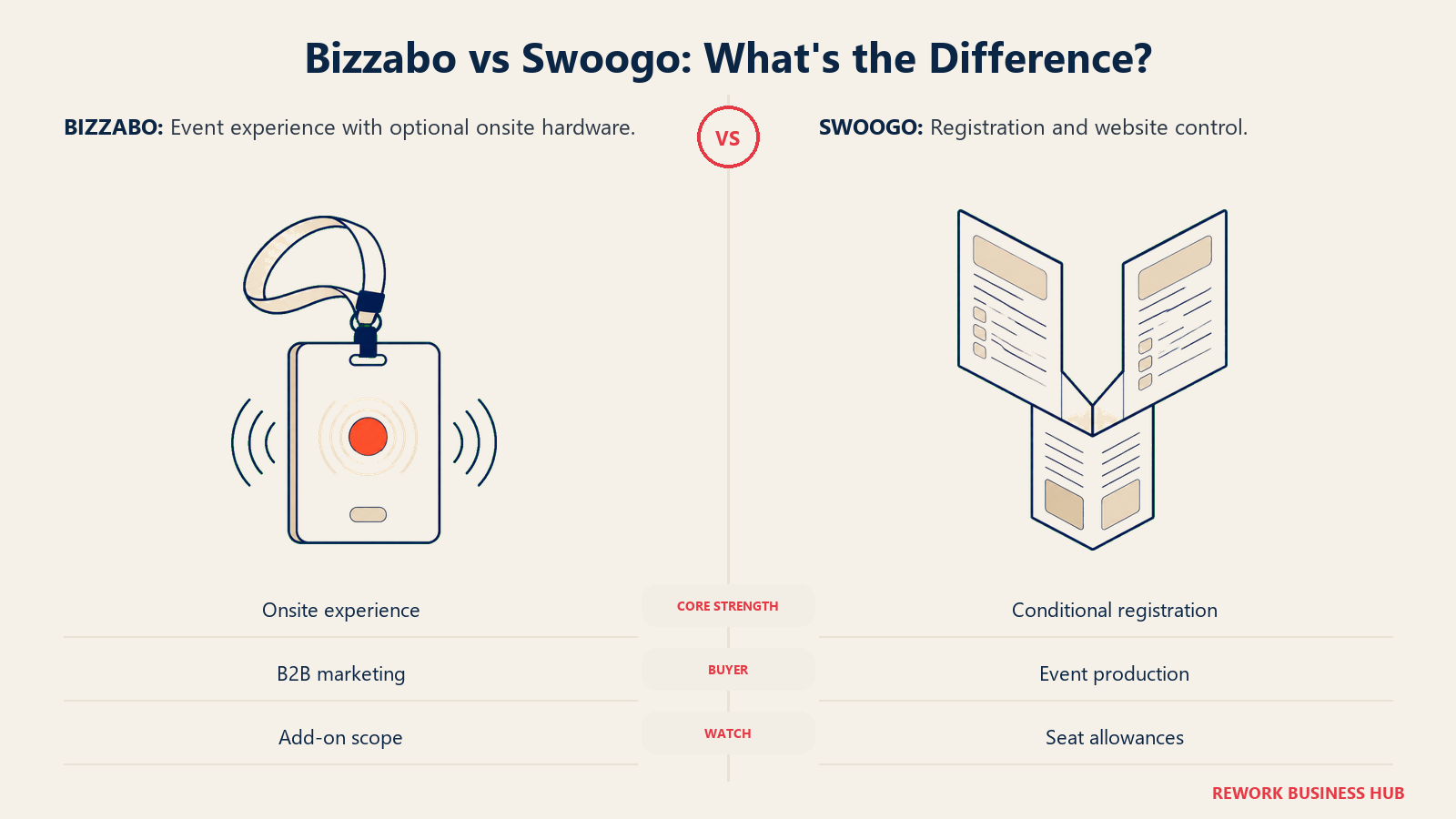
They aren't solving the same problem, and the gap shows up the moment you ask what each one is actually optimized for. Bizzabo sells an "Event Experience OS," a flat per-user license with unlimited events built in, whose signature layer sits onsite: the Klik SmartBadge wearable turns a name badge into a networking and lead-capture device, and the whole platform is built for a B2B marketing team that cares about the attendee experience at the event itself. Swoogo sells depth at the front door, unlimited conditional logic on every registration form, email and page, no per-registrant fee, and a buyer who is usually a professional event producer who wants to build a genuinely complex registration flow without hiring a developer. One is bought for the onsite moment. The other is bought for the form the attendee fills out before they ever show up. That's the decision this article is built around, not a feature checklist. For the wider field beyond these two, our best event management software guide for 2026 is the place to start.
TL;DR
| Bizzabo | Swoogo | |
|---|---|---|
| Started as | An event marketing tool that rebuilt itself as an "Event Experience OS" | A registration and event website platform built by event producers for event producers |
| Organizing principle | One per-user license, unlimited events included, onsite hardware (Klik) as the signature layer | One flat annual license, unlimited events and registrations, registration logic as the signature layer |
| Commercial model | $499 per user per month, billed annually, 3-user minimum ($17,999/year floor) | Professional at $11,800/year, includes exactly 1 Full User plus 1 Reporting User; Enterprise is "Talk to Sales" |
| Signature strength | Klik SmartBadge wearable, tap-based networking and lead capture | Unlimited conditional logic on every form, email and page, on every plan, no upcharge |
| Registration depth | Solid, bundled into the base license | The reason event producers shortlist it in the first place |
| Typical buyer | B2B marketing or demand-gen leader running flagship conferences | Professional event producer who owns registration and the event website end to end |
| Seat model | Per named user, unlimited events and registrations included | Flat license covers 2 named seats; extra seats priced on request |
| Where it disappoints | Buyers who just want deep, flexible registration forms without paying for onsite hardware they won't use | Buyers who want wearable onsite hardware or a per-user license that scales cleanly with headcount |
Key Facts
- Bizzabo's Event Experience OS starts at $499 per user per month, billed annually, with a 3-user minimum, which its own pricing page headlines as "starting at $17,999 per year."
- Swoogo's Professional plan costs $11,800 per year and includes exactly one Full User plus one Reporting User, according to Swoogo's own pricing page.
- Swoogo includes unlimited conditional logic on every plan, letting organizers show or hide registration questions based on a prior answer at no extra charge, per Swoogo's own conditional logic guide.
- 44% of event marketers named driving registration their single biggest challenge, according to Swoogo's own 2026 event industry statistics roundup.
- In a 2023 survey of more than 4,000 event organizers and attendees, 78% of attendees agreed in-person B2B conferences offer the best networking opportunities, according to Bizzabo's own State of In-Person B2B Conferences report.
Who Each Platform Is Really For
Bizzabo's natural buyer sits inside B2B marketing: a demand-gen or field marketing leader running a handful of flagship conferences a year who wants every event on one platform, connected to the same martech stack the rest of marketing already runs on, with a genuinely engaging onsite layer instead of a bare-bones check-in line. Bizzabo's own positioning names this directly, describing its ideal customer as "mid-market or enterprise teams running frequent, large B2B conferences who need registration, the app, networking, onsite lead capture, and martech integrations under one roof."
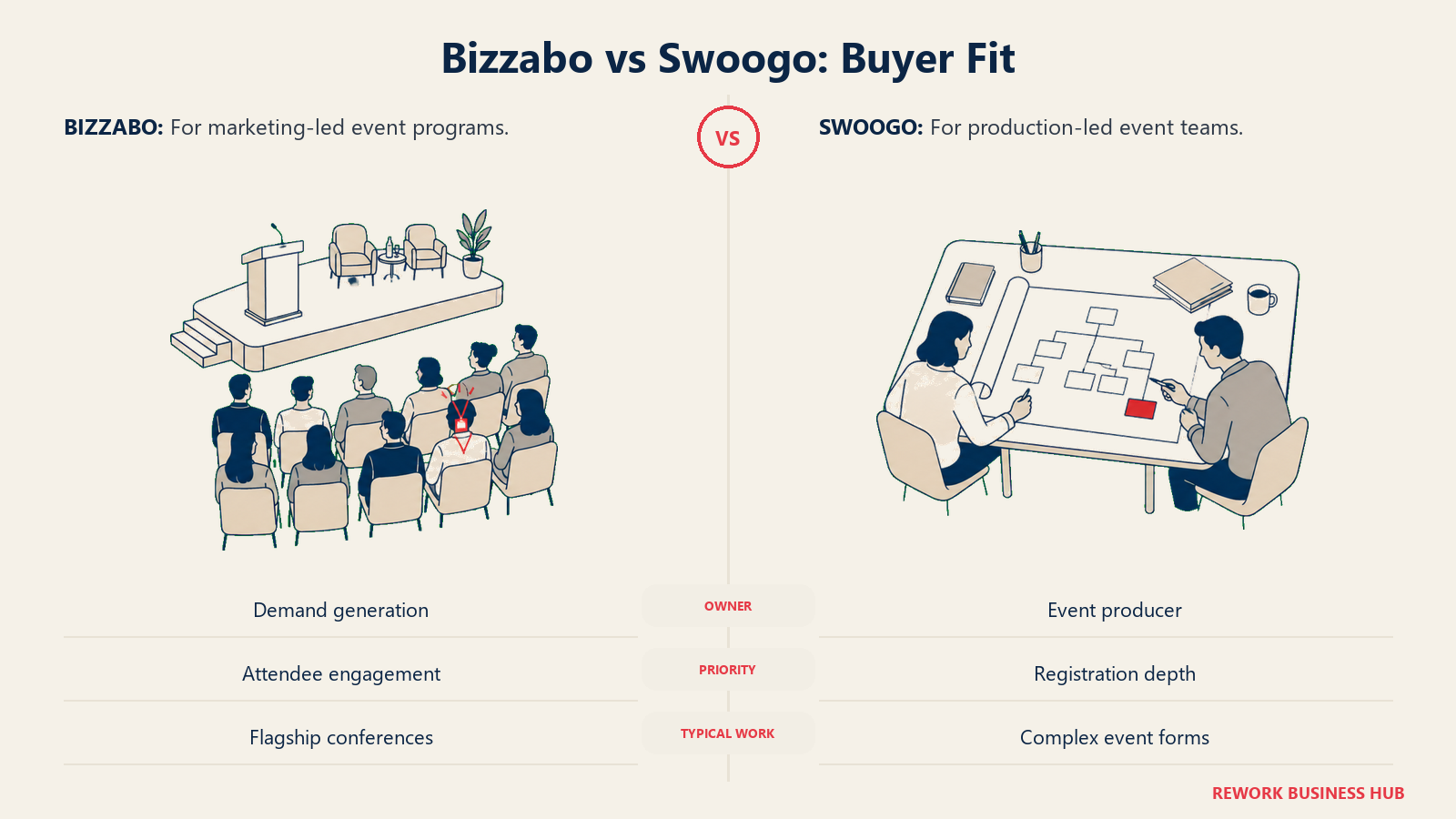
Swoogo's natural buyer sits closer to production: an event producer, often working across marketing, association management, or an agency, who has hit the wall on a lighter tool's form builder and needs registration paths that branch based on ticket type, company size, or a prior answer, without asking a developer to build it. Swoogo's own marketing leans into this identity, describing itself as built by former event planners who were frustrated with clunky, unintuitive event technology.
| Bizzabo | Swoogo | |
|---|---|---|
| Primary budget owner | B2B marketing, demand generation, field marketing | Event production, marketing operations, association event teams, agencies |
| The question they're hired to answer | "How do we run every conference on one platform with a genuinely engaging onsite experience?" | "How do we build a registration flow this complex without a developer, and keep our event site on brand?" |
| Company profile | Mid-market to enterprise B2B marketing organizations, per Bizzabo's own positioning | Corporate event teams, associations, and agencies running frequent, form-heavy events |
| Event types | Flagship B2B conferences, demand-gen events, community and user events | Multi-track conferences, association annual meetings, roadshows, recurring corporate events |
| Where it disappoints | Buyers who just want deep, flexible registration forms without paying for onsite hardware they won't use | Buyers who need a wearable onsite networking layer or per-user pricing that scales cleanly past two seats |
Neither platform sources venues or manages hotel room blocks. If that's part of your program, that's a different category entirely; our Cvent vs Bizzabo comparison and the best Cvent alternatives roundup cover the full-program platforms built for that job.
Registration and Event Websites
This is Swoogo's home turf, and it shows in how the product is built, not just how it's marketed. Every plan ships unlimited conditional logic across the registration form, the confirmation emails, and the event website itself, so a question like "which sessions are you attending" can hide or reveal a dozen downstream fields depending on the answer, with no separate logic tier to unlock and no per-form cap. Visibility rules toggle on nearly every question and every page, which is the kind of depth event producers usually build in a spreadsheet macro before they find a tool that does it natively.
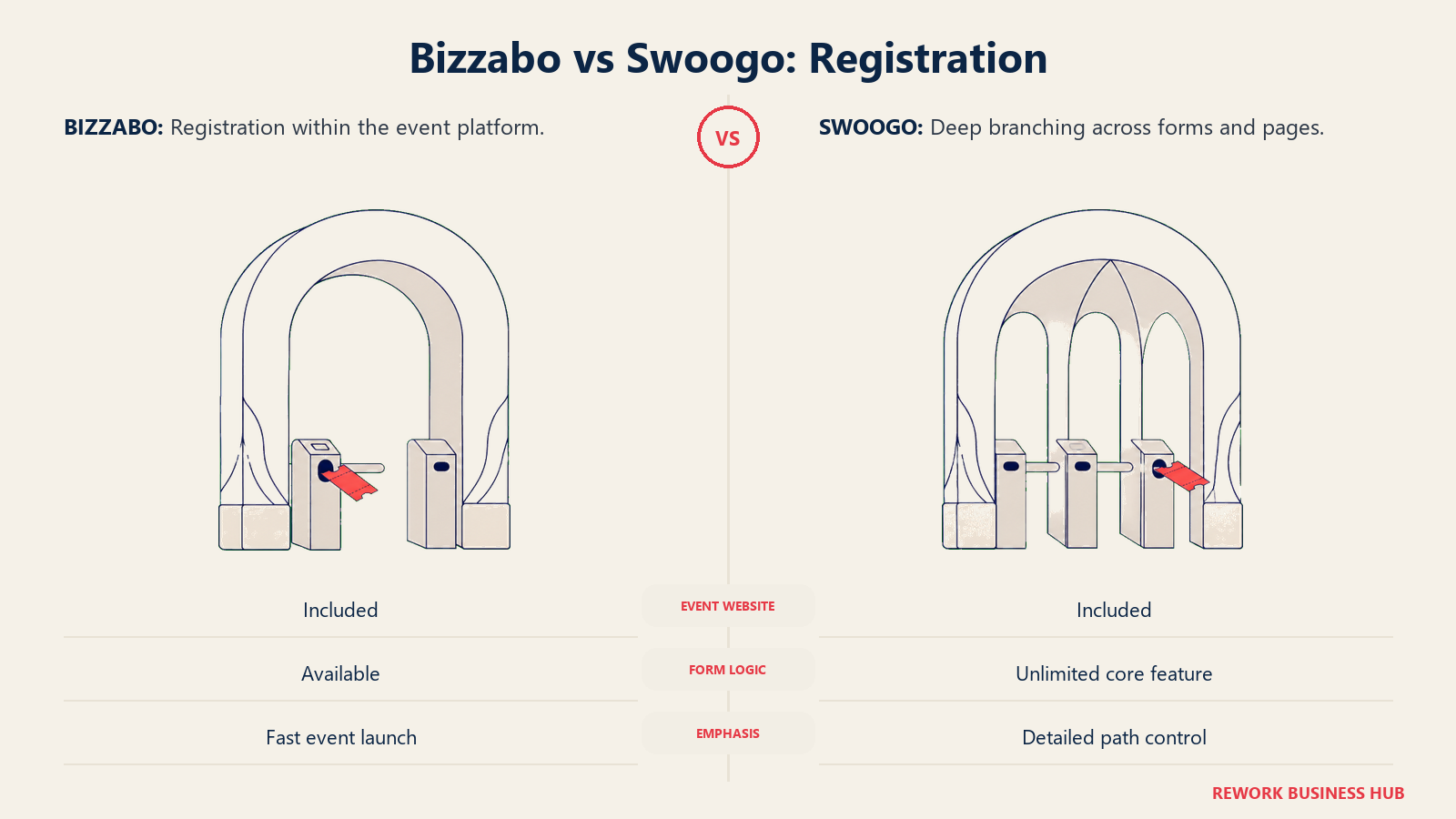
Bizzabo's registration and event websites are part of the base Event Experience OS license too, bundled with ticketing and email campaigns, and they're built to stand up a branded event site quickly. The website builder is genuinely capable and the registration paths support pricing rules and multiple ticket types. What it doesn't do is match Swoogo's branching depth as a default, unadvertised feature; conditional logic on Bizzabo's forms exists, but it isn't the platform's reason for being the way it is for Swoogo.
| Registration and website capability | Bizzabo | Swoogo |
|---|---|---|
| Unlimited conditional logic, every plan, no upcharge | Available, not the platform's central selling point | Yes, named as a core, unlimited feature on every plan |
| Event website builder | Yes, included in the base license | Yes, included in Professional, with one custom domain |
| Custom registration paths and pricing rules | Yes, part of the base license | Yes, part of Professional |
| Ticketing and payment processing | Yes, included in the base license | Yes, included in Professional |
| Attendee approval workflows | Not named as a distinct feature | Yes, included in Professional |
| Custom domains beyond the first | Depends on the tier and add-ons purchased | Extra custom domains sold as a paid add-on |
If registration and event websites are genuinely your whole problem, without needing wearable onsite hardware layered on top, our best Swoogo alternatives roundup covers other registration-and-website specialists worth comparing, and our Eventbrite alternatives guide is the better starting point if the real gap is cheaper, lighter-weight ticketing rather than deep form logic.
Attendee Experience and Mobile App
Bizzabo's mobile app is included in the base license and covers personalized agendas and session information; a fully white-label, custom-branded version of that app is a separate paid add-on. The app is one piece of a broader onsite experience layer that, once you add Klik, gives organizers a real read on which sessions and booths actually pulled a crowd.
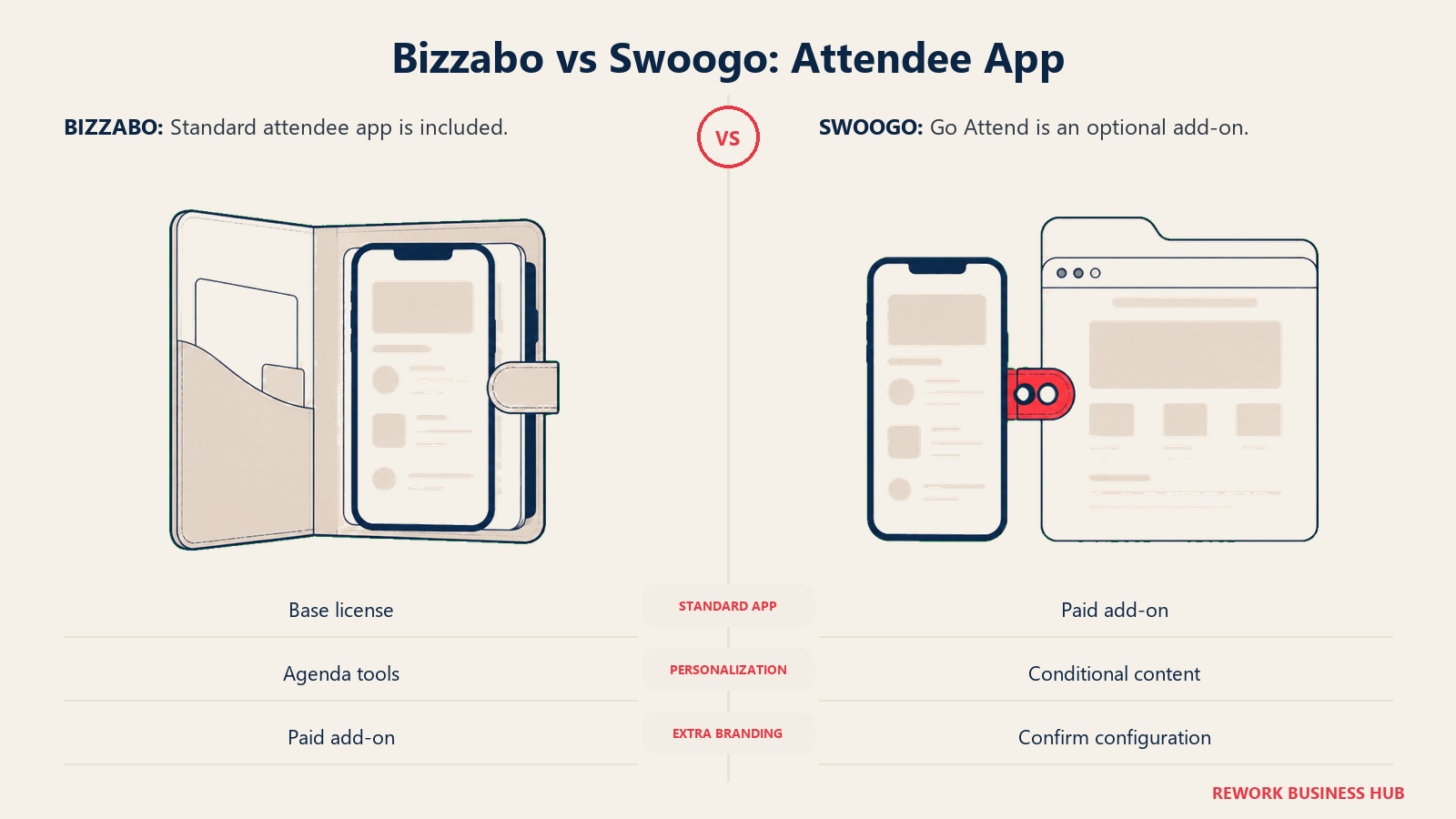
Swoogo's Go Attend mobile app is priced separately from Professional, and Swoogo does not publish its cost. Where Swoogo tends to win instead is on the browser-based attendee experience: the same conditional logic that drives the registration form also personalizes the agenda page and confirmation emails an attendee sees after they register, so a virtual attendee and an in-person attendee can see genuinely different content without a second website.
| Attendee experience factor | Bizzabo | Swoogo |
|---|---|---|
| Mobile event app | Yes, included in the base license | Go Attend, a separate paid add-on, price not published |
| Custom-branded (white-label) app | Paid add-on | Depends on the Go Attend add-on configuration |
| Personalized agendas | Yes | Yes, driven by the same conditional logic engine as registration |
| Check-in app | Included via Advanced Onsite (paid add-on) | Included in Professional |
| Content personalized by registrant type or answer | Available | A core, unlimited feature across the whole attendee journey |
Teams evaluating mid-market mobile-app-and-registration platforms more broadly should also look at our EventMobi vs Whova vs Cvent comparison, which covers three more names competing for the same attendee-experience budget.
Onsite Check-in, Badging and Klik
This is where the two platforms diverge hardest. Swoogo's onsite layer is a check-in app bundled into Professional, plus Go Onsite Pro as a separate paid add-on for teams that need more. It's a solid, standard onsite kit: scan a ticket, print or reprint a badge, register a walk-in. There's no wearable hardware line.
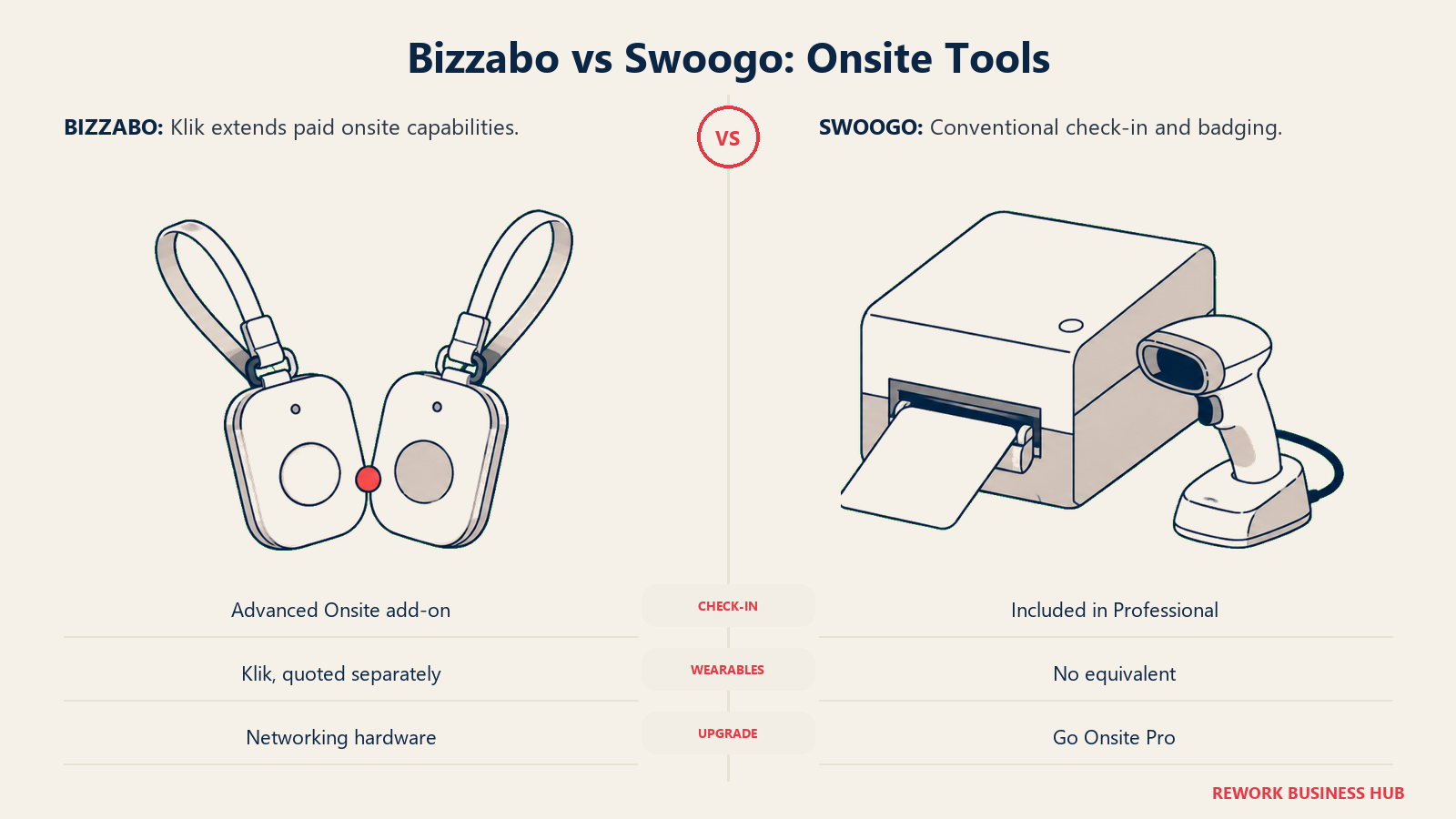
Bizzabo's onsite story runs through two purchases. Advanced Onsite, a paid add-on, covers the command app, badge printing, check-in and basic lead capture, roughly Swoogo's Go Onsite Pro equivalent. Klik is the layer Swoogo has no answer for at all: a wearable SmartBadge that lets attendees exchange contact details with a tap, lets exhibitors capture and score leads without a separate scanner, and gives organizers passive engagement data, including heatmaps of which sessions and booths drew a crowd. No personal information sits on the badge itself, and badges are collected and recycled after the event. Klik has no published price; Bizzabo sells it as single- or multi-event quote-only hardware.
| Onsite and hardware capability | Bizzabo | Swoogo |
|---|---|---|
| Attendee check-in app | Yes, via Advanced Onsite (paid add-on) | Yes, included in Professional |
| Real-time badge printing | Yes, part of Advanced Onsite | Yes, part of the standard check-in kit |
| Wearable smart badge | Klik SmartBadge, quote-only pricing | Not offered |
| Click-to-connect networking hardware | Yes, via Klik | Not offered |
| Passive engagement heatmaps | Yes, via Klik's engagement data | Not a named equivalent feature |
| Data stored on the badge itself | None; badges are reset and recycled between events | Not applicable |
| Additional onsite tier | Go Onsite Pro, price not published | N/A, this is Bizzabo's row |
If Klik-style onsite hardware is the whole reason you're shortlisting Bizzabo, our best Bizzabo alternatives roundup compares it against other platforms with a strong onsite layer, some at a lower total cost once you count the add-ons.
Networking and Matchmaking
Bizzabo splits networking across two places. Klik's click-to-connect hardware handles casual, tap-based introductions on the show floor, while a separate Networking add-on covers the more structured layer: 1:1 scheduling, matchmaking and reporting, priced apart from the base subscription.
Swoogo doesn't sell a matchmaking or scheduling product of its own. Its networking story runs through integrations and its check-in/badge data instead, which is thinner than either Bizzabo's Networking add-on or a dedicated matchmaking tool. If structured attendee-to-attendee matchmaking is a hard requirement, that's a real gap on the Swoogo side worth naming plainly.
| Networking capability | Bizzabo | Swoogo |
|---|---|---|
| Casual tap-based introductions | Yes, via Klik SmartBadge | Not applicable, no wearable hardware |
| 1:1 appointment scheduling | Yes, via the Networking add-on | Not a named native feature |
| Structured matchmaking | Yes, via the Networking add-on | Not a named native feature |
| Included in the base license or priced separately | Separate paid add-on | N/A |
For attendee-facing engagement tools like live polling and Q&A that sit alongside either platform rather than replacing it, our best audience engagement software guide for 2026 covers that adjacent category directly.
Virtual and Hybrid Coverage
Bizzabo's Virtual Event Experience, covering studio-quality video, interactive chat and Q&A, is a named premium add-on rather than something bundled into the flat base license. It's a real, usable product once purchased, built for the same B2B conference use case as the in-person side.
Swoogo supports virtual and hybrid registration paths (the same conditional logic that separates in-person and virtual attendees on a form handles that split cleanly), but it does not sell a dedicated virtual event broadcast platform the way Bizzabo does. A team that needs genuine studio-quality virtual production, not just a virtual registration path, typically pairs Swoogo with a separate streaming tool rather than expecting the platform to cover it end to end.
| Virtual and hybrid capability | Bizzabo | Swoogo |
|---|---|---|
| Virtual/hybrid registration paths | Yes, part of the base license | Yes, driven by conditional logic on the registration form |
| Dedicated virtual event broadcast platform | Virtual Event Experience, a paid add-on | Not offered as a standalone product |
| Interactive chat and Q&A for virtual attendees | Yes, part of the Virtual Event Experience add-on | Depends on a third-party streaming integration |
| Best fit | Teams that want one vendor to own the whole virtual production | Teams that pair a strong registration layer with a separate streaming tool |
Marketing, Email and CRM Integration
Both platforms connect to the CRM and martech tools most B2B teams already run. Bizzabo names Salesforce, HubSpot, Marketo and Eloqua as native integrations and markets more than 2,500 native connections overall, though worth flagging: Bizzabo's pricing page lists "Martech/CRM Integrations" as a named Premium Add-On, not something bundled automatically into every base license. Confirm which is true for your contract before you assume CRM sync ships free.
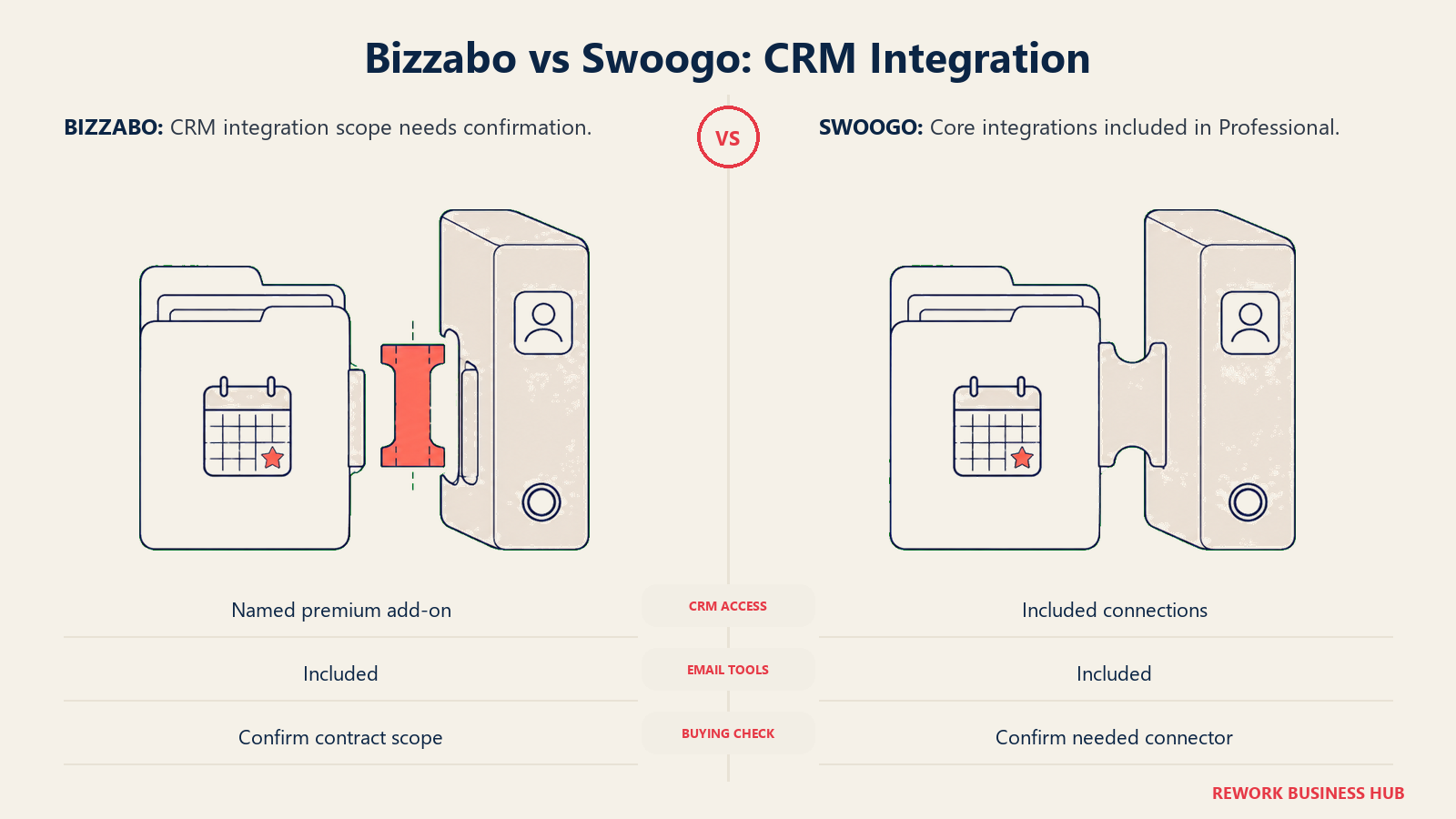
Swoogo's Professional plan includes 30-plus integrations in the base price, no separate CRM add-on tier to unlock. That's a meaningful difference at the budget-planning stage: a Swoogo quote of $11,800 (plus whatever extra seats cost) is closer to the full picture than a Bizzabo quote that may or may not include the CRM connection you actually need.
| Marketing and CRM factor | Bizzabo | Swoogo |
|---|---|---|
| Native Salesforce, HubSpot, Marketo integration | Yes, named on the integrations page | Yes, among 30-plus included integrations |
| Whether CRM sync is in the base price | Not guaranteed; a named premium add-on on the pricing page | Yes, included in Professional's 30-plus integrations |
| Email campaign tools | Yes, included in the base license | Yes, included in Professional, personalized via conditional logic |
| Number of integrations marketed | 2,500-plus, per Bizzabo's marketing | 30-plus, stated directly on the pricing page |
If you're evaluating the CRM side of that integration as its own decision, our best CRM software guide for 2026 covers that ground directly, and our best email marketing software guide is the better starting point if the email engine itself, not the event platform, is the real gap.
Reporting and Attribution to Pipeline
Neither platform's reporting is the headline feature, and both inherit a problem the wider industry shares: 96% of event leaders say they lack adequate ROI data, according to Swoogo's own 2026 event industry statistics roundup. Bizzabo's reporting is included in the base license and covers standard event analytics; deeper CRM pipeline attribution depends on whether you've bought the Martech/CRM Integrations add-on, since without it, event and pipeline data live in two separate systems. Klik adds one more useful layer here: passive engagement data (heatmaps of session and booth traffic) that neither Swoogo nor most registration-only tools produce.
Swoogo's reporting draws directly on its conditional-logic data model: because every registrant answer is captured as a structured field, segmenting a report by ticket type, company size, or any custom question is straightforward without a separate analytics build. What it doesn't do natively is close the loop to pipeline the way a dedicated CRM connection would; that again depends on which of the 30-plus integrations you've wired up.
| Reporting and attribution factor | Bizzabo | Swoogo |
|---|---|---|
| Standard event/engagement analytics | Yes, included | Yes, included in Professional |
| Native CRM pipeline attribution | Depends on the separate Martech/CRM add-on | Depends on which of the 30-plus integrations is configured |
| Klik-sourced engagement data (heatmaps, session traffic) | Yes, included with Klik | Not applicable |
| Reporting segmented by custom registration answers | Available | A natural fit, given the conditional-logic data model |
Admin Burden and Configuration
Bizzabo starts simple: one core license covering registration, websites, the app and reporting, but roughly eleven separate named add-ons sit on top (virtual, onsite, martech integrations, portals, networking, branding, API access, SSO and more), each its own line to configure and, in most cases, pay for. An admin who wants the full experience Bizzabo is known for is really assembling several purchases into one program.
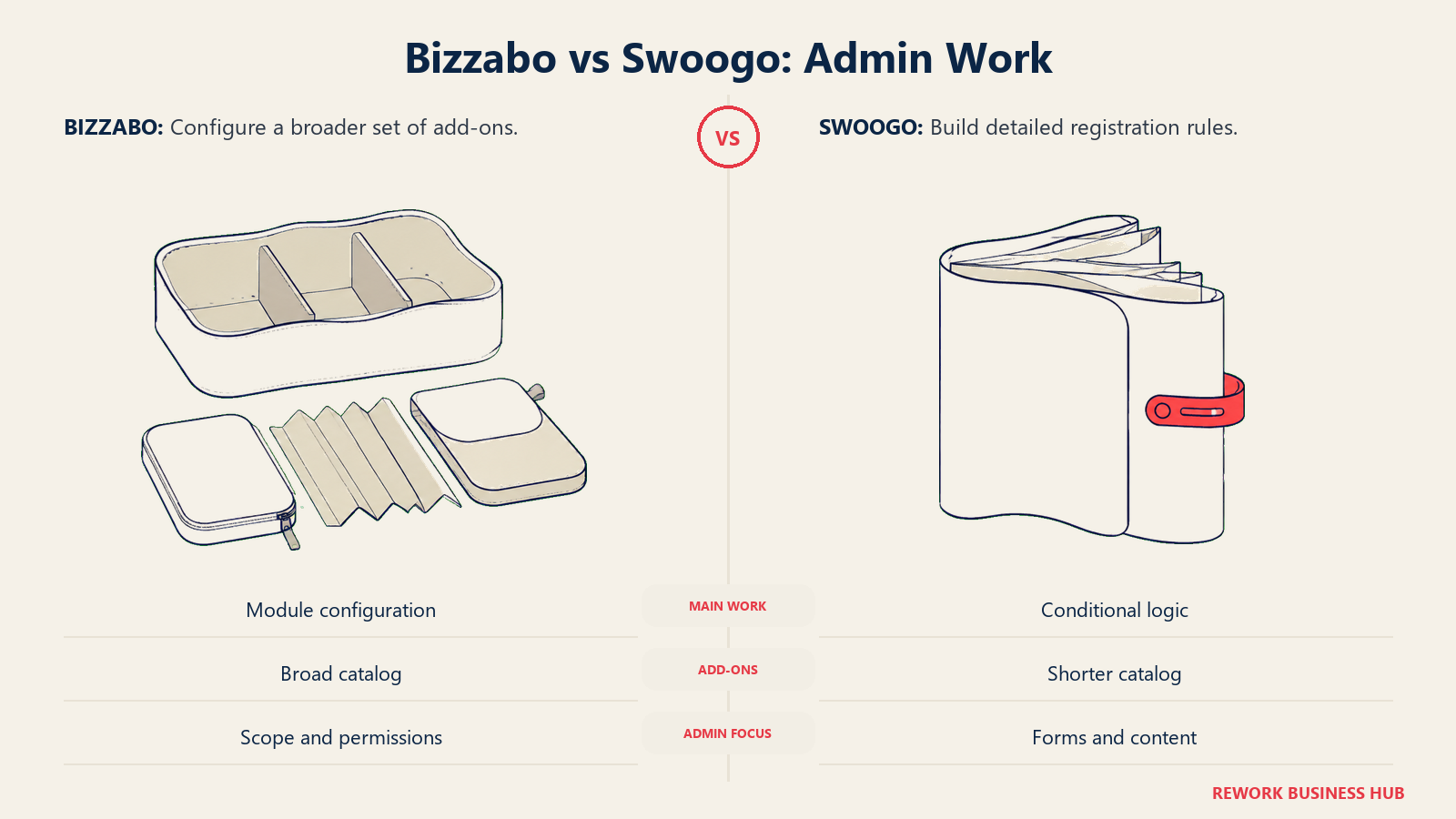
Swoogo's add-on list is shorter but real: Go Onsite Pro, Go Attend, Premium 24/7 Support, Pro Services, extra custom domains, SSO, sub-accounts, and Call for Speakers all sit outside Professional, none with a published price. The core registration and website product, though, is fully featured out of the box, so a Swoogo admin's configuration work concentrates in one place, the conditional-logic rule builder, rather than spread across a dozen separate purchase decisions.
| Admin and configuration factor | Bizzabo | Swoogo |
|---|---|---|
| Licensing model | Single base license plus separately purchased add-ons | Single base license (Professional) plus separately purchased add-ons |
| Number of major named add-ons | Roughly 11 (virtual, onsite, martech, portals, networking, branding, and more) | 8 named add-ons (Go Onsite Pro, Go Attend, Premium Support, Pro Services, extra domains, SSO, sub-accounts, Call for Speakers) |
| Where configuration concentrates | Per-add-on setup and permissions, since each is a separate purchase | The conditional-logic rule builder across forms, emails and the event website |
| Self-service option for smaller teams | Base license covers core needs without add-ons | Professional covers core needs without add-ons |
If your team is also weighing how to coordinate the broader event program across departments, not just inside the event tool itself, our best project management software guide for 2026 is worth a look for the cross-functional planning layer neither vendor is built to replace.
Security and Compliance
Both platforms carry a real, current compliance program, just documented differently. Bizzabo renewed its SOC 2 Type 2 certification in August 2025, handles EEA data under Standard Contractual Clauses for GDPR, and runs quarterly phishing-awareness testing; single sign-on is a paid add-on rather than standard. Swoogo holds SOC 2 Type II, ISO 27001, ISO 27701 and PCI-DSS Level 1 certifications, extends that same security level to every customer at no additional cost, and states GDPR compliance directly, acting as a data processor for customer event data under both the UK and EU frameworks.
| Security and compliance factor | Bizzabo | Swoogo |
|---|---|---|
| SOC 2 | Yes, Type 2, renewed August 2025 | Yes, Type II |
| ISO 27001 / ISO 27701 | Not named on Bizzabo's public security page | Yes, both |
| PCI-DSS | Not named on Bizzabo's public security page | Yes, Level 1 |
| GDPR | Yes, via Standard Contractual Clauses | Yes, as a stated data processor under UK and EU GDPR |
| SSO | Paid add-on | Named on the Enterprise tier |
| Whether the same security level applies at every tier | Depends on tier and add-ons | Yes, applied to all customers "large and small," at no additional cost, per Swoogo |
Pricing and What Each One Actually Costs
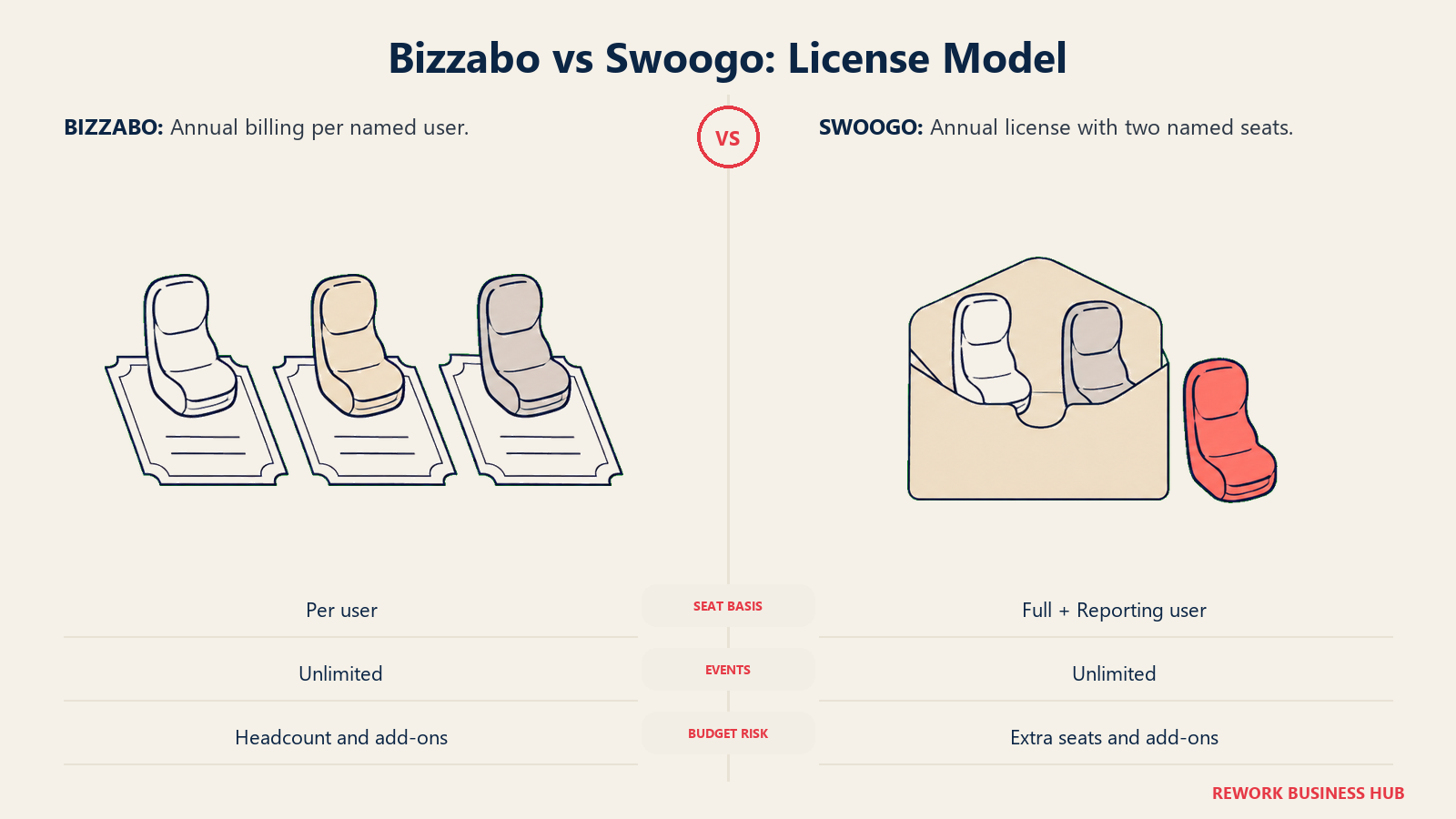
Both vendors publish real numbers, which already puts this comparison ahead of most in this category. But "unlimited" means two different things here, and getting that wrong is the single easiest way to under-budget either platform. Both say unlimited events and unlimited registrations are included. Neither says unlimited seats. Bizzabo charges per named user with a 3-user floor. Swoogo's $11,800 base covers exactly one Full User plus one Reporting User, and neither vendor publishes a per-extra-seat rate.
| Pricing dimension | Bizzabo | Swoogo |
|---|---|---|
| Published price | Yes, $499 per user per month, billed annually | Yes, $11,800 per year for Professional |
| Billing basis | Per user, per month, billed annually | Flat annual license |
| Seats included at the published price | 3-user minimum (the floor is a minimum, not an allowance) | Exactly 1 Full User plus 1 Reporting User |
| Events and registrations included | Unlimited | Unlimited |
| Per-registrant fee | None stated | None stated |
| Published rate for an additional seat | Not published | Not published |
| Top tier | Same per-user rate scales with headcount | Enterprise, "Talk to Sales" |
| What changes the real price | Add-ons: streaming, Advanced Onsite, Martech/CRM integrations, Sponsor/Speaker Portals, Networking, custom-branded app, SSO | Add-ons: Go Onsite Pro, Go Attend, Premium Support, Pro Services, extra domains, SSO, sub-accounts, plus however many extra seats your team needs |
Bizzabo's per-user structure is at least computable past the published floor, since the rate itself, $499/user/month, is public. Using that published rate:
| Illustrative model, Bizzabo base license only (published $499/user/month rate) | 3 users (stated minimum) | 5 users | 10 users |
|---|---|---|---|
| Annual cost | $17,999/year (vendor-stated floor) | about $29,940/year | about $59,880/year |
Swoogo's math stops at the vendor's own numbers and doesn't go further, on purpose. The $11,800 Professional price is real and quotable, but it buys two named seats, not a team. A five-person events team needs at least three more Full or Reporting User licenses on top of that base, and Swoogo does not publish what those cost. Estimating a per-seat number and presenting it as fact would be a guess dressed up as a quote, so the honest answer for a growing team is: budget more than $11,800, get Swoogo to price the actual seat count you need, and don't treat the headline figure as your real number. Teams that find either platform's math gets uncomfortable at their real headcount should also look at our Stova vs Accelevents vs Eventzilla comparison, which covers three platforms competing on more predictable per-seat or per-event pricing.
Implementation and Time to Value
| Implementation factor | Bizzabo | Swoogo |
|---|---|---|
| First visible output | A live, branded event registration site and app | A working registration form with the conditional logic your team actually needs |
| Realistic time to that output | Weeks for a single flagship event on the base license | Days to a couple of weeks, once the form logic is mapped out |
| Heaviest configuration work | Deciding and configuring which add-ons the program actually needs | Building out conditional logic rules across the form, emails and website |
| Who does the work internally | B2B marketing or event marketing team | Event production or marketing operations |
| Vendor-side help | Onboarding support included in the base license; deeper support tied to plan level | Standard support included; Premium 24/7 Support and Pro Services available as paid add-ons |
| What stalls the rollout | Under-scoping add-ons up front, then discovering Klik, streaming or CRM sync all cost extra | Under-provisioning seats up front, then hitting the 2-seat wall mid-build |
Switching Considerations
Switching between these platforms changes what your team owns day to day, not just which logo is on the login page. Use the table below to plan what data, contracts and workflows must move together.
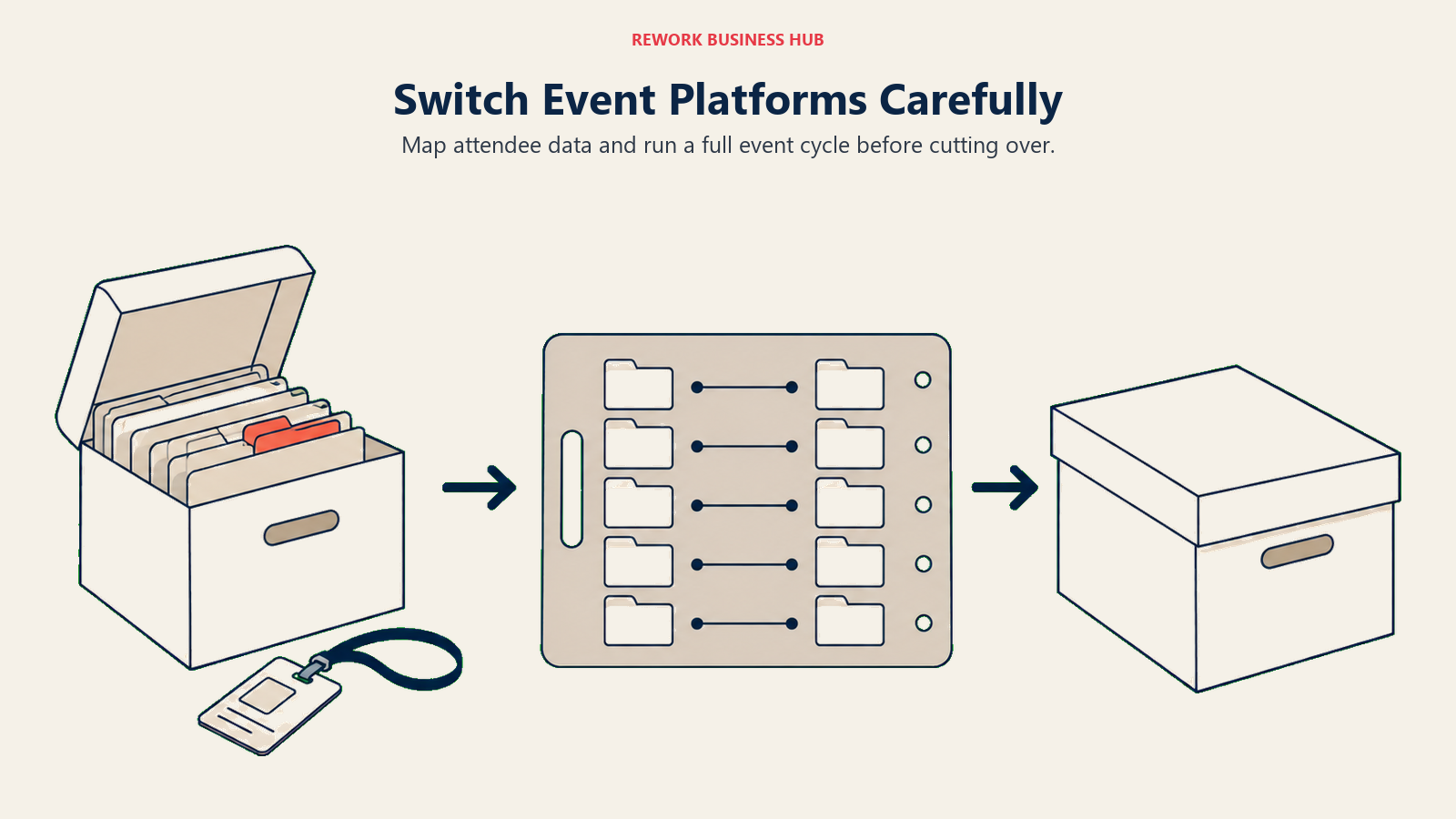
| Switching factor | What to check |
|---|---|
| Historical registration and attendee data | Ask what exports in what format, and whether custom-field data (especially conditional-logic branches) maps cleanly to the new platform |
| Contract overlap | Run one full event cycle on the incumbent before cutting over, especially mid-negotiation on add-ons |
| Minimum term and billing basis | Bizzabo bills annually per user with a 3-user floor; Swoogo bills annually per license with 2 seats included |
| Add-on migration | Klik-dependent workflows (tap-based lead capture, engagement heatmaps) have no Swoogo equivalent; deep conditional-logic forms take real rebuild time on Bizzabo |
| Change management load | Marketing teams relearn which add-ons cover which onsite feature on Bizzabo; producers relearn the logic builder's syntax and limits on Swoogo |
A third option worth naming: if the real problem isn't event-tech depth but the fact that neither platform talks to your CRM, Rework's Event module runs enterprise event management, registration, event websites, agenda and session planning, attendee records, approvals and resource booking, inside the same platform as Sales Ops (CRM and pipeline), Lead management, Work Ops and the People app. The pitch is consolidation, not competing on event-tech features: an event-sourced lead lands on the same contact timeline as the CRM record instead of needing a CSV round trip. It is not a replacement for either platform at their own depth. There's no venue-sourcing marketplace, no room blocks or air travel, no onsite badge hardware, and Rework does not ship a virtual or hybrid event platform at all. The fit is roughly 10 to 200 people. Price: quote on request, per organization; see rework.com/pricing.
When Bizzabo Is the Right Call
- You want a wearable onsite networking layer without building it yourself. Klik SmartBadge is a real, differentiated product; nothing in Swoogo's lineup matches it.
- You're running a handful of flagship B2B conferences, not a high-volume calendar of smaller events. A per-user license makes sense when the team is small and the events are big.
- Attendee experience and onsite engagement data matter more to you than registration-form complexity. Klik's engagement heatmaps and the broader Event Experience OS positioning are built around that priority.
- You'd rather pay for a platform than assemble one. If the eleven-add-on model doesn't scare you and you'll actually use most of them, Bizzabo's breadth earns its price.
If Bizzabo fits but the add-on math stacks up past what you can defend, our best Bizzabo alternatives roundup lists other event-experience platforms with more predictable pricing.
When Swoogo Is the Right Call
- Your registration logic is genuinely complicated. Multi-track sessions, different question sets by ticket type, pricing that changes based on a prior answer: this is the exact problem unlimited conditional logic on every plan is built to solve.
- You run a high volume of events and want the base price to include what you'll actually use. Thirty-plus integrations, unlimited conditional logic and no per-registrant fee are all in the $11,800 Professional price, not gated behind a separate purchase.
- You don't need wearable onsite hardware or a per-user license that scales with headcount. A two-seat team that owns registration end to end gets more for less here than on Bizzabo's floor.
- Your team is production-minded, not marketing-led. Swoogo's own identity, built by former event planners, shows up in how deep the form and website tools go before you hit a wall.
If Swoogo fits but the seat math is the sticking point, our best Swoogo alternatives roundup covers other registration specialists with clearer per-seat pricing.
Decision Framework
The final choice comes down to which layer of the event you're actually trying to fix. Match your must-have requirement to the platform before comparing secondary features.
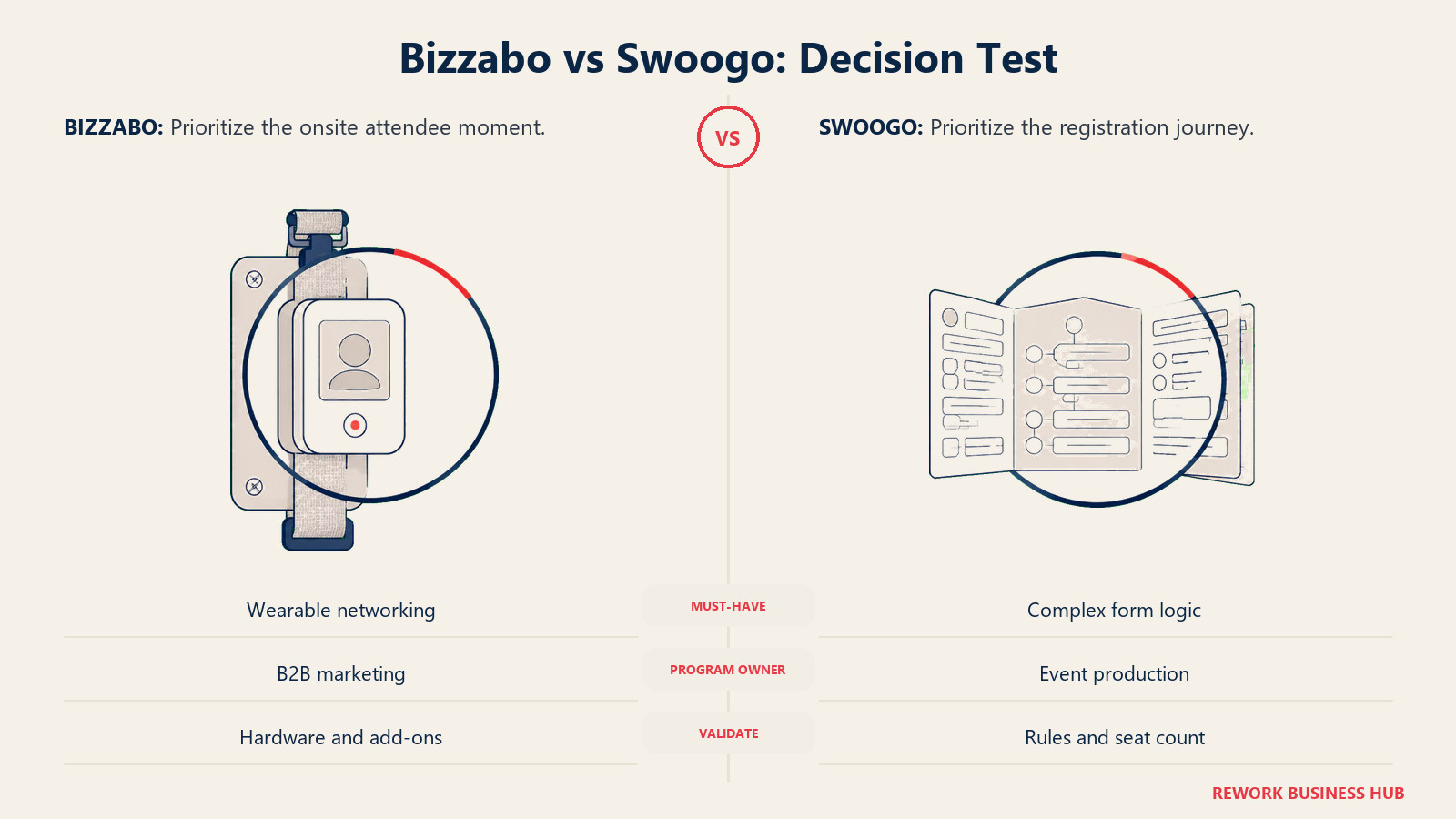
| If this is true for you | Pick |
|---|---|
| Klik-style wearable badges and onsite networking matter to your program | Bizzabo |
| Your registration forms need genuinely complex, branching logic | Swoogo |
| You want unlimited events on a predictable per-user license and a small team | Bizzabo |
| You want a flat annual price with no per-registrant fee and deep form control | Swoogo |
| Your budget owner is B2B marketing running a few flagship conferences a year | Bizzabo |
| Your budget owner is event production running a high volume of complex events | Swoogo |
| You need venue sourcing or hotel room blocks | Neither; see Cvent vs Bizzabo |
| Comparing the whole category rather than just these two | See the 2026 event management software guide |
What to Do Next
- Name the actual problem in one sentence. "We need a wearable onsite layer and a great attendee app for our flagship conference" and "we need registration forms that branch based on ten different variables" are different problems, and these two vendors solve different halves of them.
- Model Bizzabo using its own published rate. Take your real user count and the add-ons you'd need (Klik, CRM sync, virtual), and build a full quote request instead of trusting the $17,999 floor as your real number.
- Ask Swoogo to price your actual seat count. The $11,800 Professional figure covers two seats; get a written number for the team size you'll actually run, not the entry price.
- Ask both vendors what's excluded, not just included. Confirm whether CRM integration, SSO and onsite hardware are bundled or billed separately before you build a budget line.
- Check the adjacent category too. If CRM connectivity is the deciding factor, our best CRM software guide for 2026 covers the systems both platforms connect to.
Frequently Asked Questions about Bizzabo vs Swoogo
What is the main difference between Bizzabo and Swoogo?
Bizzabo is an event experience platform on a flat per-user license with unlimited events, distinguished by the Klik SmartBadge wearable onsite layer, typically bought by B2B marketing teams. Swoogo is a registration and event website platform on a flat annual license with no per-registrant fee, distinguished by unlimited conditional logic on every form, typically bought by professional event producers.
How much does Bizzabo cost?
Bizzabo publishes $499 per user per month, billed annually, with a 3-user minimum, which its own pricing page states works out to $17,999 per year. That covers the base Event Experience OS: unlimited events, registrations, contact management, ticketing, email campaigns, event websites and the mobile app. Klik SmartBadge, streaming, advanced onsite tools, CRM integrations, networking and custom branding are separate paid add-ons.
How much does Swoogo cost?
Swoogo's Professional plan is $11,800 per year and includes exactly one Full User plus one Reporting User, unlimited events, unlimited registrations, a check-in app, 30-plus integrations, one custom domain and attendee approval workflows. Enterprise pricing is "Talk to Sales." Extra seats have no published rate.
Does Swoogo really include unlimited conditional logic on every plan?
Yes. Swoogo states this directly: unlimited conditional logic across registration forms, confirmation emails and the event website is included on every plan at no extra charge, with visibility rules that can be toggled on nearly every question and page.
Does either platform charge extra for team members?
Both, in different ways. Bizzabo charges per named user with a 3-user minimum, so the license cost rises directly with headcount. Swoogo's base Professional price covers exactly one Full User and one Reporting User, and additional seats are priced on request with no published rate, so a growing team should get a real seat-count quote rather than assuming the $11,800 figure covers everyone.
What is Klik SmartBadge, and does Swoogo have anything like it?
Klik is Bizzabo's wearable event badge. It lets attendees exchange contact information with a tap, gives exhibitors tap-based lead capture without a separate scanner, and gives organizers passive engagement data, including heatmaps of session and booth traffic. Swoogo has no comparable hardware product; its onsite layer is a standard check-in app plus the Go Onsite Pro add-on.
Which platform has stronger security certifications?
Swoogo's public security page names a broader set for a single price tier: SOC 2 Type II, ISO 27001, ISO 27701 and PCI-DSS Level 1, applied to every customer at no additional cost. Bizzabo renewed SOC 2 Type 2 in August 2025 and handles GDPR through Standard Contractual Clauses, with SSO sold as a separate add-on rather than included.
Can a mid-size team afford either platform?
Both publish a real, budgetable floor: Swoogo's $11,800 covers two seats, and Bizzabo's $17,999 covers three. Neither number is the full picture once you add the seats or hardware a real team needs, so get both vendors to quote your actual headcount and add-on list before comparing totals. Teams around 10 to 200 people that also need CRM and pipeline connectivity should weigh consolidated platforms too.
Related Resources:
- Best Event Management Software in 2026
- Cvent vs Bizzabo
- Best Cvent Alternatives
- Best Bizzabo Alternatives
- Best Swoogo Alternatives
- Best Eventbrite Alternatives
- EventMobi vs Whova vs Cvent
- Stova vs Accelevents vs Eventzilla
- Best Audience Engagement Software in 2026
- Best CRM Software in 2026
- Best Email Marketing Software in 2026
- Best Project Management Software in 2026

Principal Product Marketing Strategist
On this page
- TL;DR
- Key Facts
- Who Each Platform Is Really For
- Registration and Event Websites
- Attendee Experience and Mobile App
- Onsite Check-in, Badging and Klik
- Networking and Matchmaking
- Virtual and Hybrid Coverage
- Marketing, Email and CRM Integration
- Reporting and Attribution to Pipeline
- Admin Burden and Configuration
- Security and Compliance
- Pricing and What Each One Actually Costs
- Implementation and Time to Value
- Switching Considerations
- When Bizzabo Is the Right Call
- When Swoogo Is the Right Call
- Decision Framework
- What to Do Next