Best Marketo Alternatives in 2026: 12 Tools for Mid-Market and Enterprise Marketing Teams

Turn this article into takeaways for your work.


Each assistant summarizes the article only for you and suggests best practices for your work.
Adobe Marketo Engage is the platform that defined enterprise marketing automation. Its lead scoring engine, multi-step nurture programs, and account-based marketing capabilities are genuinely sophisticated, and its integration with the Adobe Experience Cloud gives large enterprise teams a unified data layer that few competitors can match. If your company runs global demand-gen campaigns across dozens of segments, scores millions of leads against behavioral and firmographic signals, and reports attribution back to a Salesforce opportunity, Marketo built exactly what you need.
But Marketo is also expensive, complex, and built for a specific kind of team. Pricing is custom-quoted, database-driven, and rarely comes in under $2,000 per month for mid-market deployments. Implementation takes months. The interface carries a learning curve that frustrates anyone who didn't grow up in it. And for the majority of B2B teams who mostly need clean lead capture, scoring, routing, and a reliable sales handoff, Marketo is overkill. The question isn't whether Marketo works. It's whether you need all of it. If you're re-evaluating, here are 12 alternatives worth a serious look.
Quick Comparison Table
| Tool | Best For | Starting Price | Key Strength | Key Limitation |
|---|---|---|---|---|
| HubSpot Marketing Hub | Inbound-led teams wanting full marketing + sales suite | Free CRM; Marketing Hub Starter from $15/seat/mo | End-to-end inbound: landing pages, forms, email, CRM, attribution | Professional tier requires $3,000 onboarding; costs jump fast |
| ActiveCampaign | Mid-market teams wanting deep email automation with CRM | From $15/mo (1,000 contacts, billed annually) | Best visual automation builder in the mid-market | Pricing tiers confuse buyers; CRM is bolted on, not native |
| Salesforce Pardot (Account Engagement) | Salesforce shops needing B2B nurture on native CRM data | From $1,250/org/mo (Growth) | Deep Salesforce CRM integration; robust ABM and scoring | Expensive, Salesforce-dependent, complex to configure |
| Rework | Mid-size B2B teams needing lead ops + sales handoff | From $99/mo billed yearly, 5 seats (rework.com/pricing) | Lead capture, scoring, routing, and SLA timers in one app | Not a marketing automation platform; no landing pages, attribution, or ABM |
| Braze | Consumer and mobile-first brands running lifecycle messaging | Custom, from ~$50K/yr | Omnichannel engagement: push, email, SMS, in-app | Enterprise-only; not suited for B2B demand gen |
| Customer.io | Product and SaaS teams running behavior-triggered messaging | From $100/mo (5,000 profiles) | Real-time event-based triggers; developer-friendly | Requires technical setup; not a full MAP or lead scoring platform |
| Klaviyo | E-commerce brands running email and SMS revenue campaigns | Free up to 250 contacts; from $20/mo | Native Shopify/WooCommerce integration; revenue attribution | Built for e-commerce; weak fit for B2B demand gen |
| Brevo | Budget-conscious teams needing email, SMS, and automation | Free; paid from $9/mo (5,000 sends) | Per-send pricing (not per-contact); multi-channel at low cost | Automation depth and deliverability lag behind Marketo |
| Mailchimp | Small teams wanting simple email with maximum brand recognition | Free (250 contacts); from $13/mo | Easiest onboarding; wide integration catalog | Automation significantly weaker; not built for B2B lead scoring |
| GetResponse | Teams wanting email, webinars, and landing pages bundled | Free (500 emails/mo); from $19/mo (1,000 contacts) | Webinar hosting built in; solid landing page builder | Automation complexity below Marketo; limited CRM depth |
| Oracle Eloqua | Large enterprise demand-gen teams running complex multi-stage programs | From ~$2,000/mo (Basic) | Most sophisticated lead scoring and campaign canvas in market | Highest TCO; steep learning curve; requires dedicated admin |
| Conversion | Enterprise MOps teams on Salesforce and a warehouse, migrating off Marketo | Not published; demo required | Governed AI agents building and QAing campaigns on unified data | Needs a modern warehouse and a dedicated MOps function |
Stage Fit Matrix
| Tool | Startup (1-20) | Growth (20-100) | Mid-Market (100-500) | Enterprise (500+) |
|---|---|---|---|---|
| HubSpot Marketing Hub | Good fit (free) | Strong fit | Strong fit | Enterprise tier available |
| ActiveCampaign | Good fit | Strong fit | Works | Shows limits at scale |
| Salesforce Pardot | Not recommended | Selective fit | Strong fit | Strong fit |
| Rework | Not ideal | Strong fit | Sweet spot | Selective fit |
| Braze | Not recommended | Not recommended | Selective fit | Strong fit |
| Customer.io | Good fit (tech) | Strong fit (SaaS) | Strong fit (SaaS) | Works |
| Klaviyo | Good fit (e-com) | Strong fit (e-com) | Good fit (e-com) | Works |
| Brevo | Strong fit | Good fit | Works | Not designed for it |
| Mailchimp | Strong fit | Works | Limited | Not designed for it |
| GetResponse | Good fit | Good fit | Works | Not designed for it |
| Oracle Eloqua | Not recommended | Not recommended | Selective fit | Strong fit |
| Conversion | Not recommended | Not recommended | Selective fit | Strong fit |
Sizing and Persona Table
| Tool | Ideal Team Size | Who Buys It |
|---|---|---|
| HubSpot Marketing Hub | 20-1,000 employees | CMO, Marketing Ops, RevOps, VP Sales |
| ActiveCampaign | 5-500 employees | Marketing Director, Marketing Manager, Growth Marketer |
| Salesforce Pardot | 100-5,000 employees | Marketing Ops Director, CRM Admin, Demand Gen Lead |
| Rework | 20-500 employees | VP Marketing, Marketing Ops, RevOps Lead, COO |
| Braze | 200+ employees | VP Lifecycle Marketing, Mobile Marketing Lead, Head of Growth |
| Customer.io | 10-500 employees | Head of Product Marketing, Marketing Engineer, Growth Lead |
| Klaviyo | 5-500 employees | E-commerce CMO, DTC Brand Owner, Email/SMS Marketer |
| Brevo | 1-200 employees | Marketing Manager, Small Business Owner, Solo Marketer |
| Mailchimp | 1-100 employees | Marketing Manager, Small Business Owner |
| GetResponse | 5-500 employees | Marketing Director, Course Creator, Solopreneur |
| Oracle Eloqua | 500+ employees | Marketing Ops Director, VP Demand Gen, Enterprise CRM Admin |
| Conversion | 500+ employees | Marketing Ops Director, VP Marketing, Head of Data |
1. HubSpot Marketing Hub: Full Inbound Suite with Native CRM
HubSpot is the most common landing spot for teams leaving Marketo who need marketing automation without enterprise complexity. The product covers the full inbound loop: landing pages, forms, ad management, email marketing, lead nurture workflows, lead scoring, social publishing, and reporting, all wired natively to the HubSpot CRM. And unlike Marketo, the interface is genuinely usable without a six-week onboarding program. See the best ActiveCampaign alternatives guide if HubSpot also seems large for your budget and you want the mid-market comparison.
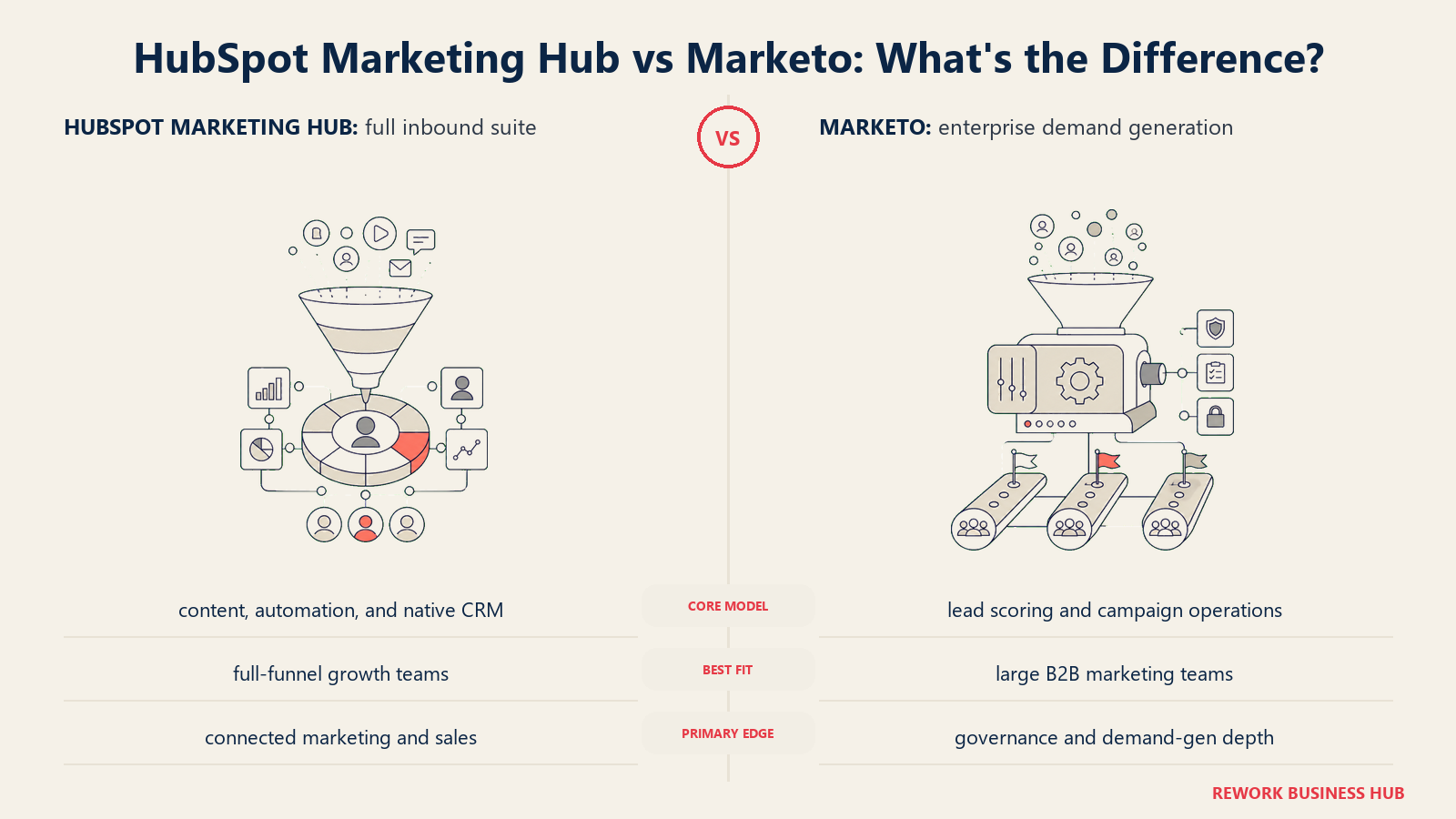
The honest cost accounting is important here. Marketing Hub Starter at $15/seat/month sounds accessible. But running real nurture campaigns requires Marketing Hub Professional at $890/month (with a mandatory $3,000 onboarding fee), and that base price covers only 2,000 contacts. Once you add more contacts and the seats for your marketing, sales, and RevOps teams, a 50-person company using both Marketing Hub Pro and Sales Hub Pro can realistically expect $3,000 to $8,000 per month. That's not a downgrade in cost from Marketo. It's a different cost profile.
Methodology / Vision: The inbound flywheel. HubSpot's philosophy is that marketing, sales, and service should be one connected loop that compounds over time. The CRM is the connective tissue.
Target Audience: Marketing-led B2B companies, typically 20 to 1,000 employees, with meaningful content, ads, or inbound programs that need to feed a sales pipeline.
Sizing Fit: Free tier works for small teams. Professional tier is the sweet spot for growth and mid-market. Enterprise tier exists but competes on price with Marketo and Pardot.
Stage Fit: Startup through mature. Genuinely works across all stages with different cost profiles at each.
Team vs. Company-Wide: Full GTM platform. Marketing, sales, and service all have dedicated hubs.
| What you get | What you don't |
|---|---|
| Full inbound suite: landing pages, ads, email, forms, workflows | Predictable per-seat pricing as contacts and hubs scale |
| Native CRM with deal tracking, forecasting, and attribution | Native WhatsApp/Instagram DM on base plans |
| Large partner and integration ecosystem (1,500+ integrations) | Simple lead distribution on base plans |
| Free CRM tier for small teams | Enterprise-grade lead routing without add-ons |
Pricing: Free CRM. Marketing Hub Starter from $15/seat/mo (billed annually). Marketing Hub Professional at $890/mo base (requires $3,000 mandatory onboarding). Enterprise from $3,600/mo. See HubSpot's pricing.
Best for: Marketing-led growth companies that need content, email, nurture, and pipeline in one connected platform and are willing to budget for the full suite.
2. ActiveCampaign: Best Visual Automation Builder in the Mid-Market
If your reason for leaving Marketo is cost and complexity, and you want the most sophisticated automation logic available at a sub-enterprise price, ActiveCampaign is the clearest alternative. Its visual automation builder supports multi-branch if-then logic, goal tracking, split testing of sequences, and CRM-triggered actions that most tools reserve for $1,000/month+ plans. For teams that live and die by behavioral email sequences, nothing in this price range comes close.
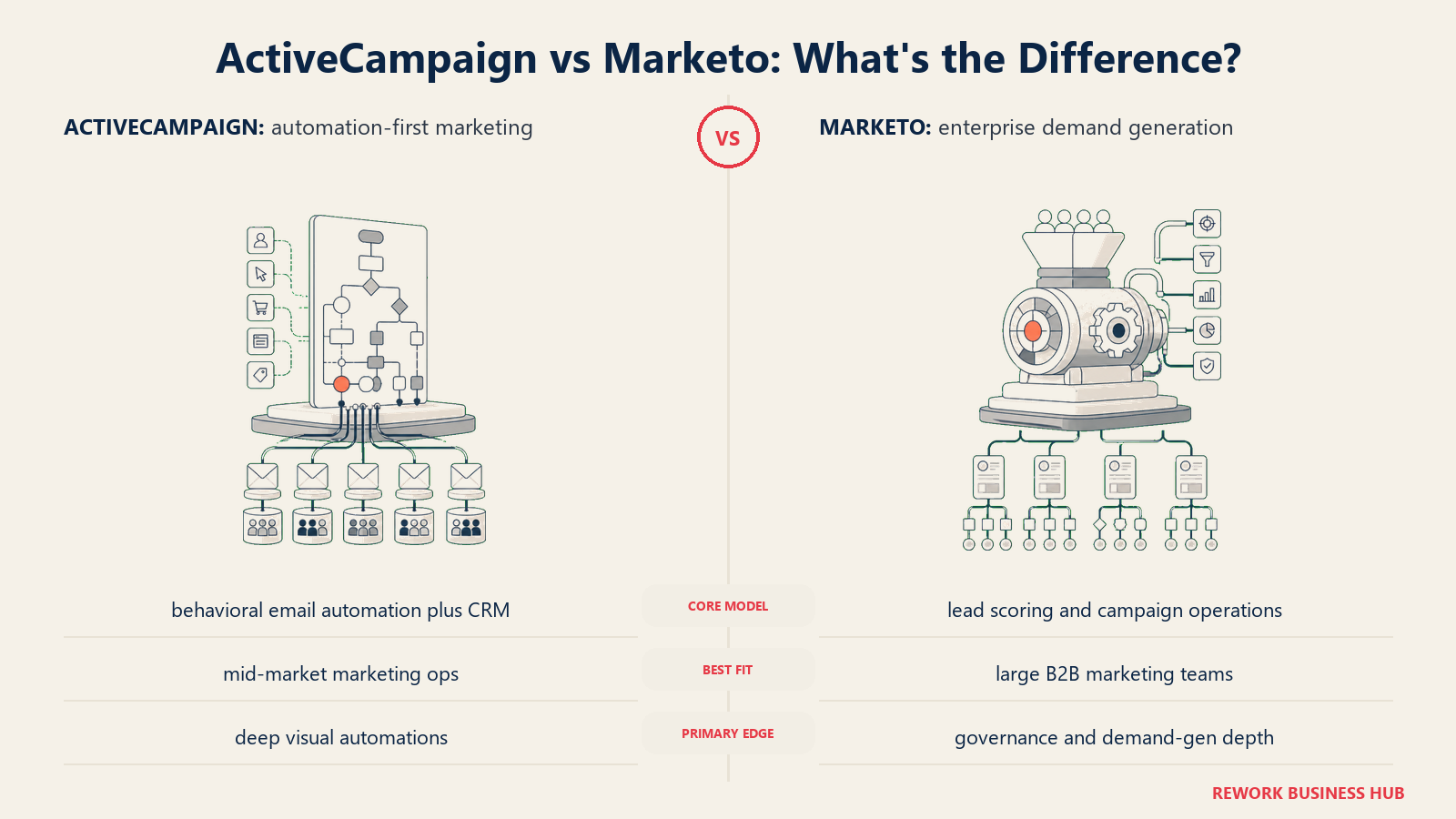
The friction is architectural. ActiveCampaign's CRM (Deals) is a bolted-on addition to an email marketing core, not a native two-way data model. Sharing sales deal data back into marketing segmentation still requires configuration work at higher tiers. Pricing tiers fragmented across Starter, Plus, Pro, and Enterprise have surprised buyers mid-purchase. And deliverability, once a selling point, has drawn more complaints on review platforms in recent years. See the best ActiveCampaign alternatives guide for a deeper comparison if you're weighing this against HubSpot or Brevo.
Methodology / Vision: Behavior-driven automation for the mid-market. The product bet is that personalized, event-triggered email automation shouldn't require enterprise budget or an ops team to configure.
Target Audience: Marketing teams from 5 to 500 employees, especially in SaaS, e-commerce, and professional services where the buying journey is email-heavy and segment-driven.
Sizing Fit: Works at startup scale. Strongest in the 10 to 200 employee range. Shows architecture limits above 500 as marketing-sales data sharing needs grow.
Stage Fit: Startup through mid-market. Strong when the team has defined email sequences but hasn't yet needed account-based programs or multi-channel attribution depth.
Team vs. Company-Wide: Primarily a marketing tool. The CRM serves sales but as a secondary use case, not a co-equal architecture.
| What you get | What you don't |
|---|---|
| Best visual automation builder in the mid-market | Native two-way CRM-marketing data model |
| Deep behavioral triggers and event-based segmentation | Predictable pricing as contacts scale |
| Split testing for sequences and automations | Consistent support quality at higher tiers |
| 900+ integrations including Salesforce and Shopify | ABM or account-level scoring and targeting |
Pricing: Starter from $15/mo (1,000 contacts, billed annually) to $145+/mo (Enterprise). Scales with contact volume. See ActiveCampaign's pricing.
Best for: Mid-market marketing teams that need sophisticated behavioral email automation without jumping to Marketo or Pardot pricing.
3. Salesforce Marketing Cloud Account Engagement (Pardot): Marketo's Closest Enterprise Rival
If your team runs on Salesforce CRM and you're leaving Marketo because the Salesforce integration is too brittle, Account Engagement (Pardot) is the most logical move. It's built natively on the Salesforce platform, which means contact records, opportunity data, and campaign influence are shared without any third-party sync. The B2B marketing automation capabilities are comparable to Marketo: lead scoring, dynamic content, A/B testing, ROI reporting, and Salesforce Engage for sales-triggered nurture.
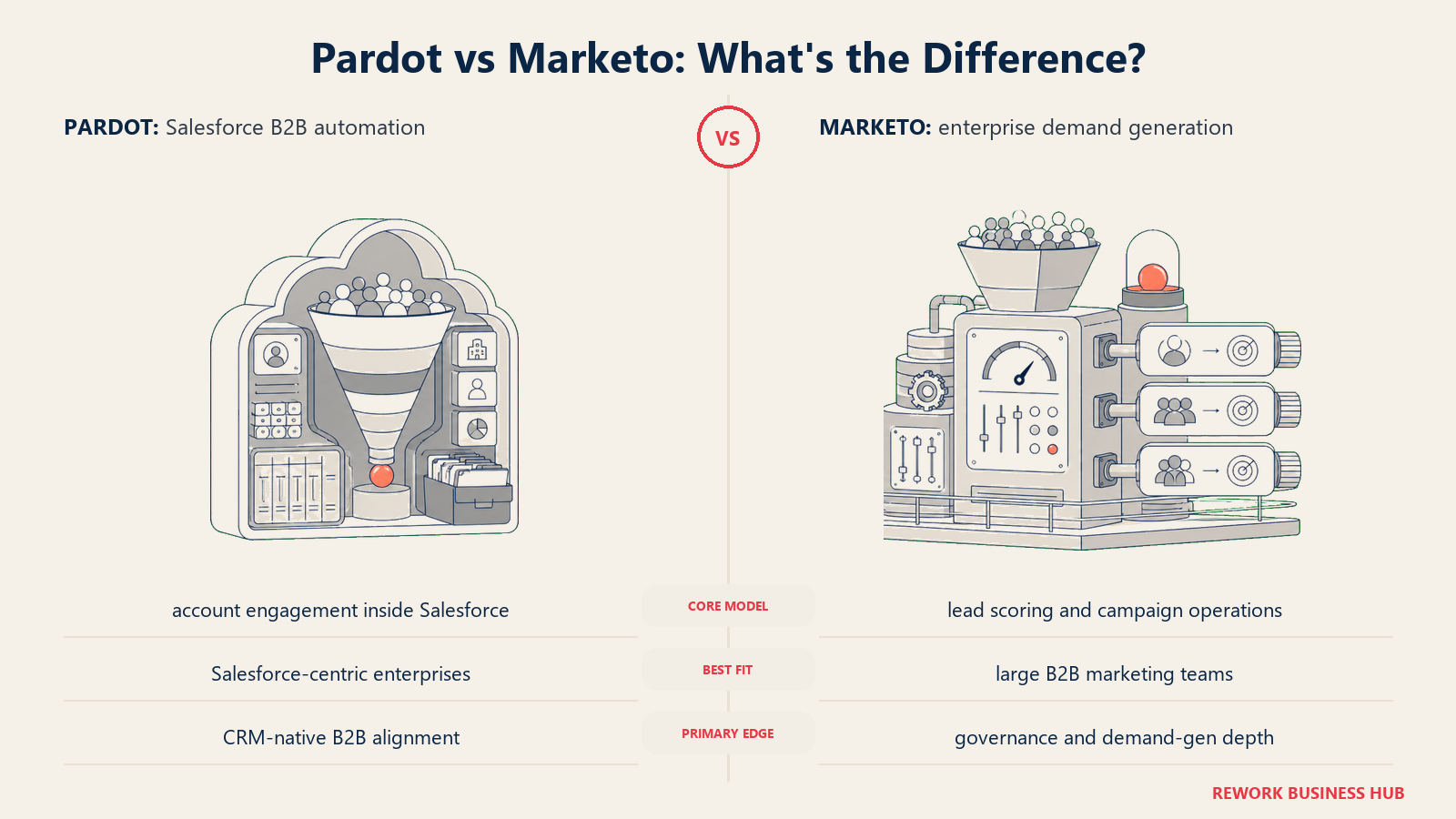
The catch is that Pardot compounds Salesforce's cost. Growth tier starts at $1,250/org/month, Plus at $2,500/org/month, and Advanced at $4,000/org/month, all billed annually. Add the Salesforce Sales Cloud licenses your sales team already carries, and the combined annual spend for a 50-person team can run $100,000 to $300,000. It's not a downgrade from Marketo cost-wise. It's a trade-off between Adobe ecosystem lock-in and Salesforce ecosystem lock-in.
Methodology / Vision: B2B marketing automation as a native Salesforce module. The product philosophy is that marketing attribution is only meaningful when built on the same data model as the CRM.
Target Audience: B2B companies of 100+ employees already running Salesforce Sales Cloud as their CRM, with dedicated marketing ops and demand-gen teams.
Sizing Fit: Mid-market minimum. Most value unlocks above 200 employees where Salesforce ecosystem depth pays off. Below 100 employees, the cost is hard to justify.
Stage Fit: Mature through enterprise. Best for teams that have already defined their demand-gen playbook and need a MAP that integrates cleanly with their existing Salesforce investment.
Team vs. Company-Wide: Marketing and sales share the Salesforce data model. Full GTM integration for Salesforce shops.
| What you get | What you don't |
|---|---|
| Native Salesforce CRM data sync (no third-party integration) | Affordable pricing for teams not already on Salesforce |
| Robust lead scoring, dynamic content, and ABM support | Independence from Salesforce licensing |
| Deep ROI and multi-touch attribution back to opportunities | A modern, fast UI (similar vintage UX concerns as Marketo) |
| Salesforce Engage for sales-triggered nurture | Easy setup without Salesforce admin expertise |
Pricing: Growth $1,250/org/mo; Plus $2,500/org/mo; Advanced $4,000/org/mo; Premium $15,000/org/mo. Billed annually. See Salesforce's pricing page.
Best for: Salesforce-native organizations running serious B2B demand gen where native CRM attribution is non-negotiable.
4. Rework: Lead Capture, Routing, and Sales Handoff, Not a Full MAP
Rework isn't a Marketo replacement, and it shouldn't be judged as one. It has no landing page builder, no campaign email A/B testing, no ABM orchestration, and no multi-touch attribution. It earns a place on this list for one specific kind of Marketo customer: the team that over-bought, and whose real problem was getting ad and form leads scored, routed to the right rep, and followed up on time.
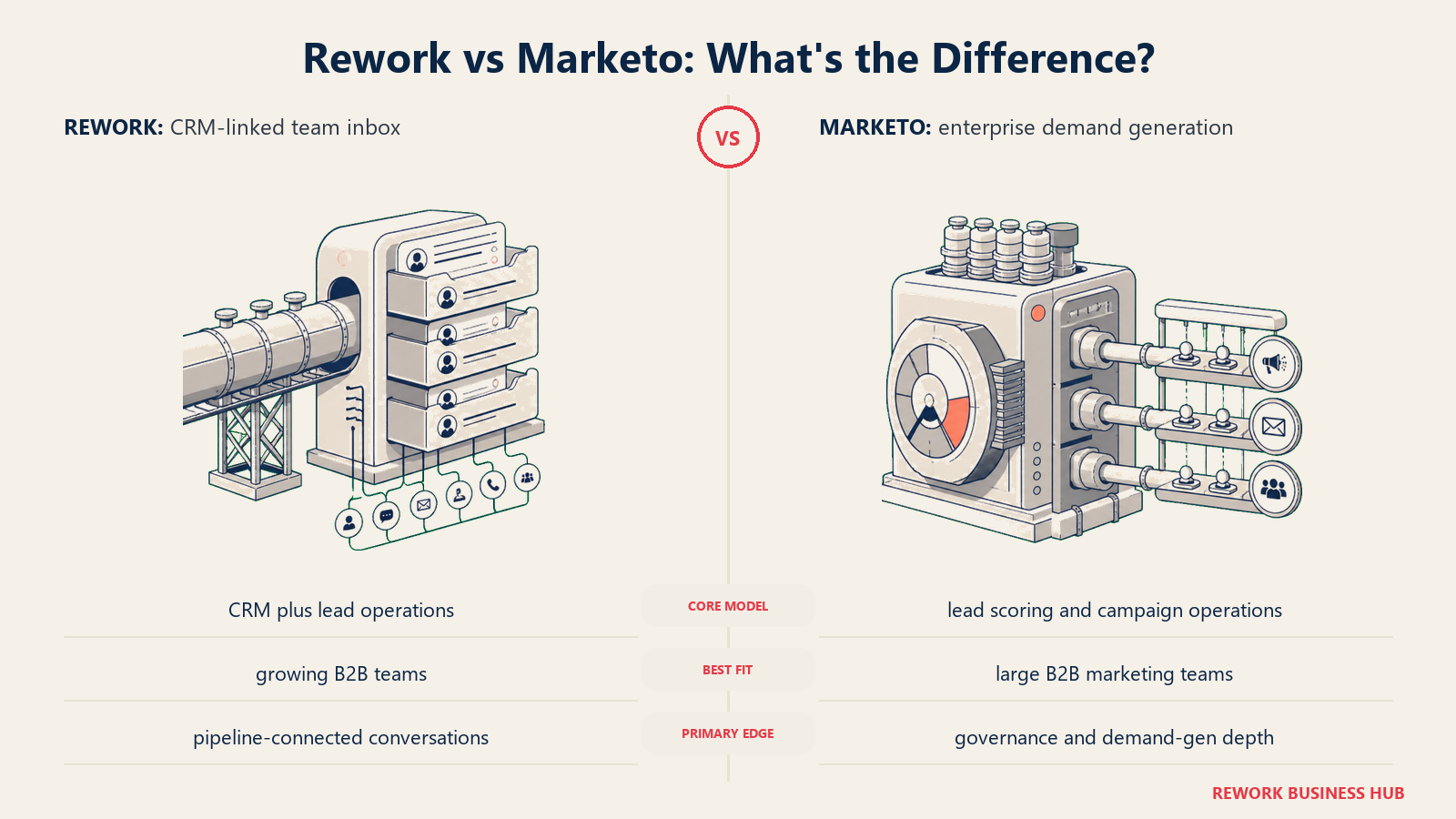
Rework's Lead app captures leads from web forms, webhooks, Zapier and Make, and from Meta, Google, TikTok and LinkedIn lead ads through its Ads Manager. Routers assign each lead by rule (company size, country, job title), share work out by round-robin or a claimable lead pool, and start an SLA clock on first response. Nurture sequences mix automated email and chat steps with call tasks for reps, but leads are enrolled into them by hand, so this is follow-up discipline, not campaign automation. Sales reps work from the same record marketing scored when you add the Sales app.
Target Audience: B2B companies with 20 to 500 employees running paid ads or inbound, where the bottleneck is the marketing-to-sales handoff rather than nurture complexity.
Sizing Fit: Not built for solo users or very small teams. Above 500 employees, enterprise governance needs usually point to Pardot, Eloqua, or staying on Marketo.
| What you get | What you don't |
|---|---|
| Lead capture, scoring, routing, and SLA timers in one app | Landing pages, campaign email builder, and email A/B testing |
| Round-robin and claim-based lead pools with per-rep caps | ABM orchestration and multi-touch attribution |
| Ad lead sync with cost per lead fed back to the ad platforms | Automatic enrolment into large nurture programs |
| Clean handoff into Rework's Sales pipeline | An AppExchange-scale integration library |
Pricing: the Marketing Engine (Prospect, Lead, and Ads Manager) is $99/month billed yearly or $115 month to month, with 5 marketing seats included; extra seats come in blocks of 5. The Revenue Engine adds the Sales app for $159/month billed yearly. 14-day free trial, no free plan. See rework.com/pricing.
Best for: Mid-size B2B teams leaving Marketo whose real need is lead ops: capture, score, route, and hand off to sales. Not ideal for: Anyone who needs Marketo's marketing automation itself: multi-stage nurture, attribution, ABM, or large email programs. HubSpot Marketing Hub Pro, Pardot, or Eloqua fit those needs better.
5. Braze: Omnichannel Lifecycle Messaging for Consumer and Mobile-First Teams
Braze is a different category than Marketo, and that distinction matters. Where Marketo focuses on B2B demand gen (lead scoring, nurture, and sales handoff), Braze focuses on consumer lifecycle engagement: push notifications, in-app messages, email, SMS, WhatsApp, and Content Cards fired on real-time behavioral events. Think product onboarding, win-back campaigns, and personalized user journeys for mobile apps and consumer SaaS products.
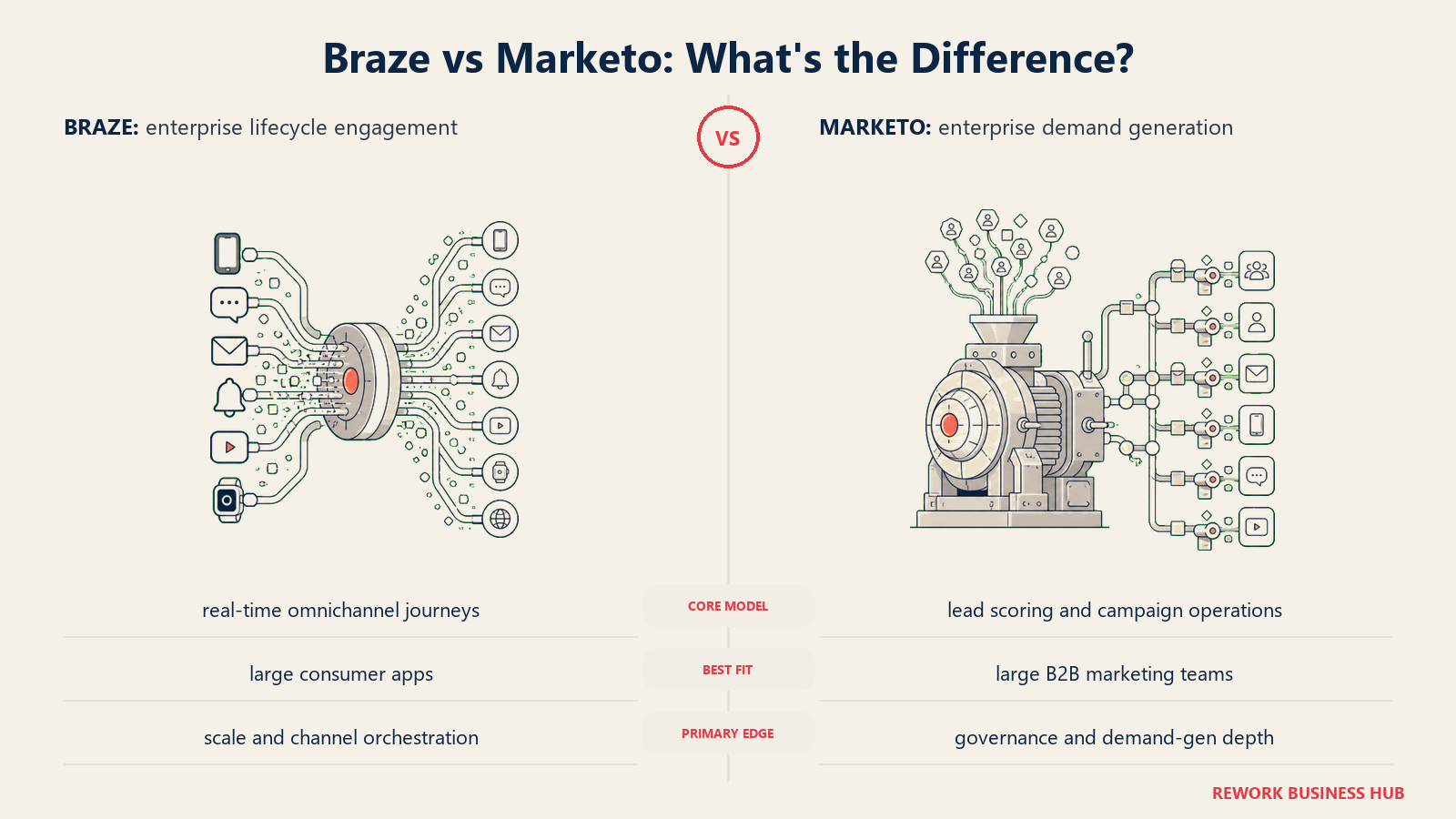
For B2C companies, subscription businesses, and mobile-first consumer brands that have outgrown simple email tools, Braze is among the best platforms available. Its Canvas visual workflow builder, Connected Content for personalization, and Predictive Suite are genuinely enterprise-grade. But Braze is not designed for B2B demand gen. There's no B2B lead scoring model, no Salesforce opportunity attribution, and no form-to-rep routing. If you're evaluating it as a Marketo replacement for a B2B demand-gen motion, it's the wrong category.
Methodology / Vision: Real-time, customer-centric lifecycle engagement across every channel. Braze bets that marketing effectiveness comes from meeting customers in the moment of intent, not on a scheduled email cadence.
Target Audience: Consumer SaaS, mobile app companies, fintech, retail, and B2C subscription businesses with 200+ employees and dedicated lifecycle marketing teams.
Sizing Fit: Mid-market minimum. Most contracts are in the $50,000 to $500,000+ annual range. Not accessible for teams under 200 employees.
Stage Fit: Growth through enterprise. Requires a reasonably mature data infrastructure (event tracking, CDP or data warehouse integration) to deliver full value.
Team vs. Company-Wide: Lifecycle marketing and growth teams. Not a cross-functional company-wide platform.
| What you get | What you don't |
|---|---|
| Real-time event-triggered omnichannel messaging (push, email, SMS, in-app) | B2B lead scoring or sales pipeline integration |
| Canvas visual workflow builder with branching logic | Affordable pricing for teams under 200 employees |
| Predictive churn and action scores | Form-to-rep lead routing |
| Deep personalization via Connected Content and Liquid | Simple self-serve setup |
Pricing: Custom, contact sales. Annual contracts typically start around $50,000 and scale to $500,000+ based on monthly active users and message volume. See Braze pricing.
Best for: Consumer-facing or mobile-first companies running omnichannel lifecycle engagement at scale.
6. Customer.io: Behavior-Triggered Messaging for SaaS and Product-Led Teams
Customer.io is built for product and SaaS teams whose marketing is driven by what users do in the product, not by external campaign schedules. Connect your event stream (via API, Segment, or direct SDK), define triggers based on user actions or inactions, and fire personalized emails, push notifications, or SMS at exactly the right moment. For SaaS companies running onboarding sequences, trial-to-paid conversion campaigns, and churn prevention workflows, Customer.io competes with the best tools in this category.
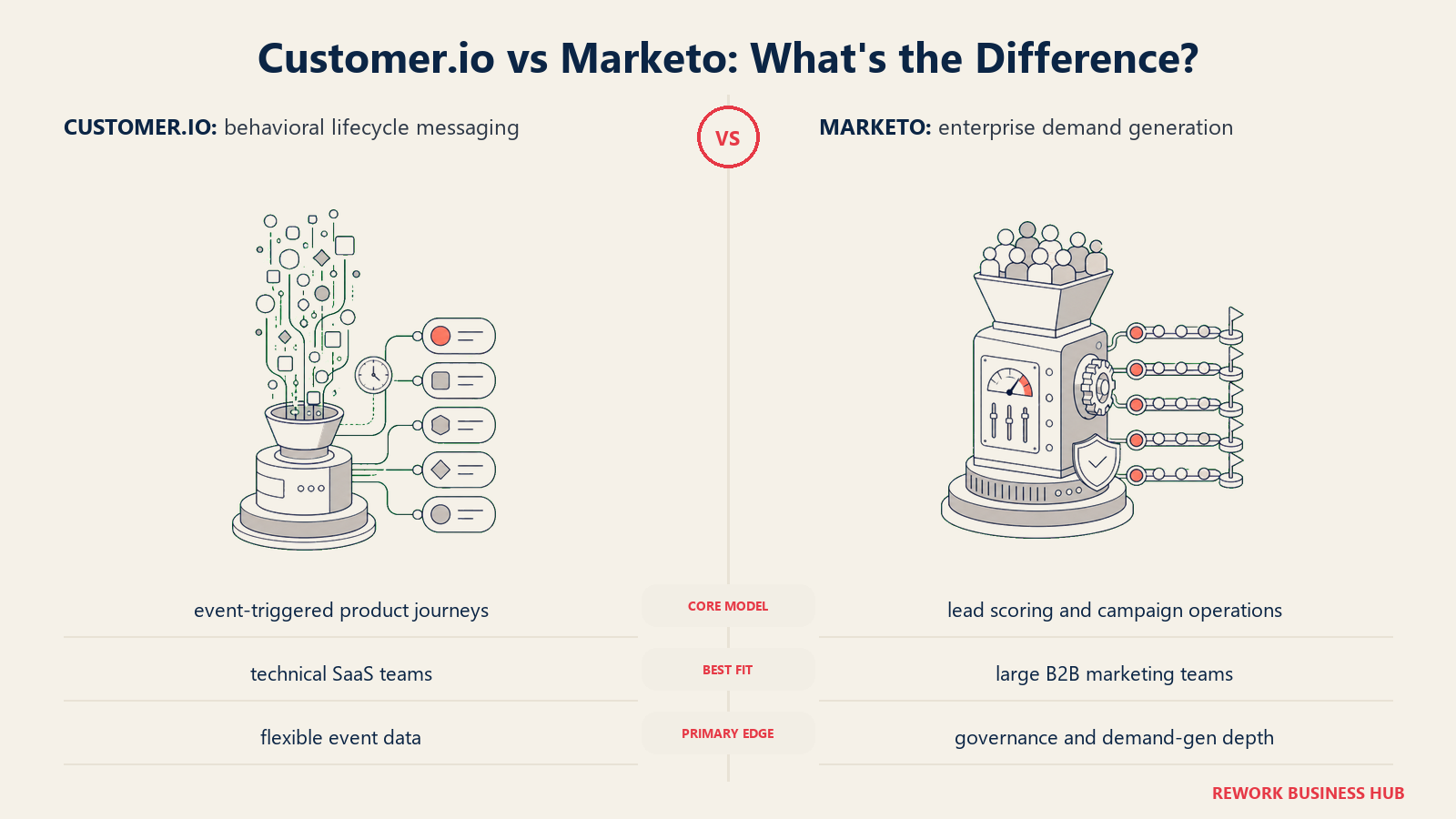
The key distinction from Marketo: Customer.io doesn't have a lead management layer or B2B demand-gen capabilities. There's no native lead scoring against firmographic data, no ABM support, and no form-to-rep routing. It's a messaging platform wired to product events, not a marketing automation platform wired to ad campaigns and contact databases. If your Marketo use case was primarily product-driven SaaS lifecycle messaging, Customer.io replaces it at a fraction of the cost. If your use case was demand-gen and lead nurture, it doesn't.
Methodology / Vision: Behavior over broadcast. Customer.io's philosophy is that the best message is the one triggered by what a user just did, not the one scheduled for Tuesday at 10am.
Target Audience: SaaS product teams, growth marketers at B2B SaaS companies (10 to 500 employees), and consumer app teams with technical marketers comfortable with event data.
Sizing Fit: Works from seed-stage startups with a technical founder to mid-market SaaS teams with dedicated lifecycle marketing. Requires engineering involvement for setup.
Stage Fit: Startup through mid-market for product-led teams. The value unlocks as soon as you have meaningful event data from your product.
Team vs. Company-Wide: Product marketing, lifecycle, and growth teams. Not a company-wide GTM platform.
| What you get | What you don't |
|---|---|
| Real-time behavioral triggers from product event data | B2B lead scoring or CRM-style pipeline management |
| Visual workflow builder for complex branching journeys | Native ABM or account-based targeting |
| Multi-channel: email, push, SMS, in-app, Slack | Self-serve simplicity (setup requires technical comfort) |
| Transparent per-profile pricing | Form-to-rep lead routing |
Pricing: Essentials from $100/mo (5,000 profiles, 1M emails/mo). Premium from $1,000/mo (10,000 profiles). Enterprise: custom. See Customer.io pricing.
Best for: SaaS and product-led companies running behavior-triggered lifecycle messaging based on product event data.
7. Klaviyo: Email and SMS Revenue Automation for E-Commerce
Klaviyo owns the e-commerce marketing automation category the way Marketo owns enterprise B2B. If your business sells through Shopify, WooCommerce, or BigCommerce, Klaviyo's native integrations pull purchase history, cart abandonment, product views, and order data directly into the segmentation and automation engine. Revenue attribution per flow (how much did this abandoned cart sequence generate last month?) is built in and accurate.
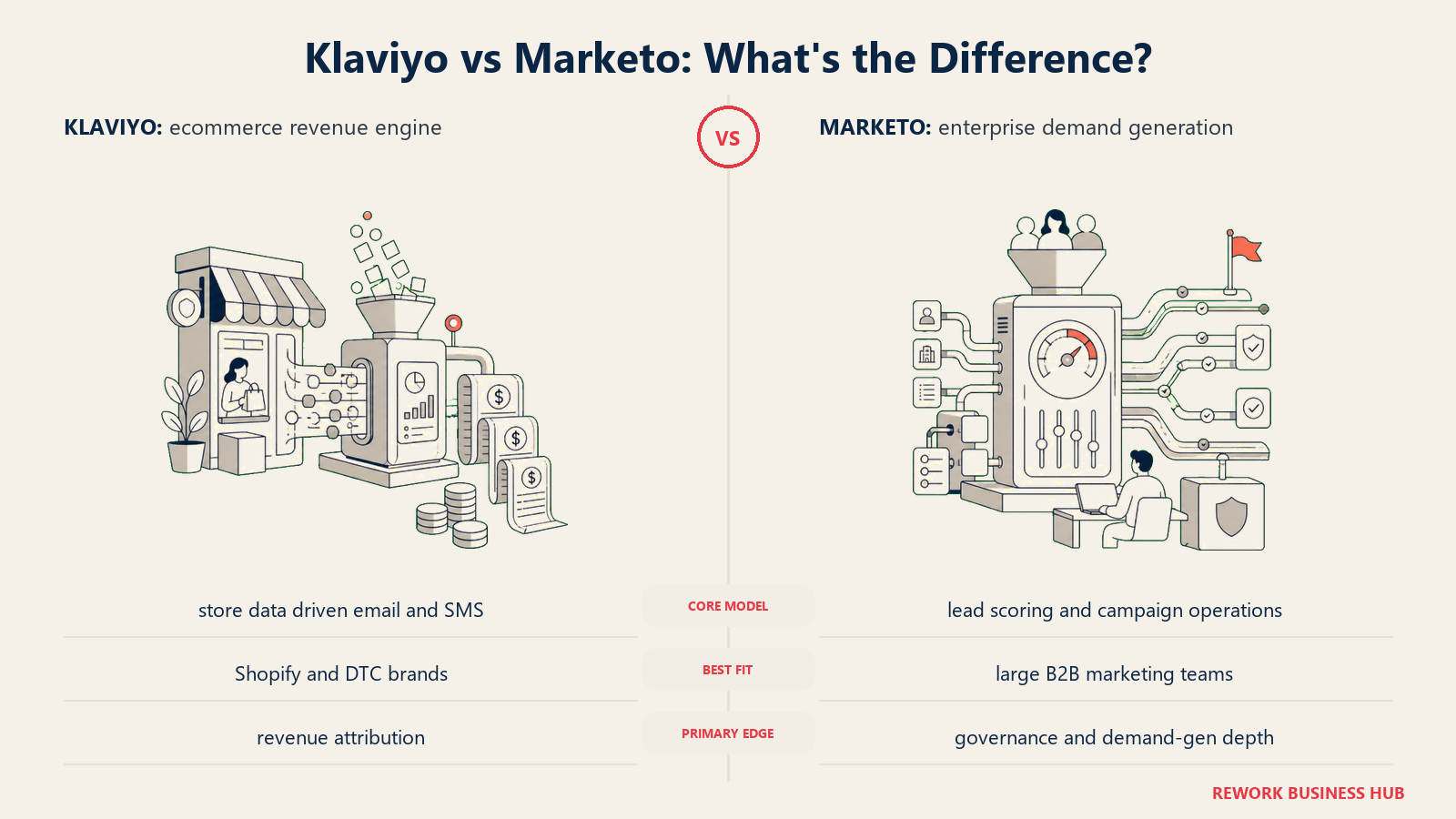
Klaviyo is only on this list because some B2C/DTC brands use Marketo as an overkill solution for what Klaviyo handles better and at a tenth of the cost. For B2B teams, Klaviyo isn't the right move. There's no B2B lead scoring, no Salesforce or HubSpot CRM integration depth, and no account-based functionality. The audience is brand marketers and e-commerce operators, not demand-gen directors at B2B SaaS companies. See best Klaviyo alternatives if you're evaluating the e-commerce MAP category more broadly.
Methodology / Vision: Revenue-first email and SMS for e-commerce. The product bet is that every email and SMS send should be tied to measurable revenue, not open rates.
Target Audience: E-commerce brands, DTC companies, and retail businesses on Shopify or WooCommerce. Ranges from small boutique brands to enterprise retailers.
Sizing Fit: Works at any e-commerce team size. Pricing scales with contact volume but remains accessible for smaller brands.
Stage Fit: Startup through enterprise, for e-commerce specifically. Strong once a brand has enough transaction data for segmentation to work well.
Team vs. Company-Wide: Marketing team tool for e-commerce operators. Not a cross-functional platform.
| What you get | What you don't |
|---|---|
| Native Shopify/WooCommerce integration with revenue attribution | B2B lead scoring or CRM integration depth |
| Excellent abandoned cart, win-back, and post-purchase flows | Webinar hosting or event management |
| Email + SMS in one platform with shared audience data | B2B account-based marketing features |
| Strong segmentation on purchase behavior and lifetime value | Affordable pricing at high contact volumes |
Pricing: Free up to 250 active profiles. Email plan from $20/mo (500 contacts). Email + SMS from $35/mo. Scales by contact volume. See Klaviyo pricing.
Best for: E-commerce and DTC brands running email and SMS revenue campaigns with Shopify or WooCommerce at the center.
8. Brevo: Multi-Channel Email at the Lowest Entry Cost
Brevo (formerly Sendinblue) competes on price. The per-send pricing model (not per-contact) means a team with 100,000 contacts who sends campaigns to 20,000 of them monthly pays for sends, not for the full database. That's a structurally cheaper model than almost every other tool on this list, and it's why Brevo is the first stop for budget-constrained teams who are tired of Marketo's six-figure contracts.
The honest limitation: Brevo's automation builder is functional but not sophisticated. Complex multi-branch behavioral sequences, advanced scoring models, and dynamic content personalization at Marketo's level aren't here. Deliverability has been average on recent independent tests. And the CRM is lightweight. For teams running simple send-and-track campaigns to large lists with SMS as a supplementary channel, Brevo is a solid value. For teams that need the automation depth of Marketo, it's a step back. Check the best Brevo alternatives guide if Brevo itself looks like it might be too limited.
Methodology / Vision: Affordable multi-channel marketing for growing businesses. Brevo's bet is that email, SMS, chat, and CRM should be accessible to teams who can't afford Marketo's contract minimums.
Target Audience: SMBs and lower mid-market teams from 1 to 200 employees. Particularly useful for teams with large contact databases and moderate send frequency.
Sizing Fit: Startup through early mid-market. The value is sharpest for teams where per-contact pricing at other tools creates a prohibitive cost as the database grows.
Stage Fit: Startup through growth. Works as a long-term solution for teams with relatively simple automation needs.
Team vs. Company-Wide: Marketing-focused. The built-in CRM can support a small sales team but isn't competitive with HubSpot or Rework for routing and distribution.
| What you get | What you don't |
|---|---|
| Per-send pricing (not per-contact) for budget efficiency | Automation depth comparable to ActiveCampaign or Marketo |
| Email, SMS, WhatsApp, push, and live chat in one tool | Advanced lead scoring or ABM |
| Free tier with 300 emails/day for testing | Deliverability rates matching dedicated platforms |
| CRM included in paid plans | Deep analytics and attribution |
Pricing: Free (300 emails/day). Starter from $9/mo (5,000 sends). Standard from $18/mo. Professional from $499/mo. See Brevo pricing.
Best for: Budget-conscious teams with large contact databases who need multi-channel campaigns without per-contact cost surprises.
9. Mailchimp: Simplest Onboarding for Teams New to Email Marketing
Mailchimp is the most recognized name in email marketing and often the first tool teams use before graduating to something more sophisticated. It's on this list not because it competes with Marketo technically, but because some teams that over-bought Marketo are really running a much simpler email program and Mailchimp is enough.
The honest assessment: Mailchimp's automation has improved with the Standard tier's multi-step journeys, but it's still significantly simpler than Marketo, ActiveCampaign, or HubSpot. Lead scoring, advanced segmentation, and CRM-driven campaign triggers require workarounds or integrations. Pricing jumped in January 2026 when the free plan dropped to 250 contacts and 500 sends, and legacy plan prices rose 11 to 13% in April 2026. See best Mailchimp alternatives if you need more automation depth than Mailchimp provides.
Methodology / Vision: Simple email marketing for everyone. Mailchimp's original and durable thesis is that small businesses should be able to do professional email without a marketing degree.
Target Audience: Small businesses, solo marketers, and early-stage teams from 1 to 100 employees. Best for straightforward newsletter and campaign workflows.
Sizing Fit: Strongest from solo to early growth. Shows its limits as automation complexity, list size, and multi-team access requirements increase.
Stage Fit: Early startup. Strong as a first email tool. Teams typically outgrow it by the time they need behavioral triggers or CRM-connected scoring.
Team vs. Company-Wide: Marketing team tool. No meaningful CRM or sales pipeline layer.
| What you get | What you don't |
|---|---|
| Fastest onboarding on this list; near-zero learning curve | Multi-branch behavioral automation depth |
| 300+ integrations including Shopify, Salesforce, and WooCommerce | Native lead scoring |
| Clean template builder and campaign previews | Predictable pricing as your list grows |
| Multi-step journeys on Standard and Premium plans | B2B CRM or pipeline depth |
Pricing: Free (250 contacts, 500 sends/mo). Essentials from $13/mo (500 contacts). Standard from $20/mo. Premium from $350/mo. See Mailchimp pricing.
Best for: Small teams and solo marketers who need simple email campaigns and newsletters without the overhead of a full MAP.
10. GetResponse: Email, Webinars, and Landing Pages in One Tool
GetResponse sits between Mailchimp and ActiveCampaign on the complexity curve. The automation builder is functional for multi-step sequences, the landing page builder is polished, and the native webinar hosting (10 attendees on Marketer tier, up to 1,000 on higher plans) is a genuine differentiator for teams that run webinars as a demand-gen channel. If your marketing motion includes live events, the bundled webinar hosting removes one tool from the stack.
The limitation is depth. GetResponse's automation logic doesn't match ActiveCampaign's branching sophistication, and its CRM is lightweight. For teams running complex lead scoring, behavioral segmentation, or account-based programs, it's not the right tier. But for marketing teams at 10 to 200 employees who use webinars, email, and landing pages as their primary demand-gen channels, it covers the bases at a reasonable price.
Methodology / Vision: Accessible full-funnel marketing with webinars as a first-class channel. GetResponse bets that many marketing teams want email, landing pages, and live event hosting without patching three separate tools together.
Target Audience: SMB and mid-market marketing teams from 5 to 500 employees, particularly those using webinars or online courses as a marketing or lead-gen channel.
Sizing Fit: Startup through mid-market. Works well for growing teams with defined channels. Shows automation limits at scale.
Stage Fit: Growth through mature for its target audience. Best once a team has repeatable webinar and email programs running.
Team vs. Company-Wide: Marketing team tool. The CRM is too lightweight for sales team use at any real scale.
| What you get | What you don't |
|---|---|
| Native webinar hosting (standout feature in this price range) | Automation depth matching ActiveCampaign or Marketo |
| Email automation with visual journey builder | Strong native CRM or sales pipeline |
| Landing page builder with conversion tracking | Deep lead scoring |
| Free tier for basic email (500 emails/month) | Scalable multi-user permissions and team workflows |
Pricing: Free (2,500 emails/mo). Starter from $19/mo (1,000 contacts). Marketer from $59/mo (automation + webinars). Creator from $69/mo. See GetResponse pricing.
Best for: Marketing teams that use webinars or live events as a primary demand-gen channel and want email automation bundled in one product.
11. Oracle Eloqua: The Enterprise Alternative When Marketo Isn't Enough
Oracle Eloqua competes with Marketo directly at the top end of the enterprise MAP market. It's on this list for a specific reason: some enterprise teams leaving Marketo are leaving because Marketo isn't sophisticated enough for their program complexity, not because it's too complex. If your marketing operations team runs multi-wave, multi-segment global campaigns with complex lead routing rules, custom revenue attribution models, and governance requirements that include single-tenant infrastructure options, Eloqua is worth evaluating alongside Marketo.
Eloqua's campaign canvas is widely considered the most powerful in the market. Its lead scoring engine supports dynamic, multi-attribute scoring models with custom score decay. Its integration ecosystem with Oracle CX, Salesforce, and Microsoft Dynamics is enterprise-grade. But the trade-offs are real: Eloqua's UI is dated even by enterprise standards, implementation takes months, and the product requires a dedicated Eloqua admin to function properly. Pricing starts around $2,000/month for Basic and scales past $8,000/month for Enterprise. This is an enterprise decision, not a marketing team decision.
Methodology / Vision: Enterprise-grade marketing automation with governance and data management at the center. Oracle's bet is that large enterprises need a MAP that can handle global data residency, complex approval workflows, and multi-CRM integration depth.
Target Audience: Fortune 1000 and large enterprise companies with 500+ employees, dedicated marketing ops teams, and complex global campaign requirements.
Sizing Fit: Enterprise only. The complexity, cost, and implementation overhead make it inaccessible and inappropriate for teams under 500 employees.
Stage Fit: Mature through enterprise. Requires an existing, well-defined demand-gen playbook and the headcount to support it.
Team vs. Company-Wide: Marketing ops and demand gen. Requires Salesforce or Oracle CX as the CRM backbone.
| What you get | What you don't |
|---|---|
| Most sophisticated campaign canvas and lead scoring in the market | Accessible pricing or fast implementation |
| Enterprise data governance, single-tenant options | A modern UX (dated interface) |
| Deep integration with Oracle CX, Salesforce, and MS Dynamics | Self-sufficiency without a dedicated Eloqua admin |
| Multi-touch attribution across complex global programs | Flexibility for mid-market teams |
Pricing: Basic from ~$2,000/mo; Standard from ~$4,000/mo; Enterprise from ~$8,000/mo (custom). Contact Oracle directly for quotes. See Oracle Eloqua on G2.
Best for: Large enterprise marketing ops teams running complex global demand-gen programs that have outgrown Marketo or need Oracle ecosystem integration.
12. Conversion: Agentic Marketing Automation Built to Replace Marketo
Conversion is the only tool on this list built explicitly as a Marketo replacement rather than an adjacent product that happens to compete for the same budget. The architecture starts one layer below the campaign: Salesforce records, warehouse tables from Snowflake, BigQuery, Databricks or Redshift, and product events resolve into a single context layer, and the marketing automation runs on top of that rather than on a flat contact database.
What sits above it is an agent layer. Agents take a request from Slack or a ticket and build the campaign, QA a campaign before it sends, pull reporting on a schedule, and work through a migration from a legacy MAP step by step. The governance model is approval-first, so every agent output waits for a human and stays reviewable, which is the part that decides whether a marketing ops team can actually defend using it.
The core MAP underneath is complete rather than minimal: campaigns, journeys, segmentation, an email studio with live CRM fields, landing pages, forms, lead scoring and routing, and bidirectional Salesforce sync with audit logs on every record. Mosaic adds attribution and reporting natively instead of bolting on a separate tool. SOC 2 Type II, GDPR, SSO and role-based access come standard.
The prerequisites are steep, and they are the real filter. Conversion assumes Salesforce plus a modern warehouse, and a marketing ops function mature enough to define what approval-first governance means in practice. A team without the warehouse, or without someone owning campaign standards, ends up with an agent layer and nothing solid underneath it. Teams at the other end of that range should look at our GoHighLevel alternatives comparison instead.
Methodology / Vision: Unify CRM, warehouse, and product data into one context layer, then let governed agents do the repetitive build-QA-send-report work on top of it. The bet is that legacy MAPs fail on data model rather than features.
Target Audience: Enterprise and upper-mid-market B2B companies on Salesforce with a modern data warehouse, migrating off Marketo, Pardot, HubSpot, or Iterable. Named customers include ClickHouse, Plaid, Productboard, and ACV Auctions off Marketo, Veriforce and AMCS off Pardot, BuildOps off HubSpot, and Webflow off Iterable.
Sizing Fit: 500 employees and up in practice. The warehouse requirement and the MOps headcount needed to govern agents put it out of reach below that.
Stage Fit: Mature through enterprise. Requires an existing demand-gen playbook, not a team building one.
Team vs. Company-Wide: Marketing ops led, with Salesforce as the CRM backbone and a data team owning the warehouse.
| What you get | What you don't |
|---|---|
| CRM, warehouse, and product-event data in one context layer | A fit without an existing modern data warehouse |
| Agents that build, QA, send, and report, human-approved | Published pricing; every deal starts with a demo |
| Native attribution through Mosaic, not a bolted-on tool | Value without a dedicated marketing ops function |
| Bidirectional Salesforce sync with full audit logs | A sensible option for mid-market email needs |
Pricing: Not published. There is no pricing page and no self-serve tier; every deal is quoted after a demo, which puts it in the same bracket as the enterprise platforms it replaces rather than the self-serve tools lower on this list. See Conversion for current details.
Best for: Enterprise B2B marketing ops teams on Salesforce and a modern warehouse that are migrating off Marketo and want the agent layer to do the campaign labour.
How to Choose: Decision Framework
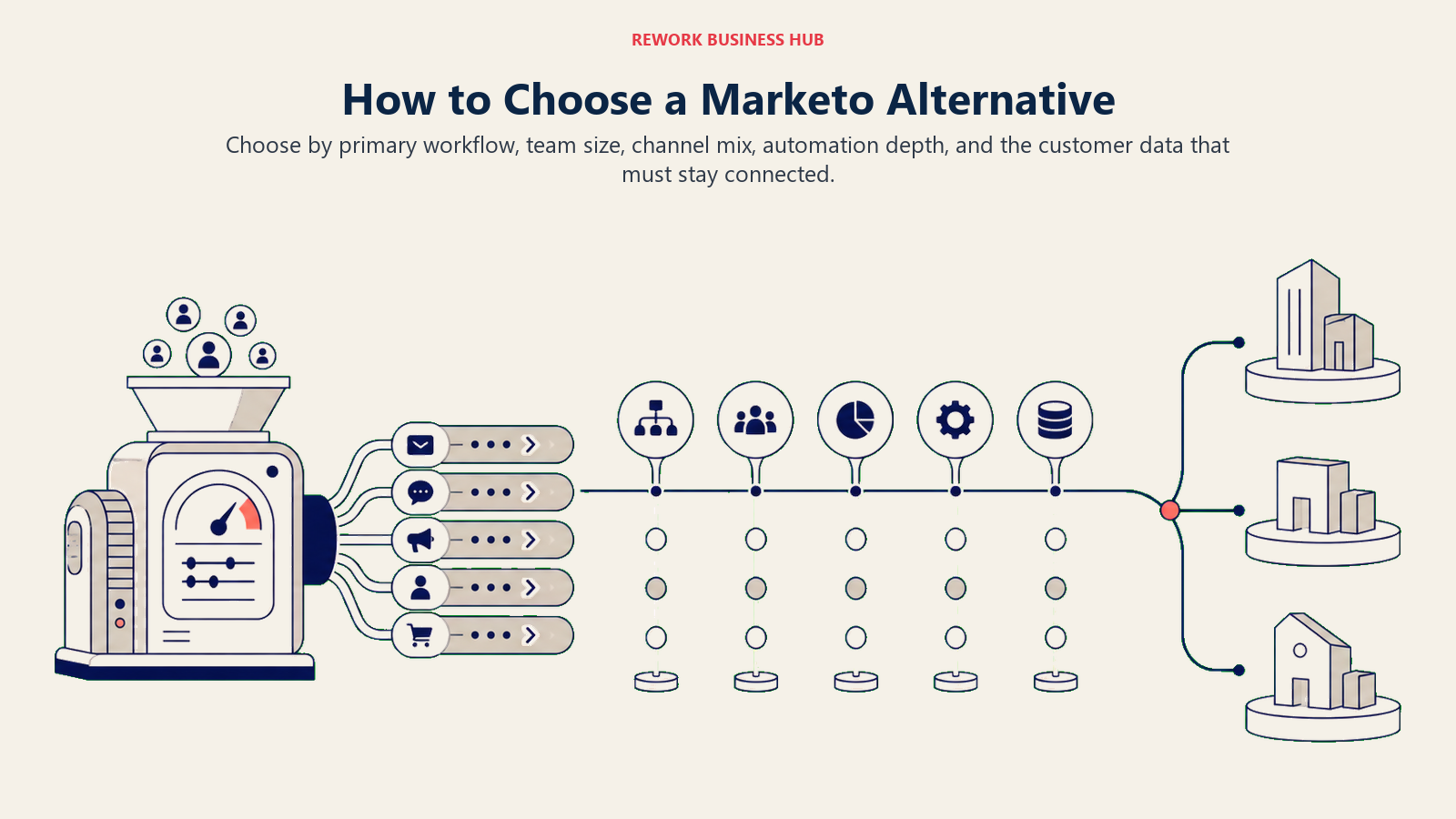
Use these criteria to narrow the field by workflow, team size, channel mix, automation depth, and connected customer data.
| If your team needs... | Best pick |
|---|---|
| Full inbound marketing suite: landing pages, forms, email, CRM, attribution | HubSpot Marketing Hub |
| Best visual automation builder without enterprise pricing | ActiveCampaign |
| Native Salesforce CRM integration with B2B nurture and ABM | Salesforce Account Engagement (Pardot) |
| Lead capture, scoring, routing, and clean sales handoff at mid-market cost | Rework |
| Omnichannel lifecycle messaging for consumer/mobile-first products | Braze |
| Behavior-triggered messaging driven by product event data | Customer.io |
| Email and SMS revenue automation for e-commerce with Shopify | Klaviyo |
| Multi-channel campaigns with per-send pricing (not per-contact) | Brevo |
| Simplest email campaigns without automation complexity | Mailchimp |
| Email + webinar hosting + landing pages in one tool | GetResponse |
| Enterprise MAP competing directly with Marketo at the top end | Oracle Eloqua |
| Full B2B demand-gen + marketing automation without Marketo's contract size | HubSpot Marketing Hub Pro or ActiveCampaign |
Frequently Asked Questions
What is the best Marketo alternative for mid-market B2B teams?
For most mid-market B2B teams (20 to 500 employees) that are leaving Marketo because of cost and complexity, the strongest alternative is HubSpot Marketing Hub. It covers the full inbound suite (landing pages, forms, email, nurture, CRM) with a gentler learning curve than Marketo. ActiveCampaign is the pick when deep email automation matters more than an all-in-one suite, and Pardot is the pick if you already run Salesforce. If the real problem was never marketing automation but lead operations (capturing leads from ads and forms, scoring them, routing them to the right rep, and getting a clean handoff to sales), Rework's Marketing Engine covers that from $99/month billed yearly, though it does not replace Marketo's email and campaign features.
How much does Marketo cost?
Adobe Marketo Engage uses database-size pricing with no public price card. Contracts are custom-quoted. Most mid-market deployments start between $1,500 and $3,000 per month, and average annual contract values for Marketo across all segments run around $112,000 per year according to third-party procurement data. Enterprise deployments frequently exceed $5,000/month once database size, additional modules, and support packages are included.
What is the difference between Marketo and HubSpot?
Both are marketing automation platforms, but they're built for different team sizes and philosophies. Marketo is enterprise-grade, built for large demand-gen teams running complex multi-stage nurture, ABM, and attribution programs with dedicated marketing ops staff. HubSpot is built for inbound-led growth companies that want marketing, CRM, and sales in one connected product with a faster onboarding curve. HubSpot's interface is significantly more accessible. Marketo's depth is greater for complex enterprise programs, but that depth requires a trained admin to unlock.
Is ActiveCampaign a good Marketo replacement?
ActiveCampaign is a good replacement if your primary Marketo use case was email automation, behavioral segmentation, and nurture sequences. Its visual automation builder is genuinely strong for the price. But if your Marketo use case included native Salesforce CRM integration, account-based marketing, or multi-touch attribution reporting, ActiveCampaign won't fully replace those capabilities. It's a strong mid-market email and automation tool, not an enterprise MAP.
What is the cheapest Marketo alternative with decent automation?
Brevo starts at $9/month for 5,000 email sends (per-send pricing, not per-contact) and includes multi-step automation on the Standard plan. GetResponse starts at $19/month for 1,000 contacts with an automation builder and native webinar hosting. ActiveCampaign starts at $15/month for 1,000 contacts with the most sophisticated automation logic in this price range. For B2B teams where the primary need is lead routing and follow-up rather than email automation, Rework's Marketing Engine at $99/month billed yearly covers capture, scoring, and routing, but not campaign email.
Can Pardot replace Marketo?
Yes, for Salesforce shops, Pardot (Salesforce Marketing Cloud Account Engagement) is the most logical Marketo replacement. It's native to the Salesforce data model, so CRM integration is friction-free by design. The B2B marketing automation capabilities (scoring, nurture, dynamic content, ABM) are comparable to Marketo. The trade-off is that Pardot is Salesforce-dependent. If your team doesn't already run Salesforce CRM, Pardot requires that investment too. And Pardot pricing starts at $1,250/org/month, which is comparable to or higher than Marketo at similar database sizes.
Who should not switch away from Marketo?
Teams that should stay on Marketo: enterprise demand-gen organizations running multi-wave global campaigns, complex multi-stage nurture across dozens of segments, ABM programs targeting named accounts with custom scoring models, and deep Adobe Analytics or Adobe Experience Manager integration. Marketo's sophistication is genuinely best-in-class for these use cases. The teams that should switch are those who bought Marketo for its reputation and are only using a fraction of its capabilities, or teams where the implementation overhead and per-month cost no longer match the return.
What to Do Next
Start by naming exactly why you're leaving Marketo. Cost alone points you toward ActiveCampaign or Brevo, or toward Rework if what you actually used Marketo for was lead routing. Automation depth without enterprise pricing points to HubSpot Marketing Hub Pro or ActiveCampaign. Salesforce CRM dependency points directly to Pardot. Consumer or mobile lifecycle messaging points to Braze or Customer.io. E-commerce points to Klaviyo.
Once you've identified your category, run a two-week pilot with 3 to 5 people from the actual team that will use it daily. Don't evaluate in a sandbox. Load real contact data, build one real campaign, and see which tool your team opens first on Monday morning.
If you need the full inbound suite with landing pages, content, and attribution, start with HubSpot Marketing Hub Professional's 14-day trial. If you over-bought enterprise nurture and mostly need lead capture, scoring, routing, and a clean sales handoff, a pilot of Rework's Marketing Engine (14-day free trial) tests that narrower need.
Most tools on this list have free tiers or free trials. There's no reason to make this decision based on a vendor demo alone.
For additional context on the broader marketing automation category, check out the best ActiveCampaign alternatives, best Mailchimp alternatives, and best Brevo alternatives guides for side-by-side comparisons within specific price tiers. If HubSpot is on your short list, the best HubSpot alternatives article covers the CRM side of that evaluation.

Principal Product Marketing Strategist
On this page
- Quick Comparison Table
- Stage Fit Matrix
- Sizing and Persona Table
- 1. HubSpot Marketing Hub: Full Inbound Suite with Native CRM
- 2. ActiveCampaign: Best Visual Automation Builder in the Mid-Market
- 3. Salesforce Marketing Cloud Account Engagement (Pardot): Marketo's Closest Enterprise Rival
- 4. Rework: Lead Capture, Routing, and Sales Handoff, Not a Full MAP
- 5. Braze: Omnichannel Lifecycle Messaging for Consumer and Mobile-First Teams
- 6. Customer.io: Behavior-Triggered Messaging for SaaS and Product-Led Teams
- 7. Klaviyo: Email and SMS Revenue Automation for E-Commerce
- 8. Brevo: Multi-Channel Email at the Lowest Entry Cost
- 9. Mailchimp: Simplest Onboarding for Teams New to Email Marketing
- 10. GetResponse: Email, Webinars, and Landing Pages in One Tool
- 11. Oracle Eloqua: The Enterprise Alternative When Marketo Isn't Enough
- 12. Conversion: Agentic Marketing Automation Built to Replace Marketo
- How to Choose: Decision Framework
- Frequently Asked Questions
- What is the best Marketo alternative for mid-market B2B teams?
- How much does Marketo cost?
- What is the difference between Marketo and HubSpot?
- Is ActiveCampaign a good Marketo replacement?
- What is the cheapest Marketo alternative with decent automation?
- Can Pardot replace Marketo?
- Who should not switch away from Marketo?
- What to Do Next