Best Eventbrite Alternatives in 2026: 13 Tools for Ticketing, Branding, and Full Event Management
Turn this article into takeaways for your work.


Each assistant summarizes the article only for you and suggests best practices for your work.
Eventbrite's biggest advantage isn't a feature, it's traffic: a built-in audience of people already browsing for something to do this weekend, which none of the 13 tools below can hand you out of the box. For a public, paid event trying to reach strangers, that discovery audience is worth real money. It's also the reason most people searching this term aren't actually looking for the same thing.
This guide covers two different readers. If you just want lower fees or your own branding on checkout, look at Eventzilla, Zoho Backstage, and RingCentral Events first. If you've realized ticketing was never the real problem, that you need registration workflows, agendas, sponsors, and badge printing for internal or B2B programs, look at Cvent, Swoogo, Whova, Accelevents, EventMobi, and Rework instead. For the wider category, see the Best Event Management Software in 2026 roundup.
Figures marked "reported" come from third-party pricing analyses and buyer benchmark data, since most enterprise event platforms, including several on this list, don't publish rates.*
Key Facts
Event Ticketing and Event Management Software in 2026
- The global event management software market is valued at $18.6 billion in 2026 and is projected to reach $36.8 billion by 2031, a 14.6% compound annual growth rate. (MarketsandMarkets, via PR Newswire)
- Eventbrite's paid ticketing costs organizers 3.7% + $1.79 per ticket plus 2.9% payment processing per order; free events publish at no cost. (Eventbrite)
- 67% of B2B event teams have now integrated their primary event platform with their broader sales and marketing stack, up 44% year over year, and teams with deep integration report 62% satisfaction versus 37% without it. (Forrester, Q1 2026 State of B2B Events Survey)
- More than half of B2B event teams name net-new lead generation as their top event objective for 2026. (Forrester, Q1 2026 State of B2B Events Survey)
- 78% of event organizers say in-person conferences, summits, and conventions are their organization's most impactful marketing channel, per Bizzabo's own 2026 State of Events Benchmark Report. (Bizzabo)
Quick Comparison Table
| Tool | Best For | Starting Price | Key Strength | Key Limitation |
|---|---|---|---|---|
| Cvent | Enterprise programs needing venue sourcing plus registration | Quote only | Venue sourcing via the Cvent Supplier Network, not just registration | No pricing published; long implementations |
| Bizzabo | Enterprise teams wanting an event experience OS with onsite hardware | $499/user/mo, 3-user min ($17,999/yr floor) | Klik SmartBadge hardware plus unified registration, app, reporting | Per-user pricing with a 3-seat floor; add-ons cost extra |
| Swoogo | Unlimited registrations without a per-ticket fee | $11,800/yr (1 Full User + 1 Reporting User) | Unlimited events and registrations on one license | "Unlimited" is per user; a five-person team needs multiple licenses |
| Stova | End-to-end enterprise programs, heir to Aventri and MeetingPlay | Quote only | Broad feature set spanning registration, hybrid, mobile apps | No published pricing; demo-request-only |
| Whova | Conferences and associations wanting a highly rated attendee app | Quote only, per event | Strong attendee networking and agenda tools; high G2 scores | No self-serve pricing; every deal starts with a demo |
| Rework | Company events feeding a CRM pipeline, not public ticket sales | Quote on request (rework.com/pricing) | Registrations land on the same contact timeline as CRM and ops data | No ticket marketplace, discovery audience, or virtual event platform |
| Webex Events (formerly Socio) | Teams standardized on Cisco Webex for hybrid programs | Quote only | Hybrid delivery tied to a Webex stack IT teams already run | No published pricing; sold through Cisco's sales motion |
| RingCentral Events (formerly Hopin) | Virtual/hybrid events billed per organizer, not per attendee | $99/organizer/mo (Events Pro) | Unlimited events and registrations on the published tier | Only the entry tier is published |
| Accelevents | Mid-market teams wanting a published entry price | $7,500 for one event | Rare published price plus fundraising and auction tools | $7,500 buys one event; unlimited needs Business at $13,500 |
| EventMobi | Associations and non-profits choosing per-event or per-year pricing | $3,000/event or $8,900/yr | No per-registration fees on free or paid tickets | Add-ons stack up fast for onsite programs |
| Eventzilla | Lowest per-registration fee for budget-conscious organizers | $1.50/registration or $1,999/yr flat | Cheapest published per-registration fee, plus a fee-free annual plan | Higher tiers add processing percentages on top |
| Zoho Backstage | Teams already on Zoho wanting a usable free tier | Free (100 attendees); Essentials US$99/mo annually or US$299/event | Usable free tier plus 0% ticketing commission on paid plans | Attendee and speaker caps stay tight even on top tier |
| Virtual PRO (formerly Hubilo) | Enterprise virtual and hybrid programs, post-Brandlive relaunch | $15,000/yr (PRO 1) | Enterprise virtual/hybrid delivery carried over from Hubilo | Higher capacity needs the quote-only PRO MAX tier |
What a Ticket Actually Costs: Fee Math by Pricing Model
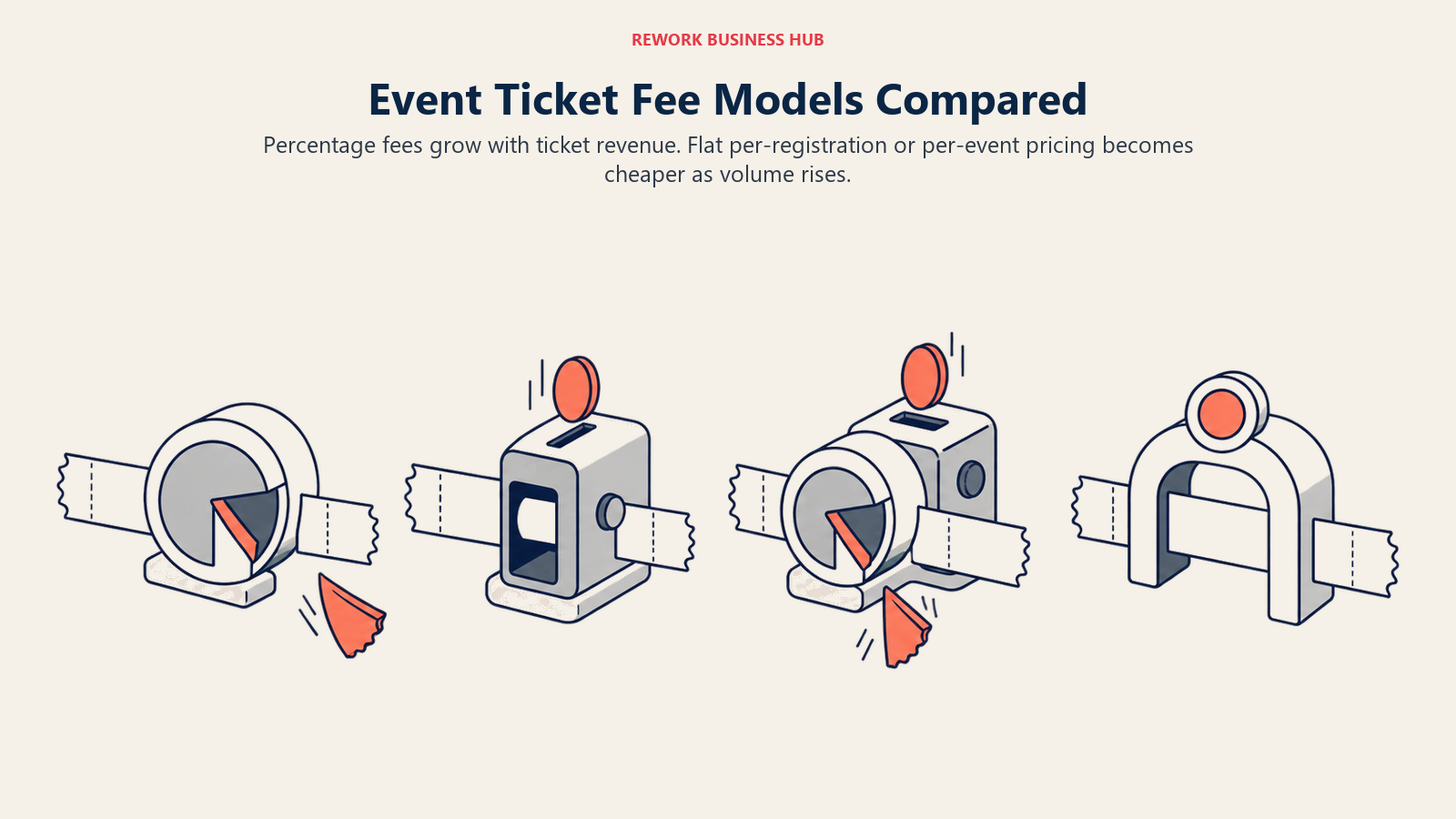
The fee stack is the single biggest reason this search happens. Here's what a $20, a $50, and a $150 ticket actually cost once fees are added, under four pricing models from the table above. Figures assume one ticket per order, since Eventbrite's payment processing fee is charged per order rather than per ticket.
| Pricing model | $20 ticket | $50 ticket | $150 ticket |
|---|---|---|---|
| Eventbrite (3.7% + $1.79 + 2.9% processing) | $3.11 fee: attendee pays $23.11 passed through, organizer keeps $16.89 absorbed | $5.09 fee: attendee pays $55.09 passed through, organizer keeps $44.91 absorbed | $11.69 fee: attendee pays $161.69 passed through, organizer keeps $138.31 absorbed |
| Eventzilla Basic ($1.50 flat per registration) | $1.50 fee: attendee pays $21.50, organizer keeps $18.50 | $1.50 fee: attendee pays $51.50, organizer keeps $48.50 | $1.50 fee: attendee pays $151.50, organizer keeps $148.50 |
| Eventzilla Pro (1.9% + $1.50) | $1.88 fee: attendee pays $21.88, organizer keeps $18.12 | $2.45 fee: attendee pays $52.45, organizer keeps $47.55 | $4.35 fee: attendee pays $154.35, organizer keeps $145.65 |
| Zoho Backstage Essentials (0% ticketing commission, flat US$299/event) | $0 per-ticket fee; cost is fixed regardless of ticket price | $0 per-ticket fee | $0 per-ticket fee |
For a like-for-like look at the flat-fee model, Eventbrite vs Ticket Tailor walks the same fee math through in detail. The gap widens with volume, not ticket price. Sell 200 tickets at $50 each and Eventbrite's fee stack totals roughly $1,018, versus $300 on Eventzilla Basic's flat fee, versus a flat US$299 for the whole event on Zoho Backstage Essentials regardless of how many of those 200 sell. That's the arithmetic behind most "why is Eventbrite so much more" complaints: a percentage fee scales with revenue, not with the actual cost of processing a registration.
Stage Fit Matrix
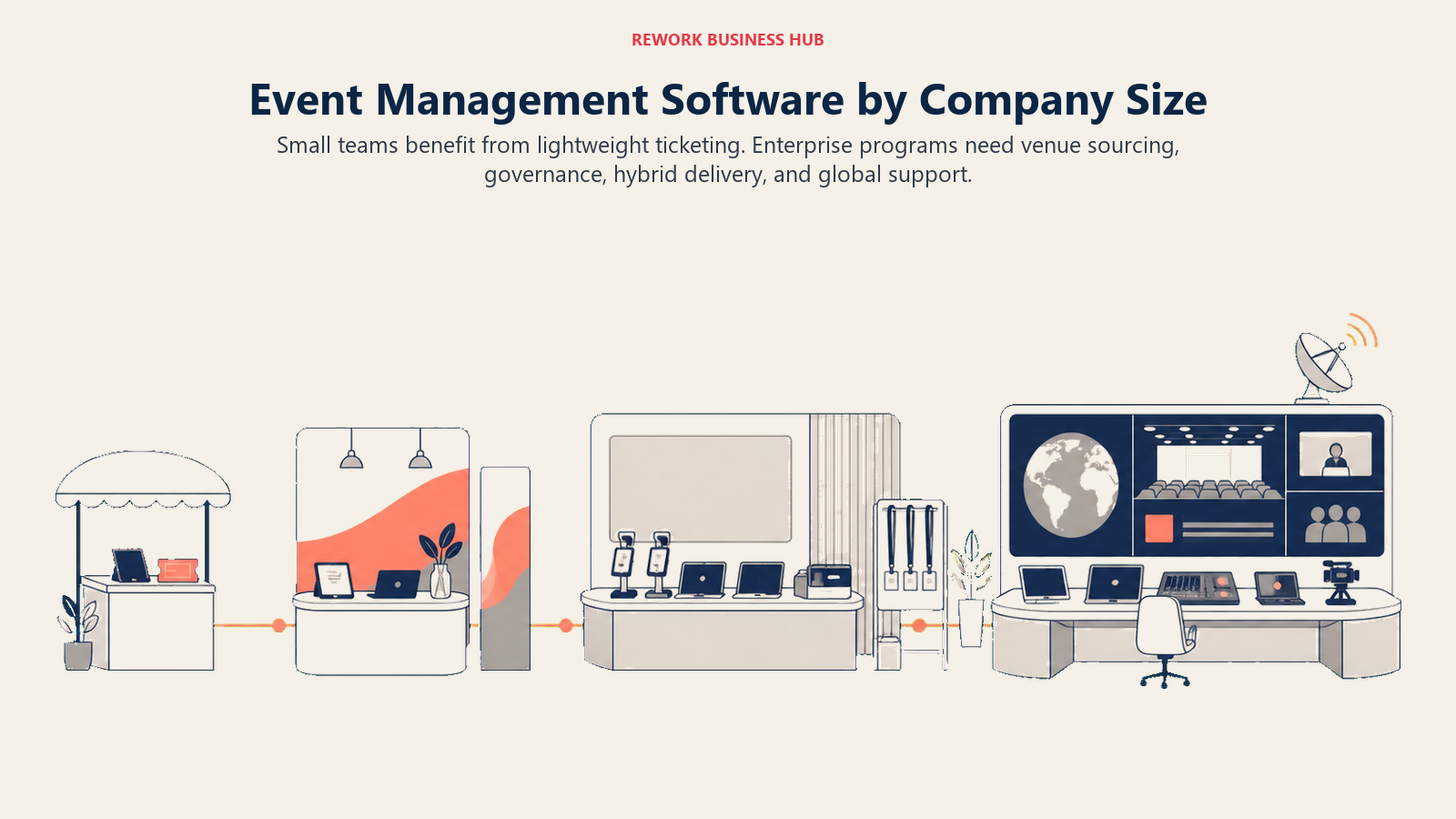
Event software fit changes with organizational scale. Lightweight ticketing platforms suit smaller teams, while enterprise programs justify deeper venue, hybrid, governance, and global capabilities.
| Tool | Startup/SMB (1-50) | Growth (50-500) | Enterprise (500-5,000) | Global Enterprise (5,000+) |
|---|---|---|---|---|
| Cvent | Not ideal | Limited | Best fit | Best fit |
| Bizzabo | Limited | Good | Best fit | Good |
| Swoogo | Good | Best fit | Good | Limited |
| Stova | Not ideal | Limited | Best fit | Best fit |
| Whova | Best fit | Best fit | Good | Limited |
| Rework | Good | Best fit | Limited | Not ideal |
| Webex Events | Limited | Good | Best fit | Good |
| RingCentral Events | Good | Best fit | Good | Limited |
| Accelevents | Best fit | Good | Limited | Not ideal |
| EventMobi | Best fit | Good | Good | Limited |
| Eventzilla | Best fit | Good | Limited | Not ideal |
| Zoho Backstage | Best fit | Good | Limited | Not ideal |
| Virtual PRO | Limited | Good | Best fit | Good |
Sizing and Persona Table
| Tool | Team Size Sweet Spot | Primary Buyer | Use Case Fit |
|---|---|---|---|
| Cvent | 500-10,000+ | VP Events, Head of Marketing | Enterprise programs needing venue sourcing plus registration |
| Bizzabo | 200-5,000 | CMO, VP Events | Branded flagship conferences with onsite hardware needs |
| Swoogo | 20-500 | Events Manager, Marketing Ops | Registration and event-website builds without per-registration fees |
| Stova | 500-10,000+ | VP Events, Meeting Planner | Enterprise meetings and incentive travel programs |
| Whova | 20-2,000 | Conference Organizer, Association Director | Conferences and associations wanting a highly rated attendee app |
| Rework | 10-200 | COO, RevOps, Marketing Ops | Company events feeding the same CRM pipeline as sales |
| Webex Events | 100-5,000 | IT-aligned Events Manager | Hybrid programs inside an existing Cisco Webex stack |
| RingCentral Events | 20-500 | Events Manager, Demand Gen | Virtual and hybrid events billed per organizer, not attendee |
| Accelevents | 20-500 | Events Manager, Nonprofit Director | Mid-market hybrid events, fundraising, and auctions |
| EventMobi | 10-500 | Association Director, Event Planner | Per-event or per-year associations and non-profits |
| Eventzilla | 5-200 | Small Business Owner, Community Organizer | Budget registration and ticketing on a fixed cost |
| Zoho Backstage | 5-200 | Ops Manager already on Zoho | SMB events wanting a free tier and 0% ticketing commission |
| Virtual PRO | 200-5,000 | Events Manager, Marketing Ops | Enterprise virtual and hybrid programs |
1. Cvent: The Enterprise Standard With Real Venue Sourcing
Cvent does something almost nothing else on this list does: source and book the physical venue, not just manage registration once one's chosen. The Cvent Supplier Network connects planners to a huge venue database, and the platform bundles registration, budgeting, onsite check-in, and badge printing into one enterprise program.
| What you get | What you don't |
|---|---|
| Venue sourcing via the Cvent Supplier Network, not just registration | Published pricing anywhere on the site |
| Full-lifecycle management: budgeting, registration, onsite, reporting | A fast, self-serve setup for a first event |
| A G2 Score of 89, rated 4.3/5 across 2,144 reviews | A lightweight footprint for a single small event |
| Deep badge printing and onsite check-in tooling | Simplicity; assumes a dedicated events function |
Pricing: No public pricing; the site names Professional and Enterprise packages with no figures attached. Third-party pricing analyses report roughly $19,550/year median to $79,000-plus/year for full enterprise programs, plus $7 to $12 per registrant for the Attendee Hub add-on and $5,000 to $50,000 in Year 1 implementation. (reported, via docket.io and eventcloud.io pricing research)
Best for: Enterprise events teams that need to source and book venues, not just manage registration. See the best Cvent alternatives guide if the price and timeline don't fit. Not ideal for: A team running its first event or two; Cvent's feature set and sales process are overkill below a real events function.
2. Bizzabo: Enterprise Event Experience With Onsite Hardware
Bizzabo's "event experience OS" pitch: one platform spanning registration, website, mobile app, and reporting, tied to its own Klik SmartBadge wearable hardware for onsite networking and lead capture at flagship conferences.
| What you get | What you don't |
|---|---|
| Klik SmartBadge wearables for onsite networking and lead capture | A price under five figures; the floor is $17,999/year |
| Unlimited events and registrations in the base plan | Streaming or CRM integrations without paying extra |
| Contact management, ticketing, email, and reporting in one suite | Simplicity for a team running one small event |
| 24/7/365 support on every plan | A published price for Klik hardware; it's quoted separately |
Pricing: $499 per user per month, billed annually, with a 3-user minimum, putting the real floor at $17,999 per year. That covers unlimited events and registrations, contact management, ticketing, email campaigns, the website builder, mobile app, and reporting. Streaming, advanced onsite tools, CRM integrations, networking, and custom branding cost extra. (bizzabo.com/pricing)
Best for: Enterprise marketing teams running flagship, branded conferences that want onsite hardware and a full event experience suite in one contract. See the best Bizzabo alternatives guide if the per-user pricing doesn't fit. Not ideal for: A team running only a handful of small events a year; the 3-seat floor makes it expensive before you've used most of what it does.
3. Swoogo: Unlimited Registrations Without a Per-Ticket Fee
Swoogo prices registration and event-website software by user license, not by how many people show up. For a team running dozens of programs a year, a flat per-user cost with unlimited events and registrations changes the math versus anything charging per attendee.
| What you get | What you don't |
|---|---|
| Unlimited events and registrations, no per-registration fee | More than one Full User in the base price |
| A flexible event-website builder and marketing automation | Onsite badge printing hardware as a native feature |
| Custom fields and workflows without an enterprise sales cycle | Venue sourcing or full budgeting like Cvent |
| Predictable annual cost regardless of attendee volume | A price under $11,800 for even one user |
Pricing: Professional is $11,800 per year, including one Full User and one Reporting User, with unlimited events and registrations and no per-registration fee. Enterprise is quote-only. Add-ons include Go Onsite Pro, the Go Attend mobile app, Premium Support, extra custom domains, SSO, sub-accounts, and Call for Speakers. (swoogo.events/pricing)
Best for: Growing events teams running many registrations a year who want to stop paying per attendee. The best Swoogo alternatives guide covers this segment if per-user licensing doesn't fit a bigger team. Not ideal for: A multi-person events team; "unlimited" is per user, and Professional includes only one Full User.
4. Stova: End-to-End Enterprise Programs
Stova is the product of a 2023 merger between Aventri, MeetingPlay, and eventcore, three platforms each covering a piece of enterprise event management (registration, mobile apps, incentive travel) now combined into one suite.
| What you get | What you don't |
|---|---|
| A broad feature set: registration, hybrid delivery, mobile apps | Published pricing anywhere on the site |
| Meeting and incentive-travel management inherited from Aventri | A fast, transparent buying process |
| Enterprise-grade reporting and budgeting tools | A lightweight option for a small or first-time event |
| A single vendor across registration through onsite delivery | A modern brand identity; still building recognition post-merger |
Pricing: No public pricing. The site is demo-request only, with no tier names or figures published anywhere.
Best for: Enterprise meeting and events teams, especially those already running incentive travel, that want one vendor across the full lifecycle. Not ideal for: A team wanting to self-serve or compare pricing without a sales call.
5. Whova: The Attendee App Conferences Actually Like
Whova earns its spot through the attendee-facing app, not administrative depth: it's built for conferences and associations, with a highly rated networking and agenda experience attendees use without much training. Coordinating a multi-track program like this usually means a project tracker running alongside it; the best project management software roundup covers that layer.
| What you get | What you don't |
|---|---|
| A G2 rating of 4.8/5 across 1,847 reviews, unusually high here | Published pricing; every deal starts with a demo |
| Nine straight years of Event Technology Awards recognition | Deep venue sourcing or budgeting tools like Cvent |
| Strong attendee networking and agenda tools out of the box | Enterprise onsite hardware like Bizzabo's Klik wearables |
| A reputation for running reliably during peak conference traffic | A price to compare before a sales call |
Pricing: No public pricing. Whova's pricing page is a quote-request form plus a 20-minute demo offer, with no tiers or figures published. Third-party sources describe it as priced per event based on attendee count. (reported)
Best for: Conference organizers and associations that prioritize a well-reviewed attendee app and networking experience over administrative depth. Not ideal for: A team that wants to compare pricing without booking a call first.
6. Rework: Events on the Same Platform as CRM and Pipeline
Rework is the right pick when the actual problem isn't Eventbrite's fees, it's that a registration list has nowhere to go once the event ends. Its Event module runs registration, event websites, agenda planning, and attendee records inside the same platform as Sales Ops (CRM and pipeline), Lead management, Work Ops, and the People app, so registrants land on the same contact timeline as everything else a prospect does with you.
| What you get | What you don't |
|---|---|
| Registrations tied to the CRM contact and deal record, not a separate export | A ticket marketplace or Eventbrite's discovery traffic |
| Work Ops approval routing for budgets and vendor sign-off | A virtual/hybrid platform; the Live module isn't live yet |
| One contact timeline across event, sales, and ops history | Audience polling, live Q&A, or session-engagement tools |
| Packaged annual pricing, not a per-registration fee | A price published for the Event module |
Pricing: Rework does not publish a price for the Event module. Rework sells packaged plans, not per-registration ticketing fees, and Event is quoted per organization. See rework.com/pricing for the published Sales Ops, Lead Ops, and Work Ops lines, or ask the team for an Event quote. If a bundled CRM isn't the plan, pair whichever ticketing tool you pick with a standalone CRM instead; see the best CRM software for options.
Best for: Mid-size, sales-led or operations-heavy companies (roughly 10-200 people) whose events are company-run programs (field marketing, customer conferences, internal town halls) that should feed the same CRM everything else runs through. Not ideal for: Anyone selling tickets to strangers. Rework has no public ticket marketplace and no consumer discovery audience, so a promoter running paid public events should stay with Eventbrite or move to Eventzilla or Zoho Backstage instead. It also doesn't ship a virtual event platform, so a fully virtual or hybrid program needs RingCentral Events, Webex Events, or Virtual PRO.
7. Webex Events (formerly Socio): Hybrid Delivery Inside the Cisco Stack
Webex Events, formerly Socio before Cisco's rebrand, makes the most sense for a team already running Webex for meetings that wants hybrid event delivery from the same vendor instead of adding a new one.
| What you get | What you don't |
|---|---|
| Hybrid delivery tied to a Webex stack IT teams already run | Published per-event pricing anywhere on Cisco's site |
| Session streaming, networking, and attendee engagement tools | A fast, self-serve setup outside Cisco's sales motion |
| Enterprise-grade security and reliability inherited from Cisco | A lightweight option for a simple registration page |
| A single vendor for meetings, webinars, and events | Independent brand recognition; most still know it as Socio |
Pricing: No public pricing. Cisco quotes Webex Events per event or per program through its sales team. The published Webex figures available online cover Meetings and Webinars, not Events, and shouldn't be assumed to apply here.
Best for: IT-aligned events teams already standardized on Cisco Webex that want hybrid delivery without adding a new vendor. Not ideal for: A team without an existing Cisco relationship; little reason to start here over a purpose-built events platform.
8. RingCentral Events (formerly Hopin): Virtual and Hybrid, Billed Per Organizer
RingCentral Events, built on what used to be Hopin before RingCentral's 2023 acquisition, prices differently from most of this list: per organizer per month, not per registration or attendee, with unlimited events and registrations from the entry tier up.
| What you get | What you don't |
|---|---|
| Unlimited events and registrations from the published entry tier | Onsite hardware or badge printing; virtual/hybrid-first |
| A 30-day free trial with limited registrations | Published pricing above the entry tier; higher plans need sales |
| Per-organizer pricing that doesn't scale with attendee count | Venue sourcing or in-person management like Cvent |
| Up to 16% savings on annual billing | The brand recognition Hopin had before the rename |
Pricing: Events Pro starts at $99 per organizer per month, billed monthly or annually (annual saves up to 16%), with unlimited events and registrations included. Two paid tiers exist above that; only the $99 entry is published, and higher tiers go through sales. (ringcentral.com/pricing/events.html)
Best for: Teams running frequent virtual or hybrid events who want cost to scale with organizer count, not attendee count. Not ideal for: A team focused on in-person events; this is built virtual-first, with in-person tools layered on.
9. Accelevents: A Rare Published Starting Price
Accelevents stands out for a simple reason: it actually publishes a starting number. In a category where most vendors hide behind "request a demo," that alone makes it worth a look for a mid-market team wanting to compare cost before a sales call.
| What you get | What you don't |
|---|---|
| A published starting price, rare in this category | Unlimited events at the entry Professional tier |
| All-in-one registration, virtual, and hybrid event tools | Any published figure above the Business tier |
| Built-in fundraising and auction tools for nonprofit events | A price under $7,500, even for one small event |
| Enterprise and White Label tiers for larger needs | 24/7 support as an add-on; it's included at every tier |
Pricing: Professional starts at $7,500 for one event. Business starts at $13,500 for unlimited events. Enterprise and White Label are quote-only. All tiers include 24/7 support. The vendor doesn't state whether Professional and Business are billed annually or per contract term, so treat $7,500 as the cost for a single event, not a confirmed annual rate. (accelevents.com/pricing)
Best for: Mid-market teams and nonprofits that want a published starting price and built-in fundraising tools without a full enterprise sales cycle. Pair it with whatever CRM tracks post-event follow-up; see the best HubSpot alternatives guide if that pairing is also due for a look. Not ideal for: A team running just one small event a year; $13,500 for unlimited events only pays off once you're actually running several.
10. EventMobi: Per-Event or Per-Year, No Registration Fees
EventMobi targets a niche well: associations and non-profits needing real event technology (app, badge printing, registration) without per-registration fees eating into ticket revenue. Pair whichever plan you land on with the email tool that already handles post-event follow-up; the best Mailchimp alternatives guide covers that layer if Mailchimp is already in the stack.
| What you get | What you don't |
|---|---|
| No registration fees on free or paid tickets, either model | A per-registration model if that's your budget expectation |
| A choice between per-event and per-year pricing | Bundled onsite hardware; badges and rentals are add-ons |
| A dedicated Event Success Manager on the annual plan | Enterprise-scale venue sourcing like Cvent |
| Straightforward add-on pricing for badges, hardware, streaming | Custom pricing below 10,000 attendees; needs a quote too |
Pricing: Per event starts at $3,000. Per year starts at $8,900, including unlimited events and a dedicated Event Success Manager. Neither model charges a registration fee. Add-ons: pre-printed badges at $3.99 each, hardware rental from about $1,000 for two iPads and printers on a 7-day rental, and streaming/video storage from $500 per event. Custom pricing applies above 10,000 attendees. (eventmobi.com/pricing)
Best for: Associations and non-profits running a predictable slate of events each year who want to avoid per-registration fees entirely. Not ideal for: A team running just one small event; the per-event floor and add-ons add up faster than a pure per-registration platform.
11. Eventzilla: The Cheapest Published Per-Registration Fee
Eventzilla's pitch is transparent, low per-registration pricing, and it delivers: Basic costs $1.50 per registration flat, among the lowest published fees here, with an annual flat-fee option for skipping the math entirely. Community organizers running it often already have Constant Contact handling reminders; see the best Constant Contact alternatives guide if that's due for a look too.
| What you get | What you don't |
|---|---|
| A $1.50 flat per-registration fee on Basic, free for free events | Deep enterprise features like venue sourcing or Klik-style hardware |
| An annual plan from $1,999/year, zero per-registration fees | An interface on par with Bizzabo or Cvent |
| Higher tiers (Pro, Plus) adding white-label, virtual, exhibitor tools | Vendor recognition on the level of Eventbrite or Cvent |
| Published, transparent pricing on every tier | A large ecosystem of integrations |
Pricing: Basic is $1.50 per registration (free events are free, limited to one paid ticket type). Pro is 1.9% plus $1.50 per registration. Plus is 2.9% plus $1.50 per registration, adding white label, virtual events, exhibitor management, and up to 10 account users. The Annual plan starts at $1,999 per year with zero per-registration fees, including 500 registrations. Fees can be passed to attendees. (eventzilla.net/pricing)
Best for: Budget-conscious organizers and community groups who want the lowest published per-registration fee in the category, with a flat annual option once volume grows. Not ideal for: A team that wants Cvent- or Bizzabo-level program depth; Eventzilla optimizes for low cost, not feature breadth.
12. Zoho Backstage: A Free Tier That's Actually Usable
Zoho Backstage is the only tool here with a genuinely free tier, not just a trial, paired with 0% ticketing commission on its paid plans, which matters if per-ticket fees are the whole reason you're reading this guide.
| What you get | What you don't |
|---|---|
| A free tier for up to 100 attendees, 300 invites, 3 sessions | High attendee or speaker caps, even on paid tiers |
| 0% commission ticketing on paid plans, unlike percentage-fee rivals | Deep enterprise features like venue sourcing |
| AI matchmaking and lead capture on the Premium tier | A confirmed vendor price; figures below are reported |
| A natural fit if the rest of the team runs on Zoho | Independent brand recognition outside the Zoho ecosystem |
Pricing: Free covers up to 100 attendees, 300 RSVP invites, and 3 sessions capped at 45 minutes. Essentials (200 attendees, 25 speakers, 0% commission ticketing), Premium (1,000 attendees, 100 speakers, AI matchmaking, lead capture), and Ultimate (5,000 attendees, 200 speakers, white-label mobile app) are the published tier limits. Zoho sells each paid plan two ways, as a subscription billed annually or as a per-event licence valid for a year: Essentials at US$99 per month billed annually or US$299 per event, Premium at US$208 per month or US$599 per event, and Ultimate at US$416 per month or US$1,499 per event. (zoho.com/backstage/pricing.html)
Best for: SMB teams, especially those already using other Zoho products, that want a free entry point and zero ticketing commission. Not ideal for: A larger conference; attendee and speaker caps stay tight even on Ultimate, next to Cvent, Bizzabo, or Stova.
13. Virtual PRO (formerly Hubilo): Enterprise Virtual and Hybrid, Post-Brandlive
Virtual PRO is what's left of Hubilo after Brandlive acquired it in September 2025 and relaunched it under the new name in January 2026. Existing customers were migrated, and hubilo.com/pricing now redirects straight to virtualpro.com; treat Hubilo as a former name, not a current, independently purchasable platform.
| What you get | What you don't |
|---|---|
| Enterprise-grade virtual/hybrid delivery carried over from Hubilo | Independence from Brandlive; now part of that company |
| Tiered pricing scaling by admin seats and audience capacity | A published figure for the top PRO MAX tier; quote-only |
| Continuity for existing Hubilo customers through the migration | A budget or SMB entry point; PRO 1 starts at five figures |
| A clear enterprise positioning post-relaunch | The brand recognition Hubilo built before the rename |
Pricing: PRO 1 starts at $15,000 per year, scaling by admin seats and audience capacity up to a quote-only PRO MAX tier for larger programs. (virtualpro.com)
Best for: Enterprise marketing teams running virtual or hybrid programs who were already evaluating Hubilo before the relaunch. Not ideal for: A team that hasn't budgeted for enterprise-tier virtual event software; no lower-cost tier is published.
Why Teams Look Beyond Eventbrite
Eventbrite earns its position honestly. It's the platform people already trust with their card details and already browse when looking for something to do this weekend. For a public, paid event reaching strangers, that discovery audience is worth real money, and nothing else here replicates it. Most teams shopping for alternatives aren't fleeing a broken product; they're running into the cost of that same reach.
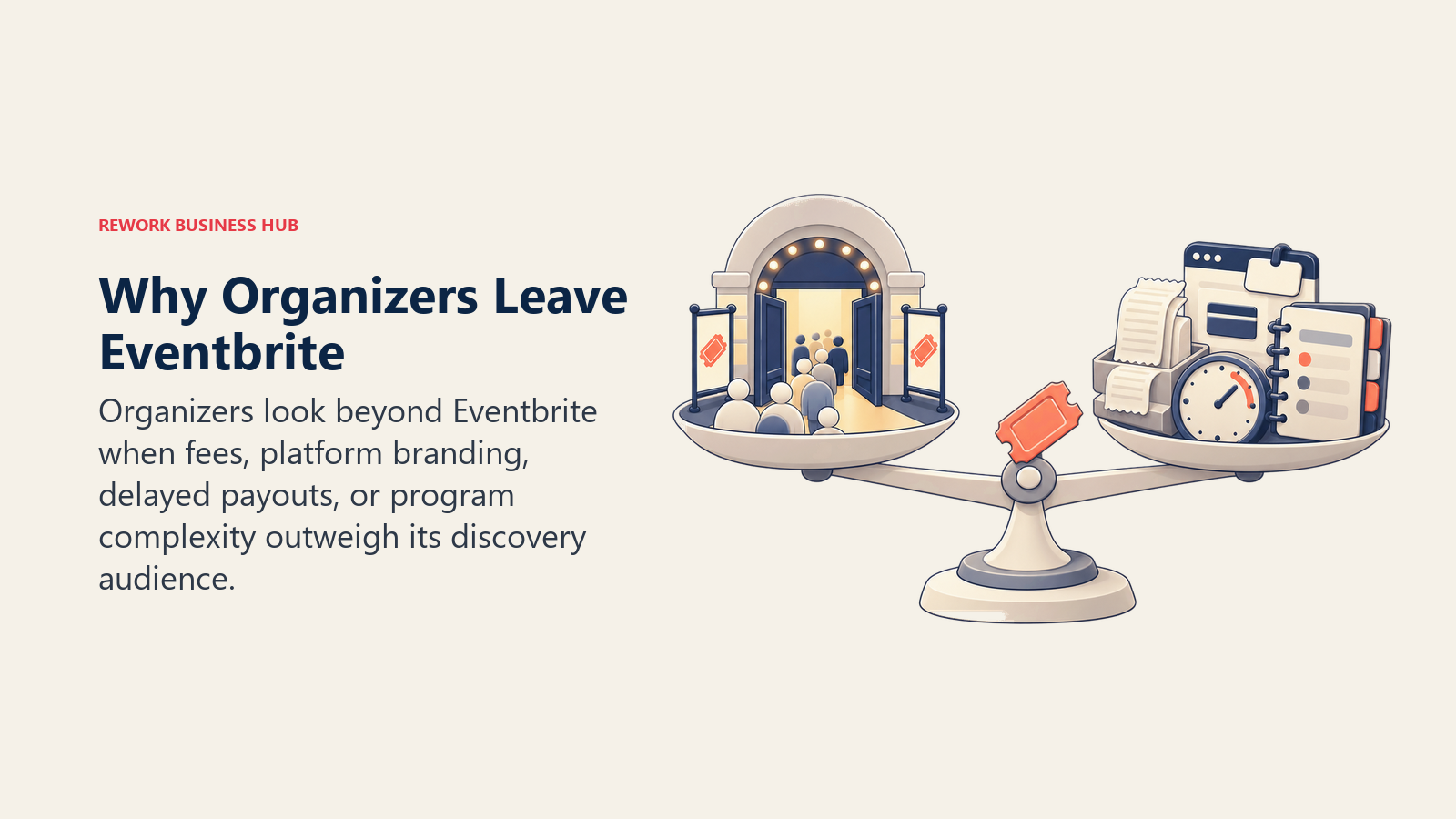
The fee stack adds up fast at any real ticket price. Paid tickets cost 3.7% + $1.79 per ticket plus 2.9% payment processing per order, absorbed or passed to the attendee. On a $50 ticket that's $5.09 in fees; sell 200 and the load crosses $1,000. Eventbrite Pro (email marketing) starts at $15 a month for 10,000 emails a day; higher tiers reportedly run $50 and $100 by volume, though only $15 is vendor-published, and email depth is worth comparing separately in the best email marketing software roundup. Eventbrite holds a strong 4.6/5 across 5,812 Capterra reviews, but fees are the single most repeated complaint in that set. (Capterra)
The checkout doesn't look like your brand. Eventbrite branding shows by default, not the organizer's, a recurring frustration for a polished, on-brand registration experience, especially for a corporate or membership event.
Payouts take 3 to 5 business days after the event, not before it. For an organizer covering venue deposits, catering, and printing upfront, that delay matters more than the fee percentage.
Some teams outgrow ticketing entirely. A team starts on Eventbrite for one public event, then finds itself running internal conferences or multi-track B2B programs needing registration workflows, agendas, sponsor management, and badge printing, none of which Eventbrite was built for. That's a different category (Cvent, Swoogo, Whova, Accelevents, EventMobi) than a cheaper ticketing swap (Eventzilla, Zoho Backstage, RingCentral Events).
None of this makes Eventbrite wrong for every organizer. For a public event reaching strangers, that discovery traffic is a real, hard-to-replace asset. The question this guide answers is what to evaluate once fees, branding, or program complexity make that trade-off stop being worth it.
How to Choose: Decision Framework
Start here: if the whole problem is ticketing cost or branding, the top rows below are built for that. If you've realized you need real event management (agendas, sponsors, badges, approvals), the enterprise and mid-market rows fit better.
| If you need... | Best pick |
|---|---|
| Company events feeding the same CRM pipeline as sales | Rework |
| Enterprise program management plus venue sourcing | Cvent |
| A branded event experience with onsite hardware | Bizzabo |
| Unlimited registrations without a per-ticket fee | Swoogo |
| End-to-end enterprise meetings and incentive travel | Stova |
| A highly rated attendee app for a conference or association | Whova |
| Hybrid delivery inside an existing Cisco Webex stack | Webex Events |
| Virtual or hybrid events billed per organizer, not per attendee | RingCentral Events |
| A published starting price plus fundraising tools | Accelevents |
| Per-event or per-year pricing with zero registration fees | EventMobi |
| The lowest published per-registration fee in the category | Eventzilla |
| A genuinely free tier plus 0% ticketing commission | Zoho Backstage |
| Enterprise virtual and hybrid delivery, formerly Hubilo | Virtual PRO |
Frequently Asked Questions about Eventbrite Alternatives
What's the biggest reason organizers look for alternatives to Eventbrite?
The per-ticket fee stack. Paid tickets cost 3.7% + $1.79 per ticket plus 2.9% payment processing per order, which adds up fast at real prices and volumes. Forced Eventbrite branding at checkout and a 3 to 5 business day payout delay are the next most common reasons, both recurring themes in Eventbrite's Capterra reviews.
Is Eventbrite actually free?
Only for free events. The moment you charge for a ticket, Eventbrite takes 3.7% + $1.79 per ticket plus 2.9% payment processing per order, and Eventbrite Pro (email marketing) starts at $15 a month on top of that.
What's the cheapest Eventbrite alternative for paid ticketing?
Eventzilla's Basic tier charges $1.50 flat per registration, among the lowest published per-registration fees here, and its Annual plan starts at $1,999/year with zero per-registration fees for up to 500 registrations. Zoho Backstage's paid tiers charge 0% ticketing commission instead, with a flat per-event cost.
Which Eventbrite alternative fits a team that has outgrown simple ticketing?
Cvent, Swoogo, Whova, Accelevents, and EventMobi are built for real B2B event management (registration workflows, agendas, sponsors, badges), not just ticket sales. Rework fits a narrower need: company events, like customer conferences or town halls, that should feed the same CRM pipeline as the rest of sales.
Does Rework replace Eventbrite for a team selling public tickets?
No. Rework has no public ticket marketplace or consumer discovery audience, so a promoter selling to strangers should stay with Eventbrite or move to Eventzilla or Zoho Backstage. Rework fits company-run events whose registrants should land on the same CRM timeline as everything else a customer does.
What happened to Hubilo?
Brandlive acquired Hubilo in September 2025 and relaunched it as Virtual PRO in January 2026. Existing customers were migrated, and hubilo.com/pricing now redirects to virtualpro.com. It's no longer sold as an independent, standalone platform under the Hubilo name.
Is Cvent's reputation for having no public pricing accurate?
Yes. Cvent's pricing page names Professional and Enterprise packages but publishes no dollar figures, framing pricing as fully custom. Third-party analyses report a wide range, from roughly $19,550/year median to $79,000-plus/year for full enterprise deployments.
Can fees be passed to the attendee instead of absorbed by the organizer?
On most of these platforms, yes. Eventbrite, Eventzilla, and similar per-ticket models let the organizer absorb the fee (attendee pays the sticker price, organizer nets less) or pass it through (attendee pays sticker price plus fee). Flat-fee platforms like Zoho Backstage's paid tiers or Swoogo's per-user license skip this trade-off entirely.
What to Do Next
Pick based on which half of this guide describes your problem, not which demo looked flashiest. If it's ticketing cost or branding, put Eventzilla and Zoho Backstage head to head against your current Eventbrite fee total for your last three events; the fee-math table above makes that quick. If it's program complexity, trial Whova or Accelevents against your next event with real attendee data, not a demo environment.
If your actual problem is that registrants have nowhere to go once the event ends, and should be showing up in the same CRM as every other customer, start with Rework. Pricing for Event is quoted per organization; see rework.com/pricing. For the wider landscape beyond single-vendor alternatives, the Best Event Management Software in 2026 roundup covers additional categories.

Principal Product Marketing Strategist
On this page
- Key Facts
- Quick Comparison Table
- What a Ticket Actually Costs: Fee Math by Pricing Model
- Stage Fit Matrix
- Sizing and Persona Table
- 1. Cvent: The Enterprise Standard With Real Venue Sourcing
- 2. Bizzabo: Enterprise Event Experience With Onsite Hardware
- 3. Swoogo: Unlimited Registrations Without a Per-Ticket Fee
- 4. Stova: End-to-End Enterprise Programs
- 5. Whova: The Attendee App Conferences Actually Like
- 6. Rework: Events on the Same Platform as CRM and Pipeline
- 7. Webex Events (formerly Socio): Hybrid Delivery Inside the Cisco Stack
- 8. RingCentral Events (formerly Hopin): Virtual and Hybrid, Billed Per Organizer
- 9. Accelevents: A Rare Published Starting Price
- 10. EventMobi: Per-Event or Per-Year, No Registration Fees
- 11. Eventzilla: The Cheapest Published Per-Registration Fee
- 12. Zoho Backstage: A Free Tier That's Actually Usable
- 13. Virtual PRO (formerly Hubilo): Enterprise Virtual and Hybrid, Post-Brandlive
- Why Teams Look Beyond Eventbrite
- How to Choose: Decision Framework
- What to Do Next