Mural vs Lucidspark: Which Whiteboard Fits How Your Team Actually Works in 2026?
Turn this article into takeaways for your work.


Each assistant summarizes the article only for you and suggests best practices for your work.
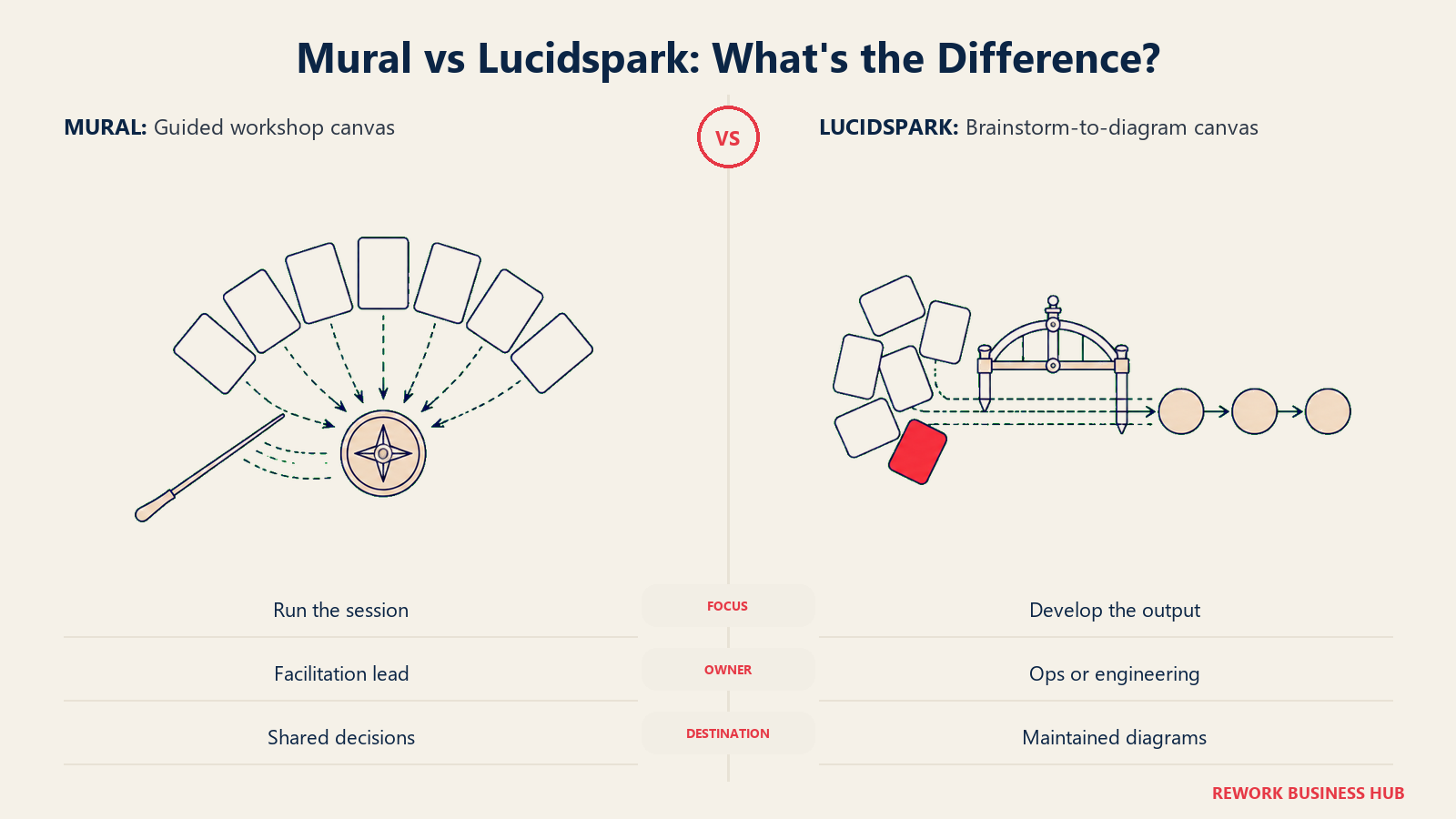
If you're comparing Mural and Lucidspark, you're probably not choosing between two identical sticky-note tools. You're choosing between two different jobs a whiteboard can do. Mural is built around the facilitated session: someone is running the room, and the product hands that person timers, private idea generation, structured voting and a curated method library so the workshop actually goes somewhere. Lucidspark is built around the brainstorm that needs to become something else: a messy round of stickies that turns into a formal, structured Lucidchart diagram without anyone exporting a screenshot or rebuilding the thing from scratch in a second tool.
That distinction matters more than any feature-grid checkmark, because it changes who should be evaluating each product. If you're a facilitator, an agile coach, an HR or L&D lead standardizing how your organization runs workshops, Mural's whole design philosophy is aimed at you. If you're an ops or engineering lead who already lives in Lucidchart, or expects to soon, Lucidspark's pitch is that the brainstorm and the finished diagram never have to leave one ecosystem. This guide compares both honestly, including a pricing asymmetry worth naming up front: Mural publishes its rates in plain dollars on its own pricing page, and Lucid does not.
TL;DR
| Mural | Lucidspark | |
|---|---|---|
| Core bet | Facilitated session tooling built around a named session leader | Fast brainstorming canvas that hands off into Lucidchart and the wider Lucid Visual Collaboration Suite |
| Free tier | Unlimited murals, 3 editable at a time, unlimited members, unlimited view-only visitors | 3 editable boards, emoji reactions, freehand drawing |
| Entry paid tier | Team+: $9.99/member/mo billed annually, $12.99/mo billed monthly (vendor-published) | Individual: around $9/month (reported, not vendor-published) |
| Mid tier | Business: $17.99/member/mo billed annually, no monthly figure published (vendor-published) | Team: around $10/user/month with a three-user minimum (reported, not vendor-published) |
| Enterprise | Custom pricing, by contact | Custom pricing, sales-quoted, bundles the Lucid Visual Collaboration Suite |
| Facilitation controls | Native on every paid plan: timer, Private Mode, Summon, voting, Hide & Reveal, Facilitator Lock | Present (private mode, timer, follow-presenter, breakout boards) but not the product's central identity |
| Path to a formal diagram | Basic shapes and connectors; not a diagramming specialist | Native handoff into Lucidchart for a structured, data-linked diagram |
| Best for | Consultants, agile coaches, HR/L&D teams running recurring structured workshops | Teams that want a brainstorm to become a shareable process diagram without switching platforms |
Key Facts
- The collaborative whiteboard software market is valued at an estimated $3.81 billion in 2026, up from $3.17 billion in 2025, and is forecast to reach $9.59 billion by 2031, a 20.28% CAGR, according to Mordor Intelligence.
- Real-time collaboration was the largest feature segment in 2025 at 30.0% of category revenue, and IT and telecom was the largest end-use segment at 32.0%, per Precedence Research.
- When Google retired Jamboard on 31 December 2024, it named Lucidspark, FigJam and Miro as its official migration partners, per Google Workspace Updates.
- SessionLab's State of Facilitation 2026 report, based on 714 respondents across 60 countries, found that 38% of experienced facilitators design sessions a few times a month or more, a sign that facilitated work is a steady, recurring job function.
- Mural stated in a December 2022 brand announcement that its platform powers collaboration at 95% of the Fortune 100, a figure the company has not republished with a newer date since.
What Each One Is Actually Built For
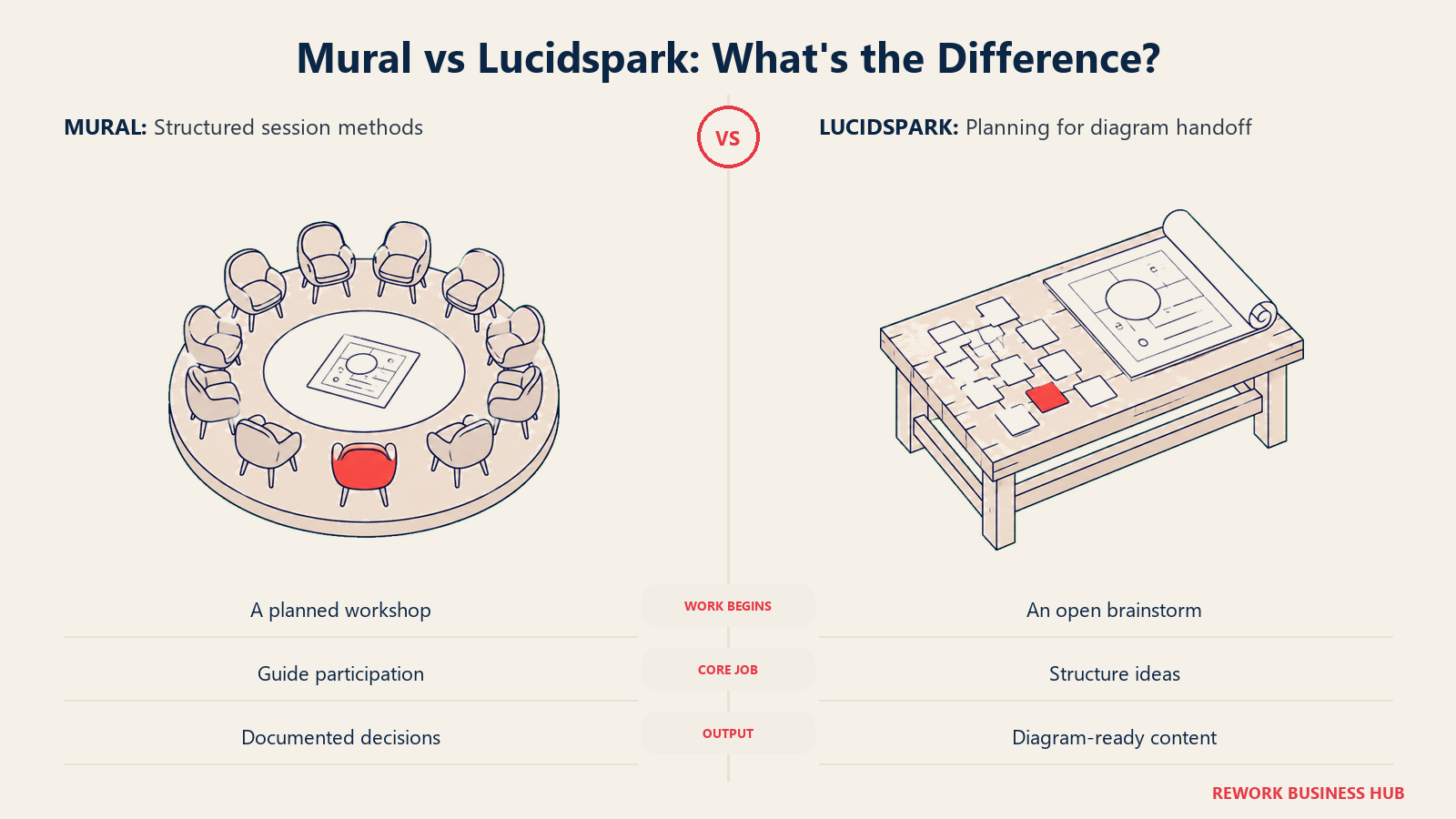
Mural started life as a facilitation tool for design thinking workshops and has stayed close to that identity, even as it added always-on features that let murals persist between sessions. Lucidspark started as a whiteboard sibling to Lucidchart, and its product decisions still trace back to that sibling relationship: the company's own positioning leans on the idea that a brainstorm shouldn't die as a pile of stickies, it should become a diagram someone can actually hand to engineering or ops.
| Dimension | Mural | Lucidspark |
|---|---|---|
| Primary use case | Structured, facilitated sessions: workshops, retros, discovery sprints, training, client engagements | Open brainstorming that's meant to convert into a formal process, flowchart or org diagram |
| Who typically buys it | A consulting practice, agile coaching function, or L&D/HR team standardizing how sessions run | An ops, engineering or IT team already invested in Lucidchart, buying the Suite as a package |
| Board lifecycle | A mural is usually built for a specific session, then archived or referenced afterward | A Lucidspark board is often a staging area, meant to be culled and handed off into Lucidchart, not a permanent home |
| Adoption pattern | Top-down within a practice: a facilitation lead standardizes the toolkit for a team of session leaders | Frequently bundled: teams license the Lucid Visual Collaboration Suite for the diagramming half and get Lucidspark along with it |
| Product self-description | A guided visual collaboration platform for structured teamwork | The whiteboard half of the Lucid Visual Collaboration Suite, built to pair with Lucidchart |
If your actual pain point is "our workshops run long, participants go quiet, and the facilitator loses control of the room," that's a Mural-shaped problem, and its native controls are built specifically to solve it. If your pain point is "we run good brainstorms but the output dies in a screenshot instead of becoming a diagram anyone else can maintain," that's the exact gap Lucidspark is positioned to close, provided your team is willing to buy into the wider Lucid ecosystem to get there.
Pricing at 10, 25 and 100 Seats
Here's the finding worth stating plainly before any table: Mural publishes its prices, in dollars, on its own pricing page. Lucid does not. That's not a knock on how hard we looked. A raw fetch of lucid.co's pricing pages returns plan features and $0 for the free tier, but zero dollar-sign characters anywhere in the underlying markup for any paid tier, across lucid.co/pricing, lucid.co/pricing/lucidspark, lucidspark.com/pricing and Lucid's own help center. The paid figures are rendered client-side by an API call the page makes after it loads, not withheld by a paywall or a blocked crawler. That's a genuine non-publication, and it changes how you should budget: with Mural you can build a seat-cost model from the vendor's own numbers today; with Lucidspark you're working from third-party reporting until a sales conversation gives you a real number.
Mural, vendor-published, current as of September 2026:
| Plan | Annual billing | Monthly billing | 10 seats/yr | 25 seats/yr | 100 seats/yr |
|---|---|---|---|---|---|
| Free | $0 | $0 | $0 | $0 | $0 |
| Team+ | $9.99/member/mo | $12.99/member/mo | $1,198.80 (annual) / $1,558.80 (monthly) | $2,997.00 (annual) / $3,897.00 (monthly) | $11,988.00 (annual) / $15,588.00 (monthly) |
| Business | $17.99/member/mo | Not published | $2,158.80 (annual) | $5,397.00 (annual) | $21,588.00 (annual) |
| Enterprise | By contact | By contact | Contact sales | Contact sales | Contact sales |
Lucidspark, no vendor-published dollar figure at any tier. What Lucid does confirm directly: Free includes 3 editable boards plus emoji reactions and freehand drawing; paid plans add unlimited boards, tags and assisted grouping; the free trial runs 7 days and requires a card up front, then auto-bills unless you cancel; billing is offered monthly or annually; and the tier ladder runs Free, Individual, Team, Enterprise, with Team adding chat, voting, timers and facilitator tools on top of Individual. Enterprise is sales-quoted and bundles the full Lucid Visual Collaboration Suite (Lucidchart plus Lucidspark), team hubs, enterprise templates and Enterprise Shield as an add-on.
| Plan | Reported monthly rate | Confirmed by Lucid? | Source |
|---|---|---|---|
| Free | $0 | Yes, vendor-confirmed | Lucid's own pricing page |
| Individual | Around $9/month (reported) | No, rendered client-side | RevPilots' Lucidspark pricing breakdown |
| Team | Around $10/user/month, three-user minimum (reported) | No, rendered client-side | RevPilots' Lucidspark pricing breakdown |
| Enterprise | Sales-quoted | Confirmed to be custom, no figure published | Lucid's own pricing page |
Do the math on that Team figure and the asymmetry gets sharper. If the reported $10/user/month rate is roughly accurate, a 10-seat Lucidspark Team purchase runs about $1,200/year, a 25-seat purchase about $3,000/year, and a 100-seat purchase about $12,000/year, which lands within a few hundred dollars of Mural's vendor-published Team+ numbers at every seat count above. That's a plausible, useful estimate for early budgeting. It is not a number you should put in a board deck as confirmed, and it is not a number Lucid will honor if your actual quote comes in different: treat it as a planning input, not a commitment, and get the real figure from Lucid sales before you sign anything.
There's a second wrinkle specific to Lucidspark's pricing model that Mural doesn't have: the three-user minimum on Team. A two-person team wanting Lucidspark's facilitator tools for a weekly planning session still pays for three seats, whether or not a third person ever logs in. Mural has no equivalent floor. It bills strictly per member, so a two-person team on Team+ pays for two seats, not a padded minimum.
Facilitation Features Compared
This is Mural's home turf, and the company doesn't hedge about it: its facilitation controls are marketed under the name "Facilitator Superpowers" and sit on every paid plan, not gated behind a premium add-on. Lucidspark has built genuine equivalents, since Lucid is competing directly for the same facilitated-workshop budget, but the framing is different: on Lucidspark these controls read as a strong feature set inside a broader whiteboard, not the product's reason for existing.
| Facilitation control | Mural | Lucidspark |
|---|---|---|
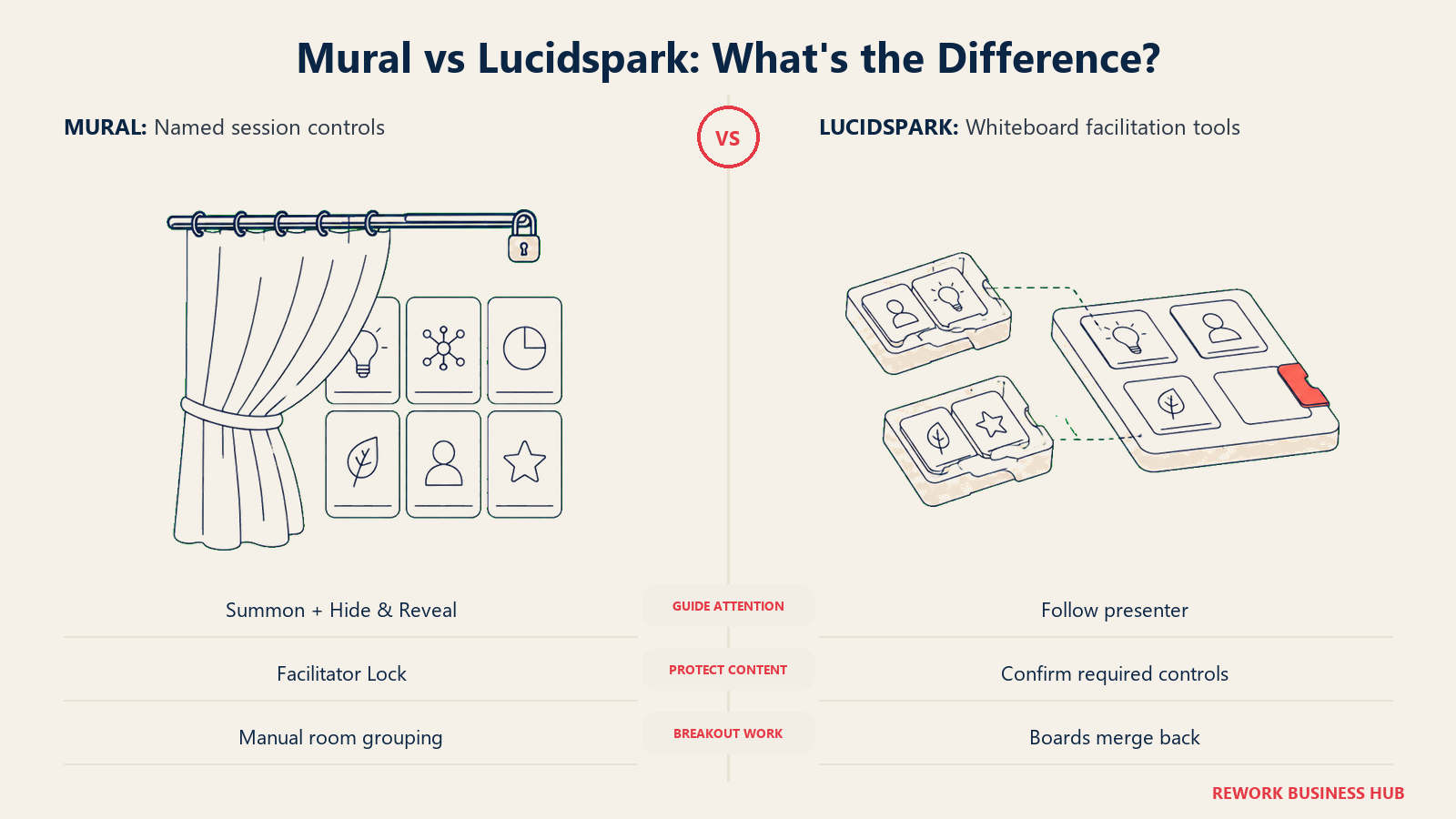
| Session timer | Native, described by the vendor as a way to "time box activities to keep them running on track" | Native countdown timer with quick-add presets |
| Private/anonymous idea generation | Native "Private Mode," built specifically to reduce groupthink and Highest-Paid-Person's-Opinion bias, per Mural's facilitation features page | Native private mode that hides new stickies from the group until the host reveals them |
| Summon/follow participants | Native "Summon," described by the vendor as pulling every participant's view to exactly where the facilitator is looking | Native "follow presenter" mode |
| Small-group breakouts | Available via private rooms and frame-based grouping, more manual than a dedicated breakout mechanic | Native breakout boards that merge participant work back into the main board automatically |
| Structured voting | Native anonymous voting for prioritization and consensus | Available on the canvas; not documented with the same named specificity as Mural's dedicated voting tool |
| Hide/reveal content in sequence | Native "Hide & Reveal," built to control what's visible in the Outline until the facilitator chooses to show it | No comparably named feature confirmed |
| Lock content during a session | Native "Facilitator Lock," specifically framed to stop accidental moves mid-session | No comparably named feature confirmed |
| Guided walkthroughs for non-facilitator participants | Native guided tours that walk participants through a workshop without requiring facilitation experience | No comparably named feature confirmed |
Two rows genuinely cut in Lucidspark's favor and are easy to miss if you only read Mural's marketing: breakout boards that auto-merge results back into the main canvas are a cleaner mechanic than Mural's more manual private-room approach, and the follow-presenter mode is functionally close to Mural's Summon. But on template-mapped facilitation depth, Hide & Reveal, Facilitator Lock and guided walkthroughs, Mural still ships a named, discoverable control that Lucidspark's own documentation doesn't clearly match. If your team runs sprint retrospectives or structured sprint planning on a fixed cadence, that gap compounds: a facilitator hunting for a workaround loses the room's attention, and attention is the entire point of a live session.
Templates and Frameworks
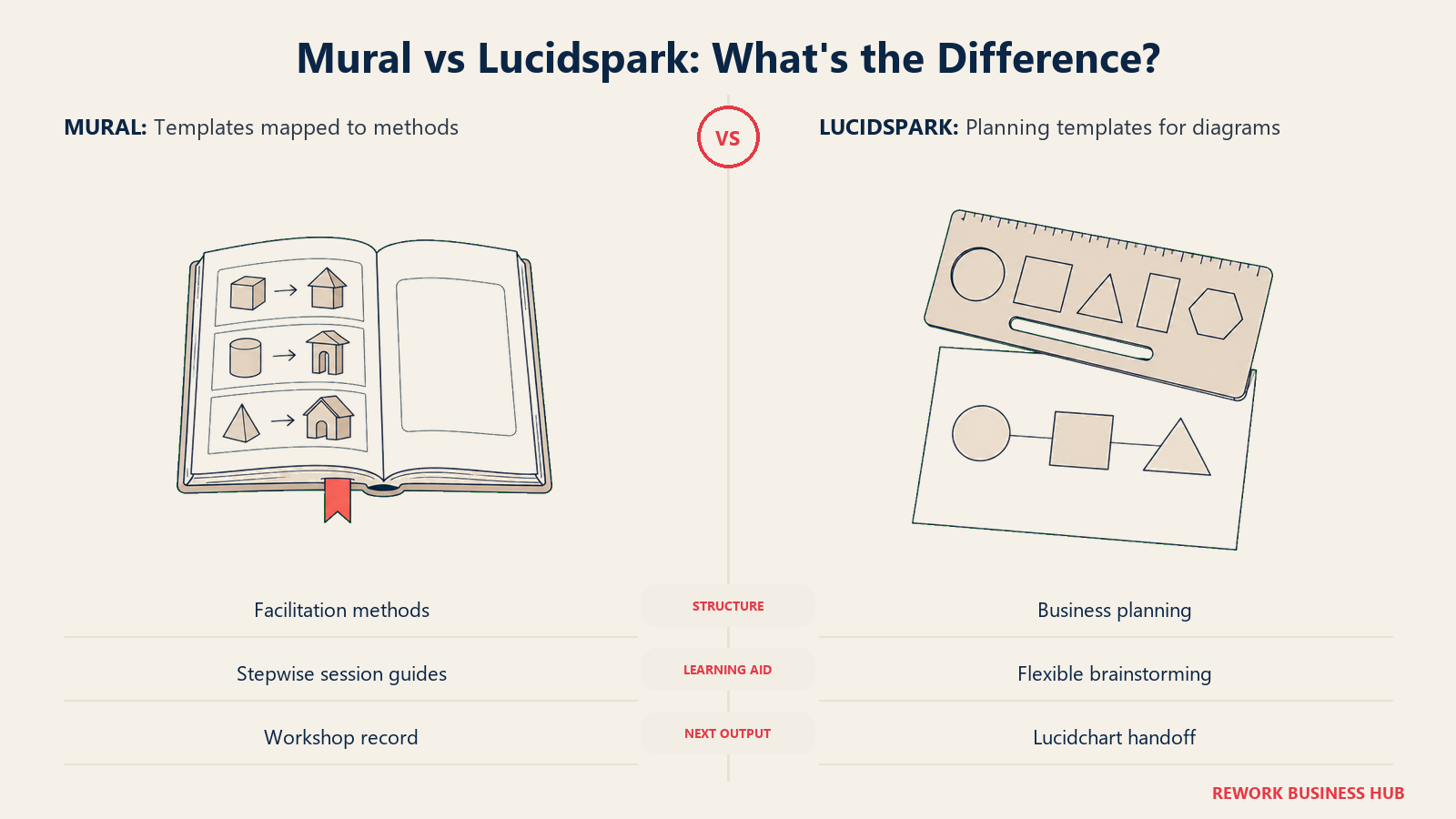
Mural's template library is organized around named facilitation methods: design thinking, agile ceremonies, research synthesis, and team-building exercises like ice breakers, so a first-time facilitator can pick a template and follow the method step by step rather than inventing a structure from a blank canvas. Business-tier Mural also adds LUMA, Mural's own facilitation framework, layered on top of the general template library. Lucidspark's templates lean the other direction: fewer named facilitation methods, more templates aimed at business and technical planning that assume the output is heading toward a diagram, not just a discussion.
| Mural | Lucidspark | |
|---|---|---|
| Organizing principle | Depth on facilitation methods, sorted by workshop type and outcome | Breadth across brainstorming, planning and light process templates |
| Named framework support | LUMA (Mural's own facilitation framework), Business tier and above | No comparable named in-house framework |
| Fit for a first-time facilitator | Templates map directly onto known facilitation techniques a novice can follow | Requires more improvisation to turn a template into a run-of-show |
| Fit for a team headed toward a diagram | Templates stop at the whiteboard; no native handoff to a formal diagramming tool | Templates and boards are built with the Lucidchart handoff in mind |
Neither library is "better" outside of what you're trying to produce. If the deliverable of your session is a shared understanding and a documented decision, Mural's method-mapped templates get a less experienced facilitator to a workable run-of-show faster. If the deliverable is a diagram someone downstream has to maintain, a Lucidspark template that's already thinking about that handoff saves the rebuild step entirely. Both tools support the underlying technique well regardless of platform: our guide to running an affinity diagram session works whichever canvas you use, since the method itself doesn't depend on the software.
Diagramming: Lucidspark's Real Advantage
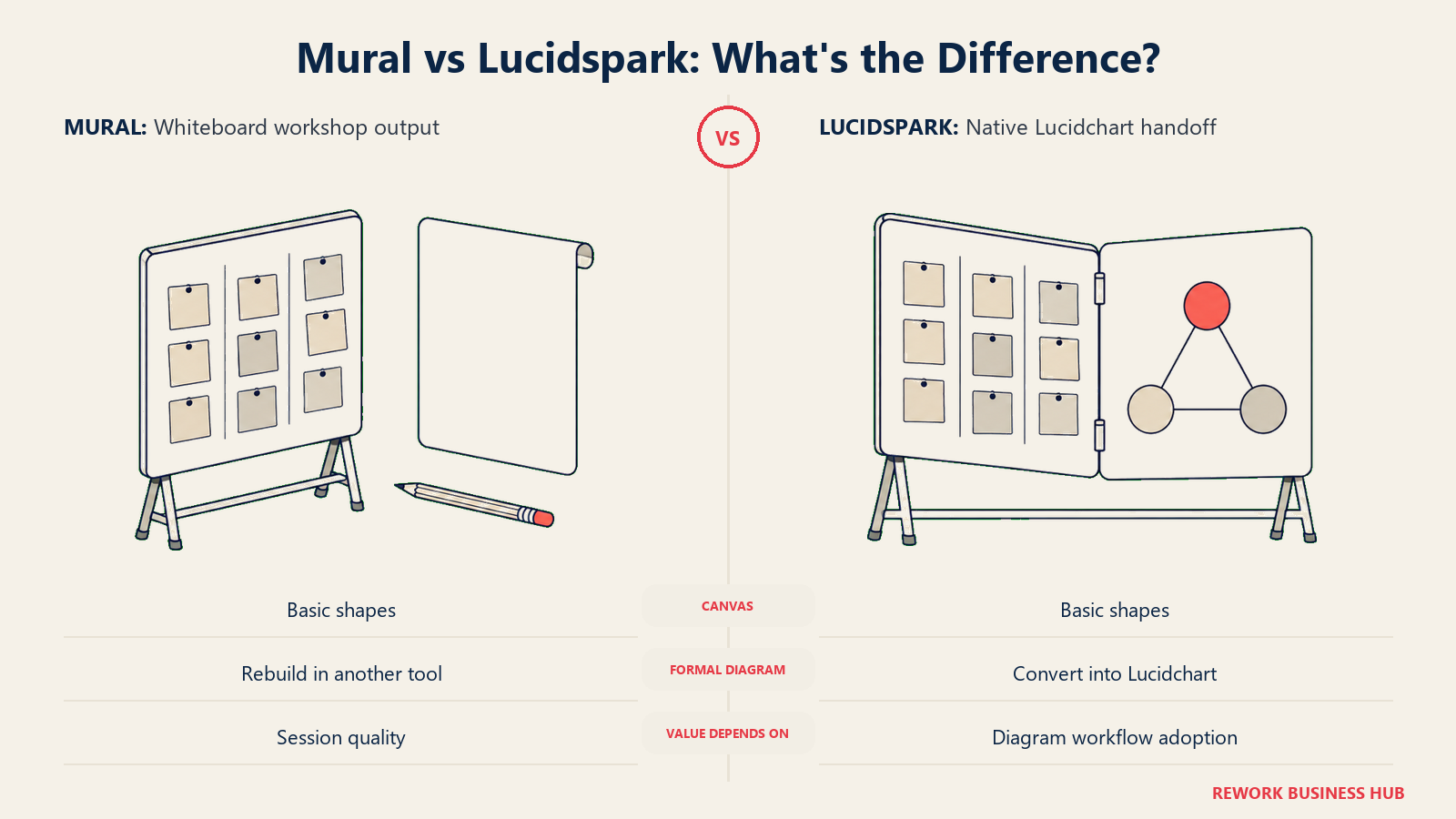
This is the section that actually decides a lot of Mural-vs-Lucidspark evaluations, and it has nothing to do with sticky notes. Lucidspark's core structural advantage isn't a feature on its own canvas, it's what happens when you're done brainstorming: content built in Lucidspark can convert directly into Lucidchart, Lucid's dedicated diagramming product, without anyone manually rebuilding the shapes, connectors or logic. That single integration is the reason Lucidspark gets bought as part of a Suite rather than as a standalone whiteboard, and it's the honest core of why some teams pick it over Mural even when Mural's facilitation tooling is objectively deeper.
| Capability | Mural | Lucidspark |
|---|---|---|
| Native flowcharts and diagrams on the canvas | Basic shapes and connectors, functional but not a diagramming specialist | Basic shapes and connectors on the whiteboard itself, comparable depth to Mural |
| Formal handoff to a dedicated diagramming tool | Not available; content stays on the whiteboard or gets rebuilt elsewhere | Native handoff into Lucidchart, converting brainstorm content into a structured, data-linked diagram |
| Best fit | Teams whose deliverable is a decision, a plan or documented workshop output | Teams whose deliverable is a process map, org chart, systems diagram or flowchart someone else has to maintain |
| Cost of the advantage | None; Mural is priced and sold as a standalone product | Requires buying into the Lucid Visual Collaboration Suite to get the full benefit, not just a Lucidspark seat |
If your team's actual bottleneck is "we run a good brainstorm and then someone spends two hours manually turning it into a proper diagram in a different tool," that bottleneck is exactly what the Lucidspark-to-Lucidchart handoff is built to remove. Mural has no equivalent path; a mural stays a mural unless a human rebuilds it. Teams evaluating this specific gap should also look at best Lucidchart alternatives for the diagramming half of the comparison and best Lucidspark alternatives for the whiteboard half, since the Suite-dependency is the single biggest objection buyers raise against Lucidspark on its own.
Integrations and Where Each One Sits in a Stack
| Mural | Lucidspark | |
|---|---|---|
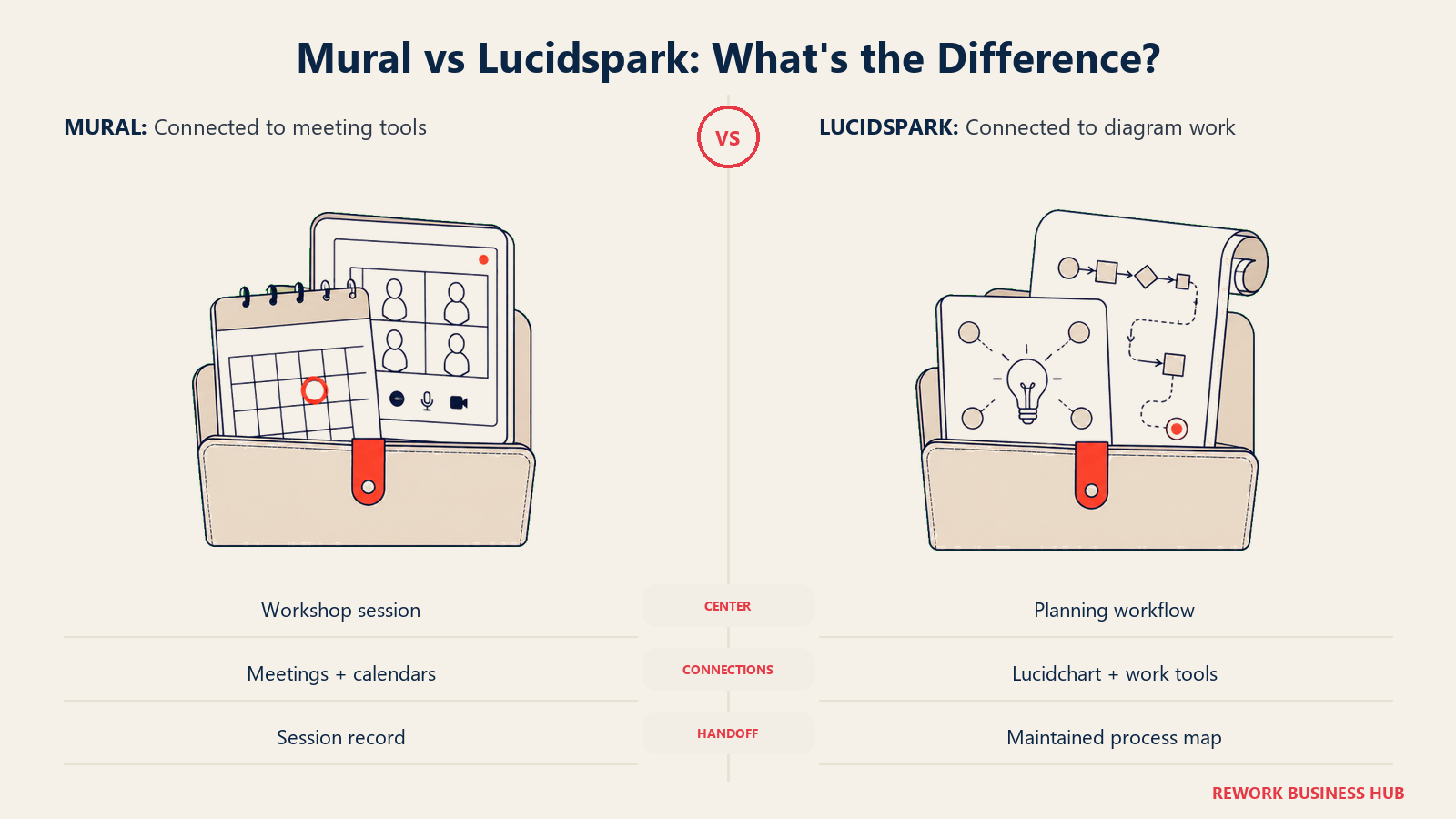
| Common stack fit | Meeting and workshop tool stacks: Zoom, Webex, Microsoft Teams, Slack, calendar tools | Planning and diagramming stacks: Lucidchart first, plus Slack, Microsoft Teams, Zoom, Jira, Confluence |
| Depth of the flagship integration | Basic integrations (Zoom, Webex) on Team+; advanced integrations (Azure, GitHub, Okta) on Business | Deep, native handoff into Lucidchart, the product's core differentiator, present at every paid tier |
| SSO providers | SAML 2.0 on Business and Enterprise | Available on higher tiers, tier-dependent |
| Where it usually sits | Bolted onto the meeting stack, invoked when a session is scheduled | Embedded inside the planning-to-documentation workflow, alongside Lucidchart and ticketing tools |
The integration story mirrors each product's core identity again. Mural's most important integrations are the ones that get people into a session (video conferencing, calendar invites), because the product's job ends when the workshop does. Lucidspark's most important integration is the one that happens after the session ends, converting rough output into a diagram other tools and teams can consume.
Performance and Board Scale
| Factor | Mural | Lucidspark |
|---|---|---|
| Typical strain point | Very large live sessions with dozens of simultaneous editors adding content at once | Boards that accumulate a large volume of stickies before a facilitator culls or converts them |
| Designed session length | Optimized for a defined session window, though murals can also persist afterward | Similarly session-oriented, though boards headed for a Lucidchart handoff tend to get archived once converted |
| Concurrent editing at scale | Built to handle a full live workshop with many simultaneous participants, since that's the core use case | Comparable, built for the same live-brainstorm use case |
| Enterprise-scale deployment history | Cited by the vendor as powering collaboration at a large share of the Fortune 100 as of its most recent brand announcement | Backed by Lucid's broader enterprise base across the Visual Collaboration Suite, though Lucidspark-specific figures aren't separately published |
Neither vendor publishes a hard object-count ceiling for either product, so the practical advice is the same on both sides: archive or convert boards that have grown unwieldy rather than treating either canvas as infinite storage, and test with a realistic participant count before running your highest-stakes session live.
AI Features in 2026
Both platforms have added generative AI features aimed at the same underlying problem: reducing the manual work of turning raw session output into something usable.
| AI capability | Mural | Lucidspark |
|---|---|---|
| Content summarization | Native Mural AI, can summarize sticky notes, paragraphs and headings into takeaways | Available for summarizing board content into structured notes |
| Clustering/theming sticky notes | Native, automatically clusters notes by topic and can re-sort by new criteria | Available, with AI-assisted grouping called out specifically as a paid-tier upgrade over Free |
| Diagram/content generation from a prompt | Available for generating ideas, flowcharts and mind maps from the AI toolbar | Available, with the added benefit that generated content can flow into a Lucidchart diagram afterward |
| Specialized facilitation AI | Not a comparable named feature | Not a comparable named feature |
Both companies are shipping AI features fast enough that specifics shift month to month, so treat this table as a snapshot rather than a permanent scorecard, and re-check each vendor's own AI feature page before a purchase decision that hinges on a specific capability.
Admin, Security and Governance
| Control | Mural | Lucidspark |
|---|---|---|
| SSO/SAML | SAML 2.0 on Business and Enterprise | Available on higher tiers, tier-dependent |
| Guest and external sharing controls | Visitors free on every plan; Business and Enterprise add unlimited external Guests | Managed per plan; Enterprise adds Enterprise Shield as a dedicated security add-on |
| External collaborator model | Visitor (free, temporary access) and Guest (free, ongoing access on Business+) kept separate from paid Member seats | Tier-dependent, with the strongest governance controls concentrated in Enterprise |
| Advanced integrations for IT | Azure, GitHub, Okta on Business tier | Depends on the wider Suite; Enterprise bundles team hubs and enterprise templates |
| Billing options | Card or invoice on Business tier and above | Monthly or annual billing offered; invoicing terms not published |
Neither vendor publishes a full, current compliance matrix in a form stable enough to summarize responsibly here. If governance is a gating requirement, confirm current certifications (SOC 2, ISO 27001, regional data residency) directly against each vendor's trust or security page before a contract is signed, since these details change more often than pricing does, and in Lucid's case, pricing itself already requires a direct conversation.
Implementation and Change Management
| Factor | Mural | Lucidspark |
|---|---|---|
| Fastest realistic rollout | Days, since Free and Team+ support self-serve signup with no sales conversation required | Days for Free and Individual, though the 7-day trial requires a card up front and auto-bills unless cancelled |
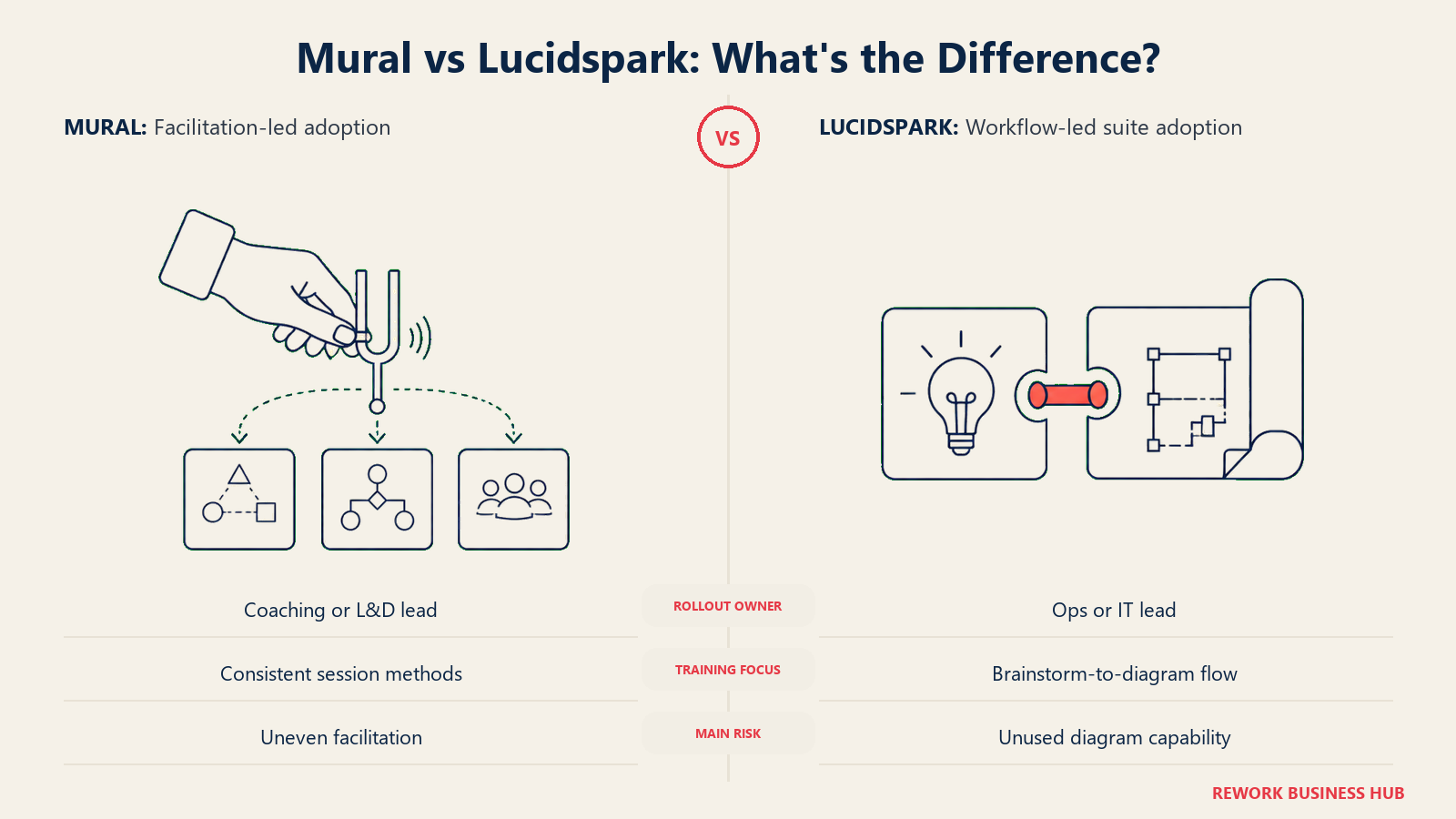
| Who typically owns rollout | A facilitation, agile coaching or L&D lead standardizing practice across a team of session leaders | An ops, engineering or IT lead already managing the Lucidchart relationship |
| Training load | Lower per-facilitator training load, since the method library maps directly onto known facilitation techniques | Moderate; the canvas itself is easy to pick up, but getting real value from the Lucidchart handoff requires some process design |
| Change management risk | Drift risk: without a facilitation lead maintaining standards, session quality varies by who's running the room | Suite-dependency risk: the value case weakens if the team never actually adopts Lucidchart alongside it |
The rollout pattern mirrors each product's buying motion. Mural tends to arrive because someone already owns "how we run sessions" as part of their job, so the real implementation risk is facilitator skill variance, not tool adoption. Lucidspark tends to arrive as half of a bundled decision, so the real implementation risk is buying the Suite and never building the workflow that makes the Lucidchart handoff worth paying for.
When Mural Is the Right Call
- Someone in your organization already owns "how we run workshops" as a defined responsibility, whether that's an internal agile coaching function, an HR/L&D team, or an external consulting practice running client sessions.
- Session quality depends on control, not just content. If retros run long, quiet participants never speak up, or one loud voice dominates, Mural's Private Mode, Summon, voting and Facilitator Lock solve a real facilitation problem rather than a content problem.
- You run the same structured session repeatedly (a recurring retro cadence, a standard discovery workshop, a training curriculum) and want a curated method library, plus the LUMA framework on Business tier, that maps directly onto that repeatable structure.
- You want a vendor-published price you can plan around today. Mural's rates are on its own pricing page in plain dollars, which matters if your budgeting process needs a number now rather than after a sales call.
When Lucidspark Is the Right Call
- Your team's real bottleneck is turning a brainstorm into a maintainable diagram, not running a tighter facilitated session. If the output of your whiteboard sessions is supposed to become a process map, org chart or systems diagram, the native Lucidchart handoff removes a manual rebuild step that Mural simply doesn't have an answer for.
- You're already invested in Lucidchart, or expect to be soon. Buying Lucidspark alongside it, rather than a standalone whiteboard, means the brainstorm and the finished diagram never leave one ecosystem.
- Your team is comfortable working from a reported price during early evaluation and getting the confirmed figure from a sales conversation before committing, rather than needing a number in dollars on the page today.
- You're evaluating the Lucid Visual Collaboration Suite as a package, not Lucidspark in isolation. The economics make more sense when the diagramming half of the Suite is doing real, ongoing work for your team, not just the whiteboard half.
Decision Framework
| If you are... | Pick |
|---|---|
| A facilitator, agile coach, or L&D/HR lead running recurring structured workshops | Mural |
| A team whose sessions need to end in a maintainable process diagram, not just a decision | Lucidspark |
| Already invested in Lucidchart, or planning to be soon | Lucidspark |
| Struggling with session control (quiet participants, groupthink, sessions running long) more than diagram output | Mural |
| Budgeting today and need a confirmed dollar figure, not a reported estimate | Mural, since its pricing page publishes real numbers |
| A two-person or three-person team wary of a seat-count minimum | Mural, since it has no three-user floor the way Lucidspark's Team plan does |
| Weighing the two as a bundle decision alongside a diagramming tool purchase | Lucidspark, evaluated as part of the wider Lucid Visual Collaboration Suite |
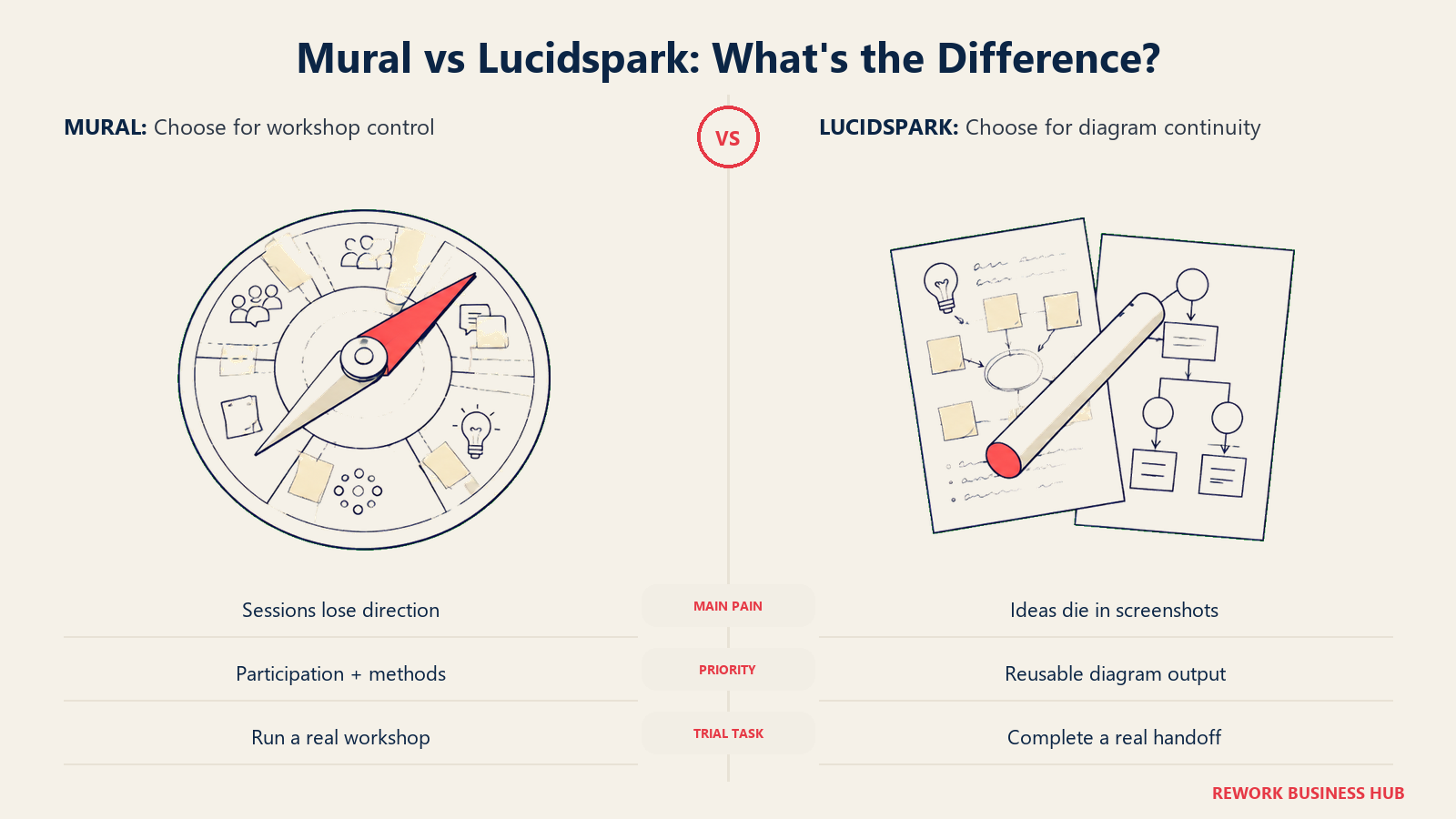
The honest bottom line: this isn't "which whiteboard is better," it's "which half of the work matters more to your team, the session or the handoff." Some teams need both and end up running Mural for facilitated sessions while a Lucidspark-to-Lucidchart pipeline handles the diagramming work that follows. If your shortlist still includes Miro or FigJam, Miro vs Mural and Miro vs FigJam run the same kind of comparison against those platforms, and our roundup of the best online whiteboard software in 2026 covers the wider category if neither tool here turns out to be the right fit. Teams that want a lighter, cheaper canvas than either Mural or Lucidspark should also look at the best Whimsical alternatives guide.
What to Do Next
Before comparing another feature row, write down which half of the problem you're actually solving: a better-run session with a named facilitator in charge, or a brainstorm that needs to become a real diagram without a manual rebuild. Then test the specific thing that matters most with your actual team on each platform's free tier, a real retro on Mural, a real planning session that you try to hand off into Lucidchart on Lucidspark, rather than a demo account. If Mural's facilitation model fits but the per-member pricing doesn't, our best Mural alternatives guide works through cheaper facilitation-capable options, and if Lucidspark's pitch fits but you want to see the full field of diagram-ready whiteboards first, our best Lucidspark alternatives guide covers eleven of them with real, vendor-verified pricing.
Frequently Asked Questions about Mural vs Lucidspark
What's the core difference between Mural and Lucidspark?
Mural is built around the facilitated session, with native timers, private idea generation, summon-and-follow, voting, Hide & Reveal and Facilitator Lock designed for a named facilitator running a room. Lucidspark is built around the brainstorm-to-diagram pipeline: its real advantage is a native handoff into Lucidchart, so a messy round of stickies can become a structured, maintainable diagram without leaving the Lucid ecosystem.
Is Mural or Lucidspark cheaper?
Mural publishes its prices directly: Team+ is $9.99/member/mo billed annually or $12.99/member/mo billed monthly, and Business is $17.99/member/mo billed annually. Lucid does not publish a dollar figure for Lucidspark on any of its own pricing pages; the commonly reported numbers are around $9/month for Individual and around $10/user/month with a three-user minimum for Team, per RevPilots, not confirmed by Lucid. If the reported Team figure is roughly accurate, the two land close at most seat counts, but only Mural's number comes from the vendor itself.
Why doesn't Lucid publish Lucidspark pricing the way Mural does?
Lucid's pricing pages display dollar figures dynamically rather than in the page's static content, and the free tier is $0 across lucid.co/pricing, lucid.co/pricing/lucidspark and lucidspark.com/pricing. Confirm current paid-tier pricing with Lucid or its sales team.
Does Lucidspark's Team plan really require a three-user minimum?
That is what third-party reporting says, and Lucid doesn't confirm it on any page we could fetch, so treat it as a planning assumption to check with sales. On that reported structure, a two-person team wanting Lucidspark's Team-tier facilitator tools still pays for three seats, whether or not a third person logs in. Mural has no equivalent minimum; it bills strictly per member on Team+ and Business.
Which platform has better facilitation features?
Mural, on named depth. Its Private Mode, Summon, Hide & Reveal and Facilitator Lock are native, discoverable controls present on every paid plan, and the company markets them as "Facilitator Superpowers," the product's core identity. Lucidspark has genuine equivalents for several of these, including private mode, a countdown timer and breakout boards that auto-merge results, but its documentation doesn't clearly match Mural on Hide & Reveal, Facilitator Lock or guided walkthroughs.
Which platform is better if my team needs a real diagram out the other end?
Lucidspark, by a clear margin, because of its native handoff into Lucidchart. Mural supports basic shapes and connectors on the canvas itself, comparable to Lucidspark's own on-canvas tools, but it has no equivalent path to a dedicated, structured diagramming product. A mural stays a mural unless someone rebuilds it elsewhere.
Can I use Mural and Lucidspark on different teams inside the same organization?
Yes, and it's a common pattern. A facilitation, coaching or L&D function often standardizes on Mural for structured workshops and training, while an ops or engineering team licenses the Lucid Visual Collaboration Suite, including Lucidspark, for planning work that's meant to end in a maintained diagram. The two tools solve different enough problems that running both isn't necessarily redundant.

Principal Product Marketing Strategist
On this page
- TL;DR
- Key Facts
- What Each One Is Actually Built For
- Pricing at 10, 25 and 100 Seats
- Facilitation Features Compared
- Templates and Frameworks
- Diagramming: Lucidspark's Real Advantage
- Integrations and Where Each One Sits in a Stack
- Performance and Board Scale
- AI Features in 2026
- Admin, Security and Governance
- Implementation and Change Management
- When Mural Is the Right Call
- When Lucidspark Is the Right Call
- Decision Framework
- What to Do Next