Pipedrive vs HubSpot: Pipeline Simplicity vs Full Suite in 2026
Turn this article into takeaways for your work.


Each assistant summarizes the article only for you and suggests best practices for your work.
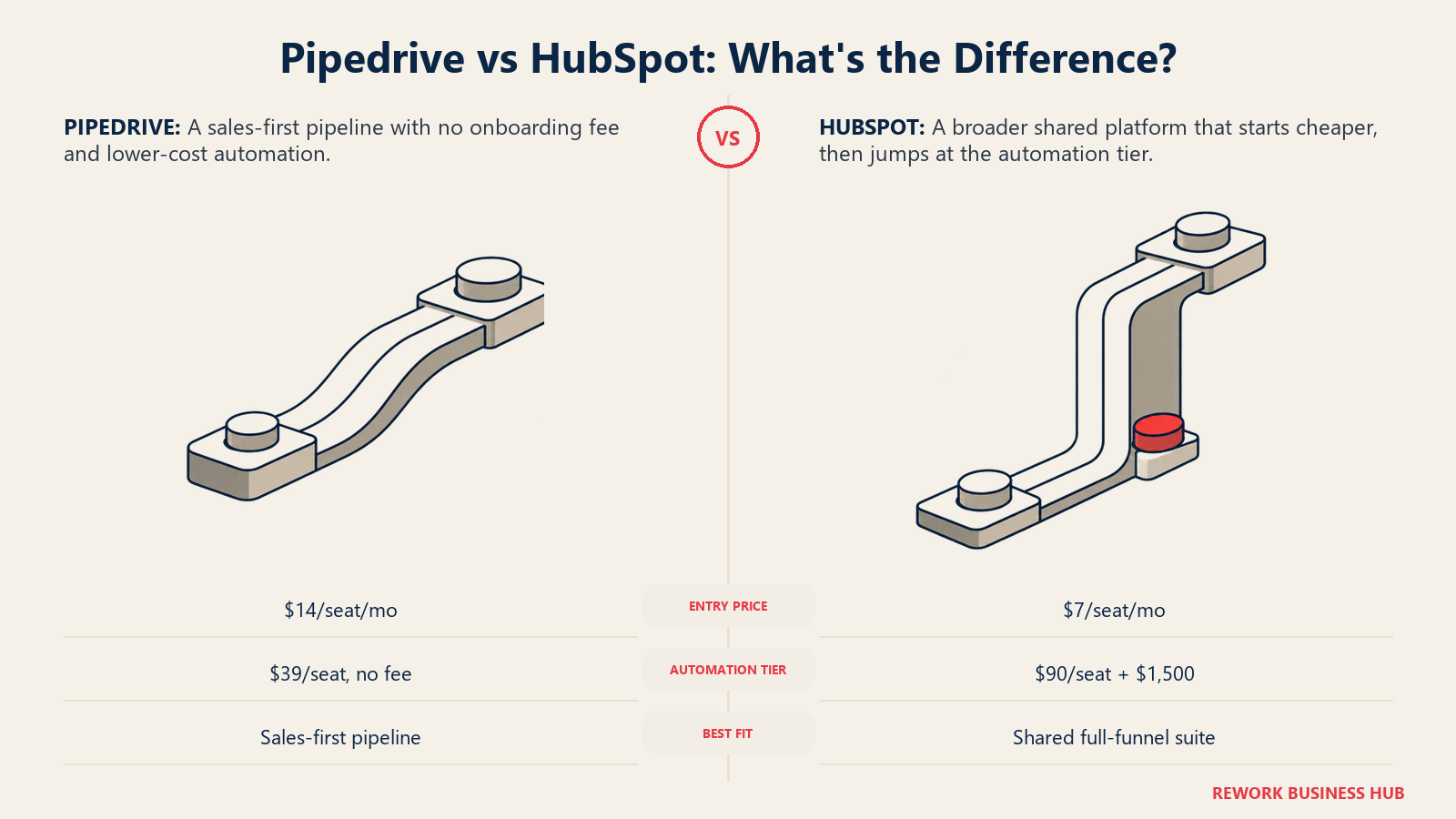
Pipedrive vs HubSpot usually gets framed as "simple and cheap" against "full-featured and expensive." That framing is out of date. HubSpot's entry-level Sales Hub Starter now costs less per seat than Pipedrive's entry-level Lite plan, which flips a piece of received wisdom that most comparison articles still repeat without checking. The real decision isn't about which one is cheaper in the abstract. It's about where each vendor puts the automation and forecasting depth you'll actually need, and what it costs to reach that tier once you're there.
This comparison is built for sales leaders and RevOps owners who need to defend a number to whoever signs off on software spend. We ran the seat-count math at 5, 10, 25, 50, and 100 users, priced in HubSpot's mandatory onboarding fees, and checked which tier of each product actually unlocks automation and forecasting instead of just promising it on a marketing page. If you're comparing the wider field first, our guide to the best sales pipeline software of 2026 covers more of the category before you narrow to these two.
Key Facts
- HubSpot Sales Hub Starter costs $7/seat/month billed annually, undercutting Pipedrive's entry-level Lite plan at $14/seat/month billed annually, a reversal of the old "Pipedrive is the cheap one" assumption (HubSpot pricing; Pipedrive Lite price per Pipedrive pricing).
- HubSpot's Professional and Enterprise Sales Hub tiers each carry a mandatory one-time onboarding fee on top of the seat price: $1,500 and $3,500 (HubSpot pricing).
- HubSpot's free Sales Hub tools are capped at 2 users. It is not an unlimited free CRM (HubSpot pricing).
- HubSpot's connected ecosystem includes more than 2,000 App Marketplace integrations, per its own Q1 2026 earnings release (HubSpot investor relations).
- Pipedrive's Marketplace lists 400+ apps, and Pipedrive reports that users with at least one app installed win 1.5x more deals than users with none (Pipedrive Marketplace).
- Pipedrive's newer conversational AI agent (OpenAI-powered, voice and text) is still a beta feature requiring opt-in. The deal-prioritization and win-probability version of its Sales Assistant is generally available on paid tiers (Pipedrive AI knowledge base).
Pipedrive vs HubSpot at a Glance
| Factor | Pipedrive | HubSpot Sales Hub |
|---|---|---|
| Best known for | Visual pipeline built for sales reps, not admins | Marketing-to-sales handoff in one shared data model |
| Entry price | $14/seat/mo (Lite, billed annually) | Free tools for up to 2 users, then $7/seat/mo (Starter, billed annually) |
| Where automation unlocks | Growth tier, $39/seat/mo, no onboarding fee | Professional tier, $90/seat/mo, plus a mandatory $1,500 onboarding fee |
| Mandatory onboarding fee | None at any tier | $1,500 (Professional), $3,500 (Enterprise) |
| Marketing capability | Email marketing sold separately as a Campaigns add-on, not bundled into any CRM tier | Marketing Hub shares the same contact record as Sales Hub out of the box |
| Multiple pipelines | Available even on the entry-level Lite plan | Gated by tier: 1 at Starter, 2 at Professional, 15 at Enterprise |
| Marketplace size | 400+ apps | 2,000+ apps |
| AI pricing | Bundled into the seat price by tier, no separate credits | Outcome-based since April 2026: pay per resolved conversation or qualified lead |
| Where it tends to lose | Marketing automation, multi-hub data sharing, deep customization | Budget at the automation-capable tier, and the "call sales" number once you outgrow Starter |
What Pipedrive and HubSpot Actually Cost
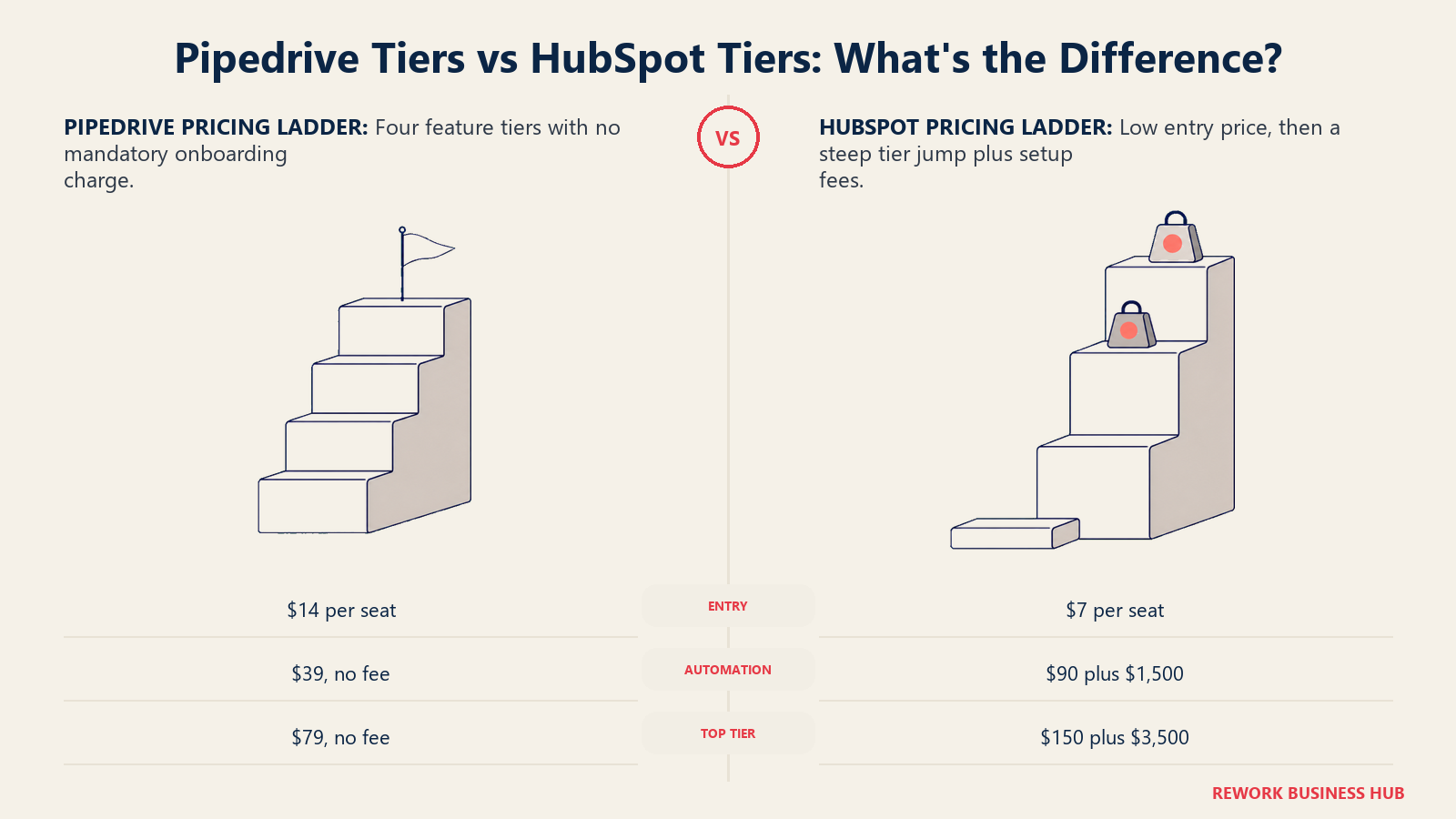
Start with what each vendor publishes, because that's where most comparisons get sloppy. Both Pipedrive and HubSpot put every consumer-facing tier's price on their own pricing page, but they structure the ladder differently: Pipedrive prices by feature depth across four flat tiers, while HubSpot prices by feature depth plus a mandatory setup charge once you're past the entry tier.
| Pipedrive tier | Price (billed annually) | What you're buying |
|---|---|---|
| Lite | $14/seat/mo | Pipeline and deal management, activity tracking, mobile app, basic reporting, no workflow automation |
| Growth | $39/seat/mo | Full two-way email sync, workflow automation, email sequences, meeting scheduler, forecast view |
| Premium | $64/seat/mo | AI email tools, lead scoring and routing, Smart Docs (create, share, and e-sign in-platform), phone support |
| Ultimate | $79/seat/mo | Highest usage ceilings, LeadBooster and project management tools included |
Source: Pipedrive pricing
| HubSpot Sales Hub tier | Price (billed annually) | Required onboarding | What you're buying |
|---|---|---|---|
| Free Tools | $0, up to 2 users | None | Basic contact and deal tracking, email tracking |
| Starter | $7/seat/mo | None | 1 deal pipeline, sequences, basic reporting, no forecasting |
| Professional | $90/seat/mo | $1,500 one-time, required | 2 pipelines, workflow automation (up to 300 workflows), forecasting, custom reporting |
| Enterprise | $150/seat/mo | $3,500 one-time, required | 15 pipelines, workflow automation (up to 1,000 workflows), forecasting across team hierarchies, custom objects |
Source: HubSpot Sales Hub pricing
Neither number tells the whole story alone. Pipedrive's entry tier costs twice HubSpot's, but HubSpot's entry tier can't forecast a pipeline and caps you at one deal pipeline. HubSpot's automation-capable tier costs more than double Pipedrive's, plus a required fee Pipedrive doesn't charge at any tier. Look at what each price actually unlocks, not just the number on the page.
If Pipedrive's ceiling feels too flat for what you need, our roundup of Pipedrive alternatives covers tools with a higher customization ceiling. If HubSpot's automation-tier price is the dealbreaker, our HubSpot alternatives guide covers cheaper self-serve options that still automate.
The Real Cost at 5, 10, 25, 50, and 100 Seats
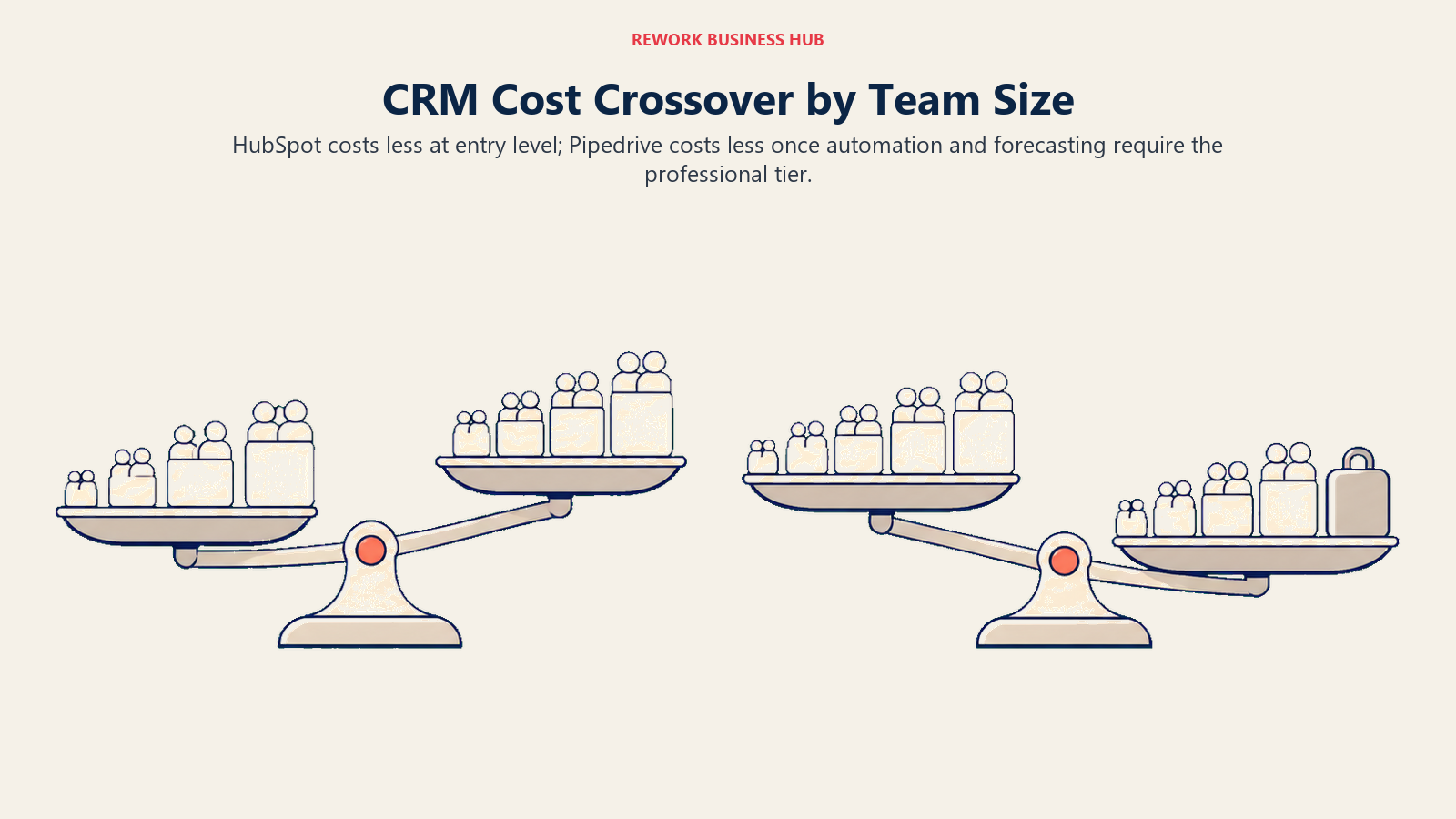
Seat price times headcount is the calculation most people run, and for the entry tiers it's the whole story. It stops being the whole story the moment your team needs automation, because that's the tier where HubSpot's onboarding fee lands.
Entry-tier cost: Pipedrive Lite vs HubSpot Starter
| Seats | Pipedrive Lite | HubSpot Starter |
|---|---|---|
| 5 | $840/yr | $420/yr |
| 10 | $1,680/yr | $840/yr |
| 25 | $4,200/yr | $2,100/yr |
| 50 | $8,400/yr | $4,200/yr |
| 100 | $16,800/yr | $8,400/yr |
At every seat count here, HubSpot Starter runs exactly half of Pipedrive Lite. If your team genuinely fits within Starter's single pipeline and no-forecasting limits, HubSpot is the cheaper entry point, full stop.
Automation-tier cost: Pipedrive Growth vs HubSpot Professional (Year 1, onboarding included)
| Seats | Pipedrive Growth | HubSpot Professional (Year 1) | HubSpot Professional (Year 2+) |
|---|---|---|---|
| 5 | $2,340/yr | $6,900 ($5,400 licenses + $1,500) | $5,400/yr |
| 10 | $4,680/yr | $12,300 ($10,800 + $1,500) | $10,800/yr |
| 25 | $11,700/yr | $28,500 ($27,000 + $1,500) | $27,000/yr |
| 50 | $23,400/yr | $55,500 ($54,000 + $1,500) | $54,000/yr |
| 100 | $46,800/yr | $109,500 ($108,000 + $1,500) | $108,000/yr |
This is the crossover the "Pipedrive is cheap" reputation misses. Once you need real automation and forecasting, not just the promise of it, Pipedrive Growth costs less than half of HubSpot Professional's Year 1 total at every seat count, and less than half of HubSpot's Year 2 recurring price too. The $1,500 onboarding fee only widens a gap that was already there.
For teams that need HubSpot's or Pipedrive's top tier, the pattern holds at a smaller scale, since Pipedrive's ceiling still tops out well under HubSpot's:
| Seats | Pipedrive Ultimate ($79/seat/mo) | HubSpot Enterprise, Year 1 ($150/seat/mo + $3,500 onboarding) |
|---|---|---|
| 25 | $23,700/yr | $48,500 ($45,000 + $3,500) |
| 50 | $47,400/yr | $93,500 ($90,000 + $3,500) |
| 100 | $94,800/yr | $183,500 ($180,000 + $3,500) |
Year 2 onward, drop the one-time onboarding fee from HubSpot's totals since it doesn't recur. A 25-seat HubSpot Professional deployment runs $28,500 in Year 1 and $27,000 every year after that.
Time to Value and Implementation Effort
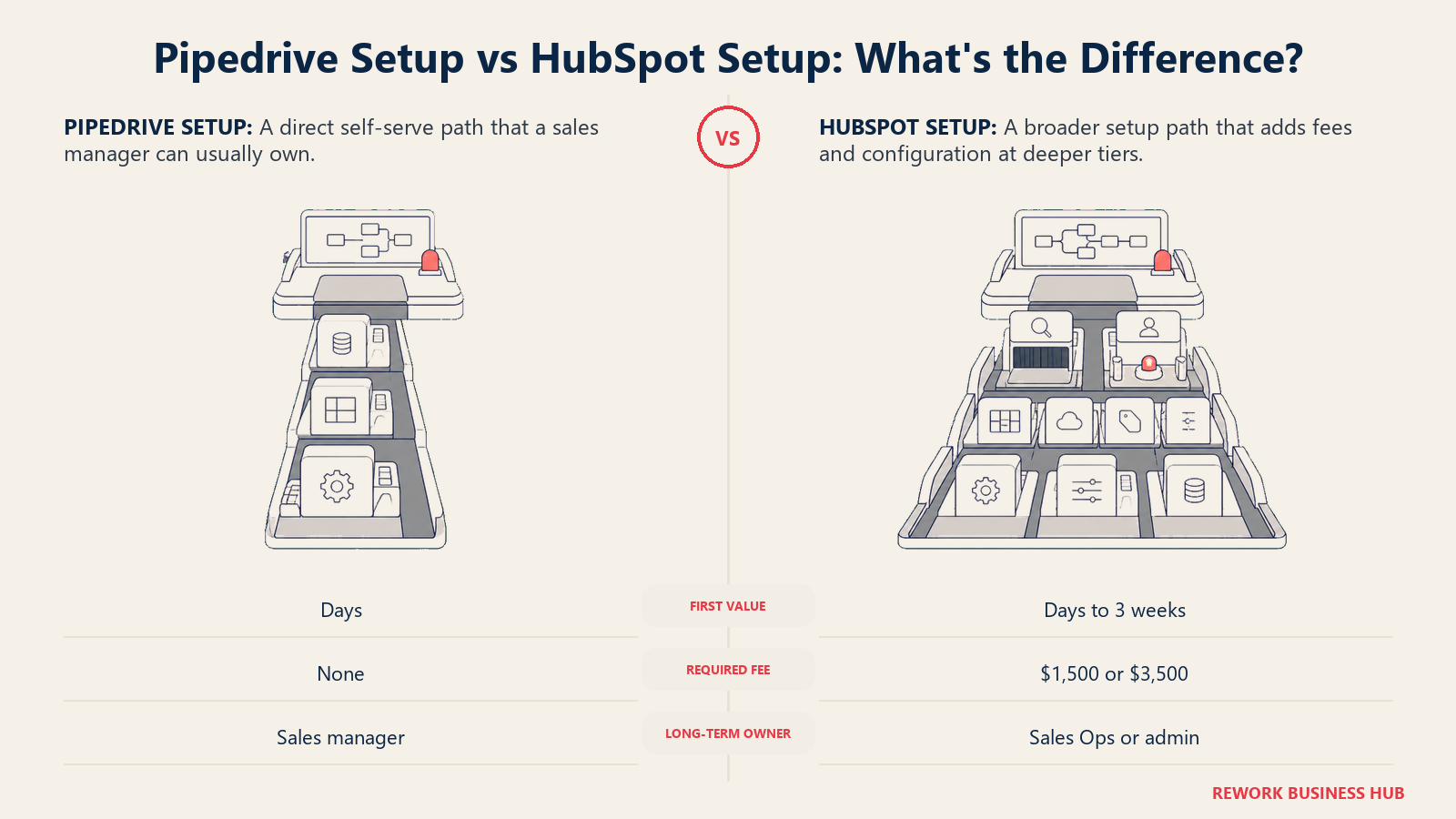
Setup speed matters as much as the license price, especially for a team losing deals to the old tool while a rollout drags on.
| Dimension | Pipedrive | HubSpot |
|---|---|---|
| Typical setup path | Self-serve at every tier, no partner required | Self-serve for Starter and most Professional deployments; Enterprise-level complexity often benefits from a partner |
| Time to first value | Days, even at Growth or Premium | Days for Starter; 1-3 weeks for Professional with real data migration |
| Onboarding cost | Not charged by Pipedrive at any tier | $1,500 (Professional) or $3,500 (Enterprise), mandatory, itemized on the invoice |
| Who maintains it long-term | A sales manager can usually own pipeline stages, fields, and automations without a dedicated admin | A sales ops generalist maintains workflows and properties comfortably through Professional; Enterprise-level custom objects and permission sets benefit from more dedicated ownership |
| Where the hidden cost hides | Add-ons: Campaigns (email marketing), LeadBooster below Premium, and per-seat AI feature gating | The onboarding fee is visible on the invoice, but the seat-price jump from Starter to Professional ($7 to $90) is easy to underestimate when budgeting a rollout |
Neither platform needs a dedicated hire to get started. The difference is what's optional: Pipedrive's setup cost is mostly upfront and visible in the plan you pick, while HubSpot's is partly a line item and partly a seat-price jump you feel once Starter stops holding your team.
Migrating from a legacy CRM carries its own risk, independent of which vendor you pick. Our CRM migration guide covers the cleanup and validation work both vendors' onboarding docs tend to underestimate.
Pipeline and Deal Management Depth
This is where Pipedrive built its reputation, and it mostly still holds. Pipedrive was designed around the visual pipeline first; multiple customizable pipelines are available even on the entry-level Lite plan, no upgrade required (Pipedrive Lite plan features; Pipedrive multiple pipelines). HubSpot gates pipeline count tightly by tier instead: 1 pipeline at Starter, 2 at Professional, and 15 at Enterprise (HubSpot Sales Hub pricing).
| Dimension | Pipedrive | HubSpot |
|---|---|---|
| Deal pipelines | Multiple, available from the entry tier | 1 (Starter), 2 (Professional), 15 (Enterprise) |
| Leads + deals capacity | 2,500/user (Lite) up to 15,000/user (Premium) | Not published as a hard cap; governed by object and workflow limits instead |
| Deal splits (crediting multiple reps) | Not a native feature | Available from Professional up |
| Custom fields | 30-ish on entry tiers, rising to 500 at Ultimate | Not published as a flat number; governed by object-level property limits |
| Interface philosophy | Opinionated pipeline view, minimal configuration to get moving | Broader object model (contacts, companies, deals, tickets), more configuration surface |
If your process is genuinely just "move a deal through stages until it closes or dies," Pipedrive's interface gets a rep productive faster. If you need deal splits, multi-object relationships, or reporting spanning contacts, companies, and tickets in one view, HubSpot's data model earns its extra configuration.
Marketing and Sales Alignment
This is the section that decides the comparison for a lot of buyers, and it's the one place Pipedrive doesn't really compete.
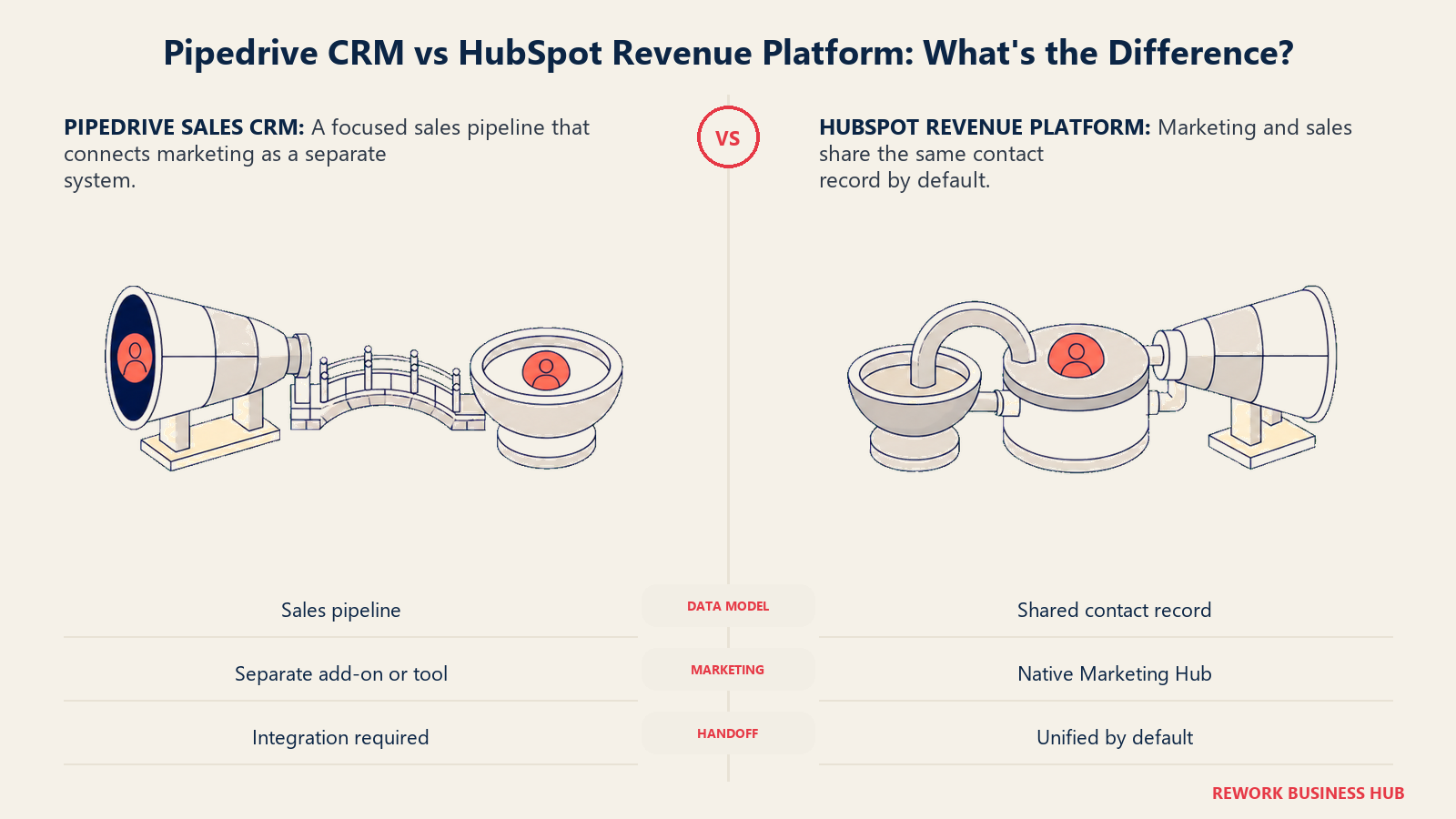
HubSpot was built marketing-first (inbound marketing, founded 2006) with the CRM added later, and it still shows in the product: Marketing Hub, Sales Hub, Service Hub, and CMS Hub share the same contact record by default. Lead scoring, form fills, and lifecycle stage all live on the record a sales rep already sees, with no integration project required to connect the two sides of the funnel.
Pipedrive was built sales-first, and it stays that way. Email marketing is sold separately through a Campaigns add-on that isn't bundled into any CRM tier, including Ultimate, and it ships without the automation depth, deliverability analytics, or A/B testing a real marketing platform needs. It's a sales pipeline tool with an email add-on bolted on, not a marketing platform.
| Dimension | Pipedrive | HubSpot |
|---|---|---|
| Native marketing automation | No; Campaigns add-on covers basic email only | Yes, Marketing Hub shares Sales Hub's data model |
| Lead scoring visible to sales | Available from Premium ($64/seat/mo) | Available from Starter (up to 5 scores), expands at Professional |
| Handoff friction | Higher if you need real nurture sequences; requires a separate marketing tool | Low, if you're buying or already own Marketing Hub |
| Best fit | Teams where marketing sits in a separate, dedicated tool already | Teams where one small-to-mid funnel is owned by overlapping people |
If your funnel is small enough that the same one or two people touch both sides, HubSpot's shared object model removes an integration project you'd otherwise build yourself. Our guide on marketing automation vs CRM breaks down when you need the combined platform versus a dedicated pipeline tool plus a separate marketing tool.
Automation and Workflow Limits by Tier
Both vendors gate automation by tier, and the gap between "some automation" and "meaningful automation" is wider than either pricing page suggests.
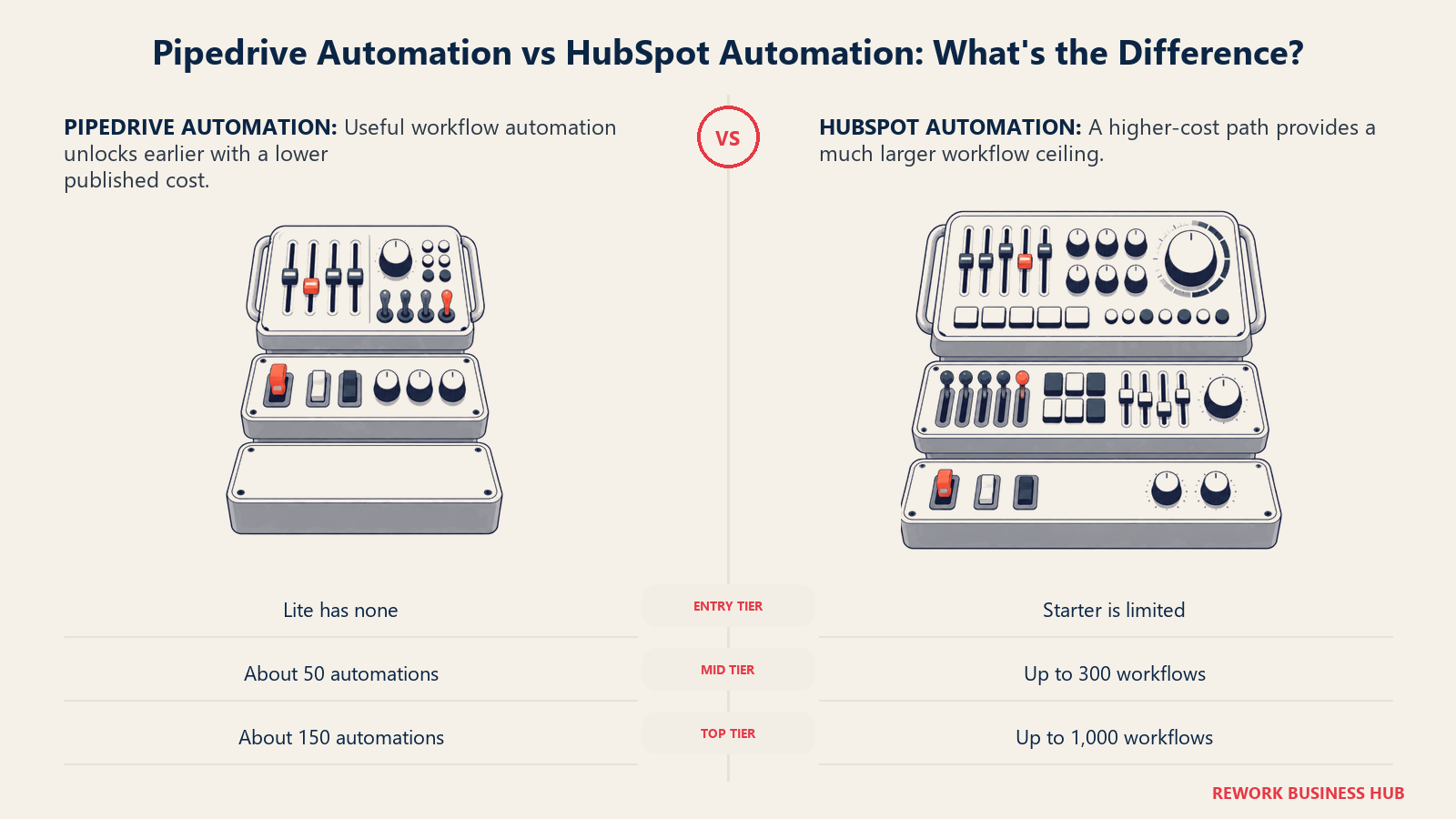
| Tier | Pipedrive | HubSpot |
|---|---|---|
| Entry | Lite: no workflow automation | Starter: workflows described as "Limited" on HubSpot's own comparison table |
| Mid | Growth ($39/seat/mo): automation unlocked, roughly 50 active automations, 3 if/else conditions per automation | Professional ($90/seat/mo + $1,500 onboarding): up to 300 workflows, quote-based workflows not included |
| Top | Premium/Ultimate ($64-79/seat/mo): roughly 150 active automations, 10 if/else conditions per automation | Enterprise ($150/seat/mo + $3,500 onboarding): up to 1,000 workflows, quote-based workflows included |
Source: Pipedrive plan tiers; HubSpot Sales Hub pricing
The pattern repeats what the cost tables already showed: Pipedrive's automation tier runs roughly a third of HubSpot's, before onboarding. If workflow count is the deciding factor for a large team, HubSpot Enterprise's 1,000-workflow ceiling is genuinely higher than anything Pipedrive publishes. For most mid-size teams, Pipedrive Growth's automation cap is enough that the ceiling question never comes up.
Reporting and Forecasting
Forecasting is the clearest example of the automation-tier crossover playing out in a single feature. Pipedrive's forecast view and reporting unlock at Growth, $39/seat/mo, no onboarding fee. HubSpot's forecasting is a Professional-tier feature, $90/seat/mo plus the mandatory $1,500 onboarding charge.
| Dimension | Pipedrive | HubSpot |
|---|---|---|
| Forecasting | Available from Growth | Available from Professional; "default and custom forecasting," expanding to cross-team hierarchies at Enterprise |
| Reports per user | 50 (Growth) rising to 500 (Ultimate) | Not published as a flat report count |
| Dashboards | Customizable insights dashboards from Premium | 10 (Starter), 30 (Professional), 75 (Enterprise) |
| Where it's cheapest to unlock | Growth, $39/seat/mo | Not available below Professional, $90/seat/mo |
If forecasting is a must-have, this is the clearest dollar-for-dollar argument for Pipedrive in the whole comparison: more than $50 a seat cheaper per month, with no onboarding fee attached.
AI: Pipedrive AI vs HubSpot Breeze
Both vendors ship AI features today, priced and packaged in genuinely different ways, and it's worth checking what's actually shipped rather than what's marketed.
| Dimension | Pipedrive AI | HubSpot Breeze |
|---|---|---|
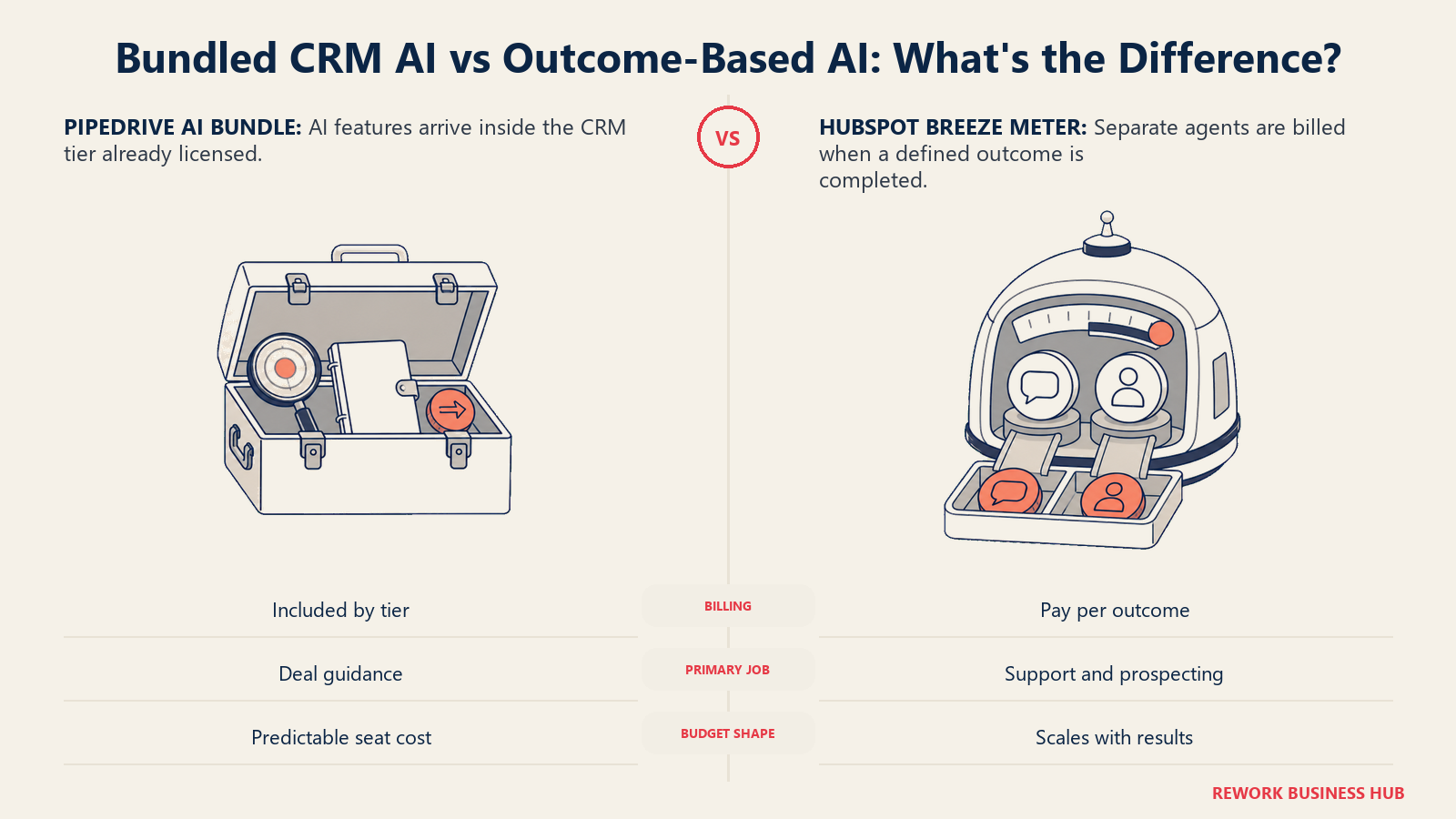
| Pricing model | Bundled into the seat price by tier, no separate credits | Outcome-based since April 2026: $0.50 per resolved conversation (Customer Agent), $1 per qualified lead (Prospecting Agent), billed via HubSpot Credits |
| What's generally available | AI import assistant, AI-assisted report creation, marketplace search, smart app recommendations (all plans); AI email writing and win-probability notifications (Premium and up) | Customer Agent and Prospecting Agent on Professional and Enterprise Sales/Service Hub |
| What's still in beta | Conversational Q&A Sales Assistant (voice and text, OpenAI-powered), AI email summarization, AI suggested replies | Not applicable; Breeze's current pricing model launched in April 2026 as a general release |
| Vendor-reported performance | Not independently published on a page we could verify | Breeze Customer Agent resolves 65% of conversations and cuts resolution time by 39%, across more than 8,000 activated customers (HubSpot, April 2026) |
| What it automates | Deal prioritization, next-best-action suggestions, email drafting and summarizing, app discovery | Customer support resolution, prospecting and lead qualification, content and data agents |
Source: Pipedrive AI knowledge base
The honest read: Pipedrive's AI is a feature bundle that comes with the tier you already pay for, no separate bill to track. HubSpot's Breeze is metered, with a public price per outcome that's easier to model against ROI but is a genuinely separate cost that scales with usage. Neither is "better AI." They're different pricing philosophies.
Integration Ecosystem Size
| Dimension | Pipedrive | HubSpot |
|---|---|---|
| Marketplace size | 400+ apps (Pipedrive Marketplace) | 2,000+ App Marketplace integrations (HubSpot Q1 2026 earnings release) |
| Notable native depth | AI-powered marketplace search finds integrations by describing the workflow in plain English | Ecosystem spans Marketing, Service, and CMS Hub apps in addition to Sales Hub apps |
| Vendor-reported adoption stat | Users with at least 1 app installed win 1.5x more deals | Not independently published on a page we could verify |
HubSpot's marketplace is roughly five times the size of Pipedrive's, and a meaningful share of that gap is HubSpot's own multi-hub ecosystem (Marketing, Service, CMS) pulling in category-specific apps that a sales-only tool like Pipedrive has no slot for. If a specific niche integration decides your stack, check both marketplaces directly before assuming either has it.
Strengths and Trade-offs, Side by Side
Pipedrive
| Strengths | Trade-offs |
|---|---|
| Automation and forecasting unlock at a genuinely lower price than HubSpot's equivalent tier | Marketing automation isn't native; Campaigns is a thin, separate add-on |
| No onboarding fee at any tier | Smaller third-party marketplace than HubSpot's |
| Multiple pipelines from the entry tier, no upgrade required | Data model is simpler by design, which caps how far you can customize |
| Sales rep-first interface, fast to learn | AI's conversational agent is still beta, opt-in only |
HubSpot Sales Hub
| Strengths | Trade-offs |
|---|---|
| Cheapest entry-level seat price of the two, published pricing all the way to Enterprise | Onboarding fee is mandatory once you're past Starter, $1,500 or $3,500 |
| One data model shared with Marketing, Service, and CMS Hubs | Automation-capable tier costs more than double Pipedrive's equivalent |
| Largest marketplace of the two, 2,000+ apps | Starter's single pipeline and missing forecasting won't hold most growing teams long |
| Outcome-based AI pricing tied to a specific, countable result | Free tools cap at 2 users; it isn't an unlimited free CRM |
When Pipedrive Is the Right Call
- You want automation and forecasting without paying HubSpot's Professional-tier premium or its onboarding fee.
- Your team's process is genuinely "manage the pipeline," not "manage the pipeline and run nurture campaigns from the same tool."
- You'd rather a sales manager own the setup than budget for a partner or an onboarding line item.
- You already run a dedicated marketing platform and don't need the CRM to double as one.
If you're a small team weighing whether you even need a full CRM yet, our guide on how to choose a CRM for a small business is worth reading before you commit to either vendor's paid tier.
When HubSpot Is the Right Call
- You want the lowest entry-level seat price of the two and your process fits one pipeline without heavy customization.
- Marketing and sales already share, or want to share, one system of record, and you don't want to build or maintain an integration between two separate tools.
- You can budget the $1,500 or $3,500 onboarding fee as a known, published number rather than treating it as a surprise.
- You expect to need HubSpot's broader ecosystem (Service Hub, CMS Hub) down the line and want one platform now instead of migrating later.
Who Should Actually Pick Which
| Your situation | Better fit |
|---|---|
| Small sales team, simple pipeline, wants automation without a big price jump | Pipedrive Growth |
| Team that also runs marketing campaigns and wants them on the same contact record | HubSpot, for the shared data model |
| Budget-sensitive team that fits in one pipeline with no forecasting needs | HubSpot Starter |
| Team that needs forecasting and doesn't want to pay for onboarding | Pipedrive Growth |
| Sales-only team, no marketing use case, deal splits not required | Pipedrive |
| Org planning to add Service Hub or CMS Hub eventually | HubSpot |
| Team comparing the wider budget CRM field before deciding | See Zoho CRM vs Freshsales or the Close alternatives roundup for other sales-only pipeline tools |
What to Do Next
If you're leaning Pipedrive: start on Growth, not Lite, if automation or forecasting is part of the reason you're switching tools at all. Lite's price looks attractive next to HubSpot Starter, but it doesn't do the thing that usually justifies leaving a spreadsheet. If you're leaning HubSpot: get the Professional quote with the $1,500 onboarding fee itemized separately from the seat price before you present a budget number, and confirm whether your team actually needs Marketing Hub's shared data model or whether you're paying for an integration you don't need yet.
Either way, run this article's seat-count math against your headcount a year from now, not today. Automation-tier pricing is where the two vendors diverge most, and that's exactly the tier most growing teams end up needing. For the fuller category view, our guide to the best CRM software of 2026 and our CRM evaluation criteria checklist both cover the wider field, including HubSpot against Salesforce specifically, broken down separately in HubSpot vs Salesforce.
Neither of these might be the right shape of tool if the real problem isn't the pipeline view, it's that leads and conversations are scattered across your sales and marketing tools with no shared record between them. If what you need is CRM, lead management, and a multi-channel chat inbox in one product, without a mandatory onboarding fee on one side or a bolted-on email add-on on the other, that's a smaller, less enterprise-shaped category than either vendor here. Rework packages that combination as its Revenue Engine, from $159/month billed yearly with 5 marketing and 5 sales seats (rework.com/pricing). It's a smaller player than either Pipedrive or HubSpot, with a thinner marketplace than HubSpot's and less pipeline depth than Pipedrive's, so it's not the answer if deep pipeline customization is the whole point. But if the real blocker is choosing between "cheap but sales-only" and "full-suite but expensive to automate," it's worth a look.
Frequently Asked Questions about Pipedrive vs HubSpot
Is Pipedrive cheaper than HubSpot?
Not at the entry tier anymore. HubSpot Starter runs $7/seat/month billed annually versus Pipedrive Lite at $14/seat/month. Pipedrive becomes the cheaper option once you need automation and forecasting: Pipedrive Growth at $39/seat/month costs less than half of HubSpot Professional's $90/seat/month plus its mandatory $1,500 onboarding fee.
Does Pipedrive charge an onboarding fee like HubSpot does?
No. Pipedrive doesn't charge a mandatory onboarding fee at any tier. HubSpot requires a $1,500 one-time fee at Professional and $3,500 at Enterprise, on top of the published seat price.
Which one is better for a team that does both marketing and sales?
HubSpot, if marketing and sales share one small-to-mid funnel. Marketing Hub, Sales Hub, Service Hub, and CMS Hub share the same contact record by default. Pipedrive sells email marketing separately through a Campaigns add-on that isn't bundled into any CRM tier and doesn't include real marketing automation.
Is HubSpot's free CRM actually free and unlimited?
It's free, but not unlimited. HubSpot's free Sales Hub tools are capped at 2 users. Past that, you need at least the Starter tier at $7/seat/month.
Which CRM has better AI features right now?
They're priced differently, which matters more than a feature checklist. Pipedrive AI is bundled into your existing tier, though the deeper features (email writing, win-probability notifications) require Premium. HubSpot Breeze is outcome-based since April 2026: $0.50 per resolved conversation, $1 per qualified lead. Pick based on whether your budget prefers a flat number or a usage-based one.
Can I get workflow automation on Pipedrive's cheapest plan?
No. Pipedrive Lite doesn't include workflow automation. You need Growth, $39/seat/month, to unlock it, still without an onboarding fee.
How many pipelines can I create in each tool?
Pipedrive supports multiple customizable pipelines even on its entry-level Lite plan. HubSpot gates pipeline count by tier: 1 at Starter, 2 at Professional, and 15 at Enterprise.
Do I need a dedicated CRM administrator for either tool?
Not necessarily for Pipedrive at any tier, or for HubSpot through Professional. A sales manager or sales ops generalist can typically own setup and maintenance. HubSpot Enterprise's custom objects and advanced permission sets are the point where dedicated ownership starts to matter more.

Head of Enterprise Solutions
On this page
- Key Facts
- Pipedrive vs HubSpot at a Glance
- What Pipedrive and HubSpot Actually Cost
- The Real Cost at 5, 10, 25, 50, and 100 Seats
- Entry-tier cost: Pipedrive Lite vs HubSpot Starter
- Automation-tier cost: Pipedrive Growth vs HubSpot Professional (Year 1, onboarding included)
- Time to Value and Implementation Effort
- Pipeline and Deal Management Depth
- Marketing and Sales Alignment
- Automation and Workflow Limits by Tier
- Reporting and Forecasting
- AI: Pipedrive AI vs HubSpot Breeze
- Integration Ecosystem Size
- Strengths and Trade-offs, Side by Side
- Pipedrive
- HubSpot Sales Hub
- When Pipedrive Is the Right Call
- When HubSpot Is the Right Call
- Who Should Actually Pick Which
- What to Do Next