HubSpot vs Salesforce: Which CRM Actually Fits Your Sales Team in 2026?
Turn this article into takeaways for your work.


Each assistant summarizes the article only for you and suggests best practices for your work.
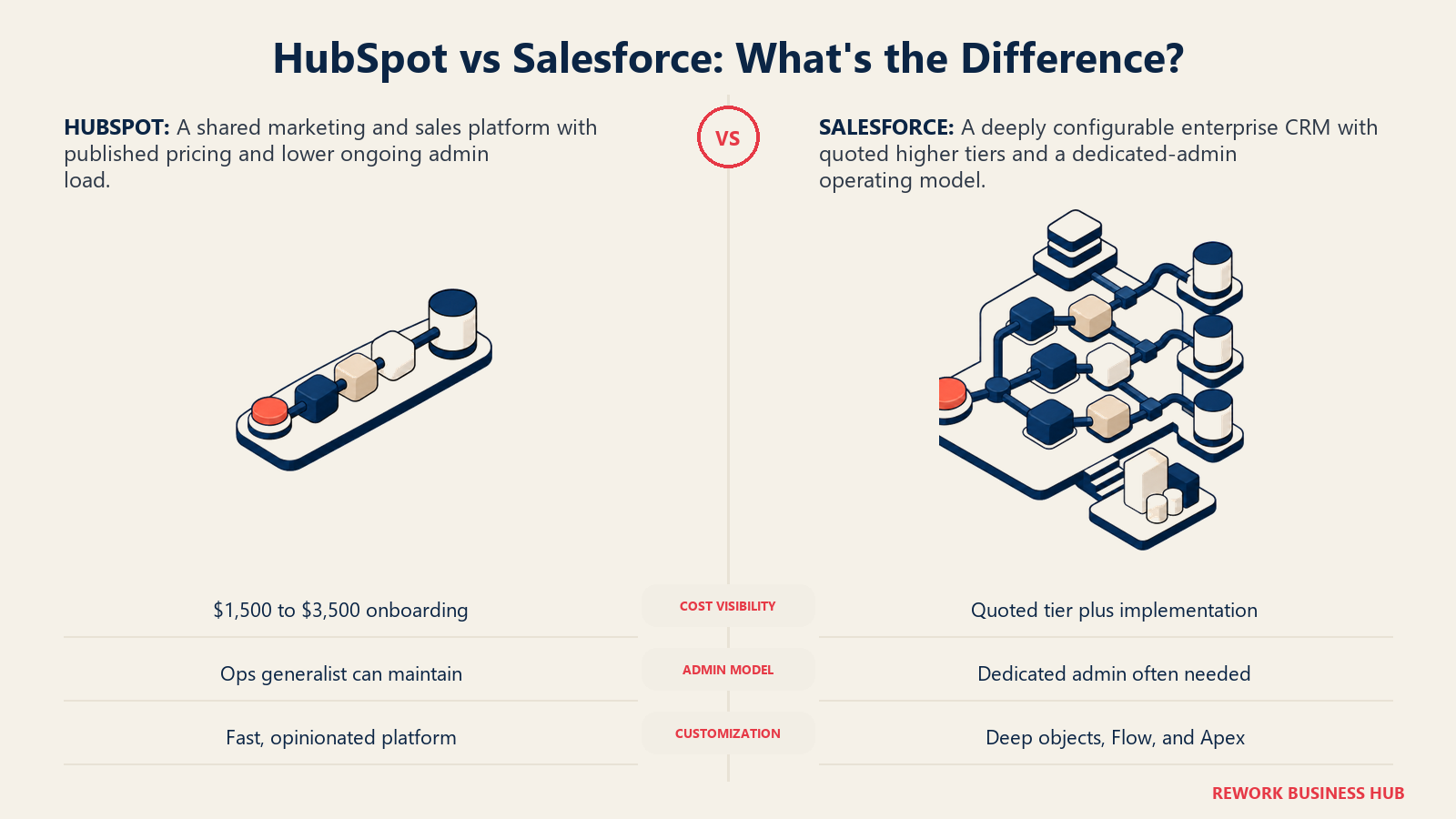
HubSpot vs Salesforce is one of the most searched CRM decisions in B2B software, and most of what ranks for it is a features table dressed up as an opinion. That's not useful when you're the person who has to defend the number to a CFO. This comparison skips the feature bingo and goes straight at the four things that actually decide it: what the seat price turns into once onboarding fees and admin time are added, how far each platform bends before it breaks, how marketing and sales data flow (or don't) between the two halves of the deal, and where each vendor's AI story is real versus still a pricing page in progress.
This matters more than usual right now. CRM vendors are consolidating: Zendesk is retiring Zendesk Sell entirely by August 2027 and pointing displaced customers toward Pipedrive, and HubSpot and Salesforce remain the two default landing spots for almost everyone else re-platforming a CRM in 2026. If Zendesk Sell's retirement is what sent you here, our breakdown of Zendesk Sell alternatives covers that migration directly. If you want the fuller category view before narrowing to these two, our guide to the best sales pipeline software covers the wider field.
Read on for where each one is actually strong, not just where its marketing says it is.
Key Facts
- Salesforce holds roughly 20% of the global CRM applications market, its 13th straight year at #1 and about four times the share of its nearest rival, Oracle, at 4.1% (IDC Worldwide Semiannual Software Tracker, via Salesforce).
- In Gartner's 2026 Magic Quadrant for CRM Sales Platforms, published August 6, 2026, Salesforce stayed a Leader for the 20th consecutive year, while HubSpot moved up from Niche Player to Challenger (CX Today).
- HubSpot's Professional and Enterprise Sales Hub tiers each carry a mandatory one-time onboarding fee on top of the published per-seat price: $1,500 and $3,500 (HubSpot pricing).
- Salesforce markets AppExchange as home to "7,000+ apps," while an independent tracker counted 5,877 publicly listed apps as of June 2026, a real gap between the marketing number and the visible catalog (SF Apps Stats).
- Salesforce's Agentforce actions run on Flex Credits priced at $500 per 100,000 credits, with a standard agent action consuming about 20 credits, roughly $0.10 per action (Constellation Research).
HubSpot vs Salesforce at a Glance
| Factor | HubSpot | Salesforce |
|---|---|---|
| Best known for | Marketing-to-sales handoff in one product | Depth and customization at enterprise scale |
| Entry price | Free tools, then $7/seat/mo (Starter, billed annually) | $25/user/mo (Starter Suite, billed annually), the only tier Salesforce publishes |
| Mandatory onboarding fee | $1,500 (Professional), $3,500 (Enterprise) | None published; higher editions are quoted, so implementation cost gets negotiated, not listed |
| Typical setup path | Self-serve for most teams | Partner-led or admin-led for Pro Suite and up |
| Data model | Contacts, companies, deals, and tickets shared across Marketing, Sales, Service, and CMS Hubs | Fully custom objects on every paid edition; Marketing Cloud is a separate product and data model |
| AI pricing model | Outcome-based: pay per resolved conversation or qualified lead | Consumption-based: Flex Credits, plus per-user add-ons Salesforce doesn't itemize publicly |
| 2026 Gartner MQ standing | Challenger, up from Niche Player | Leader, 20th consecutive year |
| Where it tends to lose | Deep customization, multi-entity org structures | Budget, timeline, and admin availability for smaller teams |
What HubSpot and Salesforce Actually Cost
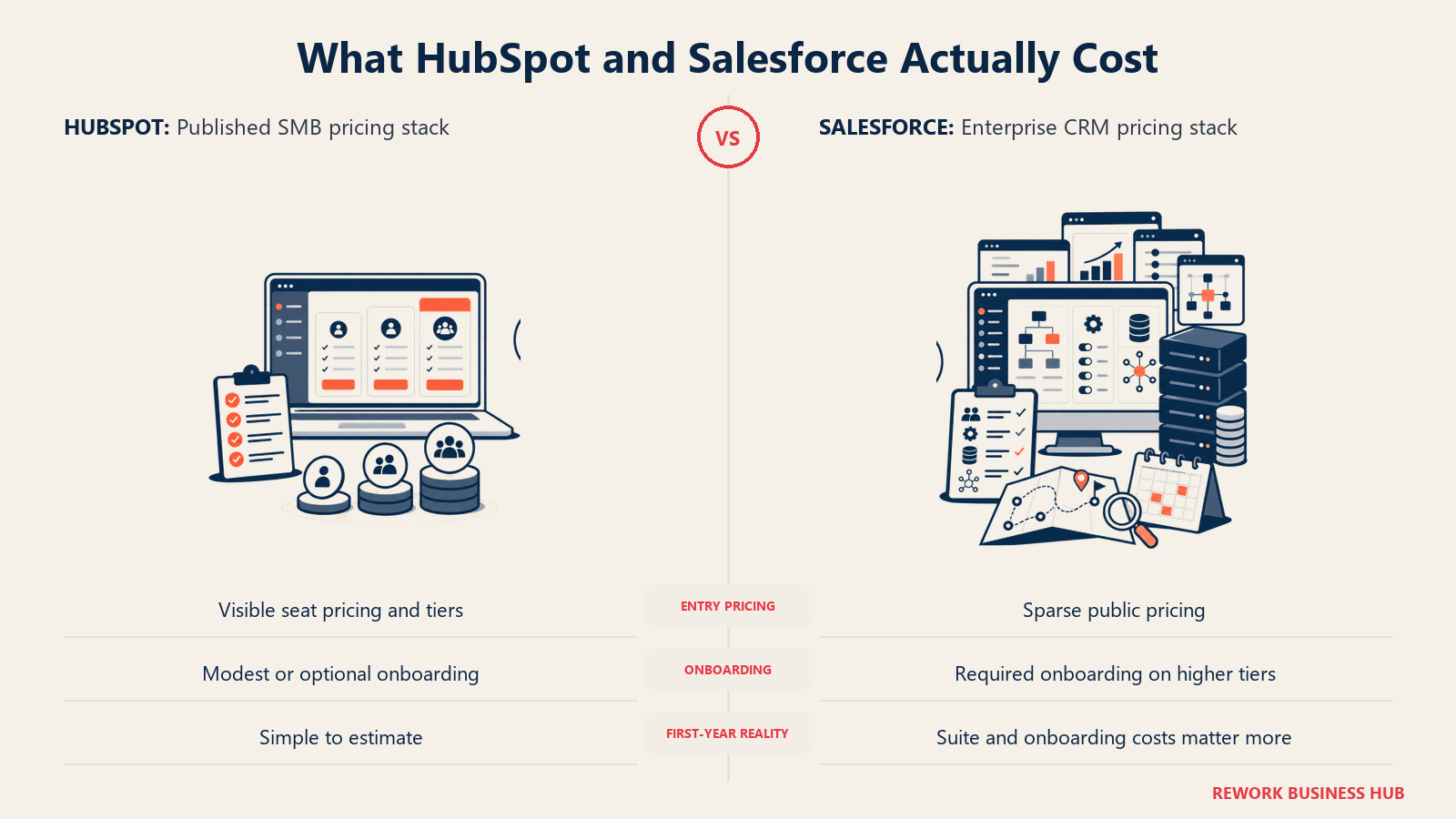
Start with what's actually published, because that's the first place these comparisons go wrong. HubSpot puts every tier's price on its own pricing page, including the onboarding fees most competitor roundups leave out entirely. Salesforce publishes exactly one number.
| HubSpot Sales Hub tier | Price | Required onboarding | What you're buying |
|---|---|---|---|
| Free Tools | $0, up to 2 users | None | Basic contact and deal tracking, email tracking |
| Starter | $7/seat/mo billed annually ($20/seat/mo monthly) | None | Simple pipeline, sequences, basic reporting |
| Professional | $90/seat/mo billed annually ($100/seat/mo monthly) | $1,500 one-time, required | Automation, forecasting, playbooks, custom reporting |
| Enterprise | $150/seat/mo billed annually | $3,500 one-time, required | Advanced permissions, predictive lead scoring, custom objects |
Source: HubSpot Sales Hub pricing
| Salesforce Sales Cloud tier | Price | Notes |
|---|---|---|
| Starter Suite | $25/user/mo billed annually | The only tier with a fixed number on Salesforce's own pricing page |
| Pro Suite | Not published | Quoted through Salesforce sales |
| Enterprise | Not published on a page we could independently verify | Quoted through sales; several 2026 third-party pricing guides report a figure near $165/user/month tied to Agentforce edition requirements, labeled here as reported, not vendor-confirmed |
| Unlimited | Not published on a page we could independently verify | Quoted through sales; reported near $330/user/month, same caveat |
| Agentforce 1 Sales | Not published | Quoted through sales |
Source: Salesforce Sales Cloud pricing (the page blocks automated verification of anything past Starter Suite, which is why the higher tiers here are marked as reported rather than vendor-confirmed)
That gap matters more than it looks. A HubSpot Professional quote comes with the real number attached, onboarding fee included, before you ever talk to a rep. A Salesforce Pro Suite or Enterprise quote comes out of a sales conversation, which means the number you get depends partly on your negotiating leverage, not a published rate card. Neither approach is dishonest. But only one of them lets you build a budget without a call.
If even HubSpot's published number is more than your seat count justifies, our roundup of HubSpot alternatives covers cheaper self-serve options. And if "call sales to find out" is itself the dealbreaker, our Salesforce alternatives guide covers CRMs that publish real numbers past the entry tier.
The Real Cost at 10, 25, 50, and 100 Seats
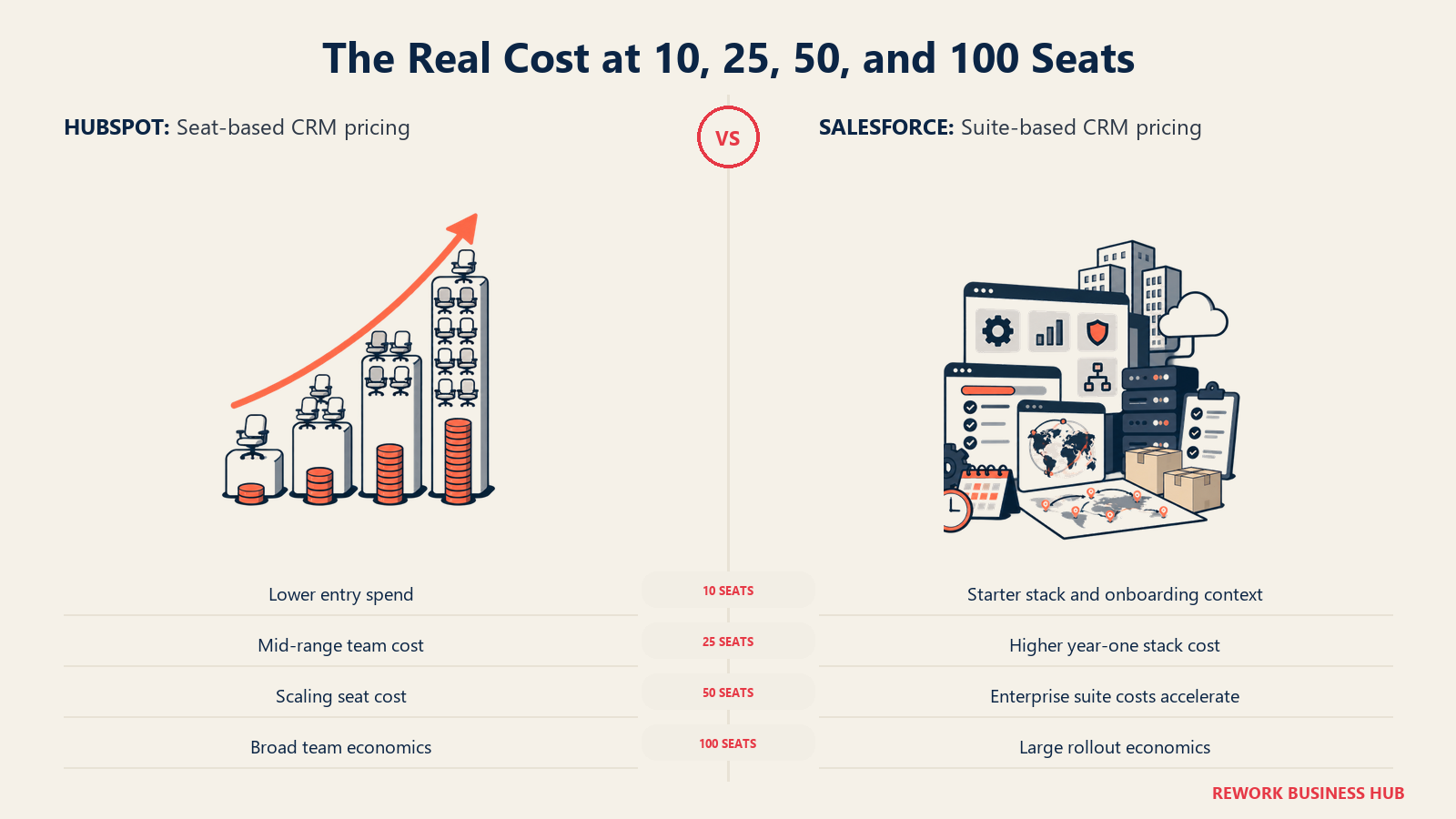
Seat price times headcount is the calculation everyone runs. It's also the wrong one for HubSpot Professional and Enterprise, because the onboarding fee is required, not optional, and it's easy to miss when you're comparing a monthly per-seat rate across vendors that don't structure pricing the same way.
| Seats | HubSpot Starter | HubSpot Professional (Year 1, onboarding included) | HubSpot Enterprise (Year 1, onboarding included) | Salesforce Starter Suite |
|---|---|---|---|---|
| 10 | $840/yr | $12,300 ($10,800 licenses + $1,500) | $21,500 ($18,000 + $3,500) | $3,000/yr |
| 25 | $2,100/yr | $28,500 ($27,000 + $1,500) | $48,500 ($45,000 + $3,500) | $7,500/yr |
| 50 | $4,200/yr | $55,500 ($54,000 + $1,500) | $93,500 ($90,000 + $3,500) | $15,000/yr* |
| 100 | $8,400/yr | $109,500 ($108,000 + $1,500) | $183,500 ($180,000 + $3,500) | $30,000/yr* |
*Starter Suite is built for small teams. At 50-100 seats, most organizations need the automation and forecasting depth that only Pro Suite or Enterprise provide anyway, so Salesforce typically routes deals at this size into a sales conversation rather than a self-serve Starter Suite checkout, regardless of what the raw seat count technically allows.
Salesforce Pro Suite, Enterprise, and Unlimited don't appear in this table with real numbers because Salesforce doesn't publish them. That's not a knock, it's how enterprise software pricing usually works, but it means you can't build an apples-to-apples 25-seat comparison the way you can with HubSpot. Budget for a sales conversation, not a page.
Year 2 onward, subtract the onboarding fee from the HubSpot Professional or Enterprise totals since it's one-time, not recurring. A 25-seat HubSpot Professional deployment runs $28,500 in Year 1 and $27,000 every year after.
Time to Value and Implementation Effort
Admin burden isn't a one-time setup cost. It's an ongoing line item that rarely makes it into the budget conversation until six months in, when workflows are misfiring and nobody remembers why.
| Dimension | HubSpot | Salesforce |
|---|---|---|
| Typical setup path | Self-serve for Starter and most Professional deployments | Partner-led or admin-led for Pro Suite-equivalent complexity and up |
| Time to first value | Days for Starter; 1-3 weeks for Professional with real data migration | Days for Starter Suite; commonly weeks to months for Pro Suite/Enterprise with a partner |
| Who configures it long-term | A sales ops generalist can usually maintain workflows, properties, and sequences | Flow automation, custom objects, and permission sets benefit from a dedicated admin once complexity grows |
| Where the hidden cost hides | The $1,500 / $3,500 onboarding fee is mandatory and easy to leave out of a seat-only budget | Partner implementation cost and admin time rarely appear in the per-seat headline number at all |
| What breaks without upkeep | Sequences and lifecycle stages drift if properties aren't maintained | Automation rules fire on the wrong records, duplicates pile up, reports lose trust without active admin attention |
Neither platform runs itself forever. The difference is where the maintenance cost is visible. HubSpot puts a chunk of it on the invoice as a one-time fee. Salesforce leaves it for you to discover, usually as a headcount decision six months to a year in.
The Customization Ceiling
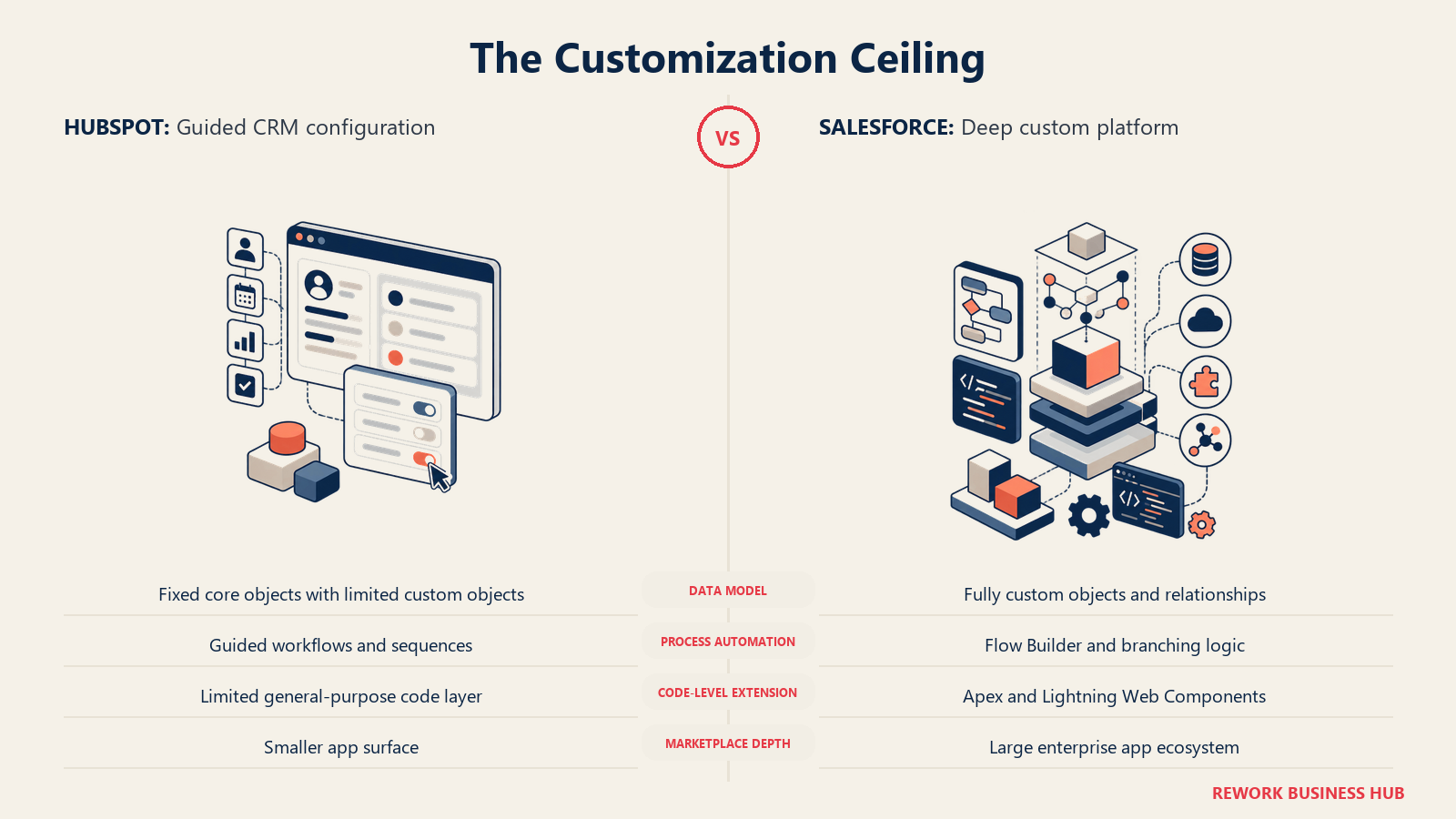
This is the section that actually decides most HubSpot vs Salesforce arguments, and it's rarely framed honestly. Both platforms can be customized. The real question is how far, and what it costs to get there.
| Dimension | HubSpot | Salesforce |
|---|---|---|
| Data model | Fixed core objects (contacts, companies, deals, tickets); custom objects available starting at Enterprise | Fully custom objects and relationships on every paid edition |
| Process automation | Workflows and sequences, built through a guided UI | Flow Builder: branching logic, scheduled and record-triggered flows, cross-object automation |
| Code-level extension | HubSpot CRM API and CMS development; no general-purpose programming layer inside the CRM itself | Apex, a full programming language, plus Lightning Web Components and triggers |
| Third-party marketplace | HubSpot App Marketplace; no published total app count, concentrated on marketing and sales tools | AppExchange, marketed at "7,000+ apps," independently counted at 5,877 as of June 2026, spanning deep industry-vertical solutions |
| Where the ceiling actually bites | Multi-entity org structures, complex multi-step approval chains, industries whose data model doesn't map to contacts/companies/deals | The ceiling isn't the platform, it's budget and admin capacity to configure what the platform already allows |
In practice, HubSpot's ceiling shows up around three patterns: multiple related company records that need to roll up into a parent account (franchise, holding-company, or multi-location structures), approval chains longer than two or three steps, and industries with data models that don't map cleanly onto contacts, companies, deals, and tickets (complex manufacturing bills of materials, multi-party real estate transactions, insurance policy hierarchies). Below that complexity, HubSpot's opinionated model is a feature, not a limitation, because there's less to configure and less that can drift out of sync. Above it, you're either building workarounds in HubSpot or you're looking at Salesforce's data model, which was built to handle exactly this.
Marketing and Sales Alignment
The two products came from opposite directions, and it still shows in how marketing and sales data flow between them.
| Dimension | HubSpot | Salesforce |
|---|---|---|
| Origin | Built marketing-first (inbound marketing, 2006), CRM added later | Built sales-first (sales force automation, 1999), marketing added via acquisition (ExactTarget, 2013) |
| Data model | One contact record shared across Marketing, Sales, Service, and CMS Hubs by default | Sales Cloud and Marketing Cloud run as separate products with separate data models |
| Buying motion | Marketing Hub is a separate purchase, but shares the underlying object model with Sales Hub | Marketing Cloud is a distinct contract, admin surface, and learning curve from Sales Cloud |
| Handoff friction | Low: lead scoring, forms, and lifecycle stage live on the same record sales already sees | Higher: syncing Marketing Cloud activity into Sales Cloud typically needs custom Flow or API work, or Salesforce's Data Cloud |
| Best fit | Teams where marketing and sales share one small-to-mid funnel | Teams whose marketing operation needs Marketing Cloud's depth regardless of what CRM sits underneath it |
If your funnel is small enough that one team basically owns both ends, HubSpot's shared data model removes a genuine integration project you'd otherwise have to build and maintain. If your marketing org operates at a scale that needs Marketing Cloud's channel orchestration anyway (multi-brand journeys, complex send governance, enterprise deliverability management), you're buying Marketing Cloud either way, and the Sales Cloud handoff becomes one more integration to build rather than the reason you picked Salesforce in the first place.
AI: Agentforce vs Breeze
Both vendors are leaning hard into agentic AI, and both pricing models changed materially in the last year, so treat anything you read from before mid-2026 as outdated.
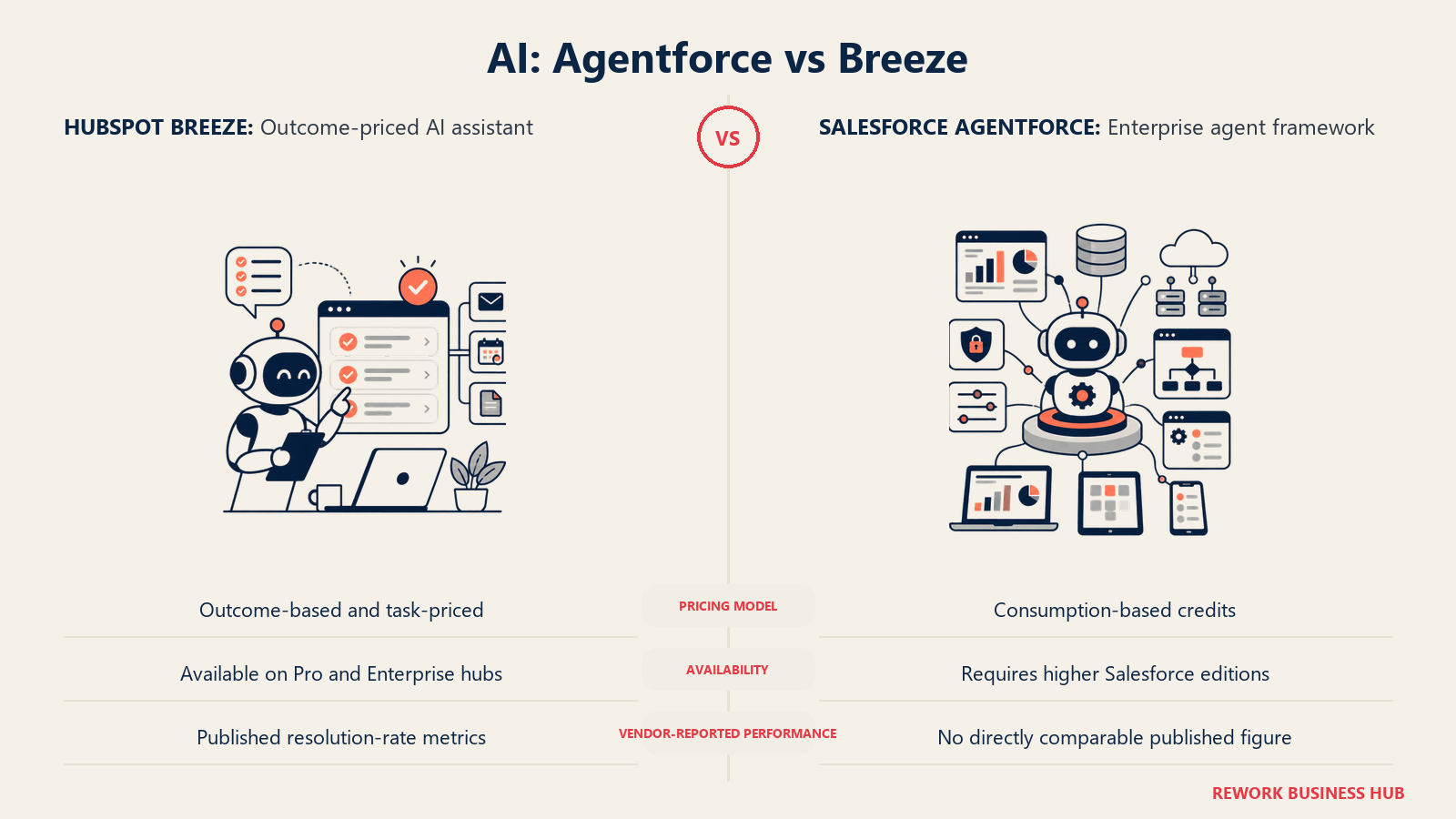
| Dimension | HubSpot Breeze | Salesforce Agentforce |
|---|---|---|
| Pricing model | Outcome-based since April 2026: $0.50 per resolved conversation (Customer Agent), $1 per qualified lead (Prospecting Agent), billed via HubSpot Credits | Consumption-based: Flex Credits at $500 per 100,000 credits, with a standard action consuming about 20 credits (roughly $0.10 per action) |
| Availability | Customer Agent and Prospecting Agent available on Pro and Enterprise Sales/Service Hub | Agentforce add-ons require Enterprise Edition or above; per-user add-on and Agentforce 1 Edition pricing aren't itemized on a page we could independently verify |
| Vendor-reported performance | Breeze Customer Agent resolves 65% of conversations and cuts resolution time by 39%, across more than 8,000 activated customers (HubSpot, April 2026) | We could not independently verify a comparable resolution-rate figure on a fetchable Salesforce page, so none is quoted here |
| What it automates | Customer support resolution, prospecting and lead qualification, plus content and data agents | A broader agent framework spanning Sales, Service, Commerce, and Industries clouds |
| Where it fits | Teams that want AI cost tied directly to a specific, countable result | Teams already invested in the Salesforce platform who want automation extended across multiple clouds and can absorb consumption-based billing variance |
The honest read: HubSpot's pricing is easier to model because it's public and tied to a specific, countable outcome. Salesforce's Flex Credit base rate is also public, but the per-user add-on and Agentforce 1 Edition pricing that determine your real bill sit behind a sales conversation, so confirm current pricing with Salesforce. If AI cost predictability matters more to your budget process than raw capability, weight that into the decision. If you're already committed to the Salesforce platform and want AI that extends across Sales, Service, and other clouds, Agentforce's broader scope is the more relevant comparison than price per action.
Strengths and Trade-offs, Side by Side
HubSpot
| Strengths | Trade-offs |
|---|---|
| Self-serve setup, live in days for most teams | Custom objects gated behind Enterprise |
| One data model across Marketing, Sales, Service, and CMS | No general-purpose programming layer for deep customization |
| Published pricing all the way to Enterprise | Onboarding fee is mandatory once you're past Starter |
| Outcome-based AI pricing tied to a specific result | Smaller third-party marketplace than AppExchange |
Salesforce
| Strengths | Trade-offs |
|---|---|
| Deepest customization ceiling in the category (Apex, Flow, custom objects) | Pro Suite, Enterprise, and Unlimited pricing is quoted, not published |
| Largest CRM marketplace and partner ecosystem | Admin burden grows with every customization added |
| Leader in Gartner's CRM Sales Platforms Magic Quadrant for 20 straight years | Marketing Cloud is a separate purchase and a separate data model |
| Enterprise compliance depth (HIPAA-eligible, FedRAMP options, SOC 2) | Pro Suite and Enterprise implementations typically need a partner |
When HubSpot Is the Right Call
- Your sales and marketing teams already share, or want to share, one system of record, and you don't want to build or maintain an integration between two separate platforms.
- You need to be selling inside a week, without a partner, and your process fits contacts, companies, deals, and tickets without heavy customization.
- You want AI pricing tied to results you can explain to a CFO in one sentence: $0.50 per resolved conversation, $1 per qualified lead.
- Your budget process can absorb the $1,500 or $3,500 onboarding fee as a known, published number rather than a negotiated one.
When Salesforce Is the Right Call
- Your sales process genuinely needs multi-product line items, multi-step approval chains, or territory-based routing that a fixed object model can't express.
- You're already running other Salesforce clouds (Service, Commerce, Marketing Cloud), and one platform across the org outweighs the Sales Cloud integration cost.
- You have, or are ready to hire, a dedicated admin, in-house or via a managed services partner. Salesforce's power is only accessible with someone actively maintaining it.
- You need compliance certifications, deep AppExchange verticals, or Apex-level customization that HubSpot's model doesn't offer.
Who Should Actually Pick Which
| Your situation | Better fit |
|---|---|
| Small sales team (under 10 reps), simple pipeline, wants to be selling within a week | HubSpot Starter |
| Growing team that also runs marketing campaigns from the same tool | HubSpot, for the shared data model |
| Sales process needs multi-product line items, approval chains, or territory-based routing | Salesforce, Flow and custom objects handle this natively |
| Team has, or will hire, a dedicated CRM admin | Salesforce, the customization ceiling is worth the admin investment |
| Team has no admin and no budget for a partner-led rollout | HubSpot, lower day-to-day admin burden |
| Org already runs other Salesforce clouds (Service, Commerce, Marketing Cloud) | Salesforce, for one platform and data model across clouds |
| Budget-sensitive and a mandatory fee or a "call sales" quote is a dealbreaker | HubSpot Starter (no onboarding fee) or Salesforce Starter Suite (published price) |
| Need compliance certifications or deep AppExchange verticals | Salesforce |
What to Do Next
If you're leaning HubSpot: get the Professional or Enterprise quote in writing with the onboarding fee itemized separately from the seat price, so your budget owner sees both numbers, not a blended one. If you're leaning Salesforce: get quotes from more than one certified implementation partner before you sign, because the license price is the number you already know and the implementation price is the one that surprises teams. Either way, run the seat-count math in this article against your headcount a year from now, not today, since both platforms get materially more expensive the more your team grows into them.
For the fuller category view, our guide to the best CRM software of 2026 covers both of these plus the mid-market and budget alternatives that don't require a sales call to get a real number.
Neither of these might be the right shape of tool for you, either. If what you actually need is CRM, lead management, and a multi-channel chat inbox in one product, without an admin hire on one side or a mandatory onboarding fee on the other, that's a smaller, less enterprise-shaped category than either vendor here. Rework packages that combination as its Revenue Engine, from $159/month billed yearly with 5 marketing and 5 sales seats (rework.com/pricing). It's a smaller player than either HubSpot or Salesforce, with a thinner third-party marketplace and none of Salesforce's governance depth, so it's not the answer if you already need the customization ceiling described above. But if the real blocker in this whole comparison is admin overhead rather than missing features, it's worth a look. See Rework vs HubSpot CRM and Rework vs Salesforce for the direct breakdowns.

Head of Enterprise Solutions
On this page
- Key Facts
- HubSpot vs Salesforce at a Glance
- What HubSpot and Salesforce Actually Cost
- The Real Cost at 10, 25, 50, and 100 Seats
- Time to Value and Implementation Effort
- The Customization Ceiling
- Marketing and Sales Alignment
- AI: Agentforce vs Breeze
- Strengths and Trade-offs, Side by Side
- HubSpot
- Salesforce
- When HubSpot Is the Right Call
- When Salesforce Is the Right Call
- Who Should Actually Pick Which
- What to Do Next