Intercom vs Tidio: When Does the Upmarket Price Tag Actually Pay Off in 2026?
Turn this article into takeaways for your work.


Each assistant summarizes the article only for you and suggests best practices for your work.
Intercom's parent company renamed itself Fin on May 12, 2026. The product you'd actually buy, the shared inbox, Messenger, help center, and AI agent, still ships under the Intercom name; Fin is now both the corporate entity and the AI agent brand inside it. On June 15, 2026, Salesforce signed a definitive agreement to acquire Fin (Intercom's parent company) for roughly $3.6 billion, planning to fold it into Agentforce. That deal has not closed and is expected to close in the first few months of 2027, subject to regulatory approval. We cover what that means for a buyer signing a contract today in the Risk and Governance section below, and we use "Intercom" for the product throughout, since that's the name on the pricing page you'd actually visit.
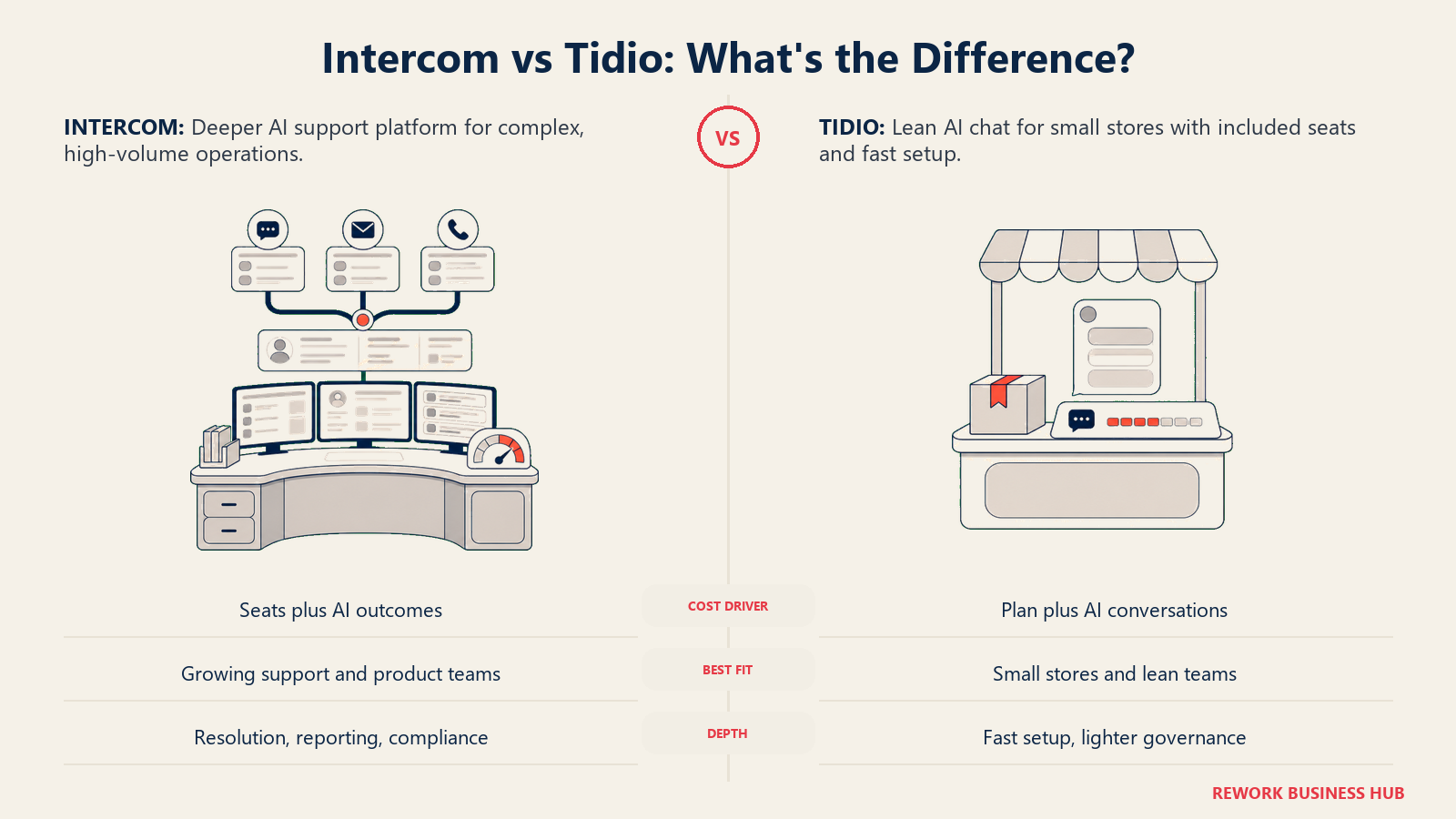
If you're picking a chat platform for a growing team, you've probably already narrowed it to some version of this exact choice: the upmarket platform with the deepest AI, or the lean tool that gets a working chatbot live before lunch. Intercom and Tidio are the two names that keep showing up on both sides of that split, and for good reason. One is built for support and product teams past the point where a shared inbox and a spreadsheet are enough. The other is built to get a small e-commerce or service business a real AI chatbot running without a sales call.
What's changed since most people last compared these two is the pricing model sitting underneath the AI. Intercom's Fin AI agent bills per outcome: $0.99 every time it resolves a conversation, hands it to a human with context attached, or disqualifies it. Tidio bills its Lyro AI agent the same way in spirit, a flat plan fee with a small free allotment, then a metered add-on once you need real AI volume. That means the number on either homepage is close to meaningless for the volume that actually matters to your budget. This article builds the real cost at two volumes, a small store just turning AI support on and one that's scaled past its first year, and shows exactly where the "affordable" option's advantage holds and where it stops being something you can verify.
TL;DR
| Tidio | Intercom | |
|---|---|---|
| Built for | Solo operators through small teams, roughly 1 to 50 people, e-commerce and service businesses | Product-led SaaS through mid-market and enterprise support teams, roughly 20 to 1,000+ people |
| Pricing model | Flat plan fee (seats included) plus metered Lyro AI conversations | Per-seat plan fee plus $0.99 per Fin AI outcome |
| Entry price | Free (10 seats, 50 conversations/mo); Starter $29/mo | Essential $29/seat/mo, billed annually |
| AI billing beyond the free tier | Lyro AI add-on from $32.50/mo per 50 conversations | $0.99 per outcome; $9.99 per qualified lead |
| Seats | 10 included free through Growth; no published per-seat fee | Priced per seat at every tier; Advanced and Expert include a batch of free "Lite" seats |
| Channels | Web chat, email, WhatsApp, Instagram, Facebook Messenger | All of Tidio's, plus SMS, Discord, Slack, voice, and native iOS/Android SDKs |
| Published resolution data | Premium tier guarantees a 50% Lyro resolution rate; no public benchmark breakdown | Fin AI resolves 76% on average across 12,000+ customers, with published per-industry benchmarks |
| Company status (Aug 2026) | Independent, privately held, founded 2013 | Parent company renamed to Fin in May 2026; pending ~$3.6B Salesforce acquisition of Fin, not yet closed |
| Best for | Small stores and lean teams that want AI chat live the same day | Teams that need the deepest resolution quality, reporting, and governance, and can absorb per-seat plus per-outcome cost |
What Each Tool Is Actually Built For
Tidio was built to get a small business off email-only support and onto a real chat widget without a developer. Connect it to Shopify or WooCommerce, and Lyro is answering order-status and product questions the same afternoon. Its four tiers (Free, Starter, Growth, Plus, plus a custom Premium) scale by conversation volume, not headcount, so a small team doesn't pay more just for adding people to the inbox. Crisp sits between the two on price if you want a flat-rate alternative to Tidio's metered AI; Crisp vs Tidio covers that matchup directly.
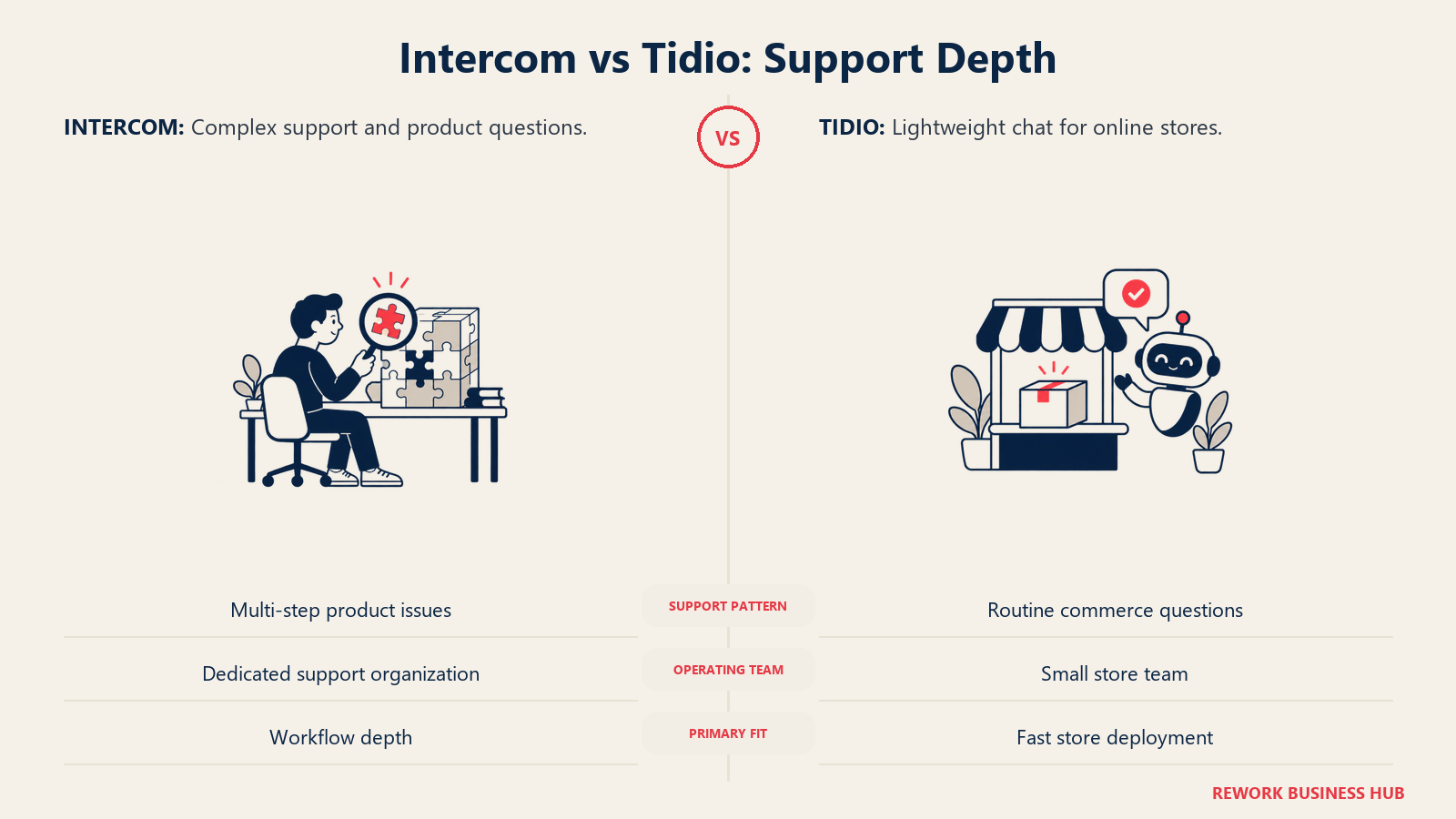
Intercom was built for the other end of that curve: support and product teams that already have real ticket volume and need an AI agent that reads product data and past conversations, not just FAQ matches, to resolve something end to end. Its Essential, Advanced, and Expert tiers add workflow automation, round-robin routing, multilingual help centers, and eventually SSO and HIPAA support as the buyer's governance needs grow. Crisp is the other name buyers usually put next to Intercom when the per-resolution AI bill feels too open-ended; Crisp vs Intercom covers that flat-rate-versus-metered tradeoff in full.
| Tidio | Intercom | |
|---|---|---|
| Sweet-spot company size | 1 to 50 employees | 20 to 1,000+ employees |
| Typical buyer | E-commerce founder, small service-business owner, first support hire | Head of Support, VP Customer Success, Product Ops, RevOps |
| Primary use case | Order status, returns, and product FAQ deflection on a storefront | Product-aware resolution across a full support operation, plus in-app and outbound messaging |
| Buying trigger | First real chat tool, replacing email-only support | Outgrowing a lighter tool's AI ceiling, or consolidating support, messaging, and help center into one platform |
Neither company is really chasing the other's customer. On review platforms, both do well with the audience they're built for: Tidio holds a 4.7 out of 5 rating across 590 reviews on Capterra, and Intercom holds a 4.5 out of 5 rating across 1,135 reviews on Capterra. Tidio serves over 300,000 businesses worldwide, most of them small; Intercom's Fin AI reports 12,000+ customers generating more than 110 million conversations in the past three months alone, a much smaller customer count carrying far higher volume per account.
Decision by Business Goal
| Your goal | Pick |
|---|---|
| Get a working AI chatbot live on a Shopify or WooCommerce store this week | Tidio |
| Resolve complex, multi-step product questions without a human, not just FAQ matching | Intercom |
| Keep one flat bill regardless of how well the AI performs | Neither publishes one; both meter AI past a small free allotment |
| Run support, in-app messaging, and outbound campaigns on a single platform | Intercom |
| Add WhatsApp and Instagram DM support without a separate tool | Both, natively |
| Pass a compliance review that asks for SSO, HIPAA support, or SLAs | Intercom (Expert tier) |
| Minimize per-seat cost for a team that answers more than it automates | Tidio (seats are free up to 10 through Growth) |
| Get a published, verifiable per-resolution rate at any volume, not just at launch | Intercom (Fin AI's $0.99 rate is flat at every tier; Tidio's real rate past Growth is a custom quote) |
Team and Role Fit
| Team | Tidio | Intercom |
|---|---|---|
| Support / CS | Core use case; Lyro handles FAQ and order-status deflection | Core use case; Fin AI resolves complex, product-aware queries end to end |
| Sales | Basic chat-to-lead capture; no dedicated qualification tooling | Messenger doubles as a qualification and onboarding channel |
| Marketing | Flows add-on covers on-site campaigns and lead capture | Product tours and outbound messaging built into higher tiers |
| IT / Compliance | Not the typical buyer; no published SSO or HIPAA support | Expert tier adds SSO, identity management, and HIPAA support |
| Ops / RevOps | Rarely the buyer at this company size | Owns the Advanced/Expert rollout, workflow automation, and the paid reporting add-ons |
Pricing at Real Team Sizes
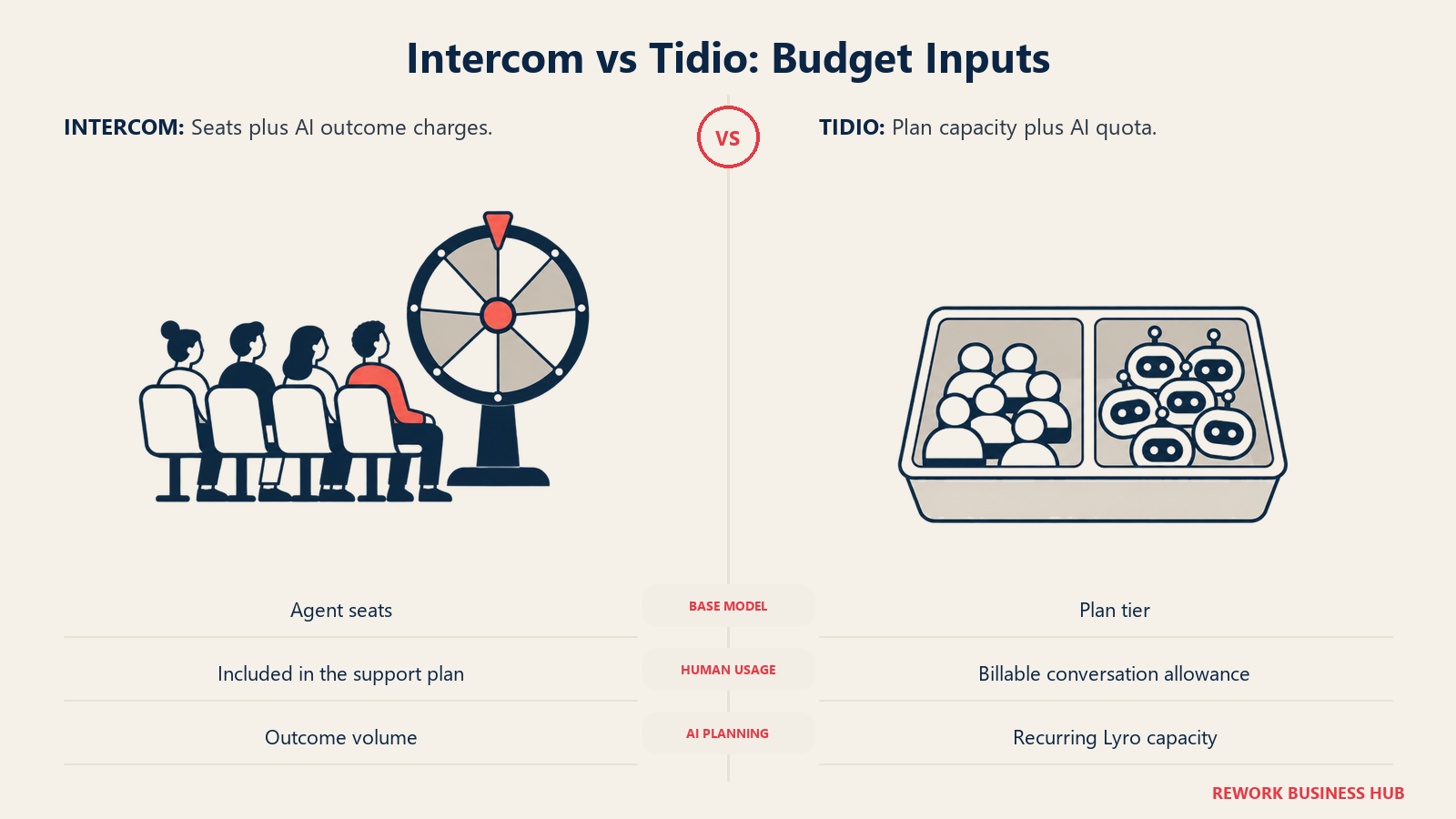
Neither company prices this comparison the old way anymore, so a simple seat-count grid would actually mislead you. Intercom charges per seat plus $0.99 for every outcome its Fin AI agent produces. Tidio charges a flat plan fee that includes up to 10 seats for free, plus a metered add-on once your Lyro AI volume outgrows the small one-off allotment baked into the free and Starter plans. Seat-based pricing is dying across the category, and this pair is a clean example of why: the number that decides your bill is conversation volume, not headcount.
What each plan actually includes
Intercom (per intercom.com/pricing):
| Tier | Price (billed annually) | What it adds | Fin AI outcome cost |
|---|---|---|---|
| Essential | $29/seat/mo | Fin for service, sales, and e-commerce; Messenger, shared inbox, ticketing, pre-built reports, public help center | $0.99/outcome |
| Advanced | $85/seat/mo | Everything in Essential, plus multiple team inboxes, workflow automation, round-robin assignment, private/multilingual help center; includes 20 free Lite seats | $0.99/outcome |
| Expert | $132/seat/mo | Everything in Advanced, plus SSO and identity management, HIPAA support, SLAs, multibrand messenger and help center; includes 50 free Lite seats | $0.99/outcome |
| Fin standalone (on Zendesk, Salesforce, HubSpot, or Freshdesk) | No seat fee | Runs Fin's AI on top of a helpdesk you already pay for | $0.99/outcome, 50-outcome/mo minimum (about a $49.50 floor) |
The $29/$85/$132 figures are the annual-billing rate. Intercom's pricing page also toggles to month-to-month billing at a higher rate; several buyer-side trackers put Essential's monthly rate around $39/seat (reported), so confirm the exact month-to-month number with sales before you commit to annual. A qualified lead, a separate outcome type, bills at $9.99 regardless of tier.
Tidio (per tidio.com/pricing):
| Tier | Price | Seats | Billable conversations/mo | Lyro AI conversations |
|---|---|---|---|---|
| Free | $0/mo | 10 | 50 | 50, one-off (a lifetime credit, not a monthly renewal) |
| Starter | $29/mo billed monthly, or $290/yr ($24.17/mo effective) billed annually | 10 | 100 | 50, one-off |
| Growth | $59/mo billed monthly, or $590/yr ($49.17/mo effective) billed annually | 10 | Up to 2,000 | "Custom" limit; not publicly quantified |
| Plus | From $300/mo plus usage | Custom | Custom | Custom, at a "discounted" but unpublished usage rate |
| Premium | Contact for pricing | Custom | Custom | 3,000+ included; guaranteed 50% resolution rate; pay-per-resolution option |
A "billable conversation" is Tidio's own term for any live chat, ticket, email, or social conversation that includes a message from a human agent; unanswered visitor messages don't count. Outside a plan, the Lyro AI Agent add-on alone starts at $32.50/mo for 50 conversations, a $0.65-per-conversation base rate. That's the only dollar figure Tidio publishes for AI volume beyond the free allotment, so it's the number this article uses to estimate cost past what a plan includes.
The small store: 3 seats, 100 human conversations, 150 AI resolutions a month
A small store answering roughly 100 conversations a month by hand and letting AI handle another 150 (order status, shipping, simple FAQ) fits Tidio's Starter tier exactly and stays comfortably inside Intercom's Essential tier.
| Tidio | Intercom (Essential) | |
|---|---|---|
| Plan fee | $29/mo (Starter, monthly billing) | $87/mo (3 seats x $29) |
| AI cost | About $97.50/mo (150 Lyro conversations at the $32.50/50 base add-on rate, once the 50 free one-off conversations are used) | $148.50/mo (150 outcomes x $0.99) |
| Monthly total | $126.50 | $235.50 |
| Annual total | $1,518 | $2,826 |
At this volume, Intercom costs 86% more than Tidio, a real $1,308-a-year gap. This is the comparison most buyers have in their head when they picture "Intercom versus Tidio," and at small scale it holds up.
The scaling store: 8 seats, 1,000 human conversations, 2,000 AI resolutions a month
Push volume up to where a store has outgrown its first year, and the picture gets more interesting. 1,000 billable conversations still fits inside Growth's published cap of 2,000; 2,000 AI resolutions clears both Essential's low-end territory and the point where a growing team typically needs round-robin routing, which lives on Intercom's Advanced tier, not Essential.
| Tidio | Intercom (Essential) | Intercom (Advanced) | |
|---|---|---|---|
| Plan fee | $59/mo (Growth, monthly billing) | $232/mo (8 seats x $29) | $680/mo (8 seats x $85; adds round-robin routing and workflow automation) |
| AI cost | About $1,300/mo (2,000 Lyro conversations at the published $32.50/50 base rate; Growth's actual included allotment is "custom" and unpublished) | $1,980/mo (2,000 outcomes x $0.99) | $1,980/mo (2,000 outcomes x $0.99) |
| Monthly total | ~$1,359 | $2,212 | $2,660 |
| Annual total | ~$16,308 | $26,544 | $31,920 |
Two things are worth sitting with here. First, the Tidio number is a ceiling, not a confirmed price: it's built entirely from the $32.50-per-50 rate Tidio publishes for its standalone AI add-on, and Growth's own pricing page doesn't say how many Lyro conversations it actually bundles before that rate applies. Second, against Intercom's realistic tier for this team size (Advanced, because a scaling team actually needs round-robin routing), Intercom costs 96% more, wider than the 86% gap at small scale, not narrower.
Where Tidio's price advantage actually disappears
Here's the part a straight seat-count comparison misses entirely. As AI-resolution volume grows, the seat or plan fee on both platforms shrinks toward a rounding error, and what's left is almost pure per-resolution math: Fin AI's $0.99 against Tidio's published $0.65 base rate. Run the same 8-seat team at 10,000 AI resolutions a month instead of 2,000, still against Intercom Essential, and Tidio's estimated total comes to about $6,559/mo against Intercom's $10,132/mo, a 55% gap, down from 63% at 2,000 outcomes and continuing to close as volume climbs. Structurally, that ratio can't fall much further than the roughly 52% implied by $0.99 divided by $0.65: past a certain volume, more conversations barely move the comparison.
That's the honest version of "where the saving disappears." It's not that Tidio becomes more expensive in raw dollars at the volumes modeled here, using the only rate Tidio publishes. It's that the certainty behind the number does. Past 2,000 billable conversations a month, Tidio's own pricing page stops applying: Growth caps out, its AI allotment was never quantified to begin with, and Plus offers a "discounted" usage rate it doesn't disclose. You're pricing Tidio off a rate card it explicitly frames as an entry-level add-on, not a volume rate, right at the point your bill depends most on getting that number right. Fin AI's $0.99 stays the same, sourced from the same page, whether you're resolving 150 conversations a month or 15,000.
What the Extra Money Buys: Resolution Quality and Reporting Depth
Intercom costs more at every volume tested. It's worth being specific about what that gap actually buys, instead of leaving "more powerful" to do the work.

| Tidio (Lyro) | Intercom | |
|---|---|---|
| Published resolution rate | Premium tier guarantees 50% (the only tier with a stated number) | 76% average across 12,000+ customers, trending up about 1% a month |
| Resolution methodology disclosed | Not published | Involvement rate x resolution rate = automation rate, defined and published |
| Industry-specific benchmarks | Not published | Published for Software & Technology (98.2%), Manufacturing (91.0%), Education (91.0%), Professional Services (90.5%), Fintech (90.0%), and Healthcare (89.6%), each the average of the top 10 performers in that industry |
| Analytics included in the base plan | "Advanced analytics" from Growth ($59/mo) | Pre-built reports from Essential |
| Deeper reporting | Not offered as a named add-on in Tidio's published tiers | CX Score, AI Topics, Trends, and custom scorecards, sold as a separate Pro add-on from $99/mo |
| Agent-facing AI assist | Not published as a distinct product | Copilot add-on, $35/user/mo |
Two honest caveats belong here. All of these resolution-rate figures are vendor-reported, not independently audited, on both sides. And Intercom's deepest reporting isn't actually included in any seat tier, it's a separate $99/mo-and-up purchase decision on top of Essential, Advanced, or Expert, so the sticker prices in the pricing tables above understate what a team chasing that level of visibility will actually pay. For more on how outcome-based AI pricing plays out across the category, our broader look at AI agents for customer service goes deeper on resolution mechanics and unit economics across a wider set of vendors, not just these two.
Channels and Integration Reach
Start with the channels customers actually use and the integrations the team must maintain.
| Channel | Tidio | Intercom |
|---|---|---|
| Web live chat | Yes | Yes |
| Yes | Yes | |
| Yes | Yes | |
| Instagram DM | Yes | Yes |
| Facebook Messenger | Yes | Yes |
| SMS | No | Yes |
| Voice / phone | No | Yes (Fin Voice) |
| Slack | No | Yes |
| Discord | No | Yes |
| Native iOS/Android SDK | Not published | Yes |
| API access | Yes, via integrations | Yes |
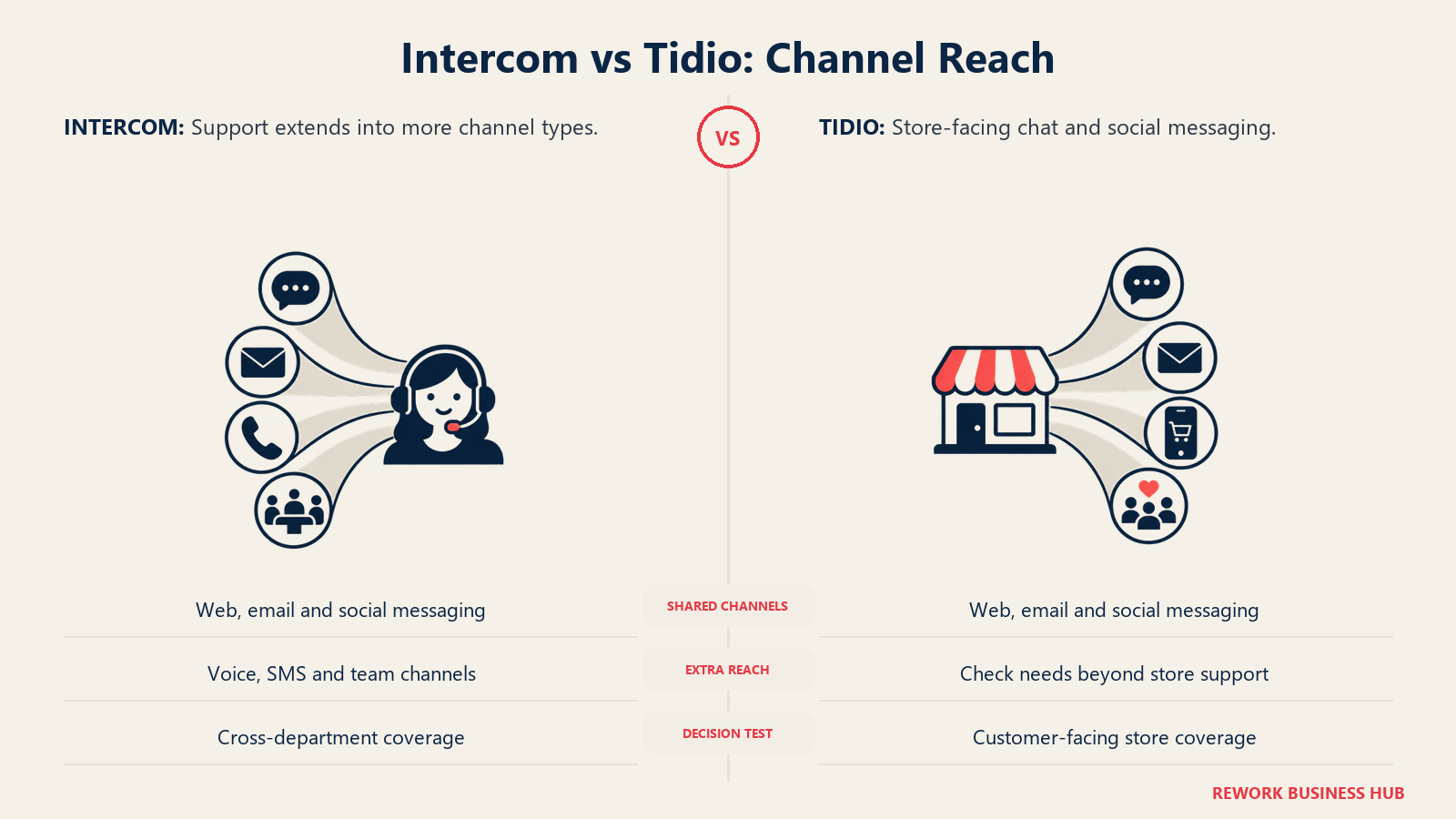
Tidio's channel list is broader than it used to be: WhatsApp and Instagram DM support are both live natively now, closing a gap that older comparisons of these two tools still flag. What it still doesn't cover is SMS, voice, or team-facing channels like Slack and Discord, all of which Intercom supports out of the box. If channel coverage across departments, not just the customer-facing widget, is the actual requirement, our guide to multi-channel inbox configuration walks through what a good setup looks like regardless of which platform you land on.
Implementation and Change Management
| Tidio | Intercom | |
|---|---|---|
| Typical time to first live chat | Same day; script-tag install on Shopify or WooCommerce | Days for Essential; workflow and help-center configuration extends it |
| Training load | Minimal; one shared inbox, low configuration surface | Moderate to real at Advanced and Expert: workflow automation, round-robin routing, and a multilingual help center all need real setup |
| Migration complexity | Low; mostly reconnecting channel integrations | Higher at Expert: SSO and identity management, multibrand configuration |
| Ongoing admin | Watch your conversation and AI caps against your plan tier | Watch outcome spend against budget; Pro and Copilot add-ons are separate purchase decisions, not automatic upgrades |
Risk and Governance
Ask for evidence of required controls and put pricing, renewal, and data terms into the contract.
| Tidio | Intercom | |
|---|---|---|
| Compliance features | Not itemized on published plans; Premium mentions "compliance features" without specifics | HIPAA support and SSO/identity management named explicitly on the Expert tier |
| Ownership stability | Independent, privately held since 2013 | Parent company renamed to Fin in May 2026; Fin agreed to a roughly $3.6 billion Salesforce acquisition, signed June 15, 2026 and not yet closed |
| Roadmap risk | Low; single-product company, no pending acquisition | Real and near-term: folding into Agentforce could change pricing, packaging, or Intercom's future as a standalone product once the deal closes |
| Vendor lock-in | Conversation history and Lyro training data tied to the platform | Conversation history, help-center content, and workflow configuration tied to the platform; migration cost rises fast once you're on Advanced or Expert |
The acquisition matters more than a passing footnote for anyone about to sign a multi-year contract. Intercom's parent company renamed itself from Intercom to Fin in May 2026, and a month later agreed to be bought by Salesforce. Salesforce's plan, per its own announcement, is to fold Fin's technology into Agentforce, positioning it as the faster-to-deploy option for smaller and mid-market buyers inside a much larger Salesforce product line. None of that changes what you're buying today; Intercom's product, pricing, and support are unaffected until the deal actually closes, if it does. But it is real uncertainty for a multi-year commitment: pricing, packaging, and Intercom's future as a standalone product are all reasonable questions to put to a sales rep before signing anything longer than the first few months of 2027. The true cost of software sprawl is worth a read before locking into either platform for the same reason: the sticker price rarely captures what you actually pay once a vendor's roadmap shifts under you.
When Intercom Is the Right Call
- Support volume is genuinely complex: multi-step product questions, not just order-status FAQ, where Fin AI's 76%-average, published-benchmark resolution rate is worth paying for
- You need SSO, HIPAA support, or SLAs for a compliance review, and Tidio's published tiers don't name any of the three
- You want support, in-app messaging, and outbound campaigns running on one platform instead of stitching several tools together
- Channel reach matters beyond web chat, WhatsApp, and Instagram, specifically SMS, Slack, Discord, or phone support
- You'd rather pay more for Fin AI's flat, always-published per-outcome rate than chase a lower sticker price that stops being verifiable past a couple thousand conversations a month
When Tidio Is the Right Call
- You're a small store or service business that needs AI chat live today, not after a sales call and an implementation timeline
- Free seats matter more to you than per-outcome pricing precision; up to 10 people can work the inbox at no extra seat cost through Growth
- Your channel needs stop at web chat, email, WhatsApp, Instagram, and Messenger
- You're testing whether AI deflection works for your business at all before committing real budget to it
- You're not ready to buy into a platform whose parent company is mid-acquisition, with real near-term roadmap uncertainty
Decision Framework
| If you are... | Pick |
|---|---|
| A small store or lean team wanting AI chat live this week without a sales call | Tidio |
| Handling under roughly 1,500 to 2,000 AI resolutions a month and want the cheapest verifiable option | Tidio |
| Past 2,000 conversations a month and want a rate you can still confirm without a sales call | Intercom |
| Needing SSO, HIPAA support, or SLAs for a compliance or security review | Intercom (Expert) |
| Choosing mainly on brand recognition rather than your own volume | Price both at your real numbers first; the label alone won't tell you the winner |
| Wary of signing into a platform whose parent company is mid-acquisition | Weigh Intercom's roadmap uncertainty against Tidio's narrower feature ceiling before committing to a multi-year term |
| Comparing the wider category, not just these two | See our full live chat software roundup |
What to Do Next
- Count your real monthly AI-resolution volume, not your seat count. That's what actually drives cost on both platforms, and it's the number a homepage price never shows you.
- Run your own numbers using the math above. The moment you're consistently past 1,500 to 2,000 AI conversations a month, ask Tidio for its actual Plus or Premium rate rather than trusting the $32.50-per-50 base rate to hold at scale.
- If governance is a real requirement, price Intercom's Expert tier now. Finding out you need SSO or HIPAA support during a security review, after you've already built workflows on a lower tier, is a more expensive problem than the seat upgrade itself.
- Still narrowing the field? Best Live Chat Software in 2026 ranks 14 platforms by fit, not just these two, and best AI agents for live chat goes deeper on resolution mechanics across the wider category. How to choose live chat software and best AI customer service tools cover the buying process itself.
- Priced out one direction or the other? Best Tidio Alternatives covers what else fits if you've outgrown Tidio's ceiling. Best Intercom Alternatives covers the field from the other direction if Intercom's per-seat-plus-outcome model doesn't pencil out.
One honest gap in both tools: neither ties a chat conversation to a CRM record and sales pipeline in the same system, so a lead that starts in chat still gets re-entered somewhere else by hand. If that hand-off, not the chat widget itself, is the actual problem in your stack, Rework's unified inbox brings WhatsApp, Messenger, Instagram DM, email, and web chat into the same CRM timeline your sales and CS teams already use; see rework.com/pricing for current plans.
Frequently Asked Questions about Intercom vs Tidio
Is Intercom still called Intercom, or is it Fin now?
Both, in a specific way. The parent company renamed itself Fin on May 12, 2026, and Fin is also the name of the AI resolution agent inside the product. But the customer service platform itself, the Messenger, shared inbox, and help center you'd actually sign up for, still ships under the Intercom name.
Is the Salesforce acquisition final?
No. Salesforce signed a definitive agreement on June 15, 2026 to acquire Fin, Intercom's parent company, for roughly $3.6 billion. The deal hadn't closed as of this update and is expected to close in the first few months of 2027, subject to regulatory approval. Nothing about Intercom's product, pricing, or support changes until then.
Is Tidio or Intercom cheaper?
Tidio is meaningfully cheaper at small volume, about 54% of Intercom's cost for a 3-seat team handling 150 AI resolutions a month. The percentage gap narrows as AI volume scales toward the ratio of their per-resolution rates, and past roughly 2,000 conversations a month, Tidio's own pricing page stops publishing a verifiable rate, while Intercom's Fin AI keeps its $0.99-per-outcome price the same at any volume.
Does Tidio support WhatsApp and Instagram now?
Yes. Tidio added native WhatsApp and Instagram DM support alongside its existing web chat, email, and Facebook Messenger channels. It still doesn't cover SMS, voice, Slack, or Discord, all of which Intercom supports natively.
How does Intercom's Fin AI pricing actually work?
An outcome bills at $0.99 when Fin AI resolves a conversation, hands it to a human with context attached, or disqualifies it; a qualified lead bills separately at $9.99. There's a 50-outcome monthly minimum, about a $49.50 floor, when running Fin AI on a non-Intercom helpdesk like Zendesk or Salesforce.
Can I use Fin AI without buying Intercom?
Yes. Fin AI runs standalone on top of Zendesk, Salesforce, HubSpot, or Freshdesk for $0.99 per outcome with no seat fee, or bundled inside Intercom starting at $29/seat/month on the Essential plan, billed annually.
Related Resources:
- Best Live Chat Software in 2026
- Best Intercom Alternatives in 2026
- Best Tidio Alternatives in 2026
- Crisp vs Intercom
- Crisp vs Tidio
- Best AI Agents for Live Chat in 2026
- Best AI Agents for Customer Service in 2026
- How to Choose Live Chat Software
- Best AI Customer Service Tools
- Seat-Based Pricing Is Dying
- The True Cost of Software Sprawl
- Multi-Channel Inbox Configuration

Senior Implementation Consultant
On this page
- TL;DR
- What Each Tool Is Actually Built For
- Decision by Business Goal
- Team and Role Fit
- Pricing at Real Team Sizes
- What each plan actually includes
- The small store: 3 seats, 100 human conversations, 150 AI resolutions a month
- The scaling store: 8 seats, 1,000 human conversations, 2,000 AI resolutions a month
- Where Tidio's price advantage actually disappears
- What the Extra Money Buys: Resolution Quality and Reporting Depth
- Channels and Integration Reach
- Implementation and Change Management
- Risk and Governance
- When Intercom Is the Right Call
- When Tidio Is the Right Call
- Decision Framework
- What to Do Next