More in
SaaS Buying Insights
How to Budget AI Spend as Pricing Shifts From Seats to Meters
Oct 2, 2026
The New B2B Buying Committee: Who's Really in the Room
Mar 30, 2026
POCs That Predict Success — and POCs That Waste Everyone's Time
Mar 23, 2026
Seat-Based Pricing Is Dying. Here's What's Replacing It
Mar 12, 2026 · Currently reading
The True Cost of Software Sprawl at Mid-Market Companies
Jan 30, 2026
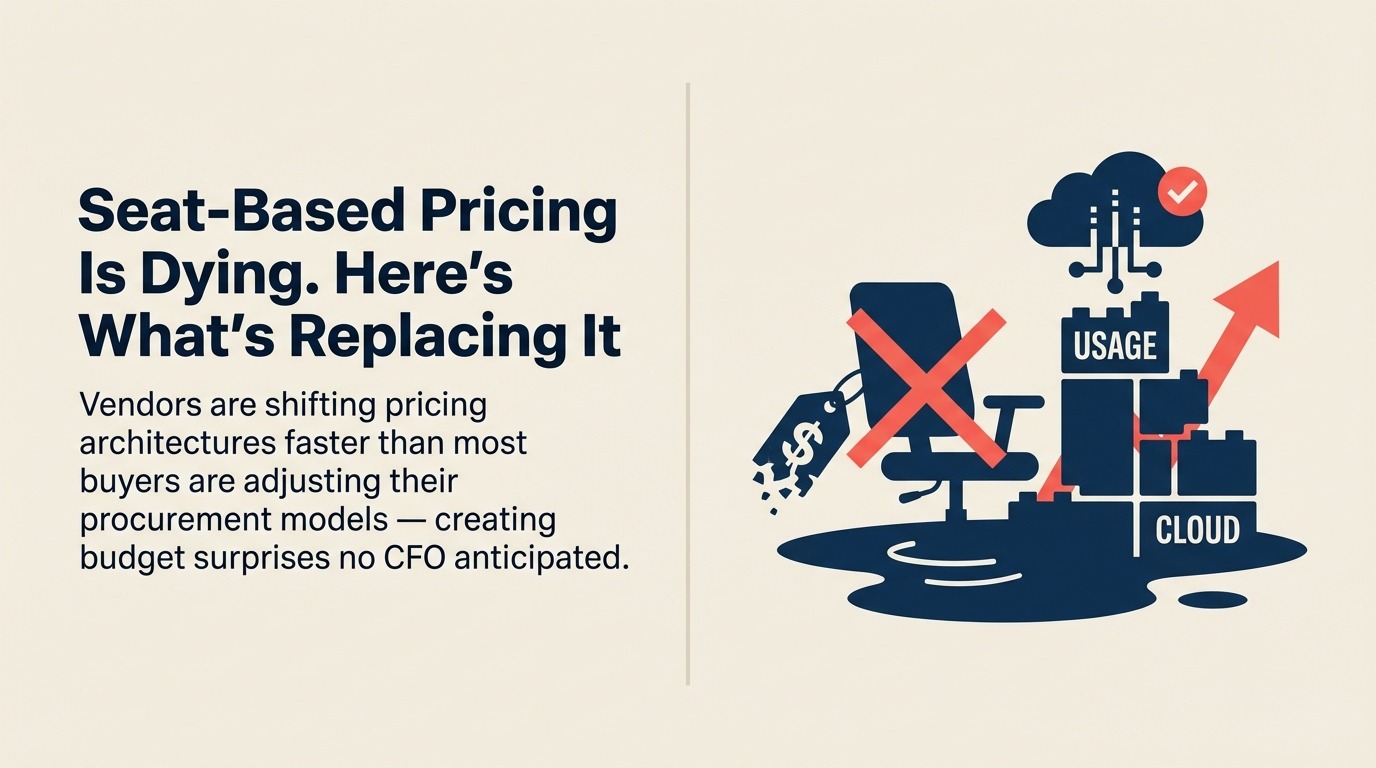
Seat-Based Pricing Is Dying. Here's What's Replacing It
Turn this article into takeaways for your work.


Each assistant summarizes the article only for you and suggests best practices for your work.
Seat-based pricing made sense when software was desktop. You had users. You counted them. You paid per license. The relationship between value delivered and cost was reasonably transparent.
In a world of AI automation, workflow orchestration, and tools that execute processes without humans in the loop, charging per human seat is increasingly disconnected from how value is actually delivered. A CRM that auto-enriches records, auto-summarizes calls, and auto-generates follow-up emails is doing meaningful work whether or not a salesperson is sitting at their desk. A workflow automation platform can process 10,000 customer records overnight without anyone touching a keyboard. The per-seat model prices neither of those outcomes.
Vendors are shifting pricing architectures faster than most buyers are adjusting their procurement models. The misalignment is creating budget surprises no CFO anticipated when they signed their last three-year enterprise agreement.
Why Seat-Based Pricing Is Under Structural Pressure
Three independent forces are converging on the seat-based model simultaneously.
AI is replacing seats, not just augmenting them. The original promise of enterprise software productivity tools was that they'd make each seat more productive. The emerging reality is that some functions are being handled by AI agents that don't have seats. A sales development team that used to require 15 SDRs running outbound sequences can now run comparable volume with five SDRs and an AI orchestration layer, a shift explored in depth in AI agents in the sales pipeline. If you're paying per seat and the number of seats is shrinking, the vendor needs a different pricing lever, and usage-based pricing on AI actions or API calls is the obvious one.
Workflow automation changes usage patterns. Traditional seat-based tools assumed that feature consumption correlated with headcount. One marketing person uses the marketing platform, and their usage scales with their time at work. Workflow automation breaks that assumption. One person can configure a workflow that runs a thousand times per day without their involvement. The value delivered bears no relationship to the number of seats.
Companies are resisting paying for inactive seats. The most direct pressure on seat-based pricing is simple: organizations are auditing their licenses and finding that 30–40% of paid seats are used rarely or not at all. According to Productiv's SaaS management research, the average enterprise wastes 37% of its SaaS spend on underutilized tools and seats. Procurement teams that have run this analysis are pushing back hard on renewal conversations. Vendors who stick with seat-based pricing are leaving money on the table in active expansions while fighting for every seat at renewal.
The Four Emerging Models
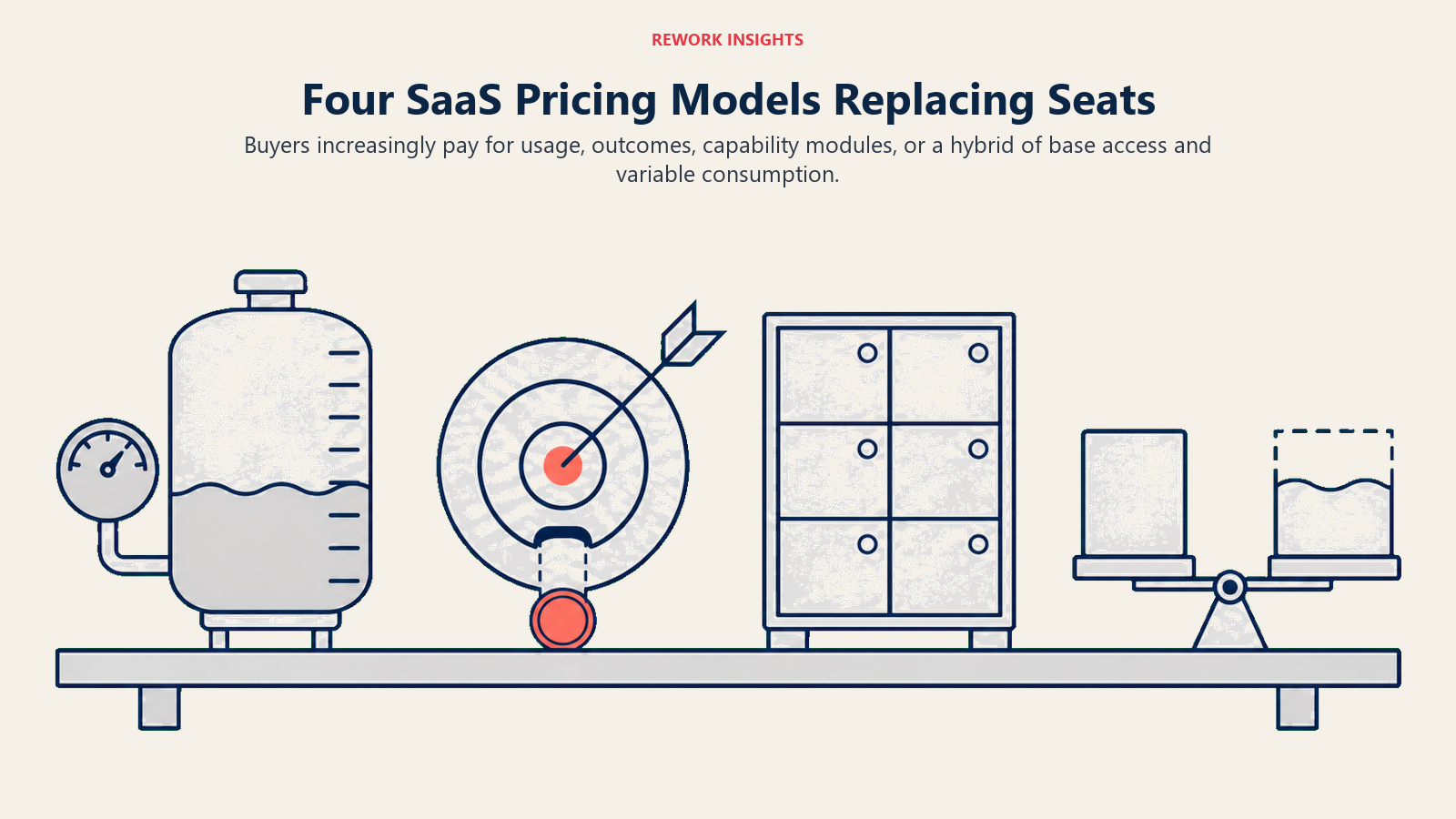
Usage-based pricing. You pay for what you consume: API calls, AI actions, records processed, emails sent, storage used. Twilio is the canonical example in communications. Snowflake in data. OpenView's annual SaaS benchmarks track the shift: usage-based pricing has moved from a startup-friendly differentiator to a dominant model in growth-stage and enterprise software alike. Newer CRM and productivity vendors are adding usage meters to capabilities that were previously flat-rate seat features, particularly AI capabilities where the cost structure is genuinely variable.
The buyer risk is bill shock. Usage-based pricing shifts forecasting responsibility from the vendor (fixed seat cost) to the buyer (variable consumption cost). Companies that underforecast usage face invoices that exceed budget with no easy recourse. Companies that overforecast waste money on committed minimums.
Outcome-based pricing. You pay when the software delivers a defined result. This model is most mature in performance marketing (pay-per-click, pay-per-conversion) but is emerging in B2B SaaS. Some revenue intelligence platforms charge based on pipeline influenced or deals closed. Some legal tech platforms charge based on contracts processed. Some HR tech platforms charge based on hires completed.
Outcome-based pricing aligns vendor incentives with buyer outcomes, which sounds ideal. The negotiation challenge is defining what "outcome" means, attributing it to the software rather than other factors, and ensuring the measurement methodology is both accurate and resistant to gaming.
Module-based pricing. Instead of per-seat, you pay per active capability module regardless of how many users access it. HubSpot's transition toward this model is instructive: rather than charging for seats in each hub, they've shifted portions of their pricing to a model where you pay for access to capabilities (Marketing Hub, Sales Hub, Service Hub) with more flexible user access within each tier. See the Rework vs. HubSpot CRM comparison for how these pricing structures play out in a real evaluation context.
Module-based pricing suits buyers who need deep use of specific capabilities across many casual users. It breaks down when you need only part of a module's capabilities but the pricing requires the full module.
Hybrid models. Most enterprise software is settling into hybrid structures: a base seat charge for core users with usage-based pricing on high-consumption features. Salesforce's Einstein AI pricing, HubSpot's Operations Hub, and Monday.com's enterprise AI add-ons all follow this pattern: a committed base plus variable consumption for AI-powered capabilities on top.
Hybrid models are the most common and the most confusing. A CFO who approved a $180,000/year Salesforce contract may not have anticipated that AI features would add $40,000 in usage charges by Q3. The contract permitted it. The budget conversation didn't anticipate it.
The Bill-Shock Problem
Bill shock is the primary buyer risk in usage-based pricing. It's not theoretical. It's a documented pattern. Zuora's Subscription Economy Index found that usage-based revenue grew faster than any other pricing model category, and buyer complaints about unexpected invoices grew alongside it.
The mechanism is straightforward: buyers don't have good models for forecasting usage of new capabilities. When a company adopts a usage-based AI feature for the first time, they're making educated guesses about consumption rates. Those guesses are often wrong, and vendors benefit from the variance. Their cost is bounded by their unit economics, while your cost is bounded by your consumption.
Three contract clauses protect against bill shock in usage-based deals:
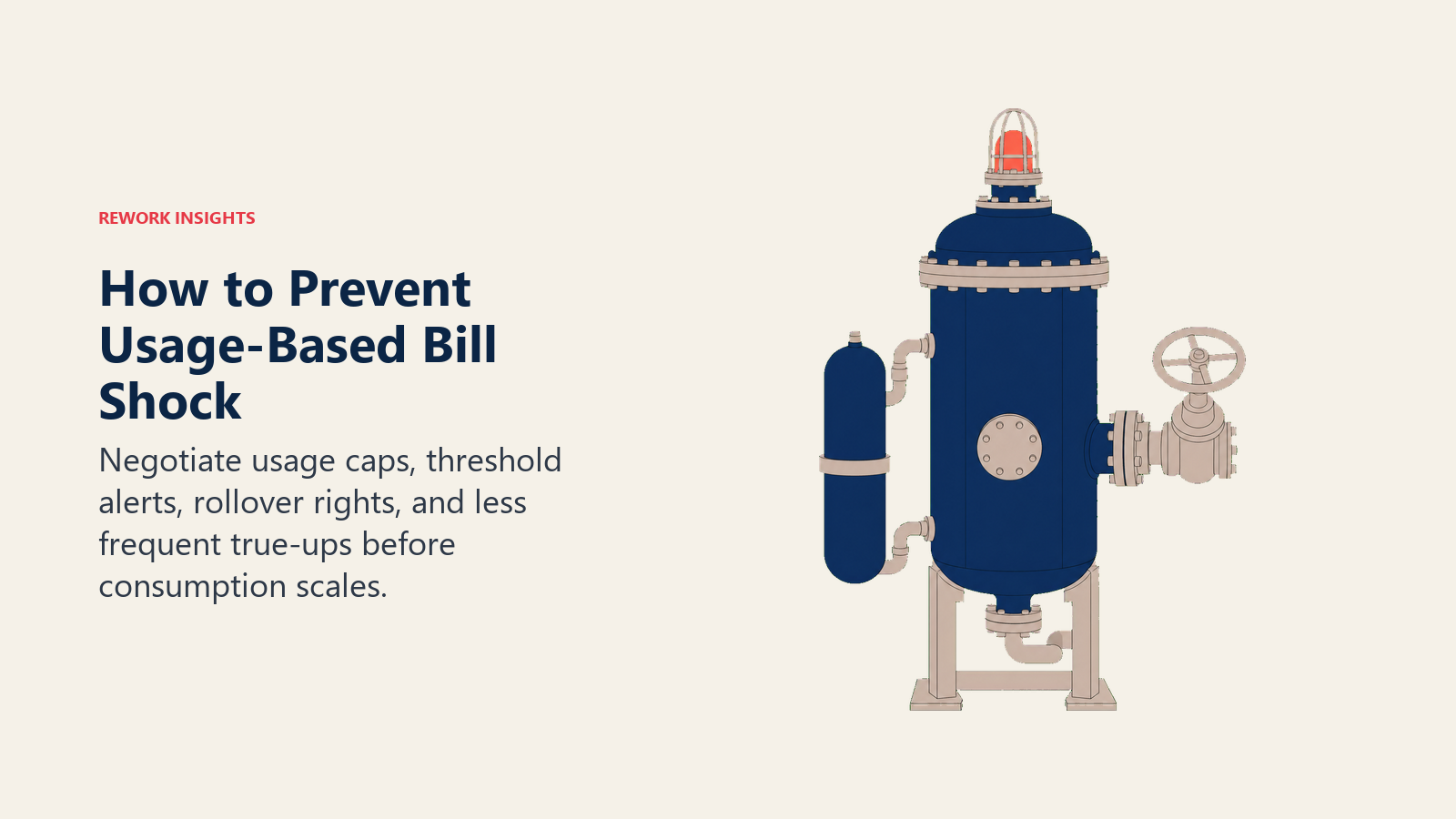
Usage caps with notification triggers. Before your bill reaches a defined threshold, the vendor notifies you and pauses consumption unless you explicitly authorize continuation. Many vendors resist hard caps (they prefer soft warnings) but notification triggers are negotiable. A 90-day average consumption ceiling with email alerts at 75% is a reasonable starting point.
Rate floors and committed minimums with rollover. If you commit to a minimum monthly consumption, negotiate rollover rights for unused capacity. Without rollover, unused minimums expire and overage charges apply separately. With rollover, over-consumed months draw from banked capacity first. This significantly reduces net variance.
True-up frequency. Annual true-ups are buyer-favorable: you reconcile consumption at year end, not monthly. Monthly true-ups mean your bill fluctuates every cycle, creating cash flow and budget management complexity. Push for quarterly or annual true-ups with monthly caps rather than monthly true-up billing.
What Changes in Procurement
Budgeting for seat-based software is straightforward: headcount multiplied by per-seat cost, with a change order if headcount grows significantly. Finance can model that scenario with confidence.
Budgeting for usage-based software requires a different analytical approach. You need a consumption model, not a headcount model. That means:
Building a usage baseline. Before signing a usage-based contract, spend 30–60 days in a trial or limited deployment tracking actual consumption rates. Don't accept the vendor's estimates. Your usage patterns are specific to your workflows and data volumes. Vendor estimates are based on averages that may not apply to you.
Modeling variance scenarios. Rather than a single budget number, build a consumption forecast with three scenarios: baseline (expected usage), growth (20% above baseline if adoption goes well), and spike (a specific high-consumption scenario like a major campaign or database migration). Your budget should accommodate the growth scenario without requiring emergency approval.
Separating AI feature budgets. AI capabilities have fundamentally different cost structures than traditional software features. Their consumption can spike unpredictably with increased team adoption or new use cases. Treat AI add-on budgets as a separate line from base platform costs, with quarterly review built into the budget cycle.
Negotiating multi-year usage rates. If you're committing to a multi-year contract, negotiate locked-in consumption pricing, not just locked-in seat pricing. A three-year deal that locks seat costs but allows the vendor to change API pricing annually provides less protection than it appears. The forecasting discipline that CROs develop applies directly here, consumption modeling is a forecasting problem, and teams with strong forecast cadence handle it better.
The Pricing Model Risk Assessment
Use this framework to evaluate any pricing structure against three dimensions before signing.
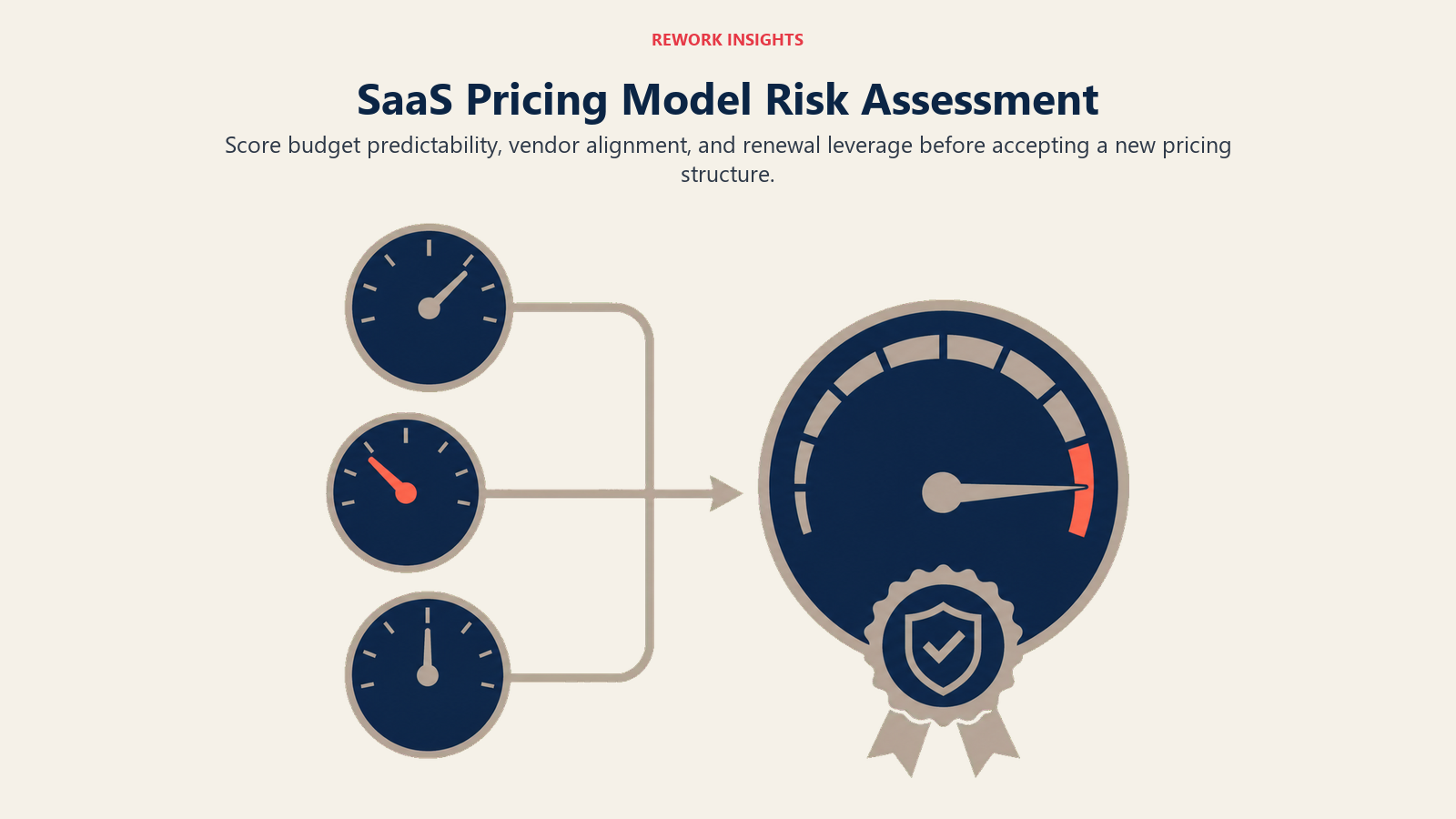
Budget Predictability Score (1–5): How predictable is your monthly bill under this pricing structure? A flat seat fee is a 5. Pure usage-based with no caps is a 1. Hybrid with caps and notification triggers is a 3–4. Assign a score and determine whether your organization's budget management processes can absorb the variance level the pricing structure introduces.
Vendor Alignment Score (1–5): Does the vendor make more money when you get more value? In outcome-based pricing, the vendor's revenue scales with your results (score: 5). In pure seat-based pricing with annual renewals, the vendor's incentive is to lock you in at renewal, not to maximize your value in year one (score: 2–3). Usage-based pricing falls in the middle: vendor revenue scales with your consumption, which correlates with but doesn't directly measure value. Score this and consider whether the pricing structure creates incentives you want your vendor to have.
Renewal Leverage Score (1–5): How much negotiating leverage do you have at renewal? Seat-based deals with high switching costs leave you exposed at renewal. Your leverage is limited unless you're willing to absorb the migration cost. Usage-based deals give you data: you can show exactly what you consumed, compare it to what you forecasted, and negotiate from an evidence base. Outcome-based deals give you the strongest leverage if outcomes are measurable and you can credibly attribute them. Score each deal based on what your renewal conversation looks like in three years.
Add the three scores. A total of 10–15 is a manageable pricing structure. Below 8 warrants a harder negotiation before signing. This isn't a pass/fail tool. It's a risk profile that tells you where to spend negotiation capital.
What Buyers Should Do Right Now
If your current contracts are seat-based and up for renewal in the next 12 months, the renewal conversation has changed. Vendors who are shifting toward usage-based or hybrid pricing will try to use the renewal as the transition point, often with an initial price that looks comparable to your current seat cost but with usage tiers that can grow your bill significantly if adoption increases.
Ask these questions before you sign:
"What happens to our pricing if we deploy your AI features to all users?" Get a specific number, not a vague "it scales with your usage." You want to know your all-in cost at full adoption.
"What have your fastest-growing customers' bills looked like in year two compared to year one under this pricing model?" This surfaces the actual variance pattern, not the model's theoretical behavior.
"What caps and protections are available for usage-based components?" Treat a vendor who can't answer this specifically as a risk indicator.
The shift away from seat-based pricing isn't inherently buyer-unfavorable. Outcome-based pricing, done well, is more aligned with how buyers think about software value. Usage-based pricing, with proper caps and modeling, rewards efficient deployment and doesn't penalize you for inactive seats. For teams evaluating whether switching platforms makes sense given a pricing model change, a head-to-head like Rework vs. Salesforce is a useful starting point for modeling the real TCO under different pricing structures.
But the transition period creates asymmetric risk. Vendors are moving to new models faster than most buyers are adjusting their evaluation frameworks. The buyer who signs a usage-based deal without a consumption model and negotiated caps is accepting risk they haven't priced. The buyer who builds the analytical framework before the conversation starts negotiates from equal footing.
Learn More
- The True Cost of Software Sprawl at Mid-Market Companies, how pricing model fragmentation multiplies the cost of running too many tools
- The New B2B Buying Committee: Who's Really in the Room, who in your organization needs to sign off on a pricing model shift
- POCs That Predict Success, and POCs That Waste Everyone's Time, how to evaluate usage-based tools before committing to a consumption model
