Crisp vs Intercom: Flat-Rate Pricing or AI Resolution Depth, Which Wins as You Scale?
Turn this article into takeaways for your work.


Each assistant summarizes the article only for you and suggests best practices for your work.
Intercom's parent company renamed itself Fin on May 12, 2026. The product you'd actually sign up for, the shared inbox, Messenger, help center, and AI agent, still ships under the Intercom name; Fin is now both the corporate entity and the AI agent brand inside it. On June 15, 2026, Salesforce signed a definitive agreement to acquire Fin (Intercom's parent company) for roughly $3.6 billion. That deal has not closed as of this update; it's expected to close in the first few months of 2027, pending regulatory approval. We cover what that means for a buyer signing a contract today in the Risk and Governance section below, and we use "Intercom" for the product throughout, since that's the name on the pricing page you'd actually visit.
If you run support or sales chat for a company somewhere between 10 and 200 people, you've probably had both of these pricing pages open at some point. Crisp's, because the flat rate looks almost too simple for what you get. And Intercom's, because everyone in your ops Slack channel name-drops Fin AI like it's a foregone conclusion. Both tools do live chat. Both do email, WhatsApp, and social DMs. Both ship an AI agent that can answer a customer without a human touching the conversation.
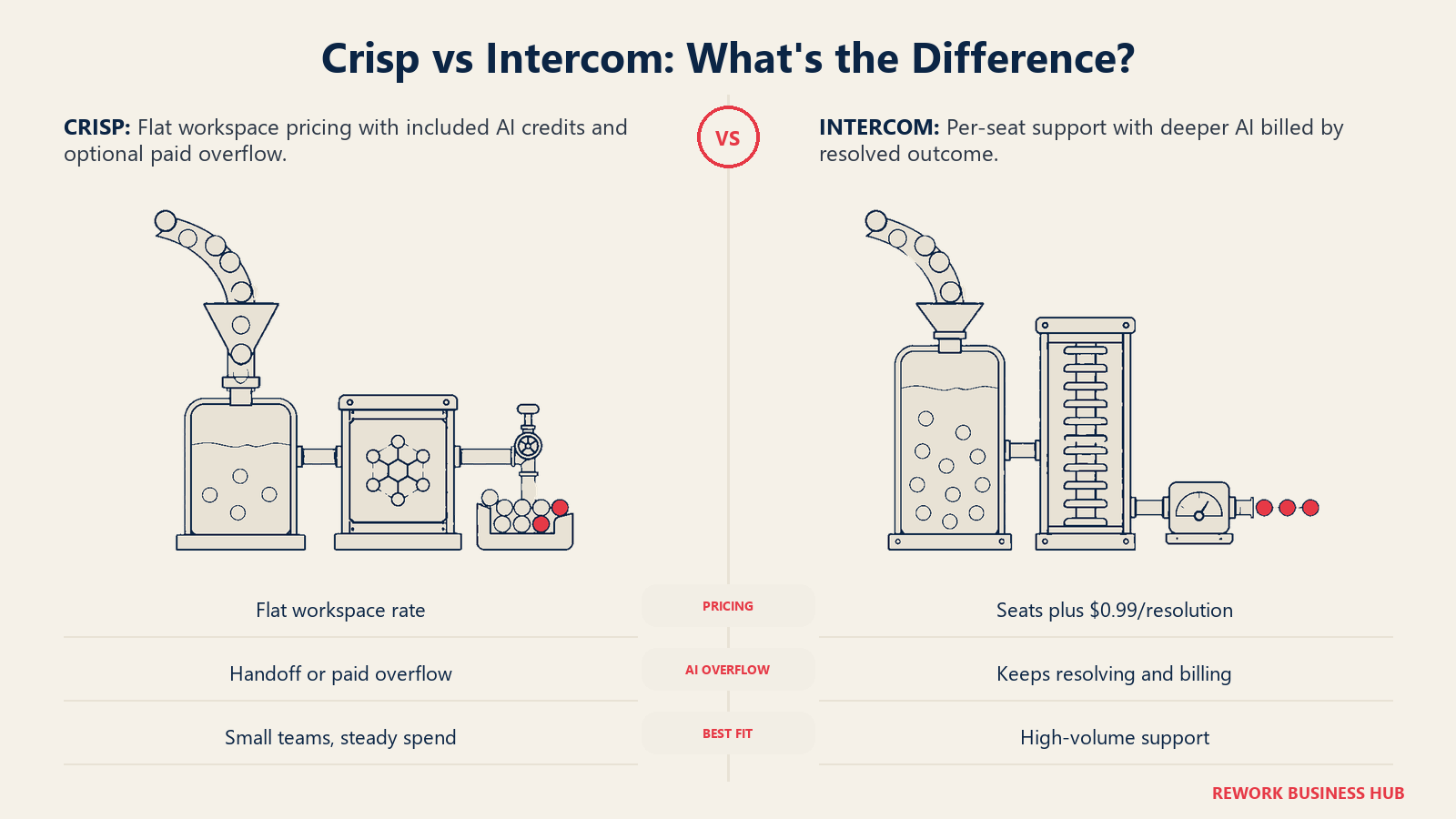
The similarity ends at the pricing model, and that's actually the whole decision. Crisp charges by workspace: a flat monthly number that includes a set number of seats and a fixed AI credit allowance, and it barely moves no matter how many conversations you run through it. Intercom charges by seat, then charges again per AI resolution on top, a model that scales cleanly with your team's ambitions and just as cleanly with your bill. Neither approach is wrong. But the gap between them gets very large very fast once you do the math at a real team size instead of the number on the homepage, and that's the math most comparison pages skip.
Key Facts: Crisp vs Intercom
- Crisp has operated independently out of France since 2015 and has never raised outside funding, according to Tracxn's company profile.
- Intercom's parent company renamed itself Fin on May 12, 2026, fifteen years after launching as Intercom in 2011, according to Intercom's own announcement.
- Salesforce agreed to acquire Fin (Intercom's parent company) for approximately $3.6 billion on June 15, 2026, a deal expected to close in the first few months of 2027, according to TechCrunch.
- Fin AI resolves an average of 76% of incoming support volume without human involvement, according to Salesforce's own figures reported by Yahoo Finance.
- Both products carry the same 4.5 out of 5 average rating on G2, Crisp across roughly 196 reviews and Intercom across roughly 3,900 reviews (G2 lists it under "Fin by Intercom," reflecting the corporate rename), a rough proxy for the difference in company scale.
TL;DR
| Crisp | Intercom | |
|---|---|---|
| Pricing model | Flat per workspace; seats and AI credit bundled in | Per seat, plus $0.99 per AI-resolved conversation |
| Entry price | Free (2 seats) | $29/seat/month (annual, Essential) |
| Top self-serve tier | Plus, $295/month (20+ seats) | Expert, $132/seat/month (annual) |
| AI agent | Hugo; credit-based, defaults to human handoff when credits run out | Fin AI; $0.99 per resolved outcome, no cap, no opt-out |
| Built for | 1 to 50 person teams that want predictable software spend | 20 to 1,000+ person teams that want the deepest AI resolution and can budget for it |
| Ownership | Independently run, bootstrapped, no acquisition pending | Parent company Fin agreed to be acquired by Salesforce for ~$3.6B, deal not yet closed |
| Wins on | Cost predictability, fast setup, broad channel coverage at low seat counts | AI resolution depth, enterprise controls (SSO, HIPAA, SLAs on Expert), integration breadth |
What Each Tool Is Actually Built For
Crisp was built in France in 2015 by Baptiste Jamin and Valerian Saliou around a simple bet: most small teams don't want to think about their support software bill every time they hire a new agent. The company has stayed self-funded since, and the product reflects that philosophy end to end. You pick a plan, you get a fixed number of seats and a fixed AI credit allowance, and the number on your invoice doesn't change because your conversation volume had a good month. It's a workspace tool first, a chat tool second, with a lightweight CRM and knowledge base bundled in. If Tidio's ecommerce-tuned AI is also on your shortlist, Crisp vs Tidio breaks down how that flat rate holds up against Tidio's metered Lyro credits.
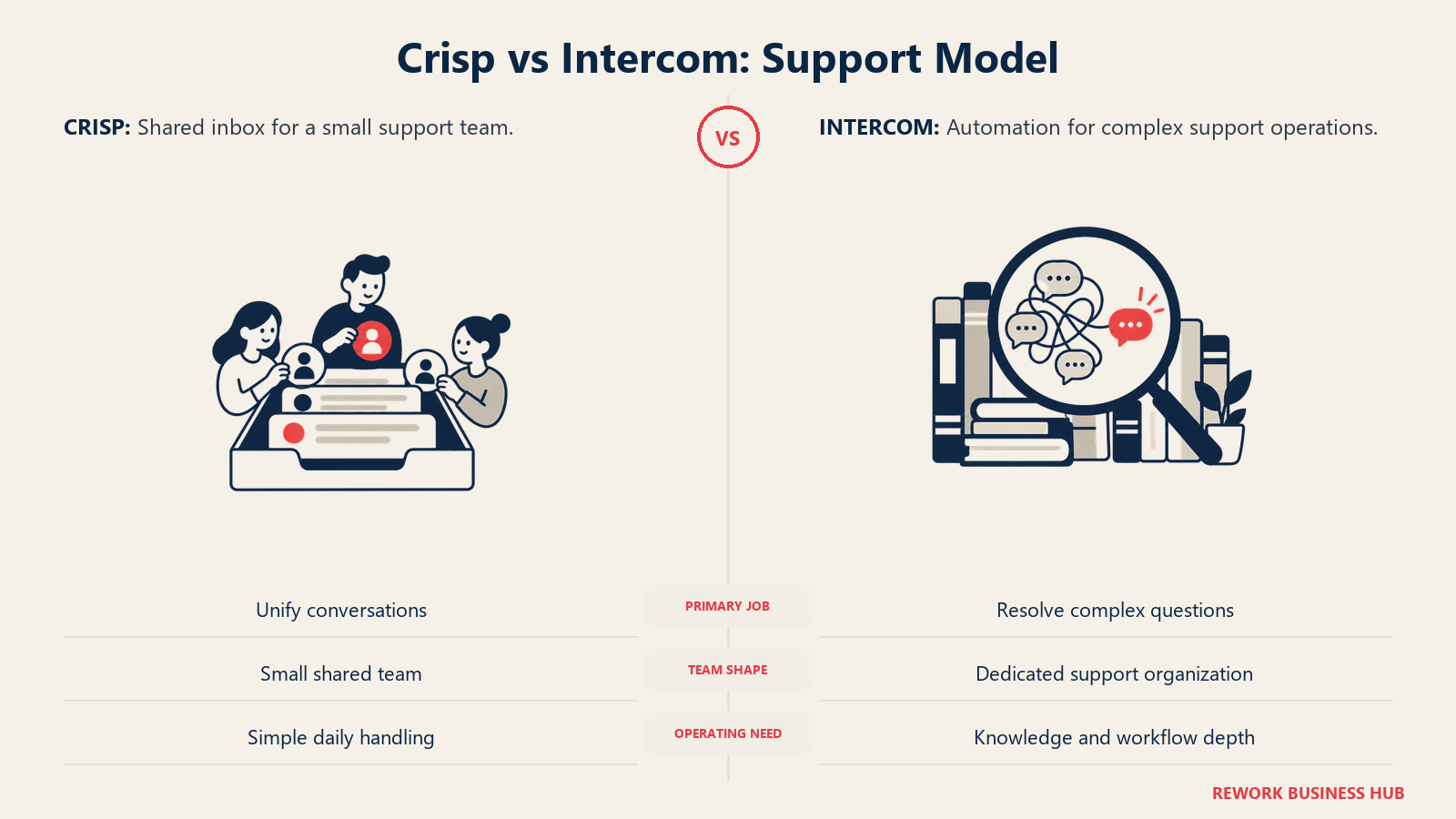
Intercom has spent the past several years rebuilding itself around Fin, the AI agent that now drives a meaningful share of the company's revenue. That AI-first identity became literal in May 2026, when the parent company renamed itself Fin, and a month later agreed to be acquired by Salesforce. The product itself, still called Intercom, is built for teams with enough support or sales volume that a genuinely capable AI agent measurably pays for itself, and enough budget discipline to track a bill that moves with usage rather than staying fixed. Tidio runs a smaller-scale version of that same metered AI model, and Intercom vs Tidio shows the volume where Intercom's higher price actually starts earning its keep.
| Crisp | Intercom | |
|---|---|---|
| Sweet-spot team size | 1 to 50 people | 20 to 1,000+ people |
| Primary buyer | Founder, small support or CS lead | Head of Customer Success, VP Support, Product Ops |
| Company stage | Early-stage to established SMB | Growth-stage to enterprise |
| Budget posture | Fixed software line item | Usage-based, needs ongoing tracking |
| What "value" means here | Same bill every month regardless of growth | Highest resolution quality per conversation, worth paying for at real volume |
Channel coverage is closer than most buyers expect. Both tools reach far beyond a website widget:
| Channel | Crisp | Intercom |
|---|---|---|
| Web chat / Messenger widget | Native | Native (Intercom Messenger) |
| Native | Native | |
| Native; Crisp is a registered WhatsApp Business Solution Provider | Native, listed among Fin AI's supported channels | |
| SMS | Available via integration | Native, listed among Fin AI's supported channels |
| Phone / voice | Not a native channel | Native; Fin AI can resolve voice queries |
| Slack as a customer-facing channel | Not a native channel | Native, listed among Fin AI's supported channels |
| Social DMs (Instagram, Messenger, Telegram) | Native across Messenger, Instagram, and Telegram | Supported through Messenger and integrations, not marketed as broadly as Crisp's social spread |
If you're also weighing a conversational-marketing tool like Drift against Intercom rather than Crisp, our Drift vs Intercom for B2B comparison covers that specific matchup in more depth.
Decision by Business Goal
| Your situation | Pick |
|---|---|
| You want the same bill every month regardless of how fast you're growing | Crisp |
| You need the deepest AI resolution for complex, product-aware support questions | Intercom |
| You're under 20 people and budget-constrained | Crisp |
| You need SSO, HIPAA support, or SLA-backed enterprise contracts | Intercom (Expert) |
| You're running high-volume WhatsApp or Telegram support and don't want per-resolution billing anxiety | Crisp |
| Support volume swings seasonally and you don't want to guess next month's bill | Crisp, since the AI portion is capped by default |
| You have the budget and volume to make a $0.99-per-resolution AI genuinely pay for itself in headcount avoided | Intercom |
| You're signing a multi-year contract and want certainty about who owns the vendor next year | Crisp (see Risk and Governance) |
Team and Role Fit
| Team | Crisp fit | Intercom fit |
|---|---|---|
| Founder-led support (1 to 5 people) | Excellent; Free or Mini tier covers it | Overkill; the 1-seat minimum plus AI billing adds up fast for tiny teams |
| Dedicated support team (5 to 20 agents) | Strong; Essentials or Plus covers most needs | Workable on Essential; Advanced needed for real workflow automation |
| Product-led SaaS support (20 to 100 agents, complex queries) | Workable, but CRM and workflow depth are thin | Strong; Fin AI's product-aware resolution is built for exactly this |
| Sales-assist chat (chat that needs to become pipeline) | Basic; contact management is lightweight | Basic on its own too; either tool needs a real CRM integration |
| Enterprise CS org (100+ agents, compliance requirements) | Not built for this | Strong on Expert tier (SSO, HIPAA, SLAs) |
Pricing at Real Team Sizes
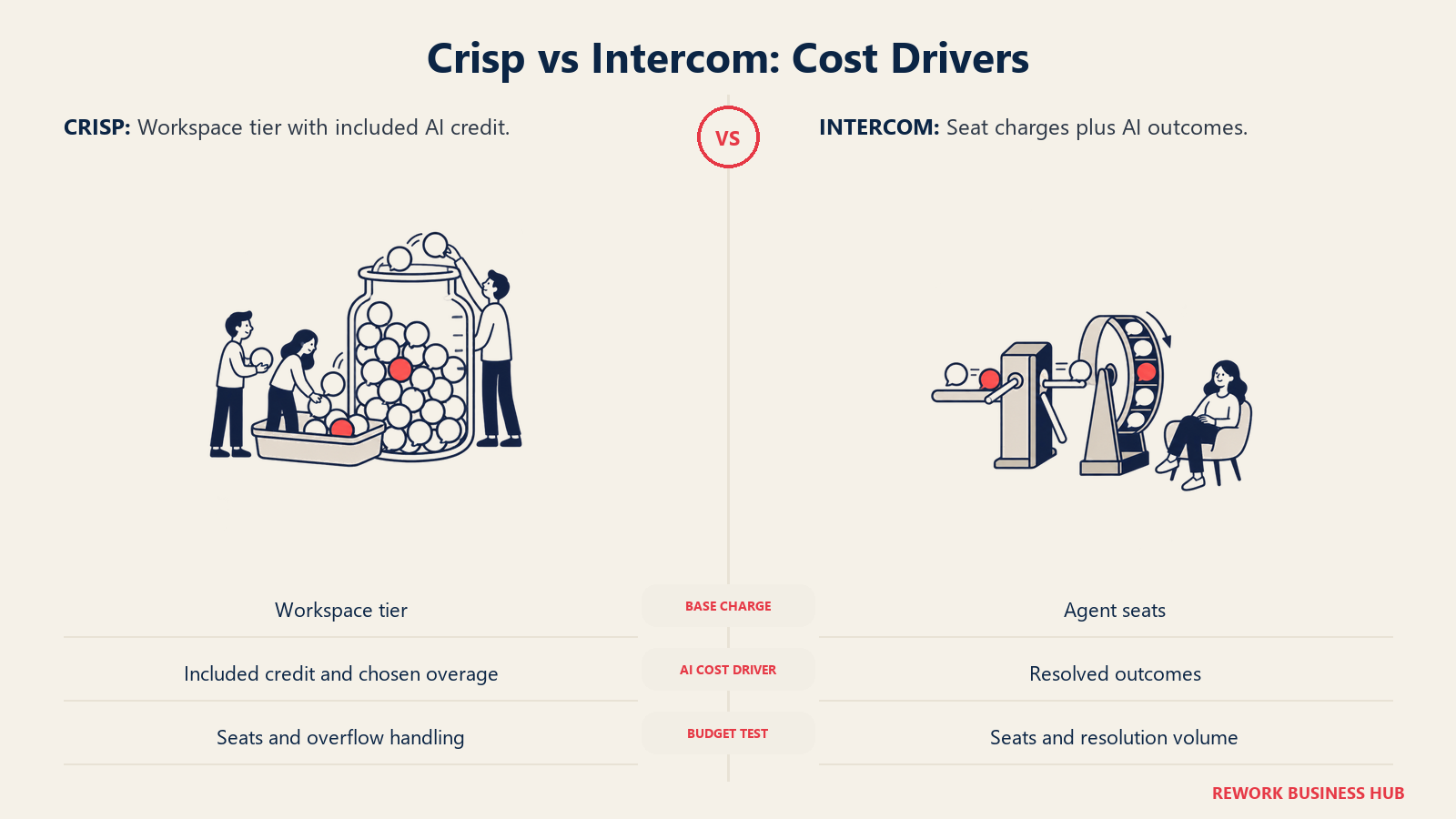
Model the workspace allowance, extra seats, and AI outcomes against real support volume.
Published pricing, headline numbers
Crisp prices per workspace, not per seat, verified from Crisp's pricing page, August 2026:
| Plan | Monthly price | Seats included | Extra seat cost | AI credit included |
|---|---|---|---|---|
| Free | $0 | 2 | Not available | None |
| Mini | $45 | 4 | $10/month each | About $5 (roughly 90 AI-handled conversations) |
| Essentials | $95 | 10 | $10/month each | About $25 (roughly 450 AI-handled conversations) |
| Plus | $295 | 20+ | $10/month each | About $75 (roughly 1,350 AI-handled conversations) |
| Enterprise | Custom | Custom | Custom | Custom |
A 14-day trial is available on any plan, no card required. Crisp also gives a 20% discount for running 3 or more paid workspaces and a 50% discount for nonprofits and students.
Intercom prices per seat, then bills again for what its AI agent actually resolves, verified from Intercom's pricing page, August 2026:
| Plan | Price per seat/month (annual) | What's included |
|---|---|---|
| Essential | $29 | Fin AI (billed separately), Messenger, shared inbox, ticketing, pre-built reports, public help center |
| Advanced | $85 | Everything in Essential, plus multiple team inboxes, workflow automation, round-robin assignment, private and multilingual help center, 20 free Lite seats |
| Expert | $132 | Everything in Advanced, plus SSO and identity management, HIPAA support, SLAs, multibrand Messenger and help center, 50 free Lite seats |
Every plan requires at least 1 full seat, with no platform fee beyond that. Monthly (non-annual) billing is available at a higher rate than shown. Fin AI resolutions bill separately at $0.99 each on top of any tier, with a minimum monthly commitment of roughly 50 outcomes once you turn Fin on at all. Startups can qualify for discounts of up to 93% through Intercom's Early Stage program, and Enterprise pricing is negotiated directly with sales.
Why the sticker price isn't the real price
Here's the mechanic that actually decides this comparison. Crisp's AI agent, Hugo, draws down a fixed dollar credit each month. Run out, and by default Hugo simply stops answering and routes the conversation to a human agent on your team, at no extra charge. You can opt into pay-as-you-go billing if you want Hugo to keep going past your included credit, and on the Plus plan you can instead route out-of-credit conversations to a workflow. Either way, spending past your plan is something you turn on deliberately, not a bill that arrives by surprise.
Intercom's Fin AI works the opposite way by design. There's no cap, no included allowance, and no graceful degrade to a human handoff. Every resolved conversation costs $0.99, on top of whatever you're already paying for seats. That's not a flaw; it's the entire pitch. Fin is meant to replace headcount, so it's priced to scale with the work it's actually doing instead of a seat count that has nothing to do with support volume. But it means your March bill and your November bill (Black Friday traffic, a product outage, a viral support thread) can look nothing alike, and there's no setting that caps it. This split, a flat fee that stays put versus a bill that tracks usage, isn't unique to these two tools; it's part of a broader shift in SaaS pricing we cover in Seat-Based Pricing Is Dying.
What this actually costs at 5, 15, and 40 agents
The modeling below assumes 150 conversations per agent per month, a reasonable middle estimate for a team running live chat plus email support (lighter than pure e-commerce order-status volume, heavier than a quiet B2B site), with half of those conversations resolved by AI rather than a human agent, a realistic middle case for a team actively using its AI agent without having fully matured its deflection strategy. We've picked the least expensive Crisp tier that comfortably covers each seat count; teams that want more AI headroom than the minimum tier's credit allows would step up a tier (Essentials instead of Mini at 5 seats gets you 5 times the AI credit for $40 more a month), which still leaves Crisp far below Intercom's modeled cost at every size tested.
| Team size | Est. monthly conversations | Crisp annual cost | Intercom annual cost (seats + AI at 50% resolution) | Intercom costs... |
|---|---|---|---|---|
| 5 agents | ~750 | $660/year (Mini + 1 extra seat) | $6,195/year (seats $1,740 + AI $4,455) | ~9x more |
| 15 agents | ~2,250 | $1,740/year (Essentials + 5 extra seats) | $18,585/year (seats $5,220 + AI $13,365) | ~11x more |
| 40 agents | ~6,000 | $5,940/year (Plus + 20 extra seats) | $49,560/year (seats $13,920 + AI $35,640) | ~8x more |
Crisp's column barely moves faster than seat count. Intercom's column compounds two variables at once, more seats and more resolved conversations, and there's no version of this model where the multiple closes.
That 50% resolution assumption is a middle case, not a guess pulled from nowhere. Salesforce's own reporting on the acquisition put Fin AI's average resolution rate at 76% of incoming support volume. Here's how Intercom's side moves between a conservative 25% resolution rate and that reported 76% ceiling, with Crisp held flat since its price doesn't move with AI usage under the default, non-pay-as-you-go behavior:
| Team size | Intercom at 25% resolution | Intercom at 50% resolution | Intercom at 76% resolution (near Intercom's own reported average) |
|---|---|---|---|
| 5 agents | $3,968/year | $6,195/year | $8,512/year |
| 15 agents | $11,903/year | $18,585/year | $25,535/year |
| 40 agents | $31,740/year | $49,560/year | $68,093/year |
Across every scenario modeled here, Intercom costs somewhere between roughly 5 and 15 times more than Crisp per year for the same team, moving with how much of your volume Fin AI actually resolves. That's not a knock on Fin AI's quality; reviewers consistently rate it as one of the more capable resolution engines in this category. It's the real price of that capability, laid out at the volume a real team runs, not the seat price on the homepage. This is exactly the dynamic explored in The True Cost of Software Sprawl: the sticker price and the actual bill are rarely the same number.
Implementation and Change Management
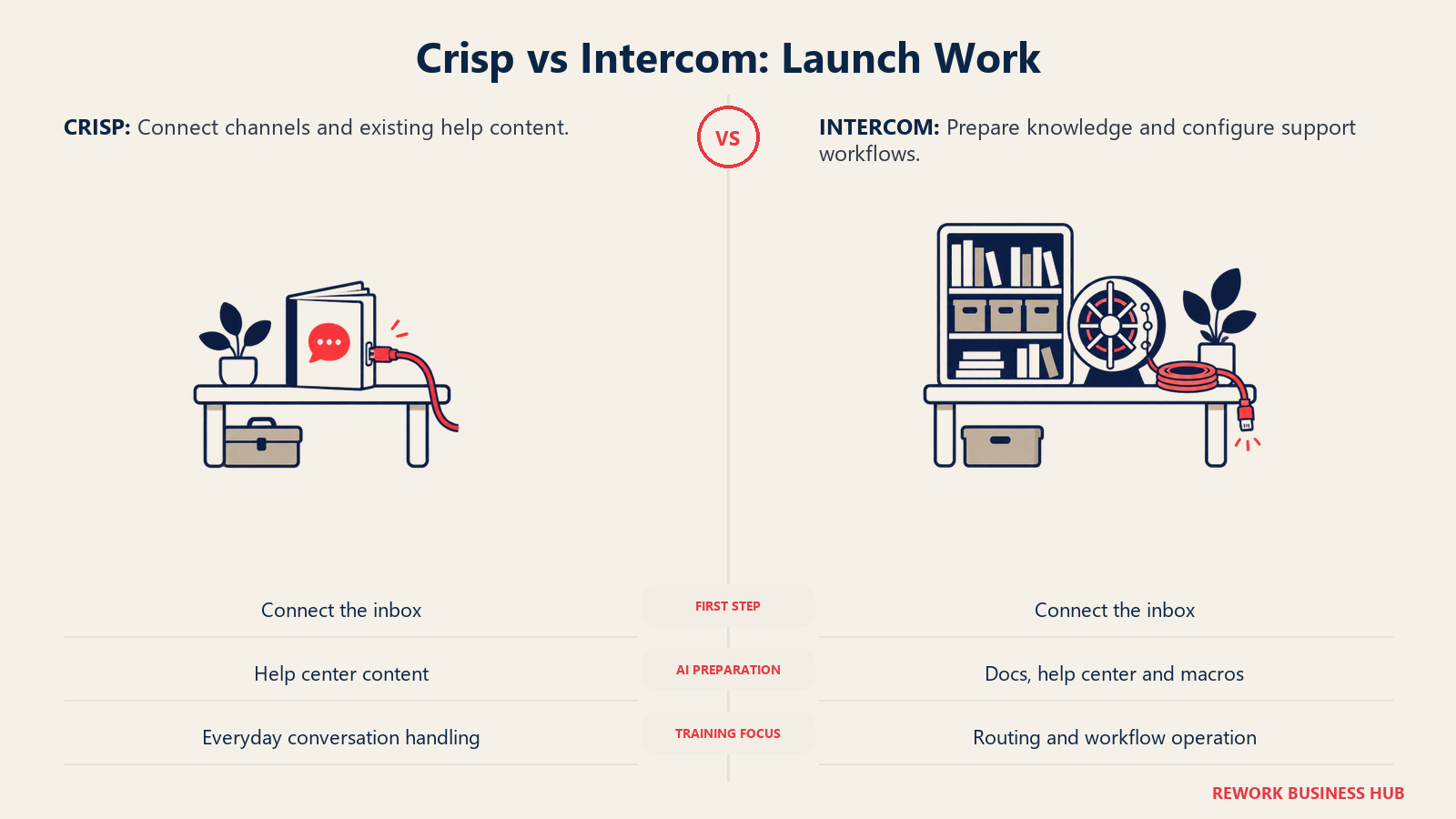
Basic chat can start quickly; useful AI depends on content preparation and workflow setup.
| Crisp | Intercom | |
|---|---|---|
| Time to first conversation | Minutes, self-serve signup | Minutes for basic chat; longer for Fin AI to perform well |
| Setup for AI to work well | Point Hugo at your help center content; light lift | Fin AI needs your help center, product docs, and macros indexed; heavier content prep |
| Training load | Low; simple enough for a founder to run solo | Moderate to high on Advanced and Expert, where the workflow builder and routing rules take real onboarding time |
| Dedicated onboarding | Not offered as a formal program | Available, more common on Advanced, Expert, and larger contracts |
| Typical time to full adoption | Days | 2 to 6 weeks, depending on tier and how much content needs indexing |
Crisp is built to be self-serve end to end. Sign up, connect a channel, and you're answering real conversations the same afternoon. Hugo starts working off whatever help center content you've already written, and there's no implementation phase standing between you and the product.
Intercom's basic chat is just as fast to turn on. What takes real time is getting Fin AI to resolve conversations well, since its accuracy depends on how much of your product documentation, help center, and macros it has to draw from. Teams that skip this step and expect Fin AI to perform like the demo usually end up disappointed in the resolution rate and surprised by the AI bill, since a low-accuracy Fin AI still charges $0.99 for every conversation it thinks it resolved. Track your actual resolution and deflection numbers against a real baseline rather than the vendor's category average; our chat funnel metrics guide covers which numbers to watch before you go live on either tool.
Risk and Governance
This is the part most vendor sales calls won't bring up on their own, and it's directly relevant if you're about to sign a 12-month or multi-year agreement with either company.
| Crisp | Intercom | |
|---|---|---|
| Ownership | Independently run since 2015; no funding raised, no acquisition pending | Parent company Fin agreed to be acquired by Salesforce for ~$3.6B (announced June 15, 2026); not yet closed, expected in the first few months of 2027 |
| Compliance / enterprise controls | Not marketed as SOC 2, HIPAA, or SSO-ready on its published plans | SSO on Advanced and Expert; HIPAA support and SLAs on Expert |
| Data residency and custom contracts | Handled case by case on the Enterprise tier | Typically negotiated at Expert or Enterprise tier |
| Contract risk on a multi-year commitment signed now | Low; the company has run independently since 2015 on a stable pricing model | A 12-month or longer contract signed today will span the ownership change |
Crisp has operated independently out of France since 2015, self-funded, with no acquisition or major ownership change on record. What you sign today is very likely what you're still using next year, run by the same team.
Intercom is in a different position. Its parent company renamed itself Fin in May 2026, and a month later agreed to be acquired by Salesforce for roughly $3.6 billion, a deal expected to close in the first few months of 2027 and still subject to regulatory approval. None of that changes what you're buying today; Intercom's product, pricing, and support are unaffected until the deal actually closes, if it does. But if you're negotiating a 12-month or multi-year contract right now, that term will span the closing. It's worth asking your Intercom sales rep directly what happens to your pricing and roadmap commitments once Fin folds into Salesforce's Agentforce lineup, and worth reading the contract's terms on price changes and termination rather than assuming today's deal holds for the full term. Salesforce hasn't announced any changes to Intercom's product or pricing as of this update, but acquisitions this size routinely reshape roadmaps, and "wait and see" is a real cost when you're the one holding a signed multi-year agreement. Running any vendor decision like this one through a structured framework rather than gut feel helps here; our SaaS Vendor Evaluation Scorecard covers exactly this kind of ownership and contract-risk question.
When Crisp Is the Right Call
- You're under 50 people and want a software bill that doesn't change when your conversation volume has a busy month
- You need broad channel coverage (WhatsApp, Messenger, Instagram, Telegram, web chat, email) without paying per resolution for any of it
- Your team can't tolerate a surprise invoice, and you'd rather cap AI usage than risk an open-ended bill
- You want to be live and answering real conversations the same day you sign up, with no implementation phase
- You're budget-conscious and would rather your team absorb AI overflow manually than pay per resolution for it
When Intercom Is the Right Call
- Your support volume and query complexity are high enough that a genuinely capable AI agent measurably reduces headcount you'd otherwise need to hire
- You need enterprise controls, SSO, HIPAA support, SLAs, that Crisp doesn't publish on any tier
- You're running a product-led SaaS company where support questions need real product context, not FAQ matching
- You have the budget discipline to track a usage-based bill monthly instead of setting it and forgetting it
- You've confirmed your contract terms account for the vendor being mid-acquisition, and you're comfortable with that
Decision Framework
| If you are... | Pick |
|---|---|
| Under 20 people, budget-conscious, want a flat bill | Crisp |
| 20+ people with support volume that justifies real AI resolution spend | Intercom |
| Running high-volume WhatsApp, Telegram, or Instagram support | Crisp |
| Needing SSO, HIPAA, or SLA-backed enterprise contracts today | Intercom (Expert) |
| Uncomfortable signing a multi-year deal with a vendor mid-acquisition | Crisp |
| Willing to track a usage-based bill in exchange for the deepest AI resolution available | Intercom |
| Comparing every live chat option, not just these two | See our full live chat software roundup |
| Not sure Intercom's price is worth it yet | Our Intercom alternatives guide covers lighter options |
| Outgrowing Crisp's ceiling | Our Crisp alternatives guide covers the step up |
The verdict: if your conversation volume is stable and predictable and your team is under about 20 to 50 people, Crisp's flat pricing is very hard to beat on pure cost, and it stays that way as you grow. Intercom earns its price at real scale, where Fin AI's resolution depth offsets support headcount you'd otherwise be hiring, and where enterprise buyers need SSO, HIPAA, or SLA terms Crisp doesn't offer. Just go in with your own conversation volume modeled, not the homepage number, and with your contract terms checked against a vendor that's currently mid-acquisition.
What to Do Next
- Model your own numbers before you demo either tool. Take your actual monthly conversation count and team size, and run them through the tables above rather than trusting either vendor's homepage price.
- If Intercom is the frontrunner, ask for a resolution-rate estimate specific to your content, not the category average. Fin AI's accuracy, and therefore its real cost, depends heavily on how complete your help center and product docs are before you turn it on.
- If Crisp is the frontrunner, stress-test what happens past your AI credit. Decide up front whether overflow conversations should go to a human agent (the default, at no extra cost) or to pay-as-you-go Hugo usage.
- Read the contract terms before signing with Intercom, specifically anything about price changes, if you're committing to a term that runs past the first few months of 2027.
- If the real gap isn't chat depth but chat living apart from your CRM and pipeline, neither Crisp nor Intercom is trying to solve that; they're both chat-first tools with, at best, a lightweight contact record attached. That's a different category of problem, and if it's yours, it's worth a look at something like Rework, which builds chat, WhatsApp, and email into the same record as your CRM and lead pipeline instead of selling them as a separate tool.
Frequently Asked Questions about Crisp vs Intercom
Is Crisp or Intercom cheaper?
Crisp is dramatically cheaper at every team size we modeled, from roughly 5 to 15 times less per year depending on how much of your volume Intercom's Fin AI resolves. Crisp charges a flat monthly rate per workspace; Intercom charges per seat plus $0.99 for every AI-resolved conversation, a cost that scales directly with your support volume.
Is Intercom still called Intercom, or is it Fin now?
Both, in a specific way. The parent company renamed itself Fin in May 2026, and Fin is also the name of the AI resolution agent inside the product. But the customer service platform itself, the Messenger, shared inbox, and help center you'd actually sign up for, still ships under the Intercom name; the company's own announcement says the Intercom name "will very much live on."
Should I be worried about signing a contract with Intercom given the Salesforce acquisition?
Not immediately. Salesforce's agreement to acquire Fin (Intercom's parent company) for about $3.6 billion was signed in June 2026 and hadn't closed as of this update, with a close expected in the first few months of 2027. Nothing about the product, pricing, or support changes until the deal closes, if it does. The real question is what your contract terms say about pricing and commitments once it does, which is worth confirming directly with your sales rep before signing anything longer than a few months.
How does Intercom's Fin AI pricing actually work?
Fin AI bills $0.99 for every conversation it resolves, counted once a customer confirms the issue is solved, stops asking follow-up questions, or Fin AI completes a defined workflow. That's on top of your per-seat plan cost (Essential, Advanced, or Expert), with no published volume discount and a minimum monthly commitment of roughly 50 outcomes once you turn Fin on at all.
What happens if my Crisp AI credits run out for the month?
By default, Hugo (Crisp's AI agent) stops responding once your included credit is used up, and incoming conversations route to your human team at no extra charge. You can opt into pay-as-you-go billing if you'd rather Hugo keep working past your included credit, but that's something you turn on deliberately rather than a bill that arrives by surprise.
Which tool is better for a small team versus a larger support organization?
Crisp fits teams under about 50 people best, especially budget-conscious ones that want a flat bill. Intercom's depth, and its price, make more sense past roughly 20 to 50 agents with real support volume, where Fin AI's resolution quality starts measurably offsetting headcount you'd otherwise need to hire.
Do both tools support WhatsApp and other social channels?
Yes. Crisp is a registered WhatsApp Business Solution Provider and natively supports Messenger, Instagram, and Telegram alongside web chat and email. Intercom's Fin AI is built to resolve queries across live chat, WhatsApp, SMS, phone calls, and Slack, though its social DM coverage isn't marketed as broadly as Crisp's.
Related Resources:
- Best Live Chat Software in 2026
- Best Crisp Alternatives in 2026
- Best Intercom Alternatives in 2026
- Drift vs Intercom for B2B
- Crisp vs Tidio
- Intercom vs Tidio
- Multi-Channel Inbox Configuration
- Chat Funnel Metrics
- Seat-Based Pricing Is Dying
- The True Cost of Software Sprawl
- SaaS Vendor Evaluation Scorecard

Senior Implementation Consultant
On this page
- TL;DR
- What Each Tool Is Actually Built For
- Decision by Business Goal
- Team and Role Fit
- Pricing at Real Team Sizes
- Published pricing, headline numbers
- Why the sticker price isn't the real price
- What this actually costs at 5, 15, and 40 agents
- Implementation and Change Management
- Risk and Governance
- When Crisp Is the Right Call
- When Intercom Is the Right Call
- Decision Framework
- What to Do Next