Best AI Agents for Live Chat in 2026: 11 Agents for Support Deflection and Sales Chat
Turn this article into takeaways for your work.


Each assistant summarizes the article only for you and suggests best practices for your work.
If you're buying an AI agent for live chat rather than a scripted bot, Fin (formerly Intercom Fin) and Zendesk lead support deflection grounded in real product data, Gorgias owns ecommerce order-aware support, Qualified's Piper is built for enterprise sales qualification rather than ticket deflection, and Tidio, Crisp, and Chatbase get a working agent live on a small business's website the same afternoon. This guide ranks 11 agents (not chatbot flow-builders) that hold an actual conversation, evaluated on how fast they respond, how cleanly they hand a conversation to a human, how long they take to deploy, and what a resolution actually costs at real chat volume instead of the homepage number.
Most "best live chat" roundups blur two different jobs into one buying decision. A widget that deflects support tickets and a widget that qualifies a sales visitor before a rep gets involved are different products, built for different buyers, priced on different units, even when they share the same chat bubble in the corner of a screen. Every agent below was checked against one question first: does it plan and complete a multi-step resolution on its own, or does it hand a scripted reply to a visitor and call that "AI"? Where a vendor didn't publish a number, that's stated plainly and any third-party figure is labeled as reported.
Key Facts
- Gartner projected in 2022 that conversational AI would cut contact center agent labor costs by $80 billion in 2026, the year this article publishes, with roughly 1 in 10 agent interactions automated by then (Gartner).
- Site visitors who use live chat are 2.8 times more likely to convert than visitors who don't, according to Forrester's Kate Leggett (Forrester).
- The global average first response time in live chat is 35 seconds, but customers still wait 4 minutes 18 seconds in queue on average, and 27.4% abandon the chat before anyone responds, per LiveChat's Customer Service Report.
- 74% of customers say it's frustrating to repeat themselves to a different agent after being transferred or escalated, which is exactly the handoff problem a live chat agent has to solve, per Zendesk's CX Trends 2026 research.
- Only 16% of enterprise AI deployments (27% at startups) actually qualify as autonomous agents that plan, observe, and adapt; most of what gets marketed as an "AI agent" is a fixed-sequence workflow wrapped around a single model call, per Menlo Ventures' State of Generative AI in the Enterprise.
Quick Comparison Table
| Agent | Best For | Starting Price | Key Strength | Key Limitation |
|---|---|---|---|---|
| Fin (formerly Intercom Fin) | Product-led SaaS with high support volume | $29/seat/mo annual + $0.99/outcome | Resolves using real product data, not a canned script | Outcome pricing gets expensive fast at high volume |
| Zendesk | Teams wanting chat, ticketing, and AI on one contract | $55/agent/mo annual (Suite Team) | Messaging bundled into every Suite plan by default | AI resolution rate isn't published; budget $1.50 to $2/resolution |
| Gorgias | Shopify and ecommerce support | $10/mo (Starter) + $0.90 to $1/resolution | Order and customer data baked into every reply | A resolved AI chat also bills against the ticket allowance |
| Freshchat (Freddy AI Agent) | Value-priced AI agent without enterprise spend | $19/agent/mo annual | Freddy AI Agent included from the Growth tier up | Multilingual routing needs the $49/agent/mo Pro tier |
| Text (formerly LiveChat) | Teams that know the LiveChat brand | $19/user/mo | AI Agent now bundled, no separate ChatBot.com purchase needed | Essential tier caps at only 10 AI resolutions a month |
| Tidio (Lyro) | Small ecommerce and service businesses | Free (50 Lyro chats/mo); Starter $24.17/mo | Fast script-tag setup, live same day | Real AI volume needs the Plus tier at $300/mo and up |
| Crisp | Startups wanting a flat bill, not per-seat | Free (2 seats); Mini $45/mo | Flat workspace pricing regardless of headcount | AI credits are metered; heavy use needs the $295/mo Plus plan |
| Zoho SalesIQ (Zia Agents) | Teams already on Zoho wanting sales + support chat | $7/operator/mo annual (Basic) | Zia Agents included in operator pricing, no separate AI meter | Only 1 operator license included per paid tier before add-ons |
| Qualified (Piper) | Enterprise ABM sales qualification | Custom quote, ~$40K to $68K/yr (reported) | Real-time video, voice, and text qualification, not just text | Requires Salesforce; not built for support deflection |
| Chatbase | Fast no-code agent with real tool-calling | Free (50 messages/mo); Hobby $32/mo | Actions, API access, and integrations from the Standard tier | Tool-calling and integrations are gated above the entry tiers |
| Chatling | Budget multi-channel agent to test the category | Free (100 credits/mo); Standard $32/mo annual | Deploys across web, WhatsApp, Instagram, and Messenger | Agentic depth is lighter than Fin or Zia Agents |
Updated August 2026: What Changed
- LiveChat rebranded to Text in May 2026. The AI Agent that used to be a separate ChatBot.com subscription is now bundled directly into the Essential and Growth plans, which is a real packaging change from what buyers saw earlier this year.
- Drift is being sunset. Salesloft, which acquired Drift through its Clari merger, states plainly on its own site that it has "transitioned from Drift to 1mind." Because Drift can no longer be recommended as a product a reader can confidently buy and grow with, it's left out of the ranked list below. If you're evaluating Drift alternatives specifically, our AI agents for sales guide covers the outbound and qualification agents that picked up share during the transition.
- Zoho shipped Zia Agents in its summer 2026 SalesIQ release, moving from a rules-based bot to an agent that pulls live context from records, webhooks, and third-party apps before it answers.
- Intercom renamed itself Fin in May 2026, and Salesforce signed a definitive agreement in June 2026 to acquire it for roughly $3.6 billion, a deal that hadn't closed. Fin's standalone pricing and product still stand as published, but budget for roadmap uncertainty until the acquisition closes.
- Outcome-based pricing is now the norm, not the exception. Fin, Zendesk, and Gorgias all charge per resolution on top of (or instead of) a seat fee. Model your real monthly chat volume before you compare sticker prices, because the seat price is rarely the number that decides your bill.
Chat Agent or Chatbot? Two Different Jobs Wearing the Same Widget
A chat "bot" and a chat "agent" get sold through the same widget and often the same vendor, which is exactly why the distinction gets lost. A scripted chatbot follows a decision tree you built: if the visitor clicks A, show reply B. It answers. An agent reads the actual message, decides what to do, pulls the data it needs from your knowledge base, order system, or CRM, and either resolves the conversation or hands it off with a clear reason why. It resolves and acts. Our breakdown of AI agents versus chatbots, RPA, and automation covers the full five-dimension test if you want to check a specific product against it before you buy.
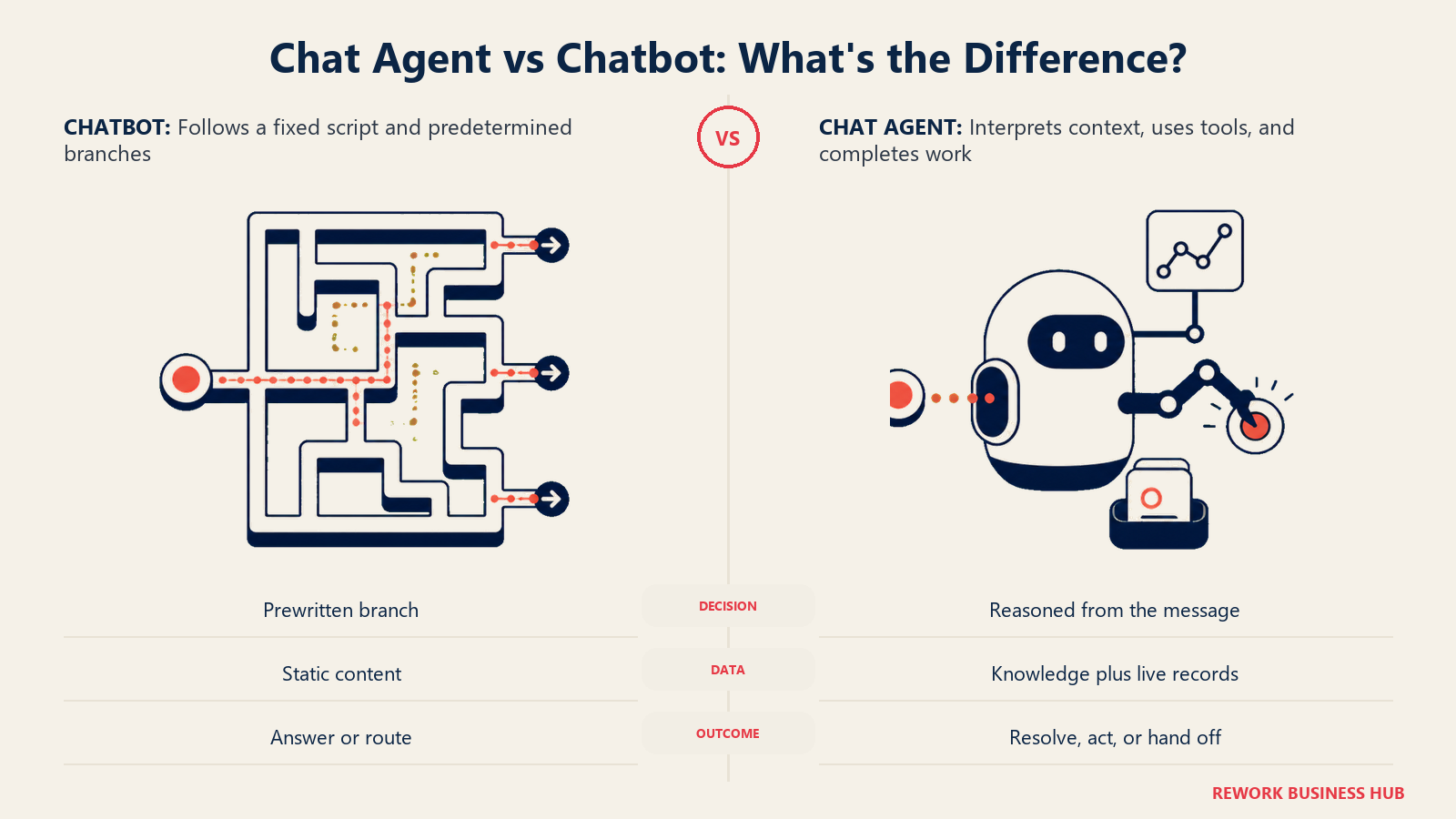
That line matters more in live chat than almost anywhere else, because the two jobs a chat widget does, support deflection and sales qualification, are genuinely different products even when they share a launcher icon.
| Job | What the Agent Needs to Do | Agents Built for This |
|---|---|---|
| Support deflection | Answer from a knowledge base, look up order or account status, resolve or escalate with full context | Fin, Zendesk, Gorgias, Freshchat, Text, Tidio, Crisp |
| Sales qualification | Ask discovery questions, score fit against an ICP, book a meeting, route to the right rep | Qualified (Piper), Zoho SalesIQ (Zia Agents), some Chatbase and Chatling deployments |
| Both, depending on setup | Split routing by intent so support and sales questions never cross wires | Zendesk, Zoho SalesIQ, Freshchat |
If what you actually want is a general-purpose AI assistant you open yourself to draft or research something, that's a different category entirely: see best AI chatbots in 2026. And if you want to build a fully custom bot from scratch rather than buy a ready-made agent, best AI chatbot builders in 2026 covers that layer, along with a broader look at the wider live-chat software market (agent or not) in best live chat software in 2026.
How to Choose: Latency, Handoff, and Time to Deploy
Response latency decides whether a visitor stays
The section evaluates the full operating journey from instant response through contextual handoff and rollout readiness.
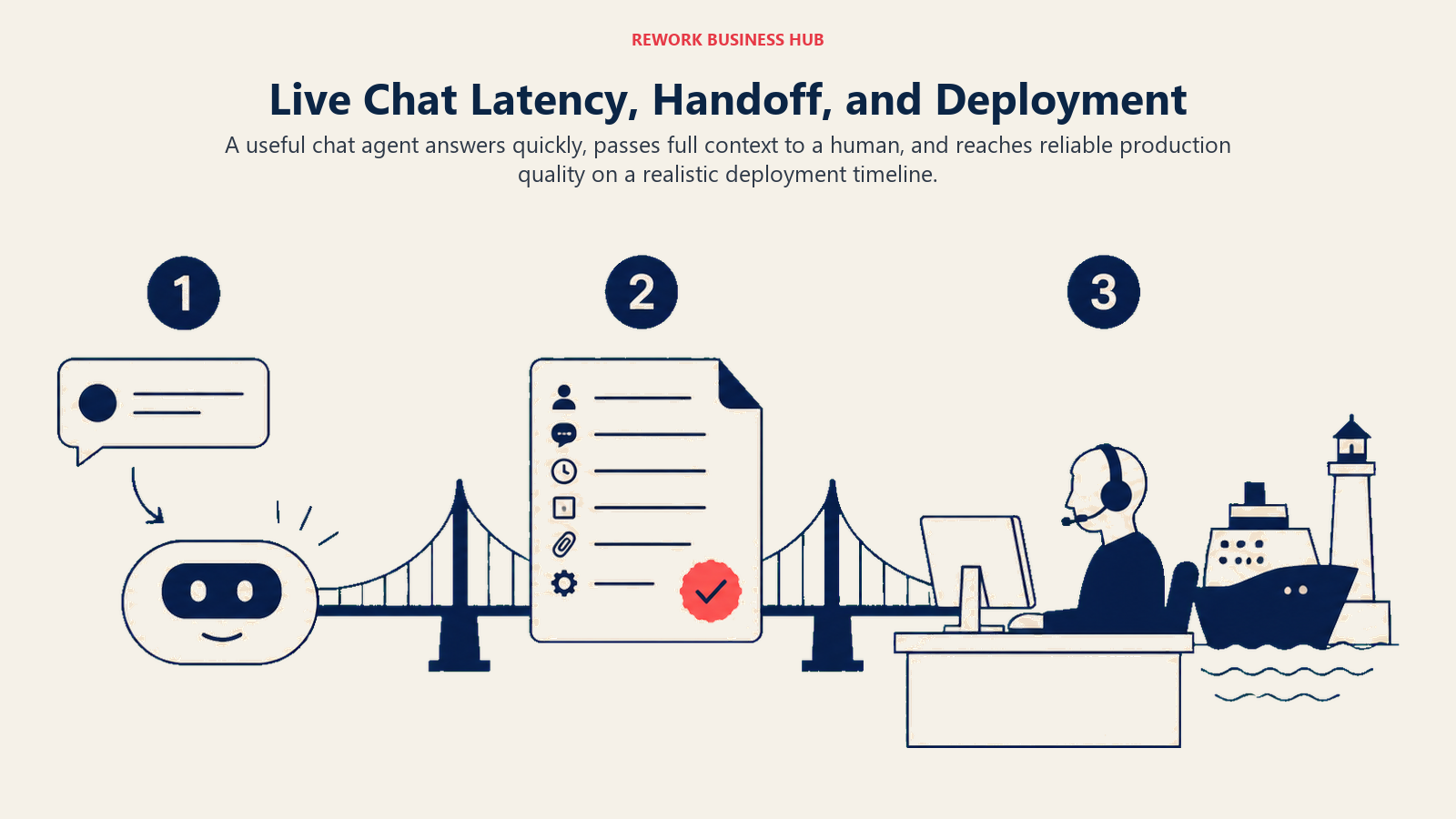
A human team's best-case first response, per the Key Facts above, is 35 seconds on a good day and over 4 minutes in an average queue. A live chat agent that's actually wired into your knowledge base responds in a second or two, every time, at 3 a.m. or during a traffic spike a marketing campaign just caused. That gap is the entire commercial case for buying one of these products instead of just hiring more agents. It's also why latency-sensitive categories keep converging: the same real-time-response problem shows up in AI voice agents for phone support, just on a different channel with a tighter tolerance for delay.
But speed only helps if the answer is right. A fast, wrong answer erodes trust faster than a slow, correct one, which is why every product below was checked for what it actually resolves, not just how quickly it replies.
Deploy time: a script tag versus a real knowledge-base build
| Agent | Setup Method | Typical Time to a Working Agent |
|---|---|---|
| Tidio, Crisp, Chatbase, Chatling | Script tag plus a scraped or uploaded knowledge base | Minutes to a few hours |
| Freshchat, Text (formerly LiveChat) | Script tag plus manual FAQ and macro setup | A day to about a week |
| Zoho SalesIQ | Operator setup plus connecting Zia Agents to existing records and apps | About a week |
| Fin, Zendesk | Full knowledge base audit, content cleanup, and resolution testing before launch | Two to six weeks for a genuinely reliable resolution rate |
| Gorgias | Shopify or ecommerce platform connection plus macro and Automate rule setup | About a week |
| Qualified (Piper) | Salesforce integration, intent data connection, agent scripting for ABM plays | Several weeks, enterprise implementation |
The fast row isn't automatically the right answer. A same-day agent that's only skimmed your help center will confidently give wrong answers to anything outside the FAQ it was trained on. The slower rows earn that time by testing against your actual ticket history before they go live in front of customers.
Handoff quality and language coverage
The moment an agent can't resolve something is the moment it either saves or wastes the relationship it just started. A clean handoff passes the full transcript, a summary of what's already been tried, and a reason for escalation to the human agent picking it up. A bad one dumps a customer into a queue with no context, and that's exactly the experience 74% of customers say is frustrating, per the Zendesk stat above.
| Agent | Human Handoff | Language Coverage |
|---|---|---|
| Fin | Full transcript and workflow context passed to the inbox | Multilingual, no published language cap |
| Zendesk | Full ticket context retained, since chat and ticketing share one system | Multilingual across Suite messaging channels |
| Gorgias | Order and customer data carried into the human view | English-first; broader language support varies by integration |
| Freshchat | Context passed to the agent inbox | English on Growth; full multilingual routing requires the $49/agent/mo Pro tier |
| Text (formerly LiveChat) | Reply Suggestions and Copilot carry context to the human agent | Multilingual reply suggestions on paid tiers |
| Tidio, Crisp | Conversation history visible in the shared inbox on handoff | Multilingual on higher tiers; capped conversation volume on entry tiers |
| Zoho SalesIQ | Zia Agents pass pulled context (records, webhooks) to the operator | Multilingual across the Zoho ecosystem |
| Qualified (Piper) | Hands off to a live rep mid-conversation with full qualification data | Multi-language agent listed as a Premier-tier feature |
Roughly two in three global customers say they'd rather deal with a brand in their own language, and a majority say they'd switch brands over it, per Unbabel's Global Multilingual CX survey. If your traffic isn't all English, confirm exactly which tier turns on real multilingual coverage before you buy the entry plan.
Pricing model: per-resolution, per-seat, or credit-based
None of these charge the same way, and the unit matters more than the sticker price once your chat volume is real.
| Pricing Model | How It Works | Agents That Use It |
|---|---|---|
| Per-seat plus per-resolution | A base seat fee, then a fee every time the AI actually resolves something | Fin, Gorgias, Zendesk (Copilot add-on), Text |
| Per-seat, AI included | One price per operator or agent; AI usage bundled up to a session cap | Freshchat, Zoho SalesIQ |
| Per-workspace flat fee | One price regardless of headcount, AI metered by credits | Crisp |
| Credit or message-based | Pay for a pool of AI credits or messages, not seats | Tidio (Lyro), Chatbase, Chatling |
| Custom / quote-based | No public unit price; negotiated per contract | Qualified (Piper) |
The headline number almost always excludes something. Per-resolution pricing excludes the seats you still need to staff the handoff. Per-seat pricing with a session cap excludes what happens the month you get a traffic spike. Model your actual monthly chat volume, not your current headcount, before you pick a plan.
Sizing and Persona Table
| Agent | Ideal Team Size | Primary Buyer Persona |
|---|---|---|
| Fin | 20-2,000+ employees | Head of Support, VP CX, Product-led growth teams |
| Zendesk | 20-5,000+ employees | Head of Support, CX Director, IT-adjacent support ops |
| Gorgias | 5-200 employees | Ecommerce Founder, Shopify Ops Lead |
| Freshchat | 10-500 employees | Support Manager, Head of Growth |
| Text (formerly LiveChat) | 5-200 employees | Support Manager, Small Agency Lead |
| Tidio | 1-50 employees | Small Business Owner, Ecommerce Founder |
| Crisp | 1-50 employees | Startup Founder, Small Support Team Lead |
| Zoho SalesIQ | 10-500 employees | Ops Manager, Sales Manager already on Zoho |
| Qualified (Piper) | 200-5,000+ employees | VP Marketing, Head of ABM, Enterprise RevOps |
| Chatbase | 1-200 employees | Founder, Developer, Ops Lead building a custom agent |
| Chatling | 1-50 employees | Small Business Owner, Solo Marketer |
1. Fin (formerly Intercom Fin): Deepest Support Deflection Grounded in Real Product Data
Intercom renamed itself Fin in May 2026, reflecting what the product had already become: an AI agent that runs across many helpdesks, not just Intercom's own, reading a knowledge base, past conversations, and live product or order data to resolve a conversation itself or hand it off with real context attached. It's still the agent other vendors get compared against in support deflection specifically. Pairing an always-on QA layer with it matters here too, since a fast wrong answer is worse than a slow right one; our AI Chatbot QA Agent blueprint covers how teams monitor and score live bot conversations at scale.
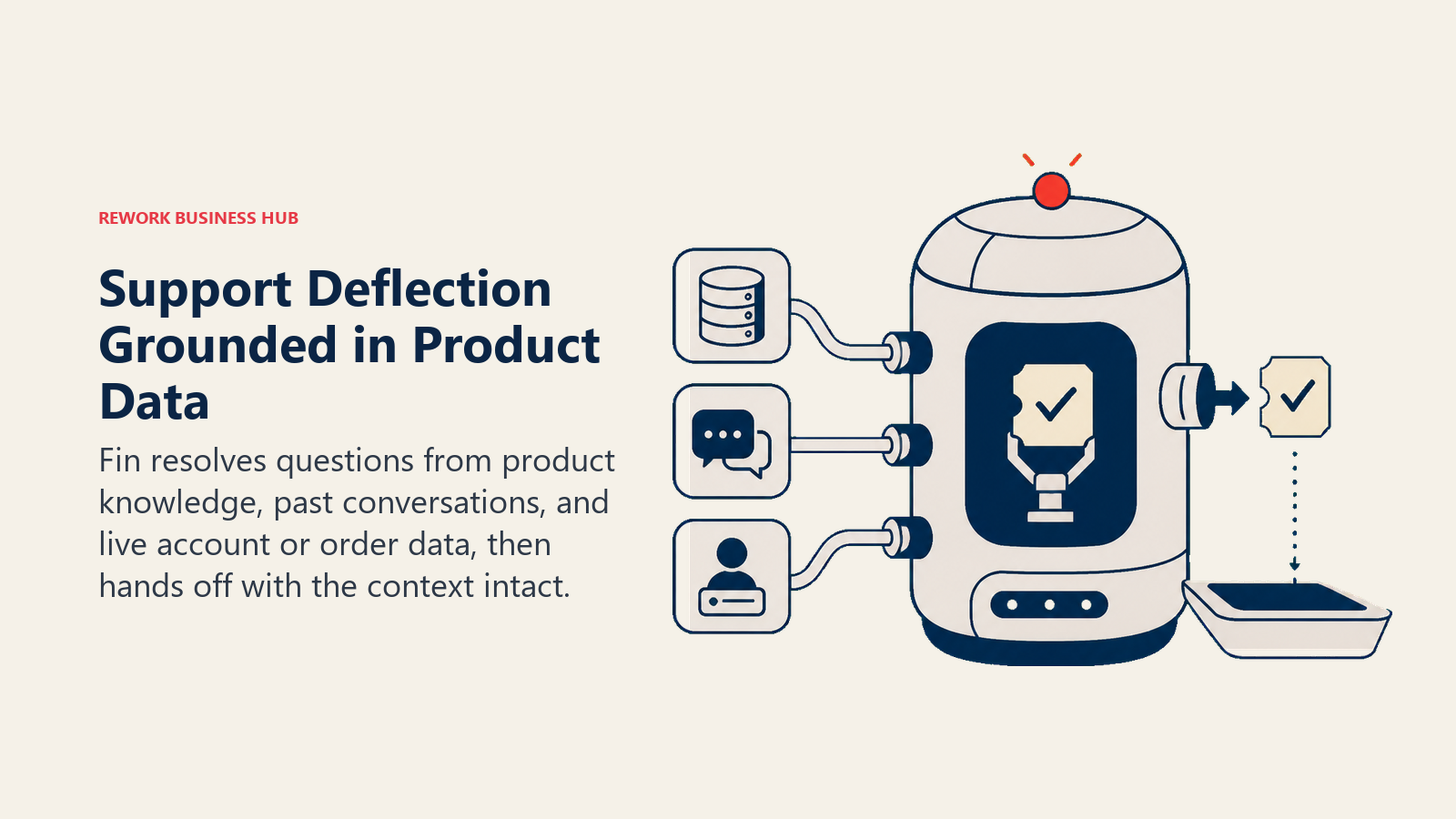
Fin's own reporting puts its average resolution rate at 76% across more than 12,000 customers (vendor-reported, not independently audited). The billing logic is simple: an outcome is a resolution, a handoff to a human with context attached, or a disqualification, each billed at $0.99, with a qualified lead billed separately at $9.99 and a 50-outcome monthly minimum. The bigger variable heading into next year is Salesforce's pending roughly $3.6 billion acquisition of Fin, announced in June 2026 and not yet closed, which adds real roadmap uncertainty on top of the pricing math.
| What you get | What you don't |
|---|---|
| Resolves using real product data, not just FAQ matching | 50-outcome/month minimum sets a real cost floor even at light usage |
| Works across many helpdesks, not locked to one ticketing product | $0.99 per resolved outcome stacks on top of seat cost |
| Deepest ecosystem of the pure support-deflection players | Pending Salesforce acquisition adds roadmap uncertainty until it closes |
Pricing: Essential $29/seat/mo annual ($39 monthly), Advanced $85/seat/mo annual ($99 monthly), Expert $132/seat/mo annual ($139 monthly), plus $0.99 per outcome (resolution, handoff, or disqualification) and $9.99 per qualified lead, with a 50-outcome/month minimum; a standalone deployment without seats is also available.
Best for: Product-led SaaS companies with a real knowledge base and high support volume who want the deepest resolution quality on the market.
2. Zendesk: One Contract for Chat, Ticketing, and AI Resolution
Zendesk's pitch for live chat is that you're not buying a separate tool. Messaging (web, mobile, WhatsApp, and social) ships inside every Suite plan by default, and the AI agent layer sits on the same ticket and conversation history your human team already works from, so there's no separate system to reconcile after a handoff.
The tradeoff is that Zendesk doesn't publish a single flat resolution rate for its AI agents the way Gorgias does. Zendesk's own documentation describes tiered "verified resolution" pricing, and buyers report the effective cost landing between $1.20 and $2.00 per automated resolution depending on volume, on top of the Suite seat price, which is a real number to model before you commit to a contract.
| What you get | What you don't |
|---|---|
| Live chat and messaging bundled into every Suite plan | AI resolution rate isn't a single published number; budget $1.20 to $2/resolution (reported) |
| One data model for chat, tickets, and AI resolutions | Suite Enterprise pricing sits behind a sales call as "Suite Enterprise + Copilot" |
| Copilot agent-assist available as a $50/agent/mo add-on | Monthly billing runs 15% to 25% above the annual-contract rate |
Pricing: Suite Team $55/agent/mo, Suite Professional $115/agent/mo, billed on an annual contract (monthly billing runs higher); Suite Enterprise + Copilot is custom-quoted. AI agent resolutions run roughly $1.20 to $2.00 each depending on volume, per Zendesk's own resolution-tier documentation.
Best for: Support teams that want live chat, ticketing, and AI resolution under one vendor relationship instead of stitching tools together.
3. Gorgias: Order-Aware Support Built for Ecommerce
Gorgias was built for one buyer: a Shopify or ecommerce brand whose support conversations are mostly "where's my order" and "can I return this." The AI Agent pulls order status, customer history, and return policy directly into every reply, which is a meaningfully different (and easier) problem than the open-ended support Fin or Zendesk have to handle across every industry.
The detail worth knowing before you buy: a resolved AI conversation counts as a billable ticket against your plan's ticket allowance and gets charged the per-resolution AI fee on top. That double-count can push a busy month's bill well past the plan's sticker price.
| What you get | What you don't |
|---|---|
| Order and customer context baked into every automated reply | Every AI resolution bills twice: once as a ticket, once as an AI resolution |
| Ticket-based plans scale from 50 to 5,000+ tickets a month | Ticket overage runs $0.36 to $0.40 each once you exceed your plan |
| AI Agent priced per resolution, not per seat | Purpose-built for ecommerce; a poor fit outside that vertical |
Pricing: Starter $10/mo (50 tickets), Basic $60/mo or $50/mo annual (300 tickets), Pro $360/mo or $300/mo annual (2,000 tickets), Advanced $900/mo or $750/mo annual (5,000 tickets), Enterprise custom; AI Agent resolutions are $1.00 each on Starter (monthly billing) and $0.90 each on every other plan.
Best for: Shopify and ecommerce brands whose support volume is dominated by order and returns questions.
4. Freshchat (Freddy AI Agent): AI Live Chat Without Enterprise Pricing
Freshchat is Freshworks' live chat layer, and Freddy AI Agent is bundled in starting at the Growth tier rather than sold as a separate product, which puts a real AI agent within reach at a lower per-seat price than Fin or Zendesk. Every paid plan includes 500 free AI sessions a month before overage kicks in.
The catch is that multilingual routing and custom dashboards, both genuinely important once you're running support at any scale, are gated behind the $49/agent/mo Pro tier rather than included at Growth.
| What you get | What you don't |
|---|---|
| Freddy AI Agent included from $19/agent/mo, no separate purchase | Multilingual support requires the $49/agent/mo Pro tier |
| 500 free AI sessions/mo bundled into every paid plan | Additional sessions cost $49 per 100, which adds up at real volume |
| Freddy Copilot agent-assist available as a $29/agent/mo add-on | Advanced routing and SLA policies also sit above the entry tier |
Pricing: Free (10 agents, no AI); Growth $19/agent/mo annual; Pro $49/agent/mo annual; Enterprise $79/agent/mo annual, all with 500 free Freddy AI sessions/mo; extra sessions are $49 per 100.
Best for: Growing support teams that want a real AI agent without Fin or Zendesk-level spend, as long as English-only is fine at the entry tier.
5. Text (formerly LiveChat): The AI Agent Is Now Bundled, Not a Separate Purchase
LiveChat rebranded to Text in May 2026, and the practical change for buyers is real: the AI Agent that used to require a separate ChatBot.com subscription is now built into the Essential and Growth plans. If you evaluated LiveChat earlier this year and passed because the AI cost extra, that math has changed.
The new bundling comes with a real ceiling. Essential includes just 10 AI resolutions a month, which is barely a trickle of automated conversations for anything beyond the smallest sites. Growth's 200 a month is a more realistic starting point for a team that wants the AI agent to actually carry load.
| What you get | What you don't |
|---|---|
| AI Agent bundled into core plans since the May 2026 Text rebrand | Essential's 10 AI resolutions/mo cap is very low |
| Reply Suggestions and AI Copilot ship on every paid plan | Enterprise pricing is custom, no public number |
| Established brand with 200+ integrations from the LiveChat era | Newly restructured pricing; verify current tiers before renewal |
Pricing: Essential $19/user/mo (1 AI Agent, 10 AI resolutions/mo); Growth $79/user/mo (10 AI Agents, 200 AI resolutions/mo), Enterprise custom; additional AI resolution packages run $49.50 per 50.
Best for: Teams that know the LiveChat product and want the now-bundled AI agent without a second subscription to ChatBot.com.
6. Tidio (Lyro): The Fastest Path to a Working Agent for a Small Business
Tidio's whole pitch is speed: a script tag, a scrape of your existing help content, and Lyro is answering real questions the same day. For a small ecommerce or service business testing whether an AI agent is even worth it, that's a genuinely low-risk way to find out.
The honest limitation shows up the moment you want real volume. The Free and Starter tiers are both capped at 50 Lyro conversations a month, which is a rounding error for most live sites. Meaningful AI volume means jumping to Plus at $300/mo and up, a large step from the Starter price.
| What you get | What you don't |
|---|---|
| Live, working AI agent the same day you install the script | Free and Starter are both capped at 50 Lyro conversations/mo |
| Premium tier offers a vendor-guaranteed 50% resolution rate | Real volume requires Plus at $300/mo plus usage fees |
| Lyro also sellable as a standalone add-on from $32.50/mo | Growth tier pricing scales with conversation volume, not flat |
Best for: Small ecommerce and service businesses that want to test a real AI agent cheaply before committing budget.
7. Crisp: A Flat Bill Instead of a Per-Seat One
Crisp's model is built around a genuinely different question than most of this list: instead of "how many seats do you need," it asks "how big is your workspace." Every plan includes a fixed seat count and a pool of AI credits, and the price doesn't move if you add another teammate within that allowance.
AI usage is metered by credits rather than a flat per-resolution fee, and the credit-to-conversation ratio holds steady across tiers at roughly $0.055 per automated conversation, whether you're on Mini or Plus.
| What you get | What you don't |
|---|---|
| Flat per-workspace pricing regardless of exact headcount | AI is credit-metered; heavy volume needs the $295/mo Plus plan |
| Unlimited task automations on the Plus tier | Free plan includes zero AI credits |
| 14-day full-feature trial on every paid plan | Additional seats beyond the plan allowance cost $10/mo each |
Best for: Startups and small teams that want one predictable bill instead of pricing that climbs with every hire.
8. Zoho SalesIQ (Zia Agents): Sales and Support Chat Inside the Zoho Ecosystem
Zia Agents shipped in SalesIQ's summer 2026 release, and the shift is real: instead of a rules-based bot following a script, Zia now pulls live context from records, webhooks, file uploads, databases, and third-party apps before it answers, and it's included in operator pricing rather than metered as a separate AI line item.
The natural buyer already runs Zoho for CRM, desk, or both, since that's where Zia Agents get the most context to pull from. Outside that ecosystem, it's a weaker reason to switch than a purpose-built specialist would give you.
| What you get | What you don't |
|---|---|
| Zia Agents pull context from records, webhooks, and third-party apps | Zia Agents require the Basic tier or above, not available free |
| No separate AI meter; included in operator pricing | Only 1 operator license included per paid tier before add-ons |
| Works across both sales qualification and support use cases | Full value depends on already being in the Zoho ecosystem |
Best for: Teams already running Zoho CRM or Desk that want sales and support chat AI without adding a separate per-resolution bill.
9. Qualified (Piper): Enterprise Sales Qualification, Not Support Deflection
Piper is built for a specific, expensive job: engaging a target-account visitor the moment they land on your website, qualifying them through an open conversation in video, voice, or text, and handing a booked meeting to the right rep before they leave. It's the clearest example on this list of a chat agent built for sales qualification rather than support, and it shouldn't be evaluated against Fin or Zendesk on the same axis.
Pricing is entirely custom. Qualified's own site is demo-gated with no published numbers across its Premier, Enterprise, and Ultimate tiers. Third-party deal reports put Premier around $68,000 a year for 25 users, with most negotiated contracts landing closer to $40,000 to $50,000 a year (reported), and that's before the required Salesforce stack on top.
| What you get | What you don't |
|---|---|
| Real-time video, voice, and text qualification, not just text chat | No public pricing; every deal is a custom quote |
| Built for account-based marketing and target-account plays | Requires an existing Salesforce instance |
| Multi-language agent support listed on the Premier tier | Not built for, or priced for, general support deflection |
Pricing: Custom quote across Premier, Enterprise, and Ultimate tiers, no public list price; industry-reported deals cluster around $40,000 to $68,000/year (reported) plus a required Salesforce subscription.
Best for: Enterprise B2B marketing teams running ABM programs with six-figure SDR budgets, not a fit for SMB or a first AI agent purchase.
10. Chatbase: A No-Code Agent With Real Tool-Calling
Chatbase's pitch is building a custom-trained agent without writing code: point it at your website, docs, or files, and it's answering from that content within minutes. What separates it from a simpler bot builder is that API access and third-party integrations, including Zendesk and Stripe, become available at the Standard tier, which is where it starts taking actions instead of only answering questions.
The free and entry Hobby tiers are genuinely just a Q&A agent. Real agentic behavior, the kind that can look something up or trigger a workflow rather than just describe one, needs Standard or above.
| What you get | What you don't |
|---|---|
| Live, custom-trained agent in minutes, no engineering needed | Free and Hobby tiers are Q&A only, no real action-taking |
| API access and integrations (Zendesk, Stripe, and more) from Standard | Extra agents beyond the plan cost $300/yr each |
| Usage-based credits scale predictably with conversation volume | Auto-recharge credits run $40 per 1,000 messages when you run out |
Pricing: Free (50 messages/mo); Hobby $32/mo or $384/yr (700 messages/mo); Standard $120/mo or $1,440/yr (4,000 messages/mo, API and integrations); Pro $400/mo or $4,800/yr (15,000 messages/mo), Enterprise custom.
Best for: Founders and small teams who want a custom-trained agent fast and don't need an engineering team to build it.
11. Chatling: The Budget Option for Testing the Category
Chatling's case is simple: the cheapest real way to put a multi-channel AI agent (web, WhatsApp, Instagram, Telegram, and Messenger) in front of customers without committing real budget. The free tier alone covers a small site's worth of conversations before any payment is required.
The honest caveat is depth. Chatling markets itself with agentic language, "AI agents that respond to queries, take actions, and deliver results," but the clearest evidence on its own site is knowledge-base question answering; Zapier and Slack integrations exist, but the documented multi-step action depth doesn't approach what Fin or Zia Agents demonstrate. Treat it as a capable entry-level agent, not a Qualified or Fin replacement.
| What you get | What you don't |
|---|---|
| Deploys across five channels from one dashboard | Agentic action-taking is less proven than higher-tier competitors |
| Free tier is a genuinely usable starting point | Removing "Powered by Chatling" branding needs the top tier |
| Straightforward credit-based pricing, no per-seat math | Extra AI credits cost $10 per 1,000 once you run out |
Best for: Budget-conscious teams that want to test whether an AI chat agent is worth adopting before spending real money.
AI Live Chat Buying Mistakes to Avoid
| Mistake | What It Looks Like | What to Do Instead |
|---|---|---|
| Buying per-seat when volume drives the real cost | Picking a plan by seat count, then getting surprised by per-resolution overages | Model your real monthly chat volume before comparing sticker prices |
| Assuming "AI agent" means autonomous | Buying a scripted flow-builder and expecting it to handle open-ended questions | Ask what happens the moment a customer asks something outside the trained script |
| Ignoring the handoff experience | A customer repeats their whole story again after escalation to a human | Test the actual handoff path yourself, not just the bot's happy path |
| Skipping multilingual checks before rollout | Discovering non-English conversations get worse answers after launch | Confirm which tier turns on real multilingual coverage before you commit |
| Confusing the AI meter with the seat plan | Budgeting only for seats, then getting a surprise resolution bill | Price out AI resolutions at your real volume, not the free bundle amount |
| Buying enterprise ABM chat for basic support | Paying Qualified-tier pricing to answer FAQ questions | Match the tool to the job; support deflection and sales qualification are different products |
| Trusting the vendor demo over your own content | The demo looks great on the vendor's curated sample questions | Load your real knowledge base and test with your worst actual tickets |
| Ignoring double-billing structures | Assuming the per-resolution rate is the entire AI cost | Check whether a resolution also counts against a separate ticket or session allowance |
How to Choose: Decision Framework
| If you need... | Pick... | Why |
The final matrix maps eleven agents to distinct chat jobs and buying constraints.
 |---|---|---|
| The deepest support deflection grounded in real product data | Fin (formerly Intercom Fin) | Resolves from live product knowledge, not just FAQ matching |
| One vendor for chat, ticketing, and AI resolution | Zendesk | Messaging and AI agents share the same Suite contract and data model |
| Ecommerce and Shopify order-aware support | Gorgias | Order and return context is built into every automated reply |
| An AI agent without Fin or Zendesk-level spend | Freshchat (Freddy AI Agent) | Freddy AI Agent included from $19/agent/mo |
| The now-bundled LiveChat AI agent | Text (formerly LiveChat) | AI Agent folded into core plans after the May 2026 rebrand |
| The lowest-cost real AI agent to test the category | Tidio (Lyro) | Free tier gets a working AI agent live the same day |
| A flat bill regardless of headcount | Crisp | Per-workspace pricing instead of per-seat |
| Sales and support chat inside an existing ecosystem | Zoho SalesIQ (Zia Agents) | Zia Agents included in operator pricing, no separate AI bill |
| Enterprise sales qualification, not support | Qualified (Piper) | Built for ABM programs with six-figure SDR replacement budgets |
| A custom-trained agent built fast without engineers | Chatbase | No-code builder with real tool-calling from the Standard tier |
| The cheapest way to test whether an agent is worth it | Chatling | Free and $32/mo tiers cover a small site's real volume |
|---|---|---|
| The deepest support deflection grounded in real product data | Fin (formerly Intercom Fin) | Resolves from live product knowledge, not just FAQ matching |
| One vendor for chat, ticketing, and AI resolution | Zendesk | Messaging and AI agents share the same Suite contract and data model |
| Ecommerce and Shopify order-aware support | Gorgias | Order and return context is built into every automated reply |
| An AI agent without Fin or Zendesk-level spend | Freshchat (Freddy AI Agent) | Freddy AI Agent included from $19/agent/mo |
| The now-bundled LiveChat AI agent | Text (formerly LiveChat) | AI Agent folded into core plans after the May 2026 rebrand |
| The lowest-cost real AI agent to test the category | Tidio (Lyro) | Free tier gets a working AI agent live the same day |
| A flat bill regardless of headcount | Crisp | Per-workspace pricing instead of per-seat |
| Sales and support chat inside an existing ecosystem | Zoho SalesIQ (Zia Agents) | Zia Agents included in operator pricing, no separate AI bill |
| Enterprise sales qualification, not support | Qualified (Piper) | Built for ABM programs with six-figure SDR replacement budgets |
| A custom-trained agent built fast without engineers | Chatbase | No-code builder with real tool-calling from the Standard tier |
| The cheapest way to test whether an agent is worth it | Chatling | Free and $32/mo tiers cover a small site's real volume |
What to Do Next
Pick the job before you pick the tool. If you're deflecting support tickets, shortlist two agents from the support-deflection row of the job table in the "Chat Agent or Chatbot" section above, then load your actual knowledge base into each one's trial and test with your worst real tickets, not the vendor's demo questions. If you're qualifying sales visitors, Qualified is worth a serious look only once your ABM program can justify a five- or six-figure contract; below that, a well-configured Zoho SalesIQ or Chatbase deployment can do real qualification work at a fraction of the price. Either way, measure the same three things before you commit budget: how often it resolves correctly on your content, how cleanly it hands off when it can't, and what a resolution actually costs once your trial's free allowance runs out. If you're mapping where a chat agent fits into a broader support or lead-qualification build rather than buying one outright, the AI Reply Agent blueprint and AI Lead Qualifier Agent blueprint cover the build-it-yourself version of the same job. And for the platform layer underneath any of these choices, best AI agent platforms in 2026 is the wider category this guide sits inside.

Principal Product Marketing Strategist
On this page
- Key Facts
- Quick Comparison Table
- Updated August 2026: What Changed
- Chat Agent or Chatbot? Two Different Jobs Wearing the Same Widget
- How to Choose: Latency, Handoff, and Time to Deploy
- Response latency decides whether a visitor stays
- Deploy time: a script tag versus a real knowledge-base build
- Handoff quality and language coverage
- Pricing model: per-resolution, per-seat, or credit-based
- Sizing and Persona Table
- 1. Fin (formerly Intercom Fin): Deepest Support Deflection Grounded in Real Product Data
- 2. Zendesk: One Contract for Chat, Ticketing, and AI Resolution
- 3. Gorgias: Order-Aware Support Built for Ecommerce
- 4. Freshchat (Freddy AI Agent): AI Live Chat Without Enterprise Pricing
- 5. Text (formerly LiveChat): The AI Agent Is Now Bundled, Not a Separate Purchase
- 6. Tidio (Lyro): The Fastest Path to a Working Agent for a Small Business
- 7. Crisp: A Flat Bill Instead of a Per-Seat One
- 8. Zoho SalesIQ (Zia Agents): Sales and Support Chat Inside the Zoho Ecosystem
- 9. Qualified (Piper): Enterprise Sales Qualification, Not Support Deflection
- 10. Chatbase: A No-Code Agent With Real Tool-Calling
- 11. Chatling: The Budget Option for Testing the Category
- AI Live Chat Buying Mistakes to Avoid
- How to Choose: Decision Framework
- What to Do Next