AdRoll vs Criteo: Which Retargeting Platform Fits Your Store in 2026?
Turn this article into takeaways for your work.


Each assistant summarizes the article only for you and suggests best practices for your work.
Updated August 2026
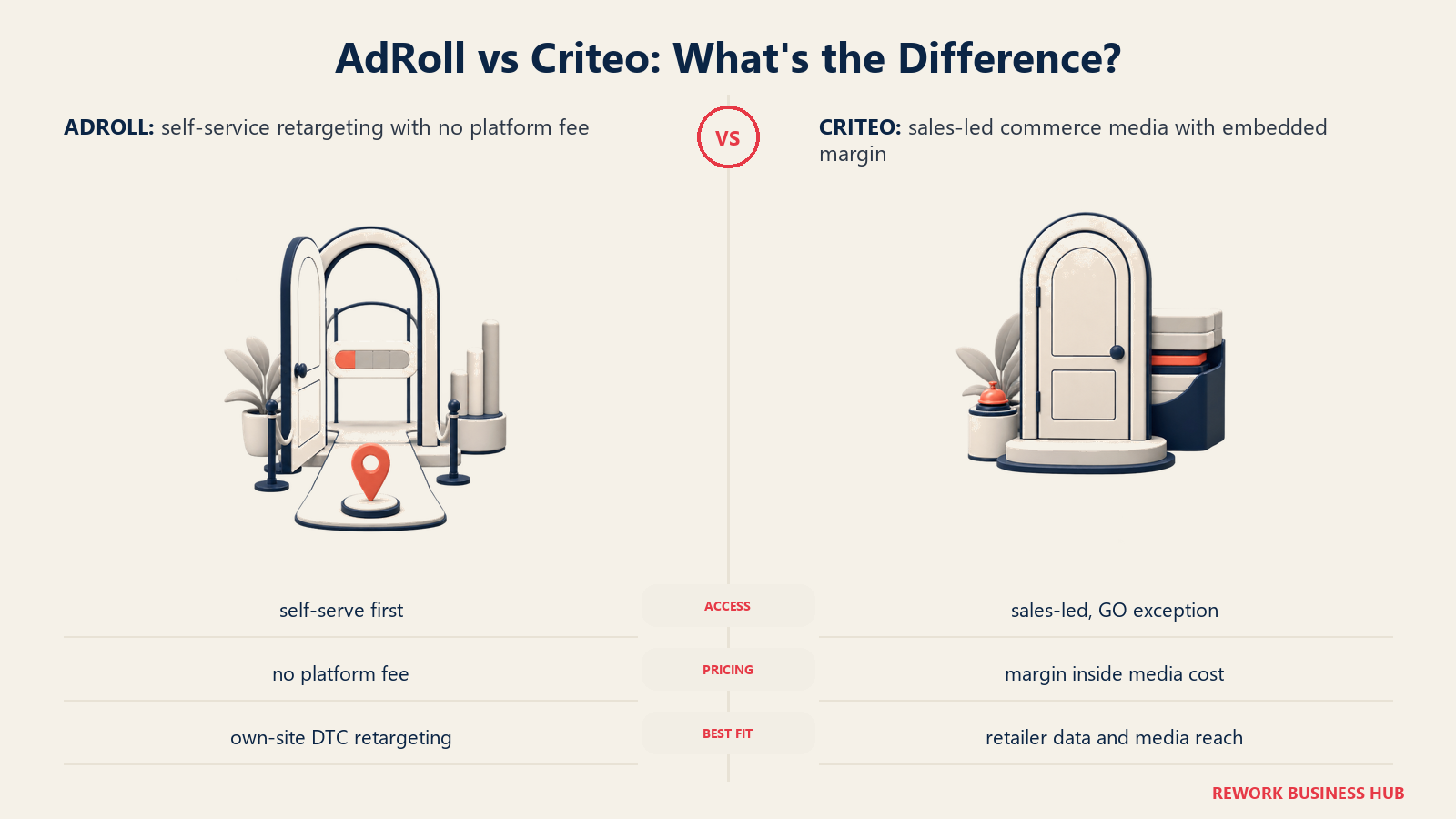
Both platforms grew out of the same idea: someone visits your site, doesn't buy, and you show them an ad elsewhere to bring them back. That's where the similarity ends. AdRoll stayed close to its retargeting roots and built a self-service dashboard a two-person ecommerce team can run without a media buyer. Criteo moved upmarket into retail media and commerce data, sells through an account team, and is bought for access to retailer inventory, not for a tool you log into every morning.
So if you're an ecommerce or performance marketing lead deciding where your next chunk of ad budget goes, the real question isn't "which platform is better." It's "am I buying software I operate myself, or media access negotiated by a rep." That distinction shapes how each vendor prices, who picks up the phone when a campaign underperforms, and how much gets automated versus handled for you. We'll walk through both, with real numbers where either vendor publishes them and an honest accounting of what you can't know until you talk to sales.
TL;DR
| AdRoll | Criteo | |
|---|---|---|
| Pricing model | Pay-as-you-go, dynamic CPM, no platform fee | Media spend with margin built into CPC/CPM, no rate card |
| How you buy it | Self-service signup, launch same day | Sales-led for most products; Criteo GO offers self-service in the US/UK |
| Minimum to launch | $5/day minimum spend, $10/day minimum budget | Not published; enterprise paths route through an account team |
| Managed service entry point | Roughly $5,000 to $10,000 in monthly spend | The default for most of the product line, not an upsell |
| Core products | Ads (display, social, CTV, native, video), Email, AdRoll ABM | Commerce Growth, Commerce Max, Retail Media, Criteo GO |
| Best for | DTC and ecommerce brands running their own retargeting | Brands and retailers needing reach into retailer-owned data |
| Contract | None on self-service; Advanced Package needs an annual term | Typically annual or multi-quarter for managed programs; GO is signup-based |
| Reviewer sentiment | Roughly 4.0 out of 5 on G2 | Roughly 3.7 out of 5 on G2 (Commerce Growth) |
Who Each Platform Is Actually Built For
AdRoll started as a pure retargeting shop in 2006 and now operates under parent company NextRoll, alongside its B2B sibling AdRoll ABM. It markets itself as a multichannel platform covering display, social, connected TV, native, video, and digital out-of-home, and leans hard into ecommerce: a native Shopify integration syncs customer, product, and purchase data automatically, turns Shopify segments into ad audiences with no developer work, and pays 10% of ad spend back in credits. The buyer it's built for is a founder, growth marketer, or small in-house team running its own retargeting and remarketing without a dedicated media buyer.
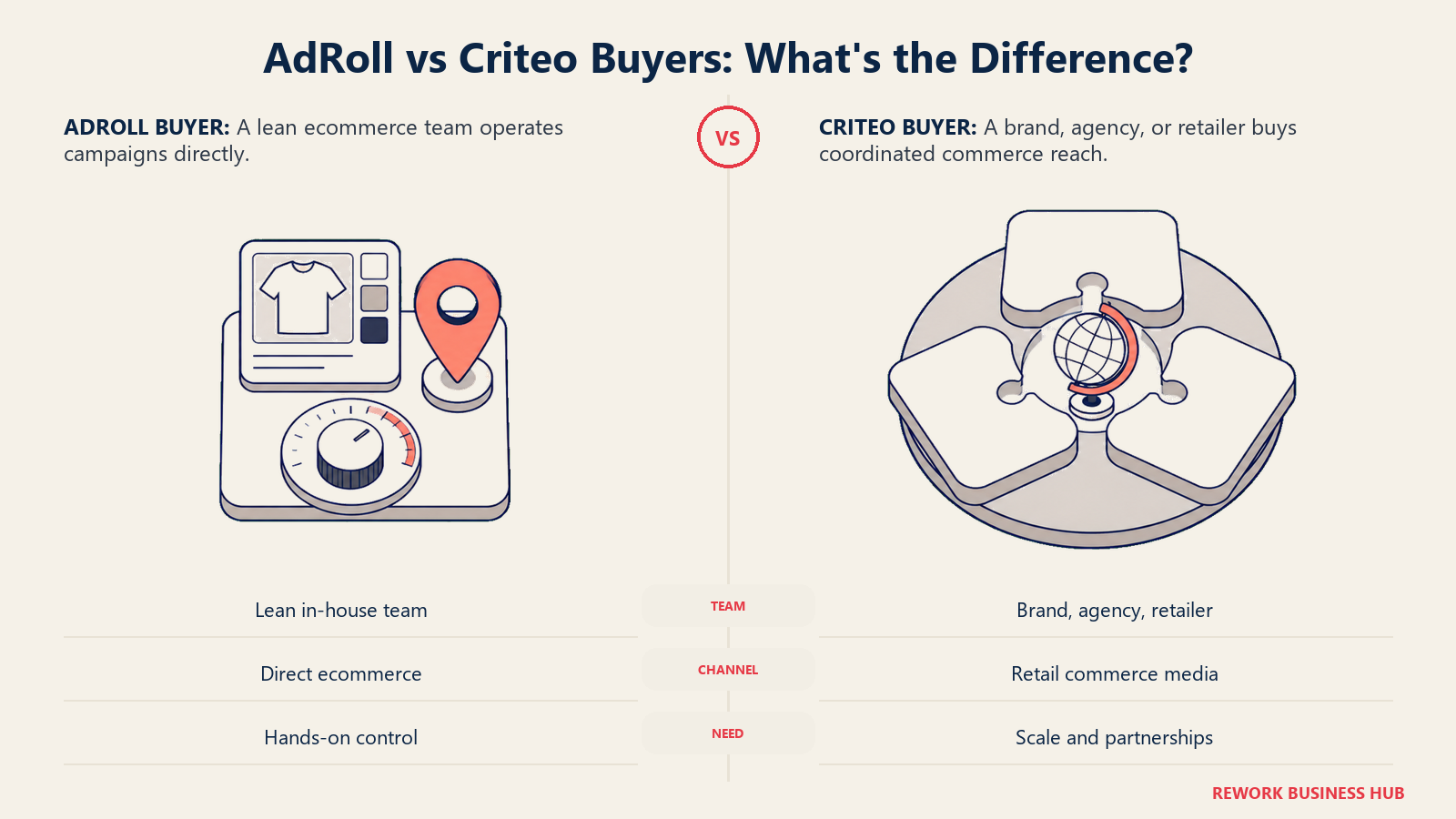
Criteo took a different path. Founded in 2005 as a commerce-focused ad tech company, it built one of the industry's largest product-level bidding engines and has spent recent years reorganizing around retail media rather than open-web retargeting alone. Its lineup, Commerce Growth for acquisition and retention, Commerce Max for reaching shoppers across the open internet using retailer data, and a Retail Media platform for retailers to monetize their own traffic, is sold primarily to brand marketers, agencies, and retailers needing scale, not a self-serve dashboard. The exception is Criteo GO, expanded to full self-service access for SMBs and growth-stage brands in the US and UK on March 31, 2026, letting an advertiser launch a campaign in five clicks, no sales call required.
| AdRoll | Criteo | |
|---|---|---|
| Founded | 2006, San Francisco, under parent company NextRoll | 2005, commerce ad tech, now organized around retail media |
| Natural buyer | Ecommerce and DTC brands, small teams, agencies running client accounts | Brand marketers and agencies buying retail media reach; retailers monetizing their own traffic |
| Core products | Ads (display, social, CTV, native, video, DOOH), Email, AdRoll ABM for B2B | Commerce Growth, Commerce Max, Retail Media, Criteo GO |
| Primary channel | Open-web display, social, and CTV retargeting | Retailer-owned inventory and data, plus open-internet via Commerce Max |
| Team size sweet spot | Solo marketer up to a small team, or an agency managing client accounts | Teams big enough to justify an account team, or retailers running their own network |
| Where it's a stretch | A retailer needing closed-loop measurement across other brands' spend | A five-person DTC brand with a few thousand a month and no appetite for a sales cycle |
Key Facts
- Third-party cookies are staying in Chrome. Google reversed its planned phase-out in July 2024, dropped a scaled-back cookie-prompt plan in April 2025, and retired the remaining Privacy Sandbox APIs in October 2025, per a timeline from Usercentrics. Google's own Privacy Sandbox site confirms cookies remain available in Chrome by default.
- US retail media ad spend is projected to reach $97.9 billion by 2028, an 88.5% increase from 2024, per eMarketer, the category Criteo's Commerce Max and Retail Media products are built to reach.
- Amazon alone is projected to generate more than $75 billion in retail media revenue by 2028, over $65 billion ahead of the next-largest network, per eMarketer's H1 2026 forecast, a reminder of how concentrated retail media inventory already is.
- AdRoll carries a rating of roughly 4.0 out of 5 across close to 700 reviews on G2; Criteo Commerce Growth sits at roughly 3.7 out of 5 across around 240 reviews on G2, a gap reviewers tie back to onboarding and support more than raw ad performance.
- Criteo expanded GO to full self-service signup for small and mid-sized businesses in the US and UK on March 31, 2026, per Criteo's press release, letting a smaller advertiser launch in as few as five clicks with no sales call, though pricing is still undisclosed.
Inventory and Reach
AdRoll buys across the open web: display exchanges, native placements, connected TV, and paid social extensions on top of its own retargeting pixel. That's a wide net for the price, but it's still open-internet inventory bought through exchanges and social ad APIs, not through direct retailer relationships.
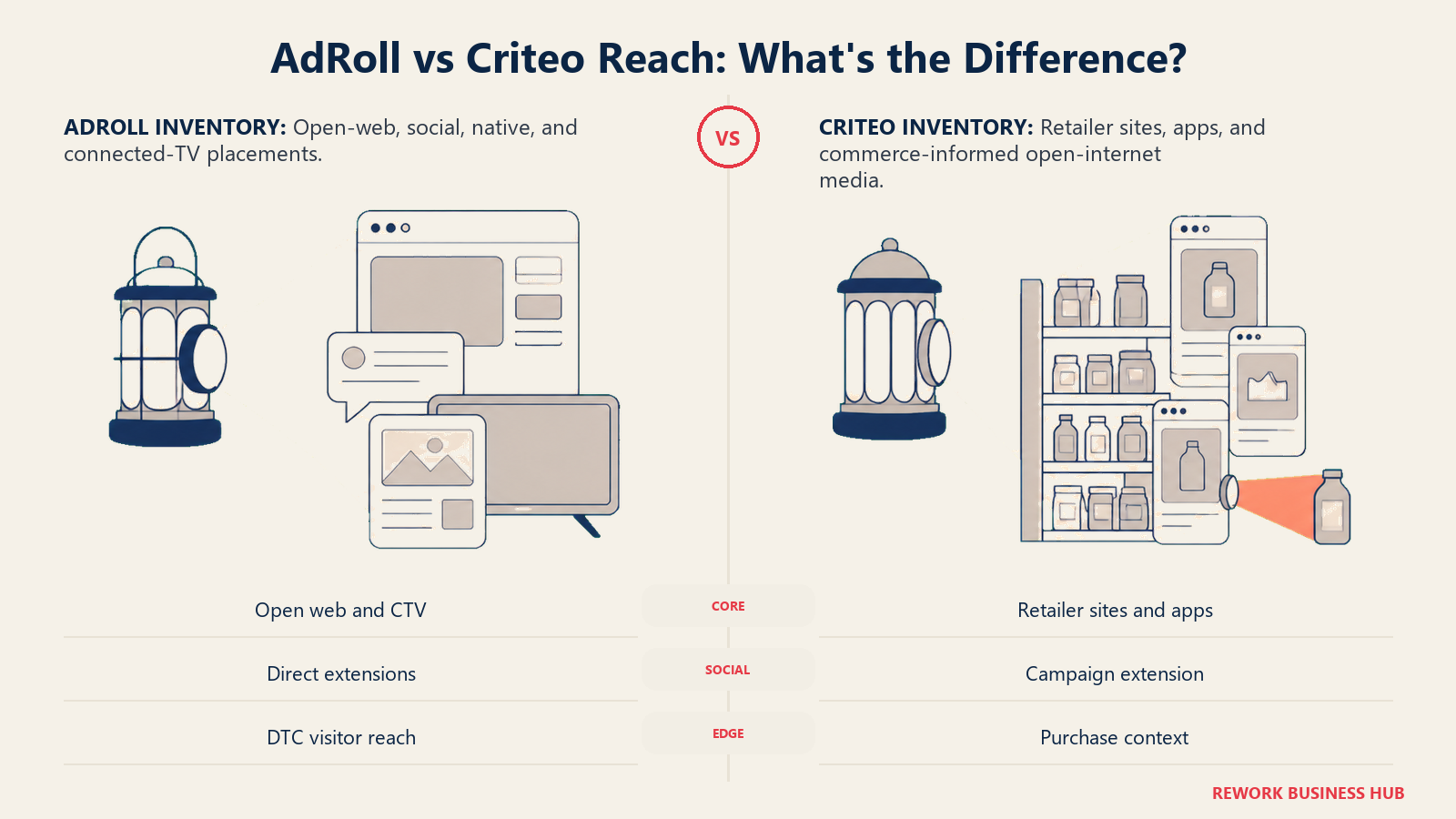
Criteo's reach is structured differently on purpose. Its core advantage is a deep bench of retailer partnerships, brands like Lidl and marketplaces like DoorDash expanded their Criteo retail media relationships through 2026, giving advertisers access to shopper data and on-site placements AdRoll has no path into. Commerce Max extends that retail data out to the open internet, so a brand isn't limited to appearing only on the retailer's own site or app.
| AdRoll | Criteo | |
|---|---|---|
| Primary inventory source | Open-web exchanges, native networks, social APIs, CTV | Retailer-owned sites and apps, plus open-internet placements informed by retailer data |
| Retailer data access | Not a core capability | Central to the product, via direct retailer and marketplace partnerships |
| Connected TV | Yes, a standard channel | Not a primary focus |
| Social platforms | Native retargeting extensions across major networks | Mainly an extension of retail media campaigns, not a standalone buy |
| Where reach is strongest | A DTC brand's own site visitors, wherever they go on the open web | Shoppers browsing or buying on a partnered retailer's property |
Retail Media and Commerce Data
This section explains why two vendors that both started as retargeting companies now feel like they're barely in the same category. Retail media, ads placed on or informed by a retailer's own first-party shopper and purchase data, has become one of the fastest-growing corners of digital advertising precisely because it doesn't depend on a browser cookie. It's built on a login and a loyalty account instead.
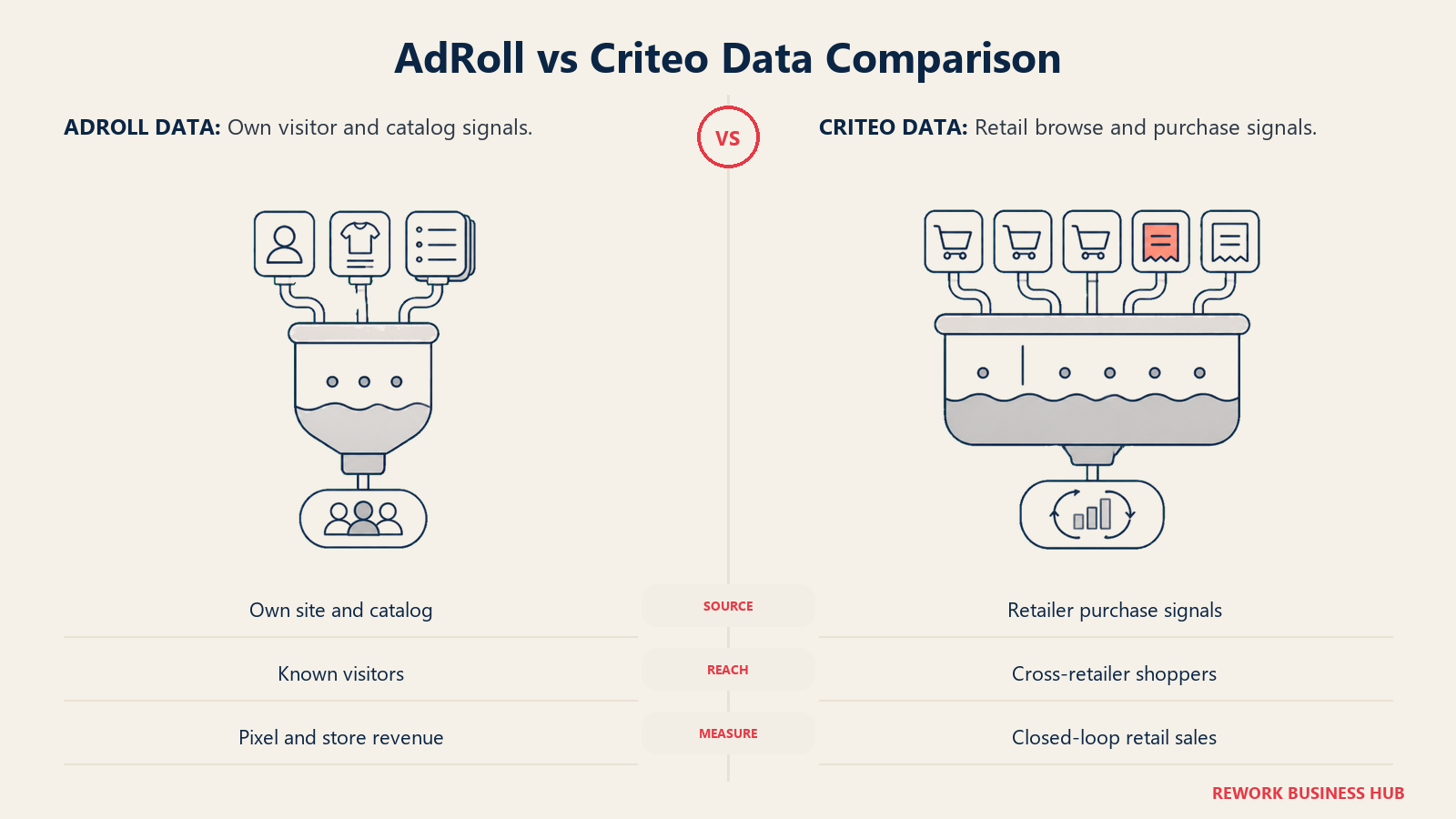
Criteo built its current strategy around that shift. Commerce Max is sold as retail media reach across the open internet for brands and agencies, and Retail Media is sold to retailers as a way to monetize their own traffic with closed-loop measurement. If your business sells through retailers rather than direct-to-consumer only, or if Amazon Advertising already eats a meaningful share of your budget, Criteo's retail media relationships are the real reason to evaluate it, not its retargeting roots.
AdRoll has no equivalent product. Its data model stays first-party and site-centric: your own site visitors, your own Shopify catalog, your own customer list, remarketed across the open web. That's a real limitation if retail media is where your budget is heading, and a non-issue if it isn't.
| AdRoll | Criteo | |
|---|---|---|
| Retail media product | None | Commerce Max (brands, agencies), Retail Media (retailers) |
| Data source | Your own site, Shopify catalog, customer list | Retailer first-party shopper and purchase data |
| Measurement model | Standard pixel-based attribution | Closed-loop measurement built for retail media |
| Fits a brand selling mostly direct | Yes, the core use case | Partially, via Commerce Max's open-internet reach |
| Fits a brand selling through retailers | Not a strength | The primary reason to buy Criteo |
Audience Building and Segmentation
AdRoll builds audiences from data you control directly: site visitors segmented by page or product viewed, cart abandoners, past purchasers, and lookalikes modeled off any of those. The Shopify integration converts Shopify's own customer segments straight into AdRoll audiences, so a merchandiser who already built a segment for email marketing doesn't have to rebuild it for ads.
Criteo's segmentation leans on a mix of its own commerce data plus whatever first-party signals a retailer partner shares. For Commerce Growth and Commerce Max, that means audiences shaped by real purchase intent and product-level browsing behavior across a wider commerce dataset than a single brand's own site traffic could produce, the whole pitch for a brand that wants reach beyond its own known customer base.
| AdRoll | Criteo | |
|---|---|---|
| Audience source | Your own site, Shopify catalog, and CRM data | Commerce data plus retailer-shared first-party signals |
| Lookalike modeling | Yes, from your own customer and visitor data | Yes, informed by a broader cross-brand commerce dataset |
| Segment automation | Shopify segments sync to AdRoll automatically | Managed largely by the platform's AI and account team |
| Best fit | A brand whose own data is rich enough to model from | A brand that wants reach beyond its known customer base |
Creative and Dynamic Product Ads
Both platforms generate dynamic product ads, pulling in the exact item a shopper looked at along with its price and image, but they get there differently. AdRoll leans on its "17+ years of machine learning," in its own words, plus an AI assistant for building creative variations across display, native, and social formats inside the same dashboard you use to manage campaigns.
Criteo GO takes a more automated-first approach: generative AI creates and adapts ad formats, including video, and keeps them consistent across placements, and Criteo reports that GO campaigns including social activation deliver over 20% higher return on ad spend than traditional setups. Treat that as a vendor claim to test against your own results, not a guaranteed outcome.
| AdRoll | Criteo | |
|---|---|---|
| Dynamic product ads | Yes, from your product catalog | Yes, from retailer or brand catalog data |
| AI creative generation | AI Assistant plus machine-learning optimization | Generative AI creates and adapts formats, including video (GO) |
| Format range | Display, native, social, video, CTV | Display, video, native, social, unified in one environment on GO |
| Reported performance lift | Not independently published | 20%+ higher ROAS on GO with social activation (vendor-reported) |
Self-Serve Control vs Managed Service
This is the real fork in the road, and both vendors have moved in 2026 rather than sitting still.
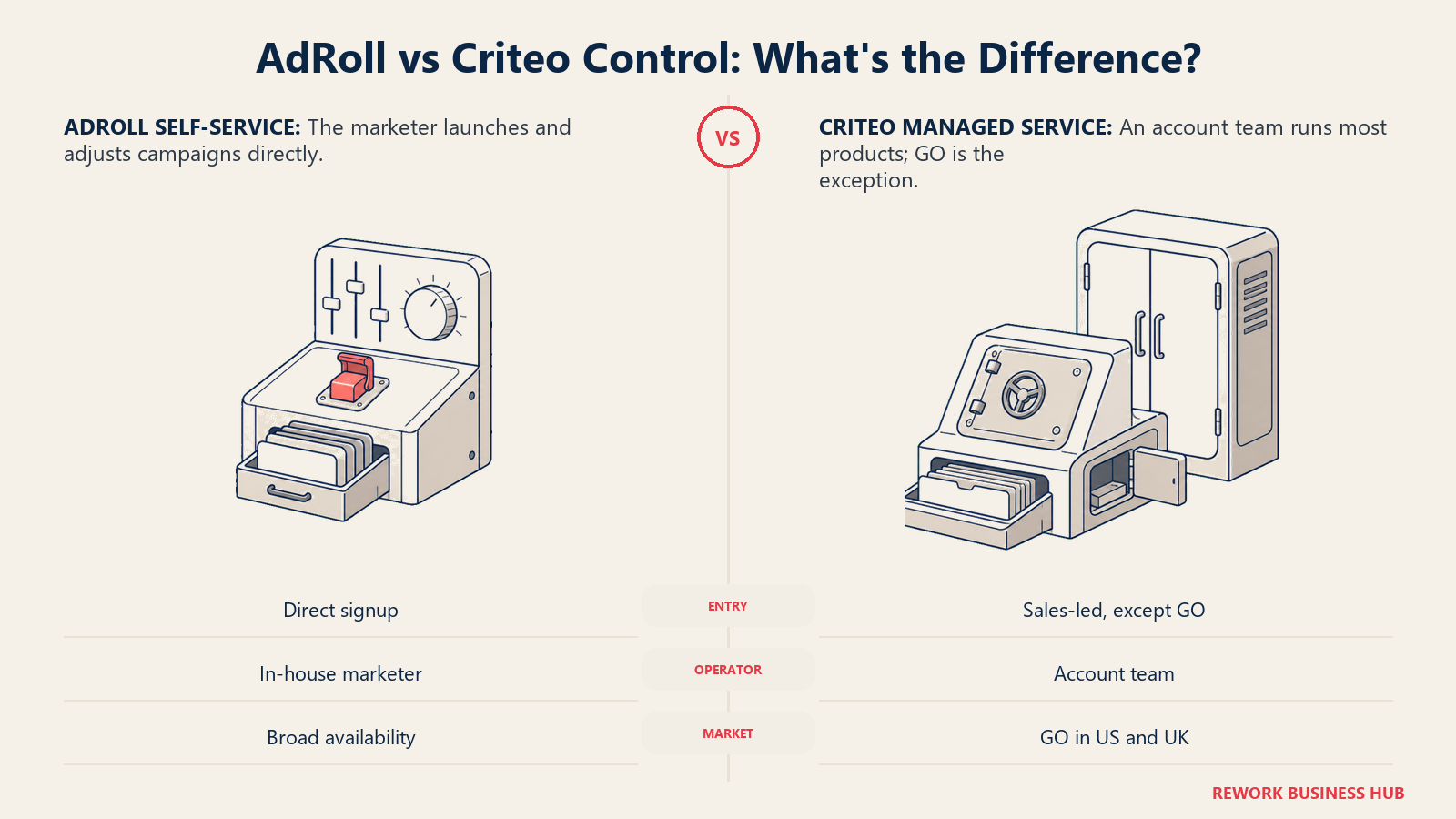
AdRoll's self-service Ads plan has always been the default path: sign up, connect your site or Shopify store, set a budget, and launch. Managed services exist above that, tied to monthly spend starting in the $5,000 to $10,000 range, for brands that want AdRoll's team running strategy instead.
Criteo has historically been the opposite: Commerce Growth, Commerce Max, and Retail Media are sold through an account team, with pricing negotiated rather than published. What changed this year is Criteo GO, expanded to full self-service access for SMBs and growth-stage brands in the US and UK, letting an advertiser skip the sales call and launch in a handful of clicks. That's a genuine shift for smaller Criteo customers, but it's still narrower than AdRoll's model: GO is one product, in two countries so far, and it still discloses no price on the page where you sign up.
| AdRoll | Criteo | |
|---|---|---|
| Default buying model | Self-service | Sales-led for most of the product line |
| Self-service option | Yes, the standard Ads plan | Yes, via Criteo GO (US and UK only) |
| Managed service | Above roughly $5,000 to $10,000 monthly spend | The default for Commerce Growth, Commerce Max, and Retail Media |
| Who runs strategy day to day | You, unless you opt into managed services | Criteo's account team, unless you're on GO |
| Direction of travel in 2026 | Unchanged, self-service remains the core offer | Moving toward self-service at the small end, enterprise stays sales-led |
Reporting and Attribution
One fact worth having before either vendor pitches a cookieless-future narrative as urgent (see Key Facts above): third-party cookies are not going away in Chrome, so neither vendor is under the deadline pressure "cookies are dying" headlines implied for years. Both AdRoll and Criteo still rely on a mix of cookie-based and first-party identity signals for cross-site retargeting.
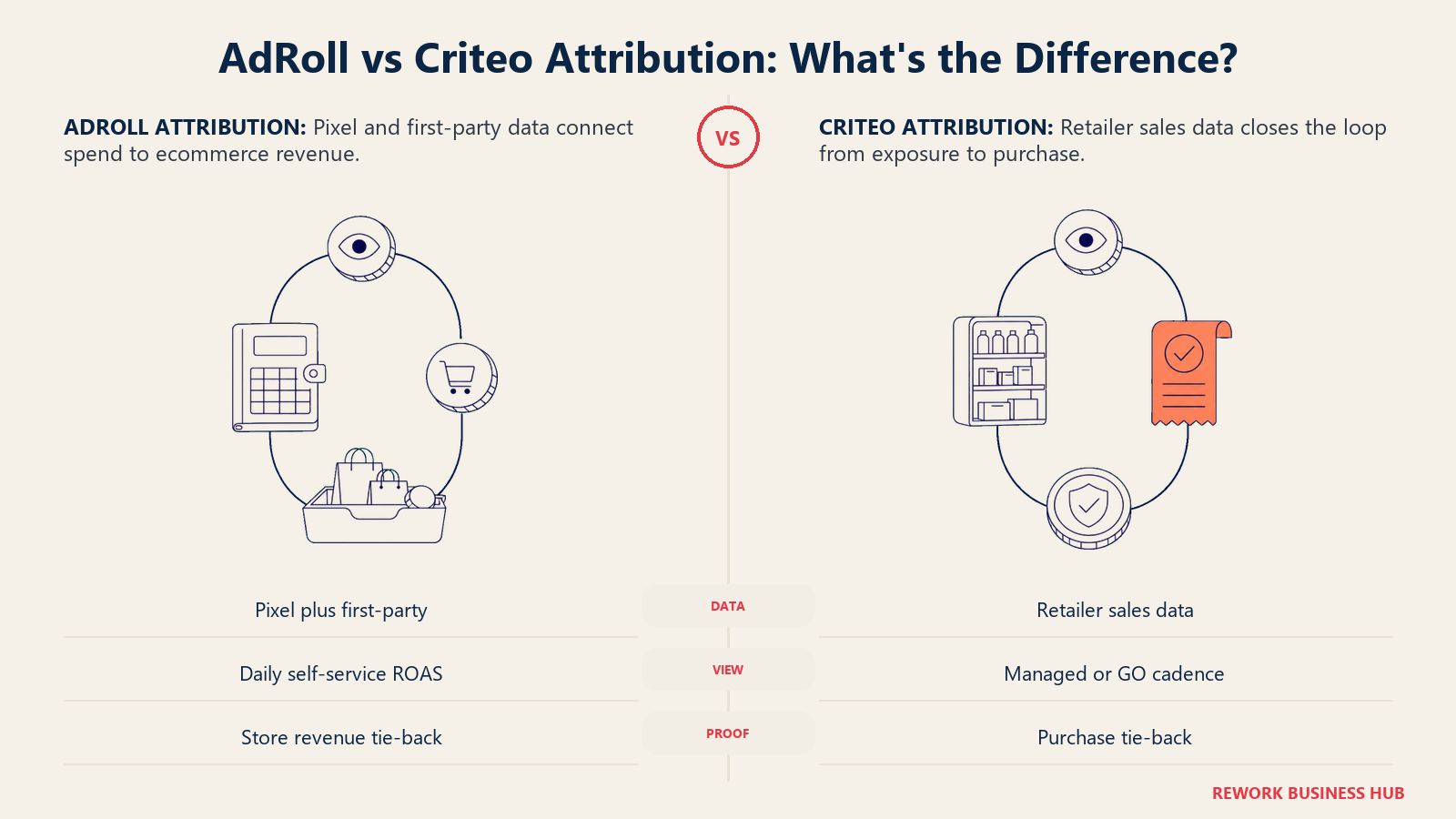
Where the two differ is in how they report performance. AdRoll's dashboard is built for a marketer checking in daily: campaign-level ROAS, conversion tracking synced from your attribution model of choice, and Shopify revenue data pulled into the same view as ad spend. Criteo's retail media reporting emphasizes closed-loop measurement, tying a retailer's own sales data back to ad exposure, a stronger claim than most open-web retargeting tools can make, since the platform sits closer to the point of sale.
| AdRoll | Criteo | |
|---|---|---|
| Attribution basis | Pixel and first-party data, cross-referenced with your chosen model | Closed-loop measurement tied to retailer sales data |
| Reporting cadence | Real-time dashboard, self-serve | Real-time for GO; account-managed cadence elsewhere |
| Revenue tie-back | Shopify and ecommerce revenue synced directly | Retailer point-of-sale data for retail media |
| Dependence on third-party cookies | Partial, alongside first-party signals | Partial, alongside retailer first-party data |
Onboarding Effort and Time to Value
AdRoll is built for a same-day launch. Connect a Shopify store or install the pixel, set a daily budget above the $5 minimum, and campaigns can go live within hours, no developer or creative resources required. That matters most to a small team that can't wait weeks for a program to spin up.
Criteo's timeline depends on which product you're on. Commerce Growth, Commerce Max, and Retail Media go through an account team, meaning scoping calls, sometimes retailer data-sharing agreements, and a setup period measured in weeks. Criteo GO is the exception, built to compress that to a five-click signup, closer to AdRoll's model, though newer and available in fewer markets.
| AdRoll | Criteo | |
|---|---|---|
| Time to first campaign live | Hours, same day is typical | Weeks for managed programs; hours on GO |
| Setup complexity | Low, no developer needed for the Shopify path | Higher for managed programs, low for GO |
| Who does the setup | You, or AdRoll's managed team above the spend threshold | Criteo's account team for managed programs; you, on GO |
| Best case for a fast launch | A DTC brand on Shopify wanting to launch this week | An SMB using Criteo GO in the US or UK |
Contract and Commitment
AdRoll's self-service Ads plan carries no minimum commitment beyond the daily spend floor, you can pause or cancel whenever you like. The exception is AdRoll's Advanced Package, which requires an annual commitment for the deeper managed-service support that comes with it. AdRoll ABM, its B2B product, is quoted and contracted separately from the core Ads plan.
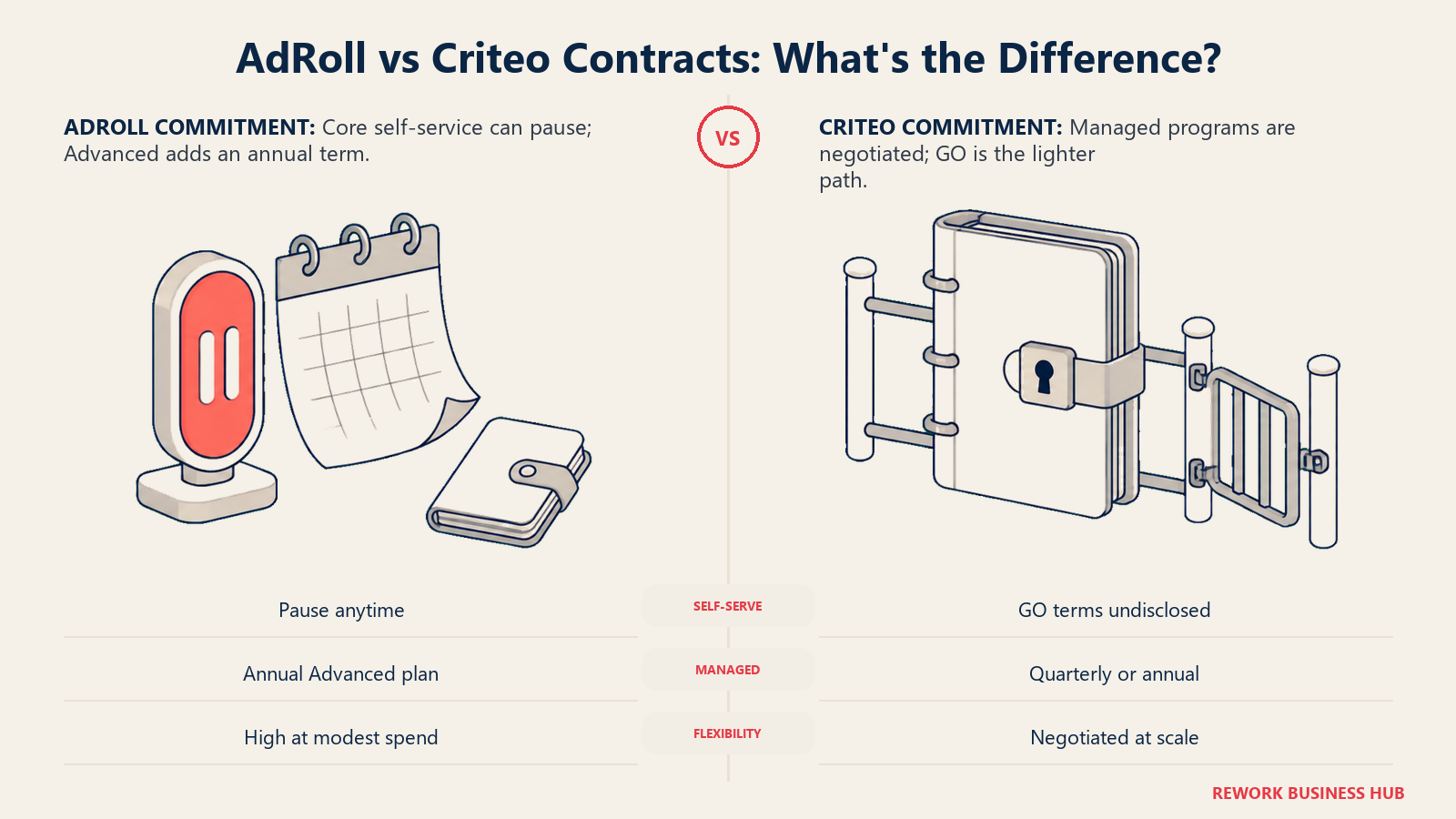
Criteo's managed programs typically run on longer commitments, consistent with how enterprise retail media deals get structured across the industry: budgets are planned on a quarterly or annual basis, and retailer data-sharing agreements can add their own terms. Criteo GO doesn't publish a contract length, but its signup flow (create an account, enter billing, launch in five clicks) suggests it's built to be entered and exited without a long-term agreement, closer to AdRoll's core plan.
| AdRoll | Criteo | |
|---|---|---|
| Self-service commitment | None beyond the daily spend minimum | Not published for GO, framed as low-friction signup |
| Managed service commitment | Annual, required for the Advanced Package | Typically quarterly or annual for managed programs |
| Cancel anytime | Yes, on the self-service Ads plan | Unclear for GO; managed programs are negotiated |
| Separate product with its own terms | AdRoll ABM (B2B) | Retail Media (sold to retailers, not brands) |
Cost at Real Monthly Media Budgets
Neither vendor sells seats, so the usual comparison math (price out 25, 50, 100 users) doesn't apply. Both are media-priced: what you pay scales with ad budget, not headcount. The honest comparison is monthly media spend, worth doing at a few real levels rather than taking either vendor's marketing at face value.
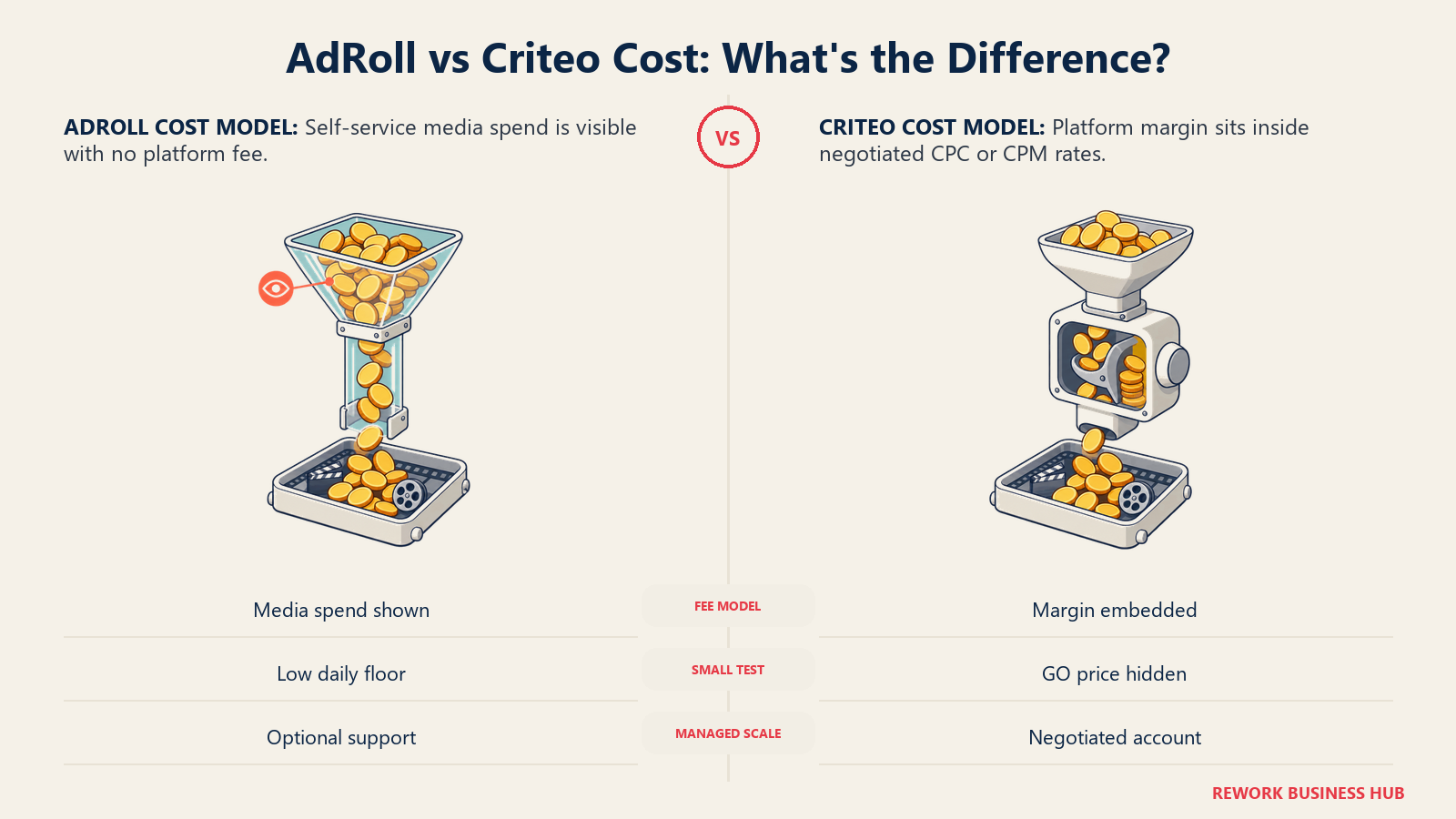
The uncomfortable truth is these two vendors withhold price for opposite reasons. AdRoll withholds a subscription number because there mostly isn't one, its self-service plan has no platform fee, so what you'd be looking for doesn't exist as a line item. Criteo withholds price because its margin is baked into the media rate itself, the CPC or CPM you pay already includes Criteo's cut, visible only once you're negotiating a program.
| Monthly media budget | AdRoll: what's knowable today | Criteo: what's knowable today |
|---|---|---|
| $2,000/month | Full amount buys media on self-service; no platform fee, and $2,000 easily clears the $5/day minimum spend and $10/day minimum budget | Below where most Commerce Growth or Commerce Max conversations start; Criteo GO (US/UK only) is the realistic option, but discloses no price, so the effective CPC/CPM markup is unknown |
| $10,000/month | The entry point of AdRoll's managed-service band; stay self-service at no added fee, or opt into managed support at an undisclosed price | Likely Criteo GO or a small managed conversation; no published rate card exists at this level, so Criteo's margin stays invisible either way |
| $50,000/month | Comfortably inside managed-service range; the media buy itself still carries no platform fee, though managed pricing above entry is unpublished | Large enough for a Commerce Growth or Commerce Max sales conversation; pricing is negotiated per account with nothing to benchmark beforehand |
| $250,000/month | Well above the Advanced Package's commitment threshold; media still carries no platform fee, but Advanced Package pricing at this scale is unpublished | Enterprise territory for Commerce Max or Retail Media; entirely negotiated, no public reference point at any budget size |
What that table really says: AdRoll's honesty gap only opens once you want a human running the account for you, the self-service math stays knowable at every budget shown. Criteo's gap never closes. Even at $2,000 a month on Criteo GO, its newest and most self-service product yet, you still can't see the rate card before you start spending. That's not necessarily a worse deal, retail media reach has real value a pure retargeting tool can't replicate, but it's a materially different buying experience, and the single most important thing this comparison can tell you before either sales conversation starts.
Support
AdRoll's self-service customers get standard support channels (help center, email, chat), with dedicated account support once you cross into managed services. G2 reviewers generally rate the self-service experience well but note support responsiveness gets more variable once you're not just following the dashboard's own guidance.
Criteo's support model is built around the account team, since that's how most customers reach the platform: a dedicated contact, not a ticket queue. That's an advantage if you want someone who knows your account, and a drawback if that person is slow to respond, a complaint that shows up often enough in Criteo's G2 reviews to flag. Criteo GO customers, by contrast, rely more on documentation than an assigned rep.
| AdRoll | Criteo | |
|---|---|---|
| Default support model | Help center, email, chat; account support above the managed threshold | Dedicated account team for managed products |
| Support for smaller accounts | Standard self-service channels | Criteo GO relies mainly on self-service docs |
| Common complaint in reviews | UI complexity managing multiple campaigns | Onboarding and support responsiveness on larger accounts |
| Best for a hands-off buyer | Less ideal, self-service assumes you're driving | A better fit, once you have an assigned contact |
When AdRoll Is the Right Call
- You're a DTC or ecommerce brand on Shopify (or a comparable platform) that wants to launch retargeting this week, not next quarter.
- Your monthly ad budget is in the low thousands and a platform fee on top of media spend would meaningfully cut into ROI.
- You don't have a dedicated media buyer and need a dashboard a generalist marketer can run.
- You want retargeting, social, email, and connected TV managed from one login instead of stitched-together tools.
- You're running B2B pipeline generation alongside ecommerce retargeting and want AdRoll ABM under the same parent company, even though it's contracted separately.
When Criteo Is the Right Call
- Your products sell through retailers, marketplaces, or grocery chains, and reaching shoppers there matters more than the open web.
- You have, or want, exposure to retail media budgets, a category eMarketer projects will keep growing faster than digital advertising overall.
- You're prepared to work through a sales conversation and value a dedicated account contact over full self-service control.
- Your monthly spend is large enough that a negotiated rate, even one you can't see in advance, is likely to beat a self-service rate card.
- You want to test the waters first: Criteo GO now offers signup without a sales call in the US and UK, a lower-commitment way to see whether Criteo's data moves your numbers.
Decision Framework
Use the operating model, data source, and buying path below to match each platform to the job it naturally serves.
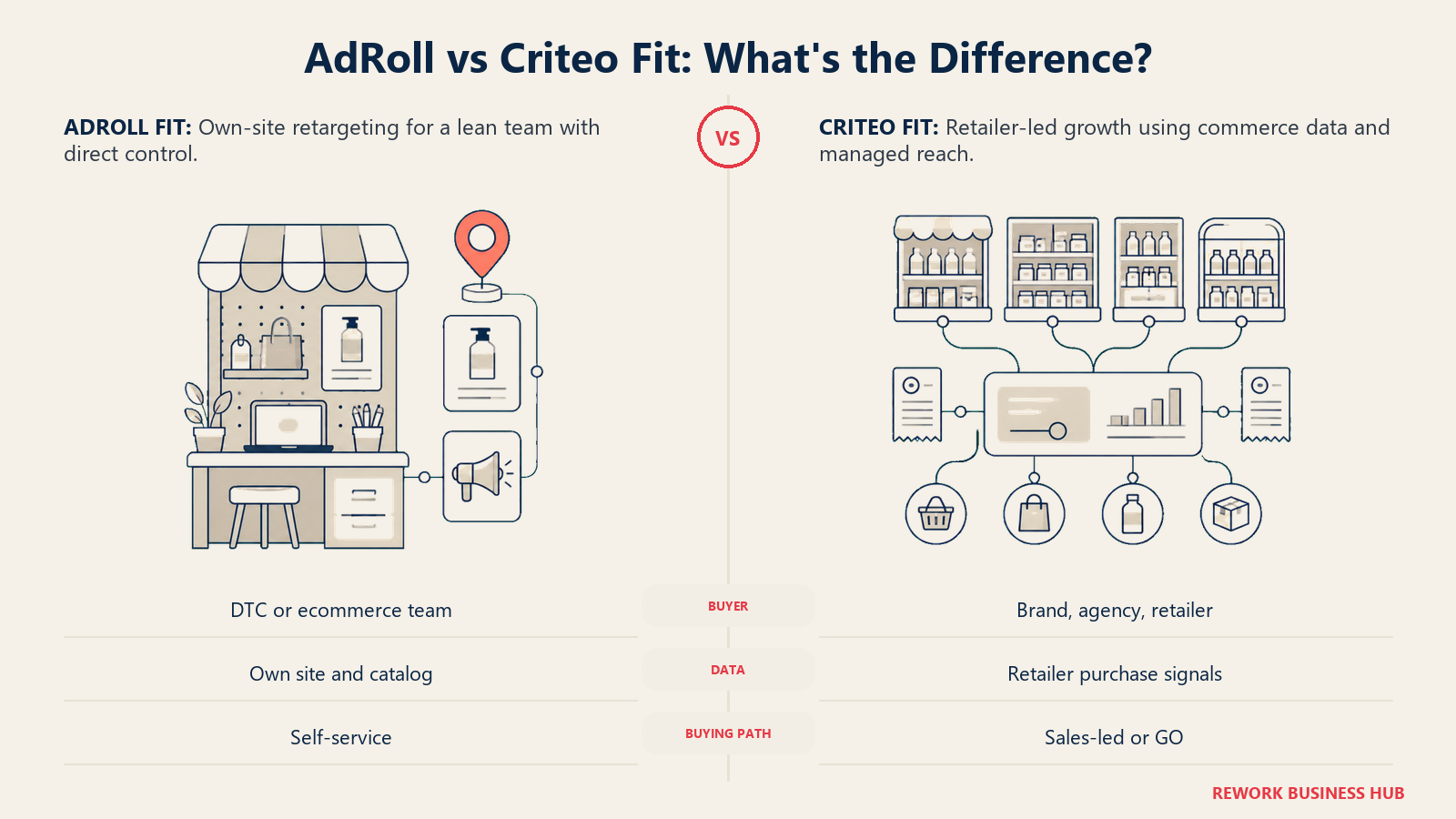
| If you are... | Pick |
|---|---|
| A DTC or ecommerce brand on Shopify wanting to launch this week, no platform fee | AdRoll |
| Selling primarily through retailers, marketplaces, or grocery chains | Criteo |
| Running a low-thousands budget and want full price transparency upfront | AdRoll |
| Chasing retail media growth and reach into retailer-owned data | Criteo |
| Comfortable with a sales conversation for a dedicated account contact | Criteo |
| Testing retail media at a small scale before committing further | Criteo GO, its self-service path in the US and UK |
| Still comparing the category before narrowing down | See our best ad management software roundup |
The verdict: if you're running your own retargeting on a modest budget and want to see exactly where every dollar goes, AdRoll's self-service model, Shopify integration, and no-platform-fee pricing are hard to beat. If your growth increasingly runs through retailers rather than your own site, or you're chasing the retail media budget eMarketer expects to keep growing past 2026, Criteo's retailer relationships and commerce data are worth the sales conversation, and worth testing through Criteo GO first if you'd rather not commit right away.
What to Do Next
Start by checking where your last quarter of ad spend went: your own site visitors, or shoppers on someone else's storefront. If it's overwhelmingly the former, run AdRoll's self-service plan for 30 days on a modest budget, no platform fee rides on the decision either way. If a meaningful share of revenue already comes through retailers, request a Criteo Commerce Max conversation, or try Criteo GO first if it's available in your market. Either way, check the wider field in our best ad management software roundup, our best AdRoll alternatives list, and our best Criteo alternatives list first.
Frequently Asked Questions about AdRoll vs Criteo
Is AdRoll or Criteo cheaper?
It depends. AdRoll's self-service plan has no platform fee, your budget is your media cost, so at a small budget it's the more transparent option. Criteo publishes no pricing anywhere, including on Criteo GO, so its true cost (media plus Criteo's built-in margin) is only visible once you're spending or negotiating.
Does Criteo have a self-service option like AdRoll?
Yes, as of March 31, 2026. Criteo expanded GO to full self-service access for small and mid-sized businesses in the US and UK, letting an advertiser create an account and launch a campaign in as few as five clicks with no sales call. It's newer and narrower than AdRoll's plan, and still doesn't publish a price.
What is the minimum spend to advertise on AdRoll?
AdRoll's self-service Ads plan requires a minimum daily spend of $5 and a minimum daily budget of $10, with no platform fee and no ongoing commitment. Managed services are a separate option starting around $5,000 to $10,000 in monthly spend.
Do I need a sales call to use Criteo?
For most of the product line, Commerce Growth, Commerce Max, and Retail Media, yes, those are sold through an account team with negotiated pricing. The exception is Criteo GO, which now offers self-service signup in the US and UK, though enterprise-scale programs still route through sales.
Are third-party cookies still active in Chrome in 2026?
Yes. Google reversed its planned phase-out in July 2024, dropped a scaled-back replacement plan in April 2025, and formally retired the remaining Privacy Sandbox APIs in October 2025. Cookies remain available in Chrome by default, and both vendors still rely on a mix of cookie-based and first-party signals for retargeting.
Does AdRoll or Criteo have better retail media reach?
Criteo, by a wide margin. Retail media, ads placed on or informed by a retailer's own shopper data, is central to Commerce Max and Retail Media, built through direct retailer and marketplace partnerships. AdRoll has no retail media product and focuses on your own first-party site and Shopify data instead.

Principal Product Marketing Strategist
On this page
- TL;DR
- Who Each Platform Is Actually Built For
- Key Facts
- Inventory and Reach
- Retail Media and Commerce Data
- Audience Building and Segmentation
- Creative and Dynamic Product Ads
- Self-Serve Control vs Managed Service
- Reporting and Attribution
- Onboarding Effort and Time to Value
- Contract and Commitment
- Cost at Real Monthly Media Budgets
- Support
- When AdRoll Is the Right Call
- When Criteo Is the Right Call
- Decision Framework
- What to Do Next