Best Criteo Alternatives in 2026: 12 Retargeting and Commerce Media Platforms Compared
Turn this article into takeaways for your work.


Each assistant summarizes the article only for you and suggests best practices for your work.
Updated August 2026
Want a self-serve swap with no annual contract? Start with AdRoll or StackAdapt. Already run a dedicated trader and want the biggest independent open-internet DSP? The Trade Desk is next. Concentrated inside one retailer's ecosystem? Amazon DSP or Google Display and Video 360 will out-target a generic pixel. This guide compares 12 platforms across three jobs, PPC/search management, paid social, and programmatic/retargeting DSPs, evaluated on pricing, access model, and fit for an advertiser who's outgrown Criteo, checked against each vendor's own page in August 2026.
Criteo earned its position honestly. It built the category of dynamic product retargeting, and its commerce data footprint, drawing on retailer and publisher relationships across thousands of sites, still gives it targeting depth few competitors match. Buyers move on anyway, mostly because Criteo has never published a rate card (its margin sits inside the CPC or CPM you already pay on media) and because its lineup has shifted hard toward commerce and retail media (Commerce Growth, Commerce Max, Retail Media, and Criteo GO) rather than the classic web-retargeting pixel that first brought most advertisers in. For the direct swap, see AdRoll vs Criteo; for the wider category, start with Best Ad Management Software 2026.
Key Facts
- Global retail media ad investment is forecast to reach $200.4 billion in 2026 and $223.4 billion in 2027, 15.2% of all worldwide ad spend, exactly the shift pulling Criteo away from classic retargeting. (WARC Media, reported by Mediabrief)
- US omnichannel retail media ad spend alone is on pace to rise 17.9% to $69.33 billion in 2026. (eMarketer)
- Google will not roll out a standalone third-party cookie prompt in Chrome and is keeping existing cookie controls as-is, a direct reversal of years of planned deprecation. (Google Privacy Sandbox)
- Chrome still runs 68.22% of global browser traffic as of July 2026, exactly why that cookie decision matters so much to any retargeting buy. (StatCounter)
- Amazon's managed-service DSP still requires a minimum spend around $50,000, while its self-serve option publishes no minimum at all. (Amazon Advertising)
What "Ad Management Software" Actually Covers
Search results for ad management tools blur together three different jobs. PPC and search campaign management (Optmyzr, Adalysis, Opteo) optimizes bids inside Google and Microsoft Ads. Paid social creative and automation (Meta Ads Manager, Smartly, Madgicx) runs and automates campaigns on Meta, TikTok, and similar platforms. Programmatic and retargeting DSPs, Criteo's actual category, buy display, video, native, and CTV inventory across the open web, often using a visitor's browsing or purchase history to decide who sees an ad. Every alternative below is labeled by group so you can tell a like-for-like swap from an adjacent tool solving a different problem.
Quick Comparison Table
| Tool | Group | Best For | Starting Price | Key Strength | Key Limitation |
|---|---|---|---|---|---|
| AdRoll | Programmatic/retargeting DSP | No-contract swap for Criteo | Dynamic CPM, no fee, $5/day min spend | No annual commitment | Managed tier gates at $5K-$10K/mo |
| StackAdapt | Programmatic/retargeting DSP | Native, CTV, email in one DSP | No published pricing, % of spend | Native inventory, channel breadth | No public rate card |
| The Trade Desk | Programmatic/retargeting DSP | Biggest independent open-internet DSP | No published pricing, undisclosed fee | Deepest CTV/audio/publisher reach, UID2 | Assumes a dedicated trader |
| Amazon DSP | Programmatic/retargeting DSP | Amazon shopper and purchase-signal data | Managed typically $50,000 minimum spend; self-serve no minimum | Closed-loop Amazon purchase data | Managed minimum varies by country |
| Google Display & Video 360 | Programmatic/retargeting DSP | Teams standardized on Google Marketing Platform | No published pricing, routes to sales | Native GA4/CM360/YouTube integration | No visible self-serve entry |
| RTB House | Programmatic/retargeting DSP | Closest 1:1 swap for Criteo's methodology | No published pricing, custom quote | Deep-learning bidding for retargeting | No self-serve tier |
| Taboola (Realize) | Programmatic DSP (native/content discovery) | Reaching readers on premium publisher sites | CPC/CPM billing, no published minimum | Broad premium native inventory | Reads as sponsored content, not a product ad |
| Outbrain (Teads) | Programmatic DSP (native/content discovery) | The other major native discovery network | No published pricing | Publisher reach plus Teads' video/CTV | Mid-merger, continuity in flux |
| Meta Ads Manager (Advantage+) | Paid social | Brands running most spend on Meta already | Free platform, media cost only | AI-automated audience/placement/creative | Confined to Meta's own properties |
| Smartly | Paid social (creative automation) | Creative automation across every social channel | No published pricing (reported: ~2-4% of spend) | Cross-channel creative automation | No self-serve or transparent price |
| Madgicx | Paid social/programmatic hybrid | AI-run Meta and Google ads | From $99/mo, per-band price in-app only | AI budget/creative automation | Pricing above $30K/mo not published |
| Basis Technologies | Programmatic/retargeting DSP | A DSP plus agency workflow tools | No published pricing, custom quote | Buying plus workflow, billing, reporting | No self-serve tier, annual contracts |
Self-Serve or Enterprise Contract: Where Each Platform Sits
This is the practical dividing line for a Criteo refugee. Criteo itself sits in the middle, no self-serve signup exists, every account starts as a sales conversation, so if what you actually want is to set up a campaign this week without a call, look at the left column below first.
| Tool | Access Model | Typical Entry Point |
|---|---|---|
| AdRoll | Self-serve | Sign up and launch directly, no sales call |
| StackAdapt | Self-serve or managed | Self-serve, with managed/hybrid support |
| Madgicx | Self-serve | Sign up, connect ad accounts directly |
| Meta Ads Manager | Self-serve | Free, built into every Meta ad account |
| Taboola (Realize) | Self-serve, historically | Advertiser signup, no minimum published |
| Outbrain (Teads) | Self-serve, historically | Signup via Outbrain Direct Response |
| Amazon DSP | Self-serve or managed | Self-serve: no minimum; managed: typically $50,000 minimum spend |
| Google Display & Video 360 | Managed/enterprise | Google sales, or sign-in for existing users |
| The Trade Desk | Managed/enterprise | Self-service seat or agency/partner |
| RTB House | Managed/enterprise | Custom, sales-led engagement |
| Smartly | Managed/enterprise | Sales-led onboarding, no public signup |
| Basis Technologies | Managed/enterprise | Annual agency contracts, sales-led |
1. AdRoll: The No-Contract Swap for Criteo
AdRoll is the alternative most people mean when they say they want "something like Criteo, but simpler." It's a programmatic/retargeting DSP built around the same core job, dynamic ads that follow a visitor after they leave your site, but it publishes an actual access model instead of routing every advertiser to sales. AdRoll's self-serve Ads product runs on a dynamic CPM with no platform fee and no minimum spend commitment, a genuinely different pitch from Criteo's quote-only setup.
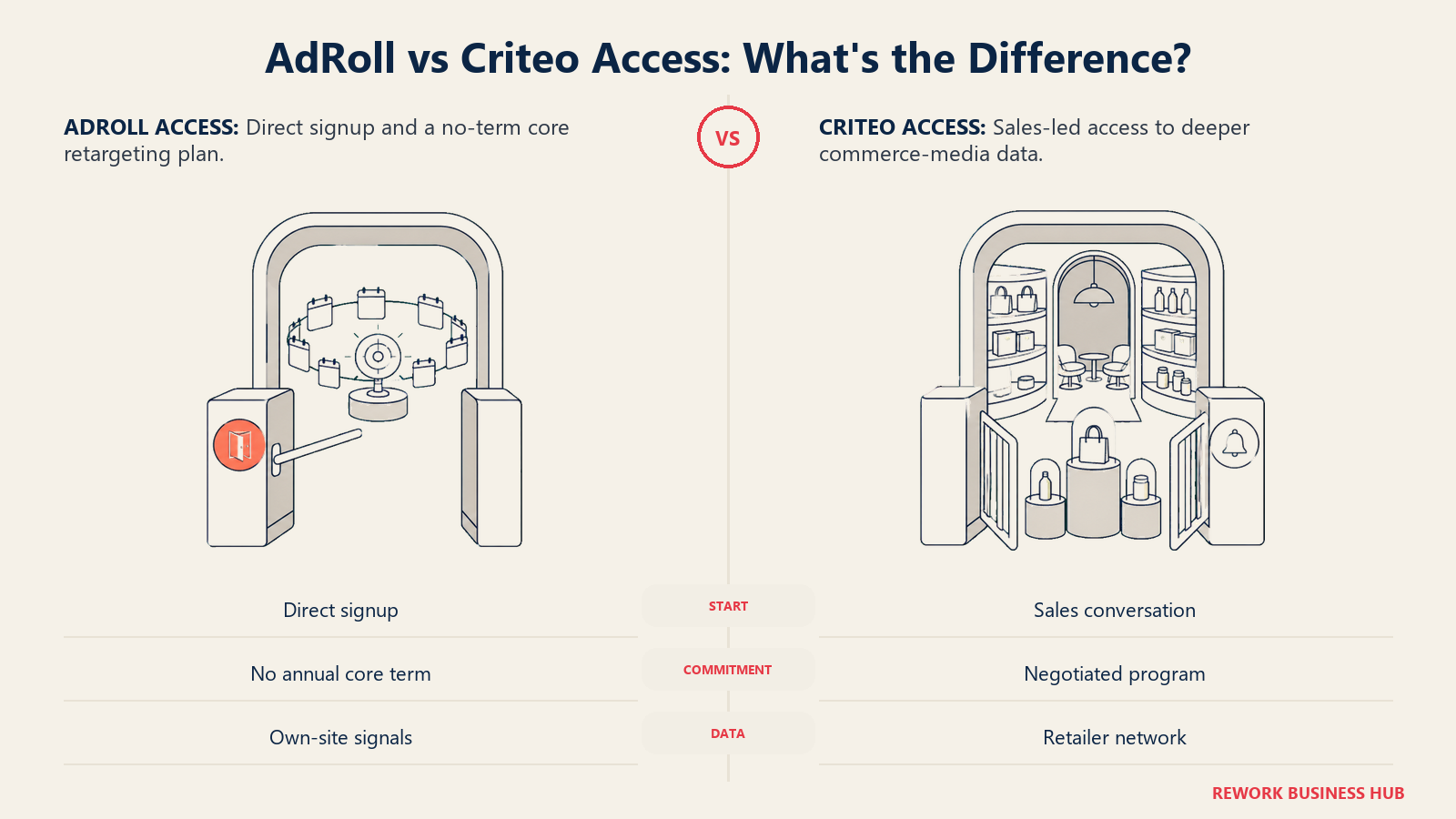
Launching a campaign takes a minimum daily spend of $5 and a minimum daily budget of $10, low enough to test in an afternoon. Managed services start around $5,000 to $10,000 in monthly spend, and the Advanced Package requires an annual commitment; AdRoll ABM, for B2B account-based retargeting, is quoted separately with no platform fee, media cost only.
| What you get | What you don't |
|---|---|
| A self-serve signup with no sales call required | Criteo's depth of cross-retailer commerce data |
| Email and onsite retargeting bundled with display | Native CTV or audio inventory |
| A real free-to-start entry point on core Ads | Deep-learning bid optimization at RTB House's level |
Pricing: Self-serve Ads: pay-as-you-go dynamic CPM, no platform fee, $5/day minimum spend, $10/day minimum budget to launch. Managed services: from roughly $5,000 to $10,000/month spend. Advanced Package: annual commitment required. AdRoll ABM: quoted separately, no fee, media cost only. Best for: Small to mid-market ecommerce brands wanting a fast, no-contract retargeting setup that doesn't require a sales conversation to start spending. Not ideal for: Advertisers wanting Criteo's cross-retailer data depth or dedicated account management from day one. If AdRoll is too light, see Best AdRoll Alternatives.
2. StackAdapt: Native, CTV, and Display in One Self-Serve DSP
StackAdapt's pitch is breadth: one self-serve platform running CTV, digital out-of-home, display, native, audio, video, and email, instead of a retargeting pixel bolted onto one channel. Its native inventory in particular, direct publisher integrations in B2B, finance, and healthcare, is a genuinely different reach pattern than Criteo's catalog-driven display ads.
StackAdapt publishes no rate card. Fees are negotiated as a percentage of media spend, and the platform supports self-serve, managed, or hybrid support models depending on how much hands-on help a team wants. There's no published platform fee to quote here, so treat any number you see elsewhere as an estimate pending your own sales conversation. If StackAdapt itself becomes the shortlist rather than the swap, best StackAdapt alternatives and StackAdapt vs The Trade Desk pick the comparison up from there.
| What you get | What you don't |
|---|---|
| One platform across CTV, native, display, audio, and email | A published rate card to budget against upfront |
| Strong native inventory for B2B, finance, and healthcare advertisers | AdRoll's genuinely free-to-start signup |
| Flexible self-serve, managed, or hybrid support | Criteo's retail-specific commerce data partnerships |
Pricing: No published pricing; fees negotiated as a percentage of media spend. Self-serve, managed, and hybrid support models available. Best for: Agencies and mid-market advertisers wanting one DSP across native, CTV, and traditional display instead of stitching together multiple point tools. Not ideal for: A brand that wants to see a number before talking to a salesperson.
3. The Trade Desk: The Biggest Independent Open-Internet DSP
The Trade Desk is where a team lands once its spend and sophistication have outgrown a retargeting-only tool. Its Kokai platform evaluates millions of ad opportunities in real time and leans on UID2, its own open-source identifier, for targeting and measurement without relying on third-party cookies. Reach is strongest in CTV, streaming audio, and premium publisher display, channels Criteo doesn't meaningfully touch.
The Trade Desk publishes no rate card; its platform fee is an undisclosed percentage of media spend. Access runs through a self-service seat or an agency/partner relationship. Kokai assumes real programmatic fluency, bid multipliers, custom-weighted scoring, identity graphs, that a lean in-house team without a dedicated trader will find steep.
| What you get | What you don't |
|---|---|
| The deepest open-internet reach across CTV, audio, and display | A published price or a simple self-serve signup |
| UID2 identity targeting built for a cookie-uncertain future | A tool a non-specialist can run without training |
| Real-time optimization across tens of millions of opportunities | AdRoll or StackAdapt's low-friction entry point |
Pricing: No published pricing; undisclosed percentage-of-media-spend platform fee. Access via self-service seat or an agency/partner relationship. Best for: Larger advertisers and agencies with a dedicated programmatic trader who need the widest open-internet reach across CTV, audio, and premium display. Not ideal for: A lean team without in-house programmatic expertise, or anyone wanting a same-day self-serve signup.
4. Amazon DSP: Shopper-Signal Data Instead of a Generic Pixel
Amazon DSP is the direct answer for a brand whose retargeting problem is really an Amazon problem: shoppers who viewed a product on Amazon.com, added it to a cart, or bought a related item. Where Criteo's retargeting relies on your own site's pixel plus its cross-retailer network, Amazon DSP buys against Amazon's first-party purchase and browsing signal, on Amazon.com and across Amazon's off-site publisher network and devices.
The managed service, where an Amazon Ads account team runs campaigns directly, typically requires a minimum spend around $50,000, which Amazon notes can vary by country. Self-service publishes no minimum spend at all, though a meaningful test budget still needs enough volume for the system to learn. For the advertising options this DSP sits alongside, see Amazon advertising.
| What you get | What you don't |
|---|---|
| Closed-loop measurement tied to actual Amazon purchase data | A low, guaranteed entry price on the managed tier |
| Reach across Amazon.com, Fire TV, and Amazon's publisher network | Criteo's broader cross-retailer commerce network |
| A genuinely open self-serve tier with no stated minimum | Amazon DSP is limited to Amazon or Amazon-adjacent inventory |
Pricing: Managed service from roughly $50,000/month, varies by country. Self-serve: no published minimum spend. Best for: Brands with meaningful Amazon sales volume wanting to retarget shoppers using Amazon's own first-party purchase signal. Not ideal for: A brand with little or no Amazon sales history; the data advantage disappears without it.
5. Google Display & Video 360: The Enterprise Pick Inside Google's Stack
DV360 makes sense for one reason: your planning, buying, and measurement are already inside Google Marketing Platform. It connects directly to GA4 and Campaign Manager 360, and it's one of the few DSPs with direct access to YouTube's reservation and programmatic inventory alongside open-web display. For a team retargeting shoppers who came from Google Shopping ads, keeping the buy inside the same ecosystem simplifies attribution.
Google's own DV360 marketing page publishes no pricing or minimum-spend information anywhere. The only calls to action are "Talk to Sales" for new advertisers and a sign-in link for existing users, confirming this is an enterprise, sales-led product with no visible self-serve entry point.
| What you get | What you don't |
|---|---|
| Native integration with GA4, Campaign Manager 360, and YouTube | Any published price or self-serve signup |
| Access to YouTube reservation and programmatic inventory | AdRoll's low, transparent minimum spend |
| One planning and measurement layer across Google's ad stack | A tool built for advertisers outside the Google ecosystem |
Pricing: No published pricing; access via Google sales or existing-user sign-in. Best for: Advertisers and agencies already standardized on Google Marketing Platform who want programmatic buying under the same measurement roof. Not ideal for: A team not already invested in Google's ad stack, or one wanting to see a number before a sales call.
6. RTB House: The Closest 1:1 Swap for Criteo's Core Job
If AdRoll is the easy self-serve swap, RTB House is the closest match to Criteo's actual methodology: deep-learning models built specifically for dynamic retargeting, not a generic DSP that happens to support it. Third-party analysis describes RTB House billing on a dynamic cost-per-click model, bids adjusting automatically on the predicted likelihood a given impression converts (reported, Adcore); RTB House's own site publishes no rate card to confirm that independently.
There's no self-serve tier here. RTB House's site carries no pricing page and routes every inquiry to a contact form, so every engagement starts as a custom, sales-led conversation, the same friction Criteo buyers are often trying to escape, traded for what its deep-learning bidding claims to deliver in return.
| What you get | What you don't |
|---|---|
| Deep-learning bidding purpose-built for retargeting | A self-serve tier or a published rate card |
| A direct methodology match to Criteo's core retargeting job | A quick, no-sales-call way to test the platform |
| Custom campaign design for each advertiser | Native, CTV, or audio inventory beyond retargeting display |
Pricing: No published pricing; every engagement is a custom, sales-led quote. Reported billing model: dynamic cost-per-click (reported). Best for: Mid-market to enterprise ecommerce and retail advertisers wanting a retargeting-first DSP with a genuine deep-learning bidding engine. Not ideal for: Anyone wanting a self-serve signup or a published price before committing to a sales conversation.
7. Taboola (Realize): Native Reach on Premium Publisher Sites
Taboola solves a different problem than Criteo, but one a Criteo buyer often runs alongside their retargeting spend: reaching readers on premium news and publisher sites through native, "recommended content" units, rather than following a known visitor with a product ad. In 2025 Taboola rebuilt its advertiser-facing product as Realize, a unified performance platform aimed at giving advertisers one surface across native placements and, increasingly, display inventory from publisher partners.
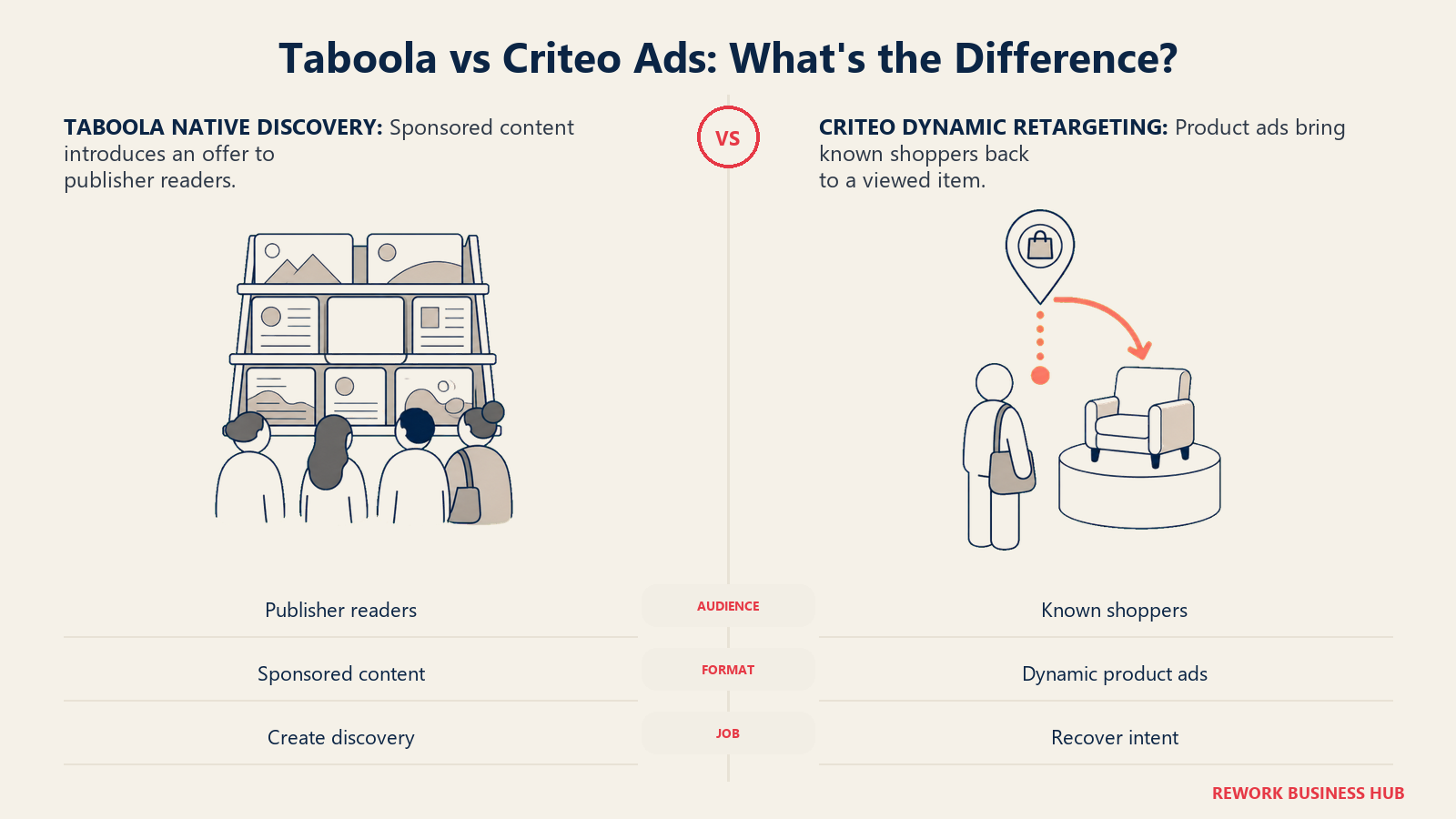
Taboola's own help center confirms campaigns run on a CPC or CPM basis, with your bid setting what you're charged per click or view. It doesn't publish a minimum campaign budget; automatic billing runs on a set increment, typically $100, once spend accrues. There's no public pricing page for the platform itself, so plan on a conversation with a Realize account rep to confirm current entry costs.
| What you get | What you don't |
|---|---|
| Native reach across premium publisher sites, not just retargeted display | A published pricing page or minimum budget |
| CPC or CPM billing, whichever fits the campaign goal | Criteo-style dynamic product retargeting on past visitors |
| Growing display inventory as Realize expands beyond native | A self-serve rate card to budget against upfront |
Pricing: CPC or CPM billing (vendor-confirmed); no published minimum campaign budget; typical automatic-billing increment of $100. Best for: Advertisers wanting native, content-style reach on premium publisher sites to complement, not replace, a retargeting program. Not ideal for: A team specifically trying to replace product-level dynamic retargeting; that's a different job than native content discovery.
8. Outbrain (Teads): Native Discovery, Now Mid-Merger
Outbrain covers the same native-discovery job as Taboola, and for years the two were the default comparison against each other rather than against Criteo. That's changed: Outbrain completed its merger with Teads and changed its corporate name to Teads Holding Co., and the advertiser-facing product now operates as "Outbrain Direct Response (ODR) by Teads," a subsidiary of the combined company. If you're evaluating Outbrain today, you're really evaluating a business mid-rebrand, worth naming plainly rather than pretending nothing changed.
No pricing is published on Outbrain's current homepage; every path leads to "Get Started" or "Request a Demo." Historically Outbrain ran a self-serve option alongside managed accounts, and that entry point still appears under the ODR branding, but expect the specifics to keep shifting as the Teads integration continues through 2026.
| What you get | What you don't |
|---|---|
| Deep native publisher relationships, now paired with Teads' video and CTV reach | Pricing stability while the merger integration is ongoing |
| A historically self-serve entry point alongside managed accounts | A published rate card on the current site |
| Combined scale with Teads across the open internet | The same product and support continuity a Criteo buyer may expect |
Pricing: No published pricing; self-serve historically available under the Outbrain Direct Response brand, managed accounts also offered. Best for: Advertisers wanting native publisher reach who are comfortable with a platform actively integrating into a larger combined company. Not ideal for: A buyer who wants pricing and product stability right now rather than mid-transition.
9. Meta Ads Manager with Advantage+: Skip the Middleman on Your Biggest Channel
For plenty of ecommerce brands, the honest question isn't "what replaces Criteo" but "do we need a third-party retargeting layer at all when most of our budget already runs on Meta." Advantage+ shopping campaigns, folded into a single unified flow as of a February 2026 Ads Manager overhaul, now handle audience targeting, placement, creative testing, and budget allocation automatically, blending prospecting and retargeting into one campaign. It performs best with a catalog of 30 or more SKUs.
There's no separate platform fee: Meta Ads Manager is free, and you pay for media the same way you already do. That makes it less a price comparison and more a question of whether Meta's own first-party targeting, run inside its own automation, replaces what Criteo was doing on top of it. For the underlying channel, see Facebook and Instagram ads.
| What you get | What you don't |
|---|---|
| No platform fee on top of media spend | Reach outside Meta's own properties |
| AI-automated audience, placement, and creative decisions | Cross-network commerce data the way Criteo aggregates it |
| A single unified campaign flow as of the 2026 overhaul | A dedicated account team unless you're on Meta's larger ad-spend tiers |
Pricing: Free platform access; media cost only. Best for: Brands running most of their paid budget on Meta already, wanting to test whether native automation covers the retargeting job without a third-party layer. Not ideal for: Advertisers needing reach beyond Meta's properties or cross-retailer commerce data.
10. Smartly: Creative Automation Across Every Social Channel
Smartly's job differs from Criteo's, but it competes for the same budget line in plenty of marketing orgs: automating ad creative and media buying across Meta, TikTok, Snap, Pinterest, and Google from one workspace instead of managing each platform separately. For a team whose real bottleneck is producing enough creative variants, not finding more retargeting inventory, that's a different, often more pressing, problem.
Smartly publishes no pricing page. G2's pricing data records no free tier or trial, and third-party pricing analyses put the platform fee at roughly 2% to 4% of managed spend, with a minimum monthly fee around $4,000 to $5,000 and a median annual contract near $90,000 (reported). Budget for an enterprise sales cycle, not a self-serve signup.
| What you get | What you don't |
|---|---|
| Creative automation across Meta, TikTok, Snap, Pinterest, and Google | A free tier, trial, or self-serve signup |
| One workspace instead of five separate ad platform logins | A published, confirmed price |
| Built for high creative-testing volume at scale | A fit for a small team without that creative-testing need |
Pricing: No published pricing; reported platform fee roughly 2% to 4% of managed spend, $4,000 to $5,000/month minimum fee, median annual contract around $90,000 (reported). Best for: Enterprise and agency teams running paid social across multiple platforms who need creative automation more than a retargeting DSP. Not ideal for: Smaller teams without the creative-testing volume or budget to justify an enterprise contract.
11. Madgicx: AI-Run Meta and Google Ads for a Small Team
Madgicx targets the ecommerce brand that wants AI doing the work a media buyer would otherwise do by hand, budget allocation, creative testing, audience decisions across Meta and Google, from one plan called Madgicx Pro Complete with AI. It's a genuinely self-serve signup with a 7-day free trial, closer in spirit to AdRoll than to RTB House or Basis.
Pricing scales with monthly ad spend and billing frequency, but Madgicx publishes almost none of it: the pricing page shows a band selector and "See price inside the app", while its academy page puts the entry at $99/month, climbing to a reported $329/month at $20,000 to $30,000. Above that, nothing is published. A Tracking Pro add-on runs $49/month and is the only fixed price on the pricing page. For the broader category, see Best AI Ad Creative Tools 2026.
| What you get | What you don't |
|---|---|
| A self-serve signup with a 7-day free trial | Retargeting reach beyond Meta and Google |
| Transparent, published spend-tier pricing up to $30,000/month | A public price above that $30,000 monthly-spend tier |
| AI budget, audience, and creative automation in one plan | Criteo or RTB House's dedicated cross-network commerce data |
Pricing: From $99/month per Madgicx's academy page, rising to a reported $329/month at $20,000-$30,000; per-band figures are in-app only and nothing is published above $30K. Tracking Pro add-on: $49/month. Best for: Small to mid-market ecommerce brands wanting one AI-run tool across Meta and Google without a dedicated media buyer. Not ideal for: Larger advertisers past the published tiers, or anyone needing open-web, native, or CTV reach. See Best Madgicx Alternatives if it doesn't fit.
12. Basis Technologies: A DSP Plus the Agency Workflow Around It
Basis solves a problem specific to agencies: combining programmatic media buying with the workflow, billing, and reporting tools an agency otherwise stitches together from separate systems. Its "Unify by Basis" positioning and Compass AI features aim at one operating layer for buying and the agency operations around it, a genuinely different value proposition than any pure retargeting DSP here.
Basis publishes no pricing anywhere on its site. Its homepage routes every visitor to a general contact form, and third-party buyer guides describe the model as custom enterprise pricing, a technology fee tied to media spend plus platform fees for the workflow components, sold through annual contracts. Those guides note Basis doesn't publicly state a minimum spend, unlike The Trade Desk or Amazon's managed service (reported).
| What you get | What you don't |
|---|---|
| Media buying plus agency workflow, billing, and reporting in one | Any published price or self-serve entry point |
| AI features (Compass) layered on top of the DSP | A stated minimum spend to plan against (reported: none published) |
| A single operating layer built for agency-scale operations | A fit for a direct brand without agency-style workflow needs |
Pricing: No published pricing; custom enterprise quote, sold through annual agency contracts. Best for: Agencies wanting programmatic buying and agency operations (workflow, billing, reporting) unified in one platform. Not ideal for: A direct-to-consumer brand without agency-style operational needs, or anyone wanting a self-serve start.
Why Teams Look Beyond Criteo
Criteo's targeting depth is real, drawn from retailer and publisher relationships across a genuinely large commerce network, and for a large retailer with a big catalog and heavy traffic, that depth can outperform a generic retargeting setup. The reasons buyers still shop around are about fit and transparency, not capability.
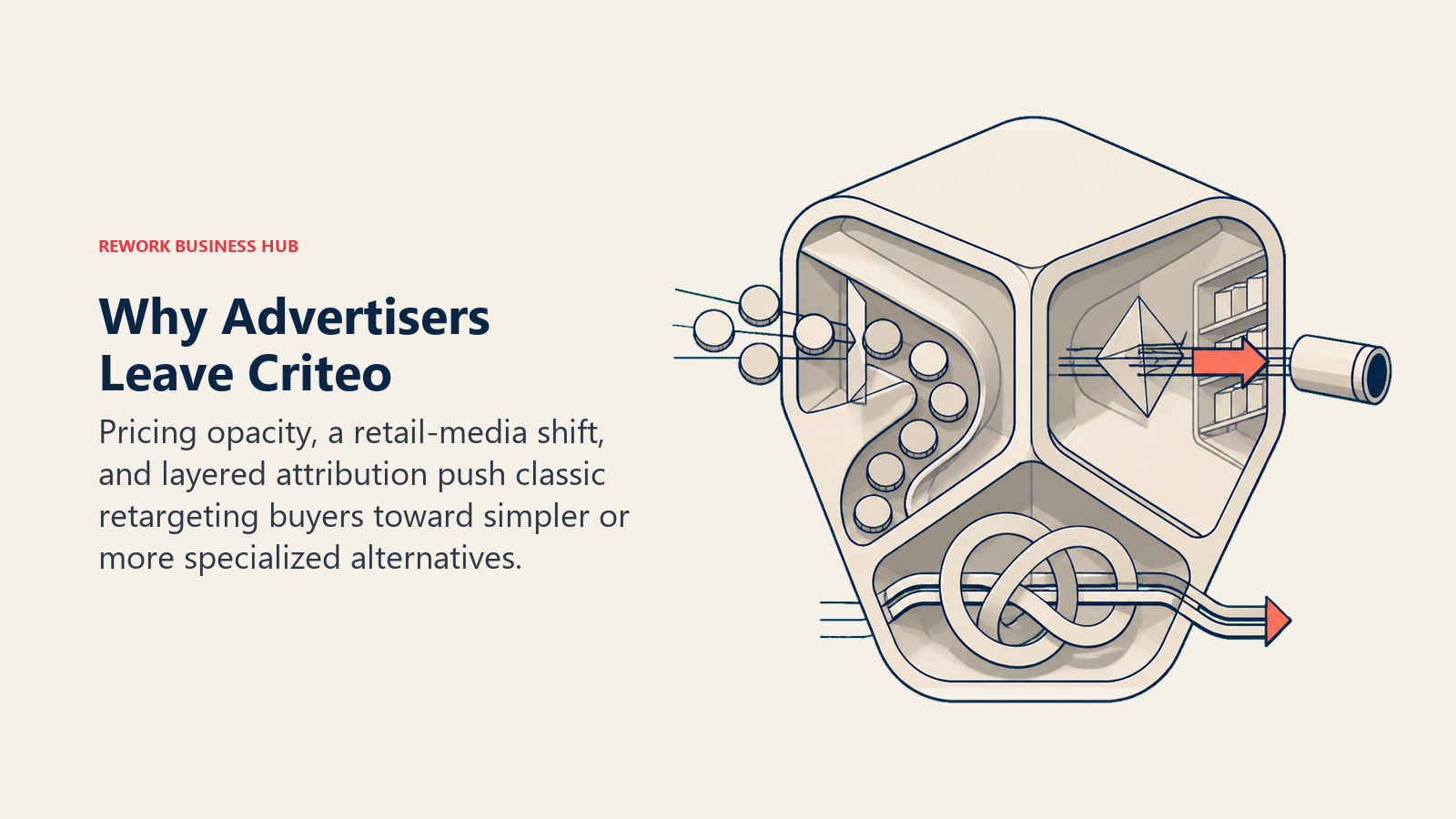
No published price, ever. Every path on Criteo's site, "Contact Sales," "Talk to an Expert," leads to a sales conversation, not a rate card. That's not unusual among enterprise DSPs (The Trade Desk, DV360, RTB House, and Basis all do the same), but it means a smaller advertiser can't self-serve a test the way they can with AdRoll or Madgicx.
The product itself has moved toward commerce and retail media. Criteo bills on media spend with its margin built into the CPC or CPM, not a separate line item, and its current lineup reflects a real strategic shift:
| Criteo Product | Built For | Starting Price |
|---|---|---|
| Commerce Growth | Automated acquisition and retention advertising | Quote only, fees inside media CPC/CPM |
| Commerce Max | Retail media on the open internet | Quote only, fees inside media CPC/CPM |
| Retail Media | Onsite and offsite campaigns across 200-plus retailers | Quote only, fees inside media CPC/CPM |
| Criteo GO | Self-service advertising powered by Criteo's AI | Quote only, fees inside media CPC/CPM |
A brand that came to Criteo in 2019 for classic web retargeting is, by 2026, being sold a retail media platform built around retailer partnerships and AI-driven shopping placements. That's a coherent business move, retail media is the fastest-growing pocket of digital ad spend, but it's exactly why a buyer whose need is still "follow my site visitors with a product ad" starts evaluating AdRoll, StackAdapt, or RTB House instead. For the fundamentals this whole category sits on, see retargeting and remarketing.
Attribution gets harder across a stacked buy. Layer Criteo, or any DSP, on top of Meta and Google's own retargeting and it gets genuinely difficult to say which channel actually drove a conversion. That's a measurement problem, not a Criteo-specific one; see attribution models both teams can trust before assuming a new vendor fixes it.
Third-Party Cookies in 2026: What Actually Changed
This is worth stating plainly because so much retargeting content repeats an outdated assumption. Third-party cookies are not being phased out of Chrome. Google reversed course: in April 2025, it announced it would maintain its existing cookie-choice approach rather than roll out the standalone consent prompt it had spent years building toward. Then, in October 2025, Google retired ten Privacy Sandbox APIs outright, Attribution Reporting, Protected Audience, Topics, and others, citing low adoption, and shut down the initiative built to replace cookies rather than the cookies themselves.
The upshot: the cookieless future that shaped years of DSP roadmaps didn't arrive, at least not through Chrome, which still carries the large majority of global browser traffic. Privacy regulation and Safari/Firefox's existing cookie blocking still apply, but a platform's pitch around "built for a post-cookie world" (The Trade Desk's UID2 is the clearest example) now solves for a genuinely uncertain future, not a fixed deadline. Verify any vendor's cookie claims against this timeline, not the 2020-era assumption most retargeting comparisons still repeat.
How to Choose: Decision Framework
Start with the media job you need to replace, then use the framework below to narrow the alternatives by buying model, data source, and reach.
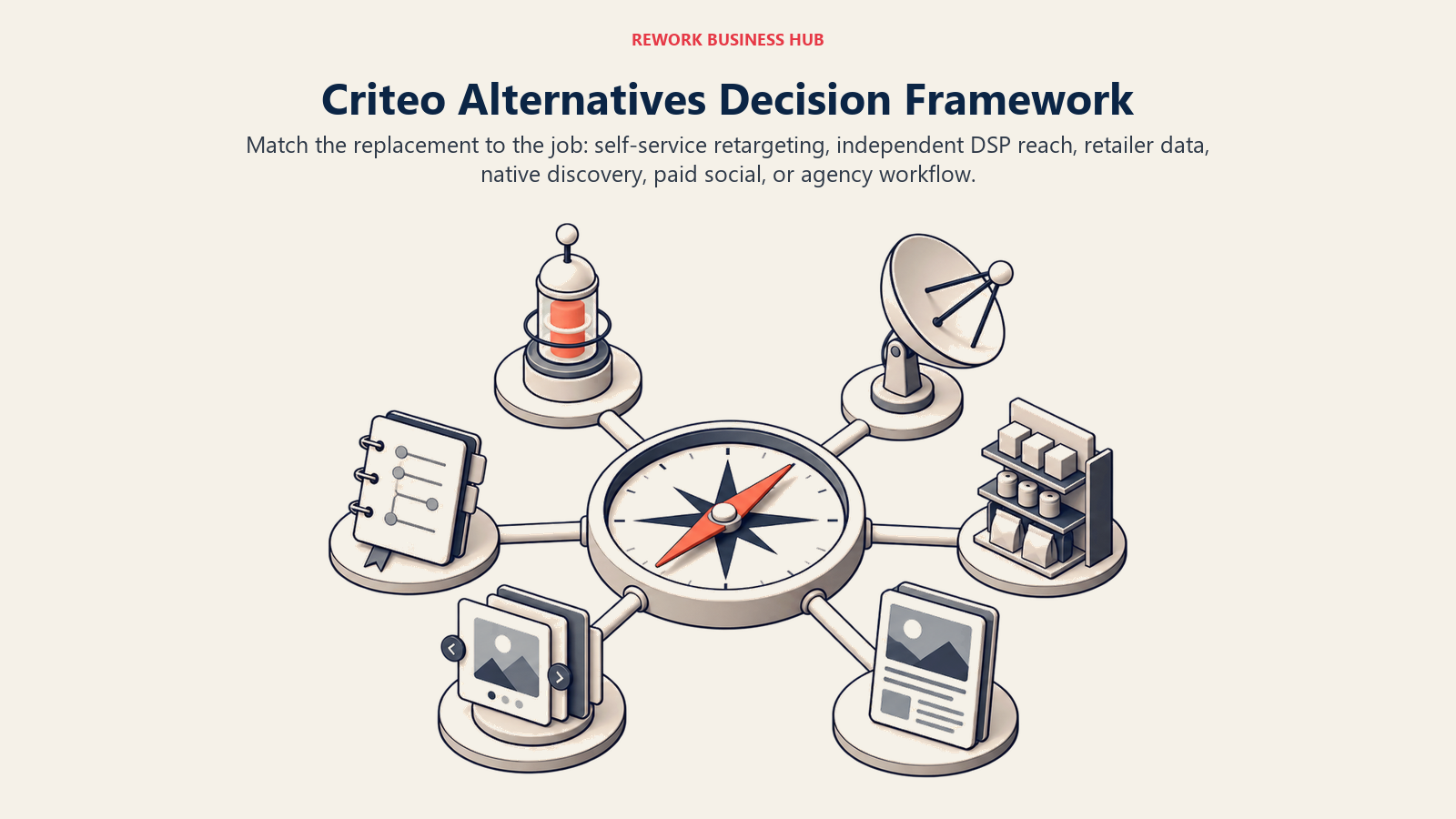
| If you need... | Best pick |
|---|---|
| A no-contract, self-serve swap for Criteo's core retargeting job | AdRoll |
| The closest deep-learning match to Criteo's actual methodology | RTB House |
| One DSP across native, CTV, display, and email | StackAdapt |
| The widest open-internet reach for a large, sophisticated buying team | The Trade Desk |
| To retarget using Amazon's own purchase and browsing data | Amazon DSP |
| Programmatic buying already unified with Google Analytics 4 | Google Display & Video 360 |
| Native reach on premium publisher sites alongside your retargeting | Taboola (Realize) or Outbrain (Teads) |
| To test whether Meta's own automation replaces a third-party layer | Meta Ads Manager (Advantage+) |
| Creative automation across every paid social channel at scale | Smartly |
| AI-run Meta and Google ads without a dedicated media buyer | Madgicx |
| A DSP unified with agency workflow, billing, and reporting | Basis Technologies |
Frequently Asked Questions about Criteo Alternatives
Why do advertisers look for Criteo alternatives?
Mostly cost transparency and product fit, not a capability gap. Criteo publishes no pricing anywhere, and its lineup (Commerce Growth, Commerce Max, Retail Media, Criteo GO) has shifted toward retail media rather than the classic web-retargeting pixel that brought in earlier advertisers. Commerce Growth, Commerce Max and Retail Media all start as a sales conversation. The one exception is Criteo GO, which Criteo expanded to full self-service signup for SMBs in the US and UK on 31 March 2026, though even there no rate card is published before you spend.
How much does Criteo actually cost?
There is no published price. Criteo bills on media spend with its margin built into the CPC or CPM you already pay, so there's no separate fee line to negotiate the way you can with AdRoll or Madgicx.
What's the closest alternative to Criteo's actual retargeting methodology?
RTB House, which runs deep-learning bidding built specifically for dynamic retargeting rather than a general-purpose DSP. It has no self-serve tier either, so expect a similar sales-led process.
What's the cheapest, fastest way to start retargeting without Criteo?
AdRoll's self-serve Ads product, a $5/day minimum spend and $10/day minimum budget to launch, no platform fee, and no annual contract on the core product.
Are third-party cookies going away in Chrome, and does that affect retargeting?
No. Google reversed course in April 2025, keeping its existing cookie-choice approach rather than forcing a deprecation deadline, then retired the Privacy Sandbox APIs built to replace cookies that October. Chrome still carries roughly two-thirds of global browser traffic, so this changes how urgent any "cookieless" retargeting pitch actually is.
Should I just use Meta's own Advantage+ instead of a third-party retargeting tool?
If most of your spend already runs on Meta and your catalog has 30-plus SKUs, it's worth testing. Advantage+ automates audience, placement, creative, and budget in one flow at no extra fee, though it only reaches Meta's own properties, not the open web or other retailers.
Does any alternative match Criteo's cross-retailer commerce data?
Not directly outside of retail media itself. Amazon DSP offers the closest equivalent, but only for Amazon's own ecosystem; Criteo's Commerce Max and Retail Media products remain the broadest cross-retailer commerce media network among the platforms discussed here.
What to Do Next
Match your actual complaint, pricing opacity, lack of self-serve access, or a shift away from classic retargeting, to the framework above, then run a genuine two-week test on your top two picks against current Criteo spend, not a sandbox demo. Pricing friction: start with AdRoll or Madgicx, both show real numbers before a sales call. Methodology: put RTB House head-to-head against existing performance. Whichever you pick, revisit your cost per lead and attribution setup too; a new vendor won't fix a measurement problem that predates it. See Best Ad Management Software 2026 for the wider category.

Principal Product Marketing Strategist
On this page
- Key Facts
- What "Ad Management Software" Actually Covers
- Quick Comparison Table
- Self-Serve or Enterprise Contract: Where Each Platform Sits
- 1. AdRoll: The No-Contract Swap for Criteo
- 2. StackAdapt: Native, CTV, and Display in One Self-Serve DSP
- 3. The Trade Desk: The Biggest Independent Open-Internet DSP
- 4. Amazon DSP: Shopper-Signal Data Instead of a Generic Pixel
- 5. Google Display & Video 360: The Enterprise Pick Inside Google's Stack
- 6. RTB House: The Closest 1:1 Swap for Criteo's Core Job
- 7. Taboola (Realize): Native Reach on Premium Publisher Sites
- 8. Outbrain (Teads): Native Discovery, Now Mid-Merger
- 9. Meta Ads Manager with Advantage+: Skip the Middleman on Your Biggest Channel
- 10. Smartly: Creative Automation Across Every Social Channel
- 11. Madgicx: AI-Run Meta and Google Ads for a Small Team
- 12. Basis Technologies: A DSP Plus the Agency Workflow Around It
- Why Teams Look Beyond Criteo
- Third-Party Cookies in 2026: What Actually Changed
- How to Choose: Decision Framework
- What to Do Next