More in
AI at Work Insights
What to Ask Before You Let an AI Agent Touch Company Data
Oct 2, 2026
How to Prepare for AI Regulation When Deadlines Keep Moving
Oct 2, 2026
How to Choose an AI Model Without Rebuilding Every Time One Launches
Oct 2, 2026
The Coordination Tax: The Hidden Cost That Kills Operational Velocity
Apr 13, 2026
Measuring AI ROI Beyond 'Time Saved'
Mar 17, 2026
The Governance Gap: What Leaders Get Wrong About AI at Work
Mar 5, 2026
AI Agents in the Sales Pipeline: Hype, Reality, and What's Actually Working
Jan 22, 2026 · Currently reading
AI Copilots vs. AI Agents: Understanding the Difference Matters
Jan 21, 2026
AI Agents in the Sales Pipeline: Hype, Reality, and What's Actually Working
Turn this article into takeaways for your work.


Each assistant summarizes the article only for you and suggests best practices for your work.
Every SaaS vendor is now selling "AI-powered pipeline." Most of it is a better autocomplete on CRM notes. But something genuinely new is emerging in a handful of sales orgs: autonomous agents that qualify leads, route them based on real-time signals, and hand off to humans at exactly the right moment. The gap between the hype and the actual working deployments is instructive. And the lesson isn't what most people expect.
Here's the uncomfortable truth for CROs evaluating AI sales tools right now: the technology works, but the implementations mostly don't. And the reason isn't the AI. It's that buyers are purchasing the wrong category of product for their actual problem.
What vendors mean by "AI sales agent" (they're not the same)
Before evaluating any tool, you need to know which of four distinct things is being sold under the "AI sales agent" label. Conflating them is how companies waste 18 months and a six-figure contract.
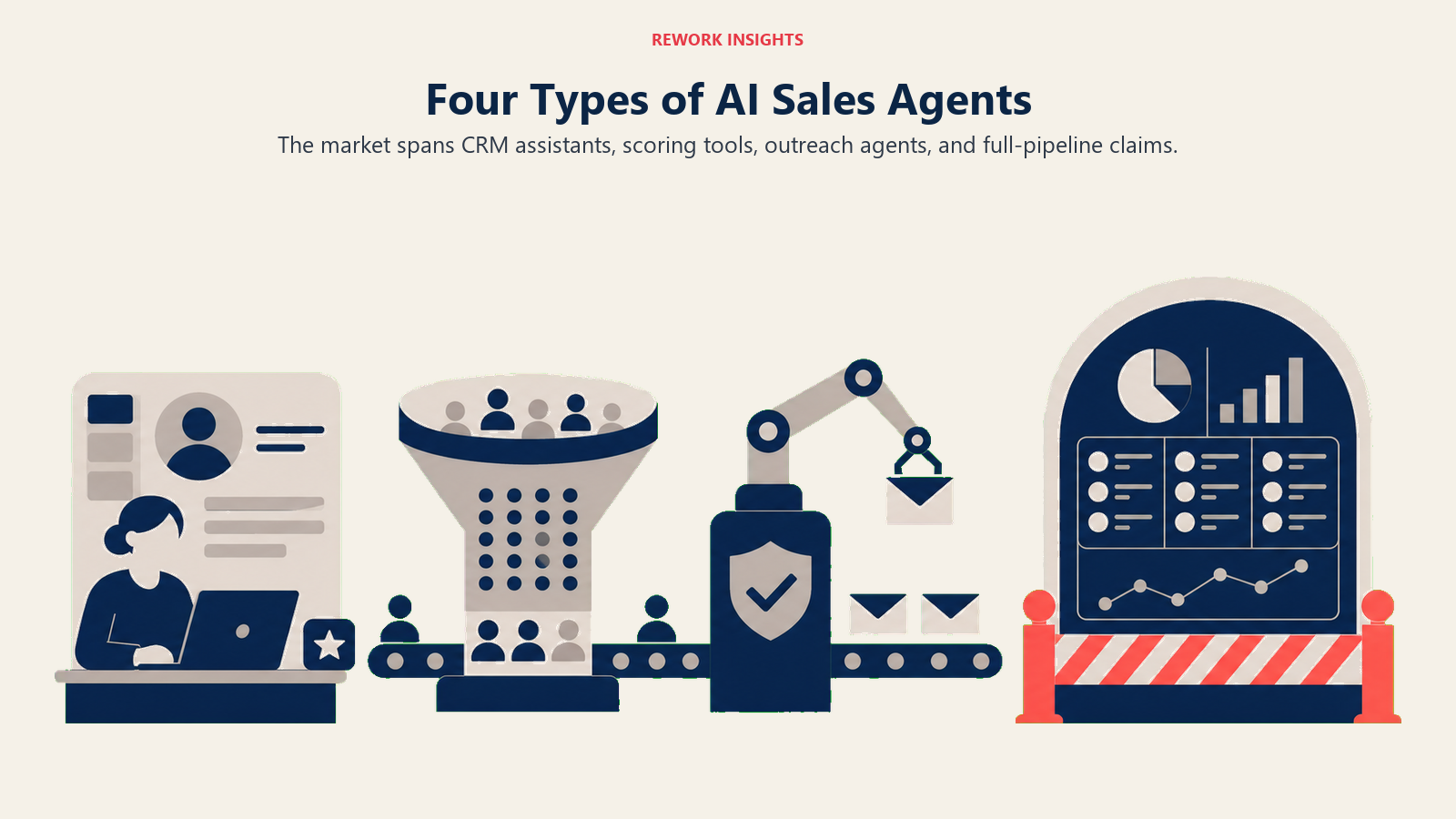
Category 1: AI-assisted CRM hygiene tools. These are workflow automations with an AI layer: they log calls, summarize emails, suggest next steps, and fill in contact records. They're genuinely useful, they're low-risk, and they require minimal change management. But they're not agents. They're smart assistants that sit inside your existing workflow. HubSpot's AI features and Salesforce Einstein's activity capture mostly live here.
Category 2: AI-powered lead scoring and routing tools. These analyze inbound leads, score them against your ICP, and route them to the right rep or sequence. This is where real pipeline leverage exists. When the scoring model is trained on actual closed-won data and the routing logic is properly configured, these tools meaningfully reduce the time reps spend on leads that won't convert. The catch: they're only as smart as your CRM data is clean. (For a deeper look at how modern lead scoring systems actually work, including the data requirements, the library article is worth reading before vendor conversations.)
Category 3: Autonomous outreach agents. These generate personalized prospecting emails, manage multi-touch sequences, and in some cases handle early-stage email replies. This is where the market splits sharply between "working" and "dangerous." Outreach agents that operate with too much autonomy and too little brand oversight produce responses that damage relationships. The ones working well run on tight rails with human review gates.
Category 4: Full-pipeline AI agents. These are the "AI SDR" and "AI AE" products that claim to handle end-to-end pipeline management autonomously. In B2B SaaS with an average deal value above $10,000, there are no credible examples of fully autonomous agents closing meaningful revenue without substantial human involvement. The category exists more in product roadmaps than production deployments.
Knowing which category a vendor is selling in takes about 15 minutes of technical questions. Most buyers skip those questions, which is why most AI sales tool implementations disappoint.
What's actually working right now
The working deployments share a common trait: they automate a specific, repetitive task that previously required human judgment but actually didn't need it.
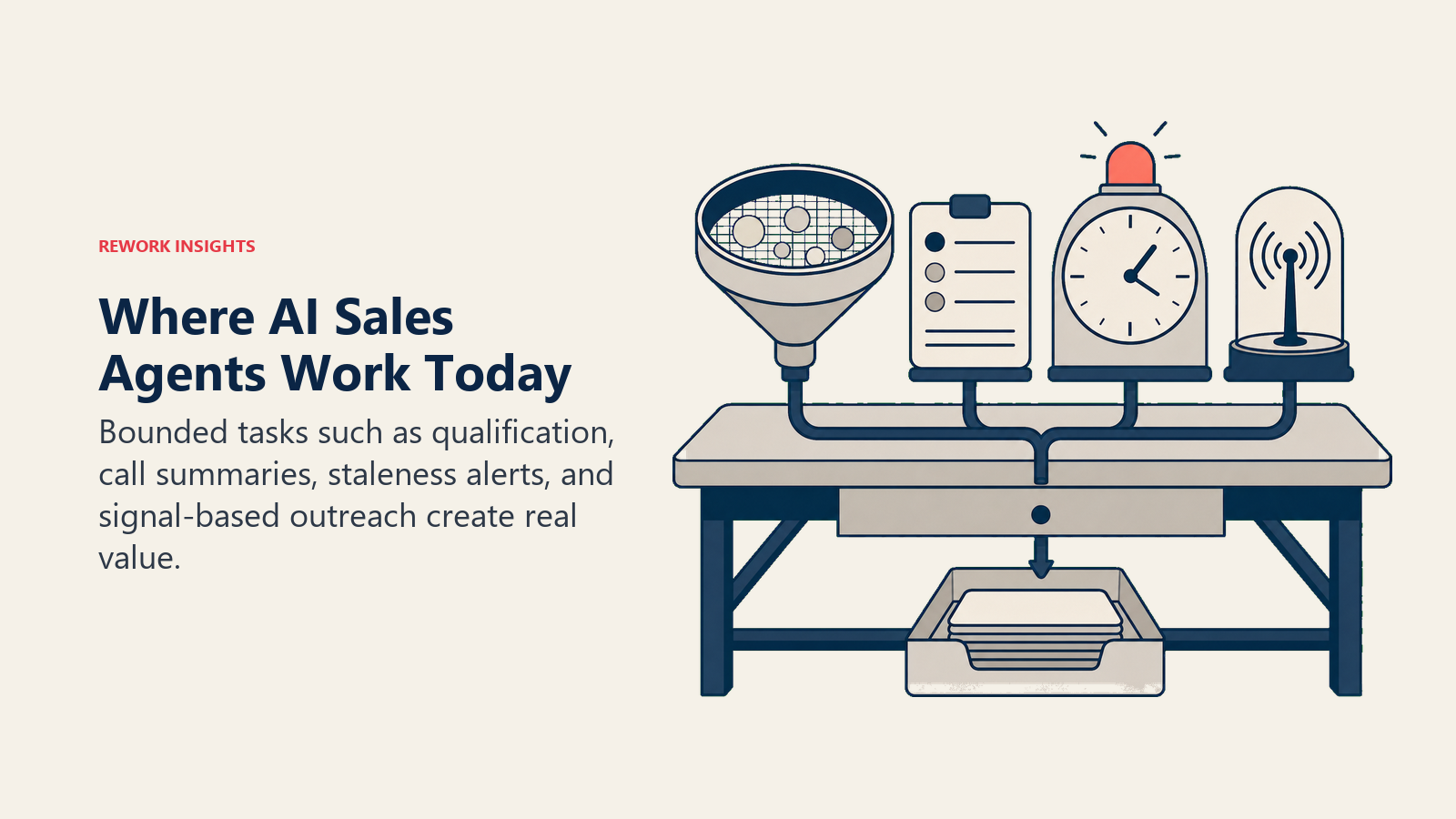
Lead qualification routing is the clearest success case. When a company has 12+ months of CRM data on closed-won deals and has done the work to define a real ICP, AI routing systems can reduce the time reps spend on low-probability leads by 30–50%. Salesforce's State of Sales research consistently finds that high-performing sales teams are more than twice as likely to use AI for lead prioritization than underperformers. The qualification happens before the lead hits a human inbox, and reps spend more time on the 20% of leads that drive 80% of revenue. This works because the decision ("does this lead fit our ICP?") is actually a pattern-matching problem, not a judgment call. AI is good at pattern matching.
Post-call summary and next-step generation has become a standard feature across sales tools, and adoption is high because it removes a task reps genuinely hate. Good implementations (Gong, Chorus, and embedded equivalents) produce summaries accurate enough that reps edit rather than rewrite them. According to McKinsey's research on AI in sales, AI-driven task automation in sales can free up as much as 20% of selling time previously spent on administrative work. The time saved is real (15–20 minutes per call), but the bigger value is consistency: every call gets documented, every next step gets logged, and pipeline data quality improves without a change management campaign.
Pipeline staleness alerts are underrated. Simple AI models that flag deals that haven't had meaningful activity in 14 days, or that flag when a deal's engagement score is dropping relative to historical patterns, give managers and reps a genuine edge on pipeline health. This isn't sophisticated AI. It's pattern detection on structured CRM data, and it works because the problem it solves (stale deals dying quietly) is real and expensive.
Personalized outreach sequencing works when the personalization is genuinely signal-based rather than template-filled. The tools that pull intent data (recent job change, funding announcement, technology stack change) and use it to customize sequence entry points and messaging show measurably higher reply rates than generic outreach. The limitation is that this only works if your ICP is tightly defined and the underlying data sources are accurate.
What's overpromised
The failures cluster around two types of problems: autonomy without oversight, and AI built on bad data.
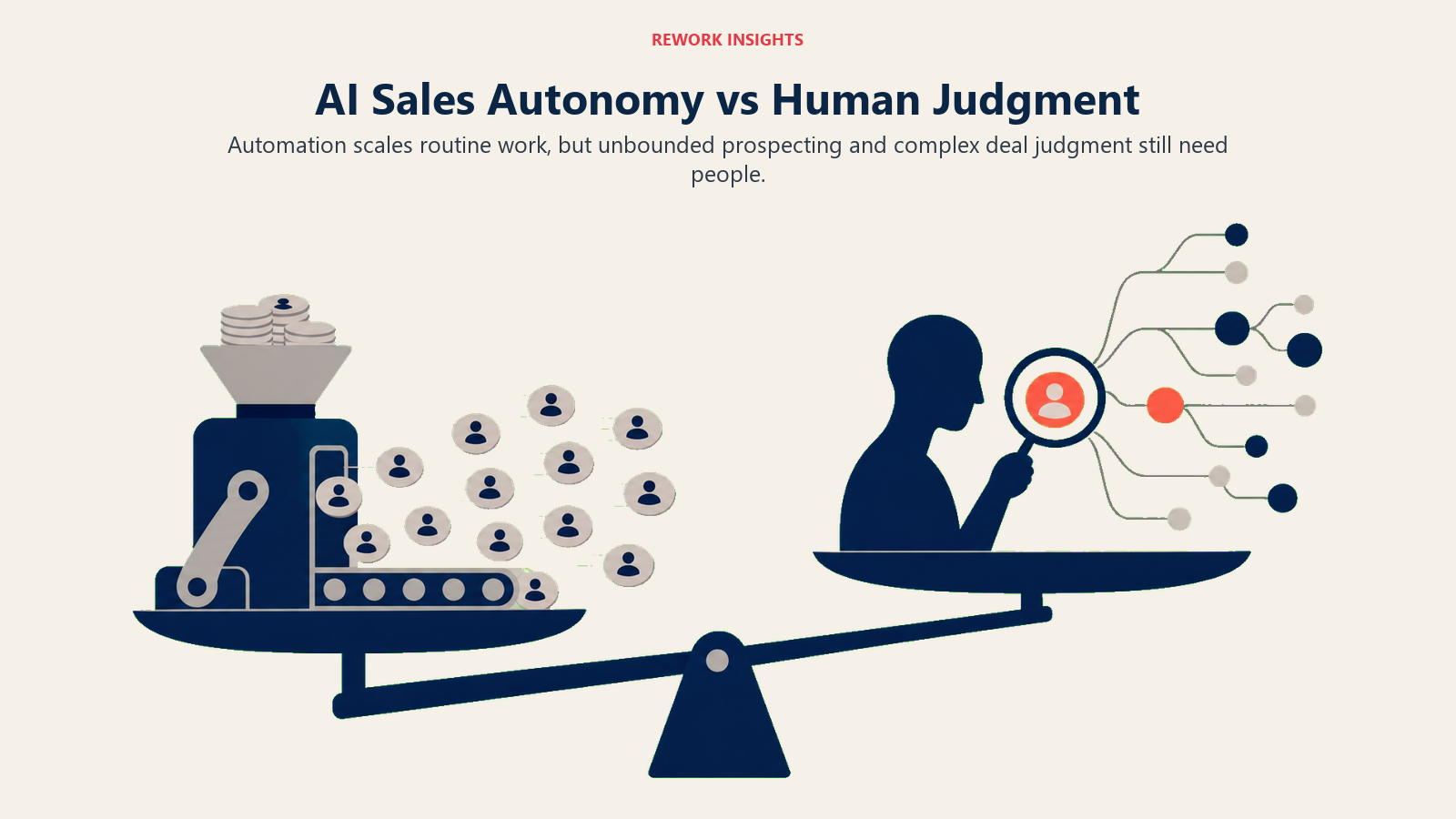
Fully autonomous prospecting doesn't work at the revenue level most companies need. An AI that sends 500 cold emails per day without human review will damage your domain reputation, irritate prospects, and generate a compliance exposure in markets with strict anti-spam enforcement. Andrew Ng's AI for Everyone course notes on agentic workflows highlight that autonomous AI systems require well-defined success criteria and bounded failure modes, criteria that most autonomous prospecting tools haven't operationalized. The SDR role requires situational judgment: knowing when a prospect has just been through a rough quarter, reading a reply's subtext, deciding when to push and when to back off. None of that is in current AI sales agent products.
AI-written proposals that close deals is a category that exists mostly in case studies with suspiciously vague attribution. Proposals that move enterprise deals close require customization that reflects a deep understanding of the buyer's internal dynamics, their specific objections, and their organizational politics. AI can draft a template. It can't replace the relationship context that makes a proposal land. Companies that have tried to automate proposal generation without heavy human review report increased cycle times, not shorter ones, because re-work takes longer than first-draft writing.
AI SDRs that replace human judgment (the fully autonomous category) are generating significant vendor investment and significant customer skepticism for the same reason. In markets where relationships drive pipeline, removing humans from early-stage conversation creates a trust deficit that's expensive to repair. A handful of high-volume, low-ACV businesses have made it work. Most B2B companies shouldn't replicate it.
The CRM integration reality
There's a floor of data quality below which no AI sales tool adds value. Most companies haven't honestly assessed whether they're above or below it.
For AI lead scoring to work, you need at minimum: consistent lead source attribution, 12 months of closed-won and closed-lost data with meaningful sample sizes by segment, accurate contact and company data, and reliable activity logging. If your CRM has 40% of deals with "unknown" lead source, or if reps are logging calls inconsistently, AI scoring will optimize for noise. You'll get confident predictions built on unreliable inputs.
The honest answer for many sales orgs is that the first 90 days of an AI sales tool deployment should be a data audit, not an AI deployment. Fix the CRM hygiene first. Then the AI actually works. But vendors don't sell data audits. They sell software. So this conversation happens after the contract is signed, if it happens at all. The CRM rollout and adoption guide covers what a structured data readiness process actually looks like before go-live.
The AI Sales Agent Evaluation Matrix
When evaluating an AI sales tool, score the product across four dimensions before signing. A structured AI tool selection framework can help you organize this across multiple vendor comparisons rather than evaluating each one in isolation.
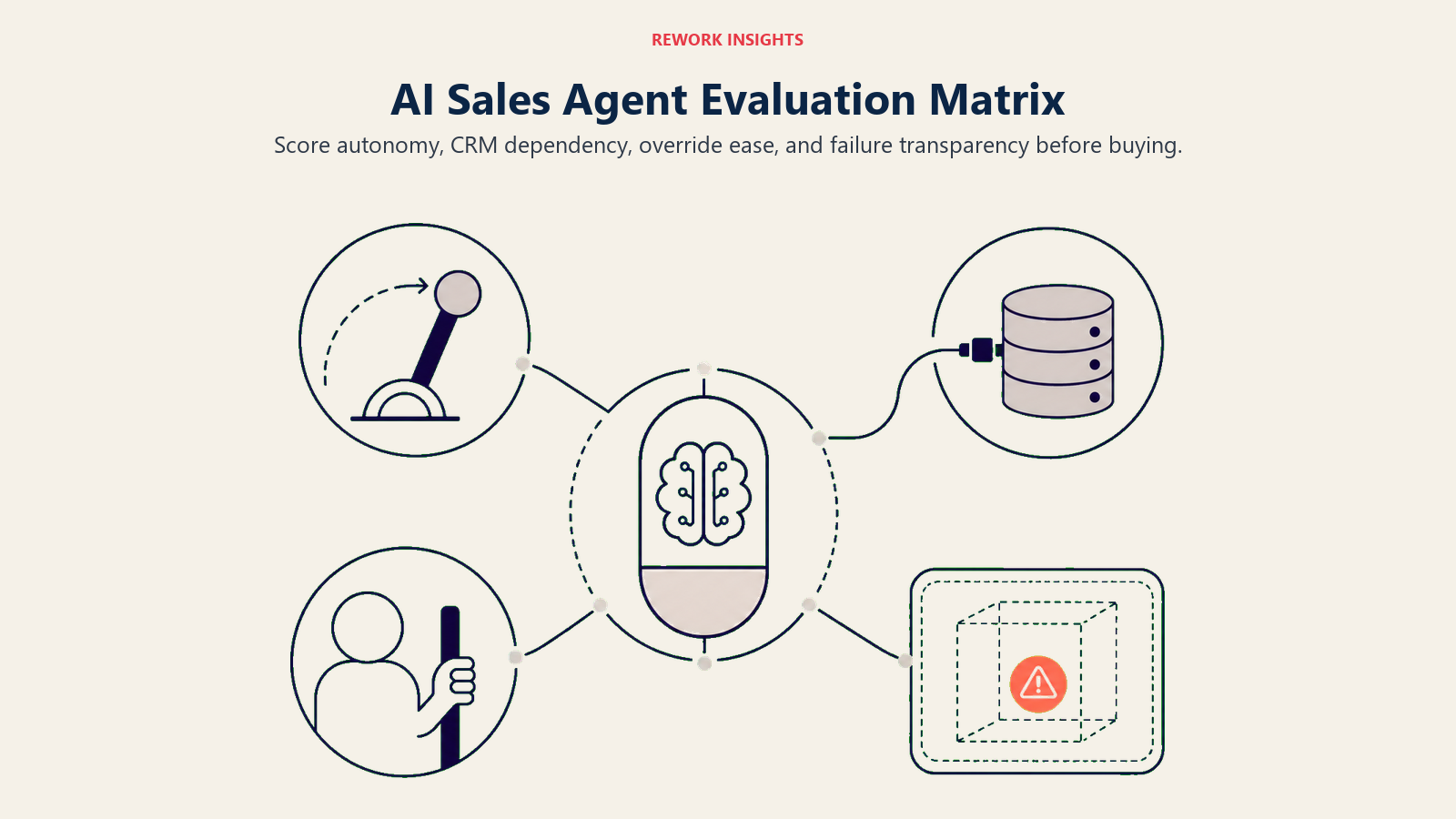
Dimension 1: Autonomy level. On a scale from "always requires human approval" to "acts independently within defined bounds": where does this tool sit? Higher autonomy means higher leverage and higher risk. For tools operating in early-stage outreach or customer-facing communications, autonomy above a certain level requires significant trust in the vendor's training data and your own process documentation.
Dimension 2: CRM dependency. How much of the tool's value relies on your existing CRM data quality? Tools with high CRM dependency fail loudly in orgs with messy data. Tools with low CRM dependency often have their own data layer, which means you're now managing two systems of record.
Dimension 3: Human override ease. When the AI does something wrong (and it will), how easy is it for a rep or manager to override, correct, and prevent recurrence? Tools with poor override design create workarounds, and workarounds create data problems downstream.
Dimension 4: Failure mode transparency. What does the tool do when it's uncertain or wrong? Good tools surface their confidence level and flag edge cases for human review. Bad tools present uncertain outputs with the same confidence as certain ones. The difference matters enormously when a rep is deciding whether to trust the suggested next step.
Score each dimension 1–5. Any tool scoring below 3 on human override ease or failure mode transparency should trigger a serious pause regardless of other scores.
Three questions every CRO should ask in a vendor demo
Before signing an AI sales tool contract, get answers to these three questions. Not from the slide deck. From the technical team or from reference customers.
"What happens when the AI is wrong, and can you show me an example?" Good vendors have a clear answer. They'll show you a failure case, explain what caused it, and describe exactly what the human override flow looks like. Vendors who deflect this question by pivoting to accuracy statistics are hiding the failure mode.
"What's the minimum CRM data quality required for this tool to perform at the benchmark you showed me?" If the answer is vague, ask for the specific data fields and completeness requirements in writing. If the vendor can't specify this, the benchmark in the demo was almost certainly built on demo data, not production data resembling your CRM.
"Which companies that bought this product six months ago have expanded their usage, and can I talk to one of them?" Expansion is the real adoption signal. Contracts signed under a pilot enthusiasm that stalled tell you something different about product reality than contracts that grew.
These questions don't take long. They tell you far more than 45 minutes of feature demonstrations.
Where this is going
The interesting development over the next 18 months isn't full automation. It's better routing intelligence: AI that understands deal context well enough to suggest not just "call this lead" but "call this lead this week because their competitor just announced a product that creates a specific urgency your offer addresses." That level of context awareness is close enough to be worth planning for.
The orgs that will benefit most from that development are the ones doing the unglamorous work now: cleaning their CRM data, documenting their qualification criteria, and training their teams on how to work alongside AI outputs rather than around them. CROs who have already built forecasting discipline into their pipeline reviews tend to adapt faster, because the habits of treating data as the source of truth transfer directly to AI-assisted pipeline management.
The hype cycle in AI sales tools is real. But underneath the hype is a set of working capabilities that, implemented with appropriate expectations and proper data foundations, generate measurable pipeline improvement. The skill is knowing which category of tool you're buying, what it actually requires to work, and how to evaluate it before you're contractually committed.
Learn More
