More in
Chat & Conversational News
Slack Is Becoming the Front Door for AI Agents: What CX Leaders Should Redesign Before the Pattern Sets
Apr 17, 2026 · Currently reading
Intercom Raised $250M to Build AI Agents That Sell: What CMOs Need to Decide About Conversational AI Investment
Mar 27, 2026
WhatsApp Calls and Chats Are Now in One Platform: What That Means for Your Lead Capture Funnel
Feb 17, 2026
Voice Agents Are Now a $11B Category: How Growth Leads Should Evaluate Adding Voice to Their Conversational Stack
Feb 13, 2026
The B2B Chat Tool Market Is Consolidating: What CMOs Need to Know About Vendor Stability Before the Next Budget Cycle
Feb 2, 2026
Meta Added the Lead Objective to WhatsApp Ads: Here's Why Performance Marketers Should Restructure Their Campaigns Now
Jan 9, 2026
A 93% Autonomous Resolution Rate: What Demand Gen Leaders Need to Know About the New Ceiling for AI-Led Lead Qualification
Jan 6, 2026
Slack Is Becoming the Front Door for AI Agents: What CX Leaders Should Redesign Before the Pattern Sets

Turn this article into takeaways for your work.


Each assistant summarizes the article only for you and suggests best practices for your work.
Quick Take: Salesforce is repositioning Slack from messaging platform to the primary interface for Agentforce AI agents. With 29,000+ enterprise customers operating at scale, including Amazon, Ford, and AT&T, the internal collaboration layer and the customer interaction layer are converging into one surface. CX leaders who don't govern that surface now will inherit governance built by IT and legal under pressure.
What the Data Says
- Agentforce crossed $800M ARR on 29,000+ customer deals since September 2024 (Salesforce / CX Today)
- Engine (corporate travel) autonomously resolves 50% of chat-based customer support via Agentforce, with no human review on those interactions
- Intercom's Fin AI agent achieves up to 93% autonomous resolution rates in production deployments (Intercom)
- 50% of U.S. workers now use AI at work, with a significant share routing work through chat-adjacent tools like Slack and Teams (Gallup 2026)
- Microsoft Copilot, Notion AI, and ClickUp's "super agents" are all moving toward the same agent-as-chat-participant pattern, making this a category direction, not a Salesforce-specific bet
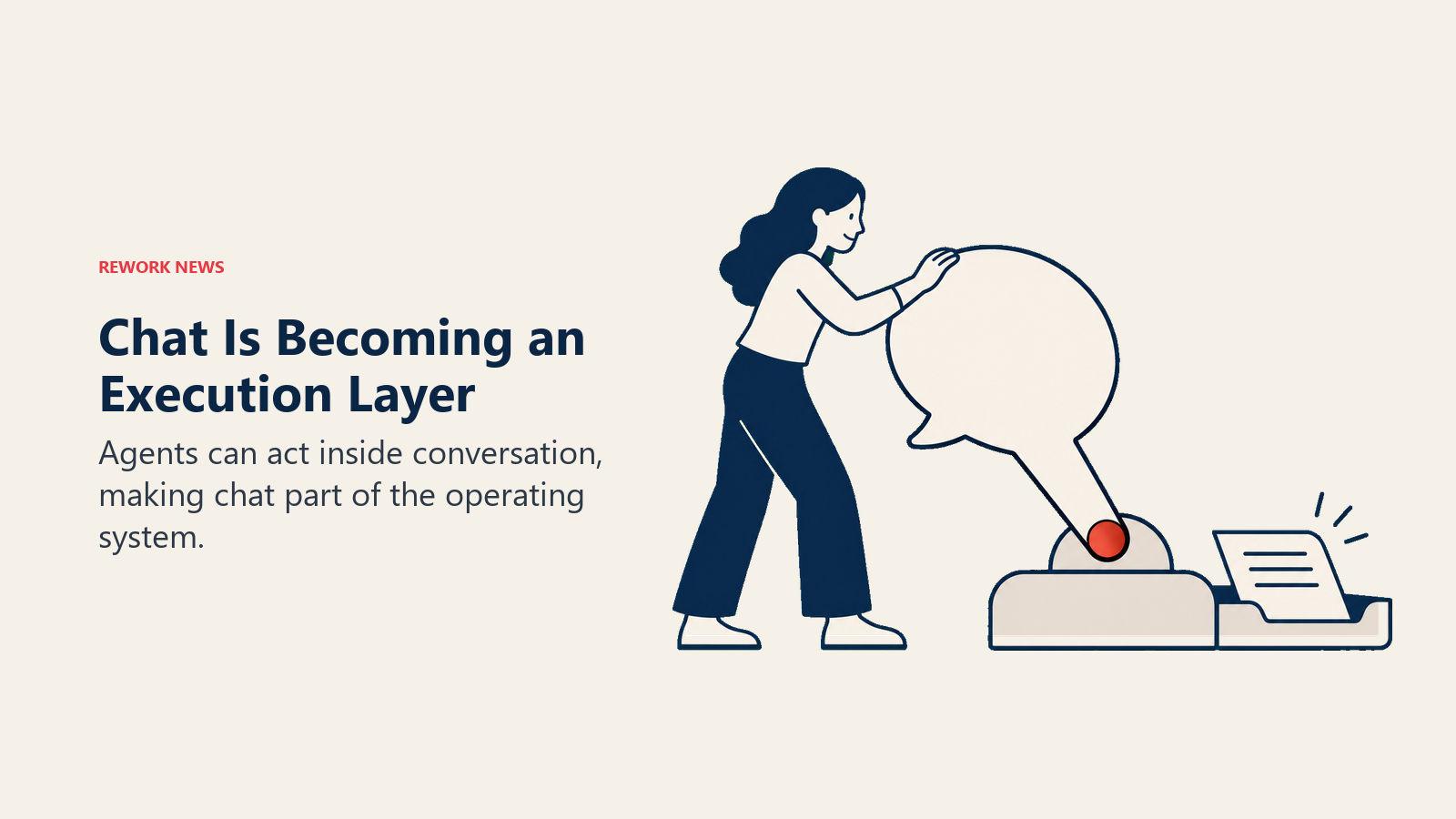
Something structural shifted when Salesforce started framing Slack as the primary interface for Agentforce. Not a distribution channel. Not an integration point. The interface: the place where AI agents receive instructions, do work, and return results, in the same threads where humans already collaborate.
CX Today covered the scale this is operating at: Agentforce has crossed $800M ARR, with more than 29,000 customer deals signed. Named enterprise customers include Amazon, Ford, GM, AT&T, Moderna, and Pfizer. That breadth matters. It means the Slack-as-interface pattern isn't being tested in low-stakes environments. It's running in regulated industries and large-scale consumer-facing operations simultaneously. For CROs thinking through the budget implications, what Agentforce's growth means for 2027 CRM planning is the parallel revenue-side question this CX governance work is meant to complement.
For CX leaders, the temptation is to read this as a Salesforce product announcement. It isn't. It's a signal that the chat surface (the one your team uses for internal coordination and the one your customers use to reach you) is converging into a single interface layer. And the organizations setting the governance rules for that layer right now will live with those decisions for years.
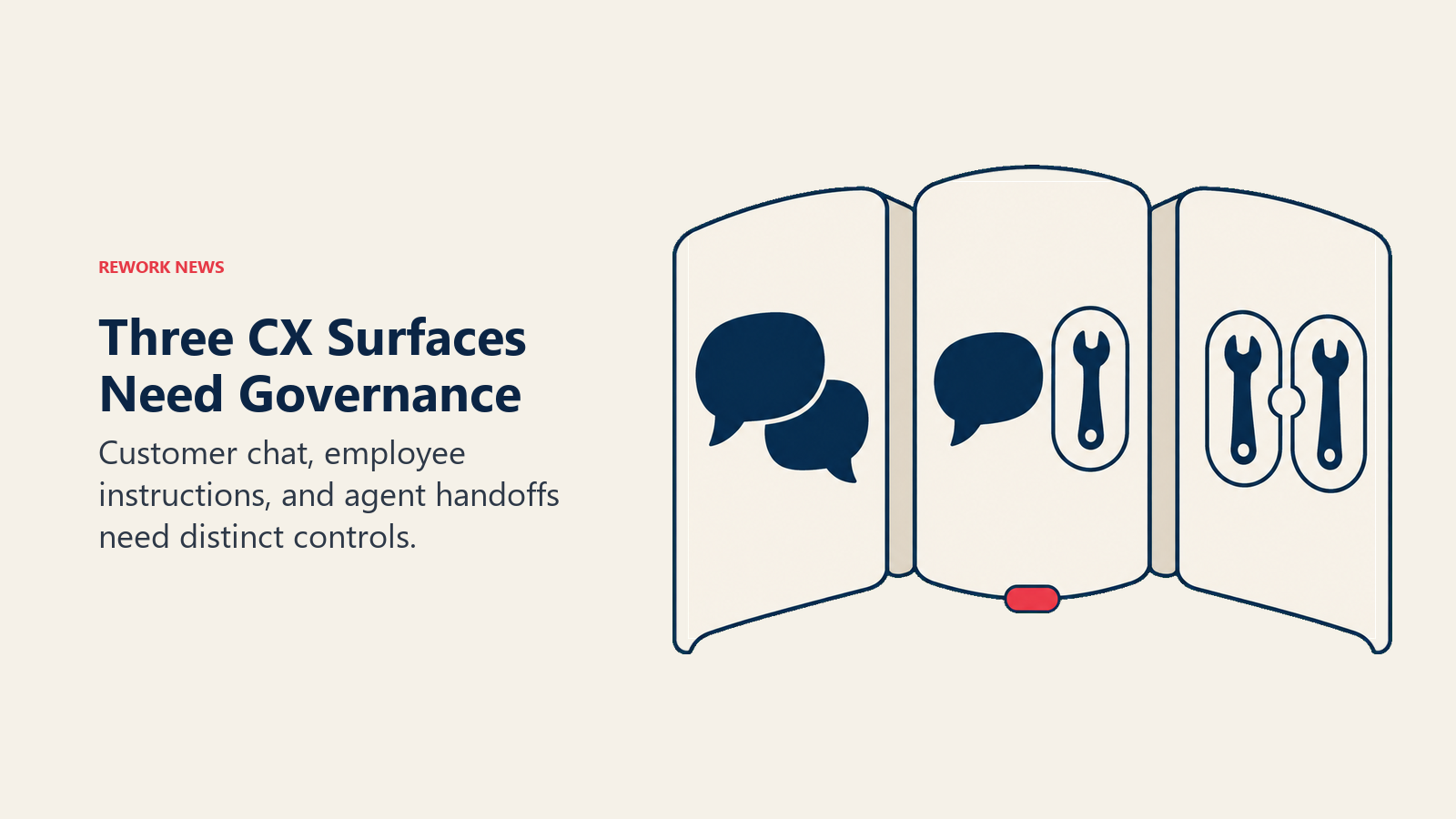
CX governance was built for one surface: customer-facing chat. But Slack-as-interface creates two additional surfaces that most organizations haven't governed. Employee-to-agent chat (where employees prompt AI agents and the outputs enter business processes) has no brand voice standards, no audit trails, and no quality checkpoints in most organizations today. Agent-to-agent orchestration, where one AI passes context to another without human review, is already production infrastructure at companies hitting 50%+ autonomous resolution rates.
The Three-Surface Rule: CX leaders who govern only the customer-facing chat surface are leaving two ungoverned surfaces (employee-to-agent interactions and agent-to-agent handoffs) operating without quality standards, brand alignment, or audit trails. At 50%+ autonomous resolution rates, the ungoverned surfaces directly affect customer experience outcomes. Governance built for one surface in a three-surface world is a governance gap, not a governance strategy.
Five Redesign Priorities Before the Pattern Sets
The redesign priorities are easier to set now, before Slack or Teams becomes the default interface layer for customer agents.
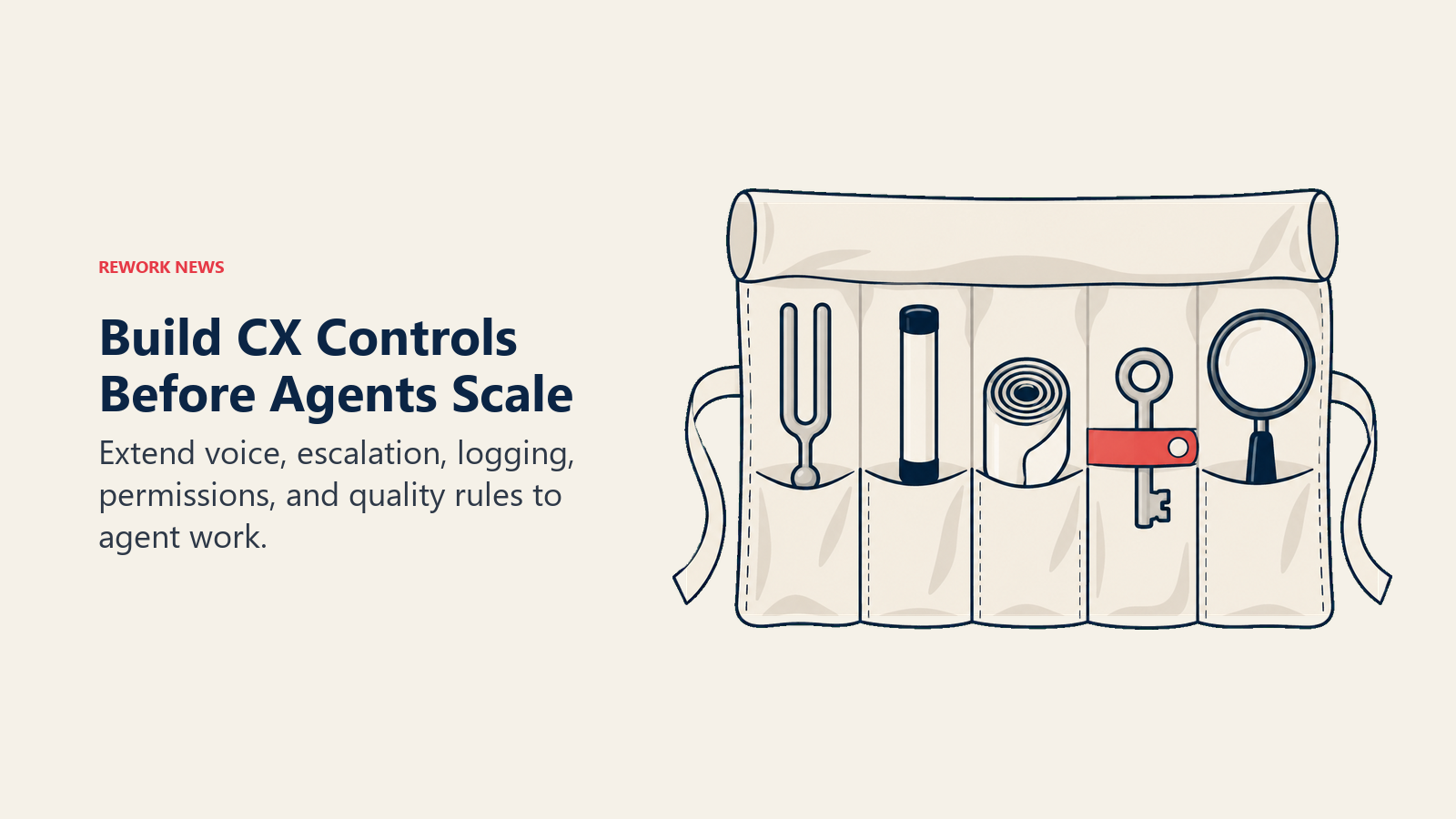
The governance work isn't optional once Slack or Teams becomes the default interface for agents. But it's significantly easier to build before the pattern calcifies than after. Here are the five areas where CX leaders should be making decisions now.
Brand voice across surfaces. Your brand voice guidelines were written for human-authored content. They probably don't address what tone an AI agent should use when responding in Slack to an internal escalation, or what formality level is appropriate when an agent drafts a customer-facing email from within a Slack thread. Extend your voice guidelines explicitly to agent-generated content on every surface. Don't assume the model defaults will align with your brand. The CMO's case for owning the chat layer makes the organizational argument for why CX and marketing need to lead this work rather than inherit it from IT.
Escalation architecture. An autonomous resolution rate of 50-93% sounds like a success metric until you ask what happens to the other 7-50%. Escalation paths designed for human agents don't automatically transfer to AI-mediated workflows. Define specifically: what triggers a handoff, who receives it, what context travels with the escalation, and how the handoff is acknowledged. Engine's 50% autonomous rate is a benchmark, but the 50% that escalates still needs a clean handoff protocol.
Prompt and data logging. When employees prompt AI agents in Slack, those prompts often contain customer data, proprietary deal context, or sensitive internal information. Most organizations have no logging or audit framework for this. Before AI agents become standard tools in Slack, establish what gets logged, where it's stored, who can access it, and how long it's retained. This isn't just a compliance question. It's the foundation for quality improvement.
Identity and permissions. An AI agent operating in Slack needs access permissions to do its work. Those permissions are typically broader than necessary because scoping them requires deliberate effort. Review the permission sets your agents are operating with, apply least-privilege principles, and establish a process for auditing permissions when agent capabilities expand.
Quality measurement. Customer satisfaction metrics cover customer-facing interactions. But what quality metrics apply to employee-to-agent interactions? How do you know if an agent's work product is accurate, on-brand, or operationally sound before it enters a customer-facing workflow? Define quality criteria and build feedback loops into agent workflows so that errors surface before they compound.
The Window Is Shorter Than It Looks
Organizational patterns around tools tend to calcify quickly. When Salesforce's Agentforce is operating across 29,000+ customer organizations with enterprise anchors like Amazon and Ford, the patterns those organizations establish will become default references for others. The governance norms that form in the next 12-18 months will be hard to undo once they're embedded in training, tooling, and process documentation.
CX leaders have a narrow window to shape how their organizations treat the conversational interface: before it becomes the default, before the agents multiply, and before the audit questions come from outside the team rather than inside it. The distinction between AI copilots and AI agents matters here: Slack-as-interface pushes organizations firmly into agent territory, where the autonomy and stakes both rise significantly.
The good news is that the work is tractable. It doesn't require rebuilding your tech stack. It requires extending existing governance (brand voice, escalation, data handling, quality measurement) to cover surfaces that didn't exist two years ago. The organizations that do this work proactively will have cleaner audit trails, more consistent customer experiences, and significantly less remediation debt when the pattern sets for the decade.
What to Do This Week
Before the next sprint planning cycle, run a quick audit against these five questions:
- Do your brand voice guidelines explicitly address AI-generated content in internal collaboration tools?
- Do you have defined escalation protocols for AI-mediated customer interactions, including what context travels with the handoff?
- Is there a logging policy covering prompts and outputs from AI agents your team uses in Slack or Teams?
- Have you reviewed the permission scopes your production AI agents are operating with in the last 90 days?
- Do you have quality metrics for employee-to-agent interactions, separate from customer satisfaction scores?
If the answer to three or more is no, that's the roadmap. The Slack-as-interface pattern is real, it's scaling fast, and the governance infrastructure you build in the next quarter will define how much control you retain over the CX surface for years after that.
Frequently Asked Questions
What does it mean for Slack to become the "front door" for AI agents?
Salesforce's Agentforce repositions Slack from a messaging record into an execution environment where AI agents receive instructions, do work, and return results in the same threads where human teams collaborate. The agents aren't bots that answer questions. They are workflow participants. That shifts Slack from a coordination tool to an interface layer that directly touches customer-facing outcomes.
Why is the Slack-as-interface pattern a CX governance issue and not just an IT issue?
Because the outputs of AI agents operating in Slack (drafted emails, updated records, generated responses, escalation decisions) enter customer-facing workflows. Brand voice consistency, escalation quality, and data handling all have CX implications that go beyond IT's access-management remit. If CX leaders don't define governance standards for agent-generated content on internal surfaces, IT and legal will define them reactively, typically after a quality or compliance incident.
What are the three surfaces CX leaders now need to govern?
Customer-facing chat (the traditional CX surface where customers contact the organization), employee-to-agent chat (internal threads where employees prompt AI agents and receive work product), and agent-to-agent orchestration (automated workflows where one AI passes context to another without human review). Most CX governance frameworks cover only the first. The second and third are where brand, quality, and compliance risks are currently accumulating.
What autonomous resolution rate should CX teams expect from AI agents?
Intercom reports up to 93% autonomous resolution in optimized deployments. Engine (corporate travel) reports 50% using Agentforce. The gap between those figures reflects configuration work, training quality, and escalation architecture, not a fundamental capability ceiling. CX teams that define clear escalation protocols, route edge cases to the right human tier, and maintain feedback loops between agent outputs and quality standards tend to move from the 50% range toward the 80%+ range over 6–12 months.
How should CX leaders start the governance redesign for agent-mediated chat?
Run a five-question audit: Do brand voice guidelines explicitly cover AI-generated content in internal collaboration tools? Are escalation protocols defined for AI-mediated customer interactions including what context travels with the handoff? Is there a logging policy for agent prompts and outputs? Have agent permission scopes been reviewed for least-privilege compliance? Are there quality metrics for employee-to-agent interactions separate from customer satisfaction scores? Three or more "no" answers is the roadmap.
Related Reading
- Intercom Raised $250M to Build AI Agents That Sell: What CMOs Need to Decide: The revenue-channel argument for conversational AI investment, including escalation architecture that complements the governance framework above
- A 93% Autonomous Resolution Rate: What Demand Gen Leaders Need to Know: Implementation detail on what separates 67% from 93% autonomous resolution, including the configuration work CX teams own
- The B2B Chat Tool Market Is Consolidating: Vendor Stability for CMOs: Why the Drift shutdown and Intercom's positioning were earlier signals of the same consolidation Slack-as-interface represents

Co-Founder, Rework.com
On this page
- Five Redesign Priorities Before the Pattern Sets
- The Window Is Shorter Than It Looks
- What to Do This Week
- Frequently Asked Questions
- What does it mean for Slack to become the "front door" for AI agents?
- Why is the Slack-as-interface pattern a CX governance issue and not just an IT issue?
- What are the three surfaces CX leaders now need to govern?
- What autonomous resolution rate should CX teams expect from AI agents?
- How should CX leaders start the governance redesign for agent-mediated chat?