More in
Conversational Growth Insights
When WhatsApp Belongs in Your B2B Sales Motion (and When It Doesn't)
Mar 27, 2026
The Death of the Contact Form — What's Replacing It and Why
Mar 19, 2026
Conversational ROI: Measuring Beyond First-Touch Attribution
Feb 24, 2026
Ad-to-Chat Funnels: A CRO's Evaluation Framework
Jan 16, 2026
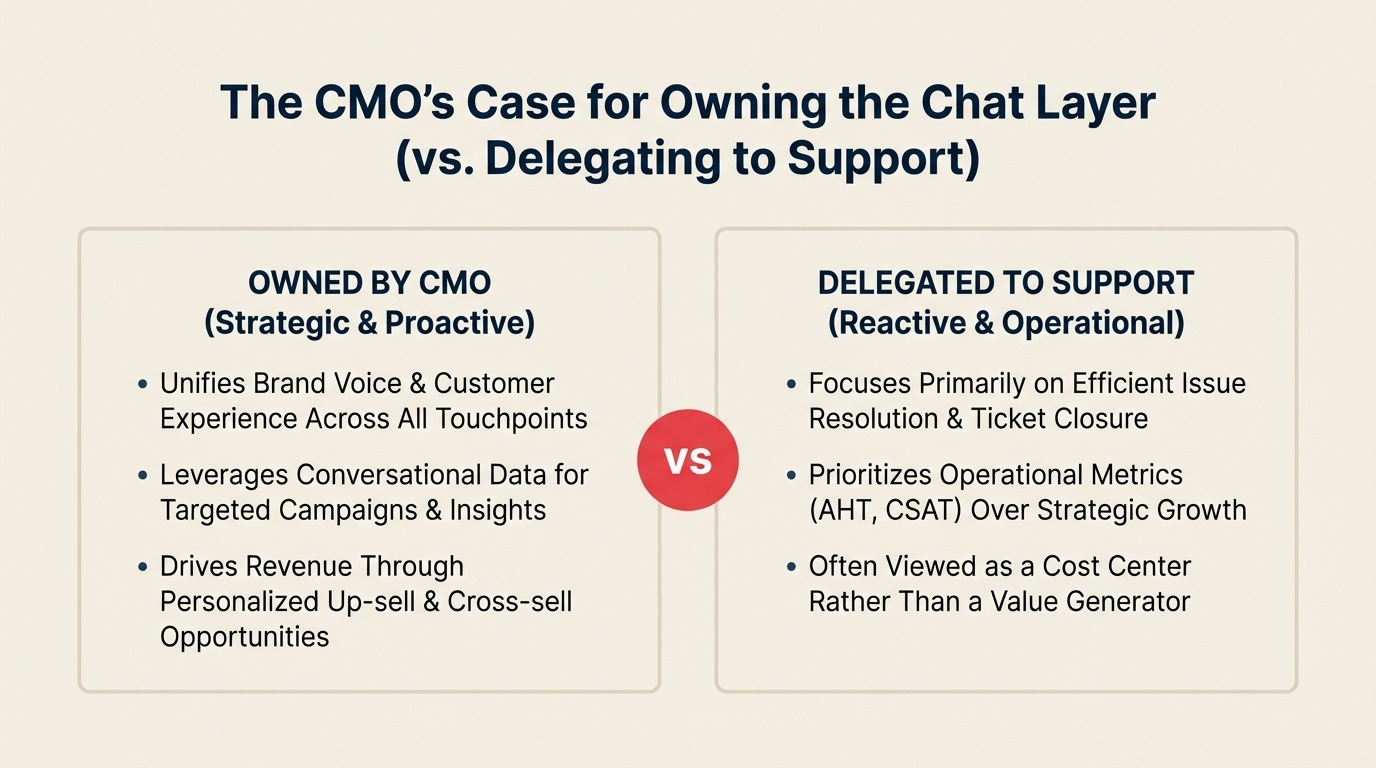
The CMO's Case for Owning the Chat Layer (vs. Delegating to Support)
Jan 15, 2026 · Currently reading
The CMO's Case for Owning the Chat Layer (vs. Delegating to Support)
Turn this article into takeaways for your work.


Each assistant summarizes the article only for you and suggests best practices for your work.
In most companies, chat sits under Support. There's a logic to it: chat resolves tickets. It routes from "I need help" to the nearest available agent. The primary metrics are CSAT, resolution time, and deflection rate.
That organizational decision has a quiet revenue cost most CMOs never quantify.
When a buyer lands on your pricing page actively comparing vendors, opens a chat widget, and gets routed to a support team optimized for ticket deflection, that's a conversion moment captured by a function not built to convert it. The buyer doesn't get a qualified sales conversation. They get FAQ answers, or a handoff to an SDR who gets pinged 45 minutes later with a cold context trail.
The CMOs building the most efficient demand gen machines aren't just running better ads or better landing pages. They've claimed ownership of the conversational layer where buying intent is highest, and they've rebuilt it around pipeline generation instead of support resolution.
The Support-Optimization Trap
It starts with the tool choice. Intercom, Drift, and Tidio are each designed with a primary buyer in mind. Intercom's product roadmap has historically been pulled toward customer success and support automation. Drift was purpose-built for marketing and sales, built on the insight that chat owned by revenue teams should function differently. According to Drift's conversational marketing research, revenue teams that own chat configuration generate 3x more qualified leads from the same widget compared to support-configured setups. Tidio serves SMB with dual support/marketing functionality. For a direct comparison of how Drift and Intercom differ on revenue team use cases, Drift vs. Intercom for B2B is a useful starting point.
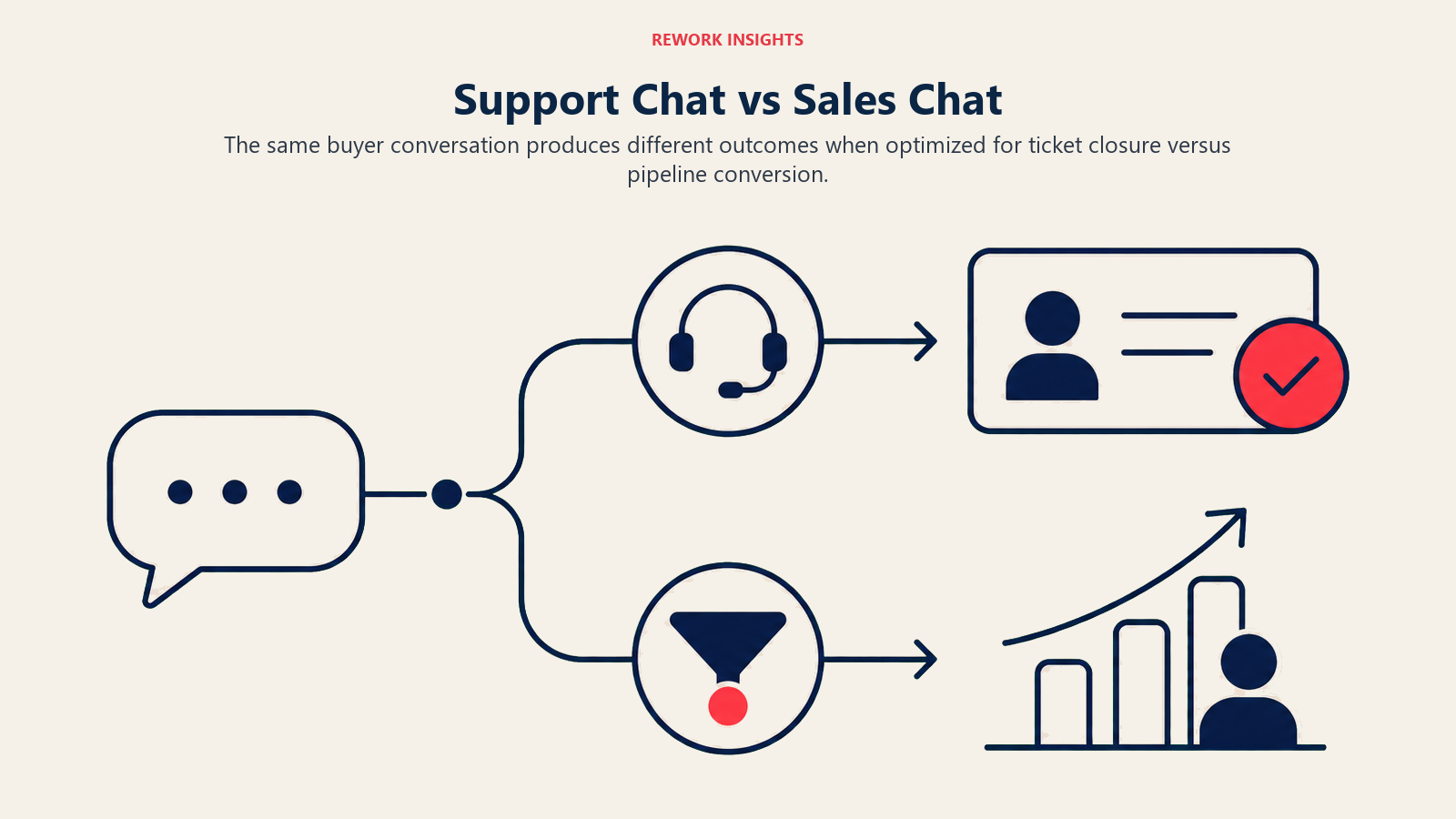
When Support selects the tool, they select for support features. The configuration follows: routing rules prioritize unresolved tickets over new inquiries. Bot sequences are built to answer questions and deflect, not to qualify and escalate. SLA metrics measure how fast conversations close, not how many turn into pipeline.
None of this is wrong for a support function. It's exactly right. But it means that every buyer who arrives with purchase intent gets a support experience, not a sales experience.
The concrete cost looks like this: a visitor reads a case study, clicks to your pricing page, starts a chat asking about enterprise pricing. In a support-optimized setup, this chat routes to a general queue. The response answers the pricing question but doesn't capture intent, doesn't offer a demo, and doesn't create a CRM record with the right lead status. The visitor leaves with their question answered, but without a next step, and without appearing in your pipeline reports.
In a marketing-optimized setup, the same chat fires a high-intent signal. Routing rules identify the visitor as "pricing page + enterprise question" and immediately escalate to an SDR. A CRM record is created with lead source, page context, and conversation transcript. The SDR offers a 20-minute call. The buyer is already qualified before the first human exchange.
That difference in outcome (same visitor, same chat tool, different configuration) is the support-optimization trap.
Where Chat Sits in the Buying Journey
The buying journey has distinct conversational needs at different stages. Understanding which stages are high-value for Marketing versus Support clarifies why ownership matters.
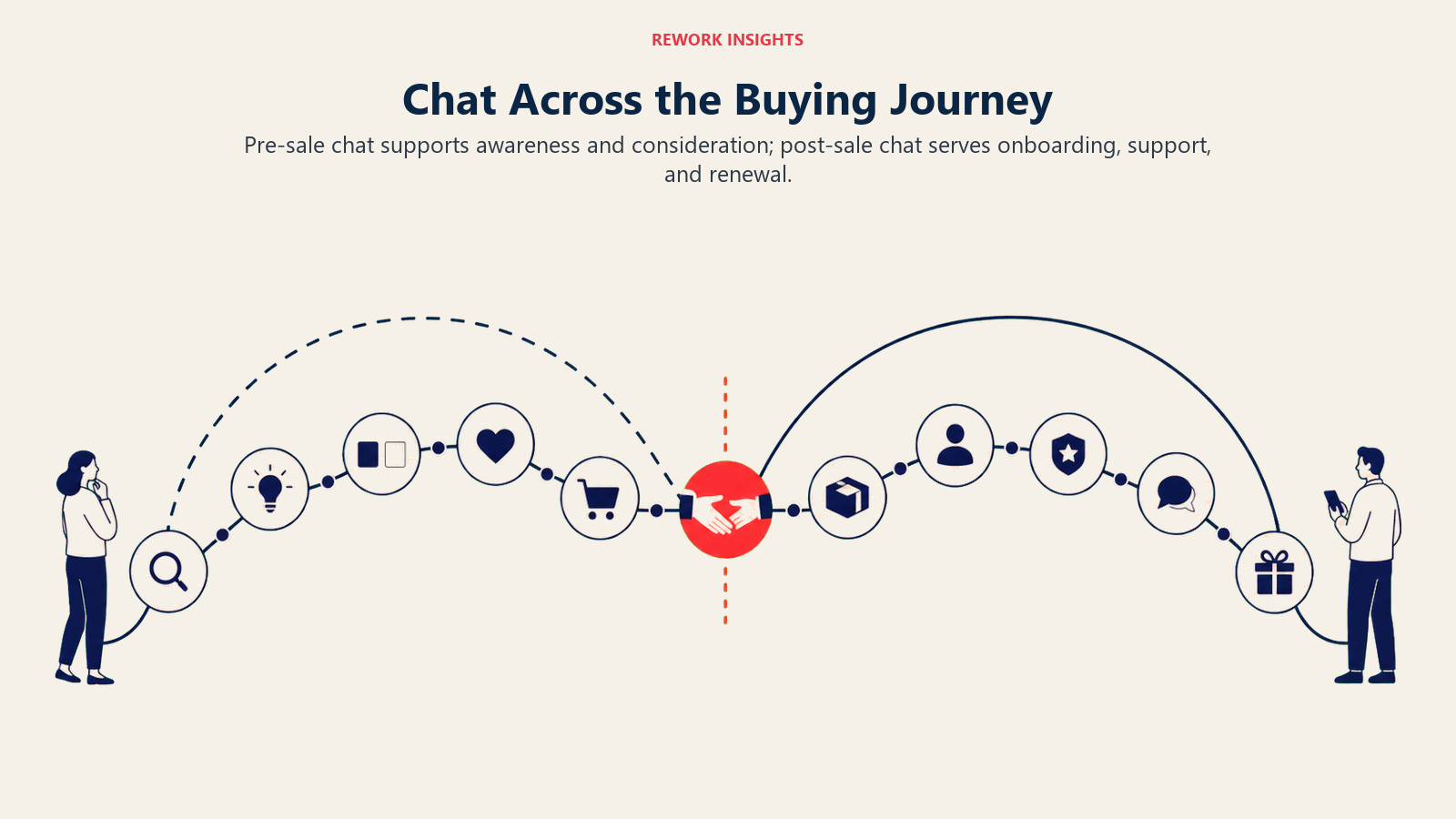
Awareness and consideration stages are Marketing's territory. Buyers here are researching, comparing, reading case studies, evaluating pricing. They have intent questions that, if answered well, accelerate the deal. The chat engagement at these stages is typically short-cycle, high-stakes, and predictable in content: pricing questions, feature comparisons, "how does this work for my use case" inquiries. These are qualification conversations, not support conversations.
Post-sale stages are Support's territory. Onboarding questions, bug reports, renewal friction, account management. The chat engagement here is high-volume, variable in content, and optimized for resolution speed. These should never land in a sales SDR's queue.
The problem is that most companies run a single chat widget across the entire customer journey. The routing rules are built for the post-sale volume, which means awareness-stage buyers get a support experience.
The structural fix is simpler than it sounds: separate the widget configurations (or use routing logic to distinguish pre-sale from post-sale traffic) and optimize each independently. The pre-sale configuration is Marketing's domain. The post-sale configuration stays with Support. Both can run on the same underlying platform.
The Org Design Question
The conversation about who should own chat is partly a tools conversation and mostly a metrics conversation. The function that owns chat will set the metrics by which it's evaluated. Those metrics determine how the configuration evolves over time.
If Support owns chat, deflection rate will creep into the optimization priority, even unintentionally. If Marketing owns chat, pipeline generation becomes the optimization target.
The argument for Marketing ownership rests on three claims:
First, pre-sale chat is a demand gen channel. It generates qualified leads, influences buying decisions, and accelerates pipeline. It should be measured, funded, and iterated on like any other demand gen channel: cost per qualified conversation, conversation-to-opportunity rate, pipeline influenced by chat.
Second, Marketing already owns the adjacent touchpoints. Landing pages, ad campaigns, email sequences, and the website experience that drives buyers to the chat widget are all Marketing's domain. Owning the handoff point (the chat widget itself) closes the loop and gives Marketing control over the full pre-sale journey. That pre-sale capture layer also needs to connect to your lead automation stack, form-to-CRM automation for inbound leads is one model for how the backend routing gets built.
Third, the tooling follows the owner. When Marketing owns chat, the team naturally selects and configures tools for conversion optimization: smart routing, CRM integration, AI qualification, handoff to SDR. The tooling gets better for the use case Marketing actually needs.
The harder question is how to make the transition without organizational conflict. Support teams are typically larger than SDR teams and have senior stakeholders who view chat as core infrastructure. The argument isn't "Support is doing it wrong." The argument is "Support chat and Marketing chat are different products that should be managed separately."
The Handoff Model
The practical version of CMO-owned chat doesn't eliminate Support from the picture. It builds a clean handoff between pre-sale and post-sale conversational layers.
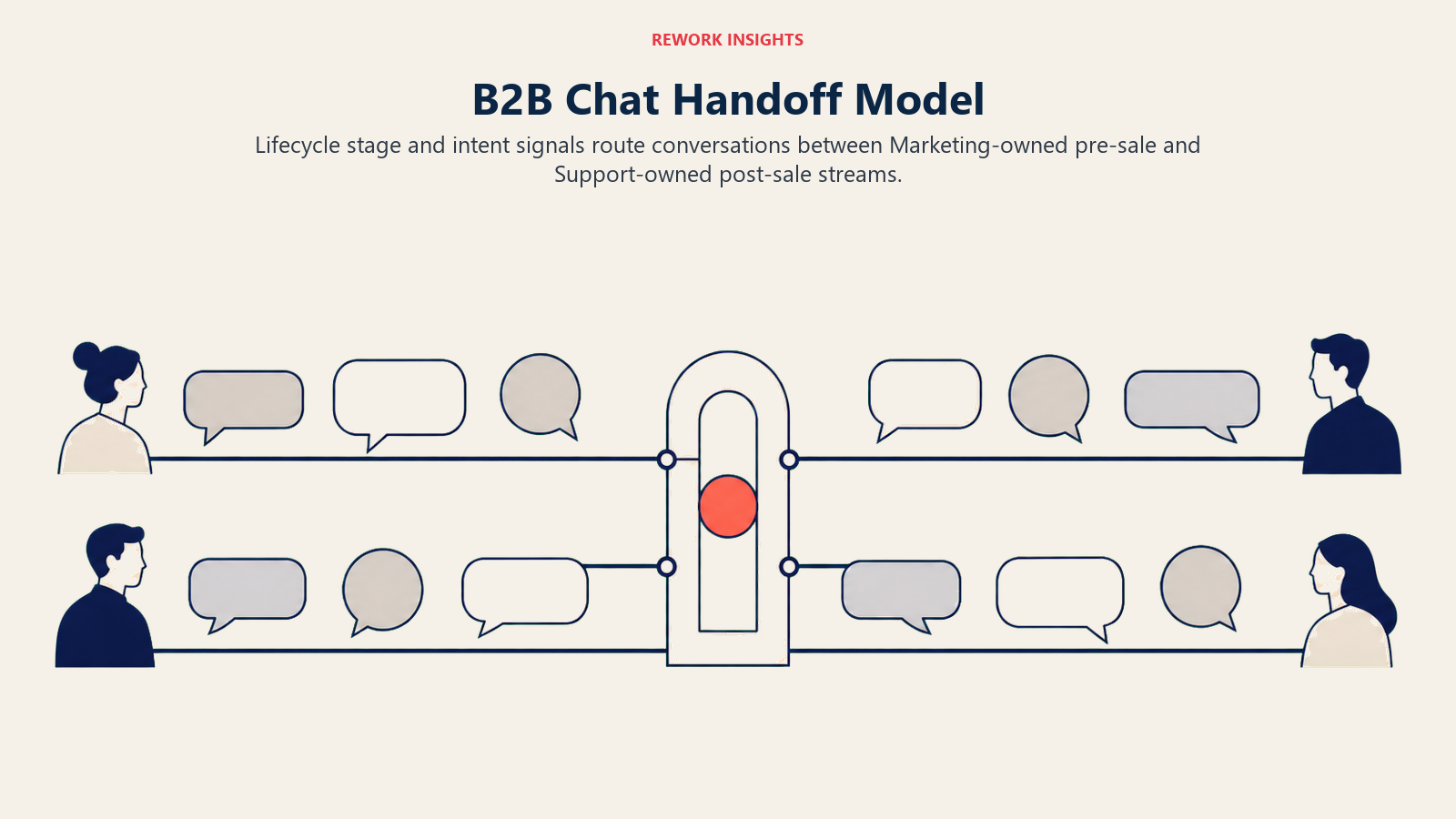
The model that works:
Pre-sale chat (Marketing-owned): Covers all inbound chat from anonymous visitors, prospect-tagged contacts, and MQL-stage leads. Routing is configured for qualification and pipeline generation. Primary tools: Drift (enterprise), Intercom with marketing configuration, or Respond.io for messaging-channel-heavy motions. Metrics: qualified conversations per week, conversation-to-CRM-record rate, time-to-qualified-response. If you're building the routing logic from scratch, lead routing from chat channels covers the decision tree for assigning conversations by segment, intent signal, and channel.
Post-sale chat (Support-owned): Covers all inbound from customers with active accounts, onboarding stage contacts, and renewal-stage accounts. Routing is configured for resolution speed and CSAT. Primary metrics: resolution time, deflection rate, CSAT.
The handoff trigger: When a pre-sale conversation results in a closed deal, the contact is migrated to the support system. When a post-sale customer expresses expansion intent (asking about new features, requesting enterprise pricing), the support agent escalates to a Marketing or Sales Ops-owned routing rule that treats this as a new pipeline conversation.
This model requires agreement on the trigger conditions (which contacts are pre-sale vs. post-sale) and CRM hygiene that keeps lifecycle stage current. Neither is technically complex. Both require cross-functional alignment.
The Chat Ownership Audit
Before deciding whether to pursue this shift, answer these questions honestly about your current setup:
What is chat's primary metric in your organization? If the answer is CSAT or ticket resolution time, chat is optimized for support. If the answer is "we don't measure chat's pipeline contribution," that's the gap this conversation is trying to close. Forrester's research on conversational marketing found that organizations measuring chat by pipeline metrics rather than support metrics saw revenue attributable to chat grow by an average of 40% within two quarters of the ownership shift.
Who configured your chat bot sequences? If Support or a CX team wrote the bot flows on your pricing and features pages, those flows are probably optimized for answering questions rather than qualifying and escalating.
What happens to a high-intent visitor who starts a chat at 11pm? Does an AI agent qualify them and create a CRM lead? Or do they get a "we'll respond during business hours" message and disappear?
How many chat conversations result in a CRM record? If you don't know this number, attribution is broken. If the answer is less than 30% of qualified chat conversations, the CRM integration isn't working. Lead qualification frameworks gives a reference model for defining "qualified" consistently across channels so your CRM record rate is comparable period over period.
Does your pricing page chat route differently than your support page chat? If not, you're treating a buyer mid-evaluation the same as a customer with a billing question.
Scoring: if you answered the "wrong" way on three or more of these questions, chat ownership is likely costing you pipeline. The question isn't whether to fix it. It's how quickly.
The 60-Day Transition
Taking ownership of chat from Support doesn't need to be adversarial. Frame it as "expanding chat's scope to cover pre-sale journeys, which Support doesn't currently have bandwidth to optimize."
Days 1-14: Audit the current setup with Support's participation. Identify which pages, routing rules, and bot sequences are serving pre-sale visitors. Map the current lead creation rate from chat. Get agreement on what "pre-sale" vs. "post-sale" means in your CRM lifecycle stage model.
Days 15-30: Build the pre-sale configuration in parallel. Don't modify Support's existing setup. Create a new routing branch for pre-sale traffic. Configure the qualification sequence, the SDR escalation rules, and the CRM integration. Test on one high-intent page.
Days 31-45: Go live on priority pages (pricing, features, case studies) with the Marketing-owned configuration. Track conversation-to-CRM-record rate and qualified conversation rate for the first two weeks. Share the data with Support leadership. You're not replacing them; you're covering traffic they weren't optimized for.
Days 46-60: Formalize the handoff model. Agree on the trigger conditions for pre-sale to post-sale migration. Establish a shared weekly metric review so both teams can see how the split is performing. Calibrate routing rules based on the first month's data.
The political risk in this transition is low if you start by expanding rather than replacing. Support keeps everything they have. Marketing adds coverage for the pre-sale layer they weren't covering well. McKinsey's analysis of conversational commerce found that companies separating pre-sale and post-sale chat into distinct configured streams saw customer satisfaction hold steady for Support while pipeline contribution from chat improved significantly. The shared metric, qualified pipeline conversations, is something both teams can accept as legitimate.
For how this pre-sale chat layer connects to paid acquisition, Ad-to-Chat Funnels: A CRO's Evaluation Framework maps the architecture for routing ad clicks directly into chat rather than landing pages.
Learn More
