More in
Chat & Conversational News
Slack Is Becoming the Front Door for AI Agents: What CX Leaders Should Redesign Before the Pattern Sets
Apr 17, 2026
Intercom Raised $250M to Build AI Agents That Sell: What CMOs Need to Decide About Conversational AI Investment
Mar 27, 2026
WhatsApp Calls and Chats Are Now in One Platform: What That Means for Your Lead Capture Funnel
Feb 17, 2026
Voice Agents Are Now a $11B Category: How Growth Leads Should Evaluate Adding Voice to Their Conversational Stack
Feb 13, 2026
The B2B Chat Tool Market Is Consolidating: What CMOs Need to Know About Vendor Stability Before the Next Budget Cycle
Feb 2, 2026
Meta Added the Lead Objective to WhatsApp Ads: Here's Why Performance Marketers Should Restructure Their Campaigns Now
Jan 9, 2026 · Currently reading
A 93% Autonomous Resolution Rate: What Demand Gen Leaders Need to Know About the New Ceiling for AI-Led Lead Qualification
Jan 6, 2026
Meta Added the Lead Objective to WhatsApp Ads: Why Performance Marketers Should Restructure Their Campaigns Now
Turn this article into takeaways for your work.


Each assistant summarizes the article only for you and suggests best practices for your work.
The short version: Meta now offers the lead objective inside Click-to-WhatsApp campaigns, with Q&A qualification flows built directly into Ads Manager and optimized by its Advantage+ AI suite. For performance marketers, this moves qualification to the moment of intent and can lift conversion well above standard landing page forms. Here's how to restructure in five steps.
Meta has extended the lead objective to Click-to-WhatsApp campaigns, and for a subset of advertisers, Q&A qualification flows are now available directly inside Ads Manager with no external tools required. Marketing Dive reported the update as part of Meta's broader push to integrate its Advantage+ AI optimization suite into WhatsApp lead generation.
This is not a minor feature addition. For performance marketers running lead generation through Meta, it's a structural change to how the platform handles conversion. And teams that don't test it will be comparing their landing page form metrics against competitors who've already restructured their campaigns around conversational capture.
The math has been public for a while: Click-to-WhatsApp conversion rates reported by practitioners run between 45-60% for qualified conversational flows. Standard landing page form conversion rates sit at 2-5% for most B2B and mid-market B2C campaigns. That's not a marginal gap. It's the kind of delta that, once a team internalizes it, makes every week without a WhatsApp campaign test feel like waste. The Meta ads to WhatsApp funnel setup guide walks through the campaign architecture in detail.
What the Q&A Flow in Ads Manager Actually Does
The Q&A flow feature, available to select advertisers initially with broader rollout expected, lets you configure a qualification sequence inside Meta's native campaign builder. When a user clicks your ad, they're routed to WhatsApp, where the pre-configured Q&A flow begins automatically before the open-ended conversation starts.
This is different from what was possible before. Previously, Click-to-WhatsApp campaigns delivered the user into a blank WhatsApp conversation, and whatever happened next depended entirely on how quickly your team or automation responded. The new flow means the qualification starts at the moment of intent, not whenever your team gets around to following up.
What can you put in the Q&A flow? Practically, it's a short sequence of branching questions, the kind you'd normally ask in the first 60 seconds of a sales qualification call. Company size, role, stated problem, budget range, timeline. The answers feed into the WhatsApp conversation and, when integrated correctly, into your CRM before a human ever sees the lead.
The Advantage+ integration means Meta's AI is optimizing targeting, creative, and placement against the conversational conversion signal, not just a click or a form fill. The algorithm sees users who complete the WhatsApp Q&A flow as the target outcome and optimizes toward people likely to complete it. Over time, this should produce better lead quality alongside better volume.
Five-Step Campaign Restructure Guide
If you're currently running standard lead campaigns with external landing pages and forms, here's how to restructure for Click-to-WhatsApp with the lead objective and Q&A flow.
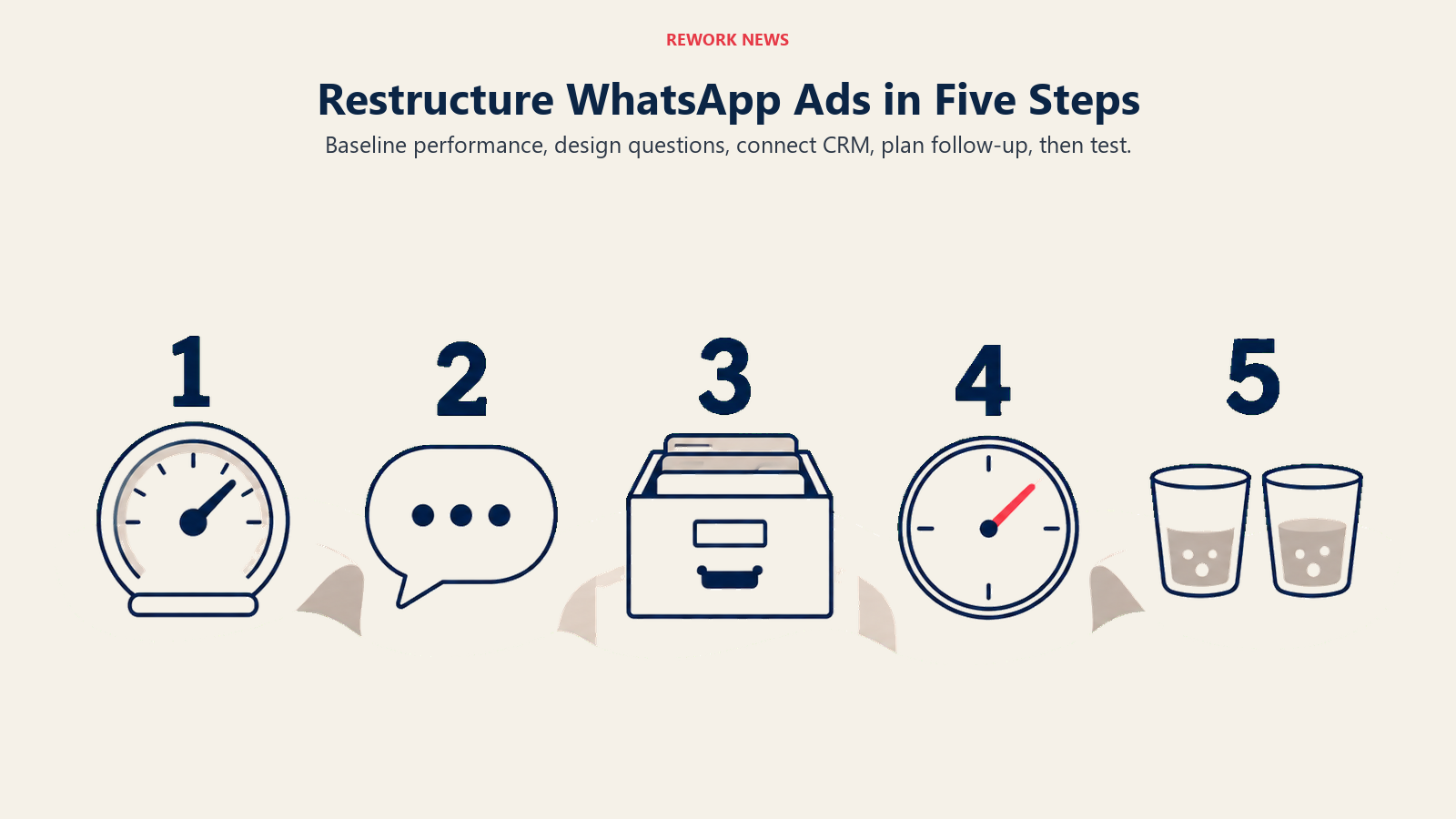
Step 1: Audit your current lead campaign performance baseline. Before restructuring, document your current cost-per-lead, form conversion rate, and lead-to-qualified-meeting rate from your existing campaigns. You need these numbers to measure the WhatsApp experiment against, and you need them now, before the Advantage+ algorithm recalibrates and makes retrospective comparison harder.
Step 2: Define your Q&A flow questions. Write out the 3-5 questions you need answered to determine if an inbound lead is worth a sales conversation. Keep each question binary or multiple-choice where possible. Open-ended questions slow the flow and produce unstructured data that's harder to use downstream. The goal is a qualification decision in under 90 seconds.
Good examples of Q&A flow questions:
- "What's your team size?" (multiple choice buckets)
- "What's the main challenge you're trying to solve?" (3-4 option categories)
- "Are you currently using a tool for [your category]?" (yes/no)
- "What's your timeline to make a decision?" (bucket options)
Avoid asking for contact information in the Q&A flow. WhatsApp already has the user's phone number. Asking again creates friction.
Step 3: Set up your CRM integration before the campaign goes live. The Q&A flow data needs to land somewhere structured. If you're using a WhatsApp Business API provider (Respond.io, Wati, 360dialog, or similar), set up the automation that captures Q&A responses as CRM fields before the first lead arrives. The Meta lead ads to CRM automation guide is a practical reference for wiring up the data flow before your first lead arrives. Running the campaign without CRM integration means you'll spend the first week manually entering data, which defeats the efficiency argument.
Step 4: Configure the 72-hour free messaging window strategy. When a lead enters through a Click-to-WhatsApp ad, a 72-hour window opens during which you can send follow-up messages without per-message charges under most WhatsApp Business API pricing models. This is your replacement for the first three days of email drip.
Map out the message sequence: a confirmation and next step within the first hour, a relevant resource or case study on day two, and a meeting booking prompt on day three. Keep messages short and conversational. This is WhatsApp, not email. Long messages get ignored or blocked.
Step 5: Structure your A/B test cleanly. Don't run WhatsApp campaigns as an entirely separate effort from your existing lead campaigns. Run them as a direct test against your current best-performing lead campaign. Same audience, same budget split (even if asymmetric), same attribution window. The only variable should be the destination: landing page form versus Click-to-WhatsApp Q&A flow.
If your current best-performing campaign runs on lookalike audiences built from historical form completers, you may need 2-3 weeks for Advantage+ to build equivalent conversational signal before the comparison is valid. Factor that into your test timeline.
The 72-Hour Window as an Email Drip Replacement
Most performance marketers think about the 72-hour free messaging window as a follow-up tool. That's true, but it undersells what it actually enables.
An email drip sequence for a new lead typically starts 1-4 hours after the form fill, depends on open rates that have been declining for years, and operates across a channel where spam filtering is increasingly aggressive. The average B2B marketing email open rate is below 25%.
A WhatsApp message from a number the lead has already engaged with, because they clicked your ad and started a conversation, arrives in a context where they're already paying attention. Open rates for WhatsApp messages from business accounts that users have initiated contact with run significantly higher than email benchmarks in every market where WhatsApp penetration is high (Southeast Asia, LATAM, India, MENA, and increasingly Europe).
For the 72-hour window, the priority sequence is: immediate qualification confirmation (so the lead knows someone saw their answers), relevant content matched to their Q&A responses (not generic; use the qualification data), and a low-friction next-step ask. The next-step ask should match the timeline they indicated in the Q&A flow. If they said they're evaluating in 30 days, ask for a discovery call. If they said they're researching, send them something worth their time.
What to A/B Test This Month
With the Q&A flow now available, here's the test backlog that matters most for teams that want data before the broader Advantage+ optimization settles:
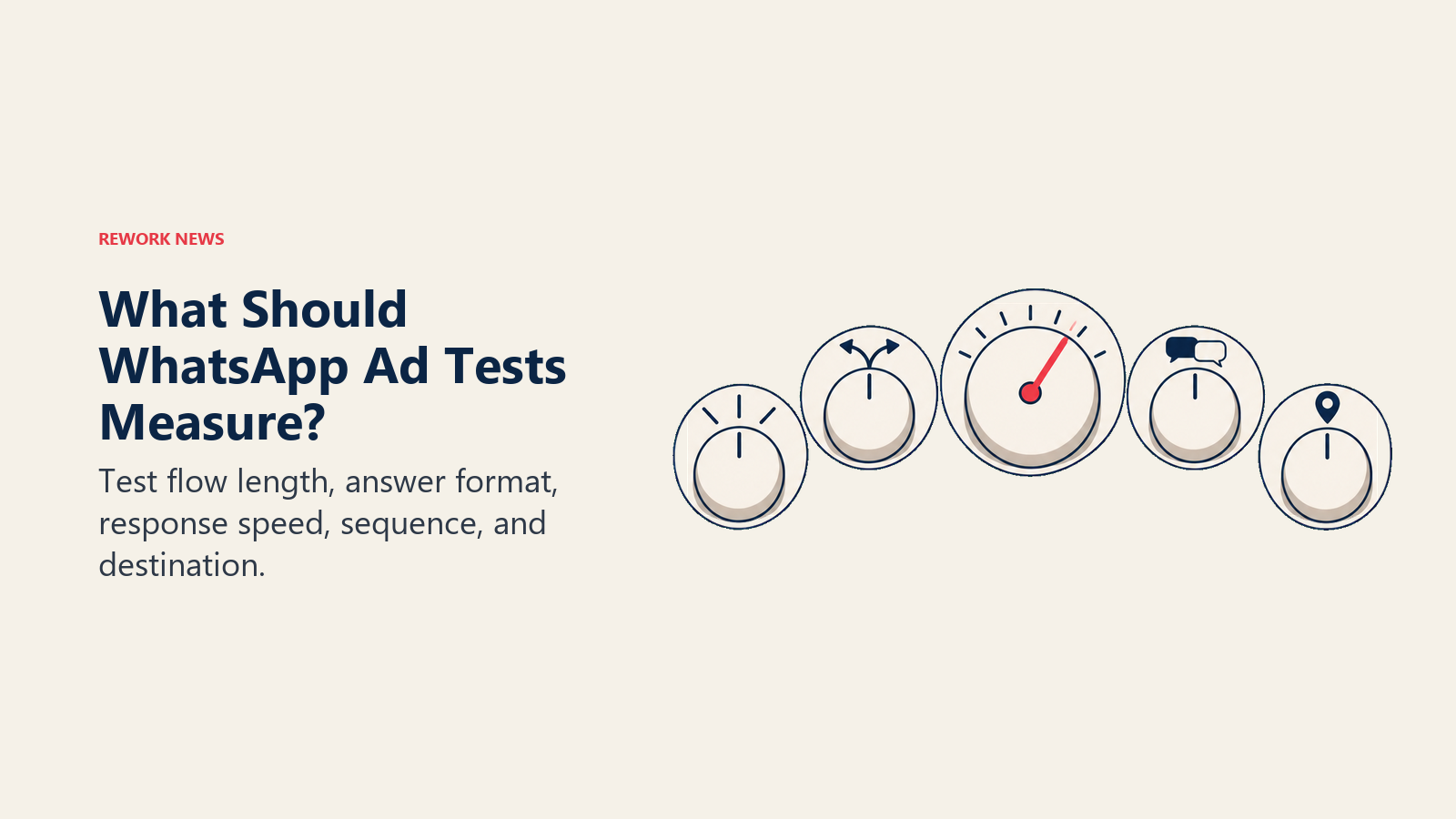
- Q&A flow length. 3 questions versus 5 questions. More questions may improve lead quality but reduce completion rate. Find your team's optimal balance.
- Q&A flow format. Multiple choice versus open-ended for the "main challenge" question. Multiple choice is faster; open-ended produces richer data. Test both.
- First message speed. Does response within 5 minutes versus 30 minutes materially affect conversion? In conversational channels, speed to first human response correlates strongly with conversion, even when an AI has already handled the Q&A.
- 72-hour sequence structure. Two messages versus three messages. Some teams find that three messages produces diminishing returns after day two.
- Landing page versus WhatsApp for the same ad. This is the core comparison, and it should be running for every team that has WhatsApp capability. The data from your own campaigns is more persuasive than any benchmark.
The update is live for select advertisers now. If your account has access to the Q&A flow in Ads Manager for Click-to-WhatsApp, there's no reason to wait on the test. For the demand gen side of building out the full WhatsApp funnel after ad click, WhatsApp calls and chat unified in Respond.io covers how to handle the voice escalation scenario when leads prefer a call over text.
Meta WhatsApp Lead Ads FAQ
What changed in Meta's Click-to-WhatsApp ads?
Meta added the lead objective to Click-to-WhatsApp campaigns and built Q&A qualification flows directly into Ads Manager. A subset of advertisers can now configure a branching question sequence that runs in WhatsApp before the open conversation begins, with Advantage+ AI optimizing toward people likely to complete it.
How does this differ from a standard landing page form?
A landing page form captures contact details on a separate web page, then hands off to follow-up. The WhatsApp Q&A flow qualifies the lead inside a chat at the moment of intent, with the phone number already known. Practitioners report conversational flow conversion rates far above typical 2-5% form rates.
Do I need an external tool to use the Q&A flow?
No. The Q&A flow is configured natively in Ads Manager. You will still want a WhatsApp Business API provider and CRM integration to capture the answers as structured fields and run the 72-hour follow-up sequence cleanly.
What is the 72-hour window?
When a lead enters through a Click-to-WhatsApp ad, a 72-hour window opens during which you can send follow-up messages without per-message charges under most WhatsApp Business API pricing. Use it as a replacement for the first three days of an email drip.
Learn More
- A 93% Autonomous Resolution Rate: AI-Led Lead Qualification. What happens after the WhatsApp ad click: building the AI qualification flow that converts
- Voice Agents Are Now a $11B Category: Growth Lead Evaluation. Connecting Click-to-WhatsApp campaigns to voice AI for leads who prefer to speak
- Chat Funnel Setup Guide. Building the full conversion architecture from ad click to qualified lead in CRM
- Respond.io vs. ManyChat for B2B Sales. Platform comparison for managing the WhatsApp conversation flow after ad click
