More in
Chat & Conversational News
Slack Is Becoming the Front Door for AI Agents: What CX Leaders Should Redesign Before the Pattern Sets
Apr 17, 2026
Intercom Raised $250M to Build AI Agents That Sell: What CMOs Need to Decide About Conversational AI Investment
Mar 27, 2026 · Currently reading
WhatsApp Calls and Chats Are Now in One Platform: What That Means for Your Lead Capture Funnel
Feb 17, 2026
Voice Agents Are Now a $11B Category: How Growth Leads Should Evaluate Adding Voice to Their Conversational Stack
Feb 13, 2026
The B2B Chat Tool Market Is Consolidating: What CMOs Need to Know About Vendor Stability Before the Next Budget Cycle
Feb 2, 2026
Meta Added the Lead Objective to WhatsApp Ads: Here's Why Performance Marketers Should Restructure Their Campaigns Now
Jan 9, 2026
A 93% Autonomous Resolution Rate: What Demand Gen Leaders Need to Know About the New Ceiling for AI-Led Lead Qualification
Jan 6, 2026
Intercom Raised $250M to Build AI Agents That Sell: What CMOs Need to Decide About Conversational AI Investment
Turn this article into takeaways for your work.


Each assistant summarizes the article only for you and suggests best practices for your work.
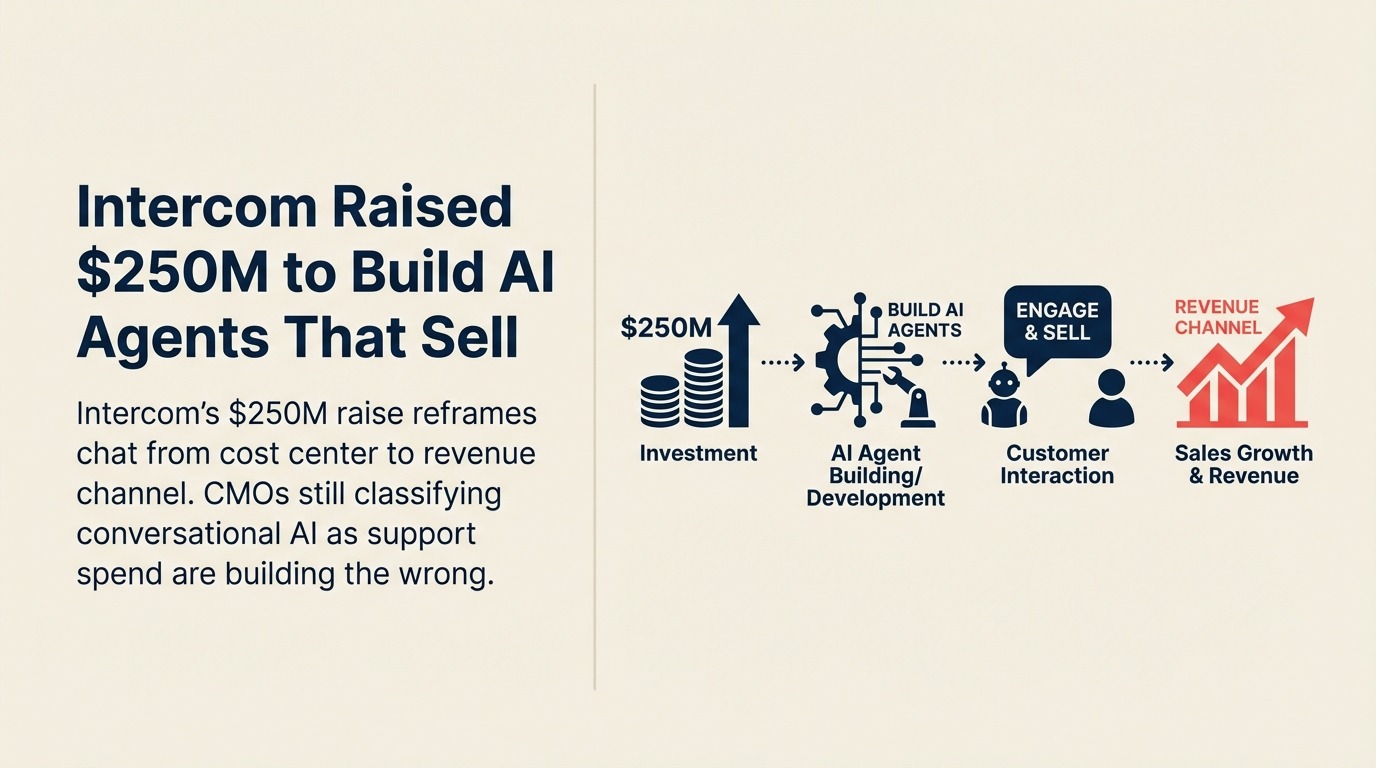
The language Intercom's CEO used when announcing the company's $250M debt financing round, reported by The Irish Times, was deliberate and worth paying attention to. The new AI agents Intercom is building this year were described as sellers, advisers, and teachers. Not support bots. Not ticket deflection tools. Sellers.
That framing isn't marketing copy. It's a category claim, and it has direct implications for how CMOs should be structuring their business case for conversational AI investment.
For most B2B marketing organizations, chat tools live in the support or CX budget. The ROI calculation is based on cost reduction: fewer support tickets, lower cost-per-resolution, reduced headcount pressure on customer service teams. That's a legitimate value story, but it's the wrong story for what conversational AI is becoming. The strategic case for reframing this investment is laid out in detail in the CMO argument for owning the chat layer.
When a company raises $250M via Hercules Capital and its CEO says the goal is agents that function as revenue generators, the category has moved. CMOs who are still building the support-cost-reduction case for chat in 2026 are presenting the wrong argument to the CFO.
The Shift From Cost Center to Revenue Channel
Understanding why this matters requires being specific about what changed. Intercom's Fin AI Agent currently resolves an average of 67% of inbound queries without human involvement, according to data the company has shared publicly. Some enterprise deployments are reporting 93% autonomous resolution across WhatsApp, web chat, email, and SMS in a unified flow.

Those numbers, at face value, sound like a support story. But read them through a revenue lens: if 93% of inbound conversations are being handled autonomously, the remaining 7% are the conversations that are too complex, too valuable, or too sensitive for AI to handle alone. That 7% is where your highest-intent leads live. The AI's job is to identify them and route them to the right human at the right moment, having already qualified them, collected their context, and primed them for a real sales conversation.
That's a sales function, not a support function. And it belongs in the marketing budget with a revenue attribution model attached to it, not in the CX budget with a cost-per-ticket metric.
A Three-Part Business Case Framework for CMOs
Reframing conversational AI as a revenue channel requires a different kind of business case. Here's a structure that works for CFO conversations.
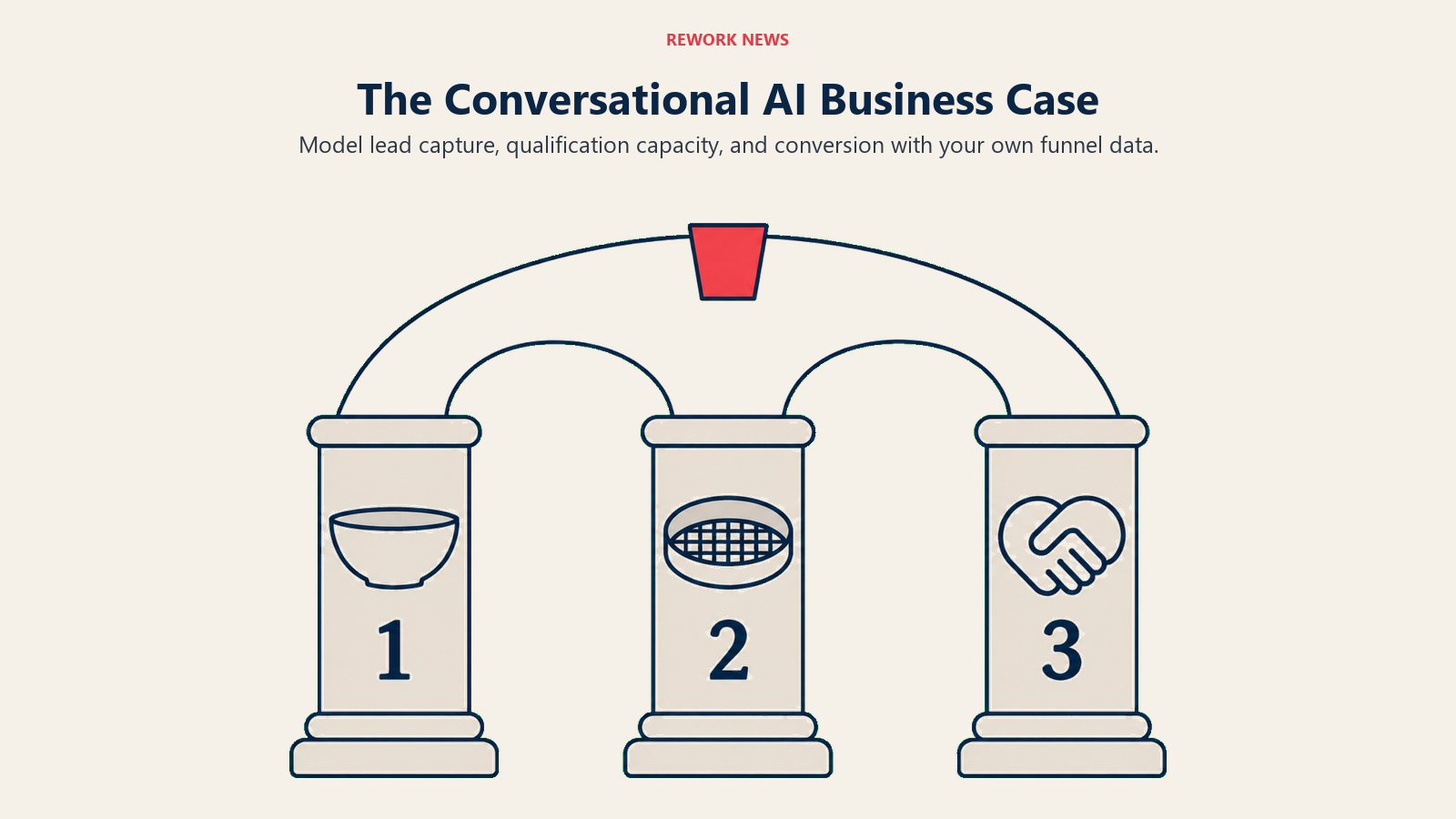
Part one: Top-of-funnel lead capture efficiency. The benchmark for traditional form-based lead capture sits at roughly 2-5% conversion on web traffic. Conversational approaches, whether chat, WhatsApp, or AI-powered qualification flows, consistently outperform this across reported practitioner data. The argument for why the contact form is losing ground to conversational capture is made in the death of the contact form. The efficiency argument is straightforward: if conversational AI captures more qualified intent signals from the same ad spend, the cost-per-qualified-lead improves without increasing budget.
Quantify this with your own funnel data. Take your current inbound traffic from paid and organic sources, apply your current form conversion rate, then model what a 2x or 3x improvement in that rate would mean for MQL volume and downstream pipeline. That's the first number for your CFO conversation.
Part two: Mid-funnel qualification at scale. The traditional qualification workflow has a ceiling defined by SDR capacity. Adding headcount is expensive, slow to ramp, and introduces inconsistency. AI-powered qualification removes that ceiling. An agent can handle thousands of simultaneous inbound conversations with consistent qualification logic, defined handoff criteria, and structured data output to the CRM.
The business case here is pipeline scaling without proportional headcount cost. Model the current cost-per-qualified-meeting including SDR fully-loaded cost, and compare it against an AI qualification model where the same funnel volume requires significantly fewer human hours. The delta is your efficiency case.
Part three: Conversion acceleration through better context. A prospect who has been qualified by an AI agent before speaking to a sales rep arrives to that conversation with context already captured: their company, their role, their stated problem, and any answers they gave to pre-qualification questions. The sales rep starts closer to the close. Meeting length decreases. Conversion rates improve.
This is harder to quantify before you have data, but it's the right argument for CMOs who want to link conversational AI investment to win rate, not just lead volume. If your ACV supports it, even a 5% improvement in post-qualification conversion rate produces a significant return on the investment.
What the $250M Signals About Category Trajectory
The financing structure Intercom chose, debt via Hercules Capital rather than equity, is worth noting. Debt financing at this scale indicates the company has predictable, recurring revenue that can service the debt. It's a confident bet on known economics, not exploratory growth capital.
For CMOs evaluating conversational AI vendors, this matters because it affects durability. A company raising debt to expand a profitable product line is in a different position than a startup burning equity to find product-market fit. Intercom is scaling an already-validated model.
The 650 planned hires, primarily in engineering and product, tell the same story. The company isn't pivoting. It's accelerating in the direction its data is pointing.
CMOs who invest in conversational AI now are aligning with vendors whose investment trajectory is clear. The tools will get better faster for the next 18-24 months as this capital deploys. That's a relevant consideration when evaluating whether to build the business case this year or defer it. See also: how demand gen leaders are designing AI qualification tiers: the implementation specifics complement the business case framework above.
What the 67-93% Autonomous Resolution Rate Actually Means
The resolution rate range is wide, 67% average versus 93% at top enterprise deployments, and the gap is meaningful for CMOs building a business case.
The 67% average reflects what Fin does out of the box with standard implementation. The 93% reflects what's achievable with high-quality knowledge base content, well-defined conversation flows, and clear handoff criteria for human escalation. The delta between 67% and 93% is almost entirely a function of how well the implementing organization has done its configuration work.
For CMOs, this means the business case isn't just about the vendor. It's about your team's willingness to invest in the setup work. An AI agent running on a sparse knowledge base and poorly defined routing rules will underperform. An agent running on deeply structured product and qualification knowledge will outperform. The technology is capable of both outcomes.
Include setup investment in your business case, not just licensing cost.
What to Bring to Your Next CFO Conversation
Before your next budget conversation, reframe your conversational AI ask:
- Lead the revenue story, not the cost story. Start with MQL impact and pipeline contribution, not support ticket deflection rates.
- Use your own funnel numbers. Model the conversion rate improvement scenario using your actual traffic, current conversion rates, and ACV. Abstract benchmarks don't persuade CFOs.
- Account for configuration investment. Build in time and resource for knowledge base development, flow configuration, and handoff rule definition. This is the work that separates 67% from 93%.
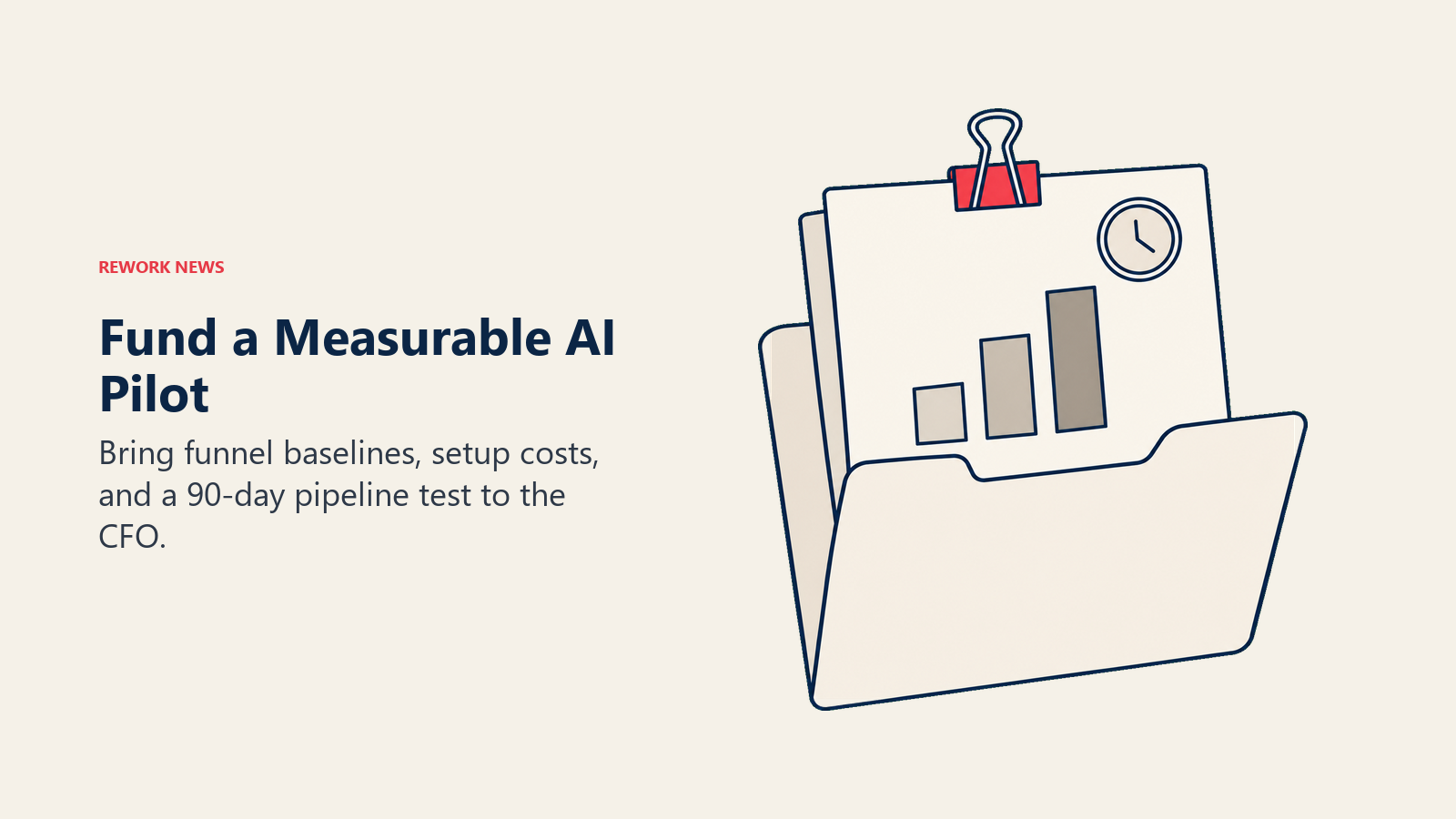
- Propose a 90-day pilot with defined success metrics. A pilot with clear pipeline attribution gives the CFO a way to approve without committing to full deployment. It also gives you the data to build the next business case.
- Connect to headcount economics. The argument for AI qualification isn't "instead of SDRs." It's "same SDR team, higher quality conversations, more pipeline per rep." That's a productivity story, not a reduction story, and it's much easier to get approved.
Intercom raised $250M because the data says AI agents that sell are working. CMOs who bring the right business case to the next budget cycle will be the ones who capture that advantage in their funnel. The lead qualification frameworks guide is a useful reference for quantifying the mid-funnel efficiency case your CFO will need to see.
Learn More
- A 93% Autonomous Resolution Rate: What Demand Gen Leaders Need to Know: The companion piece on designing the escalation architecture that turns AI resolution rates into pipeline
- The B2B Chat Tool Market Is Consolidating: CMO Vendor Stability: Why Intercom's funding makes it a more stable option than the consolidating alternatives
- Chat Funnel Setup Guide: Building the funnel architecture that Intercom's Fin AI agent operates within
- Intercom vs. Drift in B2B Chat: Head-to-head comparison for teams making the platform decision now
