More in
AI at Work News
OpenAI Opened ChatGPT Advertising to Small Businesses at Any Budget
Jun 6, 2026
AI Is Everywhere at Work. Only 1 in 10 Say It Transformed the Job
Jun 6, 2026
Vibe Coding's $10.5B Moment: AI Now Starts Most New Software Builds
Jun 6, 2026
AI Agents Now Have More System Access Than Your Employees. Few Are Secured
Jun 5, 2026
Should You Build Your AI or Buy It? Watch What the Giants Bought.
Jun 5, 2026
Uber Caps Employee AI Spending at $1,500 Per Seat After a Budget Blowout
Jun 5, 2026
Trump's AI Executive Order Is Deregulatory. Your Compliance Risk Didn't Move
Jun 4, 2026
AI Pushed 220 Unicorns Below $1B. Pre-ChatGPT Companies Face a Reckoning
Jun 4, 2026
Token Prices Fell 67% This Year. Your AI Bill Is Going Up Anyway
Jun 3, 2026
Small Businesses Using AI Report Higher Revenue and Shorter Workdays
Jun 3, 2026
Google Just Joined the Enterprise Agent Platform Wars: How Antigravity 2.0 and the Gemini Enterprise Agent Platform Stack Up for CTOs
Turn this article into takeaways for your work.


Each assistant summarizes the article only for you and suggests best practices for your work.
The enterprise agent platform shortlist just got its fourth name. Google's I/O 2026 announcement closed the gap, and every chief technology officer (CTO) evaluating agent infrastructure now has a full field to compare.
What Google Announced at I/O 2026
According to Google's I/O 2026 developer highlights, the company launched Antigravity 2.0 on May 19, 2026, as a standalone desktop application built entirely around agent orchestration. That's a meaningful distinction: this isn't a plugin added to the existing Antigravity integrated development environment (IDE). It's a separate product, purpose-built for agent workflows from the ground up.
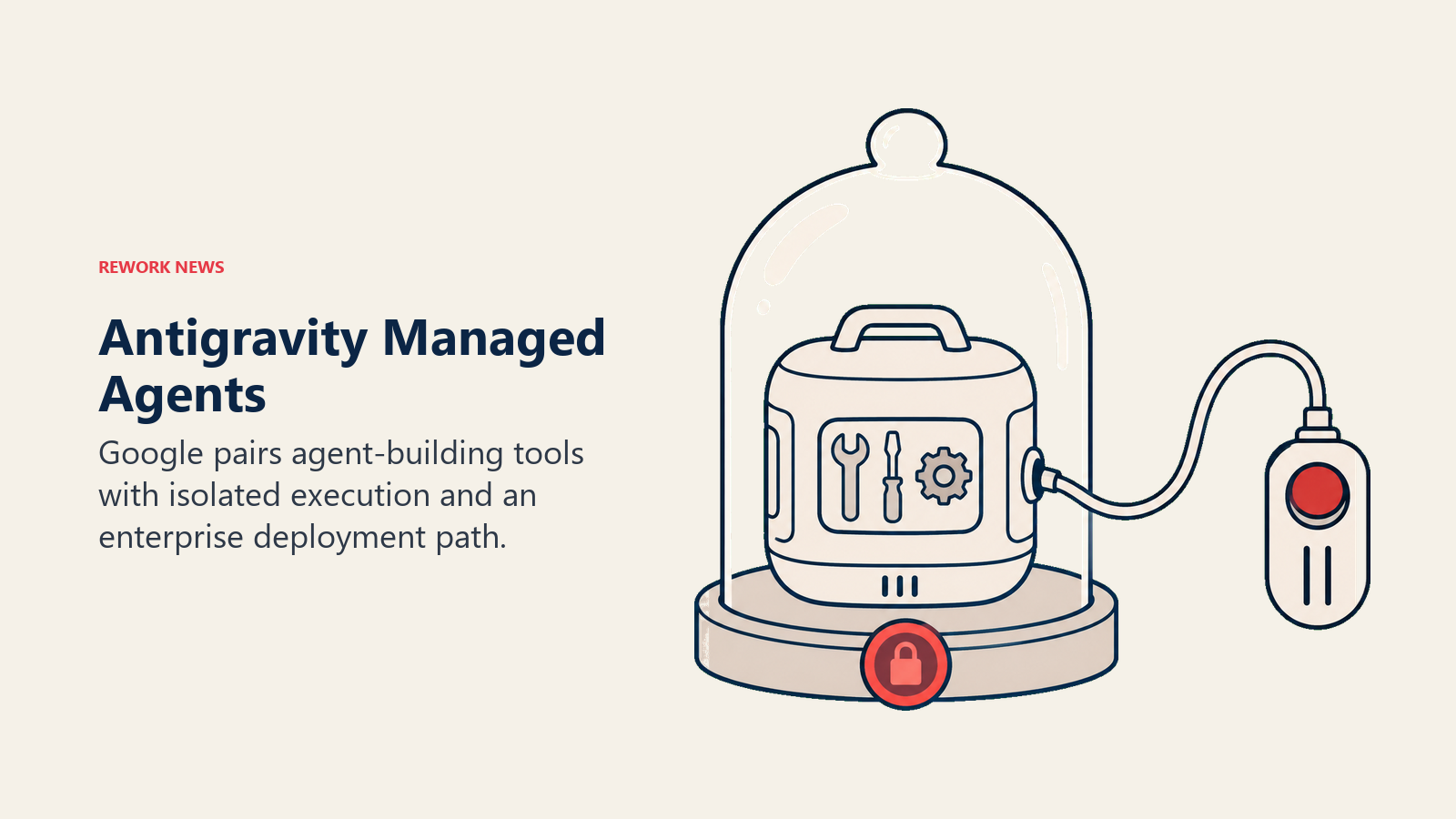
The platform ships with five components working together as a system. First, the Antigravity desktop application itself. Second, the Antigravity command-line interface (CLI), which replaces the previous Gemini CLI. Third, the Antigravity software development kit (SDK) for developers building custom agents. Fourth, Managed Agents in the Gemini application programming interface (API). Fifth, the Gemini Enterprise Agent Platform, which is the enterprise deployment path for Google Cloud customers. Google also refreshed the Agent Development Kit (ADK) 2.0 alongside the launch.
Key Facts
- Google launched Antigravity 2.0 at I/O 2026 on May 19, 2026, as a standalone agent-first desktop application separate from the existing Antigravity IDE (Google, 2026).
- Antigravity 2.0 ships with five components: desktop app, CLI, SDK, Managed Agents in the Gemini API, and the Gemini Enterprise Agent Platform deployment path (Google, 2026).
- With Managed Agents, a single Gemini API call spins up an agent that reasons, uses tools, and executes code inside an isolated Linux environment (Google, 2026).
The Managed Agents capability is worth pausing on. A single API call provisions an agent that can reason, invoke tools, and execute code inside an isolated Linux environment. That execution isolation is the technical detail that matters most to CTOs thinking about security and blast-radius control. The agent runs in a sandbox, not in your production environment, which changes the risk calculus significantly.
What the Gemini Enterprise Agent Platform Adds for Google Cloud Customers
The Gemini Enterprise Agent Platform is where this announcement gets practical for large organizations. It lets Google Cloud customers wire Antigravity directly into existing Google Cloud projects. That means the agent infrastructure inherits your existing identity and access management (IAM) configuration, billing structure, and data governance setup.
If your engineering teams are already on Google Cloud, this is the lowest-friction path to deploying agents at scale. You don't build a new identity layer. You don't renegotiate your data residency posture. You extend what you already have.
That's different from building agent infrastructure on a net-new platform. And it's a decision worth pressure-testing: the convenience of cloud-native integration is real, but so is the vendor lock-in that comes with it. Both sides belong in the CTO's evaluation.
For teams not already on Google Cloud, the calculus flips. The integration advantages disappear, and you're comparing Google's runtime capabilities and control plane directly against the other three platforms on a level field. That's where a structured comparison lens helps.
The Enterprise Agent Platform Stack: A Framework for Evaluation
Every credible enterprise agent platform in 2026 layers four things. Naming the layers gives CTOs a repeatable way to question any vendor's pitch without getting lost in branding.
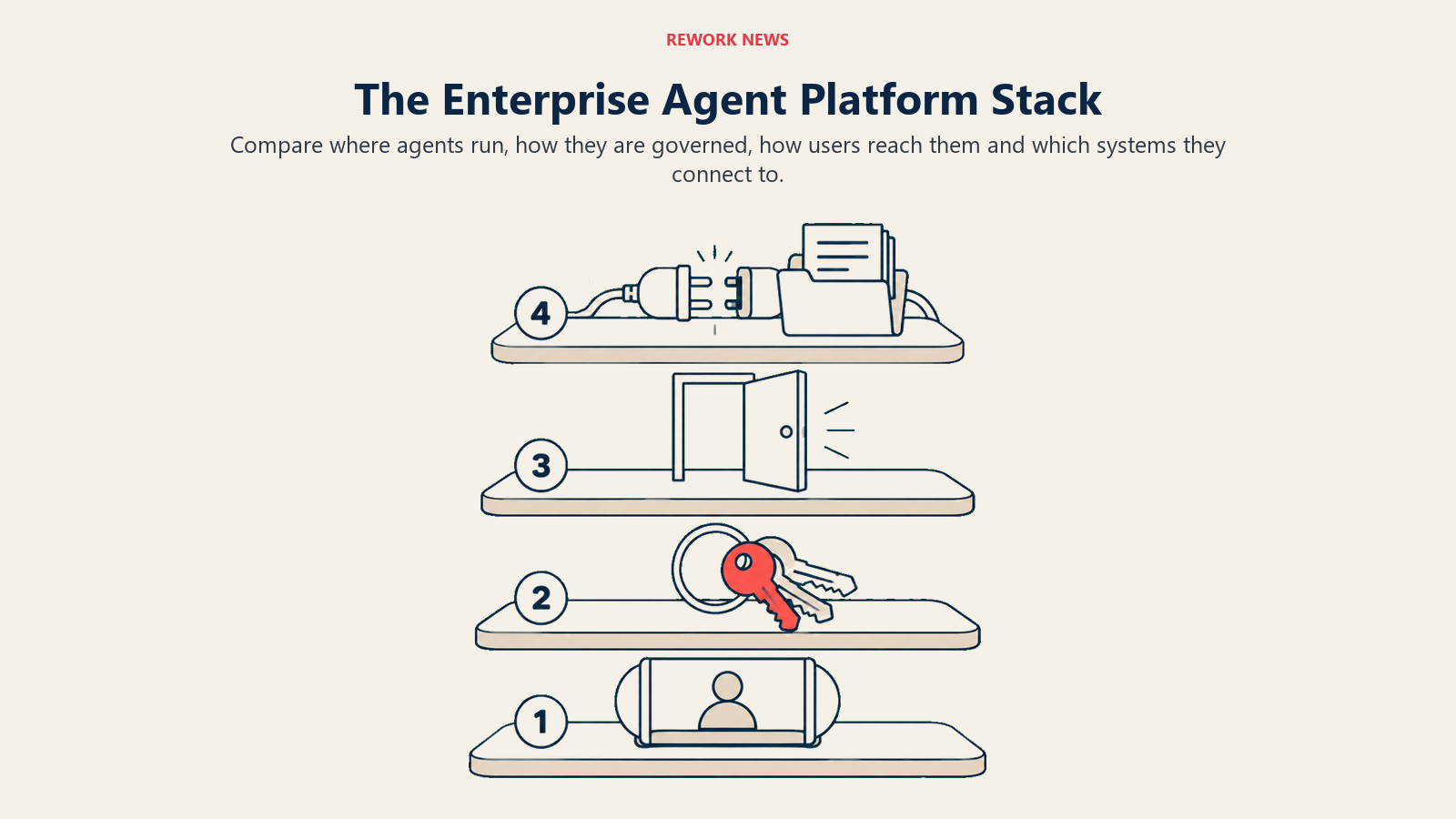
Call this The Enterprise Agent Platform Stack:
Layer 1: Runtime. Where the agent's tools actually execute. Vendor cloud? Customer cloud? Hybrid sandbox? This is the layer that varies most across vendors and carries the most security weight. An isolated Linux container (Google's approach) is different from a customer-managed sandbox (Anthropic's approach). Understanding who controls the compute matters.
Layer 2: Control Plane. The identity, audit, and fleet visibility layer. Who can see what agents are running? What audit logs exist? How do you revoke access to a runaway agent? This is where enterprise governance lives, and it's often the layer vendors undersell in demos.
Layer 3: Distribution Surface. How developers and end users reach the agents. Is it an IDE plugin? A CLI? A desktop app? An in-product button inside Slack or Salesforce? Distribution determines adoption speed inside your organization. Microsoft, OpenAI, Anthropic, and Google all answer this differently.
Layer 4: Integration Layer. Connectors to systems of record. How does the agent reach your CRM, ERP, data warehouse, or internal tools? Out-of-the-box connectors versus an API-first approach versus the Model Context Protocol (MCP) standard determines build versus buy decisions at the integration layer.
You can read more about how enterprise AI patterns stack in practice at Stacking Patterns to Build AI Agents and get grounding on the Autonomous Agent Pattern itself.
How the Four Platforms Compare
The field is now fully populated. Here's how the four named platforms map onto the Enterprise Agent Platform Stack. Every cell is a factual description, not a verdict.
| Platform | Runtime | Control Plane | Distribution | Integration |
|---|---|---|---|---|
| Microsoft (Agent 365 + Windows 365 for Agents) | Customer cloud VM via Windows 365, agent execution in isolated Windows session | Agent 365 control plane, Microsoft Entra identity, Purview audit | Microsoft 365 apps, Teams, Windows desktop, CLI | Microsoft Graph, Dynamics, SharePoint, third-party connectors |
| OpenAI (Workspace Agents) | OpenAI cloud, connector-mediated execution | OpenAI Workspace console, admin controls per tenant | Slack, Salesforce, in-product buttons, API | Salesforce, Slack, file connectors, API-first for custom integrations |
| Anthropic (Claude Managed Agents + Self-Hosted Sandboxes) | Customer-controlled sandbox, perimeter-flexible via MCP Tunnels | Claude API admin controls, MCP audit trail | Claude.ai, API, MCP-compatible surfaces, partner integrations | MCP protocol, self-hosted connectors, BYO infrastructure |
| Google (Antigravity 2.0 + Gemini Enterprise Agent Platform) | Isolated Linux environment via Managed Agents API | Gemini Enterprise Agent Platform, Google Cloud IAM, billing integration | Antigravity desktop app, Antigravity CLI, SDK, Gemini API | Google Cloud native services, ADK 2.0, API-first for custom tools |
The Microsoft Agent 365 coverage, Windows 365 for Agents breakdown, and Anthropic's self-hosted sandbox announcement each deserve a read alongside this one. Together they show the architectural pattern converging: isolated runtime plus API control plane plus multiple distribution surfaces. Google's entry confirms the pattern is now industry-wide, not a Microsoft-specific design choice.
The OpenAI connector-led model at OpenAI Workspace Agents for Salesforce and Slack takes a different integration-first approach, which makes the integration layer the most important comparison point for sales-heavy organizations.
What This Means for AI Strategy
The convergence on isolated runtimes across all four vendors is a signal worth reading carefully. Execution isolation is becoming table stakes, not a differentiator. The differentiation is moving to the control plane (who has fleet visibility and audit depth) and the integration layer (how much custom plumbing you have to build).
For CTOs already invested in Google Cloud, Antigravity 2.0 is the natural first test. The IAM and billing inheritance alone reduces the procurement and compliance overhead. But "natural first test" isn't the same as "automatic winner." The four-layer stack evaluation applies equally regardless of your current cloud footprint.
The AI Agents in the Enterprise guide covers the broader strategic context for these decisions. And if you're thinking about long-term platform dependency, the AI Sovereignty piece addresses the vendor lock-in question directly.
For teams thinking about whether to buy a platform or build on primitives, the Buy vs. Build by Pattern framework gives a decision structure that applies to this exact moment.
What to Do This Week
You don't need a final platform decision yet. But you do need to start building the evaluation muscle now, before a single vendor's demo shapes your assumptions.
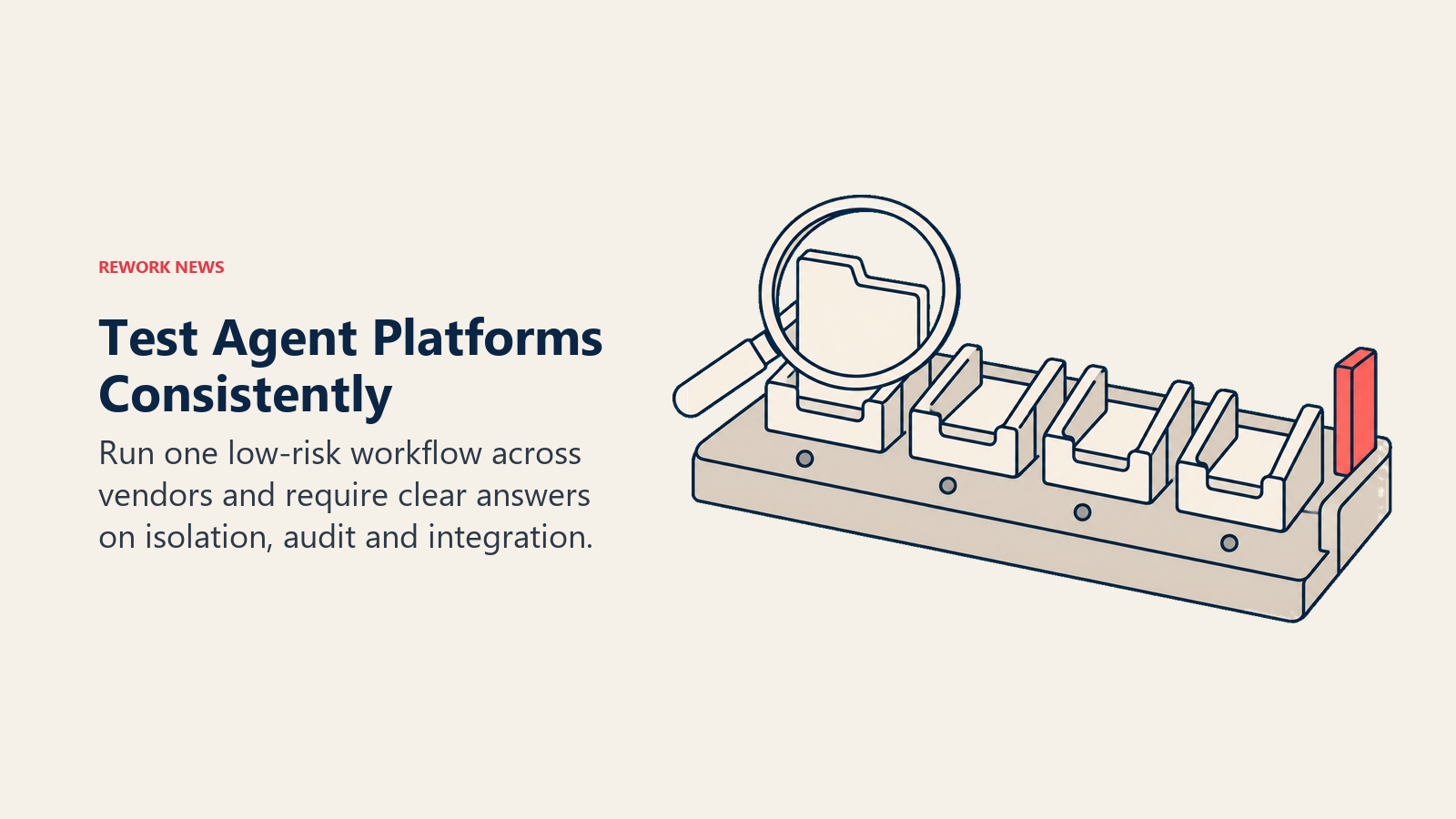
Three concrete moves:
Run one real use case through all four stacks. Pick a low-stakes internal workflow (a data retrieval agent, a document summarization task) and provision it on each platform. You don't need production-grade deployment. You need enough contact with each runtime and control plane to have an informed opinion. The hands-on hour is worth more than ten vendor briefings.
Demand a runtime-isolation diagram from each vendor. Not a slide deck. A technical diagram showing exactly where the agent's code executes, who controls the compute, and how your data crosses that boundary. If a vendor can't produce one, that's a signal.
Draft a minimum-platform request for proposal (RFP) using the four-layer stack. Write down the minimum acceptable answer for each layer before you talk to vendors. What runtime posture can your security team actually accept? What audit depth does your compliance team require? What integration connectors do you need on day one? Vendors answer the questions you give them. Give them the right questions.
The enterprise agent platform market just got a fourth serious entrant. That's not a problem. It's a CTO's advantage: real competition, real architectural variety, and a moment where the evaluation framework you build now will serve you for the next several years.
Frequently Asked Questions
What is the Gemini Enterprise Agent Platform?
The Gemini Enterprise Agent Platform is Google's enterprise deployment path for Antigravity 2.0. It lets organizations that already run on Google Cloud wire Antigravity agents directly into their existing projects, inheriting Google Cloud's IAM, billing, and data governance configuration rather than building a separate identity and security layer.
How is Antigravity 2.0 different from the existing Antigravity IDE?
Antigravity 2.0 is a separate, standalone desktop application built entirely for agent orchestration. It's not an update to the existing Antigravity IDE. The two products serve different purposes: the IDE supports general software development, while Antigravity 2.0 is purpose-built for creating, running, and managing AI agents.
Should a CTO evaluate all four enterprise agent platforms, or pick one?
Start with a structured evaluation of all four using a consistent framework before committing. The Enterprise Agent Platform Stack (Runtime, Control Plane, Distribution Surface, Integration Layer) gives you a vendor-neutral lens. In practice, your existing cloud infrastructure will likely narrow the shortlist quickly. But running at least one real use case on each platform before deciding is worth the time investment.
Learn More
