How to Reduce AI Vendor Lock-In: Data and Model Independence
Turn this article into takeaways for your work.


Each assistant summarizes the article only for you and suggests best practices for your work.
As organizations become more dependent on AI, a new strategic question emerges: How much control do you have over the AI systems you rely on?
AI sovereignty refers to an organization's ability to control and govern its AI systems, data, and infrastructure independently. It's about avoiding dependence on external providers in ways that create risk, limit flexibility, or expose sensitive information.
This isn't about rejecting cloud services or building everything in-house. It's about making deliberate choices about where dependencies exist, understanding the risks they create, and maintaining the capability to change course when needed.
Why AI Sovereignty Matters
Several trends are elevating sovereignty concerns:
Concentration of AI infrastructure. A small number of cloud providers control the computing resources needed to run advanced AI. Dependence on any single provider creates vulnerability.
Geopolitical fragmentation. Data localization requirements, export controls, and national AI policies vary by country. Operating globally increasingly requires navigating conflicting requirements.
Vendor lock-in risk. Deep integration with proprietary AI platforms can make switching difficult or impossible. What starts as a convenience becomes a constraint.
Data as competitive asset. Your data trains your AI systems. When that data flows to external providers, you're building their capabilities as much as yours. The learning may not stay exclusive to your organization.
Regulatory exposure. When you can't explain or audit AI systems you didn't build, regulatory compliance becomes harder. Accountability is difficult when you don't control the system.
The AI Sovereignty Framework
Building appropriate sovereignty requires decisions across four dimensions:
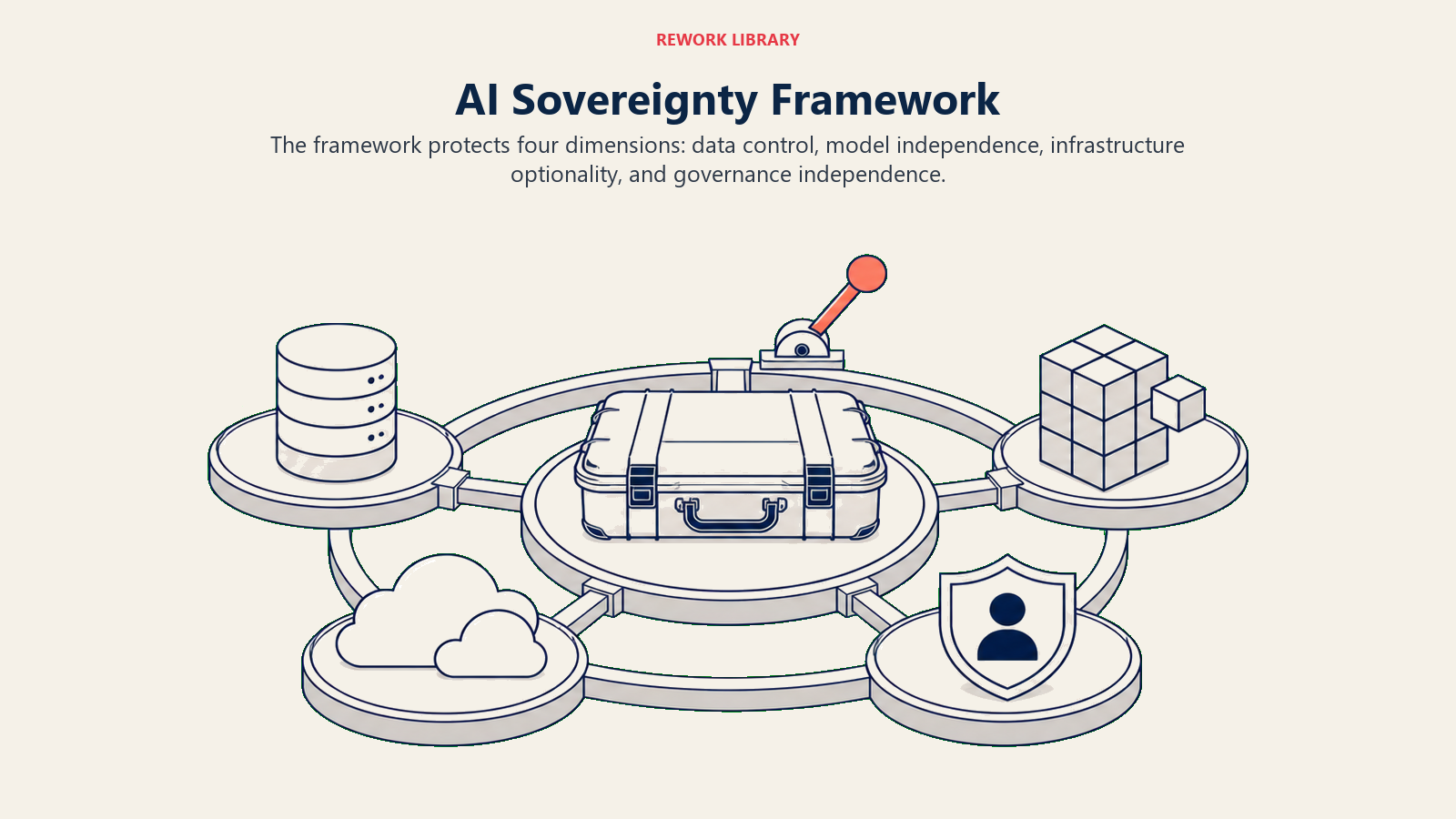
1. Data Control
Your data is your organization's most irreplaceable AI asset. Protect it:
Understand data flows. Know exactly what data leaves your organization, where it goes, and who has access. Many organizations have less visibility than they assume.
Evaluate training data rights. When using external AI services, understand whether your inputs train their models. This may share proprietary knowledge with competitors who use the same provider.
Consider data residency. Where data is stored affects what regulations apply and who might access it. Make explicit choices about data location.
Maintain data portability. Ensure you can extract your data in usable formats. Avoid proprietary data structures that create lock-in.
2. Model Independence
The AI models you use determine what's possible. Maintain optionality:
Diversify model providers. Avoid complete dependence on any single AI provider. Ensure you could switch if needed.
Evaluate open alternatives. Open-source models offer more control, even if they require more investment to deploy. For critical applications, this independence may be worth the cost.
Build internal capability. Maintain enough AI expertise in-house to evaluate options, customize solutions, and operate systems independently if necessary.
Abstract provider dependencies. Design systems so switching AI providers requires changing configuration, not rewriting applications.
3. Infrastructure Optionality
Compute resources are the foundation. Avoid complete dependence:
Multi-cloud capabilities. Maintain the ability to run on multiple cloud platforms. This provides negotiating leverage and resilience.
Understand geographic constraints. Some AI workloads may need to run in specific jurisdictions. Ensure your infrastructure supports this.
Monitor capacity dependencies. During periods of high demand, AI compute resources can become constrained. Understand your priority access and alternatives.
Evaluate edge options. Running some AI capabilities locally, rather than in centralized clouds, may provide control, latency, and privacy benefits.
4. Governance Independence
Ensure you can govern your AI use according to your own standards:
Audit capability. Maintain the ability to examine how AI systems make decisions, regardless of where they're hosted or who built them.
Override capability. Ensure humans can override AI decisions when necessary. Systems that can't be overridden create accountability gaps.
Policy enforcement. Your AI governance policies should be enforceable across all systems, including external ones. If a provider won't comply with your standards, you need alternatives.
Putting This Into Practice
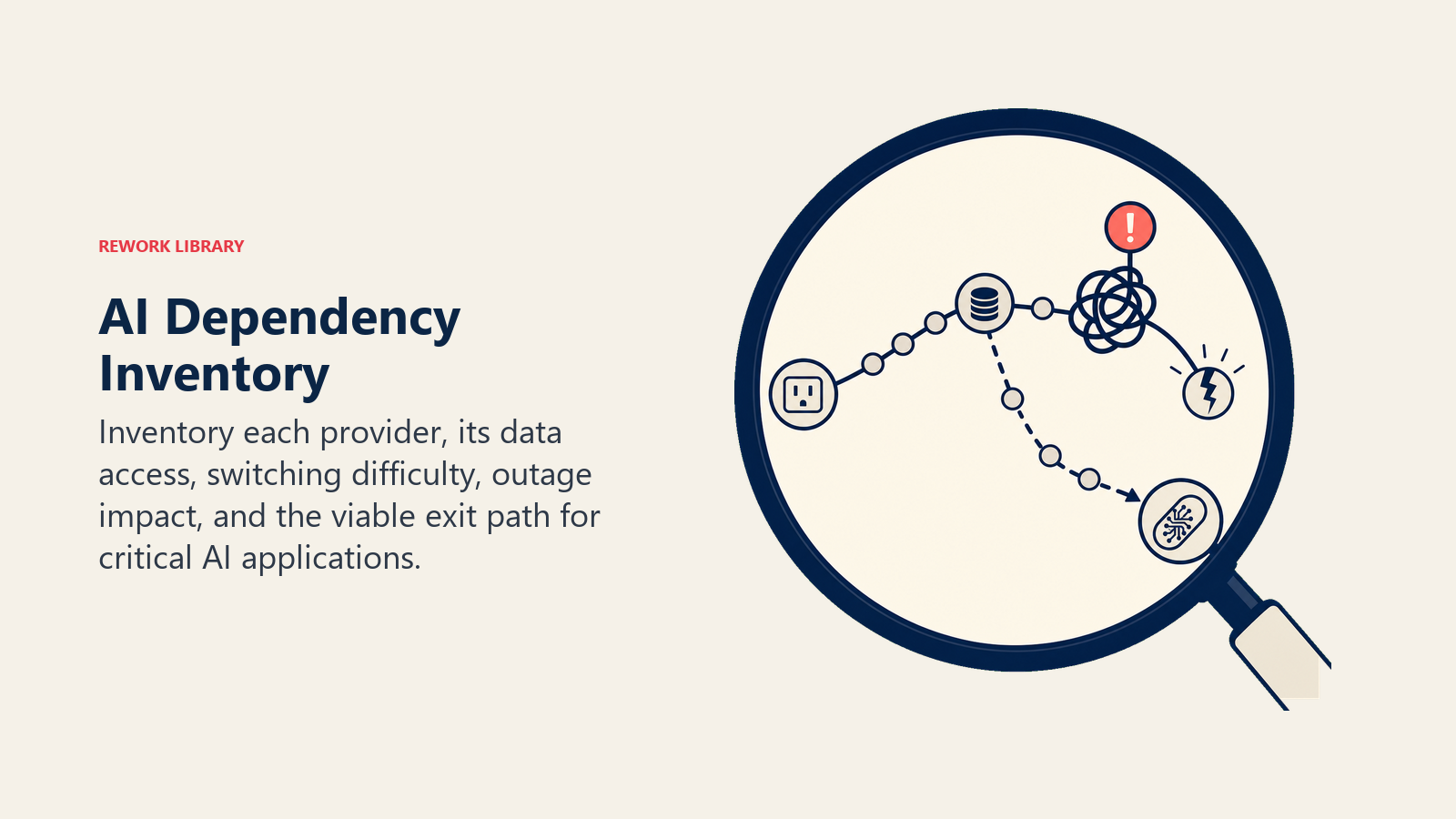
Start here: Inventory your AI dependencies. For each major AI system or service, document: who provides it, what data they access, how difficult switching would be, and what happens if they're unavailable.
Common mistake: Prioritizing speed to deployment over long-term flexibility. Today's convenient integration becomes tomorrow's constraining dependency.
Measure success by: Whether you could change AI providers for critical applications within a reasonable timeframe without losing capability or data.
AI sovereignty isn't about isolation. Most organizations will use external AI services extensively. But smart executives make these choices deliberately, understand the dependencies they're creating, and maintain the capability to change course. In a world where AI is becoming critical infrastructure, that optionality is strategic insurance.
