Territory Design Across Sales and CS: Shared Books Without the Conflict
Turn this article into takeaways for your work.


Each assistant summarizes the article only for you and suggests best practices for your work.
Here's how the conflict usually starts. Sales designs its territory model in Q3 planning: AEs split by geography, segment, or vertical, and the board approves headcount. CS designs its coverage model in the same quarter, usually in a separate planning process: customer success managers (CSMs) assigned by account count, region, or product line. Neither team gets full visibility into how the other is structured until an AE closes a new logo in a territory the CSM wasn't expecting, or a CSM identifies an expansion opportunity in an account the AE still considers "theirs."
The collision point is almost always renewal. The AE who closed the original deal three years ago comes back to re-engage, steps on the CSM's relationship, and then disputes who should lead the commercial conversation. The CSM who's been managing the account for 18 months gets marginalized from the deal that their adoption work made possible. Both scenarios are territory problems. But by the time they surface as conflict, the customer is already watching two people who report to different VPs argue implicitly about who owns them. The renewal ownership framework is what prevents that ambiguity from reaching the customer.
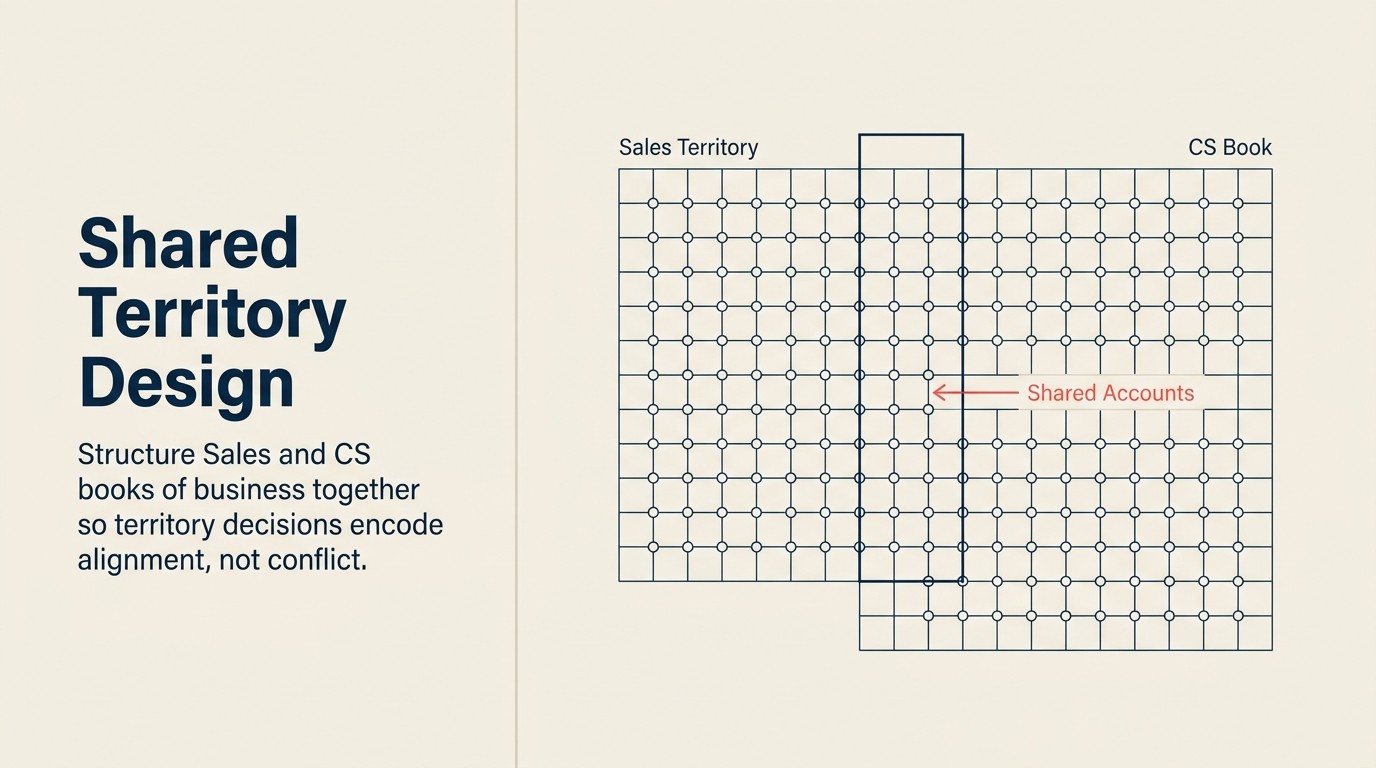
Territory design at the seam isn't about adding more rows to a headcount spreadsheet. It's about encoding the shared book logic before the disputes start.
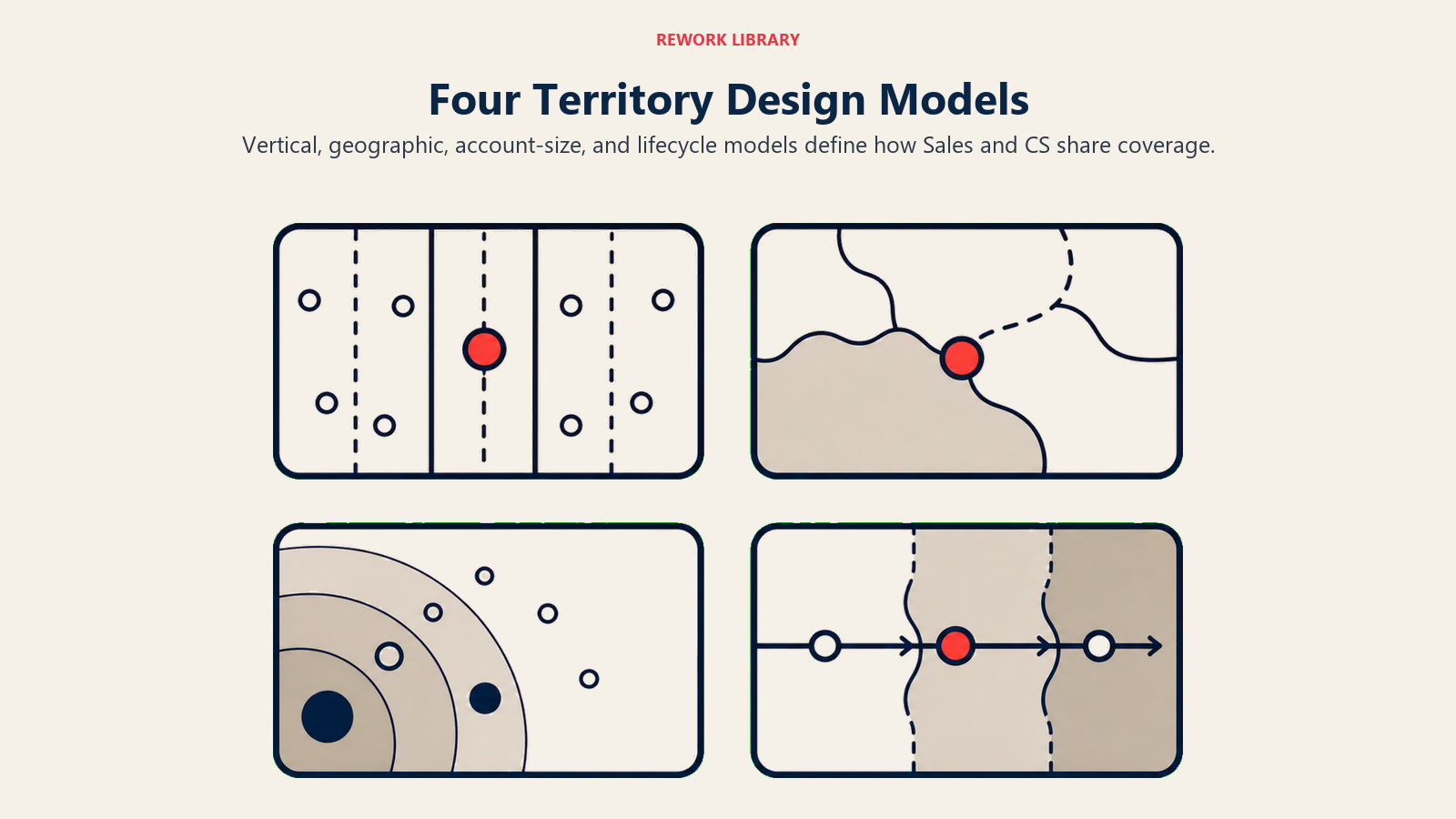
The 4-Model Territory Design is a framework for structuring shared Sales-CS books of business across four distinct coverage architectures: vertical alignment, geographic alignment, account-size tiers (ARR bands), and hybrid. Each has defined trigger conditions, failure modes, and capacity ratio requirements. The right model is determined by product complexity, segment mix, and whether CSM value creation is industry-specific, relationship-proximity-dependent, or ARR-band-driven.
Quotable: "Ownership ambiguity between Sales and CS is a territory problem before it is a renewal problem. A shared book definition in CRM, reviewed quarterly by RevOps, removes that ambiguity before it reaches the customer."
Quotable: "Every account transition driven by a territory change (rep turnover, segment reclassification, or company acquisition) resets a relationship the customer has to rebuild. Territory stability is not an administrative preference; it is a retention lever."
Why Territory Design Matters at the Seam
Most companies treat Sales territory design and CS coverage design as entirely separate planning exercises. Gartner defines territory management as the process by which sellers prioritize and manage customers organized by segments. That definition says nothing about CS coverage, which is exactly the problem. The Sales VP carves up geography, vertical, or account size bands. The VP CS decides on CSM account loads and assignment rules. The plans get approved by the same CRO or CEO, but the overlap logic (who owns what when both teams are touching the same account) is rarely explicit.
The result is three failure modes.
Orphan accounts. An AE closes a new logo in a vertical the CS team hasn't staffed for yet. The account sits without a CSM for 30-60 days. First-year churn in accounts without a CSM in the first 90 days runs significantly higher than in accounts with prompt CSM assignment. The territory plan had no answer for who handles this gap.
Coverage disputes. An account upgrades from SMB to mid-market. The SMB AE who closed them two years ago still considers it their account. The mid-market AE whose territory it now falls into expects to take ownership. The CSM who has the relationship with the actual decision-maker isn't sure which AE to work with. The customer gets a confusing experience while the internal argument plays out.
Commission conflicts. A CSM identifies an expansion opportunity: a new department wants to adopt the product. The original AE hears about it and shows up to "support the deal." Both expect comp. If territory and attribution rules weren't written in advance, you're resolving this retroactively and someone feels cheated. The expansion ownership and upsell motion article gives the attribution framework that prevents these disputes.
Territory design at the seam means making these decisions before they become disputes.
The Four Territory Design Models
There's no universal right answer for how to structure shared Sales-CS territory. The choice depends on your product, your segments, and how your CSMs actually create value. Here are the four models in practice.
Model 1: Vertical Alignment
Both AE and CSM own the same industry verticals. An AE covering financial services pairs with a CSM who covers financial services. Everyone in the pod or shared book has industry-specific expertise, can speak to compliance requirements, and knows the stakeholder map in that vertical.
When it works: When your product's value proposition is industry-specific and customer conversations require deep vertical knowledge. A workflow automation tool where a healthcare CSM can speak to HIPAA workflow requirements is much more effective than a generalist CSM who has to ask basic questions in every meeting.
When it breaks: When your customer base doesn't cluster cleanly by vertical, or when a single vertical produces wildly uneven ARR distribution. If 60% of your ARR is in fintech but your CSM vertical coverage model only allocates 20% of CSMs there, the ratio math forces compromises that undermine the model.
Model 2: Geographic Alignment
Both AE and CSM cover the same regions. East Coast AEs pair with East Coast CSMs; the EMEA team has dedicated CS coverage. The value is timezone alignment and, where relevant, on-site relationship access.
When it works: When your product requires on-site implementation, QBRs are conducted in person, or relationships are driven by physical proximity (common in manufacturing, healthcare systems, and government markets). Geographic alignment also works well when a company's sales culture is heavily territory-based and reps have strong regional identity.
When it breaks: Modern SaaS products rarely require geographic alignment for the product itself. If your CSMs are managing accounts entirely remotely, geographic alignment may be an artifact of the old field sales model rather than a genuine operational requirement. It can also fragment vertical expertise. Your three West Coast CSMs might cover fintech, healthcare, and manufacturing simultaneously, with shallow expertise in each.
Model 3: Account-Size Tiers (ARR Bands)
Territory is defined by ARR band rather than geography or vertical. Under $25K ARR goes to a pooled SMB CS team. $25-100K goes to mid-market CSMs with 30-40 account loads. Over $100K goes to enterprise CSMs with 12-20 accounts, each paired with a named enterprise AE.
When it works: When CSM capacity ratio is the binding operational constraint, and when the economics of CS service vary significantly by ARR band. Enterprise accounts justify high-touch, named CSM coverage. SMB accounts need pooled coverage to be economically viable. The ARR band model makes this explicit.
When it breaks: ARR band models create churn risk at tier transitions. An account that grows from $22K to $28K ARR gets reassigned from the SMB pool to a named mid-market CSM, a transition that disrupts the relationship at the exact moment the customer is most engaged. You need explicit transition protocols to manage this well. The alignment spectrum from SMB to enterprise maps how those transition protocols differ by segment.
Model 4: Hybrid (Named + Vertical + Pooled)
The default for companies with multiple segments. Enterprise accounts are named: specific AEs and CSMs own specific logos. Mid-market territory is defined by vertical within ARR band. SMB is pooled with automated assignment.
Most companies with 50+ customers across more than one segment end up here eventually, whether they designed it that way or evolved into it. The hybrid model's advantage is that it allocates high-touch CS resources where the ARR justifies them, while keeping SMB economics viable. Its complexity cost is that you need clear documentation of which rules apply in which segment and what happens when an account crosses a segment boundary. So how do you pick the right starting point before the evolution happens?
Decision Factors: Choosing the Right Model
Use vertical alignment when your product's commercial value is industry-specific and your CSMs can develop genuine expertise within a vertical. Threshold: minimum 3-4 CSMs per vertical to maintain coverage redundancy. Forrester's systematic approach to territory design recommends assessing total addressable market data by segment before finalizing any vertical carve. Unbalanced territory potential is the most common reason vertical alignment breaks down within a year.
Use geographic alignment when on-site relationship management is genuinely required (not just preferred), or when your sales team has strong geographic territory identity that would create coordination friction if CS cut across it. Test: if 90% of your QBRs are held via video call, geographic alignment is probably an artifact, not a requirement.
Use account-size tiers when CSM capacity is the primary planning constraint and the economics of different ARR bands genuinely require different service models. This is the most operationally honest model for companies where the customer base spans SMB to enterprise.
Use hybrid as default for any company with 3+ market segments and more than 30 CSMs. Hybrid is not a compromise. It's an acknowledgment that different segments need different coverage logic, and trying to apply one model across all of them produces worse outcomes than designing intentionally for each.
Building the Shared Book
The shared book is the set of accounts that a specific AE and CSM jointly own. Getting the shared book definition right is more important than getting the territory model right, because the shared book is what feeds comp calculations, renewal ownership rules, and CRM automation.
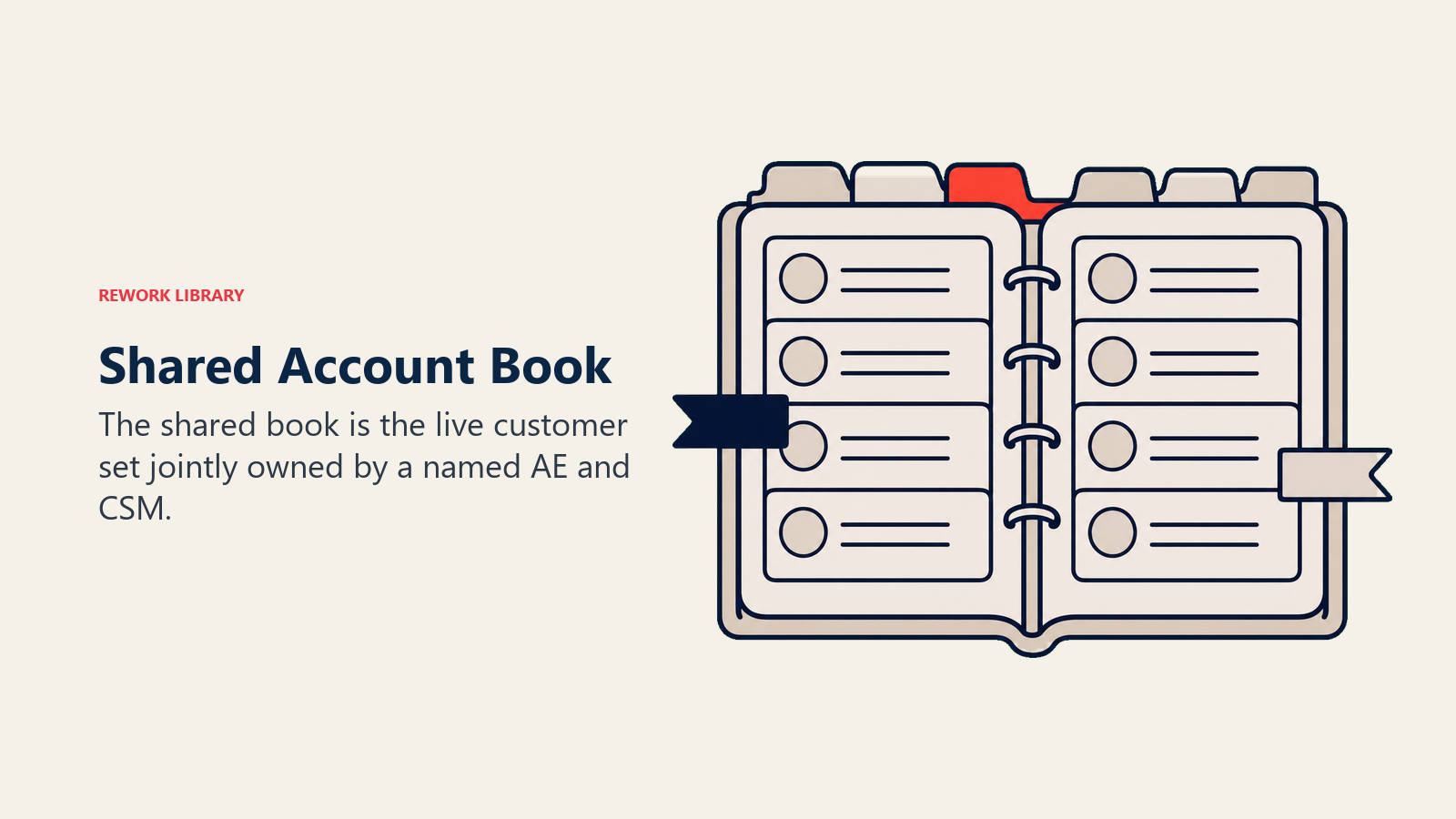
What belongs in the shared book: Active customers only. Prospects are Sales-owned until contract signature. Churned accounts are archived. The shared book is live, contracted ARR: the accounts both teams are currently responsible for.
Named account lists: Who creates them, who maintains them, and how often they're reviewed matters for operational integrity. Best practice: RevOps owns the master named account list in CRM, updated on a quarterly schedule. McKinsey's Customer Success 2.0 research identifies account planning (with clearly defined swim lanes for Sales and CS within each account) as the operational anchor that prevents territory disputes from reaching the customer. AEs and CSMs can propose changes; RevOps approves and implements. No informal "this is my account" territory that exists only in someone's head. For how RevOps encodes these rules into the systems both teams use, see RevOps as the alignment glue.
Greenfield vs. existing accounts: New logo acquisition and existing account management follow different territory rules. An AE may have a greenfield territory (the accounts they can sell to that don't yet have a contract) that's broader than the post-close shared book. This is intentional. You want AEs prospecting beyond the existing customer base. The shared book only crystallizes at contract signature.
Accounts without a CSM: This is the most dangerous gap in most territory designs. An account closes, and the CSM assignment queue is backed up for three weeks. During that time, the account gets no onboarding support, misses early adoption milestones, and starts first-year churn risk accruing from day one. The territory design must answer: who is the default CS owner for accounts awaiting CSM assignment? (Usually a team lead or a pooled coverage CSM.)
Coverage Conflict Scenarios and Resolution Rules
Write these rules before the conflicts happen. After the fact, every resolution feels like someone lost.
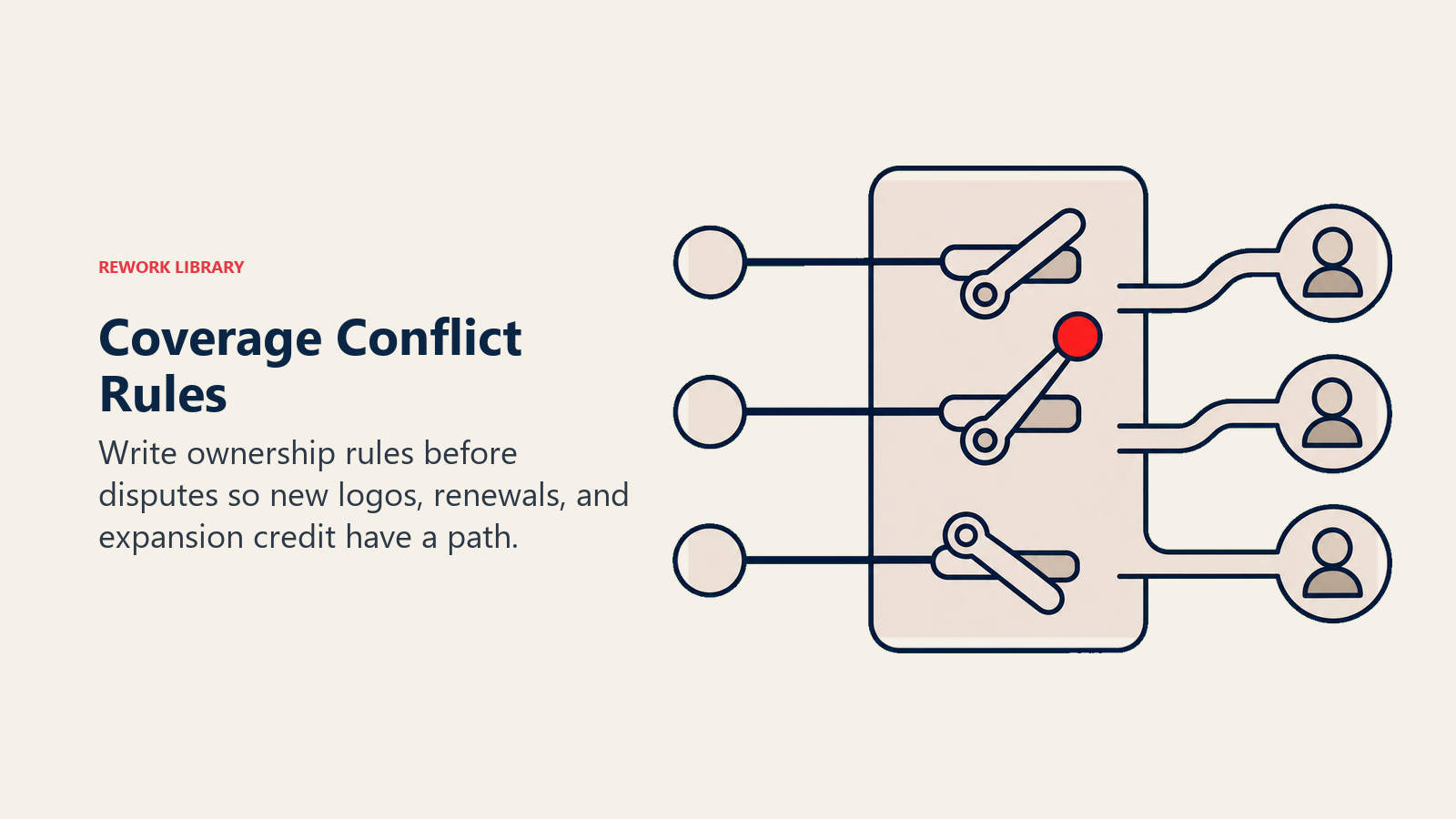
Scenario 1: AE closes a new logo in a CSM's territory while the CSM is managing a renewal. Resolution rule: The new account enters the CSM's queue with a 14-day SLA for first contact. If CSM capacity is exceeded, the account goes to a pooled coverage CSM for 90 days, then reassigns. The CSM doesn't lose the account permanently. They accept it once capacity is available.
Scenario 2: CSM identifies expansion opportunity. Does the AE get the commission? Resolution rule: Define this in the comp plan before any expansion deal closes. Common approach: CSM-sourced means CSM gets expansion credit; AE is invited into the commercial process but does not earn commission unless they run the negotiation. If the AE sourced the expansion and the CSM supported it, the AE earns the commission. Attribution is determined by who surfaced the opportunity in the CRM first.
Scenario 3: Account tier changes and territory reassignment triggers. Resolution rule: ARR-tier transitions trigger a 30-day handoff window (not an immediate reassignment). Current CSM briefs incoming CSM, customer is introduced to the new CSM with context, and a joint QBR is offered. Do not reassign accounts in the middle of an open renewal negotiation.
Scenario 4: AE departs and account ownership is in limbo. Resolution rule: Departing AE's accounts move to a defined "unassigned AE" status in CRM. CSM relationship continues uninterrupted (the CSM does not become "unassigned"). Regional AE manager or a named coverage AE takes commercial responsibility for renewals and expansion until a permanent AE is assigned. All of these rules assume you've done the math on capacity first. That's the part most territory redesigns skip.
Capacity Ratio as a Territory Input
Territory design is constrained by CSM capacity. You can't design a territory model that requires 1:1 AE-CSM pairing if your CSM headcount supports a 1:3 ratio. The capacity math has to precede the territory design.
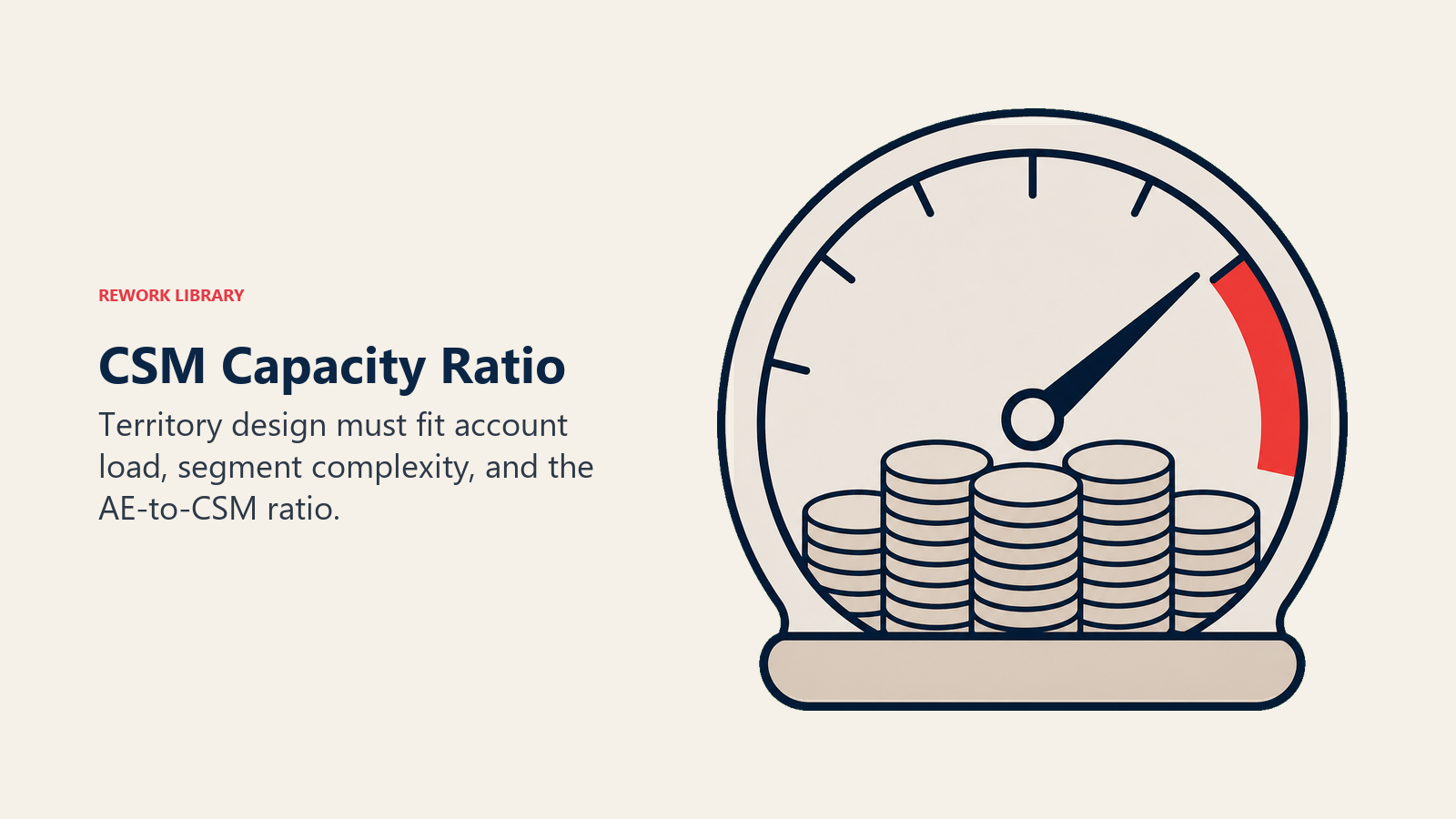
Typical CSM-to-account ratios by segment:
| Segment | ARR per Account | Accounts per CSM | AE-to-CSM Ratio |
|---|---|---|---|
| SMB (pooled) | <$15K | 60-100 | N/A (pooled) |
| Commercial | $15K-$40K | 35-60 | 1.5-2:1 |
| Mid-market | $40K-$100K | 20-35 | 1-1.5:1 |
| Enterprise | $100K-$500K | 10-20 | 1:1 or 1.2:1 |
| Strategic | >$500K | 4-8 | 1:1 with SE |
These are benchmarks, not rules. Your product complexity, onboarding depth, and expansion motion all shift these numbers. A product with 3-month onboarding and complex integrations will require lower account loads than the benchmarks suggest.
Quotable: "When RevOps owns territory change automation in CRM, rather than leaving reassignments to manual Slack updates, coverage gaps shrink from weeks to days. That gap is where first-year churn risk accumulates: no CSM contact, no onboarding support, no early adoption milestones."
Rework Analysis: The most common territory design mistake is treating Sales and CS coverage as separate planning exercises that happen to touch the same accounts. Companies that run them as a single planning process (with RevOps owning the shared book definition, both VPs signing off on the same capacity model, and territory ID encoded in CRM before the plan goes live) resolve the majority of renewal disputes before they start. The capacity ratio table above is the input to that planning process, not the output. Run the CSM capacity math first. Then design the territory model around what the ratios will actually support.
When to add a CSM before redesigning territory vs. redesign first: If the territory model is fundamentally sound but CSM ratios are stretched beyond 20% above benchmark, add headcount. If CSM ratios are within range but territory design is producing conflict, fix the design. Don't add headcount to solve a design problem. You'll just have more people in a broken system.
The RevOps Role: Encoding Territory Logic in CRM
Territory decisions only hold if they're encoded in the systems that drive comp, reporting, and automation. A well-designed territory model that exists only in a spreadsheet will be circumvented within a quarter.
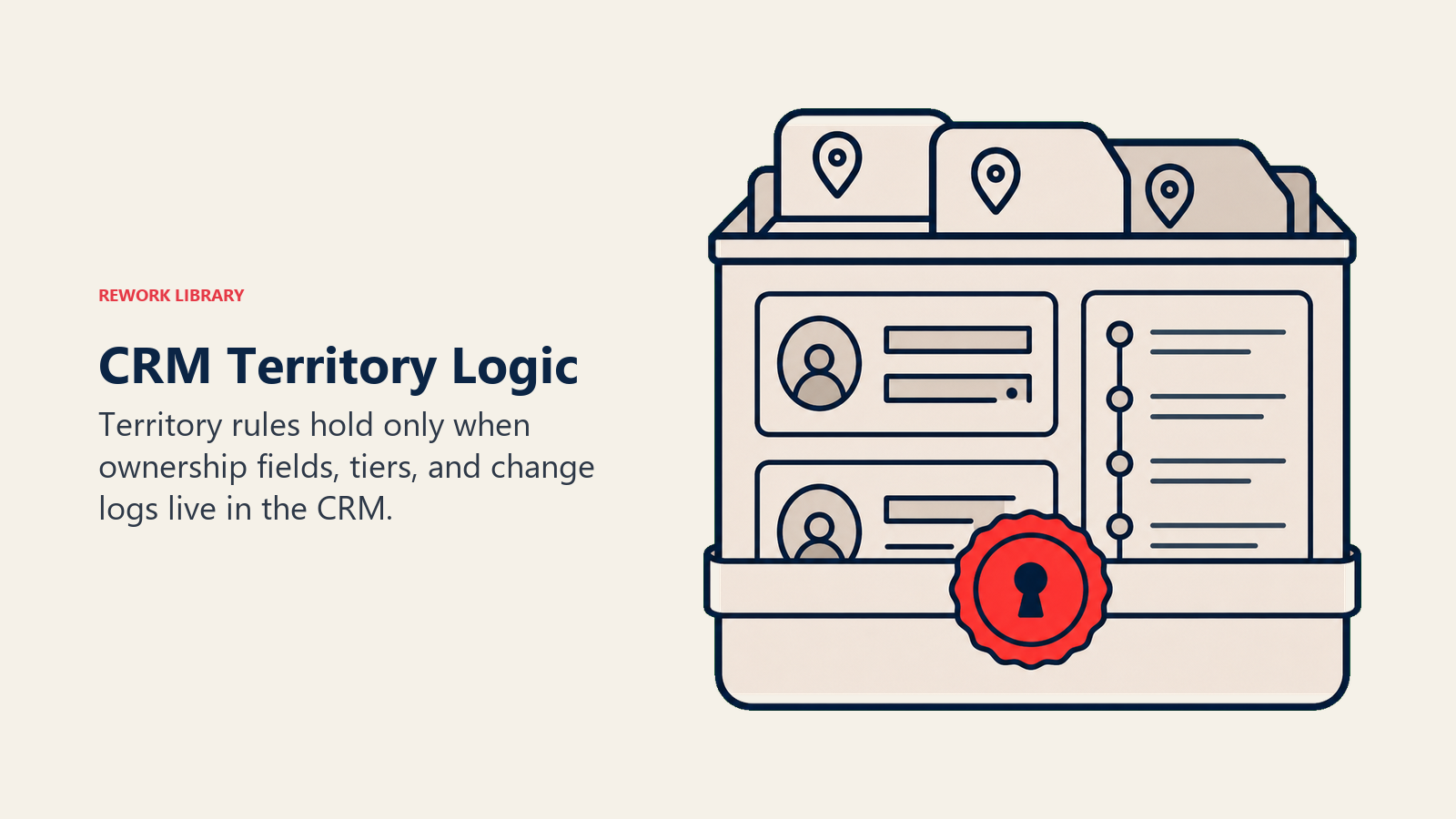
CRM field checklist for territory encoding:
- Account Owner (AE): primary field, drives AE comp calculation
- CSM Owner: required field, must be populated within 14 days of contract signature
- Territory ID: the named territory both AE and CSM belong to (enables shared book reporting)
- ARR Band: automated tier classification, updates on every ARR change event
- Last Territory Review Date: audit field, tracked by RevOps quarterly
- Territory Change Log: immutable history of all reassignments with timestamp and reason code
Source of truth: CRM is the source of truth for account ownership, not spreadsheets, not Slack messages, not informal agreements. Any territory change that isn't in the CRM doesn't exist for comp purposes. The single source of truth for the customer record covers how to structure that CRM record so both Sales and CS see the same view.
Automating tier reassignment: When an account's ARR crosses a tier threshold (e.g., from $38K to $42K, crossing the commercial-to-mid-market boundary), the CRM should trigger a reassignment workflow. This means notifying RevOps and both the current CSM and the incoming segment's CSM lead rather than immediately reassigning the account. Human review before execution prevents automated reassignments in the middle of sensitive renewal windows.
Territory change audit trail: Every territory change should create a dated record in CRM: who changed it, when, and why. This audit trail is the primary evidence in compensation disputes. "I owned that account when the expansion closed" requires CRM history to prove. Without an audit trail, these disputes are resolved by whoever has the more credible account.
Piloting a New Territory Model
Don't redesign territory across all segments simultaneously. Pick one segment, run it for one quarter, and measure before expanding.
Pilot setup:
- Choose one segment: mid-market usually has the most visible conflict and the clearest measurement baseline
- Run new territory model for 8-12 accounts in the pilot group; keep a control group of 8-12 accounts on the current model
- Designate one RevOps owner who tracks both groups and resolves disputes
- Define the measurement metrics before the pilot starts
What to measure:
- Coverage gap frequency: how often does an account lack a named AE or CSM for more than 14 days?
- Dispute frequency: how many comp or ownership disputes require RevOps escalation?
- Renewal cycle length: from renewal trigger to signature, how many days?
- NRR delta: does the pilot group outperform the control group on NRR at quarter-end?
A territory redesign that produces fewer disputes and shorter renewal cycles at neutral or better NRR is worth expanding. One that reduces disputes but increases renewal cycle length has probably optimized for internal process at the expense of customer experience. Worth diagnosing before scaling.
Territory Design Is Infrastructure
Territory design doesn't get the credit it deserves in alignment conversations. It's less visible than comp redesign, less dramatic than launching a pod model, and less urgent than resolving an active churn crisis. But it's the infrastructure that makes every other alignment mechanism work or fail.
A compensation plan aligned on NRR is worthless if the shared book isn't defined. A pod model is friction-filled if the pod's territory overlaps with three other AEs' greenfield prospects. A renewal ownership framework collapses if the CRM doesn't tell you who owns the account when the renewal fires.
Get the territory design right (the four models, the shared book construction, the CRM encoding, the conflict resolution rules) and the alignment initiatives built on top of it will hold. Get it wrong, and every downstream effort fights against a broken foundation.
Frequently Asked Questions about Territory Design Across Sales and CS
What is a shared book of business in Sales-CS territory design?
A shared book of business is the defined set of active, contracted accounts that a specific AE and CSM jointly own for revenue purposes. It includes all live ARR the pair is responsible for: retention, expansion, and renewal. It excludes prospects (Sales-only until contract signature) and churned accounts (archived). The shared book is the unit of accountability for NRR-aligned comp plans and the foundation of all territory design decisions.
When should you use vertical alignment versus geographic alignment?
Use vertical alignment when your product's value proposition is industry-specific and CSMs develop genuine expertise within a sector. For example, a compliance-heavy product where knowing HIPAA requirements in healthcare or SOC 2 requirements in fintech matters in every customer conversation. Use geographic alignment when on-site QBRs and relationship management are genuinely required by the nature of the product or market (common in manufacturing, healthcare systems, and government). If 90% of your QBRs happen over video call, geographic alignment is an artifact of the old field sales model, not an operational requirement.
What is a shared book of business and how is it maintained?
The shared book is defined by the Territory ID field in CRM, which maps each active account to a specific AE-CSM pair. RevOps owns the master named account list and reviews it quarterly. AEs and CSMs can propose changes; RevOps approves and implements. Any account ownership that exists only in someone's head or in a Slack message does not exist for comp or reporting purposes. The CRM is the source of truth.
How do you handle territory conflicts when an account changes ARR tier?
ARR-tier transitions should trigger a 30-day handoff window, not an immediate reassignment. The current CSM briefs the incoming CSM, the customer is introduced with context, and a joint QBR is offered during the transition period. Never reassign an account in the middle of an open renewal negotiation. The CRM automation should notify RevOps and both CSMs when an account crosses a tier threshold. Human review before execution prevents automated reassignments at the worst possible moment.
What happens to territory ownership when an AE departs?
Departing AE accounts should immediately move to a defined "unassigned AE" status in CRM. The CSM relationship continues without interruption. The CSM does not become "unassigned" just because the AE left. A regional AE manager or named coverage AE takes commercial responsibility for renewals and expansion until a permanent replacement is assigned. The worst outcome is leaving a CSM managing an account with no commercial owner for more than 30 days: the renewal fires with no AE accountable for the commercial close, and the CSM has to improvise.
How do you resolve commission disputes when both AE and CSM claim credit for an expansion?
Attribution rules must be written before any expansion deal closes. The standard approach: CSM-sourced expansion (CSM identified the opportunity and introduced it to the new department) means CSM gets expansion credit, AE handles contracts only. AE-sourced expansion (AE brought in the opportunity, CSM supported) means AE earns the commission. Attribution is determined by who logged the opportunity in CRM first. Any attribution dispute resolved retroactively, after the deal is closed, destroys credibility for the comp plan and incentivizes both sides to race to log opportunities rather than work them.
Learn More

Principal Solution Architect
On this page
- Why Territory Design Matters at the Seam
- The Four Territory Design Models
- Model 1: Vertical Alignment
- Model 2: Geographic Alignment
- Model 3: Account-Size Tiers (ARR Bands)
- Model 4: Hybrid (Named + Vertical + Pooled)
- Decision Factors: Choosing the Right Model
- Building the Shared Book
- Coverage Conflict Scenarios and Resolution Rules
- Capacity Ratio as a Territory Input
- The RevOps Role: Encoding Territory Logic in CRM
- Piloting a New Territory Model
- Territory Design Is Infrastructure
- Learn More