Consensus vs Top-Down Decision-Making Across Cultures
Turn this article into takeaways for your work.


Each assistant summarizes the article only for you and suggests best practices for your work.
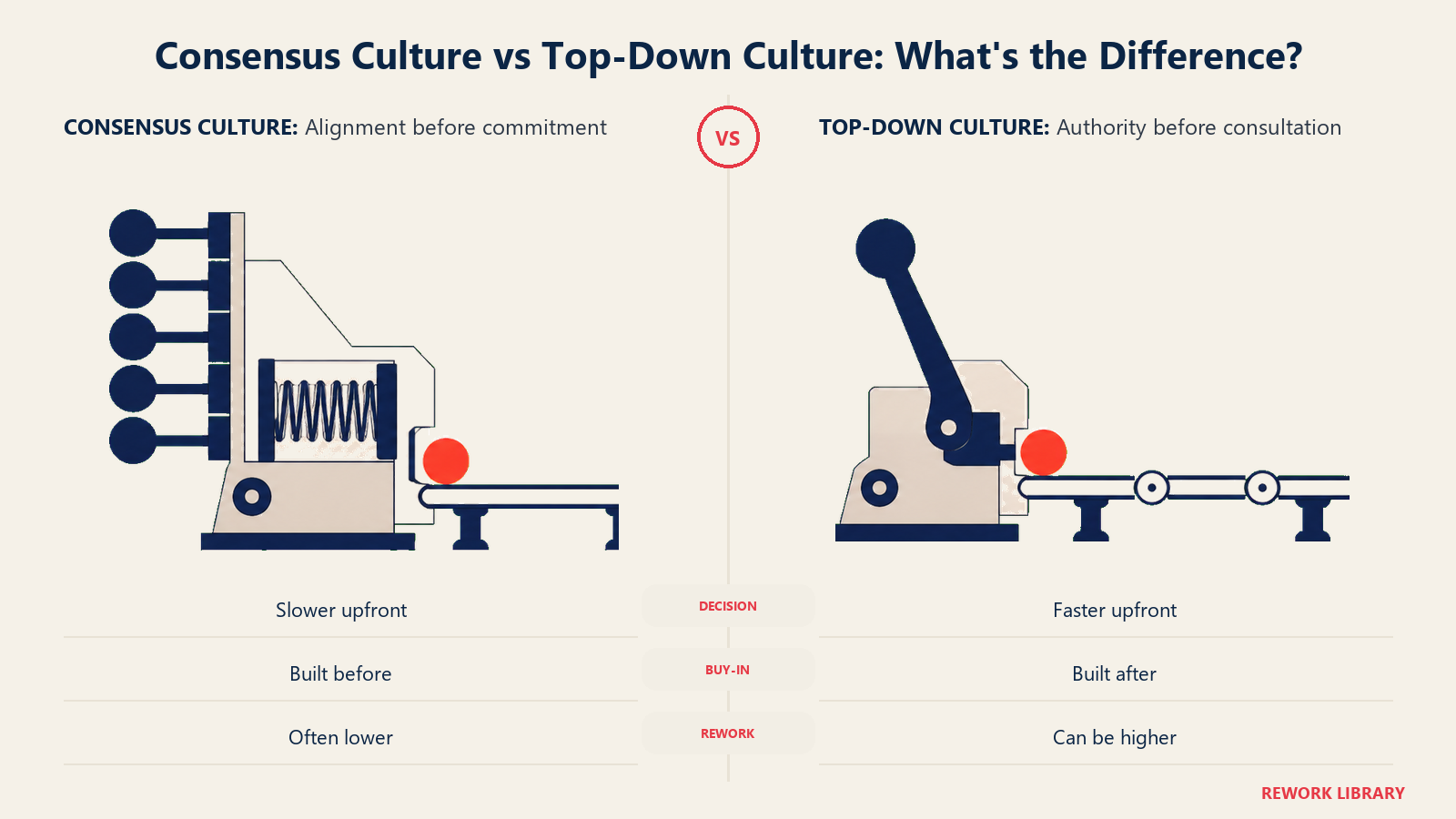
A consensus culture builds agreement among stakeholders before a decision is announced, which makes it slow to decide but fast to execute once everyone is already on board. A top-down culture puts the call in one person's hands, which makes it fast to decide but slower to execute if the people carrying it out were never consulted and quietly resist. Neither approach is more advanced. They are two ways of trading speed for buy-in, and most cross-border friction over "how decisions get made here" comes from a team running both styles in the same room without realizing it.
This is also one of the most commonly confused ideas in cross-cultural management, because it gets mixed up with hierarchy. A culture can be steeply hierarchical and still decide by consensus, the way Japan does. A culture can be almost flat and still decide top-down, the way the United States often does. Knowing which axis you're actually dealing with changes what a leader should adjust and what they should leave alone.
The Research Behind Consensus vs Top-Down Decision-Making
The clearest tool for this question comes from Erin Meyer's The Culture Map.
Erin Meyer's Deciding Scale
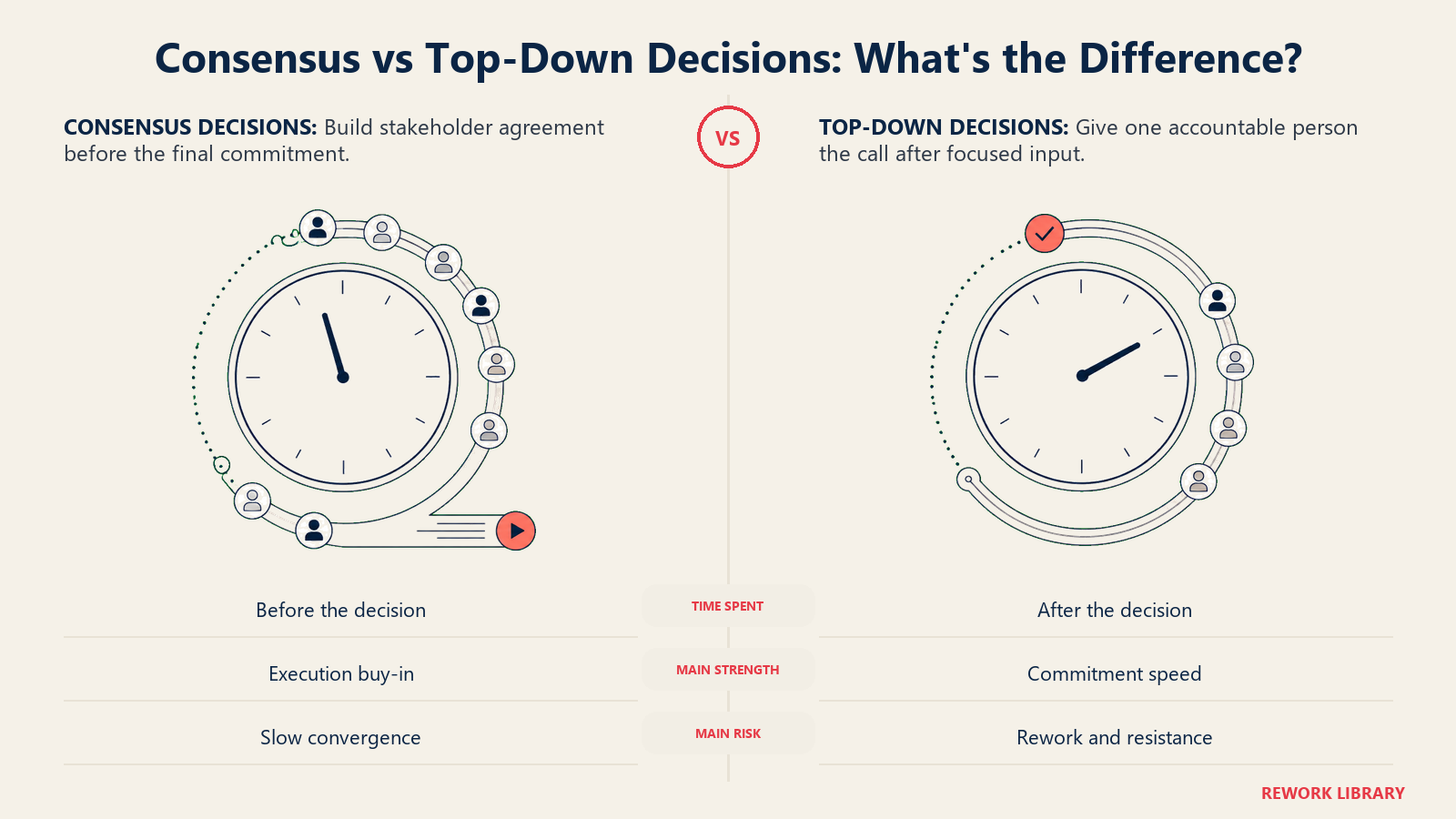
Meyer's Deciding scale, one of 8 scales in the book, runs from Consensual (the group builds agreement before a decision is finalized) to Top-down (one person, usually the most senior person in the room, makes the call). It is relative, not absolute: what matters is the gap between two cultures' positions, not either one judged alone. We cover all 8 of Meyer's scales, including how Deciding interacts with feedback and communication style, in The Culture Map explained.
A common mistake is treating "consensual" as slow and "top-down" as fast, full stop. The speed just shows up at different points. A consensual culture spends its time upfront, in quiet conversations before a meeting, then moves quickly once the decision is announced because nobody needs convincing after the fact. A top-down culture spends almost no time upfront and then spends it afterward, working through objections that never got surfaced before the call was made.
Why Deciding Is Not the Same as Leading
Meyer's framework separates Deciding from a related but distinct scale called Leading, which measures how much deference a boss gets and how much distance is expected between a manager and reports. We cover Leading and Hofstede's Power Distance Index, the research behind hierarchy specifically, in hierarchical vs. egalitarian cultures.
The two scales correlate loosely but aren't the same measurement, and the gap between them explains some of the most confusing cross-cultural moments a leader will run into. Japan is hierarchical on Leading, formal rank and seniority carry real weight, but consensual on Deciding, because decisions are built through quiet, one-on-one consultation before they're ever raised in a group setting. The United States sits closer to egalitarian on Leading, a junior employee is expected to speak up regardless of title, but often top-down on Deciding, because American teams gather input quickly and let one accountable person commit. A hierarchical culture that decides by consensus and an egalitarian culture that decides top-down are both completely normal. Assuming decision style follows directly from how much people defer to rank is the error, and it's the single most useful correction Meyer adds to the broader six axes where business culture differs across the world.
Consensual Decision Cultures: How They Actually Work
In a consensual culture, a decision isn't finished the moment it's announced. It was finished earlier, in conversations most outsiders never see.
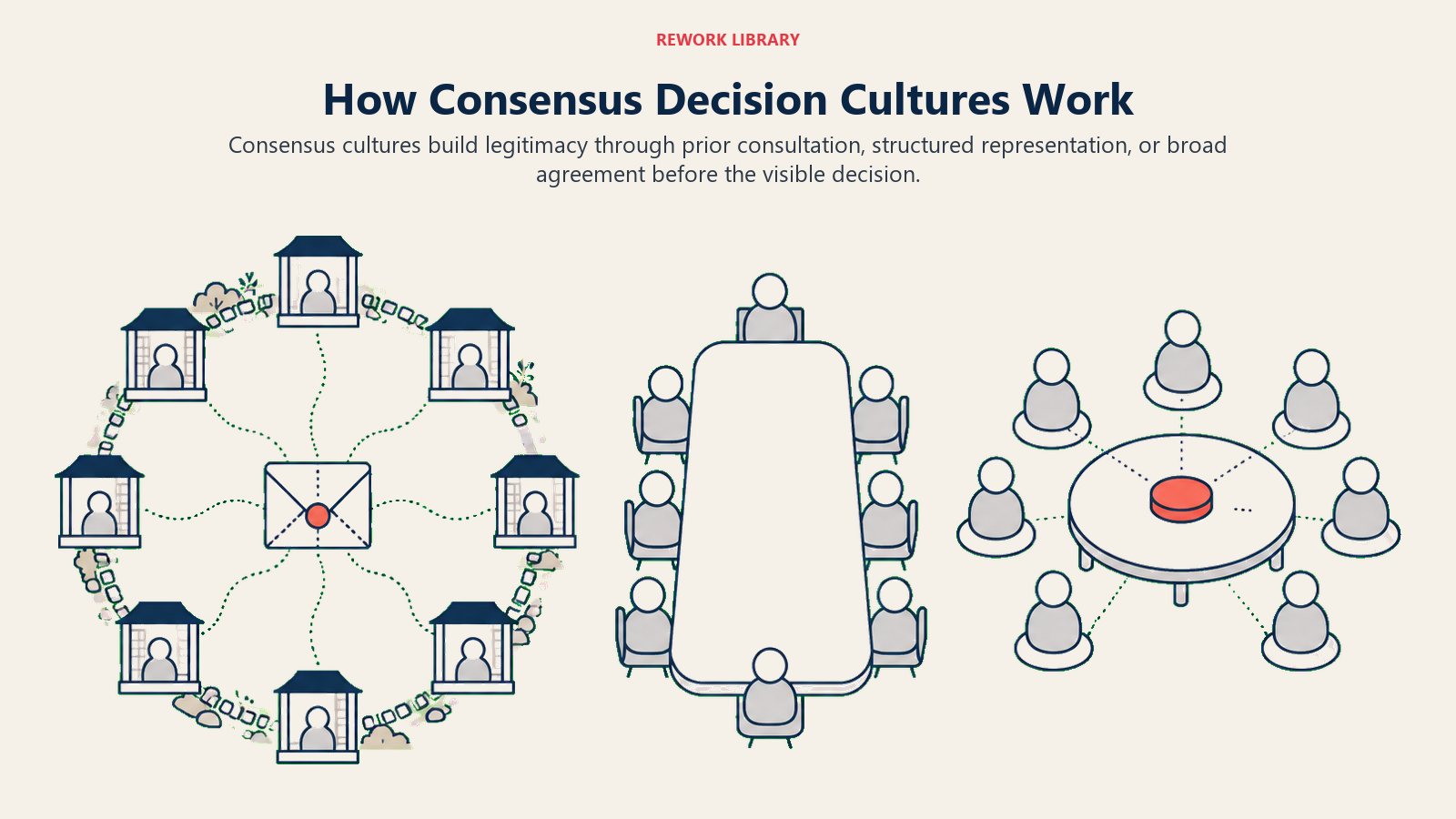
Japan runs the clearest version of this through nemawashi. Before a formal proposal reaches a meeting, the person driving it quietly consults each stakeholder one on one, tests the idea, absorbs objections, and adjusts the plan so most disagreement is resolved before the group ever convenes. The proposal is often captured in a written document called a ringi-sho, circulated for approvals that record consensus already reached rather than the moment persuasion happens. To an outsider, the meeting can look like a rubber stamp. It's the visible tail end of a decision that took real work to build.
Germany builds consensus into the company's formal structure, not just informal habit. Under German codetermination law, large companies must seat employee representatives on their supervisory boards, giving workers a structural seat at major decisions rather than leaving buy-in to a manager's personal style. Paired with a low Hofstede Power Distance score and a strong preference for direct, low-context communication, the result expects consultation before a decision lands, not after, even though authority isn't weak and titles still carry real functional respect.
Sweden sits at the flattest, most consensus-driven end of the spectrum globally. Swedish workplace culture leans heavily on building broad agreement before finalizing a decision, tied to the country's very low Power Distance score and its emphasis on collective input over individual authority. A Swedish manager who announces a decision without a visible consultation process is more likely to be read as having skipped a step than as decisive.
The common thread: consultation isn't a courtesy in a consensual culture. It's the mechanism that makes a decision legitimate, and skipping it risks the decision being quietly ignored or reworked during execution.
Top-Down Decision Cultures: How They Actually Work
In a top-down culture, the decision itself is the fast part. What happens after is where the work lives.
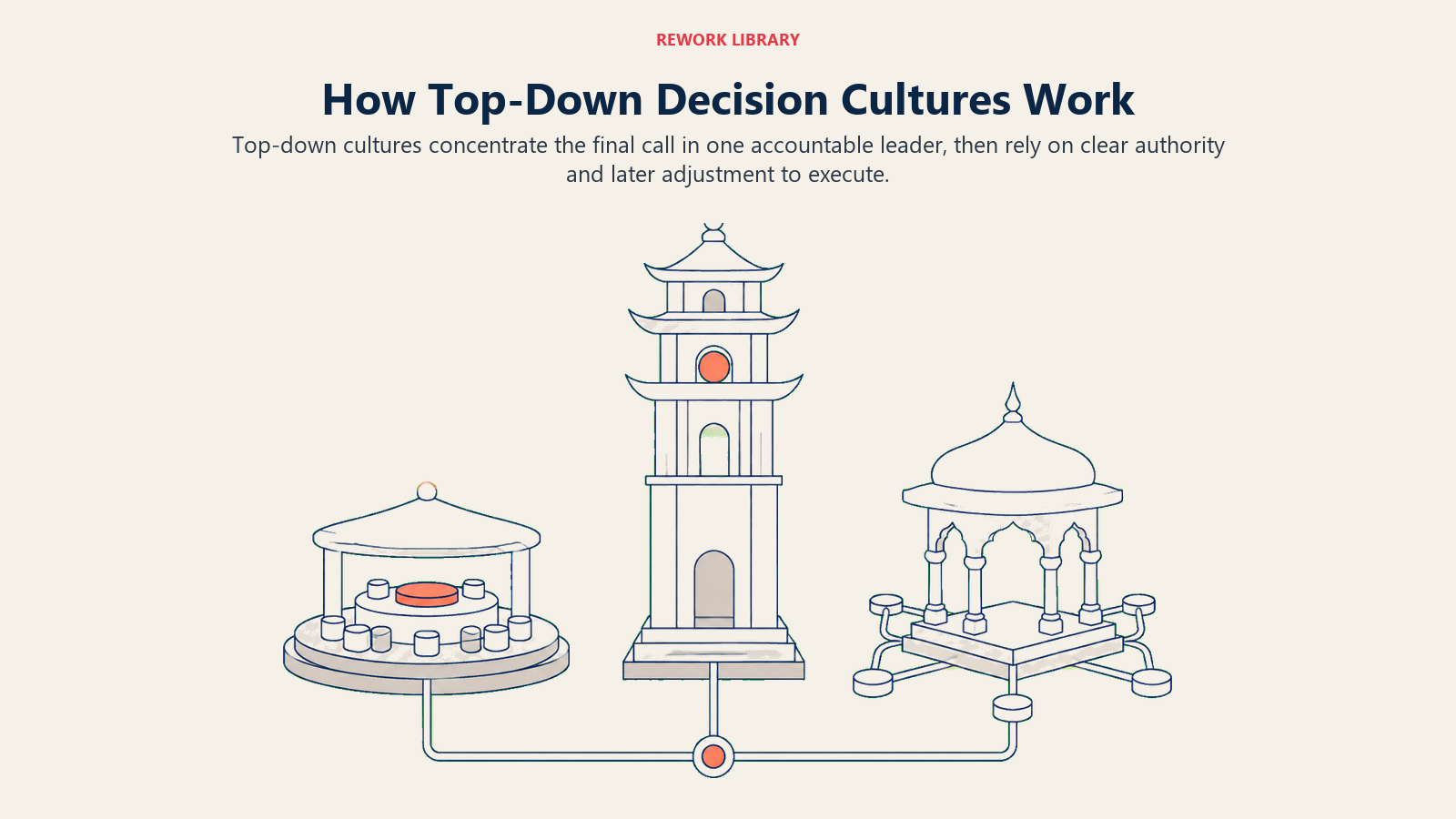
The United States defaults to gathering input quickly and letting one person own the call. A manager might solicit opinions in a meeting or a few messages, but the expectation is that this happens in hours or days, not weeks, and the accountable person decides and moves, adjusting course later rather than waiting for full agreement first. Paired with the US's individually competitive style on Meyer's other scales, "top-down" here doesn't read as authoritarian. It reads as normal, efficient management.
China concentrates decision authority more formally at the top, consistent with its high Hofstede Power Distance score. Senior leaders make the call, and the organization is built to execute quickly once a decision is set, with less of the pre-decision consultation ritual that defines Japan's model. Execution speed is often high specifically because roles and reporting lines are clear, not despite the top-down process.
India combines a high Power Distance score with decisions that often move through both formal hierarchy and an extensive layer of personal relationships. A senior leader's call carries real weight, but the practical path there frequently runs through the right relationships and context-setting conversations first, which can look consensual on the surface while formal authority still sits clearly at the top. Leaders new to Indian business culture sometimes misread this, assuming it works exactly like the American model because English is the working language, or exactly like Japan's because relationships matter, when it's genuinely its own pattern.
The tradeoff in every top-down culture is the same: decisions move fast because fewer people sign off, but they carry a higher risk of being revisited or under-executed if the people carrying them out were never brought into the reasoning.
Country Comparison: Decision Style at a Glance
The table below plots six countries on Hofstede's Power Distance Index alongside Meyer's Deciding scale, since the two don't always move together.
| Country | Power Distance (PDI) | Deciding Style (Meyer) | What actually happens |
|---|---|---|---|
| Japan | 54 | Consensual | Nemawashi builds agreement privately; the meeting ratifies a decision already made |
| Germany | 35 | Consensual, structured | Codetermination and formal process give consultation a legal, not just cultural, backbone |
| Sweden | 31 | Consensual | Among the most consensus-driven cultures globally; broad agreement expected before finalizing |
| United States | 40 | Top-down, individually owned | Input gathered fast, then one accountable person decides and moves |
| China | 80 | Top-down | Authority concentrated at the top; execution moves quickly once the call is made |
| India | 77 | Top-down, relationship-mediated | Formal authority sits at the top, but the path to a decision often runs through personal relationships first |
The pattern worth remembering: Power Distance and Deciding style correlate loosely, not perfectly. Japan and Germany sit in the low-to-middle PDI range yet land firmly on the consensual side, while the US sits in a similar PDI range and lands top-down. Power distance tells you how much deference authority gets, not how a decision actually gets made, which is why Meyer built Deciding as its own scale in The Culture Map.
Key Facts
- Erin Meyer's Deciding scale, one of 8 scales in The Culture Map, runs from Consensual (group agreement first) to Top-down (one person decides). Source: erinmeyer.com
- Hofstede's Power Distance Index scores Japan at 54, Germany at 35, Sweden at 31, the United States at 40, China at 80, and India at 77, on a 0-100 scale built from survey research across more than 100 countries. Source: geerthofstede.com
- Nemawashi, the informal one-on-one consultation process behind Japanese consensus decisions, is typically formalized in a written proposal called ringi-sho once agreement is reached privately. Source: Wikipedia, "Ringi-sho"
- German codetermination law (the Mitbestimmungsgesetz of 1976) requires large companies to seat employee representatives on their supervisory boards, giving workers a formal role in major strategic decisions. Source: Wikipedia, "Codetermination in Germany"
- Microsoft's 2026 Work Trend Index found that where managers created safety around experimenting with AI, employees were 1.4 times more likely to become frequent, judgment-driven users of agentic AI rather than passive ones. Source: Microsoft Work Trend Index 2026
Workplace Implications: Speed, Meetings, and Revisiting Decisions
This gap isn't just a cultural curiosity. It shows up in three concrete places every week.
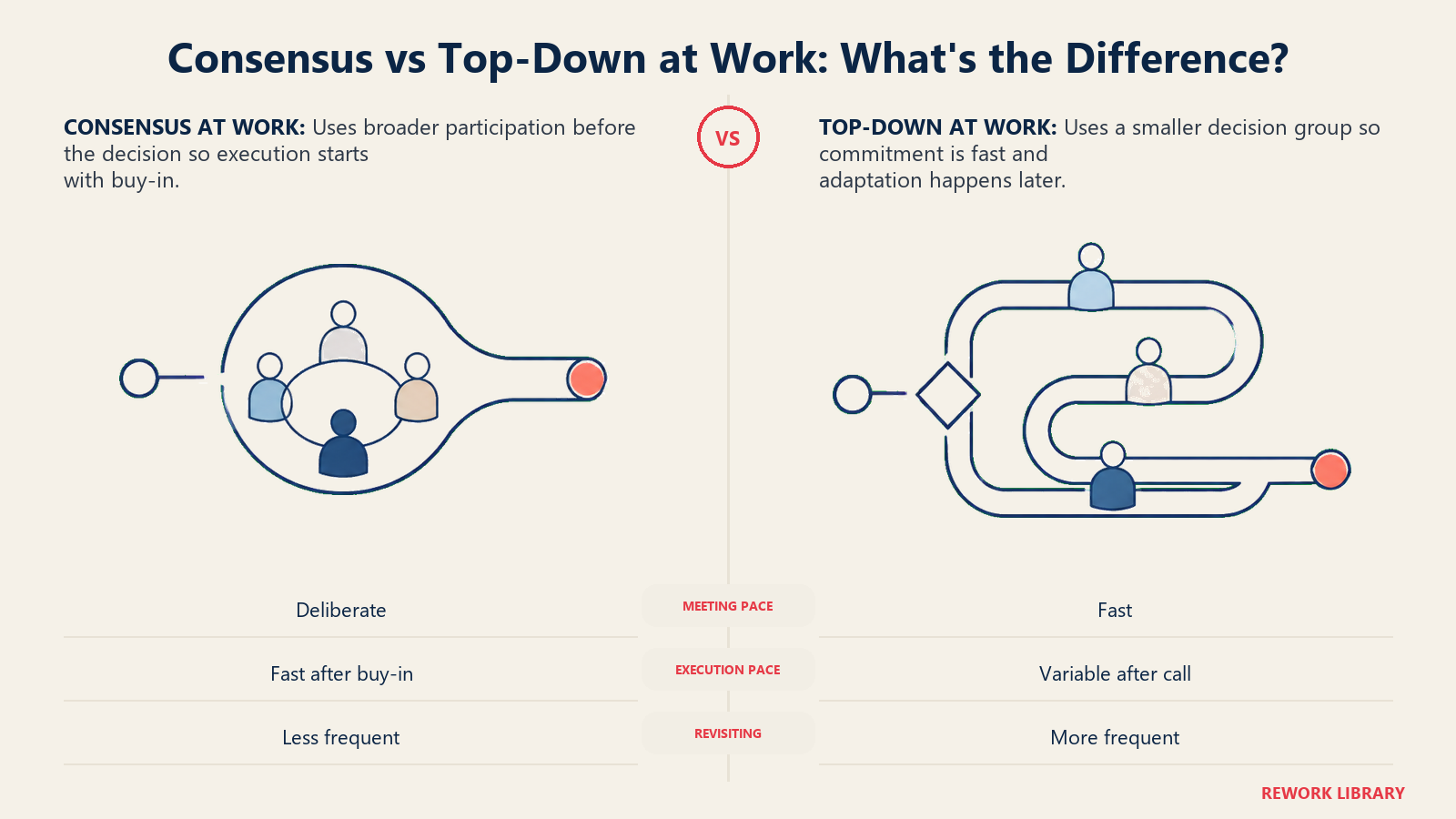
Meeting Speed vs. Execution Speed
A meeting in a top-down culture can look decisive because a call gets made in the room. A meeting in a consensual culture can look slow or indecisive for the same reason: the real decision was never meant to happen live. Judging either culture's meetings by the other's clock is the fastest way to misread what's going on. The useful question isn't "how fast did the meeting end," it's "how fast does the work start moving afterward."
How Often Decisions Get Revisited
Top-down decisions get revisited more often, not because the people making them are careless, but because the input that would have caught a problem early wasn't gathered before the call. Consensual decisions get revisited far less, since objections were surfaced and resolved before the decision was final, though a genuinely wrong consensus can be harder to unwind once a whole group has bought in publicly.
Who Needs to Be in the Room
In a top-down culture, the room only needs the person with authority to decide; everyone else informs that judgment. In a consensual culture, the room needs everyone whose buy-in matters for execution, because leaving a stakeholder out is a structural risk to whether the decision holds. Leaders running global teams often lean on structured decision-making frameworks precisely because "who needs to weigh in" means something different depending on which culture is deciding.
How a Leader Adapts Across the Decision Gap
Both directions require a genuine adjustment, not a borrowed script.
Leading a consensual team as a top-down-raised leader. Build in time for private, one-on-one consultation before expecting a decision to land, and treat that time as part of the decision process, not a delay before the real work starts. Resist reading a slow-moving meeting as a lack of decisiveness; the group is likely building the agreement a top-down culture would have skipped and paid for later. When you do need to move fast, say so explicitly rather than letting people assume you skipped a step they consider mandatory.
Leading a top-down team as a consensus-raised leader. Be ready to make the call yourself once you've gathered reasonable input, rather than waiting for full agreement that may never arrive on the timeline the business needs. A team used to fast, individually owned decisions can read extended consensus-seeking as avoiding responsibility rather than being thoughtful. Explain your reasoning when you decide, since authority alone won't carry it the way title-based deference might elsewhere, a dynamic covered in hierarchical vs. egalitarian cultures. The underlying skill in both directions is the one behind psychological safety: making it safe to tell you what people actually think, early enough to still change the outcome.
Common Cross-Cultural Clashes
Most of the friction between these two styles comes from applying home-culture instincts without adjusting.
A top-down leader announces a decision to a consensual team and gets quiet non-compliance instead of pushback. Nobody objects in the meeting, because open objection isn't how disagreement gets expressed in that culture, covered more in why teams stay silent in meetings. The decision stalls in execution, and the leader has no idea why, because the objection never surfaced anywhere they were watching.
A consensus-raised leader asks a top-down team to "align as a group" and the team reads it as a lack of direction. Extended open-ended discussion without a clear owner can look, to a team used to fast individual decisions, like a leader who doesn't know what they want. What reads as inclusive facilitation in one culture reads as indecision in another.
A cross-border project runs on two decision clocks at once. The consensual side is still quietly consulting stakeholders while the top-down side has already committed and started building, and the mismatch surfaces only when the consensual team's stakeholders raise concerns the other side assumed were settled weeks earlier. Managing this well is a core skill in managing a multicultural team: a shared decision timeline explicit enough that neither side is guessing.
Decision-Making and AI: Who Gets the Final Call
The same question shows up in a newer context: how much decision authority a team hands an AI agent, and who signs off before it acts. A top-down culture tends to give one accountable "agent boss" clear authority to approve or override an agent's recommendation quickly, matching the pattern that already governs human decisions there. A consensual culture wants broader buy-in before an agent is trusted with a consequential call, the same instinct that makes nemawashi work applied to a new kind of teammate.
Neither instinct is wrong, but both need to be deliberate. Microsoft's 2026 Work Trend Index frames the goal as human agency: as agents take on more execution, people should get more room to make judgment calls, not less, which only happens if a team's existing decision culture is extended to cover agents on purpose. We cover that shift, and the manager role it creates, in the Frontier Firm and the rise of the agent boss and in what AI-native culture actually looks like.
Where to Go Next
Consensus versus top-down is one piece of a bigger picture. From here:
- The Culture Map explained, for all 8 of Erin Meyer's scales, including how Deciding relates to Leading, Evaluating, and Disagreeing
- Hierarchical vs. egalitarian cultures, for the Power Distance research behind hierarchy specifically
- How business culture differs across the world, for the wider map of national culture differences
- Hofstede's cultural dimensions explained, for the full six-dimension model and country data behind the Power Distance scores used here
Frequently Asked Questions about Consensus vs Top-Down Decision Making
What is the difference between consensus and top-down decision-making?
Consensus decision-making builds agreement among stakeholders before a decision is finalized, slow to decide but fast to execute once the group commits. Top-down decision-making puts the final call in one person's hands, fast to decide but slower to execute if the people carrying it out were never consulted first.
Is consensus vs top-down the same as hierarchical vs egalitarian culture?
No. Hierarchy, measured by Hofstede's Power Distance Index and Meyer's Leading scale, measures how much deference a boss gets. Decision style, measured by Meyer's Deciding scale, measures who makes the final call. A culture can be hierarchical and still decide by consensus, like Japan, or egalitarian and decide top-down, like the United States.
Which countries make decisions by consensus?
Japan, Germany, and Sweden are commonly cited consensus-driven cultures, though the mechanism differs. Japan uses informal one-on-one consultation known as nemawashi, Germany builds consultation into formal codetermination law, and Sweden leans on a cultural preference for broad agreement before finalizing.
Which countries make decisions top-down?
The United States, China, and India are commonly cited top-down cultures. The US pairs top-down decisions with fast, individually owned execution. China concentrates formal authority at the top with high Power Distance. India combines high Power Distance with a decision path that often runs through personal relationships alongside formal hierarchy.
Why does a consensus culture seem slow in meetings but fast afterward?
Because the real decision-making work happens before the meeting, in private conversations that build agreement stakeholder by stakeholder. The meeting itself often just ratifies a decision already mostly settled, which is why execution moves quickly once the group formally commits.
What is nemawashi?
Nemawashi is the Japanese practice of quietly consulting stakeholders one on one before a formal proposal is raised in a meeting, so objections get surfaced and resolved in private. It's often paired with a written proposal called ringi-sho, a record of consensus already reached rather than the moment persuasion happens.
How should a leader adapt when moving between a consensual and a top-down culture?
Leading a consensual team, build in time for private consultation before expecting a decision to stick, and say so explicitly if you need to compress that timeline. Leading a top-down team, be ready to make the call yourself once you have reasonable input, and explain your reasoning since title alone won't carry the decision the way it might elsewhere.
Neither consensus nor top-down decision-making is the "right" default. Each is a rational tradeoff between speed and buy-in, built up over generations in a specific business culture, and both fail the same way when a leader assumes their home country's version is just how good decisions get made. The leaders who move easily across this gap ask which tradeoff a culture has already made, then adjust how they consult, decide, and communicate to match it, instead of importing one script and hoping it travels.

Co-Founder, Rework.com
On this page
- The Research Behind Consensus vs Top-Down Decision-Making
- Erin Meyer's Deciding Scale
- Why Deciding Is Not the Same as Leading
- Consensual Decision Cultures: How They Actually Work
- Top-Down Decision Cultures: How They Actually Work
- Country Comparison: Decision Style at a Glance
- Workplace Implications: Speed, Meetings, and Revisiting Decisions
- Meeting Speed vs. Execution Speed
- How Often Decisions Get Revisited
- Who Needs to Be in the Room
- How a Leader Adapts Across the Decision Gap
- Common Cross-Cultural Clashes
- Decision-Making and AI: Who Gets the Final Call
- Where to Go Next