High-Context vs Low-Context Cultures at Work
Turn this article into takeaways for your work.


Each assistant summarizes the article only for you and suggests best practices for your work.
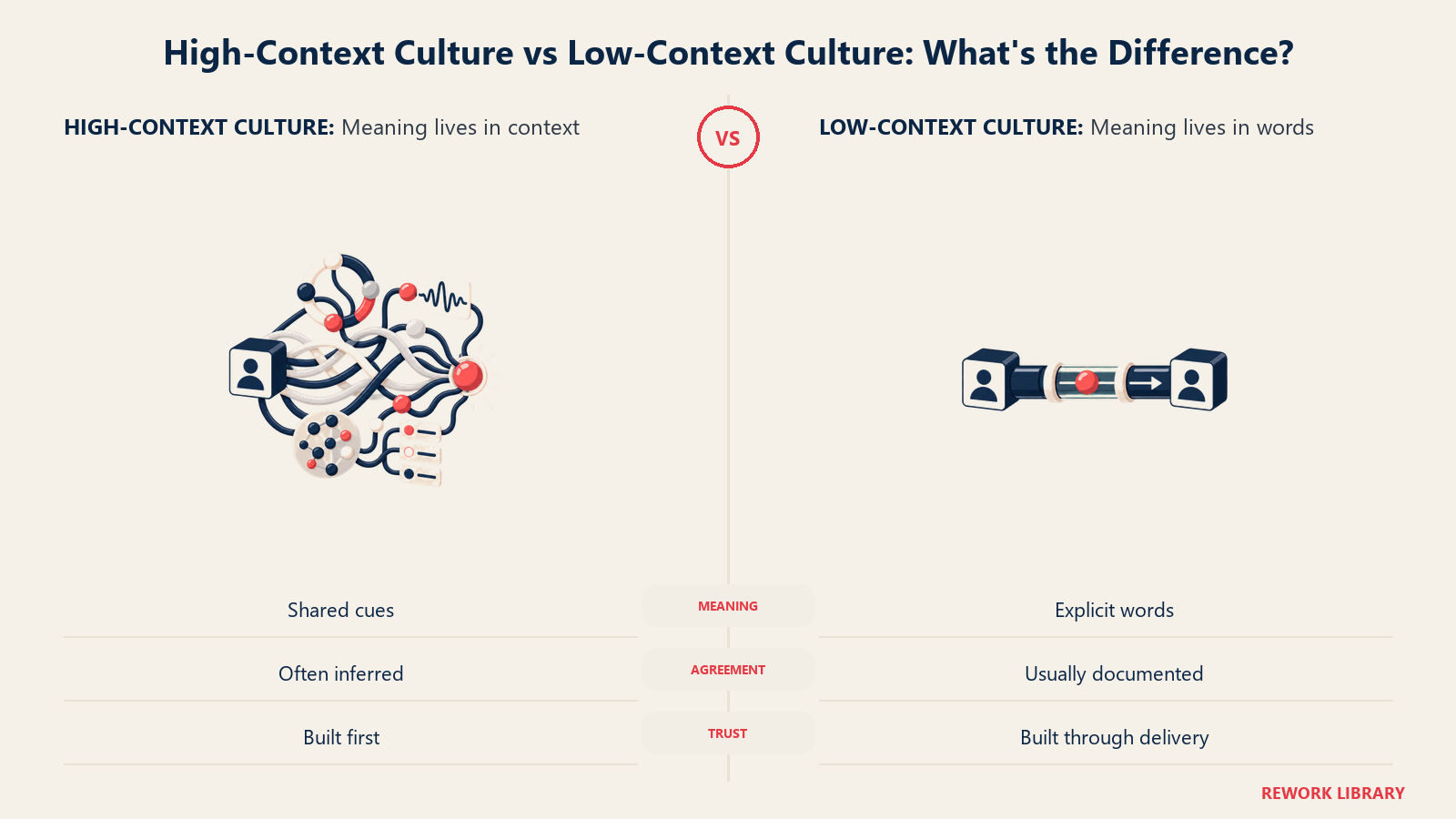
High context vs low context culture is anthropologist Edward T. Hall's framework for how much meaning a culture packs into the actual words versus into everything surrounding them: relationship, tone, silence, and shared history. Low-context cultures say what they mean. High-context cultures expect you to read the room.
You have already lived this framework even if you never heard Hall's name. A direct "this plan won't work" from an American colleague can read as refreshingly honest in New York and unforgivably rude in Jakarta. A Japanese counterpart's "that would be a bit difficult" can sound like a scheduling note to someone from Frankfurt and land as a firm no to everyone else in the room. Neither person is wrong. They are running two different operating systems for how meaning gets transmitted, and most cross-border friction at work traces back to exactly this gap.
What High-Context and Low-Context Culture Actually Means
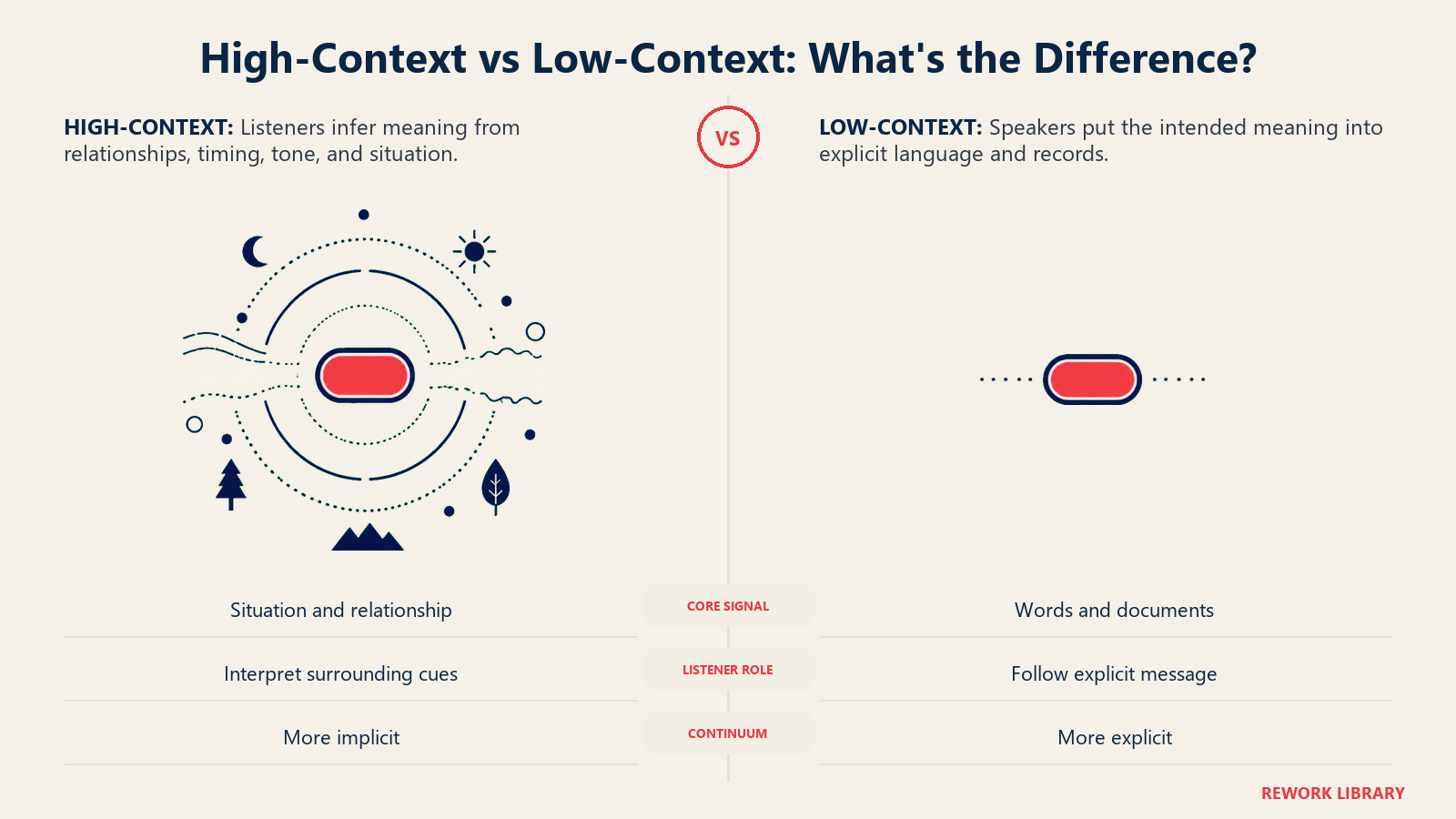
Hall introduced the distinction in his 1976 book Beyond Culture, arguing that every act of communication sits somewhere on a spectrum between two poles: how much of the message is carried by explicit words, and how much is carried by context, meaning the relationship between speakers, the physical setting, tone of voice, timing, and what both sides already understand without saying it out loud. No culture sits at either extreme. The framework describes a tendency, not a rule that applies to every person from a given country.
This is the same idea Erin Meyer later built her Communicating scale on in The Culture Map, and it connects directly to the broader six-axis view we cover in how business culture differs across the world. Hall's original contribution was naming the pattern first and giving researchers decades of vocabulary to build on.
Low-Context Communication: Meaning Lives in the Words
In a low-context culture, the words carry the message. Say what you mean, put it in writing, and expect the other person to take your sentence at face value rather than search it for hidden intent. The United States, Germany, Switzerland, the Netherlands, and the Nordic countries (Sweden, Denmark, Norway, Finland) sit toward this end. A German engineer who says a deadline is at risk means the deadline is at risk, not that they are testing how you react to bad news.
Low-context workplaces tend to over-invest in explicit documentation: detailed contracts, written meeting notes, clear job descriptions, and specific, itemized feedback. Ambiguity reads as a communication failure to fix, not a normal feature of a conversation.
High-Context Communication: Meaning Lives in the Situation
In a high-context culture, a lot of the message lives outside the sentence. Japan, China, South Korea, Vietnam, Indonesia, Thailand, and most Arab and Gulf business cultures sit toward this end, along with much of Latin America. A flat "no" is rare in these settings. Disagreement, hesitation, and bad news get carried through pauses, a change in tone, a vague "we will consider it," or a third party relaying the real answer later.
This is not evasiveness. It is a different theory of politeness and relationship management: preserving the other person's standing and the group's harmony often outweighs the value of stating a fact bluntly in the moment. Someone raised in a high-context culture can read a room with a precision that a low-context colleague genuinely cannot, because that skill has been trained since childhood.
High-Context vs Low-Context Cultures: A Comparison Table
The two ends of the spectrum diverge in predictable ways across the moments that matter most at work.
| Dimension | Low-context culture | High-context culture |
|---|---|---|
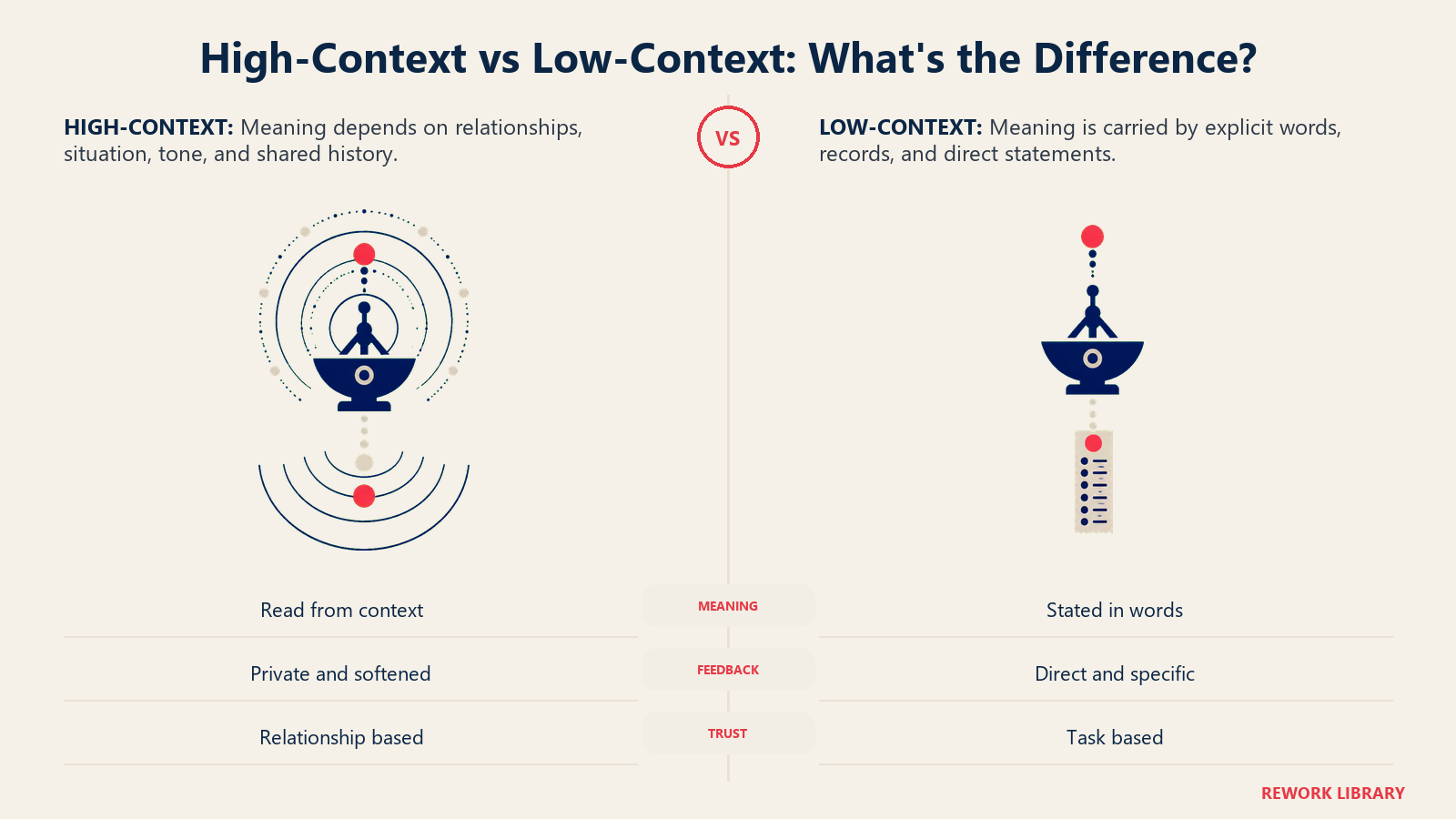
| Meaning | Carried by explicit words | Carried by tone, relationship, and situation |
| Typical countries | United States, Germany, Netherlands, Switzerland, Nordics | Japan, China, Vietnam, Indonesia, Thailand, most Arab and Gulf cultures |
| Contracts and agreements | Detailed, legally binding, the final word | A starting point; the relationship governs what actually happens |
| Feedback | Direct, specific, often delivered in the moment | Indirect, softened, often delivered privately or through a third party |
| Silence in a meeting | Usually means no objection | Often means disagreement being routed elsewhere |
| Trust | Built through delivered work and track record | Built through time spent together and personal rapport |
| "Yes" | Usually means agreement | Can mean "I hear you," not agreement |
Treat this table as a starting hypothesis, not a scorecard. Plenty of individuals sit outside their national default, and company culture (especially at a global company with deliberate onboarding) can shift someone's working style well past where their country's average would predict.
Key Facts
- Edward T. Hall introduced the high-context and low-context distinction in his 1976 book Beyond Culture. Source: EBSCO Research Starters
- Erin Meyer's Communicating scale in The Culture Map, one of eight scales in her 2014 framework, builds directly on Hall's original theory and applies it specifically to business communication. Source: Harvard Business Review, "Navigating the Cultural Minefield," May 2014
- A Harvard Business Review analysis found 89% of white-collar workers surveyed across 90 countries said they at least occasionally work on global virtual teams that cross national boundaries, exactly the setting where context mismatches surface most often. Source: HBR
- Geert Hofstede's original national culture research surveyed more than 100,000 IBM employees across 40 countries between 1967 and 1973, work that later informed how researchers like Hall and Meyer framed communication style as a measurable cultural variable. Source: geerthofstede.com
Where Countries Fall on the Spectrum
The Japan-versus-America contrast gets cited so often that it can flatten a spectrum that actually has a lot of texture in the middle. France and Russia, both nominally "Western," read as noticeably more high-context than the US or Germany on Meyer's Communicating scale, closer in style to parts of Latin America than to their European neighbors. The United Kingdom sits closer to the middle than most people assume, direct in writing but famously indirect in speech, where "that's an interesting idea" at a British company can mean the idea is dead.
For a country-by-country breakdown that goes beyond communication style into hierarchy, decision-making, and trust-building, how business culture differs across the world maps the Power Distance and Individualism axes that tend to travel alongside high-context and low-context patterns. Hofstede's cultural dimensions gives you the underlying country scores if you need a specific market before a negotiation or a hire.
What High-Context vs Low-Context Looks Like at Work
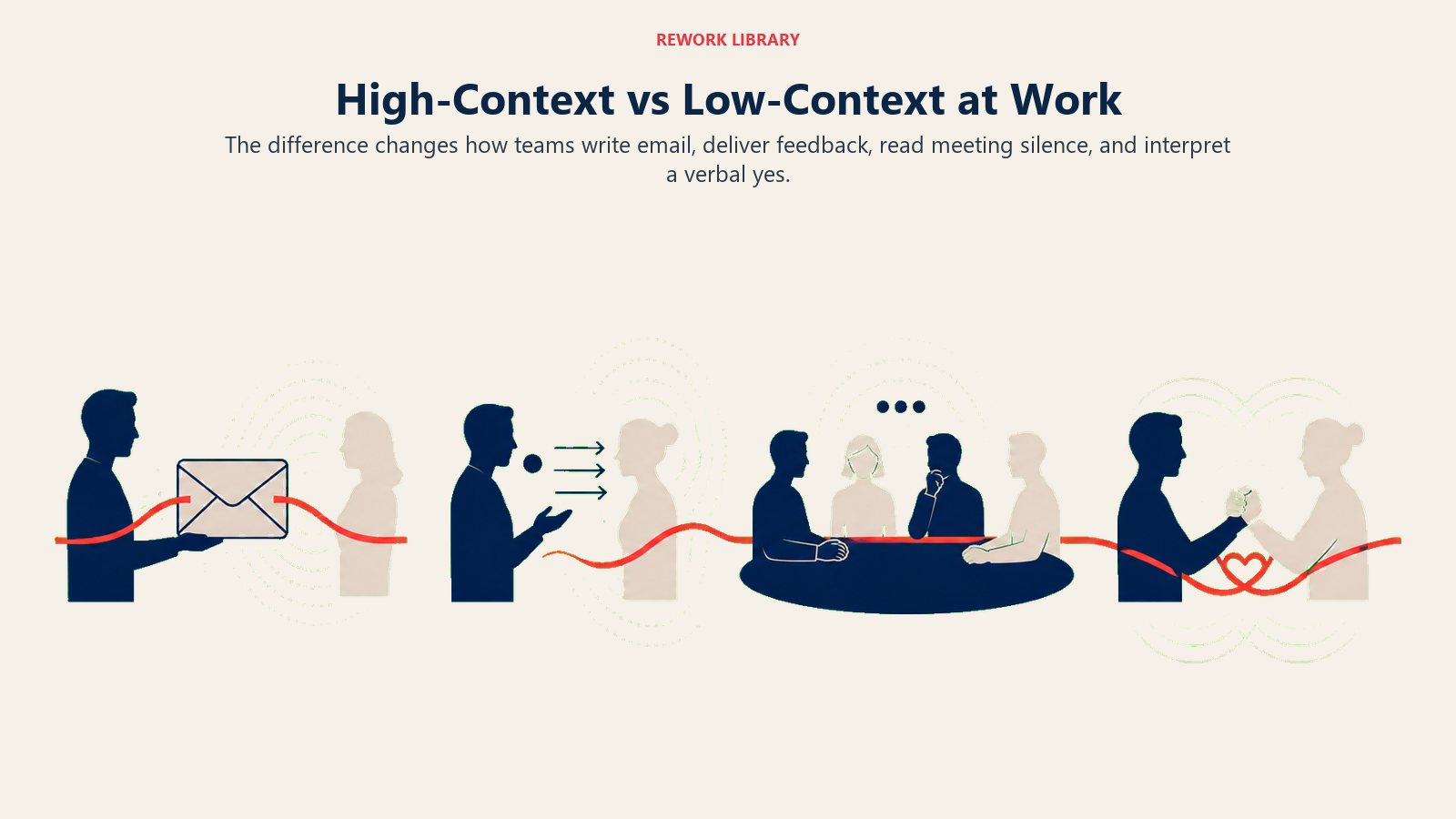
The framework stops being academic the moment two people from opposite ends have to write an email, sit through the same meeting, or figure out whether a project actually got approved.
Email and Written Communication
A low-context email states the ask in the subject line, gets to the point in the first sentence, and uses bullets for anything with more than two parts. A high-context email often opens with a relationship check-in, states the request more softly, and expects the reader to infer urgency from context (who sent it, when, and what else is happening) rather than from a bolded deadline.
The mismatch runs both ways. A low-context reader can skim past a high-context colleague's carefully placed hint and miss that it was actually an urgent ask. A high-context reader can find a low-context colleague's terse, bulleted email cold or even hostile, when the sender meant nothing more than efficient.
Feedback and Performance Reviews
Direct feedback delivered plainly and in the moment works well in low-context cultures and can feel like an attack in high-context ones, where the same substance usually needs to travel through a private conversation, a softer frame, or a trusted intermediary to land as intended. Giving feedback well across this gap means keeping the substance and changing the delivery, not diluting the message until it disappears. Leaders who default to a radical candor style everywhere they go often get read as harsh outside low-context teams, even when the intent is care, not criticism.
Meetings and Decision-Making
Silence means something different depending on which culture is in the room. In a low-context meeting, no objection usually means agreement, and a decision made out loud is the real decision. In a high-context meeting, the real decision-making often happens before or after the meeting, in one-on-one conversations, and the meeting itself is closer to a formality that confirms what has already been settled quietly. A leader who reads high-context silence as buy-in, then acts on it, is often the first to be surprised when the plan quietly stalls. This is the exact dynamic behind why teams stay silent in meetings, and it interacts closely with psychological safety: in a high-context, high-hierarchy setting, silence can be safety-seeking behavior rather than agreement, which changes what a leader needs to fix.
What "Yes" Actually Means
Nothing trips up cross-cultural teams faster than the word "yes." In a low-context culture, "yes" is a commitment. In many high-context cultures, "yes" can mean "I hear you," "I understand the request," or "I don't want to embarrass you by saying no directly," none of which guarantee the thing will actually happen. A manager who takes a high-context "yes" at face value and skips the follow-up question ("what does the timeline look like from your side?") is the person most often blindsided by a missed deadline nobody flagged in advance.
Common Misunderstandings Between High-Context and Low-Context Teams
The same behavior gets read in opposite ways depending on which side of the spectrum is doing the reading, which is why so much cross-cultural friction gets misdiagnosed as a personality clash instead of a communication-style gap.
- A low-context colleague reads high-context indirectness as evasive, dishonest, or unprepared, when the intent was actually politeness and face-saving.
- A high-context colleague reads low-context directness as blunt, rude, or aggressive, when the intent was actually efficiency and respect for the other person's time.
- A terse, bulleted email gets read as anger by a high-context recipient and as simple competence by a low-context sender.
- Silence in a meeting gets treated as agreement by a low-context leader and as a safety signal being routed elsewhere by everyone else in the room, covered further under conflict resolution across cultural styles.
- A verbal "yes" gets logged as a firm commitment on one side and as a polite acknowledgment on the other, with nobody catching the gap until a deadline is missed.
- A written contract gets treated as the final word by one side and as a starting point that the relationship will keep shaping by the other.
None of these are failures of intelligence or good faith. They are two different, internally consistent systems for transmitting meaning, colliding without either side realizing there was a translation step to do first.
How Leaders Bridge the Gap
Bridging high-context and low-context styles is a skill, not a personality trait, and it is learnable with a few concrete habits.
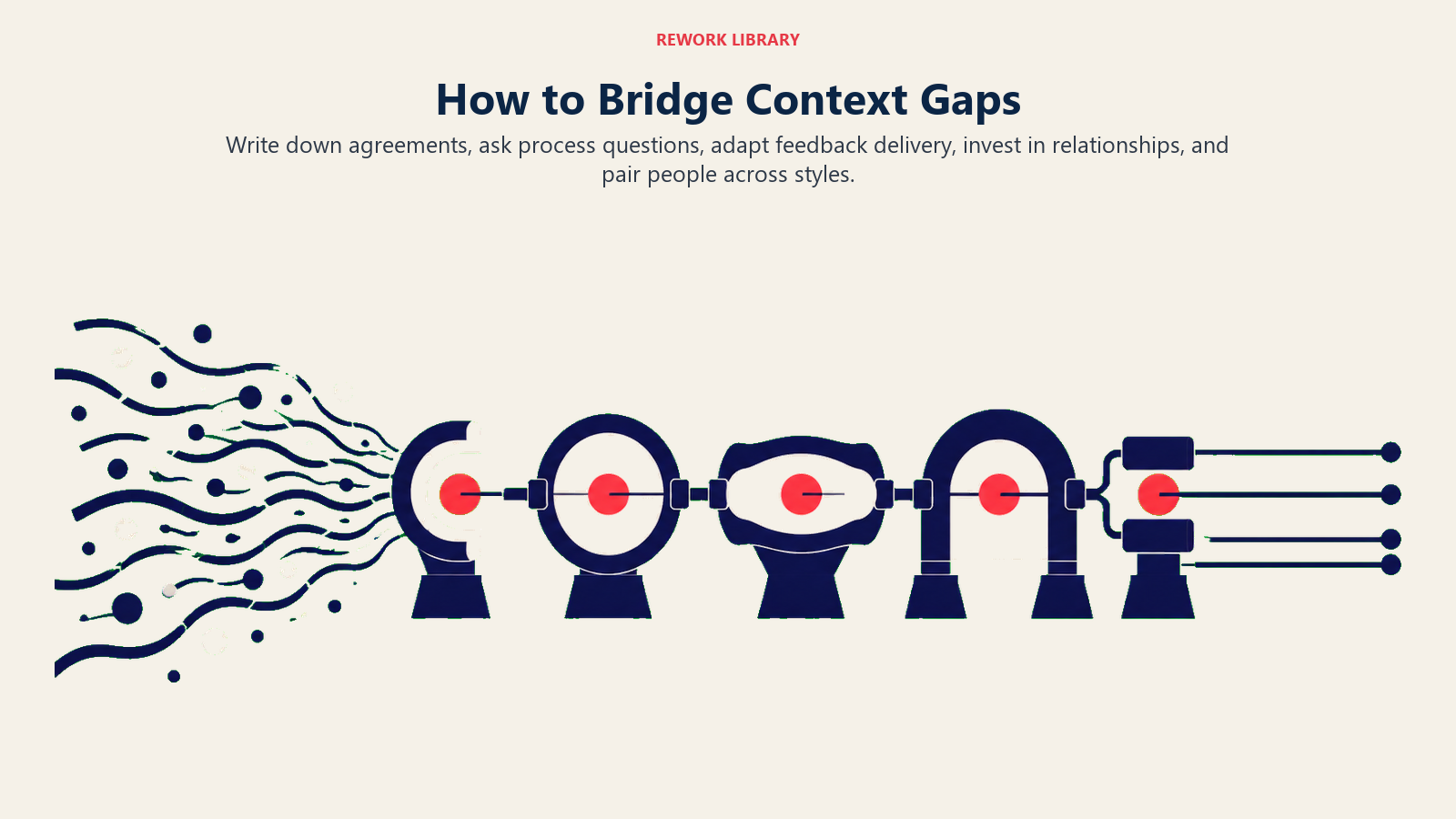
Summarize verbal agreements in writing, every time. After a meeting with a mixed-context team, send a short written recap of what was decided and who owns what. This gives low-context colleagues the explicit record they expect and gives high-context colleagues a chance to quietly correct a misread before it becomes a missed deadline.
Ask process questions instead of yes-or-no questions. Replace "does that work for you?" with "walk me through how you'd approach the first two weeks." A high-context colleague will reveal hesitation through the plan they describe long before they would say "no" outright.
Separate the message from the delivery when giving feedback. Keep the substance honest and specific, and adjust only the packaging (private versus public, direct versus softened, immediate versus scheduled) to match the person in front of you rather than a one-size-fits-all script.
Build in relationship time before the ask, in high-context markets. A negotiation or a big request that skips straight to business, with no time invested in the relationship first, reads as presumptuous in most high-context cultures and slows the deal down more than the time it would have taken to build rapport first.
Treat this as a cultural intelligence skill your team can actually build, not a fixed trait some people have and others lack. Pairing a high-context and a low-context colleague on the same account or project, so each one has a translator for the other's signals, tends to work better than a training deck alone. The same logic extends to decision-making itself: agree in advance, as a team, on what will count as a real decision (a written sign-off, a verbal yes in a meeting, silence after a deadline) so the ambiguity gets resolved before it causes a problem, not after.
High-Context and Low-Context Culture in the Age of AI
Worth naming honestly: AI-drafted communication tends to default to explicit, bullet-heavy, low-context English regardless of who is actually on the other end of the message. That is useful when the recipient wants exactly that. It is a real loss when the recipient is a high-context colleague who reads tone, hedging, and relationship framing as part of the actual content, not decoration around it. A performance review or a client email that gets run through an AI polish pass can come out clearer and colder at the same time, stripped of the contextual cues a high-context reader relies on to understand what is really being said. This is one concrete version of what AI cultural debt looks like in practice: a tool optimized for clarity quietly erasing the cultural texture a relationship actually needs.
Where to Go Next
This article is one piece of the larger cross-cultural picture in this collection. From here:
- The Culture Map, explained, for Erin Meyer's full Communicating scale and the seven other workplace behaviors it sits alongside
- Hofstede's cultural dimensions, for citable country scores on hierarchy, individualism, and four other axes
- How business culture differs across the world, for the broader six-axis map and a region-by-region playbook
- Why teams stay silent in meetings, for the specific silence-as-signal problem this framework helps diagnose
Most cross-cultural friction at work is not a values conflict or a personality clash. It is two people running different, internally consistent rules for where meaning lives, each one certain they are being clear. Learning to spot which system the person across the table is using, and adjusting your own delivery without diluting your actual message, is one of the highest-leverage skills a leader managing a global team can build.

Co-Founder, Rework.com
On this page
- What High-Context and Low-Context Culture Actually Means
- Low-Context Communication: Meaning Lives in the Words
- High-Context Communication: Meaning Lives in the Situation
- High-Context vs Low-Context Cultures: A Comparison Table
- Key Facts
- Where Countries Fall on the Spectrum
- What High-Context vs Low-Context Looks Like at Work
- Email and Written Communication
- Feedback and Performance Reviews
- Meetings and Decision-Making
- What "Yes" Actually Means
- Common Misunderstandings Between High-Context and Low-Context Teams
- How Leaders Bridge the Gap
- High-Context and Low-Context Culture in the Age of AI
- Where to Go Next