Hofstede's 6 Cultural Dimensions: A Business Leader's Guide
Turn this article into takeaways for your work.


Each assistant summarizes the article only for you and suggests best practices for your work.
Hofstede's 6 cultural dimensions are a research-based framework that scores national cultures from 0 to 100 across six axes: power distance, individualism, motivation toward achievement, uncertainty avoidance, long-term orientation, and indulgence. Built from decades of cross-cultural research, the model gives leaders a data-backed starting point for reading how culture shapes behavior at work.
The framework comes from Dutch social psychologist Geert Hofstede, who studied national culture through survey data collected across dozens of countries starting in the late 1960s. Unlike stereotypes or travel-guide generalizations, each score is derived from actual survey responses aggregated at the country level, then validated and extended by replication studies over decades. That doesn't make it perfect (more on that later), but it does make it one of the few cultural frameworks a leader can actually cite, plot, and plan around instead of guessing.
This guide breaks down what each of the six dimensions measures, what it means for the leader running a cross-border team or evaluating an international market, real country scores you can use immediately, and where the model's limits are so you don't over-apply it.
What Hofstede's 6 Cultural Dimensions Measure
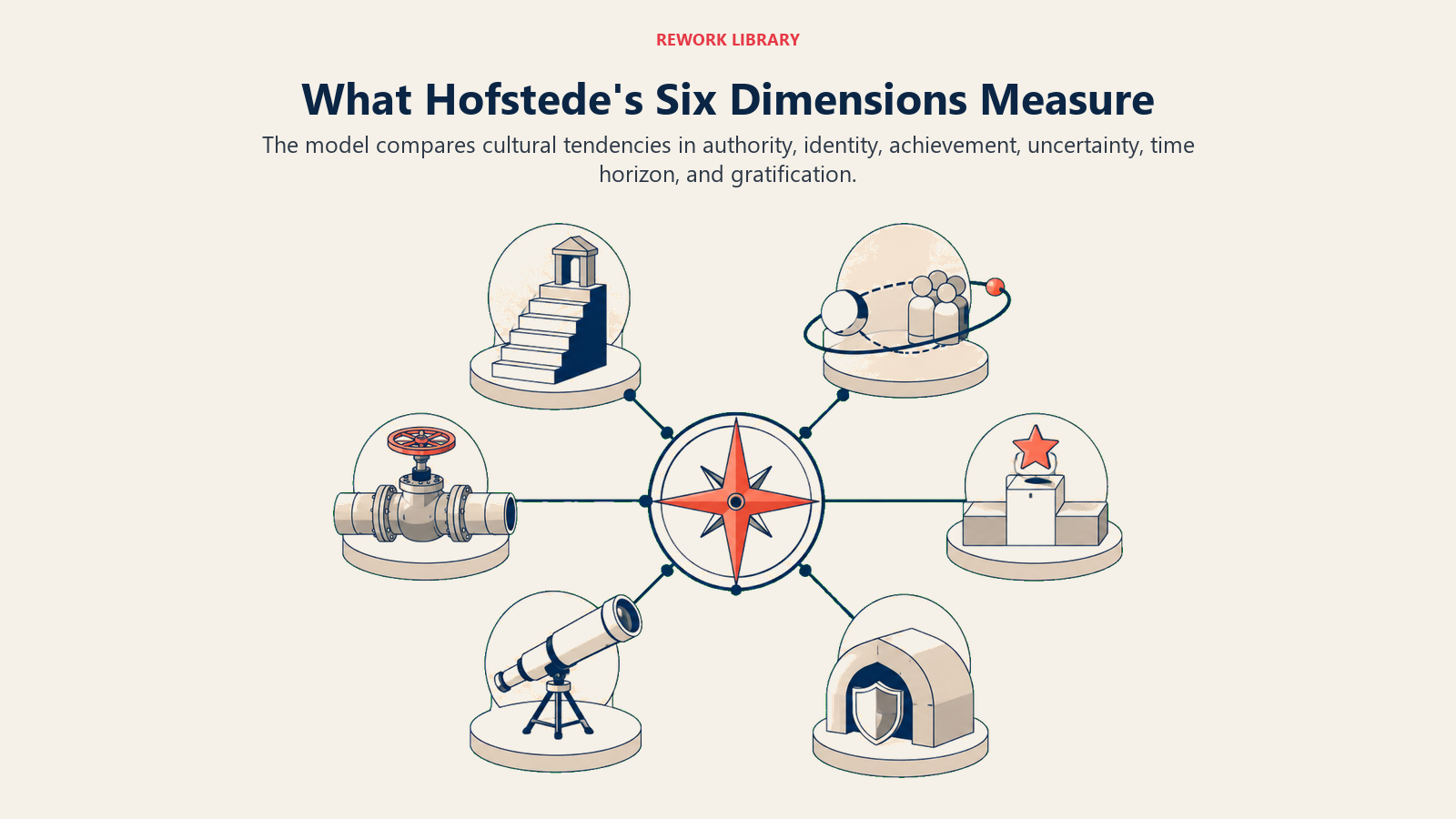
Each dimension captures a different axis of how a society tends to organize authority, identity, ambition, risk, time, and gratification. A country's score doesn't describe any one person. It describes a statistical tendency, a center of gravity that shapes norms, expectations, and defaults in that culture's workplaces.
Power Distance (PDI)
Power Distance measures how much a culture expects and accepts an unequal distribution of authority. A high PDI score means employees expect direction to flow from the top, titles and seniority carry real weight in the room, and openly challenging a superior is uncommon. A low PDI score means authority is expected to explain its reasoning, and juniors are expected to speak up when they disagree.
For a leader, PDI shapes how meetings actually work. In a high-PDI culture, silence after "any questions?" usually doesn't mean agreement. It means disagreement is being routed somewhere other than the room. In a low-PDI culture, that same silence is a much more reliable signal. We go deeper on this specific axis, including how it plays out in real meetings, in hierarchical vs. egalitarian cultures.
Individualism vs. Collectivism (IDV)
Individualism measures whether people primarily identify as "I" or as "we." A high IDV score means people are expected to look after themselves and their immediate family, and individual credit (and individual blame) is the norm. A low IDV score means people are embedded in a broader in-group, extended family, team, or company, that they support and that supports them in return, and group harmony weighs heavily in decisions.
This dimension shows up constantly in performance management. Individual bonus structures, "employee of the month" recognition, and single-owner accountability play naturally in high-IDV cultures. In low-IDV cultures, singling one person out in front of the team can embarrass the person it's meant to reward, and team-based recognition lands better.
Motivation Toward Achievement and Success (MAS)
Hofstede originally labeled this dimension Masculinity, but later reframed it as Motivation Toward Achievement and Success versus a Quality of Life orientation, since the underlying axis has nothing to do with gender composition. A high-scoring culture rewards competition, visible achievement, and assertiveness. A low-scoring culture favors cooperation, modesty, consensus, and quality of life over status.
For business, this dimension predicts how well competitive incentive structures, aggressive sales targets, and public leaderboards will land. They tend to motivate in high-scoring cultures like Japan and the UK, and can feel abrasive or status-obsessed in lower-scoring cultures that favor a quieter, more collaborative definition of success.
Uncertainty Avoidance (UAI)
Uncertainty Avoidance measures a culture's tolerance for ambiguity, risk, and unstructured situations. High-UAI cultures prefer detailed rules, formal processes, and thorough planning before acting. Low-UAI cultures are more comfortable improvising, changing course mid-project, and operating with fewer written rules.
This is the dimension that most directly predicts friction between a "move fast" startup culture and a market that expects contracts, documentation, and process before commitment. A rollout plan that reads as decisive in a low-UAI market can read as reckless or under-prepared in a high-UAI one like Japan or Germany, both of which score above 90 and 60 respectively on this axis.
Long-Term Orientation (LTO)
Long-Term Orientation measures whether a culture leans pragmatic (adapting traditions to changing circumstances, valuing perseverance and long-horizon investment) or normative (valuing tradition, quick results, and stability of truth). High-LTO cultures plan and invest for outcomes years out. Low-LTO cultures favor near-term results and hold more firmly to established norms and past practice.
Leaders negotiating market entry, partnership terms, or ROI timelines should read this score before setting expectations. A high-LTO market like Germany or Indonesia may expect a multi-year investment horizon before a partnership pays off, while a low-LTO market may expect quarter-over-quarter proof before committing further.
Indulgence vs. Restraint (IVR)
Indulgence measures how freely a culture allows gratification of natural human desires related to enjoying life and having fun, versus a Restraint orientation that suppresses gratification through strict social norms. High-IVR cultures tend to place more value on leisure, personal freedom, and positive emotion. High-Restraint cultures place more value on duty, moderation, and controlling one's impulses.
This dimension is easy to overlook but matters for benefits design and workplace culture. Flexible time off, social events, and a lighter management style tend to land well in higher-IVR cultures like the UK and the US. In more restrained cultures, structure and clearly defined obligations tend to read as respect rather than rigidity.
Key Facts
- Hofstede's original national culture research surveyed over 100,000 IBM employees across 40 countries between 1967 and 1973, and the resulting 6-D model has since been extended to cover more than 100 countries and regions on a 0-100 scale, with roughly 50 as the rough midpoint. Source: geerthofstede.com
- The GLOBE study, one of the largest cross-cultural leadership research projects ever conducted, coordinated around 200 country co-investigators to survey roughly 17,000 middle managers across 950 organizations in 62 societies. Source: globeproject.com
- A Harvard Business Review analysis found that 89% of white-collar workers surveyed across 90 countries said they at least occasionally complete projects on global virtual teams that cross national boundaries, the exact setting where these dimensions matter most day to day. Source: hbr.org
- Erin Meyer's The Culture Map, developed through her research and teaching at INSEAD, maps business culture across eight distinct scales, an alternative, more granular lens to Hofstede's six. Source: erinmeyer.com
Hofstede Scores by Country: A Comparison Table
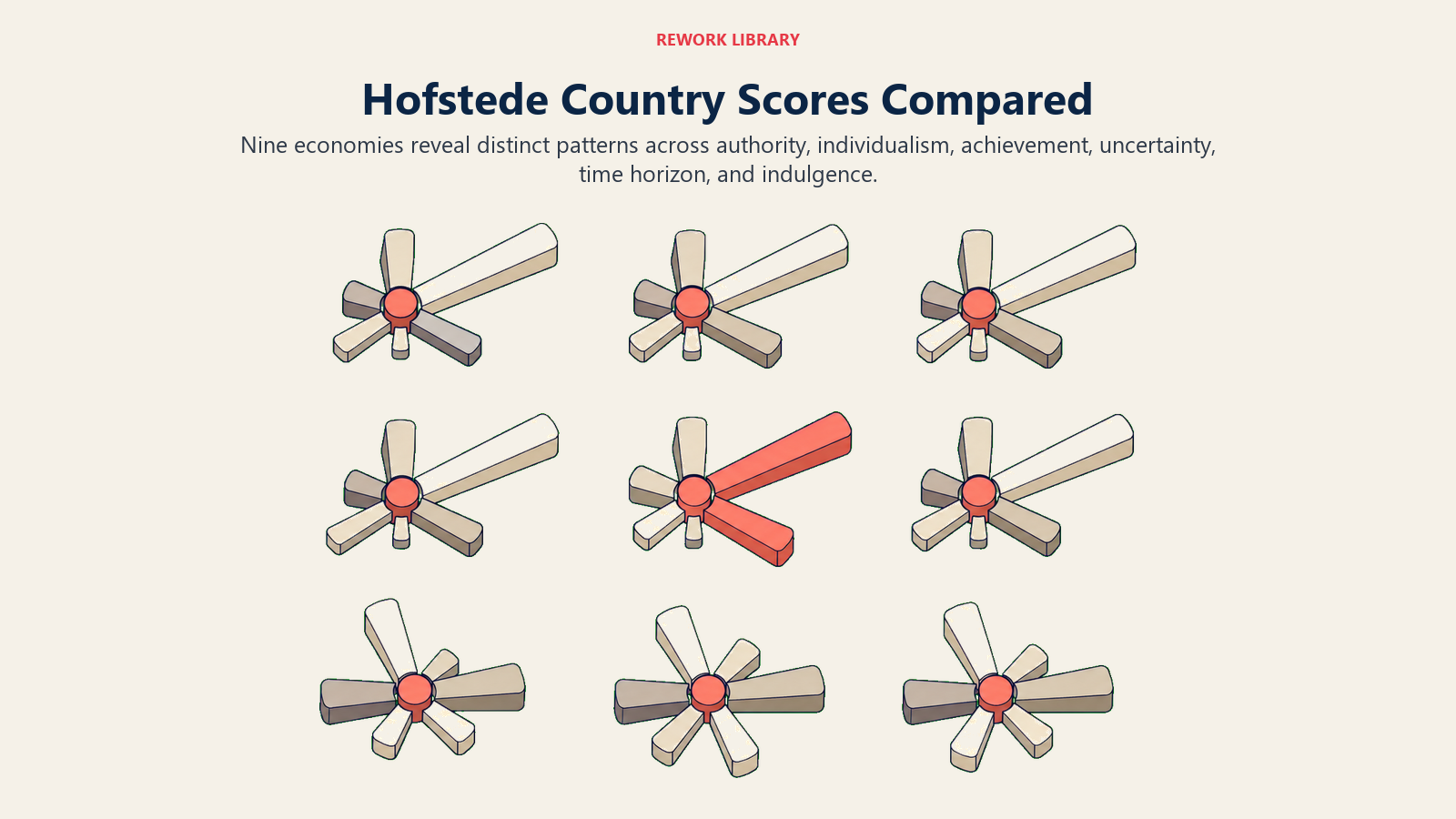
Here's how nine major economies score across all six dimensions, using Hofstede's published country data. Verify or explore any of these scores directly with the official country comparison tool.
| Country | Power Distance (PDI) | Individualism (IDV) | Achievement/Success (MAS) | Uncertainty Avoidance (UAI) | Long-Term Orientation (LTO) | Indulgence (IVR) |
|---|---|---|---|---|---|---|
| Vietnam | 70 | 20 | 40 | 30 | 57 | 35 |
| Malaysia | 100 | 26 | 50 | 36 | 41 | 57 |
| Philippines | 94 | 32 | 64 | 44 | 27 | 42 |
| Indonesia | 78 | 14 | 46 | 48 | 62 | 38 |
| Thailand | 64 | 20 | 34 | 64 | 32 | 45 |
| Japan | 54 | 46 | 95 | 92 | 88 | 42 |
| United States | 40 | 91 | 62 | 46 | 26 | 68 |
| United Kingdom | 35 | 89 | 66 | 35 | 51 | 69 |
| Germany | 35 | 67 | 66 | 65 | 83 | 40 |
A few patterns worth noting for the leader planning across these markets. Japan stands out with the highest Uncertainty Avoidance (92) and Achievement/Success (95) scores in this table, which explains both its heavy investment in process and quality control, and its reputation for intense, achievement-driven work culture. Southeast Asian economies (Vietnam, Malaysia, the Philippines, Indonesia, Thailand) cluster tightly on high Power Distance and low Individualism, the same pattern we cover in detail, including the communication and decision-making implications, in how business culture differs across the world. The US and UK cluster on low Power Distance and high Individualism, while Germany combines that same low Power Distance with the highest Long-Term Orientation and Uncertainty Avoidance of the Western economies in this set, a mix that shows up as a culture that is both egalitarian and highly structured.
How Business Leaders Use Hofstede's Dimensions
The scores are only useful once they change what you actually do. Here's where they apply most directly.
Managing across cultures. Use the scores as a starting hypothesis before you walk into a new market or inherit a team you haven't led before, not as a fixed script. A leader moving from a low-PDI, high-IDV culture (the US) into a high-PDI, low-IDV team (Vietnam or the Philippines) should expect more deference in the room and build separate channels for dissent, an approach we cover further in inclusive leadership.
Running meetings. In high-PDI, high-UAI cultures, expect more silence, more deference to the senior person present, and more discomfort with open-ended, unstructured discussion. Psychological safety research, including the foundational work covered in Amy Edmondson's leadership approach, still applies everywhere, but the mechanism for creating it looks different: a private channel for concerns, not necessarily an open floor.
Delivering feedback. MAS and PDI together predict how directly feedback lands. High-MAS, low-PDI cultures (the UK, to a degree) can absorb blunt, radical candor-style feedback delivered in the moment. High-PDI, more collective cultures need the same substance delivered privately, with the relationship and the person's standing protected first.
Making decisions. UAI and LTO together predict decision speed and the amount of consultation expected before a call gets made. Low-UAI, low-LTO cultures (the US) reward a fast, visible, top-down decision. High-UAI, high-LTO cultures (Japan, Germany) expect stakeholders to be consulted before the decision is announced, not after, the difference between leading and simply managing a cross-border team. Treating culture as strategy, not an afterthought, is the broader mindset shift covered in culture as strategy.
None of this replaces getting to know the actual person or team in front of you. It gives you a faster, evidence-based starting point instead of guessing, which matters most in the early weeks of a new market, a new hire, or a new cross-border reporting line, exactly the moments covered in building company culture as a CEO.
Limitations and Criticisms of Hofstede's Framework
No framework this widely used escapes scrutiny, and Hofstede's has drawn real, substantive criticism worth understanding before you apply it.
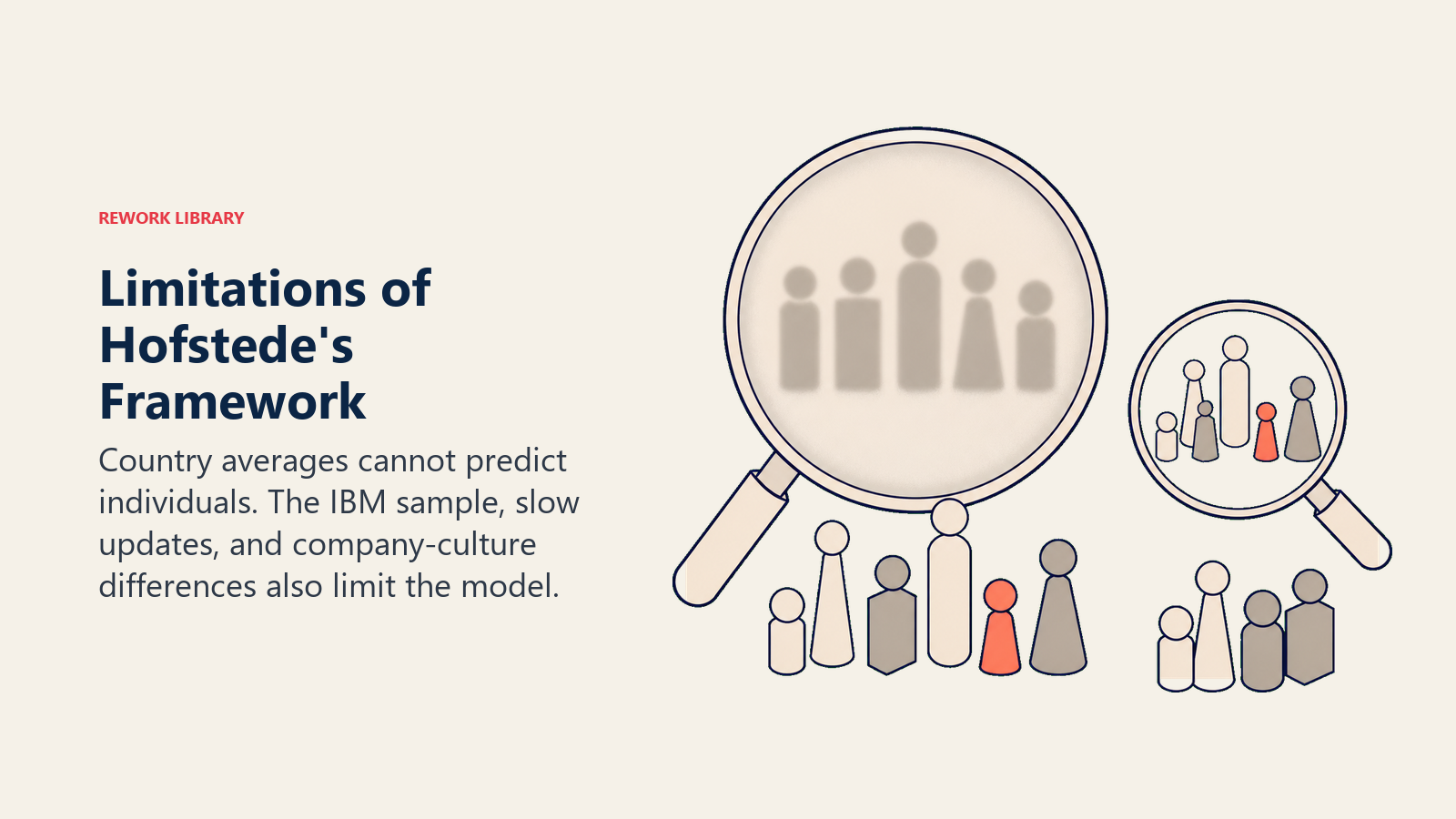
National scores describe trends, not individuals. This is the most important limitation, sometimes called the ecological fallacy: applying a group-level average to predict an individual's behavior. A country's PDI score describes the statistical tendency of that culture's workplaces, not any one employee. A Vietnamese engineer who spent five years at a US startup may communicate more like a low-PDI Californian than like Vietnam's national average, and treating the country score as a personality trait is a misuse of the data, not a feature of it.
The original sample had a narrow base. The founding research surveyed employees of a single multinational company (IBM), which controls for company culture but means the sample wasn't representative of each country's full workforce, particularly outside white-collar corporate roles. Later replication studies (including the GLOBE study, which used an independent methodology and a broader manager sample) have validated many of Hofstede's core findings, which is part of why the framework has held up, but the original dataset's limits are a fair critique.
Countries change, and the model updates slowly. National culture shifts with generational change, urbanization, and economic development, and country scores are periodically revised (as with the 2022 expansion to over 100 countries and regions), but not on the same timescale as a fast-moving market. Treat scores as a strong prior, not a live measurement.
It measures national averages, not company or team culture. A single multinational company can build a company culture that differs meaningfully from its home country's national default. National culture is the water leaders and employees grew up swimming in; company culture is what an organization deliberately builds on top of it, a distinction covered further in how business culture differs across the world.
Used correctly, as a starting hypothesis you update once you know the actual people involved, the model remains one of the most cited and empirically grounded frameworks available for reading cross-cultural business behavior. Used as a stereotype generator, it becomes a liability.
Hofstede vs. Meyer vs. GLOBE: Which Framework Should You Use
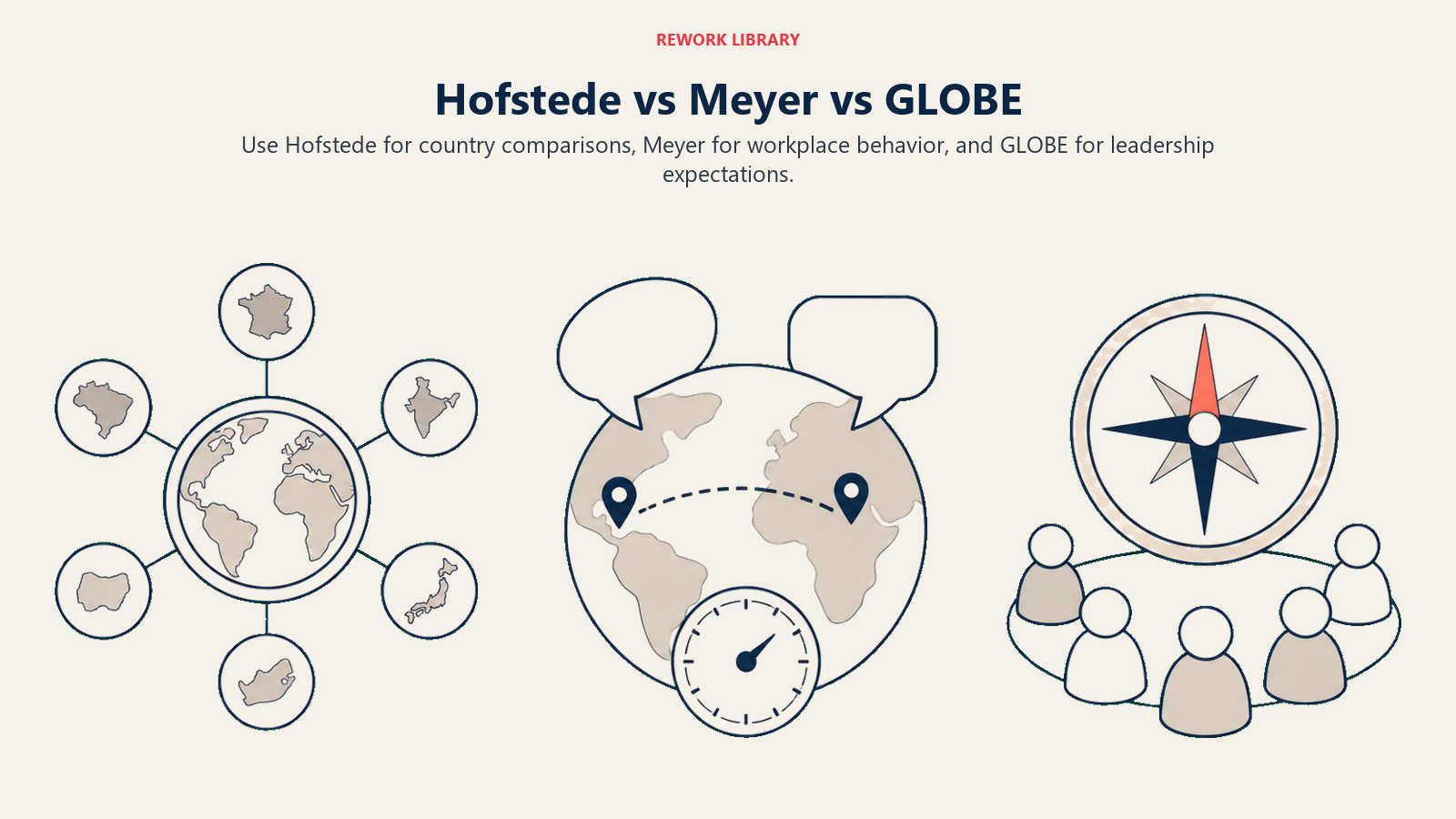
Hofstede isn't the only cross-cultural framework a leader will run into. Two others come up often enough to be worth knowing how they differ.
| Framework | Scope | What it measures | Best for |
|---|---|---|---|
| Hofstede's 6-D Model | 100+ countries and regions, national-level scores | 6 dimensions (PDI, IDV, MAS, UAI, LTO, IVR) derived from large-scale survey data | Quick, citable country-to-country comparison; market entry and org design decisions |
| Erin Meyer's Culture Map | Dozens of countries, built for a business audience | 8 practical scales (communication, feedback, persuasion, leading, deciding, trust, disagreeing, scheduling) | Day-to-day team management: how to run meetings, give feedback, and build trust across a specific pair of cultures. We break down her eight scales in The Culture Map, explained |
| GLOBE Study | 62 societies, ~17,000 managers surveyed | 9 cultural dimensions plus 6 leadership behavior styles | Leadership style and what "effective leadership" looks like in a specific culture, especially useful for global leadership development programs |
In practice, the three are complementary rather than competing. Hofstede gives you the broadest country coverage and the most citable numbers for a quick comparison. Meyer's scales translate more directly into specific workplace behaviors like how to disagree or how to schedule a meeting. GLOBE goes deepest on leadership specifically, since it was built by leadership researchers studying what "a good leader" means in each culture, rather than culture generally. For a full grounding in the broader six axes cross-cultural researchers converge on, start with what is business culture.
Frequently Asked Questions about Hofstede's Cultural Dimensions
What are Hofstede's 6 cultural dimensions?
Hofstede's 6 cultural dimensions are Power Distance (PDI), Individualism vs. Collectivism (IDV), Motivation Toward Achievement and Success (MAS, originally called Masculinity), Uncertainty Avoidance (UAI), Long-Term Orientation (LTO), and Indulgence vs. Restraint (IVR). Each is scored on a roughly 0-100 scale for countries and regions worldwide.
Who created Hofstede's cultural dimensions theory?
Dutch social psychologist Geert Hofstede developed the framework from survey research conducted among IBM employees between 1967 and 1973, later expanded and validated through decades of replication studies covering more than 100 countries and regions today.
What is the highest Power Distance country in Hofstede's data?
Malaysia holds one of the highest Power Distance scores Hofstede has measured, at 100, reflecting a business culture where decisions flow strongly from the top and open pushback against a superior is uncommon.
Which country scores highest on Individualism?
The United States scores 91 on Individualism, among the highest recorded, reflecting a culture that rewards individual initiative, individual credit, and individual accountability over group-first decision making.
Why did Hofstede rename the Masculinity dimension?
Hofstede later reframed Masculinity as Motivation Toward Achievement and Success versus a Quality of Life orientation, since the dimension measures competitiveness and achievement-orientation rather than the gender composition of a culture, a naming choice that reduced confusion without changing the underlying data.
Is Hofstede's model still relevant for managing global teams today?
Yes, with a caveat. The scores describe national tendencies, not individual employees, so they work best as a starting hypothesis before you know a specific team or market, not as a fixed rulebook. Combined with direct observation of the actual people involved, the framework remains one of the most cited and empirically grounded tools for reading cross-cultural business behavior.
How is Hofstede's framework different from Erin Meyer's Culture Map?
Hofstede's model covers more countries with 6 broad, statistically derived dimensions, making it useful for quick country-to-country comparison. Erin Meyer's Culture Map uses 8 more practical, workplace-specific scales (like feedback style and scheduling) built for day-to-day team management, and covers fewer countries in more behavioral detail.
What is the ecological fallacy in Hofstede's research, and why does it matter?
The ecological fallacy is the mistake of applying a group-level average (a country's score) to predict an individual person's behavior. A national PDI or IDV score describes a statistical tendency across a whole culture, not any one employee, so leaders should use the scores to form a starting hypothesis about a market or team, then adjust based on the actual people they're working with.
Where do Vietnam and Southeast Asia sit on Hofstede's dimensions?
Vietnam scores 70 on Power Distance and 20 on Individualism, placing it in the hierarchical, collective quadrant alongside Malaysia, the Philippines, Indonesia, and Thailand. In practice, this means decisions tend to defer to seniority, dissent is rarely voiced openly in group settings, and group harmony carries more weight than individual credit.

Co-Founder, Rework.com
On this page
- What Hofstede's 6 Cultural Dimensions Measure
- Power Distance (PDI)
- Individualism vs. Collectivism (IDV)
- Motivation Toward Achievement and Success (MAS)
- Uncertainty Avoidance (UAI)
- Long-Term Orientation (LTO)
- Indulgence vs. Restraint (IVR)
- Hofstede Scores by Country: A Comparison Table
- How Business Leaders Use Hofstede's Dimensions
- Limitations and Criticisms of Hofstede's Framework
- Hofstede vs. Meyer vs. GLOBE: Which Framework Should You Use